


MARS BIBLE — PEOPLE
Swati Mohan
Swati Mohan's documented nationality or citizenship is American; the documented birthplace is Bengaluru, Inde. Swati Mohan is one of the engineers who made the extraordinary precision of landing Perseverance on Mars visible to the public. Drawn to space while young, trained in engineering and then in guidance, control and autonomy, she built experience on Cassini and GRAIL before joining Mars 2020. Her career matters because years of modeling, navigation and testing converge into a few minutes when the spacecraft must understand its situation and act without waiting for Earth.
Chronological biography
The main narrative now follows the life in order: training, early work, acquired skills, missions, difficulties, teams, and responsibilities before reaching the Mars legacy.
Childhood, migration and education — from curiosity to engineering
From teenage curiosity to the first NASA internships. Institutional sources make it possible to tell a much more continuous story than a jump from university straight to Perseverance. Swati Mohan recalls that an episode of Star Trek: The Next Generation caught her imagination when she was young because the crew was thrown into a part of space that was genuinely unknown. That was not engineering training, of course, but it established the question that came first: how can curiosity about the unknown become a real occupation? She later discovered what engineering actually meant and what it could make possible. While still in high school she obtained an internship at Goddard Space Flight Center, then continued interning during college at NASA centers including Goddard, Kennedy and JPL.. Before Mars 2020, Swati Mohan patiently built the expertise that would place her at the center of Perseverance guidance, navigation and control. Engineering studies drew her toward autonomous systems, while her doctorate deepened her understanding of how vehicles or subsystems estimate their state and act with imperfect information. Cassini then provided experience on a mission actually operating in space, and GRAIL added work on control and navigation around the Moon. Mars was therefore not a sudden leap in her career: it was the point at which several earlier strands of learning converged.. Source
Those internships matter because they expose the future engineer to several cultures before she is given responsibility for a Mars landing. Research, mission operations, instrument development and systems work do not use exactly the same habits. The path therefore was not an instant specialization in guidance. It was a gradual transition from academic problem solving to the disciplined reality of flight programs: interfaces, documentation, test evidence, configuration control and teamwork. [source]
Institutional sources: NASA Science — Swati Mohan profile
Swati Mohan built experience at JPL on very different projects before Mars 2020. She worked on Cassini in systems engineering and operations, on GRAIL in orbit termination, and on OpTIIX, a proposed experiment for autonomous in-space telescope assembly. OpTIIX was canceled, but it connected directly to her Ph.D. work on autonomous telescope assembly. Expertise therefore developed partly on a mission that never flew. NASA Science — Swati Mohan
That range of work prepared her for guidance, navigation, and control. GNC is not simply a trajectory equation; it is the architecture that connects sensors, state estimation, decisions, and actuators. On Mars 2020, Mohan worked from mission formulation through design, assembly, testing, and operations, then served as GNC operations lead for launch, cruise, and landing. [source]
Mohan’s Mars 2020 role illustrates a category of engineering that is hard to photograph but decisive in flight. Guidance, navigation and control has to combine sensor measurements, models of vehicle motion and commands quickly enough for the spacecraft to remain inside a safe corridor. During entry, descent and landing, the distance from Earth removes the possibility of a human controller correcting each event in real time. The system must recognise its own state and continue through the sequence autonomously. [source]
That makes communication discipline inside the team as important as the algorithms themselves. A GNC lead has to connect analysts, software, sensors, testing and mission operations so that everyone is talking about the same state variables, margins and failure cases. Mohan’s public role during the Perseverance landing made one moment visible, but the deeper biography is about years spent making that moment predictable enough to trust. [source]
Before full-time JPL: migration, NASA internships, Cornell and MIT. Swati Mohan was born in India and moved to the United States with her family when she was about one year old, growing up in Northern Virginia in the Washington metropolitan area. That background matters because her route into space engineering was built step by step rather than appearing as a single moment of destiny. Popular culture first made deep space feel imaginable; internships then made the profession concrete. Beginning with Goddard after her junior year of high school, she returned to NASA internships through college and worked at Goddard, Kennedy and JPL, seeing research, launch operations and robotic exploration from different institutional angles.
She earned a bachelor's degree in mechanical and aerospace engineering at Cornell and then pursued graduate work in aeronautics and astronautics at MIT. Her doctoral research used SPHERES, a set of small free-flying satellites aboard the International Space Station, to test control algorithms in microgravity. In practical guidance, navigation and control terms, the task is to estimate position, velocity and attitude, track uncertainty and command actuators without exciting instability or driving the vehicle outside its safe operating envelope. That is the better prehistory of the Perseverance landing than the famous words from mission control alone: before becoming the voice associated with touchdown, Mohan had spent years learning how a machine estimates its state, corrects its motion and keeps making decisions when Earth is too far away to intervene in real time. [sm1] [sm2]
Cornell, MIT, Cassini and GRAIL — from control theory to flying missions
Doctoral work: learning how an autonomous vehicle knows what to do. Mars 2020 then gave her a problem for which no last-minute improvisation from Earth was possible. During entry, descent and landing, communication delay makes Earth an observer: the spacecraft must navigate, interpret its surroundings and trigger the right events autonomously. Mohan became one of the leaders responsible for the GNC chain and for keeping navigation, attitude and mission events coherent. Her public call of “touchdown confirmed” lasted only seconds; behind it stood years of simulation, failure cases and accumulated engineering decisions. Institutional source.
Mohan also worked on OpTIIX, a proposed in-orbit telescope assembly experiment that was later canceled. A canceled program is still part of an engineer’s education. Models, interfaces, review habits and test approaches can migrate to later missions even when the original hardware never flies. Her career illustrates a recurring truth of space engineering: the useful unit of experience is not merely the successful spacecraft but the problem that has been understood well enough to solve again.
Institutional sources: NASA Science — SPHERES and OpTIIX
The most important biographical thread is not simply Mohan’s arrival on Perseverance, but the way earlier assignments accumulate into a coherent set of skills. Cassini exposed her to a long interplanetary mission in which operations must be prepared far in advance and a sequencing mistake can threaten years of work. GRAIL brought a different tempo and an orbit-termination problem that still had to be treated as a real flight operation. OpTIIX, even though it was canceled, forced her to reason about autonomy and assembly when no human operator can intervene directly. Mars 2020 therefore did not begin from a blank page. Guidance, navigation, and control became the place where sensors, flight dynamics, software, ground testing, and team decisions had to remain consistent. Perseverance’s landing was the visible end of an apprenticeship that had taken much longer than the few minutes of descent seen by the public.
Cassini and GRAIL: learning on spacecraft that were already real. When Mohan joined JPL full time, she worked on Cassini roughly six months before the spacecraft reached Saturn. Her duties included systems engineering and operations. That is a profound shift from doctoral research. Decisions are no longer exercises; they touch a vehicle that has already been launched and cannot be repaired in a laboratory. Long-lived missions also teach organizational engineering: procedures, anomaly records, configuration discipline and the ability to make a change without breaking an interface owned by another team. Source.
On the GRAIL lunar mission she worked on orbit termination. That seemingly narrow assignment teaches another important principle: a mission has to be engineered through its end state, not merely through the arrival event that attracts public attention. Cassini, GRAIL and autonomy research therefore built a library of skills that Mars 2020 would later compress into a few irreversible minutes of descent.
Institutional sources: NASA Science — Cassini, GRAIL and Mars 2020
NASA's biography of Swati Mohan shows a much more gradual accumulation of capability than the dramatic image of Perseverance's landing might suggest. Her early interest in space was encouraged by science fiction, but professionalisation began through internships at several NASA centres: Goddard, Kennedy and then JPL. Moving through those environments gave her a concrete view of different professions before she became a full-time employee.
Her PhD concerned autonomous assembly of space telescopes using the SPHERES experiment aboard the International Space Station. She then worked on Cassini and GRAIL in different roles. That variety is fundamental to guidance, navigation and control. GNC is not merely an algorithm; it requires understanding sensors, vehicle dynamics, software, failure modes, operations and physical limits. Mohan therefore arrived at Mars 2020 with experience across several architectures rather than one repeated speciality.
2013–2021 — Mars 2020 and eight years preparing a landing
2013–2021: eight years of work for minutes that could not be repeated. Mohan worked on Mars 2020 guidance, navigation and control from early mission formulation, helping architect and design the subsystem before becoming the GNC operations lead through launch, cruise and landing. The landing broadcast makes the event look instantaneous; the engineering history is the opposite. Architecture, sensor interfaces, dispersion analysis, software, hardware-in-the-loop tests and operations rehearsals had to be closed years before the rover met the Martian atmosphere.
After Perseverance landed, she moved into technical supervision of a GNC engineering group supporting multiple missions. That transition is part of the Mars story too. A durable exploration program cannot rely on one engineer remembering how a subsystem works. It needs a community that can preserve methods, challenge assumptions and transfer lessons to the next vehicle. The path from intern to mission engineer to technical supervisor shows how individual expertise becomes institutional capability.
Institutional sources: NASA Science — eight years on Mars 2020
Swati Mohan describes roughly eight years of work on Mars 2020. She participated from mission formulation in the architecture of the Guidance, Navigation and Control subsystem, followed it from design through test and later became the GNC operations lead for launch, cruise and landing. That duration puts the public scene of February 2021 in proper perspective: the voice heard in mission control was the visible end of work that began years earlier. [SM1] [SM2]
GNC repeatedly answers three questions: where is the vehicle, where must it go and what correction should it make to reach the next state? During EDL those answers must be computed on board. Communication delay means that when Earth learns what is happening, Perseverance has already executed the corresponding decisions. [SM2] [SM3]
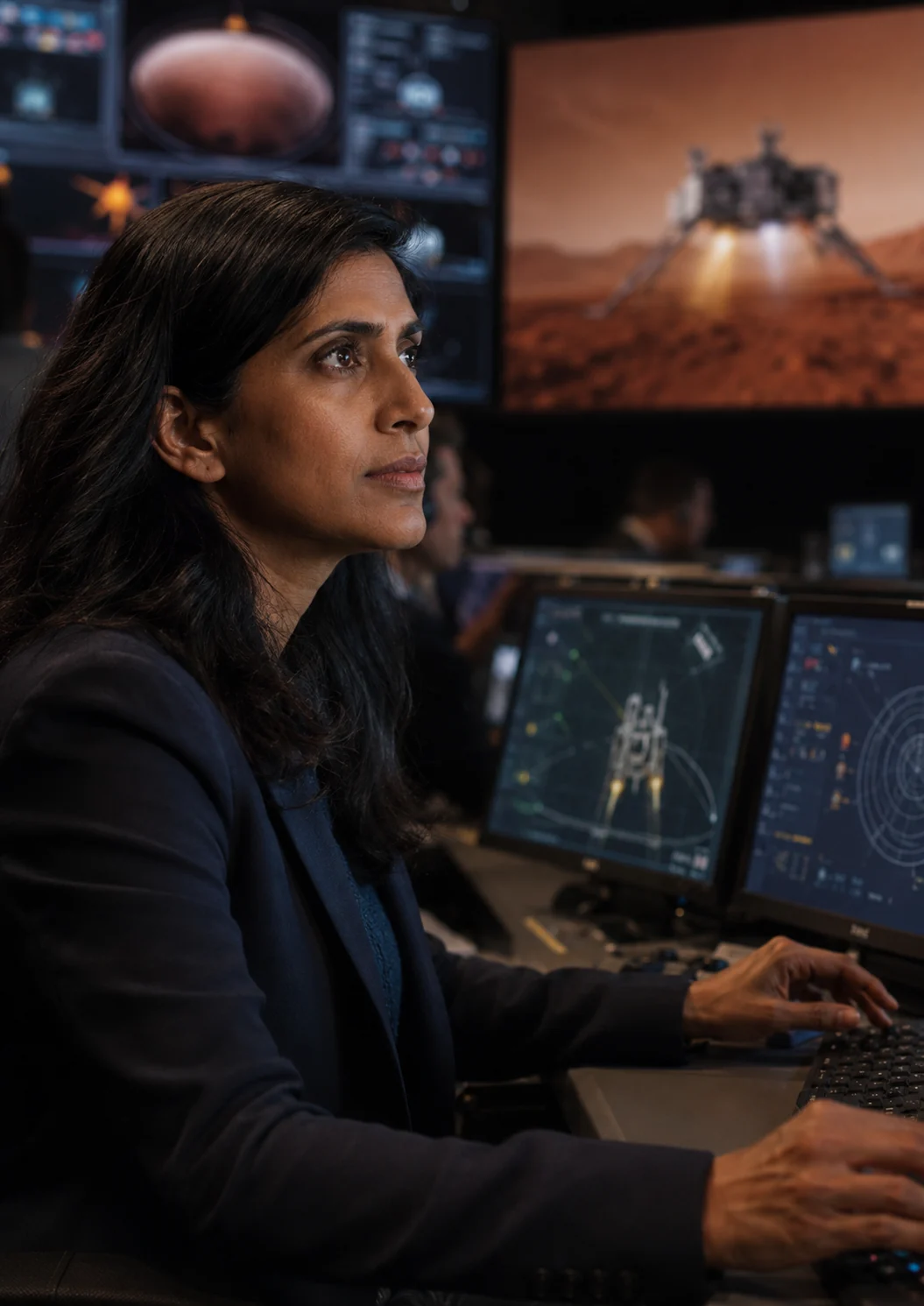
For roughly eight years she followed Perseverance GNC from formulation and design through assembly, test, launch, cruise and landing. On 18 February 2021 she became one of the most recognisable voices in mission control, but most of the work had happened long before that public minute. Her career illustrates what preparing a Mars mission really means: maturing a subsystem for years until a sequence of autonomous decisions can be executed without human intervention during the minutes when Earth is too far away for direct control.
From mission engineer to discipline leader: carrying GNC knowledge beyond Perseverance
Swati Mohan’s career shows a technical skill changing scale. For roughly eight years on Mars 2020, she followed guidance, navigation and control from formulation and paper design through assembly, test, launch, cruise and landing. That matters because it breaks the image of a specialist who appears only during the dramatic descent. GNC is built much earlier: teams define available sensors, the states the vehicle must estimate, the actuators it can command, acceptable errors and the behaviour required when information becomes uncertain.
After Perseverance landed, Mohan moved into leadership of a JPL GNC technical group. The change illustrates a second level of maturity: a space organization must not merely succeed on one mission; it must turn experience into capability available to many missions. Staffing, mentoring, technical reviews and allocation of specialists become invisible infrastructure. A durable Mars settlement will face the same problem: procedures and models are insufficient if knowledge remains trapped in a few individuals.
Her earlier work on Cassini and GRAIL also shows why breadth need not mean superficiality. Orbital contexts, dynamics and mission phases differ, but the discipline repeatedly reasons about vehicle state, uncertainty, transitions and safety criteria. That continuity is how an engineer learns to recognize the structure of a problem even when the spacecraft changes completely.
Lesson for Mars: autonomy should not be understood as removing humans. It relocates their work. Crew and mission control establish objectives, limits, models and criteria; onboard systems make faster decisions within that envelope. As communications delay grows, the quality of that envelope becomes more important. GNC is therefore also a form of technical governance: deciding in advance what the machine is allowed to decide for itself.
Supplementary documentary analysis
Biographical analysis, context and legacy
Thematic analysis and deeper reading
Essential timeline
- EducationEngineering studies including Cornell and MIT.
- 2010sWorks from early Mars 2020 formulation on GNC architecture.
- 2020GNC operations through launch and cruise.
- February 18, 2021Leads GNC operations during Perseverance entry, descent and landing.
- After 2021Continues technical and supervisory responsibilities at JPL.
Deep reading: what this trajectory teaches
Primary and institutional sources
Verification rule: this biography prioritizes institutional, archival and primary sources. Statements about living people or active programs are dated and attributed; uncertain or disputed points must remain explicitly qualified.