


MARS BIBLE — PEOPLE
Ken Farley
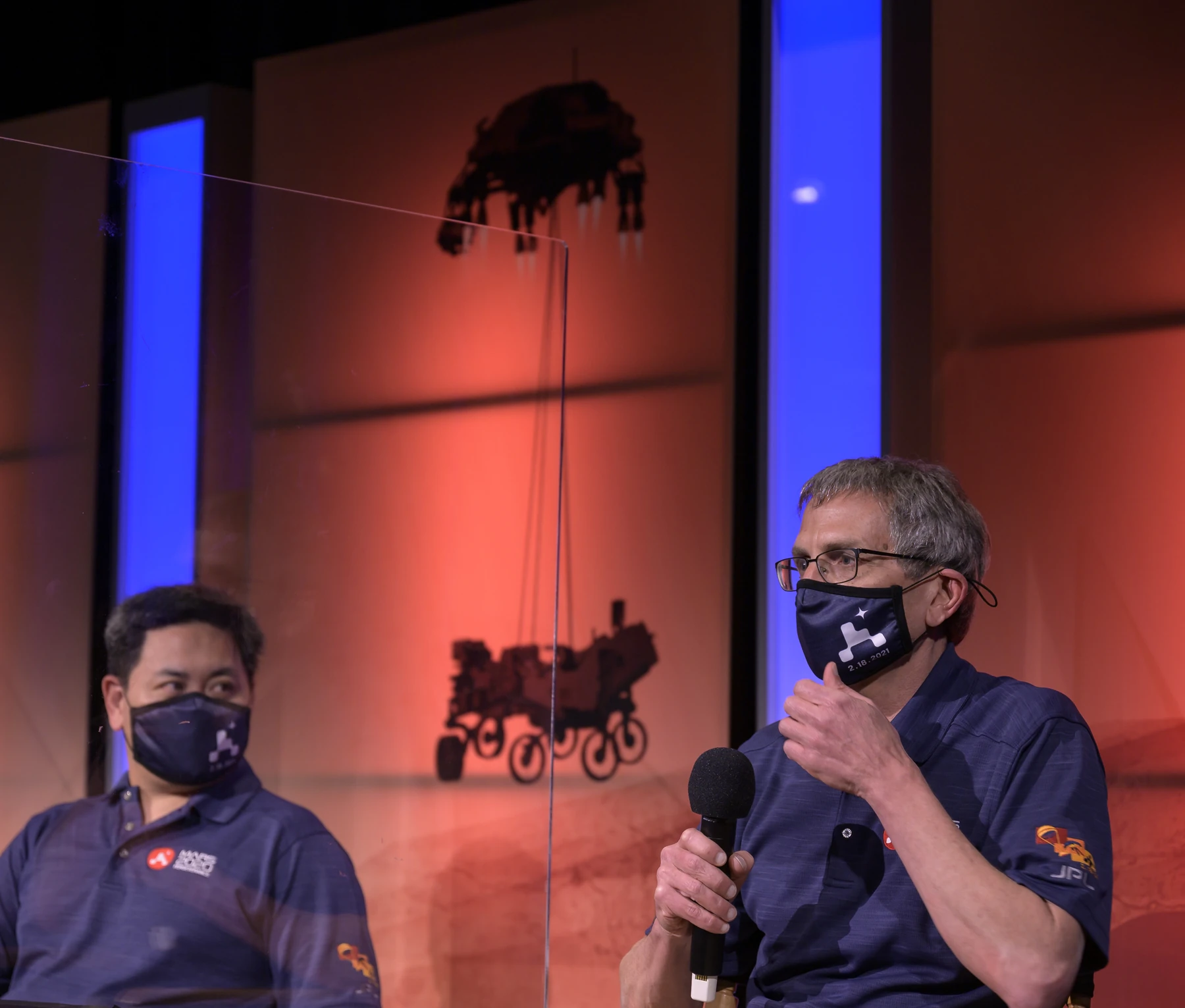
Ken Farley's documented nationality or citizenship is American; the documented birthplace is Los Angeles, Californie, United States. Ken Farley connects geochemistry, geochronology and Mars exploration to the decisive problem of samples. A researcher trained to understand planetary processes through isotopes and materials, he became Mars 2020 project scientist and helped turn a rover mission into the first stage of a much longer scientific chain. His importance lies in moving from simply seeing Mars to selecting, documenting and caching samples whose value will depend on decisions and analyses made over many years.
Chronological biography
The main narrative now follows the life in order: training, early work, acquired skills, missions, difficulties, teams, and responsibilities before reaching the Mars legacy.
1986–2013 — From noble gases to measuring geological time
1986–2013: from noble gases to measuring geological time. Ken Farley earned his B.S. from Yale in 1986 and a Ph.D. at Scripps Institution of Oceanography at the University of California, San Diego. After postdoctoral work at the University of Rochester and Lamont-Doherty Geological Observatory, he joined Caltech in 1993. His laboratory has focused on noble-gas isotopes, geochronology, and geochemical evolution. Caltech — Ken Farley Source.
Farley came to Mars with the habits of a geochemist accustomed to reconstructing history from tiny clues. Isotopes and geological clocks taught him that a sample’s value depends on context and preservation as much as composition. When Mars 2020 developed a caching strategy, that experience became operational: the team had to select rocks that could still answer, years later, questions the rover could not solve on the surface. His career therefore links terrestrial laboratory science to the design of an interplanetary scientific chain.. That geochemistry career may initially look distant from a rover, but it prepared one of Mars 2020’s central ideas: select rocks whose histories can eventually be interrogated by laboratories far more capable than any instrument package a rover can carry. Farley’s path therefore helps explain the transition from purely in-situ Mars science toward a strategy built around sampling, context, and traceability. Institutional source
Ken Farley earned a chemistry degree from Yale in 1986 and a doctorate in Earth Science from Scripps in 1991. After postdoctoral work he joined Caltech in 1993. His research focuses on geochemistry and especially noble-gas isotopes, methods that can extract timing and history from very small amounts of material. Source
The link to Mars is indirect but deep. A rover observes a rock in context; an Earth laboratory can later use instruments too massive or complex to fly. Farley therefore approached Mars with a culture in which a sample's value depends on its documented origin as much as its chemistry.
A geochemist trained to measure time. From geochemistry laboratory to Perseverance science leadership. Kenneth A. Farley, an American geochemist born in Los Angeles in 1964 according to the National Academy of Sciences, is the W. M. Keck Foundation Professor of Geochemistry at Caltech. He earned his bachelor’s degree at Yale in 1986 and his Ph.D. at the University of California, San Diego in 1991. His long-standing specialty is isotope geochemistry, especially noble gases. That field may sound remote from rover operations, yet it addresses questions central to Mars: the age of rocks, their thermal history, their exposure at the surface and the processes that modified them through time.
This measurement culture imposes a useful intellectual discipline. A geochronological result must be compatible with physics and the age of the Solar System; an anomaly has to be explained rather than merely celebrated. In Caltech’s oral-history project, Farley describes geochronology as unusually unforgiving of impossible answers. The same standard matters on Mars. A claim about ancient habitability is valuable only if geological context, relative or absolute time, mineralogy and depositional environment can be connected through a coherent chain of evidence.
Curiosity: taking geochronology from Earth to Mars. Farley participated in the Curiosity mission before becoming the science leader of Mars 2020. Curiosity provided a distinctive training ground: instead of inferring planetary history only from orbital observations, scientists could connect texture, chemistry, mineralogy, gases and chronology using a mobile laboratory. For a geochemist the question expands from “what is this rock made of?” to “when did it form?”, “how long has it been exposed?” and “what process altered it?”
The move from terrestrial geochemistry to Mars also demonstrates why an instrument never operates in isolation. A measurement depends on sample preparation, contextual knowledge, calibration and model assumptions. Teams on Earth cannot simply pick a Martian rock up again when a result is surprising. They must anticipate uncertainty before commands are sent and preserve enough complementary observations to test competing interpretations later. That discipline became part of the scientific architecture of Perseverance.
Perseverance: a mission designed around samples from the beginning. Farley’s Caltech laboratory states that he has served as Mars 2020 project scientist since the mission’s inception in 2013. A project scientist works at the boundary between science and engineering: the objectives of a large international community have to converge on a vehicle whose mass, power, mechanisms, memory and schedule are finite. Perseverance was designed to characterize Jezero crater, investigate environments capable of preserving biosignatures and select, core and seal a scientifically diverse set of samples for possible return to Earth.
That last function changes the mission logic. A conventional rover can be judged primarily by analyses performed on Mars. A caching rover must also think about future laboratories and researchers who are not present in today’s operational loop. Sample selection therefore requires judgments about geological diversity, preservation potential, comparative value and limited tube capacity. Each tube also needs enough contextual evidence that scientists years later can reconstruct why it was collected even if laboratory technology and scientific questions have changed.
Why returned samples remain scientifically different. Farley emphasizes a fundamental difference between a rover laboratory and laboratories on Earth. Every Mars instrument must be selected, miniaturized, qualified and integrated years before launch. A returned sample can be studied sequentially with much larger, more sensitive and more specialized instruments, and it can be revisited when new methods are invented. Apollo samples demonstrate this intergenerational value: material collected decades ago still produces results with techniques unavailable to the original crews.
Mars samples would add exceptional requirements for planetary protection, chain of custody and contamination knowledge. The task is not merely to bring back a rock; it is to preserve the scientific meaning of that rock without introducing ambiguity into organic or biological investigations. Farley’s career therefore provides a useful route for explaining how geochemistry, robotic exploration and sample governance become one scientific architecture.
What this career teaches a Martian settlement. A settlement will not be able to send every sample to Earth. It will gradually need local capabilities for preparation, measurement, preservation and comparison. Farley’s core principles will remain relevant: preserve context, understand instrument limits, repeat measurements, use standards, distinguish contamination from signal, document assumptions and reserve material for techniques that do not yet exist.
His historical significance is therefore rooted in a culture of evidence. Perseverance is not only a sophisticated rover; it is a machine designed to build a scientific record that other laboratories may eventually inherit. Durable human presence will have to turn that discipline into infrastructure: metrology, laboratories, sample tracking, archives and quality-control procedures will be as operationally necessary as power or water.
Perseverance: selecting, documenting and accepting uncertainty. Mars did not simply reproduce the orbital interpretation prepared before landing. Jezero's floor, delta and margin introduced different rock types and alteration histories. The science programme had to preserve enough diversity that one early hypothesis would not lock the entire collection. Source
For future human exploration, the lesson is concrete. Astronauts can sample far faster than a rover, but poorly documented material can lose much of its value. Each sample needs location, stratigraphic context, imagery, pre-sampling condition and local observations. Sample logistics is part of the science, not merely transportation.
Since 2013 — Perseverance: designing a mission as the beginning of a sample chain
2013–present: designing Perseverance as the first half of a sample chain. Farley has served as Mars 2020 project scientist since the mission began in 2013. His job connects the geology of Jezero, the search for records of ancient environments, sample selection, rover constraints, and the possibility that carefully documented tubes may later be analyzed in terrestrial laboratories. That forces the science team to think not only about what is interesting today, but about what an unknown scientist may be able to measure tomorrow if the context of the sample has been preserved. Caltech — Ken Farley Source.
Farley became Mars 2020 project scientist during the phase when goals still had to be converted into a scientific architecture. Instruments, landing site and sample strategy had to support a collection whose greatest value might emerge years later. That long time horizon changes the definition of success: a choice made today must remain intelligible to future scientists with different instruments and perhaps different questions. Source
Jezero crater fit that logic because its delta and diverse terrains could preserve multiple chapters of Martian history. The mission was therefore not designed as a search for one object called a biosignature, but as the construction of a coherent archive of ancient Mars.
Jezero and beyond — Turning geochemistry into decision architecture
A geochemist at the center of a mission built around samples. Ken Farley entered Mars exploration with a specialty that explains much of his contribution: isotope geochemistry and the measurement of geologic time. His Caltech laboratory works with noble gases and methods that date materials or reconstruct their histories. That culture of precision changes the way Mars is approached. A rover can observe, map, abrade and analyze rocks, yet some questions still require large terrestrial instruments, elaborate sample preparation and the ability to repeat a measurement with a different technique. Source.
The Perseverance project scientist role is therefore not limited to deciding which rocks look interesting. It links mission science objectives, rover operations, instrument capability, sample selection and the construction of a collection that could eventually be studied on Earth. The challenge is almost archival. Each tube must retain enough geologic context that its scientific value is not reduced to a few grams of material. Exact location, stratigraphic unit, pre-sampling observations, rock condition and relationships to surrounding terrain are part of the result. [source]
The selection of Jezero follows that logic. Orbital data showed a delta and minerals associated with aqueous environments. On the ground, Perseverance then encountered igneous rocks on the crater floor, deposits associated with the delta system and material derived from different source regions. The mission is therefore not a simple hunt for a biosignature. It is reconstructing a history: crater formation, magmatic processes, lake and river episodes, alteration, erosion and later exposure. That diversity is precisely what makes a sample collection scientifically powerful. [source]
The project scientist as an interface between science, operations and future laboratories. On a robotic mission, even the best scientific question matters only if it can be converted into actions compatible with power, safety, drive time, the robotic arm, instruments and communications. Farley and the mission leadership therefore translate research goals into operational priorities. The rover may need to cross a lower-priority area quickly, spend several sols on a single outcrop, or adapt when a rock behaves badly during abrasion. Real mission science is built through these compromises rather than through a frictionless theoretical plan. [source]
For future human exploration, one of the most useful lessons is the distinction between local analysis and sample return. A crewed Mars laboratory could do much more than a rover, but it would still be constrained by mass, power, consumables and instrument qualification. Earth laboratories would retain analytical depth that is difficult to duplicate completely on Mars. A serious settlement architecture should therefore support both: enough local capability for timely decisions, and the preservation of reference samples for later work in more capable Mars laboratories or on Earth. [source]
Farley’s work also shows why geochronology is strategic. Composition tells us what a rock contains; age and event history place that information within planetary evolution. To understand when Mars was habitable, when water circulated or how long a surface has been exposed, researchers need dates attached to processes. That focus on time connects laboratory geochemistry to the central Martian question: not only what happened, but when it happened and how long the relevant conditions lasted. [source]
Farley’s geochemistry background changes the way Perseverance can be understood. Noble-gas and isotope work is built around traceability: a measurement only has meaning if the sample, analytical method, uncertainty and geological context remain connected. Mars 2020 extends that discipline to an interplanetary scale. A tube cached on Mars is useful only if future laboratories can reconstruct why that material was chosen and what the rover observed around it. [source]
That makes the project scientist’s job unusually long-horizon. The mission is not complete when the rover drills a core. Sampling, documentation, storage and the possibility of later retrieval form one chain, and weaknesses early in the chain cannot necessarily be repaired years later. Farley’s career therefore links laboratory precision to mission architecture in a way that is directly relevant to any future Mars program that wants evidence to survive generations of hardware and teams. [source]
Supplementary documentary analysis
Biographical analysis, context and legacy
Thematic analysis and deeper reading
Essential timeline
- PeriodMars 2020 / Perseverance
- MarsPerseverance and Jezero
- LegacySamples, geochronology and biosignature search
Deep reading: what this trajectory teaches
Primary and institutional sources
Verification rule: this biography prioritizes institutional, archival and primary sources. Statements about living people or active programs are dated and attributed; uncertain or disputed points must remain explicitly qualified.
- NASA Ames — The Mars 2020 Perseverance Mission
- Caltech — Ken Farley oral history / Mars Sample Return
- Caltech — Kenneth A. Farley
- NASA Science — Perseverance project scientist talk
- National Academy of Sciences — Kenneth A. Farley
- Caltech Noble Gas Lab — Kenneth A. Farley
- Caltech Heritage Project — Ken Farley