


MARS BIBLE — PEOPLE & PIONEERS
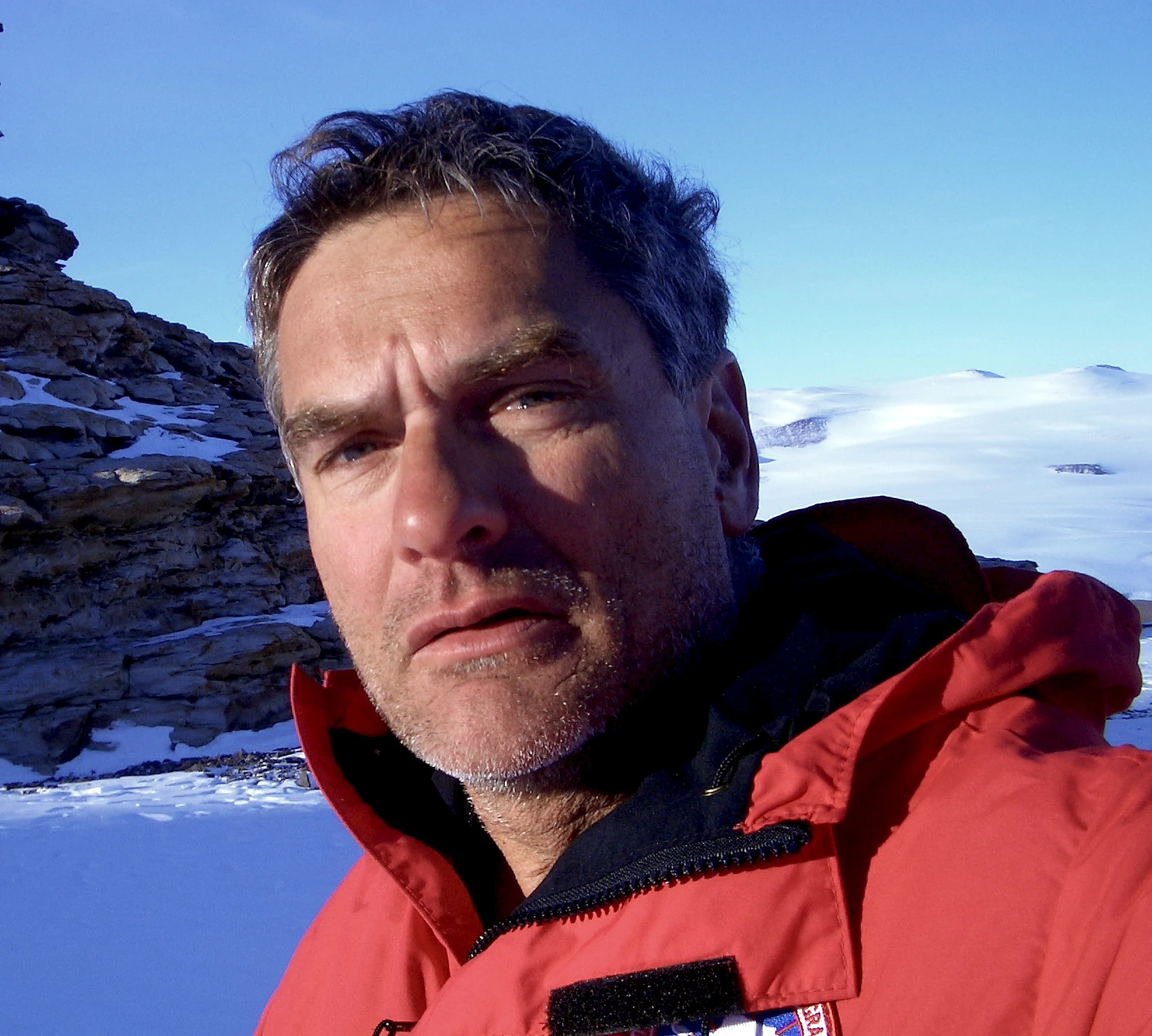
Chris McKay
Chris McKay's documented nationality or citizenship is American; the documented birthplace is Not stated in the institutional sources cited. Chris McKay is one of the researchers who most persistently connected Mars, astrobiology and the prospect of a human presence. His career spans physics, planetary science, terrestrial extreme environments and habitability before making him a long-standing figure at NASA Ames. He matters because he asks more than whether Mars once supported life: he also examines how biological exploration should be conducted, what terraforming would actually imply, and what responsibilities would accompany changing another world.
Chronological biography
Education and Viking — Mars becomes a personal scientific question
A less linear path than the title “planetary scientist” suggests. Chris McKay describes an academic path that was less preplanned than a short professional biography might suggest. He earned a Ph.D. in astrogeophysics from the University of Colorado in 1982, but says his migration toward planetary science occurred in the middle of graduate school. The Viking landings were pivotal because they turned a question about life on Mars into an experimental problem: instruments could be placed on another planet and asked to distinguish chemistry from biology. Source.
McKay developed a deliberately cross-disciplinary way of approaching Mars: environmental physics, astrobiology, microbial ecology and the engineering of a possible human presence had to inform one another. At NASA Ames he studied cold or arid terrestrial environments because they provide natural laboratories for testing ideas about Mars. That approach led him to ask not only what conditions allow life to survive but also what a deliberate transformation of the planet would imply. His career therefore became a bridge among fundamental science, robotic exploration and long-term questions about human settlement. Institutional source.
He first came to Ames as a summer student after another graduate student pointed out an opportunity he had missed. That small detail matters. Scientific careers are often shaped by available mentors and problems rather than a perfect plan made at age twenty. At Ames, work with researchers including Jim Pollack exposed him to an environment where atmospheres, planetary physics and life were connected. That combination gradually became his field.
Institutional sources: NASA — interview with Chris McKay · NASA — Chris McKay profile
Chris McKay earned a Ph.D. in AstroGeophysics from the University of Colorado in 1982. He has described his move into planetary science as something that developed during graduate school, when Viking made the search for life on Mars an experimental question rather than only speculation. He first reached NASA Ames through a student opportunity and built his career in an environment where planetary atmospheres and biology could be discussed together. Source
That path matters because a space scientist does not always follow a single predefined major. McKay moved from planetary physics toward life in extreme environments. The interface became his specialty: atmosphere, energy, water, chemistry and biology must be considered together before habitability can be discussed responsibly.
Field work in the Antarctic Dry Valleys, followed by work in the Atacama, Arctic, Namib and other deserts, taught McKay that an extreme environment cannot be described by one average value. Life may be concentrated in tiny niches while a nearby sample is sterile. Sampling strategy can therefore matter as much as the instrument. Source
That lesson is decisive for Mars. A non-detection does not automatically prove absence of life; it first shows that no signal exceeded a particular threshold in the chosen sample. This discipline forces researchers to document detection limits, contamination and representativeness. Human explorers will need the same caution at much larger scale.
McKay has also been involved in planning future Mars missions, including human exploration. At that point biology becomes an operational issue. Human crews add extraordinary field capability, but they also bring microorganisms, waste streams and contamination risk. The more powerful exploration becomes, the more capable it is of altering the environment it is trying to understand. Source
His settlement legacy is therefore a sequencing rule: identify sensitive regions and scientific questions first, establish cleanliness and control zones, and only then decide where industrial activity is acceptable. A Mars city must produce air and water, but it must also know which natural experiments could be destroyed by its own expansion.
Viking as an intellectual turning point. Chris McKay has described NASA’s Viking landings as a major influence on his scientific direction. He was in graduate training when a mission first placed explicit life-detection experiments on Mars. The power of the event was not only that Viking reached the surface, but that its biological results resisted a simple yes-or-no interpretation. Mars became both a scientific target and a lesson about evidence. Searching for life means defining in advance what would count as detection and identifying non-biological processes that can produce misleading signals.
McKay’s later work combined planetary physics, climate and biology, allowing him to focus on habitability rather than one molecule or one instrument. A planet can contain water and still be hostile; a local niche can be habitable while the average surface is not; a lifeless world today may preserve traces from a much earlier era. For Mars this requires clear separation between present life, past life, habitable environments and biosignatures preserved in rock.
1980 — Antarctica turns Mars into a field-science problem
1980: Antarctica turns Mars into a field-science problem. While still a graduate student, McKay joined work with Imre Friedmann in Antarctica and traveled there in 1980. The idea was formative: searching for life on Mars cannot be reduced to a global climate model. Researchers need to see what terrestrial life does when liquid water is scarce, temperatures are extreme and organisms survive inside rocks or under ice. Source.
The Antarctic Dry Valleys became one Mars analogue, later joined by the Atacama, Arctic, Namib and other biologically sparse environments. Field work forces problems that abstract models can hide: contamination, sampling strategy, local heterogeneity, detection limits and the difference between “we detected nothing” and “nothing could live here.” Those distinctions are central to interpreting any life-detection experiment on Mars.
Institutional sources: NASA — Antarctica and Ames interview · NASA — analogue-environment research
A telescope found in a cupboard: how a temporary curiosity became forty years of Mars research. NASA's long interview with Chris McKay contains a revealing detail about the beginning of his career. Raised in Florida, he entered university as a physics major without an already fixed Mars plan. During his third year, a ten-inch Newtonian telescope stored in a laboratory cupboard caught his attention. The question of life on Mars was still intellectually unsettled in the post-Viking era, and what he expected to be a temporary interest gradually became a durable research direction.
That matters because McKay did not specialise only by analysing spacecraft data. He developed a comparative method: travel to the Antarctic Dry Valleys, the Atacama, the Arctic and the Namib to understand how water, cold, salts, radiation and available energy constrain life. These terrestrial analogues are not copies of Mars. Their value is that accessible experiments can isolate mechanisms and force researchers to define what 'habitable' actually means.
His career also explains why he frequently appears in discussions of human exploration and possible planetary modification. He connects climate, biology, ethics and engineering rather than treating settlement as a purely logistical problem. In a Mars reference work, McKay matters not because he possesses a single answer to the question of life, but because he helped turn a general question — is there life elsewhere? — into field programmes, experiments, habitability criteria and debates over what humanity should do if it encounters a biologically interesting world.
As missions become more ambitious, planetary contamination becomes a systems problem. Humans carry vast microbial communities; a habitat produces waste, leaks, spores, effluents and warmed zones.
If Mars hosts or hosted a biosphere, human exploration must be designed so future observations do not become ambiguous. That tension between science and settlement is where biology directly becomes engineering.
Field campaigns in cold, dry, and other extreme environments gave McKay a distinctive way to progress. A terrestrial desert can help test an instrument, a sampling method, or a hypothesis about microbial survival, but it never becomes “Mars on Earth.” The difference forces a scientist to separate what an analog can measure from what it cannot reproduce: gravity, pressure, radiation, geological history, or atmospheric composition. That discipline becomes central when the subjects turn to terraforming, habitability, or the search for a second genesis. Before changing a world, explorers must know whether they risk erasing an indigenous biosphere or the evidence needed to detect it. McKay’s career therefore links an early curiosity about Mars to an operational ethic: search, test, compare, and then define the limits of what an explorer should alter.
Ames — Connecting atmospheres, astrobiology and mission design
Ames: connecting atmospheres, astrobiology and mission design. McKay remained at NASA Ames after completing his doctorate. His research spans solar-system evolution, origins of life and extreme environments. The work therefore moved beyond atmospheric physics into questions that astrobiology must answer simultaneously: is an environment habitable, could a biosignature persist there, and can an instrument distinguish that signal from a false positive? The third question makes fundamental science an engineering problem as well. Source.
His involvement in planning future Mars missions, including human exploration, creates an additional tension. Humans bring extraordinary field capability, but also biological contamination. The more capable exploration becomes, the more carefully it must protect the natural experiment represented by a potentially life-bearing planet.
Institutional sources: NASA — research interests and human Mars planning
What he brings to Mars: a discipline of comparison, not a promise of life. McKay’s contribution is not a proof that Mars is inhabited. It is a toolkit for asking the question more rigorously. Terrestrial analogues show that life can retreat into highly localized niches, and that a globally hostile environment can still contain microhabitats. They also show that a negative result depends on sampling and instrument sensitivity.
For a settlement, that legacy becomes operational policy. Human activity should be preceded by a map of what must remain biologically clean, what can be sampled and what may be altered for industry. Field astrobiology therefore connects science to governance: before construction begins, the program must decide which questions would become impossible to answer after contamination.
Institutional sources: NASA — career interview · NASA NTRS — Mars exploration and bases
Planetary protection: discovering life would change the rules. Searching for present or ancient Martian life is incompatible with uncontrolled contamination. The more microbes, waste and open human systems arrive, the harder it becomes to distinguish a Martian signal from terrestrial contamination.
McKay’s work therefore forces settlement planning to include protection geography: some locations might support industry, while others remain scientific preserves or require stricter procedures. A responsible settlement must sometimes choose not to exploit everything it can reach.
The potential conflict between settlement and the search for a second genesis. If Mars hosts life independent of Earth, discovering it would likely be one of the most important scientific results in history. A large human settlement, however, could distribute terrestrial organisms into warmed, wetted or deeply drilled environments and make some future evidence ambiguous.
The problem does not automatically imply banning all human presence. It requires boundaries: protected regions, sampling protocols, waste treatment, microbiological monitoring and criteria for opening new sites. Here scientific governance becomes an infrastructure function of the settlement itself.
Terraforming, protection and settlement — when the search for life constrains human plans
Earth analogs as a school of humility. Polar deserts, cold soils, permafrost and extremely dry environments show how life persists near important limits. McKay uses such settings to test ideas about habitability and biological detection.
An analog remains an analog. No Earth desert reproduces Martian pressure, radiation, chemistry, gravity and history at once. Its value is methodological: learn which measurements discriminate among hypotheses and where comparisons stop being valid.
Terraforming Mars: a scientific question before it becomes a promise. Chris McKay has participated in debates about changing the Martian environment over very long timescales. Serious discussion begins with inventories: accessible carbon dioxide, energy requirements, climate stability, duration and consequences for any potentially biological environments. [source]
This separates a thought experiment from an operational plan. Early settlements will depend on closed habitats; terraforming, if physically possible at all, belongs to a very different scale of time and uncertainty. [source]
McKay’s field work is most valuable when an analogue is treated as a place to test questions rather than as a miniature Mars. Antarctica, deserts and other extreme environments cannot reproduce Martian pressure, radiation or gravity, but they can expose how biology persists under stress and how scientists recognise weak signals in difficult terrain. That distinction prevents the seductive mistake of declaring an Earth environment ‘the same as Mars’ simply because it looks hostile. [source]
His career also joins astrobiology to the ethics of exploration. Searching for indigenous life changes how contamination, site access and resource use should be discussed. A human settlement that treats every interesting location as raw material could destroy part of the evidence it came to study. McKay’s biography therefore belongs to the settlement story because it forces engineering goals and biological caution to share the same map. [source]
Supplementary documentary analysis
Biographical analysis, context and legacy
Thematic analysis and deeper reading
Essential timeline
- Grows up in Florida and gradually moves toward physics and planetary science.
- Receives a PhD in astrogeophysics from the University of Colorado and continues a research career at NASA Ames.
- Research on Mars, Titan, astrobiology, extreme environments and terrestrial analogs.
- Works in Antarctica, the Atacama, the Arctic and the Namib to study environments analogous to some Martian constraints.
- Contributes to planning and discussion of future human Mars missions and settlements.
- A major figure linking astrobiology, exploration and planetary habitability.
Terrestrial analogs are useful because they are imperfect
A terrestrial desert does not become “Mars on Earth.” The Atacama can help study aridity and biological scarcity; the Antarctic Dry Valleys combine cold and dryness; Arctic sites offer other constraints. No terrestrial site simultaneously reproduces 0.38 g, the Martian atmosphere, radiation, dust and interplanetary isolation.
McKay uses analogs as comparative laboratories rather than copies of Mars. CHAPEA, MDRS and Mars500 should therefore be interpreted according to the specific constraints they reproduce, not as literal copies of Mars.
Terraform, preserve, inhabit: separate the horizons
McKay has participated in long-term discussions about possible planetary environmental modification. Those ideas must be separated from present capability. Even if some physical processes can be calculated, changing Mars on a planetary scale involves matter, energy and time far beyond building a base.
The pedagogical value is to distinguish horizons: survive in a closed habitat, build a durable settlement, and only then discuss hypothetical planetary modification.
Habitable for what, and for how long?
The word “habitable” is often used as though it simply meant “a place where life exists.” In astrobiology it more precisely describes the possible presence of conditions supporting particular biological processes, for particular organisms and durations. An environment can be habitable in a micro-niche, sterile at the surface and completely lethal to an unprotected human.
That precision is especially useful on Mars. An ancient valley that once held liquid water may have been habitable billions of years ago without being a place where a greenhouse can simply be installed today. McKay’s work helps keep biological habitability, biosignatures and human habitability distinct.
Deep reading: what this trajectory teaches
Earth analogues: learning both their power and their limits
McKay’s field work in Antarctic dry valleys, the Atacama, the Arctic and other extreme environments helped establish terrestrial analogues as laboratories for Mars questions. Their value is not that any location is literally Mars on Earth. Gravity, atmospheric pressure, radiation and global chemistry remain different. Instead, each analogue isolates specific constraints: extreme dryness tests water limitation; cold deserts show how microbes can retreat into rock or subsurface niches; salty soils allow teams to test extraction and detection methods.
The same discipline should govern human exploration analogues. An Antarctic station can teach logistics, isolation and maintenance without reproducing Martian communication delay or 0.38 g. A habitat simulation can test procedures without reproducing radiation or dust. McKay’s work therefore supports a strict rule: every analogue should state what it actually simulates and what it does not. Without that boundary, a demonstration risks becoming theatre rather than experiment.
Terraform, protect, explore: goals that can conflict
McKay has also contributed to scientific discussions of making Mars more habitable. Climate work makes clear that terraforming is not a slogan about adding heat. It involves energy balance, available gases, partial pressures, volatile inventories and very long timescales. The question has to begin with what Mars actually contains and which changes are physically plausible. A laboratory result or climate model is not evidence that a planetary-scale transformation is presently feasible.
The possibility of indigenous Martian life would make the problem harder. Even microbial biology could change planetary-protection obligations, accessible zones and the ethics of introducing terrestrial organisms. Settlement, the search for a second genesis and environmental preservation may become partially competing objectives. That conflict belongs in engineering from the beginning. A mature Mars city would need scientific governance capable of deciding which regions remain protected, which experiments are reversible and which interventions would permanently change the very environment future generations may still want to study.
Chris McKay — from Viking to a second genesis
From Viking to a second genesis: a career built around a harder question than simply finding organics
Christopher McKay's place in the history of Mars is unusual because he has worked for decades at the boundary between planetary science, microbiology, climate, exploration strategy and the ethics of changing another world. NASA's Ames profile identifies him as a planetary scientist whose work includes the evolution of the solar system and the origin of life, with particular attention to Mars, while his field work has repeatedly taken him to deserts and polar environments on Earth.[1] That combination matters. The Mars question is not only whether a machine can reach a site or whether a spectrometer can detect carbon-bearing compounds. It is whether an observation can distinguish a biological history from non-biological chemistry, and whether exploration itself can preserve the evidence long enough to make that distinction credible.
McKay completed a doctorate in AstroGeophysics at the University of Colorado in 1982 and joined NASA Ames. His scientific generation inherited the legacy of Viking, whose 1976 landers had performed the first direct biological experiments on the martian surface. Viking produced results that became a lesson in interpretation rather than a clean yes-or-no answer. Some experiments showed chemical activity, while the gas chromatograph-mass spectrometer did not detect the organics expected at the time. Later knowledge of perchlorates and of the way heating martian soil can alter or destroy organics changed how scientists understood part of that evidence. McKay has used Viking repeatedly as an example of why the search for life cannot depend on a single ambiguous response.[2]
The phrase “second genesis” gives the problem its strongest form. Finding terrestrial organisms accidentally carried to Mars would not reveal a second origin of life. Finding organisms that shared all of Earth's deep biochemistry might indicate common ancestry or transfer between planets. The most transformative result would be evidence that life began independently and follows a sufficiently different biochemical history to demonstrate that biology emerged at least twice in one solar system. NASA interviews with McKay emphasize this possibility because it changes the statistical meaning of life in the universe: one independent origin leaves us with one data point; two nearby origins would suggest that the transition from chemistry to biology may not be extraordinarily rare.[3]
This is why his work cannot be summarized as enthusiasm for microbes. The scientific task is discriminating among hypotheses. A result becomes important only if researchers can explain why contamination, terrestrial analogy, abiotic chemistry and instrument effects are inadequate alternatives. Mars is especially difficult because its surface has been exposed for billions of years to ultraviolet radiation, oxidants, low pressure and ionizing radiation. Organic evidence can be transformed or destroyed while mineral structures survive. The absence of an easy signal at the surface does not prove that the planet has always been sterile, just as a positive chemical response does not automatically prove biology.
For future human exploration, this distinction is foundational. A crew will bring a biological cloud of its own: microbes associated with people, food, habitats, waste systems, suits and vehicles. Once a region has been heavily used, a later detection of familiar organic material can become harder to interpret. McKay's scientific trajectory therefore connects directly to settlement architecture. It asks which places should be sampled before people arrive, which areas should remain controlled, what records of terrestrial biology must accompany the expedition, and how scientific access can be preserved when the operational needs of a base begin to reshape its surroundings.
Antarctica, Imre Friedmann and the discovery that “uninhabitable” depends on the scale at which one looks
One of the decisive influences on McKay's field science came from the work of microbiologist Imre Friedmann. NASA's interview with McKay recalls expeditions to Antarctica and the study of organisms living inside rocks in environments that appear lifeless from the outside.[4] Endolithic communities exploit microenvironments: translucent mineral can admit light while protecting organisms from wind and extreme surface conditions; small quantities of water can become available within pores even when the surrounding landscape is exceptionally dry. The lesson is methodological before it is martian. A landscape classified as hostile at the scale of kilometers may contain habitable niches at the scale of millimeters.
That scale dependence changes the design of life-detection missions. A rover that samples only the most convenient exposed surface could miss a protected niche. A drill that reaches depth but loses the mineral context may find organics without knowing the environmental history that preserved them. A human geologist might recognize a promising texture but contaminate it during handling. Field analogy is therefore useful when it trains scientists to ask where preservation is physically plausible, not when it encourages the claim that Antarctica “is Mars.” The two worlds differ in pressure, radiation, gravity, atmospheric chemistry and geological history. The analogy is an experimental tool, not an identity.
Antarctic work also teaches a practical lesson about logistics. Remote science is constrained by weather, transport, power, human endurance and the need to return samples without destroying their interpretive value. On Mars those constraints become much stronger. A crew cannot assume that every intriguing observation will immediately be sent to a fully equipped laboratory on Earth. The field laboratory, the sample cache and the chain of custody become part of the science. Decisions about what to preserve, what to analyze destructively and what to leave untouched must be made under finite storage and energy budgets.
For a settlement, the microhabitat lesson has another consequence. Planetary protection cannot be implemented only by drawing broad circles on a map. A region that seems geologically uniform may contain fractures, salts, ice lenses or shaded subsurface environments with very different biological potential. Traffic planning, drilling, heat rejection and waste management may need finer environmental mapping than ordinary civil engineering would require. The absence of visible biology provides no license to treat the terrain as biologically equivalent everywhere.
McKay's field research therefore bridges science and operations. It turns habitability from a vague adjective into a hierarchy of measurable conditions: availability of liquid water or transient films, temperature history, energy sources, chemistry, radiation shielding and persistence over time. A site can be habitable in principle while uninhabited, inhabited in the past while sterile today, or biologically interesting because it preserves evidence rather than because organisms remain active. That vocabulary is essential if human explorers are to avoid collapsing several different questions into the single phrase “Is there life on Mars?”
Atacama: the value and the danger of terrestrial analogues
The Atacama Desert became another important field environment in McKay's research. NASA material describes studies of microbial activity in exceptionally dry soils and the use of the region as an analogue for some martian questions.[5] The attraction is clear: extreme aridity creates environments where biological activity is sparse and where the relationship between water, salts and microbes can be studied over gradients. Instruments intended for Mars can also be tested in difficult terrain before they are entrusted with an irreplaceable interplanetary mission.
Yet the most responsible use of an analogue begins by listing its failures. Atacama soil sits under a thick terrestrial atmosphere, within Earth's magnetic and biological environment, at one gravity, with a geological and hydrological history unlike Mars. It is connected to a planet covered in life, so dispersal and contamination operate differently. Even the driest terrestrial soil is part of a global biosphere. Consequently, the purpose of an analogue is not to prove that an instrument that detects microbes in Chile will find martian organisms. It is to reveal sampling biases, detection limits, preservation pathways and operational mistakes before launch.
This distinction becomes especially important when a negative result is interpreted. An instrument can fail to find life because life is absent, because the sample missed a habitat, because the relevant molecules were degraded, because chemistry interfered with extraction, or because sensitivity was insufficient. Field campaigns help separate some of these causes by allowing researchers to compare instrument output with richer laboratory analysis after the fact. Mars generally does not offer that luxury during the mission. Sample return is valuable precisely because it can reopen questions with instruments that did not exist when the sample was collected.
The Atacama work also reinforces the importance of environmental gradients. Biology often disappears gradually rather than at a single universal threshold. A little more water, a shaded pore, a salt that absorbs atmospheric moisture or a different mineral surface can alter survival. That makes the search strategy probabilistic. Scientists must rank environments by preservation and habitability potential, then sample enough diversity to avoid treating one failed location as a verdict on a planet.
For crewed missions, analogue fieldwork provides a second category of lessons: procedure. How should tools be cleaned between sites? How should blanks be carried? Which human activities create aerosols or dust that can move contamination? How should coordinates, images and geological descriptions be linked to physical specimens? These practices sound administrative, but they are part of the scientific instrument. If the documentation chain breaks, the analytical power of the laboratory cannot reconstruct the lost context.
McKay's use of extreme terrestrial environments is therefore best understood as disciplined comparison. Earth supplies places where one variable approaches a martian extreme, never a complete duplicate of Mars. The value comes from asking exactly which process the site models and which it does not. That habit protects exploration from a seductive error: mistaking resemblance for evidence.
Ancient Mars and the shift from present-day survival to preserved history
As Mars exploration accumulated orbital mineralogy, valley networks, sedimentary structures and rover observations, the scientific emphasis increasingly included ancient environments that once possessed liquid water. McKay's work fits this shift because astrobiology does not require that modern surface Mars be comfortable for life. A planet can become less habitable while retaining geological archives from an earlier climate. The task then resembles historical science: reconstruct conditions from minerals, textures, isotopes and organic remnants that have survived alteration.
This perspective widens the meaning of a successful mission. A rover may never see a living cell and still transform the life question by identifying a lake environment, a hydrothermal system or a sedimentary setting capable of preserving biosignatures. The key is to distinguish “habitable” from “inhabited.” Habitability describes conditions compatible with life as understood; it does not establish that life actually arose. The distinction prevents the understandable excitement around water from turning into premature biology.
Ancient Mars also complicates planetary protection. If the highest-value evidence is fossil or molecular rather than living, contamination remains damaging even though forward contamination may not create an ecological interaction. Terrestrial organics can still obscure weak indigenous signals. Drilling lubricants, plastics, cleaning agents and human-associated compounds must therefore be inventoried. A future laboratory may need a contamination knowledge base detailed enough to compare a suspicious molecule with every material used in collection and storage.
Human settlement adds a spatial dimension. The most attractive settlement sites may overlap with scientifically important places because both seek water, accessible terrain and useful minerals. Ice-rich ground is a resource for drinking water and propellant, but it can also preserve climatic or potentially biological records. The conflict cannot be solved by declaring all of Mars a preserve or all useful terrain industrial. It requires zoning based on evidence, with some areas opened to extraction, some sampled before disturbance and some kept as scientific reference sites.
McKay's long involvement in Mars discussions is useful here because it resists the idea that science must simply end when settlement begins. The questions change. Early robotic missions optimize detection while minimizing disturbance. Later human missions must learn to conduct science inside a working landscape. That demands baseline surveys, environmental monitoring and archives of what the settlement itself changes. The first city on Mars will create geology as well as study it: excavations, heat plumes, imported material, exhaust deposits and redistributed dust will become part of the future stratigraphic record.
Planetary protection when robots are no longer the only visitors
Planetary protection developed largely around robotic spacecraft because they could be cleaned, assembled in controlled environments and assigned to specific categories of target. Humans cannot be sterilized. A crew depends on a dense community of microorganisms and on systems that process air, water, food and waste. For Mars, that means the arrival of people changes the problem qualitatively. McKay has repeatedly discussed the tension between the scientific desire to protect possible martian life and the eventual reality of human exploration.[1]
The practical response cannot be the fiction of zero contamination. It must be containment, characterization and separation. Before departure, the biological and chemical background of the habitat can be documented. During operations, airlocks, suitports, waste lines and sample laboratories can be designed to reduce uncontrolled exchange. Samples from sensitive sites can move through dedicated paths that do not cross ordinary living areas. Crews can carry environmental blanks and microbial reference libraries. These measures do not make human missions clean in the robotic sense; they make contamination more traceable.
Distance from the base becomes a scientific variable. Exhaust, dust and vehicle traffic can transport material beyond the visible footprint of an installation. A supposedly pristine sampling location may therefore need meteorological and particle-transport analysis, not just a map radius. Mars' thin atmosphere changes plume expansion and dust behavior, while local winds can redistribute fines. The boundary of contamination is dynamic, and different contaminants persist for different lengths of time.
There is also a distinction between forward contamination and harmful contamination. Terrestrial organisms deposited on a cold, irradiated surface may die quickly, yet their molecular remains can still confuse an instrument. In a protected subsurface niche, some cells might persist longer. A protection strategy must therefore identify the scientific harm being prevented: false biosignatures, ecological interference, genetic exchange if compatibility exists, or irreversible loss of an untouched reference environment.
The governance problem follows directly. If a mission discovers a credible indigenous biological system, decisions about access can no longer be treated as ordinary engineering choices. Science would need replication of the finding, independent review and a framework for deciding what activities remain permissible. A settlement might have to reroute infrastructure or restrict drilling. McKay's “second genesis” framing clarifies why: an independent martian biosphere would not be merely another resource. It would represent a separate origin of life and one of the rarest known natural phenomena.
Terraforming as a testable planetary problem rather than a slogan
McKay has also been associated with discussions of terraforming Mars, including the physical question of whether warming could mobilize volatile reservoirs and thicken the atmosphere. NASA Astrobiology archived early material in which such ideas were explored as scientific scenarios rather than as a promise that engineering already existed.[6] That distinction is essential. Terraforming combines atmospheric inventory, radiative transfer, surface chemistry, escape to space, timescale, energy and biology. A persuasive narrative cannot replace a planetary budget.
The first question is inventory. Warming cannot create carbon dioxide, nitrogen or water that the planet does not possess in accessible reservoirs. Later Mars research has placed strong constraints on how much CO2 could be liberated from polar deposits and minerals under plausible conditions. Even if local warming is possible, building and retaining a dense, breathable atmosphere is a different problem. Mars' gravity and interaction with the solar wind operate over long periods, while importing volatiles or manufacturing greenhouse gases at planetary scale would demand enormous industrial capacity.
The second question is sequence. A warmer planet is not automatically an Earth-like one. Pressure may rise while oxygen remains negligible. Liquid water may become more stable while radiation at the surface remains high. Dust, perchlorates and nutrient limitations do not disappear. Biological introduction itself raises protection and ecological questions. The term “terraforming” can therefore conceal a ladder of separate states, each with its own risks and engineering requirements.
For a near-term settlement, the useful legacy of this debate is often local rather than global. Controlled greenhouses, pressurized habitats, subsurface thermal management and closed-loop ecological systems attempt to create small Earth-like conditions inside boundaries. They can be measured, repaired and expanded. A settlement may gradually improve the habitability of its built environment long before any planetary transformation is technically or ethically justified.
McKay's willingness to discuss terraforming alongside planetary protection can seem contradictory only if the debate is reduced to slogans. In fact, both subjects ask what responsibilities follow from changing an environment. If Mars is sterile, the ethical calculation may emphasize preservation of geological records and future options. If Mars contains independent life, deliberate planetary-scale alteration would acquire a radically different meaning. The science of life detection therefore precedes some of the most consequential engineering decisions.
Enceladus and ocean worlds: Mars is part of a comparative astrobiology, not an isolated obsession
McKay's work extends beyond Mars to ocean worlds, including discussions of Enceladus and the opportunity created by material naturally ejected from its subsurface ocean. NASA conversations with McKay and Ron Oremland highlight why such worlds are scientifically attractive: instead of drilling kilometers of ice immediately, a spacecraft may analyze plume material that has already been transported into space.[7] This comparative perspective improves Mars science because it forces researchers to separate the universal logic of life detection from the peculiarities of one planet.
Mars offers accessible rocks, a long surface record and locations humans could eventually reach. Enceladus offers an active ocean environment sampled through plumes but presents very different access and contamination problems. Comparing them reveals that there is no single “life detector.” Instruments and sampling strategies must match the environment and the expected state of the evidence: active metabolism, complex organics, isotopic disequilibrium, cellular structures or preserved ancient signatures.
The comparison also changes mission priority discussions. If the goal is independent life, the best target may not always be the world easiest for humans to colonize. Settlement policy and astrobiology policy therefore need not have identical destination rankings. Mars can remain the leading candidate for sustained human presence while another body becomes the highest-priority target for a particular biological test.
For future Mars residents, this matters because their scientific role would extend outward. A settlement with laboratories, telescopes and eventually launch infrastructure could become a platform for wider solar-system science. The discipline learned in martian sample handling—contamination control, chain of custody, preservation and interpretation—would be relevant to returned material from other worlds. Colonization need not narrow attention to local survival; it can increase the capacity to compare environments.
When humans arrive: science, resource extraction and contamination become one operational system
The arrival of humans merges domains that robotic mission design can often treat separately. Water ice may be a scientific archive, a potential habitat, a drinking-water source and propellant feedstock at the same time. A lava tube may preserve geological history while also attracting engineers seeking radiation protection. Regolith is both sample material and construction feedstock. McKay's work on habitability and protection provides a vocabulary for recognizing those overlaps before infrastructure makes the choice irreversible.
A settlement therefore needs an environmental baseline before large-scale disturbance. High-resolution mapping, volatile measurements, atmospheric sampling and biological assays can establish what was present before excavation. The record should be stored in a form future scientists can audit. Otherwise a later anomaly—an organic plume near a processing plant, for example—may be impossible to classify because no uncontaminated reference exists.
Operational zoning can reduce conflict. Industrial zones can be located where scientific sensitivity is comparatively low; protected reference areas can preserve representative terrain; special regions can receive tighter access controls; traverses can use cleaning and documentation standards that reflect their purpose. Such zoning should be revisable as knowledge improves. A map drawn before the first landing cannot encode discoveries that have not yet been made.
The settlement must also resist a subtle institutional pressure. As the number of residents grows, scientific restrictions can come to look like obstacles imposed by a minority on essential infrastructure. The solution is not to make science absolute, but to make trade-offs explicit. What evidence would be lost? Can the resource be obtained elsewhere? Can a sample be collected first? Is the protected area unique or representative? Transparent criteria allow development and preservation to be negotiated rather than decided by inertia.
This is where McKay's career intersects the deepest meaning of a Mars “book.” The story is not one scientist advocating one answer. It is a sequence of increasingly difficult questions produced by better access to the planet. Viking asked how to interpret chemistry. Extreme-environment research asked where life can persist. “Second genesis” asks how independence could be demonstrated. Human exploration asks how to keep that test possible after people begin changing the world. Each stage inherits the uncertainty of the previous one and adds operational consequences.
Samples, context and a chain of evidence: how not to manufacture the signal one hopes to discover
The search for martian life is often reduced in popular descriptions to discovering a molecule. In practice, a molecule, an unusual isotope ratio or a microscopic form becomes persuasive only inside a chain of evidence. Investigators need to know where a sample came from, how it was handled, what blanks accompanied the measurement, which contaminants were possible and which abiotic explanations remain compatible with the result. The “second genesis” objective increases this burden rather than reducing it. The greater the consequence of the claim, the more completely the path to that claim must be auditable.[1]
Terrestrial analogues train this discipline. In Antarctica or the Atacama, a biological signature can be related to microstructure, available water, thermal history and local chemistry. The deserts also show why scale matters. A broad landscape may appear sterile while a crack, salt crust or protected pore forms a microhabitat. On Mars, choosing the right millimeter can be as important as choosing the right crater. An excellent instrument that destroys the geological context of its sample may lose information needed to interpret its own measurement.[4][5]
Humans make the evidence problem harder. They bring microbiomes, organic materials, fluids, waste and redistributed dust. Even a well-managed base cannot be biologically neutral. Astrobiology near a settlement will therefore require ways to distinguish mission contamination, established terrestrial presence and a possible martian signal. That implies pre-intervention archives, control sites, sampling corridors away from routine habitat traffic and detailed inventories of materials introduced by the mission.
The paradox is productive. Human explorers can perform adaptive geology more effectively than a robot subject to interplanetary communication delay. They can inspect a texture, debate an interpretation, change the traverse and improvise a tool. Yet their presence makes some measurements more ambiguous. A scientifically designed settlement should therefore respect chronology: characterize and sample the most sensitive environments before roads, power systems, exhaust and routine traffic alter them. Scientific value is not always recoverable later.
McKay ultimately leads to a definition of colonization in which settlement itself becomes a controlled planetary experiment. If Mars is sterile, residents still need to preserve geological and climatic archives while deciding where transformation is acceptable. If indigenous life exists, even at microbial scale, the stakes change to coexistence, access, territorial restrictions and the value of an independent biosphere. Before those can become political doctrines, exploration has to produce evidence strong enough to tell which world we actually inhabit.
A legacy of questions that become stricter as exploration becomes more capable
McKay's importance to Mars does not rest on a single mission for which he was the celebrated project scientist. It lies in the continuity of a problem. How can an arid, cold planet be interpreted through field science on Earth without confusing analogue and identity? How can instruments distinguish organics from biology? How can an independent origin be recognized? How should researchers behave if the act of searching risks contaminating the evidence? And how should those rules change when humans can no longer be treated like sterilized spacecraft?
These questions become harder as capability grows. A primitive mission is constrained by what it cannot reach. An advanced mission is constrained by the consequences of what it can reach. Drilling deeper gives access to better-preserved material but increases the importance of contamination control. Human fieldwork allows more flexible decisions but introduces biology. Industrial settlement can sustain laboratories for decades but may alter the sites those laboratories hope to study. Progress therefore does not eliminate astrobiological responsibility; it enlarges it.
For a future martian society, the most durable lesson may be procedural. Preserve reference sites. Document the biological and chemical background of every mission. Separate sample pathways from ordinary habitation. Keep raw data and context with the specimen. Treat extraordinary biological claims as hypotheses that must survive independent tests. Most importantly, accept that a negative result is not an embarrassment if the experiment genuinely reduced uncertainty. The purpose of astrobiology is not to produce the answer explorers prefer, but to make the planet capable of answering.
That standard is the bridge from McKay's field camps to a first city on Mars. The tools will change radically, but the epistemic problem remains: a new world has to be studied without allowing our expectations—or our own biological presence—to write the evidence in advance.
Below the surface: deep drilling changes planetary protection as much as it changes life detection
Modern Mars' surface is difficult for active biology and for long-term preservation of fragile molecules. Low pressure, ultraviolet light, ionizing radiation and oxidizing chemistry act together over enormous timescales. That naturally shifts part of the astrobiology search toward protected subsurface environments. Even shallow burial changes ultraviolet exposure, while meters of depth can create very different radiation and thermal regimes. But “go deeper” is not one scientific instruction. Different depths create different sampling, engineering and contamination problems.
Drilling first creates a context problem. A core crosses layers, and interpretation depends on knowing exact depth, geology and sequence. Drill lubricants, polymers or other terrestrial materials can introduce organic signals that resemble the target of the experiment. An astrobiology drill therefore has to be designed as a complete scientific instrument: characterized materials, blanks, cleaning, provenance and contamination knowledge are as important as torque and penetration rate.
Depth also changes forward-contamination risk. A dead terrestrial cell deposited on an irradiated surface is not equivalent to material introduced into a protected pocket where temperature and water activity are more favorable. The more a mission seeks potentially habitable environments, the more carefully it has to characterize what it carries. Human missions cannot be sterilized, but sensitive drilling systems can be kept operationally separated from ordinary habitat tools and waste pathways.
Settlement makes the conflict immediate because the subsurface is also a resource. Ice is attractive for life support and propellant. Lava tubes may offer natural shielding. The same environments can preserve climatic records or possible biological evidence. Resource mapping should therefore precede industrial extraction. A machine that excavates tonnes of material can erase stratigraphy that a small number of carefully documented cores might have preserved.
The response need not be a prohibition on all development. Mars can be divided by evidence and rarity. A widespread ice deposit may be opened after baseline sampling. A unique geological structure may remain a reference site. A credible biological signal may justify temporary closure and independent investigation. Graded rules allow science and settlement to share territory without pretending that their priorities are always identical.
Subsurface exploration also increases the value of laboratories on Mars. On Earth, cores can be distributed quickly among many institutions. Mars residents will benefit from local mineralogical, chemical and microscopic capabilities so an unusual result can be checked against a second sample before an extraordinary claim is transmitted to Earth. A settlement can turn astrobiology from episodic visiting science into continuous field science.
Earth return would remain powerful because terrestrial laboratories offer larger instruments, independent teams and methods not yet invented when the sample was collected. Local analysis complements rather than replaces return. It can qualify material, choose the most valuable specimens and preserve duplicates under controlled conditions.
McKay's work on extreme environments and second genesis therefore leads to a demanding rule: the most protected places may be scientifically valuable precisely because the surface has not reached them easily. The moment humans gain the tools to enter those environments is also the moment they gain the ability to contaminate them. Mature exploration has to make access and preservation parts of the same engineering design.
False positives, false negatives and public decisions: a biosignature is not an instant verdict
Life detection has an unusual communication problem. The public understandably expects a binary answer, while scientific evidence often arrives as degrees of compatibility. A molecule can be associated with biology on Earth without being exclusively biological. A microscopic structure can resemble a fossil while resulting from mineral processes. An isotope ratio can be suggestive while abiotic explanations remain. The scientific task is to reduce those alternatives until the strength of the conclusion matches the strength of the evidence.
A false positive on Mars could be extremely costly. A premature announcement of indigenous life might trigger protection rules, international controversy and settlement decisions that are difficult to reverse. A false negative is dangerous as well. Declaring a site sterile with an inadequate method could permit development that later destroys the genuine signal. Policy has to consider both forms of error.
Convergence is the strongest response. An organic signal becomes more persuasive when geological context, morphology, multiple molecular families and contamination controls support the same interpretation. An independent method is more valuable than simply repeating one instrument. The goal is to test the hypothesis through approaches whose weaknesses are different.
A Mars settlement could accelerate confirmation through local laboratories, but proximity creates pressure to reach a quick conclusion, especially if a result delays construction or resource extraction. Governance should therefore separate operational interests from confirmation, preserve sealed reference material and allow external teams on Earth to examine the evidence. Institutional design becomes part of the scientific method.
Public communication should preserve the gradient of certainty. “Signal compatible with biological origin; confirmation required” is less dramatic than announcing life, but it protects credibility. Astrobiology history demonstrates how extraordinary claims can remain disputed for decades when samples are rare and interpretation ambiguous.
McKay's second-genesis framing makes this particularly important. Independent martian biology would profoundly change estimates of how readily life begins. That consequence demands high verification standards. The more transformative the conclusion, the less acceptable it is for the claim to depend on one team or one instrument.
Future Mars residents may have to treat scientific patience as a civic responsibility. A discovery could limit industrial projects or change how they understand the world on which they live. Scientists, in return, need to state clearly what evidence supports which restrictions so that planetary protection remains auditable rather than mystical.
Uncertainty is therefore not a weakness to hide. It is a quantity to manage. A strong program explains what an observation makes more likely, which alternatives remain and which next test would discriminate among them most effectively. That method turns the search for life into a sequence of rational decisions rather than a wait for one miraculous signal.
Conclusion: preserving the ability to know
The strongest thread through McKay's work is the protection of a scientific capability: distinguishing what Mars contains from what humans bring to it. Terrestrial deserts, Viking, second genesis, planetary protection and ocean worlds are different forms of the same evidence problem. An observation becomes meaningful only when context and alternative explanations survive.
Human arrival makes that requirement harder and more urgent. Settlers will bring a biosphere, mine ice, drill and move dust. They will also perform more adaptive field science than delayed robotic operations can provide. The choice is therefore not science versus human presence, but a chronology and geography that allow each without prematurely destroying the other.
If Mars contains independent life, the result would be one of the major scientific discoveries in human history. If Mars is sterile, that conclusion would also be profound if the search were sufficiently sensitive. In either case, a martian society has a responsibility not to make the answer unknowable through its own contamination.
Preserving witness samples for instruments that do not exist yet
Planetary science repeatedly shows that a sample can become more valuable long after collection. Analytical sensitivity improves, new isotopes become measurable and hypotheses unknown at the time of sampling can later be tested. A mature Mars strategy should therefore avoid consuming every specimen in immediate analysis. Portions of selected samples should remain sealed as archives for future generations.
That policy requires material discipline: storage conditions, identification, thermal history, contamination control and geological context. A forgotten tube without metadata is not a scientific archive. A witness sample has to preserve enough information for a future laboratory to know what it is measuring and which terrestrial materials ever contacted it.
A settlement can collect far more material than a rover, but abundance makes selection more important. Not everything deserves indefinite storage. Teams need reference collections: representative rocks, rare materials, environmental gradients and samples associated with unusual signals. Scientific value comes from a designed collection rather than from accumulated volume.
Second genesis gives this restraint special importance. The decisive test may require a method that does not exist during the first human missions. Preserving unconsumed material leaves future science the ability to ask a better question. In that sense, exploring Mars also means knowing when not to use the entire sample today.
Chris McKay — an astrobiology that asks us to think before we occupy
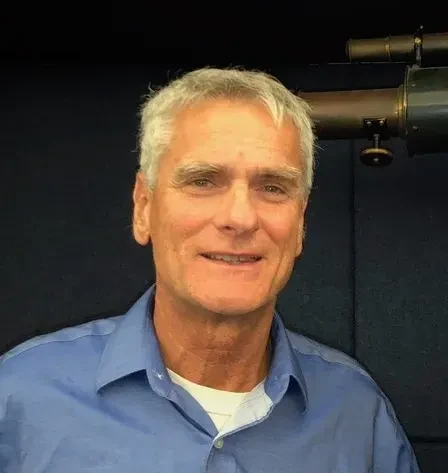
A scientist connecting the origin of life, Mars and the responsibility of exploration
Chris McKay's scientific trajectory becomes much easier to understand once his work is no longer divided into isolated topics. His studies of terrestrial deserts, ancient martian climate, icy environments, biosignature detection, terraforming, planetary protection and ocean worlds are not a loose collection of interests. They revolve around a single problem: under what conditions can a planet or moon become a place where life can originate, persist, leave a record and be recognized unambiguously by observers arriving from somewhere else? NASA Ames identifies McKay as a senior scientist whose research focuses on solar-system evolution and the origin of life while also emphasizing his involvement in future Mars missions, including human exploration. That combination is decisive. In his work, the science of extraterrestrial life cannot be separated from the practical consequences of exploration.[8]
His doctorate in AstroGeophysics from the University of Colorado in 1982 placed him at an intersection of disciplines before astrobiology had acquired its current institutional identity. Life-detection questions were distributed across exobiology, planetary science, geology, atmospheric chemistry, microbial physiology and studies of extreme environments. A planetary-physics background forces the investigation to begin with the environment rather than with an imagined organism. Pressure, temperature, energy, water, atmospheric evolution, ice stability and mineral history have to be understood before one can ask what kind of biology might have operated there.
Mars is unusually powerful as a scientific case because its ancient record and modern surface are so different. Geological evidence records past water and environments that could have been much more clement, while today's surface is cold, dry, low-pressure and exposed to radiation. That contrast requires an evolutionary view of habitability. A planet is not permanently "habitable" or "uninhabitable" in one simple sense. Conditions migrate through space and time, and biological potential may retreat from the surface into protected niches.
The search for life therefore becomes a science of evidence. An organic molecule is not automatically biological. A microscopic structure can resemble a fossil while having a mineral origin. Methane can be generated geologically. Familiar biochemistry can arrive as contamination. The scientific task is not merely to detect something unusual, but to build a chain of evidence that survives competing explanations. This distinction runs throughout McKay's career and helps explain his interest in extreme terrestrial sites, drilling below the martian surface, molecular chirality and contamination accounting.
The same logic leads to the idea of a "second genesis." If martian life shared a distant common origin with terrestrial organisms, discovering it would still be historic, but it would not necessarily provide a second independent example of life's origin. Natural transfer of rocks between Mars and Earth makes ancient biological exchange physically conceivable. A clearly independent martian biology would have even greater scientific significance: it would demonstrate that the transition from chemistry to biology happened at least twice in one planetary system. McKay has stated this goal directly in NASA work on organics, fossils and biology on Mars, emphasizing that a second example is needed to understand life at a fundamental level.[9]
Human exploration makes this issue operational. The more capable humans become at drilling, moving regolith, extracting water, cultivating organisms and traversing large areas, the more they become agents of biological and geochemical change. Human presence can multiply the power of field science while reducing the pristine character of some sites. The challenge is therefore not to choose between science and settlement, but to design settlement so that it does not make the original scientific question impossible to answer.
This expanded biography should consequently be read on two levels. One follows a scientist, his field sites, publications and mission concepts. The other follows the transformation of the Mars question itself. In the Viking era, the problem was whether the soil would produce signals compatible with biology. Modern astrobiology widened the investigation to preservation, niches, subsurface access, terrestrial analogs and ocean worlds. With the prospect of human crews, the question also becomes institutional, ethical and operational. McKay's career sits exactly at that junction, where learning about another world and deciding how to act on it become two sides of the same problem.
AstroGeophysics: learning to treat a planet as a system before searching for its inhabitants
McKay's doctorate in AstroGeophysics is an important clue to the way he approaches Mars. The discipline begins with the physics and history of worlds: heat, atmosphere, geological materials, radiation, volatile cycles and energy balance. In astrobiology, this is more than background. It determines what biochemical possibilities are physically available. Before proposing an organism, the investigator must know whether liquid water can exist, what sources of chemical energy are present and how quickly organic evidence would be destroyed or preserved.
This perspective is visible in his early work on ancient Mars. With Carol Stoker, McKay published a major review at the end of the 1980s discussing the early martian environment and its implications for life. Geological observations suggested that early Mars differed dramatically from the present desert, with surface liquid water and probably a thicker atmosphere. The paper did not claim that life had existed. Instead, it established a comparative framework: life appeared early on Earth, so if Mars maintained clement conditions for a comparable interval, the question of a martian origin of life becomes scientifically legitimate. Mars might also preserve ancient terrain more extensively than Earth because it lacks the same degree of plate-tectonic recycling.[10]
The distinction between environment and evidence is already present in that reasoning. A delta, hydrothermal mineral assemblage or ancient lake does not constitute a biosignature. It identifies a setting where liquid water, energy and preservation may have combined favorably. Mission strategy therefore becomes a problem of ranking geological contexts rather than merely finding a safe landing ellipse.
AstroGeophysics also encourages a vertical view of the planet. Modern Mars is harshest at its exposed surface. Ultraviolet radiation, energetic particles, desiccation and oxidizing chemistry alter the uppermost material. Conditions at depth can be different. Ice becomes more stable, radiation is attenuated and fractures or mineral pores may provide chemically distinct microenvironments. This contrast later becomes central to drilling concepts and to the argument that a search for extant life cannot be restricted to whatever soil is easiest to scoop from the surface.
The same systems approach matters for human settlements. A Mars base cannot be designed as a terrestrial village transplanted into a red landscape. Internal pressure, radiation shielding, dust, thermal cycling, ground mechanics, accessible ice and waste flows define the architecture. An installation that ignores subsurface ice stability can damage its foundations; one that ignores local geochemistry can compromise nearby science. The environment is not a scenery surrounding engineering. It is the set of constraints from which engineering begins.
This is also why McKay's later involvement with Enceladus, Titan and the water-activity limits of Venus is not a departure from Mars. Each world tests whether concepts such as water, habitability and biosignature remain meaningful under very different conditions. Comparative planetology protects astrobiology from treating one planet as the universal template.
Viking: a foundational lesson about measurement, chemistry and interpretation
The Viking landers of 1976 form one of the most important intellectual backgrounds to McKay's career. They attempted something few later Mars missions repeated in the same form: direct biological experiments on martian soil. The landers combined three biology investigations with an instrument intended to detect organic compounds. The results resisted a simple binary interpretation. Some experiments produced reactive responses that could appear metabolically suggestive, while the expected organics were not detected by the method then used and the overall interpretation favored non-biological soil chemistry.
For McKay, Viking is useful not because it provides an easy retrospective verdict, but because it demonstrates that an instrument never measures "life" directly. It heats a sample, adds reagents, monitors gases or records molecular masses. Each step interacts with the chemistry of the material. The later discovery of perchlorates on Mars strengthened this lesson because perchlorate-bearing soil can produce reactive products during heating and complicate organic detection. NASA Ames seminars involving McKay have explicitly revisited Viking in light of perchlorate chemistry.[11]
The history changes the meaning of a negative result. Failure to detect a target may mean that the target is absent, but it can also mean that it lies deeper, is present below sensitivity, was altered during sample preparation or does not match the biochemical assumptions built into the experiment. Positive results are equally vulnerable to contamination and unexpected abiotic reactions. Modern life-detection strategy therefore favors multiple, independent lines of evidence.
Viking also demonstrates the temporal nature of planetary science. Spacecraft are designed using the knowledge available years before landing. Engineers cannot include an experiment aimed at a soil chemistry nobody yet knows exists. The Mars program progresses through successive generations: one mission discovers a constraint, the next redesigns the measurement. Phoenix, Curiosity, Perseverance and orbiters all changed the context in which Viking is understood.
Humans will not eliminate this interpretive problem. They can adapt experiments on site and repeat a sample rapidly, which is a major advantage, but they also bring far more organic matter than any sterilized lander. The most capable biological investigator becomes the largest potential source of contamination. Human Mars science will need reference zones, microbial inventories, blanks and chain-of-custody procedures more rigorous than ordinary terrestrial fieldwork.
The lasting Viking lesson is therefore methodological. Planetary biology is extraordinarily sensitive to where an experiment is performed, how deep it samples, what chemistry occurs during analysis and what competing mechanisms have been considered. This lesson connects the 1976 landers directly to McKay's later interest in buried ice and biomolecular drilling.
The Antarctic Dry Valleys: when life retreats inside rock
Antarctic field sites occupy a central place in McKay's work because they combine cold, aridity, persistent ice and isolation in ways that are rare on Earth. The McMurdo Dry Valleys are obviously not Mars: they have terrestrial pressure, gravity and biological history. Their value lies in partial constraints. They allow scientists to examine how water becomes limiting, how ice can persist beneath dry soil and how microorganisms exploit microscale refuges even when the landscape appears lifeless.
The work of microbiologist Imre Friedmann on cryptoendolithic communities was especially influential. In some Antarctic sandstone, photosynthetic organisms live a few millimeters below the exposed surface. Translucent rock admits enough light while reducing wind exposure and desiccation. For Mars, the important result is not a prediction that identical communities exist. It is the demonstration that a landscape classified as hostile at kilometer scale can contain more favorable conditions at millimeter scale.
That scale dependence changes mission strategy. A rover sampling only broad surface units can miss protected niches. A drill that reaches depth but destroys geological context can find organics without revealing why they were preserved. Astrobiology therefore depends on combining molecular analysis with field geology. The place where the sample came from is part of the evidence.
NASA Astrobiology continues to use Antarctic sites as analog environments. University Valley contains ice-cemented ground studied in relation to modern Mars, and drilling systems have been tested there for access to subsurface samples. The field site links science to engineering: a mission must penetrate cold material without overheating it, contaminating it or losing the stratigraphic information that gives the sample meaning.[12]
Polar campaigns also provide a logistical analog. Weather limits operations, energy is finite and samples must be preserved far from major laboratories. Teams decide which analyses can be destructive and which material must be saved. Mars intensifies all of these constraints because communication delay removes immediate terrestrial supervision and resupply is far more difficult.
The Dry Valleys finally raise a broader environmental question. Low erosion and weak biological activity can preserve landscapes for extraordinary periods. McKay has written about the value of such static landscapes. On Mars, a nearly lifeless surface may be scientifically important precisely because it stores ancient geological information. Protection is therefore not limited to living ecosystems.
The Atacama: searching for the point where dryness becomes stronger than biology
The Atacama Desert provides a different experimental constraint. Some regions are so hyperarid that microbial abundance and activity become highly discontinuous. McKay participated in research asking where the threshold lies between a desert with sparse life and a material in which biological activity becomes extremely difficult to detect. NASA Astrobiology summarized the question in direct terms: when is dry too dry for life?[13]
Total water content alone does not answer the question. Salts, temperature, pore structure and chemistry determine how much water is thermodynamically available. Two soils with similar water content can offer radically different conditions to a cell. This distinction becomes central to Mars, where brines may remain liquid at low temperature while offering very low water activity.
The Atacama also functions as an instrument test. If scientists already know that microorganisms are present but an instrument detects them only occasionally, the equivalent Mars mission risks false negatives. Field campaigns can compare molecular methods, cultivation, microscopy and geochemistry against a difficult natural background. The result is not only a map of life but a map of detection probability.
As with Antarctica, analogy must not become identity. The Atacama is warmer than Mars and sits within Earth's atmosphere and biosphere. Finding a microbe there does not prove that Mars must contain one, and failing to detect life in the driest soil does not establish the sterility of martian subsurface environments. The value of the site is experimental isolation of one stressor.
For human Mars exploration, the desert provides another lesson: biologically important gradients can occur over short distances. A salt layer, shaded surface or rare wetting event can separate active and nearly inactive microenvironments. Settlement planners should therefore avoid assuming that a broad geological unit is biologically uniform.
In McKay's work, terrestrial deserts are not cinematic stand-ins for Mars. They are laboratories for designing strategies: determine thresholds, test instruments, quantify sampling statistics and learn how subtle local context controls biological survival.
From water to water activity: why the presence of H₂O is never enough
The slogan "follow the water" helped organize decades of planetary exploration, but it can become misleading if interpreted too literally. Water may be locked in ice, bound to minerals, dissolved in extremely salty solutions or present only during episodes too brief for sustained metabolism. McKay's comparative work repeatedly emphasizes that biological usefulness depends on thermodynamic availability, not simply on the chemical presence of H₂O.
Water activity, commonly written aw, is a dimensionless measure that ranges from near zero toward one for ordinary aqueous systems, with pure water close to one under reference conditions. It describes how available water is for physical, chemical and biological processes. Terrestrial organisms adapted to salt or dryness can tolerate surprisingly low values, but experimentally observed limits exist.
This matters for martian brines. Salts can depress the freezing point and allow transient liquids at low temperature, yet the same salts lower water activity and impose osmotic stress. A liquid phase is therefore not automatically a good habitat. Likewise, abundant subsurface ice can be extremely valuable to a human base while remaining biologically unavailable unless local processes produce a liquid interface.
McKay participated in research comparing water activity in planetary atmospheres, including the clouds of Venus. The estimated values for Venus are far below known terrestrial limits despite the presence of droplets. The result does not define what every conceivable alien biochemistry could tolerate, but it shows how a measurable thermodynamic quantity can replace vague language about "cloud habitability."
Water activity also informs planetary protection. Mars special-region concepts have used combinations of temperature and water availability to estimate where terrestrial microorganisms might replicate. NASA's 2024 Planetary Protection Handbook reviews the development of those criteria and their operational significance.[14]
For settlement engineering, this thermodynamic view has an additional consequence. Waste heat near ground ice can create liquid conditions that do not occur naturally. An extraction leak can concentrate salts or transport terrestrial organisms. Water management therefore becomes part of biological site management.
Habitable is not inhabited: separating possibility from history
Habitability is one of astrobiology's most useful concepts and one of its easiest to overstate. It allows scientists to rank environments using physical and chemical criteria, but public discussion often turns "habitable" into an almost biological claim. McKay's work repeatedly maintains the distinction. Ancient lakes, hydrated minerals and deltas demonstrate that some martian settings had conditions compatible with terrestrial microbial life. They do not demonstrate that life originated there.
Three questions must therefore be kept separate. First, did the environment provide liquid water, essential elements, energy and reasonable stability? Second, did those conditions persist long enough and at an appropriate time for life to arise or survive? Third, if biology existed, were its traces preserved in a form our instruments can still recognize? A mission can answer the first positively while leaving the other two completely open.
Gale crater illustrates this progression. Curiosity identified ancient sedimentary environments that were compatible with microbial habitability. That result changed our picture of Mars without constituting a life detection. It narrows the hypothesis space and justifies more demanding work on preservation and biosignatures.
Enceladus creates the same distinction in another setting. Its subsurface ocean, chemical energy and measured compounds make it potentially habitable to Earth-like organisms. The scientific task is still to test whether biology actually operates there. McKay has contributed to defining science objectives for life-detection mission concepts at Enceladus, extending the same evidentiary discipline beyond Mars.[15]
For human settlement, the distinction has political weight. A site with no detected life is not necessarily available for unrestricted development if it has been poorly sampled. "No evidence" may simply reflect low sensitivity or inappropriate depth. A staged approach—mapping, controlled sampling, reference zones and then gradual opening—protects against destroying a site before the right instruments exist.
This is not an argument for freezing an entire planet. It is an argument for distinguishing ignorance from evidence. A world can be scientifically precious even when biology has not been demonstrated, and different regions can carry very different levels of uncertainty.
Biosignatures: building evidence that survives false positives and false negatives
Life detection is often described as a search for distinctive molecules, yet most proposed biosignatures become persuasive only as part of an ensemble. Organic molecules can be synthesized abiotically. Isotopic ratios can be altered by several processes. Cell-like shapes can be mineral products. Gas variability can emerge from geochemistry. The scientific goal is therefore to find combinations for which non-biological explanations become progressively less adequate.
McKay's interest in chirality offers one example. Amino acids can exist as mirror-image forms. Terrestrial biology strongly selects particular handedness. A large extraterrestrial chiral excess, combined with independent evidence, could be significant. But abiotic processes can also produce imbalances, and terrestrial contamination can introduce familiar patterns. Chain of custody remains essential.
Modern molecular approaches expand the toolkit. McKay's NASA profile lists work on DNA extraction from Mars analog soils and solid-state nanopore characterization. Such experiments do not assume that martian life necessarily uses DNA. They test how biological polymers can be recovered from challenging mineral matrices and how compact instruments might characterize them. On Mars, finding ordinary terrestrial DNA could initially be more informative about contamination than about native biology.[8]
Geological context remains indispensable. The same organic molecule has different meaning in an ancient protected sedimentary layer and on a surface next to a human vehicle. Mineralogy, age, thermal history and three-dimensional location accompany the chemistry. Astrobiology is therefore inseparable from field geology.
False negatives deserve equal attention. Extreme environments often contain sparse and patchy biomass. A single sample can simply miss the target. Sampling plans need statistical logic: multiple locations, depths, blanks, controls and preserved fractions. The sensitivity of the detector is only one component of mission performance.
Human explorers could improve sampling through flexible field decisions, but they also become a major organic background. The paradox is unavoidable: the most capable investigator is also the most difficult contaminant to remove. Mars biosignature science after human arrival will have to become a discipline of contamination metrology.
Second genesis: why an independent life would teach more than the mere presence of microbes
The phrase "second genesis" captures one of the deepest themes in McKay's work. Discovering any extraterrestrial organism would be historic, but not every discovery would answer the same scientific question. If martian microbes used the same genetic code, the same molecular families and a deeply similar cellular architecture, scientists would still have to ask whether Mars and Earth share ancestry. Impact exchange between the planets makes ancient transfer physically possible.
A clearly independent biology would change the problem. Two origins in one solar system would provide the first comparative basis for estimating whether the emergence of life is extraordinarily rare or a relatively probable consequence of certain environments. With one terrestrial example, we cannot determine which features are universal and which are historical accidents.
In a NASA abstract from 2001, McKay explicitly framed the need for a second example as a route toward understanding life at a fundamental level. Biochemistry contains many possible local optima, and another evolutionary history could reveal a different solution to the problems of information, metabolism and structure.[9]
This goal explains why contamination is not a secondary concern. If explorers carry the exact biochemistry they want to compare, some future discoveries become harder to interpret. Life-detection missions therefore need both targeted instruments and more agnostic methods that can recognize chemical organization without assuming terrestrial genetics.
A human base may eventually need a detailed "biological passport" of its own organisms: genomes, strains, industrial microbes, crop-associated species and changes in the habitat microbiome. Decades later, a researcher finding a biological signal outside the settlement would then have a reference against which to test terrestrial origin.
Second genesis also changes the geography of settlement. A region containing potentially independent biology has information value that cannot be replaced elsewhere. Exploiting it before adequate study could erase a unique experiment. Regions shown with high confidence to be biologically insensitive would be better candidates for intensive human activity.
Ancient Mars: climate, water and the possibility of a window for life's origin
McKay's early Mars research emerged from a problem that remains unresolved in detail: how did liquid water modify the surface of a planet receiving less sunlight than Earth, especially under the faint young Sun? Valley networks, drainage systems, deltas and sediments record episodes of flowing or standing water. Climate models must reconcile those observations with atmospheric composition, greenhouse warming, clouds, impacts, volcanism and surface feedbacks.
In their 1989 review, McKay and Stoker described early Mars as potentially warmer and wetter, with a denser CO₂-dominated atmosphere in some scenarios. Models have evolved substantially since then, and no single climate history explains every observation. The astrobiological importance remains: sustained aqueous environments create plausible windows for prebiotic chemistry and perhaps microbial ecosystems.[10]
Duration matters as much as average temperature. A lake produced briefly after an impact is not equivalent to a basin replenished repeatedly by groundwater or precipitation. Wet-dry cycles can themselves influence prebiotic reactions. Reconstructing an environment therefore requires depth, salinity, pH, duration, renewal and sedimentation rather than a simple yes-or-no statement about water.
Mars has a documentary advantage over Earth. Plate tectonics, erosion, metamorphism and biology have altered much of Earth's oldest record. Mars exposes enormous regions more than three billion years old. Even a sterile Mars could preserve exceptional evidence about the chemistry and climate of early rocky planets.
The ancient-Mars question also connects to the present. If life emerged during a wetter era, did it disappear as the planet cooled or retreat underground? Terrestrial deep biospheres demonstrate that rock-water reactions can support microbial life without surface photosynthesis. This possibility motivates the search for ice-rich and protected subsurface environments.
Human settlement will eventually face the heritage implications of this record. Ancient strata are not merely construction material. Some may be irreplaceable paleoenvironments. Mars may require a planetary equivalent of archaeological or paleontological assessment before large-scale excavation.
After discovery: astrobiology would not end, it would expand into comparative planetary biology
A credible detection of martian life would not mark the end of astrobiology. It would create the field's first true comparative biological program. Researchers would need to measure diversity, ecological niches, evolutionary history and any relationship with terrestrial organisms. One strain or one fossil cannot describe an entire biosphere.
Protection could then become more precise. Some environments might require strict reserves, others could be approached by clean robots, and still others might be opened to human activity once adequate biological separation is demonstrated. Discovery would finally provide the empirical biology that present precautionary policy lacks.
Scientists would also need to preserve untouched material. The first generation of instruments would inevitably be limited. Martian and terrestrial archives should therefore retain samples for methods that do not yet exist.
This prospect summarizes McKay's logic. Life search is not a race to produce the first signal. It is the construction of a comparative planetary biology, and that science becomes possible only if exploration preserves enough context for the discovery to remain interpretable.
One final requirement: preserve the ability to be wrong without destroying the field evidence
Perhaps the best summary of this scientific trajectory is a simple rule: a mission should be able to discover that its hypothesis was wrong without having destroyed the environment needed to ask a better question. That is the purpose of controls, archives, reference areas and reversibility. Science advances by permitting error, but interpretive error is repairable only when field context, samples and raw data remain available.
On Mars this discipline becomes exceptional in importance. The first generations will encounter a world still only lightly altered by human activity. Their responsibility is not to freeze the planet, but to keep enough possibilities open that future generations can understand what we failed to recognize.
The martian subsurface: why the first meters may matter more than kilometers of exposed terrain
The modern martian surface is a difficult place for preserving biological molecules. Ultraviolet radiation reaches exposed grains directly, energetic particles penetrate farther, low pressure prevents stable pure liquid water under most surface conditions and oxidizing chemistry can alter organics. Depth therefore becomes a scientific variable. Even tens of centimeters can change radiation exposure, while meters can reach ice-cemented materials with a history unlike the surface.
Interest in the subsurface does not imply that it is automatically inhabited. It means that preservation probability and physical conditions change with depth. Ice layers can record relatively recent climate cycles. Salts may alter local water stability. Fractures can transport vapor or gases. Geothermal gradients slowly increase temperature downward. Potentially important environments are three-dimensional, whereas early Mars exploration was naturally constrained to the material a lander could reach from above.
McKay's Antarctic work with NASA Ames teams helped prepare this transition. University Valley provided a setting where extremely cold dry soil overlies ice-cemented ground. Drilling experiments there confront systems with actual mechanical and contamination problems: frozen material, low biomass, tool heating and the challenge of transferring samples to instruments without losing context.
Drilling is not merely making a hole. A bit can heat the sample and alter fragile compounds. Lubricants and polymers can introduce organics. The mechanism can mix layers that had different histories. Vibrations can damage delicate structures. Material can contact surfaces used at another depth. A life-detection mission must therefore treat drilling, transfer and analysis as one integrated experiment.
Human operations make the problem harder and more capable at the same time. Astronauts can dig trenches, deploy deep drilling rigs and inspect subsurface walls, but suits, tools and habitats release particles. Cleanliness must be quantitative rather than rhetorical. Investigators need to know what organisms and molecules were present before the operation, what appears in blanks and what is detected in the sample.
The same subsurface ice is also a resource for settlement. Deposits valued as climate archives or astrobiological targets can supply water, oxygen and possibly propellant production. Resource and archive overlap. Rational planning would reserve some deposits or cores for science while designating other bodies of ice for industrial extraction after baseline characterization.
Icebreaker Life: turning biological drilling into a mission architecture
The Icebreaker Life concept is one of the most concrete expressions of the scientific strategy associated with McKay. The proposed mission targets ice-rich martian mid-latitudes and drills to roughly one meter to search for biomolecular signatures while characterizing the habitability of ice-cemented regolith. Versions of the concept have been studied for more than a decade, and recent NASA abstracts continue to develop the science case and sampling system. A 2022 NASA NTRS description presents Icebreaker as a Discovery-class mission designed to search for molecular evidence of life in the icy subsurface, while 2024 work continues the concept.[16][17]
The approximate one-meter depth is revealing. Icebreaker is not attempting to reach a hypothetical deep aquifer. It seeks to move beyond the most exposed surface while remaining within the mass and mechanical limits of a compact landed mission. Going much deeper could improve access to protected materials but at the cost of power, mass, sterilization complexity and failure risk.
The mission also illustrates the difference between measuring habitability and searching for life signatures. Instruments must characterize ice, salts and chemistry while also looking for molecular patterns that might indicate recent or preserved biology. The contextual measurements are not secondary. A molecular signal is much more meaningful when the sample's physical history shows that preservation was plausible.
Sample handling has therefore received dedicated engineering attention. NASA work describes a chain linking drill, robotic transfer mechanism and analytical instruments. Every transfer introduces risk: material may stick, be lost, mix, warm or acquire contaminants. Mission success is not simply a matter of reaching depth; it is a matter of delivering representative and interpretable material to the detector.[18]
Icebreaker also shows how robotic missions can prepare for human settlement scientifically rather than merely technically. A clean lander can establish a biological baseline in a region before humans and their microbiomes arrive. If a site reveals highly interesting signatures, it can be protected for more careful investigation. If it proves resource-rich and biologically unremarkable after robust study, it may become a better candidate for future exploitation.
The sequence matters. It is far easier to preserve scientific value when the baseline is measured before industrial activity. Once habitats, drills and biological systems have operated for years, reconstructing the original contamination state becomes extremely difficult. Icebreaker therefore represents not only a search for life but a model for putting science ahead of development.
Instrumenting life detection: sensitivity is useless without blanks, controls and context
Life-detection instruments face a peculiar problem. They often seek extremely weak signals while the spacecraft itself carries molecules from Earth. Higher sensitivity can therefore create as many interpretive problems as it solves. If a detector becomes a thousand times more sensitive while contamination control does not improve, it may simply characterize spacecraft residue with greater precision. Metrology has to advance alongside biology.
Instrument blanks are central to this work. A blank measures the system without the target martian sample, allowing researchers to characterize background compounds, detector noise and protocol-induced products. Multiple blanks can be valuable: before landing, after environmental exposure, between samples and after operations that may release contamination.
Witness materials can accompany spacecraft fabrication and launch. Surfaces exposed in clean rooms are archived and later analyzed to identify organisms and molecules that might have traveled with the mission. Human exploration would require the same logic on a far larger scale. Crew microbiomes change, crop systems select new communities, water loops develop characteristic organisms and maintenance introduces new polymers and chemicals.
McKay's work spans approaches from chirality to biomolecule extraction in Mars analog soils. This methodological diversity reflects the difficulty of proving life. A highly targeted detector may miss unfamiliar biology; a very general detector may generate ambiguous complexity. Strong investigations combine elemental chemistry, organics, isotopes, chirality, imaging, mineralogy and environmental context.
Destructive analysis must also be managed. Heating, crushing or dissolving samples can reveal crucial information but prevent other measurements on the same material. Mission plans need aliquots—separate portions of a sample—and preserved fractions. This becomes essential when the material is rare or the sampling event cannot be repeated.
A human base could eventually operate laboratories at several cleanliness levels. Field labs would document and triage samples. Cleaner facilities would perform sensitive measurements. Some material would remain sealed for future instruments or return to Earth. The scientific architecture would resemble terrestrial geochemistry and biosafety systems but with one extra challenge: the laboratory sits inside a permanent miniature terrestrial biosphere.
Planetary protection: protecting Mars from us and Earth from what we may bring back
Planetary protection operates in two complementary directions. Forward contamination concerns transfer of terrestrial organisms to another world. Back contamination concerns the return of material that could contain an extraterrestrial biological entity. The probabilities and consequences differ, but both become central when Mars exploration moves from robotic landers to people.
Robotic spacecraft can be subjected to stringent contamination control. Components can be cleaned, heated and assembled under controlled conditions, and spore counts on relevant surfaces can be measured. A human mission cannot be sterilized in the same way. Crews carry extensive microbial communities on their bodies, food systems and life-support equipment. The question changes from "how do we carry no terrestrial biology?" to "how do we characterize and contain what we inevitably carry?"
NASA policy discussions on human Mars missions explicitly acknowledge this change. A planetary-protection report states that the goals should not simply be relaxed for human exploration even though implementation will differ. Human missions will carry microbial populations varying in type and quantity; continued monitoring will be needed; and a comprehensive protocol must address forward and backward contamination, subsurface exploration, sample handling and the return of both samples and crew.[19]
This framework closely matches McKay's concern with preserving the ability to distinguish martian biology from imported life. The solution does not necessarily require closing vast areas indefinitely. It can use differentiated geography: human activity zones, movement corridors, protected science sites, clean robotic access and pre-settlement sampling.
Back contamination creates another set of requirements. A returned sample from a site potentially harboring extant life should remain controlled until appropriate testing is complete. The hazard is not established, but uncertainty justifies containment proportional to the stakes. Human missions make the issue harder because astronauts themselves may be exposed to martian material.
Planetary protection is therefore governance under uncertainty. It does not assume that Mars is alive, nor does it assume sterility. It organizes actions during the interval in which we do not know. That is why it must be designed into mission architecture rather than added after landing sites, waste systems and drilling plans are already fixed.
Special Regions: the biological map of Mars is not the same as its geological map
The concept of Mars "Special Regions" was developed to identify environments where terrestrial microorganisms might plausibly replicate or where particular protection is warranted because of astrobiological interest. Criteria have evolved as knowledge of temperature, water activity and subsurface environments improved. NASA's 2024 Planetary Protection Handbook reviews the development of the concept and the stronger requirements that can apply to missions accessing certain environments.[14]
The difficulty is that Mars has not been biologically mapped at the necessary resolution. A region that appears dry from orbit may contain a cave, ice lens or local thermal anomaly. Orbital data reveal minerals and landforms, not microbial occupancy. Special-region classifications are therefore partly precautionary: they identify places where contamination could be unusually consequential.
This becomes especially important for people because human operations will seek water. Drilling, trenching and resource extraction may target the same ice-rich environments that astrobiologists find interesting. Operational value and scientific sensitivity can converge on one location. Without reconnaissance, the first settlement could inadvertently occupy a site that should have been studied first.
International workshops supported by COSPAR and NASA have emphasized the need to understand natural transport of contamination on Mars. Winds, dust, vehicles and gaseous emissions can move particles. A protection boundary cannot be defined only by an arbitrary distance; it depends on survival, dispersal and the environmental mechanisms that deactivate organisms.[20]
A pre-settlement biological map might therefore combine ice probability, temperature, water activity, geology, caves, radiation shielding, dust transport, paleoclimate value and human operational history. Sites could be classified for priority science, protected reference, controlled resource extraction or ordinary activity.
McKay's field experience makes the logic intuitive. Antarctic and Atacama studies show that the most biologically interesting microenvironments can occupy tiny fractions of a broad landscape. Mars may also be mostly hostile while containing rare exceptions. The rarity of those exceptions is exactly what makes them worth protecting.
Biologically reversible exploration: retaining the ability to leave without permanently rewriting the experiment
McKay has argued for "biologically reversible" exploration. The concept begins with a realistic observation: all missions introduce some contamination, but not all contamination is equally persistent. If terrestrial organisms deposited on Mars die rapidly without reproducing, their presence can remain limited and decline. If human activity creates a warm, wet niche in which they multiply, the biological modification can become much more durable.
Reversibility therefore does not mean restoring every grain of dust to its previous location. It means organizing exploration so that imported biology remains contained, measurable and, as far as practical, capable of disappearing if activity stops. Systems that accidentally create niches—water leaks, waste heat, nutrient-rich effluent or open biological processing—deserve special attention.
The principle is most valuable early in settlement, when uncertainty is greatest. A first base can use high water recycling, closed waste systems, limited travel corridors and isolated maintenance areas. As astrobiological mapping improves, restrictions can be relaxed in places shown to be insensitive while remaining strict near high-value environments.
Reversibility offers a middle path between total prohibition and unrestricted colonization. Human crews can conduct extraordinary science, but a settlement can preserve reference areas and maintain the option to withdraw from a sensitive site. This resembles staged experiments on Earth, where interventions are designed with stop criteria because future data may change the interpretation.
The principle also has an institutional dimension. A classification should be revisable. A site thought ordinary may become important after a new discovery; another may be opened after years of robust negative results. The ability to change policy without having already destroyed the site is a form of technological maturity.
In that sense, McKay's environmental ethics is practical rather than abstract. Unknown conditions are not a reason for permanent inaction, but they are a reason to keep options open. Exploration that can be reversed respects the possibility that today's model is wrong.
Human exploration zones: organizing settlement so that science remains possible outside the base
Permanent human presence changes planetary protection from spacecraft cleanliness into territorial management. A small lander has a well-defined footprint. A base produces roads, excavations, maintenance sites, dust plumes, heat, waste and continuous movement. Protection therefore becomes an exercise in spatial planning.
National Academies discussions of human Mars protection have considered exploration zones where human activity could occur under defined conditions and protected areas reserved for scientific investigations. The same work raises a key unresolved question: how far could contamination from habitats travel in Mars' thin atmosphere, particularly after failures or large releases?[21]
Simple circles around a base will not be enough. Wind direction, topography, season, particle size and microbial survival matter. A downwind site farther away may receive more contaminants than a nearer site sheltered by terrain. Rover routes can become biological corridors, and maintenance yards may release more material than ordinary habitation modules.
Maps must also change through time. Before the first landing, a region may have no known terrestrial contamination. After ten years, some sectors will carry a clear human signature. Route logs, leak reports and incident locations therefore become scientific data. A future researcher needs to know whether a surprising molecule lies inside an old operational footprint.
International coordination will likely be necessary for the most valuable sites. Mars science is global and contamination does not respect administrative borders. Protection cannot become a disguised sovereignty claim, but mutual scientific restraint is possible under international agreements and shared standards.
McKay's contribution provides the intellectual basis for this geography: Mars is heterogeneous, human impacts can be measured and the search for independent biology deserves spatial protection. A mature settlement would therefore have environmental maps, restricted corridors and monitoring systems just as terrestrial societies have land-use planning—only with the additional goal of preserving a planetary experiment.
Sample return: why a few carefully documented grams can outweigh an entire remote laboratory
Returning samples addresses a basic limitation of robotic missions. No lander can carry every instrument available in terrestrial laboratories. On Earth, material can be analyzed by microscopes, synchrotrons and mass spectrometers that did not exist when the sample was collected. It can be divided among independent teams and preserved for future generations.
For life detection, context becomes part of the sample. Scientists need location, geology, orientation, depth, handling history, temperature exposure and contamination records. A tube without metadata loses a large fraction of its interpretive value.
Back-contamination concerns add another layer. Material from a site potentially containing extant martian life must be handled so that scientific examination does not release an unknown biological agent before the relevant tests are complete. Strict containment can itself complicate ultra-sensitive measurements, so facility design becomes part of the science.
Human missions create a new class of samples: material selected with excellent field judgment but collected in the presence of people. Their scientific value may be very high while contamination burden is harder to control. Protocols will need to distinguish pre-human robotic samples, clean robotic samples teleoperated by crews and ordinary material handled inside the settlement.
Some material should also remain unopened on Mars. The history of Viking and modern biomolecular methods shows how quickly analytical techniques change. A first base should not consume every rare sample with current instruments. Sealed archives preserve opportunities for future laboratories.
This is an important cultural principle. Planetary material is not merely something to analyze as soon as possible. When access is unique, deliberate non-analysis can be a scientific investment.
A human base as an unintended biological experiment
A Mars habitat will never be biologically neutral. Even with excellent containment it will hold humans, microbes, food, organic materials and wet life-support systems. Over years, small quantities of that material will inevitably reach the exterior through suit operations, filter changes, leaks, maintenance or accidents. The realistic objective is to understand and reduce those flows rather than pretend they can be zero.
The base can be modeled as a point source in a dispersal system. Engineers can estimate water vapor, particles and chemical emissions. Microbiologists can track the habitat's community. Meteorologists can model dust transport. Combining those data produces probabilistic contamination maps that change with seasons and operations.
Monitoring also creates scientific value. Accidental terrestrial microbes can function as tracers of survival and transport. This is not an argument for deliberate release, but unavoidable incidents can teach researchers how quickly organisms are inactivated if the baseline and follow-up measurements are rigorous.
Life-support design can reduce the footprint. High water recovery lowers effluent. Biological waste can be sterilized or contained. Airlocks can capture dust. Suitports can keep heavily contaminated suit exteriors outside the pressurized habitat. Crop systems can be separated from any external vent path.
Resource-extraction facilities are particularly important because they add heat and liquid water. A failure may produce conditions more favorable to terrestrial organisms than natural Mars. Such systems should be placed away from high-value astrobiological sites and designed to recover leaks.
Human settlement therefore becomes a long-term experiment in contact between a miniature terrestrial biosphere and Mars. The McKay framework treats this not as a reason to abandon settlement, but as something that must be measured. Responsible inhabitants document their footprint and preserve uncontaminated reference areas for future science.
Terraforming Mars: from thought experiment to planetary-system physics
Chris McKay is frequently cited in discussions of terraforming because he contributed to several foundational studies on making Mars more favorable to terrestrial life. That reputation is easily simplified into advocacy for immediate planetary engineering. His published work is more demanding. It asks a sequence of questions: does Mars contain enough accessible volatile material to thicken its atmosphere, what gases could produce adequate greenhouse warming, how long would climate transitions take, what organisms could survive each stage, and would any transformation be ethically acceptable if Mars already hosts indigenous biology?
A 1991 Nature paper by McKay, Owen Toon and James Kasting, preserved in NASA's technical archive, examined scenarios in which greenhouse gases and released CO₂ could warm the planet and raise pressure. The work considered a gradual sequence toward conditions more favorable to some terrestrial organisms while emphasizing that producing an oxygen-rich atmosphere through planetary biology would require extremely long timescales under the assumptions used.[22]
The scientific value of such a scenario is not dependent on near-term feasibility. Terraforming proposals force researchers to inventory reservoirs, energy flows and climate feedbacks. If the amount of mobilizable CO₂ is uncertain, the atmospheric future is uncertain. If water stability and escape rates are poorly constrained, long-term predictions remain weak. A planetary-engineering thought experiment therefore becomes a stress test of our understanding of Mars.
Knowledge has changed since the early 1990s. Orbital and in-situ measurements have improved estimates of accessible carbon dioxide, and later work has argued that known reservoirs are insufficient for a simple "release the CO₂" route to an Earth-like atmosphere. This does not invalidate the historical study; it demonstrates how the scientific method is supposed to work. A scenario is only as strong as its inventories and boundary conditions.
McKay later explored powerful synthetic greenhouse compounds as a way of increasing radiative forcing more efficiently. The concept moves the problem from discovering a natural reservoir to building an industrial system. A civilization would need energy, feedstocks, factories, atmospheric monitoring and maintenance over long intervals. Such a society is qualitatively different from a first human outpost.
That difference in scale matters. Early settlers will struggle to maintain hundreds or thousands of cubic meters of breathable habitat. Terraforming concerns an entire atmosphere and planetary surface. Treating those as adjacent engineering steps hides orders of magnitude. McKay's work is useful because it forces Mars visions into a hierarchy: local habitat, regional environmental management, partial biosphere and global climate modification.
Warming is not enough: pressure, nitrogen, oxygen, water and atmospheric escape
Making Mars openly habitable to humans would require far more than raising surface temperature. Present pressure is so low that pure liquid water is generally unstable at the surface. A theoretical first step would therefore increase both pressure and temperature. Yet a thicker CO₂ atmosphere would still be toxic to humans. A breathable atmosphere needs oxygen, sufficient total pressure and a buffer gas such as nitrogen or another suitable component.
Oxygenation is fundamentally a stock-and-flux problem. Earth's atmospheric oxygen reflects billions of years of photosynthesis, burial of reduced carbon, rock oxidation and geological cycling. Simply introducing photosynthetic organisms to Mars would not guarantee rapid O₂ accumulation because exposed minerals could absorb oxygen for long periods. A planetary atmosphere must saturate chemical sinks as well as generate the gas.
Nitrogen creates a separate challenge. Human-compatible atmospheres need a buffer to reduce fire risk and reach practical pressure without excessive oxygen. Mars' accessible nitrogen inventory is poorly suited to naive assumptions about duplicating Earth's air. An oxygen-production technology based on CO₂ does not solve the bulk-gas problem.
Atmospheric escape also matters. Mars lacks a modern global magnetic field comparable to Earth's and has lower gravity. MAVEN has demonstrated ongoing atmospheric loss to space. A deliberately thickened atmosphere would not vanish immediately, but its stability over very long periods depends on loss mechanisms and replenishment. Planetary engineering would become a maintenance problem as well as a construction problem.
Water introduces feedbacks. Warming may mobilize ice, alter albedo, redistribute vapor and change dust processes. But martian water is heterogeneous: polar deposits, subsurface ice and hydrated minerals respond differently. A warmer Mars could develop complex regional climates instead of undergoing a uniform transition.
Terraforming is therefore a systems lesson. Pressure, temperature, atmospheric composition, water, soil chemistry and biology are coupled. McKay helped move the subject away from a science-fiction switch and toward quantitative balances, even when those balances show that the desired transformation is vastly more difficult than popular summaries suggest.
May a civilization transform a planet that already has its own biological history?
Terraforming is not only a question of capability. It is also a question of legitimacy. McKay and Margarita Marinova explicitly brought environmental ethics into their analysis of making Mars habitable. Their 2001 paper examines physics, biology and ethics together, placing the possibility of indigenous martian life at the center of the decision.[23]
If Mars is completely sterile, introducing terrestrial life can be defended as increasing biological complexity on a previously lifeless world. If Mars hosts an independent biosphere, even one consisting only of microbes, the argument changes. Indigenous life represents a unique evolutionary history. Replacing it or altering its environment beyond survival could erase scientific and moral value that cannot be recreated.
An intermediate case is equally interesting: Mars may have hosted life in the past but be sterile today. Fossils and chemical traces would then form a biological heritage without living organisms. Terraforming could destroy some of that record through erosion, hydrology and new biology, but the ethical issue would differ from extinguishing an extant biosphere.
This hierarchy explains why life detection should precede massive environmental transformation. A civilization that engineers first and investigates afterward risks changing the answer it wanted to discover. Before any global climate project, a deep survey of ice, subsurface environments and preserved ancient deposits would be scientifically prudent.
Even a lifeless landscape can have value. Geological archives, exceptional landforms and long-static surfaces may deserve protection just as Earth protects sites for geology and heritage rather than biodiversity alone. Recognizing that value does not require freezing all of Mars, but it rejects the assumption that sterile means worthless.
McKay's contribution is important because it demonstrates that enthusiasm for human expansion and environmental restraint are not mutually exclusive. A civilization can favor exploration while still deciding that some irreversible transformations should wait until the planet is better understood.
The value of nearly static landscapes: preserving information, not only organisms
McKay has written about extremely dry landscapes in Antarctica and the Atacama as settings where low water availability and sparse biology allow surfaces to remain unusually stable. The idea broadens planetary ethics. A place may deserve protection not because it contains rich biodiversity, but because it preserves physical information that more active environments would erase.
Mars is exceptionally rich in such archives. Craters, dunes, ancient sediments and volcanic deposits can remain legible over geological timescales. Their exposure makes them accessible to science but vulnerable to human activity. Roads, excavation, dust deposition or industrial heat can alter surfaces that had changed little for millions of years.
Protection must nevertheless be selective. Treating every grain of martian soil as untouchable would make exploration impossible. The practical goal is to identify rare, representative or uniquely informative sites. Protected geological reserves could coexist with regions intended for infrastructure and resource use.
Digital documentation can reduce conflict. High-resolution photogrammetry, spectroscopy and geological mapping performed before construction preserve an initial record and allow later comparison. Such archives cannot replace the physical site, but they prevent total loss of context.
Human history will also create heritage. The first landing sites, rover tracks and early habitats will acquire cultural value. Mars will therefore contain both natural scientific heritage and human historical heritage. Environmental governance must eventually manage both.
This reasoning brings astrobiology into environmental history. Understanding a world includes recognizing what our own activity removes from future understanding. A static landscape is an archive, and transformation without documentation is equivalent to destroying pages before reading them.
Before transforming Mars, learn to build reliable closed biospheres
Terraforming attracts attention because it promises an open world, but the first generations on Mars will almost certainly live in closed habitats. This stage is not merely an unfortunate temporary condition. It is a fundamental ecological experiment: keeping air, water, nutrients and waste circulating in a limited volume over long periods.
Current spacecraft life-support systems recover much of their water and manage atmospheric gases, but they depend on resupply and do not constitute fully autonomous biospheres. Mars increases the demand for closure. Transport delays and cost make material recovery, local repair and biological food production increasingly valuable.
Plants can provide food, oxygen and psychological benefits, but they also require light, water, nutrients and disease management. A closed agricultural ecosystem can drift through salt buildup, nutrient imbalance, microbial blooms or crop failure. Diversity can improve resilience while increasing operational complexity.
For a scientist interested in ecosystems under planetary constraints, closed habitats form an essential intermediate scale. They allow a civilization to test what "making an environment habitable" means without modifying a planet. Every greenhouse becomes a small experimental biosphere.
Early habitats should maintain a strong separation between internal terrestrial biology and the external environment. Air, water and waste streams require containment, while martian dust entering the habitat must also be controlled. Mars analog material can be sterilized and introduced into experiments without releasing Earth organisms outside.
A mature settlement can then compare ecological architectures: hydroponics, treated mineral substrates, algal systems, microbial reactors and integrated waste recycling. Success at this scale is a much more realistic prerequisite to planetary modification than simply assuming that Earth life will thrive once Mars is warmer.
Martian agriculture: introducing life without turning food production into uncontrolled contamination
Agriculture is likely to become essential for durable settlement. Supplying all food from Earth for decades would be expensive and operationally fragile. Crops also contribute to water and carbon cycling. Yet a greenhouse creates a planetary-protection challenge often underestimated: it contains dense terrestrial biology, including roots, microbes, fungi and possibly insects.
A Mars greenhouse should therefore be designed as a biological containment facility. Exhaust air can be filtered, water recycled, plant residues treated and substrates kept within controlled loops. Seeds and deliberately introduced microorganisms should be documented. A nutrient-solution leak into regolith could produce a warm, wet microenvironment in which terrestrial organisms survive far longer than on the natural surface.
Species selection becomes ecological engineering. The highest-yield crop is not automatically the best option. Settlement agriculture values short cycles, tolerance to environmental variation, nutritional diversity and efficient recycling. Genetic diversity acts as insurance against disease but requires more storage and management.
Raw martian regolith is not agricultural soil. It lacks organic structure and can contain salts or other compounds requiring treatment. Hydroponics avoids some problems but depends on equipment and prepared nutrient solutions. A practical food system may combine several approaches.
Organisms also alter minerals and chemistry. Microbes can change pH, release gases and weather rock. Agriculture is therefore a geochemical agent. Inside a greenhouse, that transformation is controllable. Outside, it can blur the scientific record.
Settlement and biological release should consequently be treated as separate decisions. A colony can become increasingly self-sufficient while keeping most terrestrial life inside managed habitats. Deliberately introducing organisms to the open environment is a much later and ethically distinct step.
Extracting water: a vital resource, climate archive and possible habitat in the same deposit
Water ice sits at the center of most settlement architectures. It can supply drinking water, oxygen, agriculture and potentially propellant production. Near-surface deposits are therefore strategically valuable. Astrobiology adds another perspective: the same ice can preserve climate history, organics or, in some hypotheses, biological evidence.
Industrial extraction heats, mixes and removes material. If the deposit is scientifically important, some context is inevitably lost. The rational approach is to sample before exploitation. Reference cores can be archived, layers mapped and chemistry measured. Portions of especially informative deposits can remain untouched.
Site selection should also consider biological sensitivity. If two ice bodies offer similar resource value but one lies near a potentially habitable subsurface environment, the other may be a better industrial target. This requires robotic missions to map not only ice abundance but astrobiological context.
Extraction itself introduces heat and can create transient liquid conditions. If terrestrial organisms contaminate the system, industrial equipment may manufacture a niche that natural Mars does not provide. Leak recovery and thermal isolation therefore matter for planetary protection as well as efficiency.
Industrial operations can also become scientific observatories. Continuous logging of stratigraphy and composition during excavation can produce climate records. Earth mines sometimes expose fossils or geological structures; a martian resource industry could similarly contribute to science if collection is designed into operations.
This is a recurring McKay lesson: a resource belongs to an environmental history. Engineering can either erase that history or measure it while using the material. The difference is often a matter of planning rather than a fundamental conflict between science and settlement.
Waste and effluent: the first ecological problem of a colony will be what it releases
Colonization concepts emphasize energy, rockets and habitats, while waste flows receive less public attention. Yet every kilogram of food and material eventually produces residual biomass, wastewater, gases or discarded components. In a closed settlement, those flows should be recycled because they are valuable resources. In a scientifically sensitive environment, they also need containment because they carry terrestrial signatures.
Water treatment can recover both water and nutrients. Biological residues can feed thermal or microbial processing. Plastics can be reprocessed. Simply dumping material outside would waste scarce resources and create persistent contamination zones. Circular material management is therefore both an autonomy strategy and a planetary-protection strategy.
Treatment methods need biological evaluation. Heating can kill organisms while leaving organic molecules that interfere with life-detection experiments. Strong oxidation can reduce organic burden but requires energy and may generate other compounds. External storage sites should be deliberately located and chemically documented.
Gaseous emissions are another vector. Habitats release CO₂, water vapor and trace compounds. Industrial processes may add additional gases. Future atmospheric science will need a detailed inventory of anthropogenic emissions so that natural methane or other trace signals are not confused with settlement activity.
Scale changes the problem. Ten people produce a limited footprint. Ten thousand create a genuine anthropogenic geochemistry. Researchers will need to distinguish natural martian processes from signatures of civilization just as Earth scientists distinguish pollution and industrial gases.
Standards are easiest to establish at the beginning. The first base can normalize recycling, georeferenced waste records and restricted disposal zones. If early settlers treat the exterior as an infinite dump, changing the operational culture later will be far more difficult.
Energy and waste heat: infrastructure can create its own biological microclimate
Every Mars base uses energy and rejects heat. In a naturally cold environment, that thermal footprint matters. Reactors, habitats and industrial equipment can maintain nearby ground above its original temperature. Where ice is present, heating may drive sublimation, vapor migration or local phase changes.
Waste heat should therefore be treated as an environmental impact. Radiators can be placed away from sensitive sites, buried hot lines insulated, and industrial equipment concentrated within already disturbed zones. Scientific sites intended to monitor natural thermal conditions need adequate separation.
Different energy systems produce different footprints. Solar arrays require large areas and dust management but distribute power generation. Nuclear systems offer compact, stable output with radiological and thermal considerations. Mature settlements will probably combine sources, and the choice will shape settlement geography.
Heat is also a resource. High-temperature industrial waste heat can cascade into lower-temperature uses such as habitation, drying or agriculture. Integrated thermal design reduces power requirements and external thermal disturbance simultaneously.
From an astrobiology perspective, warm infrastructure is also where terrestrial microbes are most likely to survive. Condensate lines, drains and heat exchangers become critical monitoring points. A leak that combines water, nutrients and warmth produces a niche unlike the natural martian surface.
Human civilization will inevitably create microclimates on Mars. The important distinction is whether they are confined and understood or diffuse and accidental. This is another operational expression of biologically reversible exploration.
From ten people to ten thousand: why planetary protection changes character with scale
A first crew and a martian city do not create the same environmental problem. At small scale, routes can be tightly controlled, waste tracked individually and the activity zone kept compact. As population grows, movement and construction become continuous: mines, roads, laboratories, farms, maintenance yards and travel between settlements.
Planetary protection must therefore scale institutionally rather than simply multiplying astronaut procedures. Regulations need to become part of planning permission. Operators may be required to report biological incidents. Vehicles entering controlled regions may need route logging and decontamination standards.
Scientific monitoring must become distributed as well. A central agency cannot inspect every activity in a large colony. Habitats, companies and local authorities will need standardized sampling and reporting protocols, while reference laboratories verify unusual signals.
Growth also increases scientific capability. A city can support more power, technicians, instruments and drilling systems than a short mission. Permanent settlement could create a golden age of martian field science if the contamination footprint is mapped rather than ignored.
The cultural risk is normalization. After generations, inhabitants may regard terrestrial microbes as ordinary components of Mars and forget why pristine sites matter. Scientific reserves and baseline archives therefore need to be created early, before economic pressure makes them politically difficult.
McKay's long-term perspective helps frame the question. The objective is not merely to complete the first landing but to hand future generations a planet that remains scientifically interpretable. Settlement must manage knowledge as carefully as resources.
Scientific governance: who gets to declare a site sufficiently studied?
Protected zones immediately raise a governance question. Who decides when a site has been studied enough to permit extraction or construction: a national agency, an international body, the scientific community, the operator funding the mission or the future residents of Mars? No single institution has an obvious permanent claim to the answer.
Decisions would be more defensible if based on published criteria established before the specific case. A site could be evaluated for ice, temperature, mineralogy, biosignature potential, geological uniqueness and contamination history. Minimum analytical requirements could be defined before irreversible disturbance.
Transparency matters because interests differ. A resource operator may prefer rapid access; scientists may request years of study; residents may need water. Governance should make trade-offs explicit rather than disguising them as purely technical conclusions.
Classification must also be revisable. New discoveries can make an ordinary site important. Long sequences of strong negative results can justify easing restrictions. An appeals and review process allows policy to evolve with evidence.
This is the institutional equivalent of McKay's reversibility principle. Good governance does not freeze every decision forever; it preserves the ability to change course before irreversible damage occurs.
Mars will therefore become an experiment in scientific law. Human societies will occupy a world without prior human land-use traditions but with potentially immense scientific value. Institutions will have to balance survival, economics, knowledge and heritage using categories that cannot simply be copied from Earth.
Why send humans if humans contaminate? Because field capability is transformative
Planetary protection can produce a radical objection: if people contaminate Mars more heavily than robots, why send them for astrobiology? The answer is field capability. A trained geologist can recognize a contact, change an itinerary, select an unexpected sample and connect observations in minutes. Robots are becoming far more autonomous, but they remain constrained by power, communications and hardware fixed before launch.
Humans can also maintain complex laboratories, repair instruments and operate deeper drilling systems. A permanent base can build scientific capability over decades rather than relying on one fixed payload. This transforms the scale of possible investigation.
The contamination problem can be moved away from the sensitive sample through hybrid architectures. Clean robots can travel from the base to protected sites while astronauts teleoperate them locally with negligible communication delay. Samples can be sealed before entering the inhabited zone.
This approach combines human intelligence with robotic cleanliness. It is particularly valuable for caves, ice-rich Special Regions and other environments where direct human entry would create an unacceptable biological footprint.
Human presence can also support robots with power, communication, workshops and local launch capability. Once a base exists, the marginal cost and duration of robotic field campaigns may improve dramatically.
The apparent contradiction is therefore manageable. Humans are the largest contamination source, but they are also the most flexible builders of long-term science. Mars astrobiology must learn to use their strengths while keeping their biosphere out of the most sensitive experiments.
Enceladus: when the ocean comes to the instrument instead of requiring kilometers of drilling
McKay's interest in Enceladus extends the second-genesis problem beyond Mars. Saturn's small icy moon contains a global ocean beneath an ice shell and vents material into space from its south polar region. This geometry is extraordinary for astrobiology. A spacecraft can fly through a plume and sample material originating from the ocean without landing and drilling through kilometers of ice. Cassini transformed Enceladus from a small frozen moon into one of the solar system's premier life-search targets.[24]
Cassini detected water, salts, organic compounds and evidence for interaction between the ocean and a rocky core. Coexisting H₂ and CO₂ in the plume are especially interesting because terrestrial methanogens can use those compounds as an energy source and produce methane. That analogy does not establish life. Hydrothermal geochemistry can also generate relevant compounds. The scientific challenge is to determine which chemical patterns would be difficult to maintain without biology.[25]
McKay participated in defining science objectives for flagship-class life-detection mission concepts at Enceladus, work listed on his NASA profile. The goal is to move beyond the statement that the ocean is habitable and build an instrument suite capable of testing for life. Possible measurements include detailed organic distributions, isotopes, amino acids, chirality and complex structures in ice grains.[8]
Enceladus also reframes contamination. A flythrough can examine ocean-derived material with relatively little disturbance, but any mission that impacts or lands on the moon must avoid delivering viable terrestrial organisms into a potentially habitable environment. Planetary protection remains stringent even in the absence of humans.
The comparison with Mars is revealing. Mars exposes ancient geological archives but may hide present life underground. Enceladus hides the habitable environment beneath ice but naturally ejects samples into space. The optimal mission architectures are therefore almost opposite. Astrobiology is not a single standardized measurement package; it is a strategy adapted to how each world presents its evidence.
For McKay, ocean worlds provide a second laboratory for the universal question. If liquid water, energy and complex chemistry persist together over geological time, does life emerge? A clearly independent positive result at Enceladus would turn the idea of a second genesis from a theoretical goal into an experimental fact.
Nutrients and energy: an ocean is not habitable merely because it contains liquid water
Enceladus illustrates another recurring limitation of simplified astrobiology: water is important, but organisms also require chemical building blocks and usable energy. Researchers have therefore examined phosphorus availability, redox chemistry and the energy sources that might operate in the moon's subsurface ocean.
Phosphorus is central to terrestrial nucleic acids, membranes and energy metabolism. For years, some models suggested that ocean worlds might suffer from very low phosphate availability. More recent NASA-supported research has indicated that water-rock chemistry on Enceladus may allow more favorable concentrations. The shift is a useful reminder that "habitability" is a model-dependent conclusion that evolves as geochemistry improves.[26]
Energy availability is equally important. Terrestrial deep ecosystems can operate without sunlight by exploiting chemical gradients generated through water-rock reactions. An ocean in contact with a rocky core can therefore offer metabolically useful disequilibria. Cassini's detection of molecular hydrogen in the plume increased interest in this possibility.
Yet a usable energy source is not evidence that organisms are consuming it. Missions must compare reactants, products and expected abiotic equilibria. Biology can maintain disequilibria by continually processing compounds, but geology can also create strong chemical gradients.
The same logic applies on Mars. A hypothetical aquifer may contain water while offering too little metabolic energy. Conversely, rock-water reactions can produce useful chemical energy in dark subsurface settings. A true habitability map must therefore include geochemical energy, not simply water abundance.
McKay's comparative work helps move exploration from "find water" toward a more complete question: where do solvent, elements, energy, stability and time coexist? Life as we know it requires the intersection of those constraints.
Titan: testing how far astrobiology can move away from terrestrial biochemistry
Titan pushes astrobiology into a different conceptual regime. Its surface is extremely cold, but it has lakes and seas of liquid hydrocarbons and a dense atmosphere that produces complex organic chemistry. Surface water is frozen hard. If life existed in methane-ethane liquids, its solvent and temperature regime would differ radically from those of terrestrial cells.
McKay has explored several aspects of Titan, including atmospheric hydrogen and organic chemistry. His NASA publication list includes work on hydrogen sensing in Titan's atmosphere and on nucleic-acid bases produced in Titan-like tholins. These laboratory products do not demonstrate life; they show that complex prebiotic or alternative chemistry can arise in a world very different from Earth.[8]
Titan forces scientists to distinguish "life as Earth does it" from more general systems capable of organization and evolution. Our detectors naturally favor water-based carbon chemistry and familiar biomolecules. A methane-solvent biology might not trigger those instruments. The false-negative risk becomes conceptual, not only technical.
This motivates agnostic life-detection approaches. Instead of searching solely for a known molecule, missions can examine complexity, non-random distributions, chemical disequilibria and selective patterns. Any life must obtain energy, maintain organization and reproduce with variation even if its molecular implementation differs.
The contrast with Mars is valuable. Mars shares many rock-forming materials and a history of water, making terrestrial-style categories somewhat more plausible. Titan is a test against biological provincialism. It asks whether scientists are prepared to recognize something that does not resemble the only life they already know.
Titan is therefore not a detour from a Mars-centered biography. It clarifies the deepest Mars question: what are we actually looking for when we say "life"? Comparative worlds force the discipline to separate fundamental properties from terrestrial historical details.
Venus and the limits of water: learning that droplets can be biologically unusable
Venusian clouds have occasionally been proposed as a refuge because some altitudes have temperatures and pressures closer to terrestrial conditions than the surface below. Public interest increased during debates over possible atmospheric biosignatures. But temperature and the existence of droplets are not enough. Extreme acidity and very low water availability impose additional constraints.
McKay participated in research evaluating water activity in planetary atmospheres, including Venus. The estimated values in Venusian cloud droplets fall far below known terrestrial biological limits. This does not prove that every conceivable alien chemistry is impossible there, but it demonstrates why a measurable thermodynamic criterion is more useful than visual analogy with Earth clouds.
The lesson returns directly to Mars. A salt-stabilized liquid phase can sound biologically promising while having water activity too low for known terrestrial replication. Conversely, environments without obvious surface liquid water may contain transient microscopic interfaces with more favorable conditions.
Planetary-protection rules benefit from the same precision. Restrictions should focus on environments where terrestrial contamination can plausibly replicate, not everywhere a water molecule occurs. Overbroad criteria can unnecessarily immobilize exploration, while criteria that are too narrow can expose sensitive sites.
Venus also demonstrates the value of extreme comparison. Mars, Enceladus, Titan and Venus combine temperature, pressure, solvent and energy in radically different ways. A theory of habitability that survives comparison among them is more robust than one derived only from temperate terrestrial environments.
McKay can therefore be read as a researcher of limits: dryness limits in the Atacama, cold and ice in Antarctica, water activity in clouds, chemistry in hydrocarbons and acceptable contamination on Mars. Together these boundaries map what Earth life can and cannot tell us about other worlds.
Arctic, Namib and other field sites: the strength of a network of analogs rather than one "Mars on Earth"
McKay's NASA profile notes field work in Antarctica, the Atacama, the Arctic and the Namib Desert. The diversity matters methodologically. No terrestrial site reproduces Mars as a whole. The best analog depends on the question: cold and ground ice in polar regions, extreme aridity in the Atacama, wind-driven sediment in deserts, or particular salt and rock processes elsewhere.
A network of analogs lets scientists separate variables. If a phenomenon appears across several very different deserts, it may reflect a general constraint. If it occurs only at one site, investigators can identify what makes that environment unique. This avoids overinterpreting visual similarity.
Field sites also test operations. Batteries, clothing, communications, transport, human fatigue and sample handling all behave differently outside the laboratory. A planetary mission is a sociotechnical experiment as well as a scientific one. Protocol quality depends on whether it survives real constraints.
Robotic systems benefit similarly. A rover can be tested in dunes, frozen terrain and rocky slopes, each exposing different failure modes. Life-detection instruments can be challenged with low-biomass soil, saline material and known biological targets to measure sensitivity and specificity.
For future astronauts, analog campaigns provide training in decision-making. Who can change the traverse? How are samples prioritized? Which information has to reach the laboratory before a destructive analysis begins? Mars crews will make such decisions while isolated from immediate Earth support.
The value of terrestrial analogs therefore lies less in resemblance than in testability. They convert broad questions into protocols: measure a threshold, test survival, validate a drill, compare a detector. McKay helped make this experimental logic a durable part of planetary field science.
Field science: learning to see before measuring
Modern instruments can generate extraordinary data, but choosing where to measure remains decisive. In a desert or glacial valley, an experienced field scientist learns to recognize textures, color changes, fractures, grain transitions and depositional contacts that indicate different histories. Sampling is guided by interpretation before it is refined by instrumentation.
Mars rovers reproduce part of this workflow using cameras, spectrometers and planning teams on Earth. Scientists study the scene, select targets and send commands. Human crews on Mars could accelerate the cycle dramatically, provided contamination controls remain strict.
Field science also depends on documentation. A sample without context loses value. Photographs should record the location before and after collection. Coordinates, depth and orientation matter. Tools and contact surfaces need identification. These details may look mundane compared with an instrument spectrum, but they determine whether later researchers can reconstruct the event.
McKay's analog-field work exemplifies this culture. The goal is not merely to return with containers of soil but to connect biological observations to microgeography, water distribution and climate. On Mars, this discipline becomes even more important because some sites will be altered by the act of visiting them.
Astronaut scientific training should therefore include field geology and contamination awareness even when specialists remain on Earth. Crews need to understand why a layer must remain separate, why a tool cannot touch two samples without cleaning or why a visually ordinary site deserves preservation.
Technology can support judgment with augmented-reality maps, contamination histories and automated tool logging, but it cannot remove the need for interpretation. McKay's work reminds planetary exploration that context is itself a scientific instrument.
Uncertainty as data: scientific caution is not the absence of a conclusion
Astrobiology often works with weak signals and incomplete information. Public discussion can find that frustrating because it expects a binary answer—life or no life. Yet quantifying uncertainty is a form of progress. Saying that an environment is compatible with life, that a signal has several explanations or that an instrument's sensitivity is insufficient tells researchers what experiment should come next.
McKay has repeatedly worked on questions where negative or limiting results matter. If parts of the Atacama approach the dry boundary for detectable microbial activity, that constrains habitability. If Venusian cloud water activity is too low for known terrestrial life, that narrows hypotheses. If a drill fails to detect a biomolecule despite successful controls, the result informs mission design.
The discipline is to distinguish "not detected" from "not present." A site sampled once cannot support the same conclusion as a broad campaign with known sensitivity. Serious reporting includes detection limits, sample mass and control performance.
Planetary-protection decisions are especially sensitive to this uncertainty. Waiting for absolute proof of life before protecting any site may be too late. Treating the entire planet as biologically active can make exploration impractical. Policies therefore have to operate on graded risk and evolve with evidence.
A Mars settlement could institutionalize this by mapping confidence levels rather than using only allowed-forbidden categories. Different activities can face different requirements according to probability and consequence.
This may be one of astrobiology's broader cultural contributions: learning to make consequential decisions without pretending to know more than the data support. Mars will test whether that maturity can survive political and economic pressure.
Long timescales: thinking in decades, centuries and millions of years without losing engineering discipline
McKay's subjects span radically different timescales. A field campaign lasts weeks. A space mission may take a decade to design. A settlement can persist for generations. Terraforming scenarios extend over centuries or longer, while biological and geological evolution operates across millions and billions of years. The challenge is to connect these scales without using one to hide the difficulty of another.
Long-horizon proposals are particularly vulnerable to hand-waving. A phrase such as "plants will produce oxygen" conceals stocks, fluxes and chemical sinks. Simple order-of-magnitude calculations can reveal that a physically possible mechanism is far too slow for a human objective. Historical terraforming work was valuable partly because it translated imagination into rates and timescales.
Slow projects can still be meaningful. A durable civilization can undertake programs longer than one lifetime if intermediate stages have value. Mapping ice, building reference reserves and preserving samples benefit current science while preparing future generations.
Planetary protection is also long-term policy. A contamination event can leave molecules or dormant spores for years. Excavated geological context cannot be recreated. The first generation's choices can therefore shape the tenth generation's science.
Documentation becomes a form of intergenerational communication. Operational archives, contamination databases and sealed samples are messages to future researchers who may possess better instruments. Planetary science should be designed as a multigenerational program.
McKay's own career spans multiple eras of Mars exploration, from Viking's legacy to modern biomolecular mission concepts and human-settlement debates. His work demonstrates that a question can remain open for forty years while becoming progressively more precise.
Explaining Mars without turning hypotheses into promises
McKay has regularly participated in NASA interviews, public lectures and podcasts. Communication matters in a field where words such as "life," "terraforming" and "habitable ocean" can be amplified rapidly. Scientific language needs to preserve the boundary between observation, inference and speculation.
Evidence for ancient martian lakes does not mean the lakes contained organisms. An apparently habitable Enceladus ocean is not a life detection. A climate model showing warming is not an engineering commitment. Every statement carries a level of evidence.
Public communication can still explore implications. A clearly labeled hypothesis helps explain why a mission is built or why planetary-protection constraints exist. The problem begins when conditional language disappears between a technical paper and a headline.
NASA features on McKay often use terrestrial extreme environments as a bridge. The public can understand a cold desert or organisms living inside rock, then follow the logic toward Mars while being reminded that the analogy is incomplete.
Future Mars residents will need the same clarity. Protected zones and contamination controls may appear burdensome unless people understand the scientific value of an independent biosphere and the difficulty of distinguishing it from imported life.
Scientific culture therefore includes language. Uncertainty has to be communicated as a property of evidence rather than as weakness. McKay's public work has helped make highly speculative questions discussable without completely detaching them from experiment.
Scientific transmission: building teams that think beyond a single instrument or mission
A long career at NASA Ames produces an influence that extends beyond individual papers. Senior researchers participate in mission studies, collaborate across disciplines, review concepts and train younger scientists. McKay's work is particularly valuable as a model for connecting field analogs, climate theory, microbial limits and life-detection engineering.
The search for life requires genuine interdisciplinarity. Microbiologists define physiological limits; geologists recognize preservational contexts; chemists test abiotic pathways; engineers know what an instrument actually measures; planetary-protection specialists trace contamination. A mission can fail when these disciplines work sequentially rather than together.
Analog field sites become training grounds for this integration. Researchers immediately see the consequences of poor sampling, incomplete documentation or unexpected environmental conditions. Field campaigns teach adaptability in a way that a perfectly controlled laboratory cannot.
Transmission also occurs through open literature and archives. A paper from the 1980s can become newly relevant when a mission discovers a constraint that changes its interpretation. McKay's work on ancient Mars, terraforming and extreme environments has repeatedly been reconsidered as new measurements appeared.
Future Mars societies will need to reproduce this professional memory locally. Settlers cannot depend indefinitely on specialists living on Earth. They will need martian-trained geologists, microbiologists, laboratory technicians and contamination officers capable of teaching the next generation.
McKay's methodological legacy is therefore collective: ask questions broad enough to connect disciplines but precise enough to generate falsifiable experiments. That is essential when the object of study is an entire planet.
The next major Mars questions: moving from habitability to biology without skipping steps
After decades of exploration, Mars has provided a robust answer to one major question: some ancient environments were habitable in the sense that they contained liquid water and chemistry compatible with terrestrial microbes. The next step is harder. Scientists must determine whether biology actually emerged, whether it survives somewhere today and how any evidence can be separated from non-biological chemistry.
This step requires deeper sampling, more sensitive and diverse instruments, sample return and improved contamination knowledge. Icebreaker represents one direction. Perseverance's sample caching represents another. Future missions may target ice, caves or hydrothermal deposits depending on what current measurements reveal.
Contemporary gradients also need better mapping: ice stability, brine potential, radiation penetration and geochemical energy. Human settlement should ideally arrive after a meaningful baseline of current habitability has been established near candidate regions.
Human missions can accelerate the work if astrobiology is designed into the architecture. Clean robots, locally teleoperated from habitats, can access sensitive locations. Laboratories can maintain contamination-controlled chains. Reference monitoring can begin before the first crew steps outside.
Second genesis remains the ultimate prize. Even an ambiguous ancient biosignature is scientifically important, but an independent living biology would permit direct comparison with terrestrial life. Its preservation would become a planetary priority.
If no life is found after sufficiently deep investigation, that result will also be fundamental. A once-habitable but sterile planet would help explain why origin-of-life events may not be automatic. Either outcome makes Mars valuable, provided the experiment has not been compromised by our own presence.
Legacy: turning astrobiology into a discipline of civilization
Chris McKay's contribution to Mars exploration is not reducible to one discovery. It lies in the continuity of a problem pursued through climate, deserts, ice, biochemistry, mission design and ethics. That continuity helped transform life search from a Viking-era experiment into a discipline shaping planetary strategy.
His work first insists that life cannot be searched for independently of environment. Atmosphere, water, salts, geology and energy set the stage. It then insists that habitability is not life and that evidence requires multiple lines of support. Finally, it recognizes that exploration changes the object being studied, making planetary protection part of engineering.
Second genesis gives the program its cosmic scale. An independent biology on Mars or Enceladus would move humanity from one example of life to two. A strong absence of biology in apparently habitable settings would be equally informative about the rarity of origins.
Terraforming adds responsibility. A civilization capable of altering a climate can no longer behave as an external observer. Technical power creates an obligation to understand what might be replaced.
For future Mars residents, this philosophy becomes practical: zoning, microbial monitoring, waste recycling, greenhouse containment, pre-extraction sampling and protected scientific reserves. Astrobiology becomes part of urban planning and law.
McKay therefore represents a historical transition. The twentieth-century question was whether Mars might have been habitable. The twenty-first-century question includes how humans can live there without destroying the evidence. When science can modify a world, it becomes a discipline of civilization.
Regolith thermal conductivity: an understated property linking climate, ice and settlement
Among recent publications listed on McKay's NASA profile is work on the thermal conductivity of planetary regolith and the effects of grain-size distribution. The subject can look far removed from life detection, yet it demonstrates how strongly astrobiology depends on ordinary physical properties. Heat transport controls the depth at which ice remains stable, the amplitude of temperature cycles and the conditions experienced by possible subsurface niches.[8]
A highly insulating regolith can protect the subsurface from rapid temperature change. More conductive material transmits surface variation deeper. Porosity, grain size, contact geometry and ice all influence the effective conductivity. Thermal observations of the martian surface therefore contain information about soil structure, but only when models account for those variables.
Settlement engineering faces the same physics. Foundations, buried cables, heat pipes and resource systems interact with the thermal properties of the ground. A warm line passing through ice-rich regolith can cause long-term sublimation or settling. Ignoring those processes can turn a stable site into an engineering problem.
The disturbance also matters scientifically. Sensors near a habitat no longer measure completely natural subsurface temperatures. Climate-reference stations need to be separated from artificial heat sources. Cores intended to reconstruct climate history should avoid thermally modified ground.
Regolith is therefore not inert construction dirt. It transports heat, adsorbs gases, contains salts and can trap ice. McKay's attention to such properties reveals an astrobiology rooted in planetary physics rather than only in molecular biology.
The knowledge serves autonomy as well. The same thermal models that predict ice stability help determine where to extract water and how to insulate habitats. Fundamental planetary science and settlement engineering share the same physical substrate.
Detecting endolithic communities remotely: learning to recognize hidden life without breaking every rock
McKay coauthored work on spectroscopic detection of cryptoendolithic colonization in Antarctic sandstone and its application to Mars life searches. The idea is attractive because of its efficiency. If biological colonization changes the spectral properties of a rock enough to be recognized, remote or contact spectroscopy can help select targets before destructive sampling.
Endolithic communities are difficult to see from the outside. A rock surface may appear sterile while a biological layer exists a few millimeters below. Drilling every candidate is impractical. Spectroscopy can operate as a triage tool, looking for pigments, mineral changes or other anomalies associated with colonization.
On Mars, the method would need careful validation. Indigenous life would not necessarily use the same pigments, and martian minerals can mimic spectral patterns. The technique is therefore better understood as a way to identify unusual targets than as a direct life detector.
This creates a hierarchy of observation. Imaging covers broad areas. Spectroscopy narrows the field. Microscopy and geochemistry examine selected targets. Molecular instruments then operate on small samples. Each stage reduces the number of candidates while increasing analytical depth.
Human explorers can use the same hierarchy. A handheld spectrometer allows an astronaut to scan a wall or outcrop and select areas without touching everything. Clean teleoperated robots can extend the method into protected zones.
The endolith work illustrates a recurring McKay theme: Earth extremophiles are useful because they help design the logic of detection, not because Mars must contain the same organisms. The central question is how to find a rare signal in an enormous landscape.
Lake Untersee: a laboratory beneath ice where interfaces matter more than the visible surface
Lake Untersee in East Antarctica is an ice-covered lake studied by teams including McKay. Its persistent cover, unusual chemistry and anoxic regions make it useful for selected comparisons with ancient martian lakes and ocean worlds. The analogy is necessarily limited: it is an Earth lake embedded in terrestrial geology and biology.
Its scientific value lies in gradients and interfaces. Ice limits exchange with the atmosphere and modifies light. Water below can develop strong thermal and chemical structure. Microbial communities respond to those gradients. For an ocean world such as Enceladus, where a liquid reservoir is separated from space by ice, terrestrial sub-ice systems provide a tangible model for some transport processes.
For ancient Mars, ice-covered lakes are also relevant. McKay contributed to modeling work exploring whether lakes under ice could persist in Gale crater during cold Hesperian conditions. An insulating lid can reduce evaporation and allow liquid water beneath a cold atmosphere for longer than an open lake would survive.
The distinction changes biosignature expectations. Open, evaporating lakes and ice-covered systems do not have the same oxygen, light, sedimentation or chemistry. Geologists need to reconstruct lake type before making biological inferences.
Untersee also teaches sampling discipline. Drilling through ice and inserting instruments can mix layers or introduce contamination. Techniques developed to preserve gradients become valuable training for future planetary ice investigations.
The work broadens the meaning of field science. Sometimes the observable surface is only the lid of the system of real interest. Mars and the icy moons require an explicitly vertical geology.
Martian methane: a fascinating signal that refuses to become a simple life claim
Martian methane has attracted attention because much of the methane on Earth is biological. Curiosity reported variations in methane abundance at Gale crater, while other instruments and missions have not always observed the same concentrations. McKay appears among coauthors of work on seasonal atmospheric-composition variations measured at Gale, linking his research to this broader debate.
Methane is an excellent example of the difference between a potential biosignature and evidence of life. Geological reactions, ancient reservoirs and release processes can generate or liberate CH₄. Unknown sinks or adsorption mechanisms may influence its atmospheric lifetime. Biology is one hypothesis among several.
Spatial scale further complicates the problem. A rover measures locally. An orbiter samples a much larger atmospheric column. If emissions are patchy or short-lived, different instruments may legitimately see different values. Disagreement does not automatically imply measurement failure.
Human settlement will add a new complication. Industrial systems, agriculture and leaks can produce trace gases. Future atmospheric investigations will need emission inventories from settlements and reference stations placed far outside their influence.
Methane also teaches patience. An intriguing signal can remain unresolved for years without becoming scientifically worthless. Progress comes through better spatial coverage, time series, isotopes and source models.
For second-genesis research, methane would become much stronger only when embedded in a converging context: geology, isotope ratios, associated molecules and a credible production mechanism. The case is a textbook argument for multiple lines of evidence.
Dry permafrost over ground ice: a subsurface architecture more useful than a superficial resemblance to snow
McKay participated in studies of Antarctic terrain where very dry permafrost overlies ice-cemented ground. The configuration is relevant to Mars because a surface layer can be extremely dry while substantial ice exists at shallow depth. Vapor diffusion, climate and thermal properties control the vertical structure.
For astrobiology, this creates several distinct environments. The upper dry soil may be severely limiting. The ice-soil interface can experience different microphysical conditions. The ice itself may preserve a climatic or chemical record. A drill therefore needs to maintain stratigraphy rather than mixing a meter of material into one bulk sample.
For engineering, the same profile controls resource access. Orbital ice maps can be translated too quickly into "easy water." The thickness and mechanical properties of the dry overburden determine excavation mass, power and equipment design.
Extraction can also alter the local vapor regime. Heating a well changes how ice sublimates and may destabilize surrounding material. Sustainable use requires monitoring beyond the immediate borehole.
The research again shows that water quantity is not enough. Form, depth, temperature and relationship to regolith determine both biological significance and engineering value.
A mature Mars settlement will likely manage ground ice as both a reservoir and an archive, with long-term observation of how extraction modifies the surrounding environment.
Buried CO₂ deposits: remembering that the martian climate has reservoirs we do not see in the atmosphere
McKay also coauthored work on formation and stability of buried carbon-dioxide deposits in the martian polar regions. These reservoirs demonstrate that the modern atmosphere is only one part of Mars' volatile inventory. Orbital and climate cycles can transfer CO₂ among atmosphere, polar deposits and subsurface storage.
The dynamics matter for climate reconstruction. Changes in obliquity redistribute solar energy and can move ice and volatiles. Layered polar deposits therefore contain records of past conditions. Reading them is equivalent to reconstructing a climate archive.
The subject naturally connects with terraforming. Early scenarios relied in part on releasing stored CO₂ to increase pressure and temperature. Better measurements of reservoirs constrain how much atmosphere can actually be mobilized. Planetary engineering becomes an inventory problem rather than a purely imaginative one.
Astrobiology also benefits. Climate cycles change where ice and potentially favorable subsurface conditions occur. Mars is not biologically static simply because its present surface is cold. Habitable microenvironments may migrate over long timescales.
Human activity near the poles could disturb the same archives. Ice extraction and thermal systems should be preceded by stratigraphic mapping. A layered sequence may carry greater scientific value than the resource it contains.
McKay's research again links climate, volatiles, life and planetary modification through one underlying question: how does a world store and move matter and energy over time?
Atmospheric chemotrophy: ecosystems that may survive on traces rather than sunlight
McKay's recent publication list includes work on atmospheric chemotrophy—the possibility that microorganisms can obtain energy from gases present at very low concentrations. Some terrestrial soil microbes use atmospheric hydrogen or carbon monoxide, allowing persistence in extremely nutrient-poor environments.
The idea matters because it reduces the assumed material requirements for metabolism. A place that looks nearly devoid of nutrients may still provide a weak but continuous chemical energy flux. In deserts, such strategies may help microbial communities persist between favorable episodes.
Mars is different in pressure and atmospheric chemistry, so terrestrial mechanisms cannot simply be copied. Nevertheless, the concept widens the list of energy sources to consider. A subsurface or endolithic ecology need not depend on abundant organic food if geochemical or atmospheric gradients are available.
Instrumentation is affected as well. Very low-flux ecosystems can have extremely small biomass. Life searches focused only on visibly rich deposits may miss systems operating close to maintenance energy limits. Detection strategies need sensitivity and spatial persistence.
The same biology can inspire settlement biotechnology. Microorganisms able to remove trace gases could contribute to air purification or recycling inside controlled systems, provided they remain contained.
The topic reflects McKay's consistent method: study how life operates near known limits on Earth so that mission designers know which assumptions can safely be relaxed elsewhere.
What is life? A definition that is too narrow can make a mission miss the discovery
McKay devoted a 2020 article to the question of what life is and when to search for it on other worlds. The problem is not merely philosophical. A spacecraft must translate definitions into measurable criteria. If life is defined operationally as DNA, unfamiliar biology may be missed. If the definition is too vague, any sufficiently complex chemistry becomes suspicious.
Functional definitions often emphasize chemical systems capable of Darwinian evolution. That captures replication, variation and selection, but it is difficult to test from a single fossil-like sample. Other definitions emphasize metabolism, compartmentalization or information. No single criterion performs perfectly in every scenario.
Practical missions therefore search for multiple properties associated with living systems rather than relying on one absolute test. Molecular selectivity, organized complexity, persistent disequilibrium and environmental context can reinforce one another.
This pluralism guards against two errors. One is molecular anthropocentrism—the assumption that all life must use exactly our biochemical components. The other is overenthusiasm—calling every unusual pattern biological. Strong evidence has to navigate between them.
Second-genesis research particularly needs this openness. If alien life is truly independent, it may differ precisely in the features that seem universal only because humanity has observed one lineage.
"What is life?" is therefore not a prerequisite solved once before exploration. It is an experimental question that changes as new environments and new instruments expand the space of possibilities.
If Mars reveals extant life: the first decisions may matter as much as the discovery
Imagine a martian drill returns several converging signals consistent with active biology. The first scientific response should be verification: repeat the measurement, examine blanks, analyze contamination witnesses and use independent methods. A premature announcement could damage the credibility of the field for years.
If the evidence survives, priority shifts to characterization with minimal disturbance. How extensive is the biosphere? What chemistry does it use? Is it related to Earth? Which environmental variables control survival? The site may require immediate protection from terrestrial contamination.
Culturing an organism would be tempting but complicated. On Earth, isolation and growth are powerful tools. An extraterrestrial organism placed in a rich artificial medium might behave differently from its native state, and the experiment could create new biosafety questions. In-situ observation and containment would need to precede routine culture.
Return to Earth would not be automatic. Extant martian life would trigger the strongest back-contamination considerations. Many investigations might be conducted on Mars or in an isolated facility before any controlled transfer.
The discovery would also reshape settlement geography. Biologically active regions could become protected science reserves, while human expansion moves toward other areas. The information value of independent life would justify substantial operational constraints.
This scenario shows why McKay's work on reversibility and protection is not peripheral. It is institutional preparation for precisely the discovery astrobiology is trying to make.
If Mars is sterile: absence of life could still be a fundamental discovery
Life-search narratives often imply that only a positive result matters. Yet sufficiently deep exploration that repeatedly fails to find biology in environments once considered habitable would have major scientific consequences. It would show that water and favorable chemistry do not automatically produce life.
A robust negative result is difficult at planetary scale. Researchers would need to explore many environments, sample the subsurface, analyze ancient archives and understand detection limits. Absolute proof of sterility may be impossible, but the probability of an extensive biosphere can be reduced.
This matters for second genesis. If early Mars and early Earth both possessed habitable environments but life emerged only on Earth, the origin event may be more contingent than optimistic models assume. Estimates of life elsewhere would need to account for that comparison.
A sterile Mars would also alter the ethics of terraforming. The strongest objection—destroying indigenous life—would weaken, but geological heritage and landscape values would remain. Transformation might become more acceptable without becoming automatically desirable.
For settlement, increasing confidence in sterility could justify relaxing some biological restrictions in heavily studied regions while preserving reference reserves and ancient archives.
The negative scenario confirms McKay's scientific posture. The goal is not to prove that life exists. It is to ask the question in a way that allows either answer to teach something fundamental.
What McKay's work implies operationally for a first Mars settlement
Translated into settlement practice, decades of McKay's research suggest a first principle: establish a biological and geochemical baseline before large-scale disturbance. Precursor robots should map ice, trace gases, minerals and high-value biosignature environments. Data need enough spatial detail for later comparisons.
Second, separate functions. Habitat, industry and resource zones should not be identical to protected science sites. Sensitive laboratories need a cleaner chain than mechanical workshops. Greenhouses and waste systems require containment. Clean robots can handle the interface with special regions.
Third, measure the human footprint. Water releases, biological incidents and movement into controlled zones should be logged. Weather stations and dust collectors can track dispersion. The settlement microbiome should be characterized regularly so that external samples can be compared against a changing terrestrial background.
Fourth, preserve witnesses. Some ice, soil and rock should remain untouched. Pre-human samples should be archived. No-traffic reference areas provide long-term controls. Redundancy protects future scientists from present mistakes.
Fifth, make rules adaptive. A region shown to be sterile and insensitive can be opened more widely. A new biosignature should trigger stronger protection immediately. Decision criteria should be public and reviewable.
These points are not a formal McKay settlement plan. They are the logical operational consequences of themes running through his work: second genesis, extreme analogs, subsurface life search, planetary protection, reversibility and ethics of transformation.
Comparing Earth and Mars without turning Earth into a universal template
Earth is the only inhabited world we know, so astrobiology necessarily begins with terrestrial evidence. Limits for temperature, water activity, salinity and radiation are measured using Earth organisms. That creates an unavoidable bias. When scientists call an environment "uninhabitable," they often mean that no known terrestrial organism can reproduce under the tested conditions. An independent biology could shift some boundaries.
McKay uses extremophiles to test what terrestrial life actually demonstrates. Antarctic communities show that cold does not eliminate biology. The Atacama shows that extreme dryness can approach a much sharper boundary. Saline systems demonstrate that liquid water can be present while becoming biologically unavailable. Each case expands or refines the known domain without claiming to define all possible life.
This distinction is essential on Mars. Failure of terrestrial organisms to grow in a Mars analog does not prove that martian biology is impossible. Conversely, survival of an Earth bacterium in a simulation chamber does not prove that it could colonize natural Mars. Experiments test hypotheses rather than identities.
History matters as well. Modern Earth has an oxygen-rich atmosphere and a biosphere that has transformed the planet. Early Earth was radically different. A martian lineage could have originated under ancient conditions and later retreated into protected refuges. The best analog is therefore sometimes a process or microenvironment rather than a whole modern landscape.
This approach avoids two symmetrical errors. One assumes that life is so adaptable that it must be everywhere. The other assumes that environments unlike present Earth must be sterile. McKay's work instead measures known limits and insists on evidence.
Human-exploration policy inherits the same balance. Contamination rules should reflect what terrestrial microbes can plausibly survive while retaining caution about what an unknown martian biology might require. Planetary protection operates between empirical knowledge of our life and uncertainty about another.
Long-duration datasets: seeing changes that no spectacular expedition can reveal
Several studies involving McKay rely on climate or environmental observations accumulated over years, especially in Antarctica. Such datasets receive less attention than a spacecraft landing, yet they teach a crucial methodological lesson. Extreme environments vary seasonally and across decades; a single field visit can mistake a temporary state for a permanent limit.
Mars increases the need for long time series. Seasonal frost, pressure and dust cycles alter local conditions. Orbital cycles act over much longer intervals. Stations operating through multiple martian years can separate normal variability from rare or anomalous events.
Trace gases provide a clear example. A single methane measurement is difficult to interpret. A time series associated with temperature, wind, pressure and geological context allows competing mechanisms to be tested. If biology ever contributes to a signal, it may also vary seasonally.
Permanent settlement is ideally suited to maintaining such observatories. Instruments can be repaired, recalibrated and expanded. Human presence transforms Mars from a world visited by isolated missions into one monitored continuously for generations.
That capability requires external reference stations. A climate sensor inside the thermal or chemical footprint of a city no longer measures natural conditions. Networks should include sites at different distances and in directions selected using atmospheric transport models.
McKay's long-term field science reinforces the principle that biological and environmental limits are not abstract constants. They emerge from systems that vary over time. Understanding a world therefore requires duration as well as instrumental precision.
Open science and traceability: a life-detection claim must be re-examinable by teams that were not there
A credible detection of martian life would face worldwide scrutiny. Independent groups would need enough information to reconstruct the analysis: instrument configuration, blanks, known contaminants, sampling location and every transformation applied to the material. Methodological transparency becomes part of the evidence itself.
Raw data should be preserved, not only the figures selected for publication. Calibration parameters, software versions and operations logs have to accompany measurements. Future improvements in instrument models can then be applied retrospectively, just as new knowledge of perchlorate chemistry changed how parts of the Viking record were interpreted.
Traceability becomes harder after human arrival. Scientific operations interact with maintenance, agriculture and industrial systems. An unexpected organic compound could come from a material used days earlier. Without detailed logs, contamination hypotheses cannot be tested.
A contamination archive should therefore be treated as a common scientific asset. Agencies and companies operating on Mars may need to share enough information about organisms and chemicals they introduce for life-detection teams to interpret nearby sites. Commercial confidentiality cannot logically conceal the identities of contaminants required to evaluate a planetary biology claim.
This is not bureaucracy for its own sake. Astrobiology searches for weak signals in an environment where false positives are plausible. Extraordinary discoveries need stronger reproducibility than routine measurements.
McKay's methodological legacy therefore points toward a Mars where open data and traceable operations are part of planetary protection, not merely Earth-based academic norms.
The first decade of human Mars science: priorities implied by this framework
A scientifically mature first decade would begin with high-resolution environmental baselines around the settlement. Teams would measure dust transport, trace gases, ice, thermal structure and organic backgrounds. Those observations would reveal how human activity changes the site over time.
Clean robots would simultaneously explore areas of higher astrobiological value. Humans could remain outside protected zones and teleoperate machines locally, taking advantage of low latency without directly introducing their microbiome. Samples could be sealed before entering inhabited facilities.
The next priority would be depth. Drilling from a few meters toward tens of meters would map ground ice, thermal gradients and better-preserved molecules. Resource-extraction projects could share some infrastructure, but scientific cores should be collected before industrial disturbance.
A weather and contamination network should operate from day one. Water releases, biological incidents and major maintenance events would be georeferenced. Reference areas with no traffic would provide controls that can never be reconstructed later.
The settlement would also create archives for the future: sealed samples, microbiome records, maps of pristine sites and route histories. The first generation should not consume every scientific opportunity available to it.
This is not an official NASA plan. It is what McKay's recurring ideas look like when translated into temporal architecture: study before modifying, use humans to amplify science and preserve the ability to distinguish Mars from what humans add to it.
Clean robots operated by nearby humans: a practical bridge between intelligence and biological control
One of the strongest architectures for human astrobiology separates decision-making from physical contact. Astronauts can remain inside or near a base and teleoperate specially cleaned robots in sensitive regions. Communication delay is then measured in fractions of a second rather than the minutes required between Earth and Mars.
The robot can be designed for sterilization or strict bioburden control in ways a human suit cannot. It can carry single-use sampling tools, isolate cores and seal containers before returning. The nearby crew can interpret unexpected geology in real time and redirect the machine without waiting for an overnight planning cycle.
This approach is particularly attractive for caves, ice-bearing scarps and potential Special Regions. Human entry may be unnecessary and biologically undesirable, while a robotic interface still provides access to the site.
The base can support the robot with repairs, new instruments and power. Instead of one immutable payload operating until failure, a family of clean field robots can be maintained and upgraded over decades. Human infrastructure becomes an enabling layer for repeated planetary-protection-compliant missions.
Contamination control would still require discipline. Robots returning from sensitive areas cannot simply enter ordinary workshops. Maintenance zones need directional flows and records of which components contacted which environments.
The hybrid model reconciles two truths: humans are extraordinarily good at field decisions, and robots are far easier to control biologically. McKay's work makes this combination a natural consequence of preserving second-genesis science after settlement begins.
Sampling statistics: life can be present and still be missed
Extreme environments teach an uncomfortable lesson: biological material can be extraordinarily patchy. One rock contains a community; the next appears sterile. A centimeter of soil carries detectable organics while an adjacent sample falls below the instrument threshold. A negative result can therefore reflect sampling geometry rather than true absence.
Mars missions need explicit statistical thinking. How many independent samples are required? How are they distributed across geological units? At what depths? What constitutes replication? A sophisticated detector used on one poorly selected sample may provide less information than a simpler method applied across a well-designed set.
Field analogs allow researchers to test these questions because the true biological distribution can be mapped more extensively than on Mars. Investigators can simulate rover-scale sampling, then compare the inferred result with the actual field. This measures the probability of false negatives under realistic constraints.
Human crews can expand the sample size dramatically, but they must avoid a different bias: selecting only visually interesting targets. Random or systematic sampling remains necessary alongside expert judgment to estimate background distributions.
Sample preservation also enters the statistics. If every specimen is consumed by the first assay, independent confirmation becomes impossible. Aliquots and archive fractions preserve the ability to test the same material with another method.
McKay's desert research therefore has a mission-design consequence that is easy to overlook. Life detection depends not only on instrument sensitivity but on whether the sampling plan gives the instrument a fair chance to encounter the target.
Chirality: when molecular handedness becomes a clue rather than a verdict
Many organic molecules exist in mirror-image forms. Terrestrial biology displays strong handedness in amino acids and sugars, a pattern often discussed as a possible biosignature. McKay's work has included practical studies of chiral selectivity for life-detection instruments, reflecting the appeal and difficulty of using molecular asymmetry on another world.
A strong chiral excess can be interesting because abiotic synthesis often produces more balanced mixtures, while biological systems select specific forms. Yet the inference is not absolute. Physical processes can produce some asymmetry, and contamination by Earth life naturally introduces the same handedness our instruments are optimized to recognize.
A chiral measurement therefore becomes powerful only when combined with context. An excess detected in a protected ancient mineral assemblage, confirmed by independent methods and absent from blanks is more meaningful than the same result on a surface exposed to spacecraft hardware.
Independent martian biology might also choose the opposite handedness or use different monomers entirely. A detector that searches only for the terrestrial pattern should therefore be paired with broader organic characterization.
Chirality is a good example of McKay's evidentiary style: a potentially elegant biological signature is treated as one member of a larger argument rather than a magic test.
For human missions, the contamination challenge is obvious. Terrestrial amino acids from skin, food and materials are ubiquitous inside a habitat. Sensitive chiral analysis will require laboratories and sampling chains physically isolated from ordinary life-support spaces.
Clean rooms are not sterile worlds: understanding the microbial background before launch
Spacecraft intended for life-detection missions are assembled under controlled conditions, but a clean room is not biologically empty. Microorganisms adapted to dryness, cleaning agents and nutrient scarcity can persist. Some are especially interesting precisely because they survive the procedures designed to reduce contamination.
Planetary protection therefore relies on measurement rather than the assumption of sterility. Surface bioburden can be counted, witness plates archived and molecular signatures documented. The spacecraft's biological history becomes part of the mission record.
This is important for Mars because any organism recovered later from a spacecraft-accessed site must be compared with what could have traveled from Earth. Genome sequencing and modern microbial ecology make these comparisons more powerful than they were in the Viking era.
Human bases expand the background enormously. Instead of a fixed spacecraft community, the settlement microbiome evolves with people, food and maintenance. Continuous monitoring will therefore replace one-time launch certification.
The operational lesson is that "clean" is a measured state with a purpose. A surface can be clean enough for mechanical work but inadequate for a second-genesis sample. Different facilities and tools need different contamination budgets.
McKay's emphasis on distinguishing imported biology from martian evidence turns clean-room practice from a manufacturing detail into a central part of epistemology: we can only know what the sample means if we know what we brought with us.
Human exposure and back contamination: when the crew becomes part of the sample-return pathway
Robotic sample return can isolate martian material inside engineered containers. Human missions create a more complex pathway because astronauts interact with dust, suits, tools and habitats. Even if samples remain sealed, crew members and life-support systems may contact martian particles indirectly.
Planetary-protection planning therefore has to treat the crew as a potential exposure route. Monitoring, quarantine capability and medical observation are not predictions that martian pathogens exist; they are precautions under uncertainty.
The biological risk is difficult to quantify because truly alien life may not interact with terrestrial organisms in familiar ways. Lack of shared biochemistry could reduce pathogenic potential, but unexpected chemistry could create other hazards. The most rational policy avoids both complacency and science-fiction certainty.
Operationally, dust control is central. Mars dust is pervasive and electrostatically difficult. Suitports, external suit storage and decontamination systems reduce the quantity entering habitats. These systems are valuable for crew health even before planetary-protection concerns are considered.
Returned crews may also carry terrestrial microorganisms that changed during the mission. Distinguishing ordinary microbiome evolution from an actual martian exposure requires baseline samples collected before launch and throughout the mission.
McKay's framework makes clear why human exploration cannot simply inherit robotic return procedures. The biological boundary becomes the entire human system, not one capsule.
Scientific autonomy on Mars: decisions cannot wait for Earth when the evidence is fragile
Communication delay between Earth and Mars means that crews will frequently make scientific decisions without real-time terrestrial approval. This autonomy is especially important when a sample is fragile or an unexpected feature is exposed during drilling. Waiting tens of minutes for each instruction can allow thermal, mechanical or contamination conditions to change.
Protocols therefore need decision trees that crews understand rather than scripts they merely follow. Scientists should know when to stop a drill, when to preserve an untouched core, when to declare a contamination event and when a result requires repetition before further manipulation.
Artificial intelligence and onboard software can assist by flagging anomalies, comparing spectra and maintaining contamination logs. But automated systems also need transparent reasoning and calibrated uncertainty. A life-detection program cannot rely on a classifier that produces a label without an interpretable evidentiary trail.
Local laboratories will progressively reduce dependence on Earth. The more analytical capability Mars gains, the more the settlement can keep sensitive samples away from return pathways while still obtaining sophisticated results.
This autonomy has a cultural dimension. A Mars scientific community will eventually set priorities based on local knowledge of terrain and seasons. Earth institutions remain partners, but they cease to be the sole center of expertise.
McKay's combination of field science and mission planning anticipates this shift. Planetary exploration works best when investigators understand both the scientific question and the operational constraints well enough to adapt intelligently.
Priority before proof: why protection may need to begin while biology is still uncertain
A central difficulty in environmental ethics is timing. If protection begins only after life is conclusively demonstrated, the discovery process may already have contaminated or damaged the site. If maximum protection is imposed everywhere from the beginning, exploration can become unnecessarily restricted.
McKay's work suggests an intermediate logic based on information value and reversibility. Sites with the highest potential for extant life, unique preservation or second-genesis evidence receive stronger precaution. Ordinary regions remain available for exploration under less restrictive rules.
This is similar to risk management in other domains. Regulators act before certainty when both probability and consequence justify caution. The purpose is not to assume the worst case is true, but to avoid irreversible loss while evidence is gathered.
The classification needs periodic review. A site can move toward greater protection after a new biosignature or toward wider access after extensive negative results. Protection becomes adaptive rather than permanent by default.
Such a framework will inevitably involve value judgments. How much uncertainty justifies delaying a resource project? How unique must a site be? The scientific community can provide evidence but cannot entirely eliminate the need for political decisions.
McKay's significance lies partly in forcing those questions into the open before Mars is densely occupied. Ethical planning is easier while choices remain reversible.
Law and science on Mars: protecting knowledge without converting protection into ownership
Protected scientific zones raise legal concerns because space law rejects national appropriation of celestial bodies. A restriction established to preserve an astrobiological site must not become a disguised territorial claim. The goal is functional protection of an experiment, not sovereignty.
International agreements can distinguish those concepts. States and operators already coordinate frequencies, orbital debris practices and scientific access in other contexts. Mars could develop shared criteria for temporary or conditional protection based on transparent evidence.
Time limits may help. A site reserved for clean investigation during a defined research phase is easier to justify than an indefinite exclusion zone without review. Stronger long-term protection could follow if independent life or uniquely important geological evidence is actually found.
Access protocols can also be non-exclusive. Multiple scientific teams may work within the same protected region using common contamination standards. Protection does not have to mean monopoly.
Settlement growth will eventually require local participation. Decisions that affect water access or transport cannot be made indefinitely by Earth agencies without input from the people living there. Planetary science and political legitimacy will have to coexist.
McKay's focus on scientific value and reversibility provides useful criteria for such legal development. Protect what cannot be recreated, make restrictions proportional to evidence, and preserve pathways for future review.
One lineage or two? The discovery after the discovery
Suppose Mars produces convincing evidence of organisms. The first question—does life exist?—would immediately be followed by another: is it related to us? This second question may be scientifically more important than the first.
Researchers would compare molecular building blocks, genetic systems if present, membrane chemistry, isotopic fractionation and metabolic pathways. Strong similarity could indicate common ancestry, especially given natural exchange of rocks between the planets. Strong differences could support independent origin.
The test will not necessarily be easy. Billions of years of evolution can erase obvious relationships, while universal chemistry can produce convergence. A martian organism might use DNA yet still have an independent origin if DNA-like chemistry is highly favored, or it might be related to Earth while having radically modified pathways.
Phylogenetic analysis would be powerful if shared genetic machinery exists, but completely alien information systems would require other criteria. The investigation may therefore need to define relatedness across multiple levels rather than seeking one decisive molecule.
Contamination records again become essential. A terrestrial microbe altered by years on Mars could look unusual while still belonging to the Earth tree of life. Detailed genomic archives of settlement organisms would help prevent such confusion.
McKay's second-genesis framing ensures that the discovery of microbes is not the endpoint. It is the beginning of a comparative biology capable, for the first time, of asking which features of life are universal.
NASA Ames as an intellectual environment: where planetary science, biology and field experimentation meet
McKay's long association with NASA Ames is important because the center has historically supported astrobiology, atmospheric modeling, planetary science, life-detection technology and field analog research. Such an environment makes it easier for questions to cross disciplinary boundaries.
A life-detection problem can move from microbial physiology to instrument development without leaving the broader institutional ecosystem. A climate model can inform field selection. A drilling test can expose a contamination problem that changes the biological protocol. The work becomes iterative rather than compartmentalized.
NASA's current description of Ames astrobiology emphasizes laboratory studies, field analog research, theoretical investigation, biosignature preservation and instrumentation, including concepts for searching ice-cemented martian soils. That institutional continuity helps explain why McKay's research spans such a broad range without losing a coherent core.[27]
Centers also preserve scientific memory. Researchers who experienced earlier Mars missions can transmit lessons to teams designing later instruments. Viking's ambiguities, field contamination problems and evolving climate models remain part of the institutional conversation rather than isolated historical episodes.
For Mars settlement, an analogous local institution will eventually be necessary. The colony will need a center that combines planetary environment, biology, engineering and operations rather than separating them across distant organizations.
McKay's career therefore illustrates not only individual interdisciplinarity but the importance of institutions that allow disciplines to interact over decades.
Mars as a climate archive: why a dead planet can still teach how habitable worlds fail
Even if Mars never hosted life, its climate history would remain one of the most important comparative records available to planetary science. Earth and Mars formed in the same broad era from related solar-system materials, yet their atmospheres, hydrology and long-term surface environments diverged dramatically. Understanding that divergence helps scientists identify which processes preserve or destroy habitability on rocky planets.
McKay's early work on ancient Mars placed this comparison near the center of astrobiology. If Mars once possessed a denser atmosphere and stable surface water, researchers need to understand how that state ended. Atmospheric escape, cooling, changes in volcanic outgassing, mineral sequestration and solar evolution all contribute to the story. The answer informs not only Mars but also the interpretation of terrestrial exoplanets.
Ancient sediments preserve environmental sequences that can reveal whether wet conditions were persistent or episodic. A long-lived lake indicates a different climate system from short meltwater events. Mineral assemblages can record pH, oxidation state and water-rock interaction. Each layer narrows the range of possible planetary histories.
Human exploration can greatly expand this work through regional field geology. Crews can trace units over kilometers, drill stratigraphic sequences and return large, carefully selected sample sets. The challenge is to preserve the original relationships before roads and resource extraction disturb them.
A settlement should therefore maintain climate-archive reserves just as it maintains biological reserves. Some polar layers, ancient lake deposits and transition zones may deserve special status because they record processes that no current instrument fully understands.
In this sense, McKay's Mars is valuable whether it is alive, once alive or always sterile. The planet is an experiment in the evolution of habitability itself.
Preservation potential: the best place for life may not be the best place to find its remains
A habitat favorable to organisms is not automatically favorable to long-term preservation. Active environments recycle material. Water can support life but also dissolve or alter molecules. Oxidants destroy organics. Heat accelerates reactions. A site can therefore have been biologically rich yet leave a poor fossil record.
Astrobiology must distinguish where life might have lived from where evidence might survive. Fine-grained sediments can trap organics. Rapid mineral precipitation can encapsulate structures. Clay minerals can protect molecules. Deep burial can shield material from radiation but later heating can erase signals.
McKay's work on ancient Mars and extreme terrestrial environments repeatedly intersects with this problem. Endolithic communities demonstrate how mineral shielding changes preservation. Ice preserves some compounds while exposing others to long-term radiation chemistry. Hyperarid landscapes reduce biological turnover and may leave old surfaces intact.
Mission planning should therefore rank sites along at least two axes: past habitability and preservation potential. A location scoring moderately on both may be more valuable than one extremely habitable setting with almost no surviving record.
Human geologists can improve this selection by reading stratigraphy in context. They can identify depositional changes, protected horizons and mineral cements that remote mapping cannot resolve. But sampling must occur before construction disrupts the sequence.
This distinction helps avoid a common public misunderstanding. Finding no biosignature in one once-habitable environment does not prove that no organisms existed. The preservation filter sits between biology and observation.
Ice as an archive: climate information and biological uncertainty frozen into the same material
Ice is simultaneously a resource, a climate record and a possible preservational medium. On Earth, ice cores trap gases, particles and chemical signals that reconstruct past atmospheres. Martian ice may likewise contain layered information about dust, volatiles and climate cycles, although the processes and timescales differ.
For astrobiology, ice can shield material from some surface processes but does not guarantee perfect preservation. Radiation penetrates, salts react and recrystallization can redistribute impurities. Understanding those transformations is necessary before interpreting a molecule found in old ice.
Ice-rich regions are also operational targets for human settlement. This overlap creates a need for baseline cores before extraction. A settlement might treat certain cores as a permanent scientific archive, stored at martian temperature and isolated from terrestrial organics.
Industrial monitoring could turn extraction into science. Continuous logging of depth, mineral content and gas inclusions provides a climate transect. The important requirement is that data collection begin before machinery mixes the layers.
Ice also records contamination. If terrestrial organisms or molecules enter an extraction site, later frozen layers may preserve that event. Detailed operational logs can therefore help future scientists distinguish human history from natural stratigraphy.
McKay's long interest in polar and ice-cemented environments makes these overlaps clear. On Mars, a liter of water can have three values at once: survival resource, environmental archive and possible astrobiological sample.
Planetary ecology before ecosystems: managing interactions among life, machines and geology
Before Mars has any open terrestrial ecosystem, human activity will already create a form of planetary ecology. Habitats exchange heat with regolith. Water extraction alters subsurface vapor. Dust carries microbes and industrial particles. Greenhouses transform imported nutrients. Machines and biology interact with local geology.
This system can be studied using ecological ideas even when the external environment remains lifeless. Flows of matter and energy determine where contamination concentrates and where resources are depleted. Feedbacks can amplify small disturbances. A leak that warms ice can create more vapor, which moves and refreezes elsewhere.
The settlement therefore needs environmental monitoring comparable to a watershed or ecosystem observatory on Earth. Sensors track water, gases, temperature, dust and biological markers. The objective is not only compliance but understanding how the human system is coupled to Mars.
Such monitoring can reveal emergent problems before they become irreversible. Rising organic background around a waste facility may trigger improved containment. Thermal anomalies around a pipeline may indicate ice loss. Changes in dust composition can reveal industrial dispersal.
McKay's work on ecosystems at environmental limits provides a natural intellectual bridge. Habitability is not a static property of a location; it emerges from flows and interactions. Human activity will create new flows and therefore new microhabitats.
The first martian ecology may consequently be the ecology of contamination itself. Learning to manage it is a prerequisite for any later decision to introduce life deliberately on a larger scale.
The human microbial cloud: a settlement has a biological radius larger than its walls
Humans continuously shed cells, microbes and organic compounds. On Earth this biological cloud is invisible against an already dense biosphere. On Mars it becomes a distinct environmental signal. Airlocks, suit surfaces, vehicles and maintenance operations can carry material beyond habitat walls even when no deliberate biological release occurs.
The radius of influence will depend on particle size, wind, ultraviolet exposure, temperature and local topography. Many organisms may die rapidly, yet molecular remains can persist and interfere with sensitive instruments. Planetary protection therefore concerns both viable cells and organic background.
Monitoring stations around a settlement could measure how concentration declines with distance and direction. Periodic sequencing or molecular analysis would identify which habitat organisms are reaching the exterior. Such data would turn a poorly understood risk into a measurable environmental field.
The information could guide zoning. Clean science laboratories may be placed upwind or far from high-emission facilities. Protected sites might require approach routes that avoid the main contamination plume. Vehicle decontamination standards can be adjusted using actual transport data.
As settlements grow, microbial clouds from different facilities may overlap. Regional coordination then becomes necessary. One operator's waste system can affect another research team's supposedly clean site.
McKay's concern with biological reversibility gains a concrete metric here. Reversibility partly depends on how far the microbial footprint extends and how quickly it decays after activity stops.
A decision tree for unexpected biosignatures: stop, verify, isolate, then explain
Human Mars science will eventually encounter surprising measurements. Most will not be extraterrestrial life. Some will be instrument artifacts, contamination or unusual geology. The response must therefore be disciplined enough to protect both evidence and credibility.
The first action after a potentially biological signal should often be to stop changing the sample. Additional destructive analysis can erase the evidence needed for confirmation. The sample and relevant tools should be isolated, while blanks and contamination records are reviewed.
The second stage is replication using an independent method. If a molecular detector finds an anomaly, imaging, isotopes or another instrument should test a different aspect of the hypothesis. Agreement among methods is far more powerful than repeated measurements with the same potential bias.
The third stage is environmental context. Researchers ask whether the geology, water activity, temperature and preservation history are compatible with the proposed biology. A signal biologically plausible in isolation may be implausible in its actual setting.
Only after these steps should the result be communicated as a serious life-detection candidate. A staged announcement process prevents the public narrative from outrunning the evidence.
This decision logic follows the methodological spirit running through McKay's work. The goal of a life search is not to maximize the number of exciting claims. It is to maximize the probability that the claim that survives is true.
Science before industry does not mean science instead of industry
The recommendation to characterize a site before exploitation can sound like a permanent veto on settlement. It need not be. In many cases the scientific baseline requires only a small fraction of the time and material that industrial activity will later consume. A sequence of reconnaissance, sampling and then development can preserve information while still allowing resource use.
Ice extraction provides a clear example. Several cores and remote measurements may establish stratigraphy and chemistry before a plant begins operating. Mining can then proceed in designated sectors while reference material remains intact.
The same principle applies to construction. A geological survey can identify rare sedimentary contacts, fossils if any exist, unstable ground and ordinary regolith. Infrastructure is then routed through less sensitive areas. Science can improve engineering rather than merely constrain it.
Industrial systems can also contribute data. Drills, excavators and pipelines reveal subsurface material continuously. If sensors and logging standards are built in, resource operations create a large observational network at relatively low marginal cost.
The conflict becomes serious only when speed eliminates the baseline or when a uniquely valuable site has no substitute. Those cases require stronger protection because the information loss is irreversible.
McKay's approach is therefore compatible with an inhabited Mars. It asks that development recognize the scientific value of an unexplored planet and sequence irreversible actions intelligently.
Cultural memory on Mars: preserving why the rules existed after the first explorers are gone
Environmental rules are easiest to respect when the reason is remembered. The first Mars crews will understand planetary protection as part of mission preparation. Several generations later, residents born on Mars may experience restrictions around a distant valley as an inherited inconvenience unless the scientific history remains visible.
Education therefore becomes part of protection. Schools, museums and public archives can explain Viking, the search for second genesis, early contamination incidents and the discoveries that led to protected regions. The rules acquire narrative meaning rather than existing as unexplained bureaucracy.
Protected sites can also be made scientifically accessible through remote data, virtual reconstructions and clean robotic exploration. Residents do not need to physically enter every reserve to benefit from it.
Historical records of the first settlements will themselves become heritage. The boundary between natural and human history on Mars will grow increasingly complex. Some contaminated sites may become valuable precisely because they document the earliest interaction between terrestrial life and the martian environment.
Governance therefore needs institutional memory. Decisions should preserve not only outcomes but the evidence and reasoning behind them so that later generations can review rather than merely inherit.
McKay's long-term perspective makes this cultural dimension unavoidable. A scientifically responsible Mars is not built once; it must be taught repeatedly.
An intellectual summary: from "is there life?" to "would we know another life if we saw it?"
At the beginning of modern Mars exploration, the question could appear straightforward: deliver a laboratory and test the soil. Half a century later, the problem has deepened. Scientists need to know where to sample, how evidence survives, which signals are diagnostic, how contamination can be excluded and which definition of life avoids trapping the search inside terrestrial history.
McKay's career tracks that transformation. Ancient-Mars studies framed habitability as a climate and geological problem. Desert work mapped terrestrial limits. Second-genesis arguments gave a theoretical reason to seek independent biochemistry. Planetary protection connected the search to the responsibility of exploration.
Ocean worlds then expanded the comparison. Enceladus offers an active ocean, Titan offers organic chemistry in hydrocarbons and Venus demonstrates that droplets do not automatically imply biologically useful water. Mars becomes one member of a much larger experimental set.
Human arrival creates the next transition. For the first time, the project of settlement and the search for indigenous life will occur in the same place. Explorers may be capable of discovering biology and contaminating it within the same operational day.
McKay's legacy is therefore less a single answer than a discipline of questioning. Search enthusiastically, but evaluate skeptically. Explore worlds, but do not make them unreadable. Translate ambitious ideas such as terraforming into physical inventories and ethical decisions.
That posture may be what allows the first genuine extraterrestrial biological discovery, if it comes, to be more than a headline: a conclusion that can survive scientific history.
Conclusion — Chris McKay and the planet humanity should not understand too late
Chris McKay belongs to a class of scientists whose influence is visible less through one eponymous mission than through the way a field learns to formulate its questions. In his work, Mars is never merely a destination. It is a test of our understanding of life, our ability to recognize an unfamiliar biology and our maturity when exploration becomes environmental change.
The Antarctic Dry Valleys and Atacama demonstrate that biological limits are local, measurable and sometimes surprising. Ancient-Mars studies show that a planet can change climate regimes enough to lose favorable surface environments. Second-genesis work explains why an independent martian biology would have extraordinary scientific value.
Icebreaker and subsurface research translate the philosophy into mission design: reach better-protected material, control contamination and connect molecules to geological context. Work on Enceladus and Titan prevents astrobiology from becoming exclusively martian and reminds scientists that another life may require broader categories.
Terraforming exposes the other side of the problem. A civilization capable of modifying an atmosphere is no longer an outside observer. It becomes a planetary force. Its responsibility is to learn enough, early enough, not to erase a unique answer before recognizing it.
For future Mars residents, this thinking will move out of laboratories. It will affect where mines are built, how greenhouses are contained, how waste is processed, where robots can travel and which areas remain untouched. The life question becomes part of urban planning.
The underlying message is demanding but optimistic. Exploration and preservation can coexist if designed together. Humans can search for a second genesis, build habitats and use martian resources while recognizing that some information, once destroyed, cannot be recreated. Understanding Mars before transforming it may become one of the first ethical obligations of an interplanetary civilization.
Field logistics as scientific method: what isolated environments teach before Mars
Polar and desert campaigns have another value that is easy to underestimate: they show how science changes when it operates far from ordinary infrastructure. In an urban laboratory, a failed instrument can be replaced, a sample sent to another department and an analysis repeated quickly. In Antarctica or a remote hyperarid region, every decision depends on fuel, weather, communications, sample preservation and the remaining field schedule.
This constraint resembles what Mars crews will experience. Protocols need explicit priorities. If a drill fails, which samples are still worth preserving? If planned depth cannot be reached, what shallower horizon retains scientific value? If a result looks unusual, should a second specimen be consumed for confirmation or saved for a different method? These are scientific decisions expressed through operations.
Field work also teaches redundancy. Photography complements a sample. Environmental measurements explain chemistry. Written field notes protect against partial digital-data loss. Mars will require such redundancy because replacement equipment cannot arrive the next day.
Operational culture also reduces contamination mistakes. Teams learn to separate clean and dirty areas, track tools, change gloves and document contacts. Those habits become essential when a putative biosignature must withstand global scrutiny.
McKay's analog work therefore contributes to an astrobiology in which field sites are not illustrations of theory. They test whether evidence can actually be produced under imperfect conditions. Mars will magnify every weakness already visible on Earth.
Martian scientific reserves: preserving controls rather than declaring an entire planet untouchable
Mars protection is sometimes reduced to a false choice between a completely forbidden planet and a completely available one. A more realistic policy would establish representative scientific reserves. Some could protect ice-rich environments, others ancient terrains, caves, hydrothermal deposits or regions still free of known human contamination.
The experimental-control principle is central. To understand the effect of a settlement, researchers need an analogous site that has not been transformed. To evaluate an exploited ice body, they need preserved reference material. To interpret organics decades later, they need samples collected before human arrival. A reserve is therefore not only protected land; it is a planetary-scale control experiment.
Such areas can remain accessible to suitably clean robots. They need not be hidden from the public. Real-time data, imaging and teleoperated campaigns can allow broad scientific participation without direct human entry.
Periodic review prevents institutional stagnation. A reserve can expand after a discovery, remain protected because of continuing uniqueness or be partially opened after decades of evidence show low sensitivity. The objective is information protection, not symbolic prohibition.
This logic is fully consistent with McKay's idea of reversibility. Enough of Mars must remain comparable to its pre-settlement condition that human environmental effects can still be measured rather than merely assumed.
The cosmic significance of a microbe: why a few martian cells could change our view of the universe
Astrobiology contains an extraordinary mismatch between the size of the target and the importance of the result. A microbial community hidden in a few grams of ice could matter intellectually more than hundreds of tonnes of martian rock. If its biochemistry demonstrated independent origin, humanity would finally possess a second example of the transition from nonliving chemistry to life.
Two origins in one solar system would not yield a simple universal probability, because the cases are not statistically independent and the sample would still be tiny. The qualitative change would nevertheless be enormous. The hypothesis that life requires an almost unique sequence of accidents would become less natural, and exoplanet life searches would gain a much stronger empirical foundation.
Related martian and terrestrial life would also be profound. It would show that interplanetary transfer can have biological consequences and open the question of direction: did life or its precursors move from Mars to Earth, from Earth to Mars, or through more complex exchange? Phylogeny would become a planetary science.
A once-habitable but sterile Mars would provide the opposite kind of evidence, challenging the assumption that life readily appears whenever liquid water persists.
McKay's second-genesis framing therefore gives planetary protection a cosmic dimension. Preserving the ability to distinguish independent biology is not a laboratory obsession; it protects an experiment that could change how humanity estimates the prevalence of life throughout the universe.
What Chris McKay contributes to the history of human Mars exploration
After this expansion, the Chris McKay page no longer functions as a list of missions, deserts and publications. It presents a coherent intellectual architecture. Mars appears as a changing climate system, a biosignature search environment, a planetary-protection problem, a resource base for human settlement and an ethical object that a future civilization might modify on planetary scale.
Second genesis supplies the central thread. Searching for independent life requires understanding terrestrial limits, sampling below the surface, documenting contamination and resisting premature conclusions. The same requirement explains the relevance of Antarctica, the Atacama, Icebreaker, Enceladus and molecular life-detection methods.
Human beings also acquire a precise role. Astronauts are neither intruders who should never reach Mars nor conquerors whose arrival makes protection obsolete. They are powerful scientists and powerful contaminants. Mission architecture must exploit the first property while controlling the second.
McKay's career ultimately shows that durable Mars settlement is a knowledge problem as much as a transportation problem. A martian society will need to manage zones, archives, microbiomes, resources and geological heritage. It will decide what to transform, what to preserve and what must be studied first.
The page can therefore be treated as closed for this editorial cycle: it narrates the career, explains the scientific concepts, connects field research to future operational choices and keeps established facts distinct from hypotheses and long-range civilization scenarios.
What would actually count as success for a life-detection mission?
Public discussion often judges a life-search mission by one dramatic criterion: did it find an organism or not? For McKay's style of astrobiology, that measure is too narrow. A mission can be scientifically successful without detecting life if it sharply reduces uncertainty, establishes defensible sensitivity limits, maps an unknown environment and eliminates several competing hypotheses. Conversely, an exciting signal that cannot be reproduced may leave the field more confused than before.
Real success therefore means producing information that survives later reinterpretation. Data must remain usable when new chemistry is discovered. Samples need enough context to be reanalyzed. Blanks and contamination witnesses must allow investigators to revisit conclusions. Viking demonstrates exactly why this durability matters: decades later, knowledge of perchlorates changed the interpretation of some analytical processes without making the original measurements worthless.
A successful mission also improves the next mission. It identifies useful depths, difficult materials, real contamination pathways and mechanical limitations. It may show that an instrument concept should be replaced or that a favored landing environment is less informative than expected. Producing a better question is itself a scientific product.
The same standard should apply to a human Mars base. The number of analyzed samples is not enough. Quality depends on traceability, diversity of sites, preservation of reference material and the ability to share the evidence. A settlement generating millions of poorly documented measurements can contribute less than a small but disciplined robotic mission.
McKay's body of work therefore encourages a definition of success centered on the integrity of the evidentiary chain rather than the intensity of the announcement. In a search for second genesis, the best result is not the one that arrives fastest; it is the one scientists can still defend after the excitement has passed.
Primary and institutional sources
Verification rule: this biography prioritizes institutional, archival and primary sources. Statements about living people or active programs are dated and attributed; uncertain or disputed points must remain explicitly qualified.
- NASA — Chris McKay biography
- NASA — Interview with Chris McKay
- NASA Ames — 2012 Summer Seminar biography
- NASA Ames — Chris McKay on life in extreme places
- NASA — Chris McKay profile
- NASA — Interview with Chris McKay
- NASA Gravity Assist — Life under ice in Antarctica and the Mars question
- NASA — Ocean worlds and the search for life
- NASA — Microbial activity in Earth’s driest desert
- NASA Ames Summer Series 2011 — Mars, Viking and perchlorate
- NASA Astrobiology archive — Thawing Mars
- NASA — Chris McKay profile
- NASA NTRS — Searching for Organics, Fossils, and Biology on Mars / second genesis
- NASA NTRS — The early environment and its evolution on Mars: implications for life
- NASA Ames — Viking, perchlorates and the search for life on Mars
- NASA Astrobiology — field analog sites, University Valley and polar research
- NASA Astrobiology — The Driest Place on Earth / Atacama
- NASA — Planetary Protection Handbook 2024
- NASA Astrobiology — Cassini-Huygens and Enceladus
- NASA NTRS — Icebreaker Life Mission to Mars, 2022
- NASA NTRS — Icebreaker Life Mission, COSPAR 2024
- NASA NTRS — Sample Handling System for the Mars Icebreaker Life Mission
- NASA — Planetary Protection Independent Review Board report
- COSPAR/NASA — planetary protection for human missions
- National Academies / NASA — planetary protection policy development and human Mars exploration
- NASA NTRS — Making Mars habitable, McKay, Toon & Kasting
- NASA NTRS — The physics, biology, and environmental ethics of making Mars habitable
- NASA Astrobiology — Enceladus, plumes and subsurface ocean
- NASA Astrobiology — The Chemistry of Enceladus’ Plumes: Life or Not?
- NASA Astrobiology — phosphorus and prospects for life on Enceladus
- NASA Ames — Astrobiology and Detection of Life, Core Capability 7
Sources checked for this version on 23 August 2026. Future targets are dated and kept distinct from demonstrated capabilities.