


MARS BIBLE — PEOPLE & PIONEERS
Hermann Oberth
Hermann Oberth's documented nationality or citizenship is German; the documented birthplace is Hermannstadt (now Sibiu, Roumanie), then Austria-Hungary. Hermann Oberth belongs to the small group of theorists who moved spaceflight from literary dream to engineering problem. Born in Transylvania and captivated by Jules Verne while young, he developed a physical theory of rockets, published on interplanetary travel and directly influenced the generation that included Wernher von Braun. His importance to Mars lies in showing how equations, experiments, teaching and technical demonstrations can prepare capabilities decades before the hardware exists.

Chronological biography
1894–1922 — Transylvania, education and a dissertation the university rejected
A rejected thesis that became a foundational book. Oberth’s early work initially met academic skepticism. Part of what became his 1923 book grew from doctoral work that was not accepted in its original form. The episode illustrates the gap that can appear between an emerging discipline and existing academic categories. Source.
It is tempting to turn this into a romantic story of the “misunderstood genius.” A more useful lesson is that a radical idea has to gain rigor, calculations and peer confrontation before it becomes a discipline. Astronautics later became institutional because theory and experiment converged.
Oberth initially studied medicine, shaped partly by family expectations and the First World War, before redirecting his education toward mathematics and physics. That change of discipline is central to his career. He did not become an astronautics specialist because a university already offered such a profession; he assembled the mechanics, thermodynamics and ballistics he needed. When academic reviewers rejected his rocket work as a thesis, he chose publication rather than abandonment, turning institutional rejection into a reason to make the argument available to a wider technical community. Source
1923–1929 — Making spaceflight calculable and then visible
1923: making spaceflight calculable. Oberth argued that the rocket was not merely an atmospheric curiosity. With sufficient velocity and suitable propulsion it could reach space, place payloads in orbit and support scientific or interplanetary missions. Source.
The power of the book came from combining equations with uses. The reader no longer saw only a machine but the outline of a possible space infrastructure.
Hermann Oberth was born in 1894 in Hermannstadt, then part of Austria-Hungary. During the First World War he drew up a long-range liquid-propellant rocket concept that the German War Ministry rejected as fantasy. After the war he pursued formal study and tried to make spaceflight an academic engineering subject. In 1922 Heidelberg rejected his dissertation on rockets. Source
Instead of abandoning the work, Oberth published it in 1923 as Die Rakete zu den Planetenräumen. The book explained mathematically how rockets could reach the velocities required for spaceflight. His first major success was therefore not a launch but the conversion of a rejected dissertation into a text that engineers and enthusiasts could build upon.
His 1923 book and later expanded work gave a new generation a framework for discussing propulsion, staging, escape conditions and interplanetary travel. Oberth's importance lies as much in the community he helped create as in individual equations. Young enthusiasts, including Wernher von Braun, could gather around explicit technical problems, build engines and compare calculations with tests. A field becomes durable when reasoning is stated clearly enough that other people can criticize it, reproduce it and continue it. Source
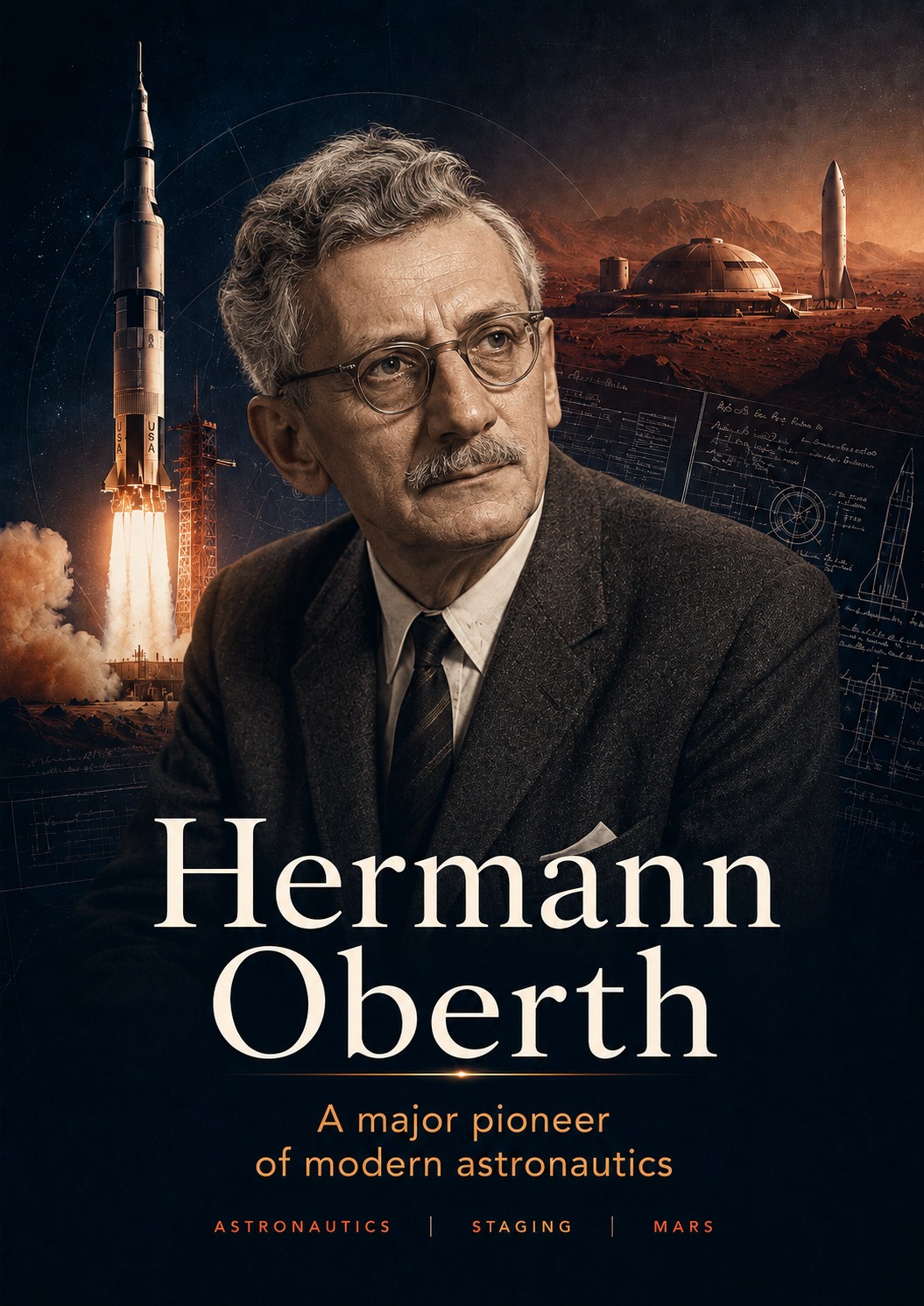
From rocket societies to von Braun — Turning a marginal idea into a technical community
Oberth and von Braun: influence followed by technical continuity. Von Braun explicitly identified Oberth as a major intellectual influence and worked near him when young. Decades later their paths crossed again in the United States. The continuity gives a concrete picture of knowledge transmission: a theoretical book shapes a student who later leads a massive launch-vehicle program.
For Space Academy this is an ideal pedagogical chain. An equation explained correctly today can become a design skill tomorrow, provided the learner can connect symbols to physical phenomena and real machines.
When a rejected dissertation becomes a technical programme: learning to prove spaceflight. Hermann Oberth's career is an almost perfect illustration of an idea moving from apparent impossibility into engineering. During the First World War he was already developing concepts for a liquid-propellant rocket. In 1922 Heidelberg University rejected his dissertation on spaceflight. Rather than abandon the subject, he published Die Rakete zu den Planetenräumen the following year, treating mathematically the possibility of achieving velocities sufficient to escape Earth.
That shift was essential. Oberth was not trying to persuade through imagination alone; he wanted space travel to become calculable in terms of mass, velocity, staging, efficiency and trajectories. His work influenced a generation of enthusiasts who began to build and test. In 1931 he obtained a Romanian patent for a liquid-propellant rocket and took part in experiments; among the younger people shaped by his work was Wernher von Braun.
His legacy is historically complex. Oberth's and von Braun's paths later intersected German military programmes and, after the war, American work. A serious biography should therefore not turn the theoretical pioneer into a context-free hero. For Mars, his durable contribution lies elsewhere: he helped move astronautics from speculation into problems that could be calculated. A modern interplanetary architecture still rests on that requirement — quantitatively demonstrating that trajectory, propellant mass, propulsion and systems can actually close.
Direct influence on the rocket community. German rocket societies in the 1920s and 1930s brought together people who would later become important in launch-vehicle development. Oberth served as an intellectual reference point.
This does not mean all astronautics descends from one man. Tsiolkovsky, Goddard and others worked independently or in other contexts. The history is a network of converging ideas.
How Oberth turned a rejected idea into an experimental community. Oberth matters not simply because he wrote a famous book. His importance lies in the chain he triggered: make spaceflight calculable, persuade a community that liquid propulsion was worth testing, then work close enough to young experimenters for equations to become engines. His 1923 book treated human spaceflight as an engineering problem and helped create a wave of German-speaking interest in rocketry.
1930: proving a theory with a tiny engine. In Berlin, Oberth's conical Kegeldüse was officially tested for roughly ninety seconds on liquid oxygen and gasoline, producing about seven kilograms of thrust. Eighteen-year-old Wernher von Braun was one of the assistants. The number is tiny compared with later missiles, but the test mattered because it transformed a theoretical claim into a measurable combustion system.
A mentor creates a technical culture, not a clone of himself. The VfR and Raketenflugplatz brought together theory, improvised fabrication, public demonstrations and repeated test work. Oberth's enduring contribution was therefore partly educational: he helped create a language in which a generation could discuss mass, propellants and performance as engineering quantities rather than as science-fiction decoration.
Sources: Smithsonian Pioneers of Flight; Smithsonian Kegeldüse.
Oberth's influence spread through German rocket societies and popular culture. His involvement with the film Frau im Mond helped make spaceflight visible beyond specialist circles. He also worked on engines and received a Romanian patent for a liquid-propellant rocket in 1931. A rocket associated with his work was launched near Berlin that year. Source
This period shows how a technical field forms before national budgets dominate it: books, lectures, clubs, small test stands and assistants create a community. Among the younger people influenced by and working with Oberth was Wernher von Braun. Oberth's importance therefore lies partly in creating an environment in which other engineers could continue the problem at larger scale.
After 1945 — Lasting influence in a completely transformed political and industrial context
From equation to technical community: the career of a man who made the problem shareable. Oberth matters less because of one machine than because he helped turn a marginal subject into a technical problem that others could continue. His publications supplied equations, assumptions, and architectures; rocket societies then provided a place where readers became experimenters. The small engines, tests, and collaborations of the period did not yet constitute a space program, but they changed the nature of the debate. Thrust could be measured, cooling discussed, mass calculated, and a result compared with a prediction. The presence of younger engineers such as von Braun around this community shows how a scientific career can also produce intellectual descendants. For Mars, Oberth’s legacy is therefore not a ready-made roadmap. It is a culture in which interplanetary travel gradually stops being a literary image and becomes a collection of divisible, calculable, testable problems. [source]
The rejected dissertation and the publication of Die Rakete zu den Planetenräumen belong together because they show how Oberth reacted when an established institution did not yet have a place for the subject he wanted to formalize. He did not resolve that mismatch by abandoning the problem. He reframed the work for a wider technical audience, turning equations, staging ideas and spaceflight arguments into a text that could circulate beyond a university committee. That transition from rejected academic work to a public technical program is a major part of his influence. [source]
Oberth’s later importance is also organizational. Rocket societies, demonstrations and his relationship with a younger generation including Wernher von Braun helped convert isolated calculations into a technical community. After the Second World War the political and industrial setting changed completely, but the earlier intellectual bridge remained: spaceflight had become something engineers could discuss through mass, velocity, propulsion and staging rather than through literary speculation alone. ESA and NASA material linked in the bibliography support that long arc. ESA · NASA historical image/context.
Supplementary documentary analysis
Biographical analysis, context and legacy
Thematic analysis and deeper reading
Essential timeline
- Born in Hermannstadt, Transylvania, then part of Austria-Hungary.
- Studies and develops theoretical work on rockets.
- Publishes Die Rakete zu den Planetenräumen.
- Works around rocket demonstrations and the film Frau im Mond; influences young enthusiasts including von Braun.
- Receives a Romanian patent for a liquid-propellant rocket and conducts experimental work.
- Continues astronautics-related work and later spends time in the United States with von Braun’s circle.
- Dies in Nuremberg.
Stations, telescopes and travel beyond Earth
Oberth also imagined orbital stations and observatories above the atmosphere. Some of these ideas now sound familiar precisely because several eventually became real categories of space systems.
For Mars, his main lesson is methodological: a vision becomes engineering when we ask what velocities, masses, stages, trajectories and functions are actually required.
Deep reading: what this trajectory teaches
1894–1914: Transylvania, a German-speaking family, and the conversion of fiction into mechanics
Hermann Julius Oberth was born in 1894 in Hermannstadt, today Sibiu in Romania, then part of the Austro-Hungarian Empire. He belonged to the German-speaking Transylvanian community, which makes his nationality and identity more complex than the simplified label “German scientist” suggests. Smithsonian archival material notes that he was a Transylvanian German and later obtained German citizenship in 1941. His professional life consequently crossed Romania, Germany and eventually the United States. Smithsonian — Hermann Oberth Collection National Air and Space Museum
Like Tsiolkovsky and later von Braun, Oberth was deeply affected by speculative literature. A journey to the Moon did not appear in an engineering curriculum because no such curriculum existed. Fiction provided a mental laboratory. Oberth’s decisive move was to ask what velocity, mass and energy would actually be required. A cultural fascination was converted into a quantitative problem. Smithsonian
That distinction explains his historical importance. Oberth was not the first person to derive every rocket relationship and he did not make the first liquid-propellant flight. His major contribution was to organize theoretical astronautics in a form rigorous and readable enough for a generation of students and enthusiasts to adopt it. He became a bridge from isolated calculation to technical community. NASA — Realizing the Dream of Flight
1914–1918: world war, medical studies and early long-range rocket ideas
The First World War interrupted Oberth’s studies and transformed the world in which he would work. He entered medical studies and served in the Austro-Hungarian context, a path that seems remote from astronautics. Yet ESA records that during the war he drew up a concept for a long-range liquid-propellant rocket. The German War Ministry rejected it as fantasy. The episode shows how quickly modern rocketry appeared at the boundary between exploration and military application. ESA
The rejection does not necessarily prove bureaucratic blindness. In the late 1910s no practical large liquid engine, reliable turbopump, precision guidance system or industrial production chain could turn the proposal into an operational weapon. An idea could be physically possible and technologically immature at the same time. That distinction would recur throughout the history of spaceflight. ESA
Oberth gradually understood that space propulsion required a discipline that did not yet exist. He moved toward mathematics, physics and engineering. The personal change was decisive: instead of treating medicine as his only profession, he spent more and more of his life making interplanetary travel calculable. Smithsonian Archives
1919–1922: universities and a dissertation that did not fit existing academic categories
After the war Oberth resumed studies at several German-speaking universities and prepared a dissertation on rockets and space travel. ESA notes that the dissertation was rejected in 1922. Accounts differ in some details of the academic path, but the essential point is clear: astronautics still sat at the edge of respectable university science. No established laboratory, industry or professional community existed to make interplanetary rocket research an ordinary doctoral subject. ESA Deutsche Biographie
The rejection is useful for understanding how disciplines form. Universities evaluate not only the internal mathematics of a thesis but also whether the question belongs to an accepted field. How should a faculty judge engineering for a machine that no laboratory can yet build? Oberth’s subject crossed the boundary between theoretical physics, speculative engineering and science fiction. NASA
His response was publication rather than abandonment. A rejected dissertation became the basis of a book with a much larger potential readership. That decision altered the historical impact. A thesis might have remained obscure; a book circulated among students, engineers and enthusiasts and helped create a community that did not previously exist. Smithsonian
1923: Die Rakete zu den Planetenräumen and the birth of a technical public for spaceflight
In 1923 Oberth published Die Rakete zu den Planetenräumen, commonly translated as The Rocket into Interplanetary Space. Smithsonian material emphasizes that the book discussed the feasibility of human spaceflight, laid out basic rocket relationships and described the performance advantages of liquid propellants over traditional powder rockets. It appeared at a moment when aviation, radio and mechanical technology were advancing rapidly and young readers were prepared to imagine spaceflight as an engineering career rather than fantasy. National Air and Space Museum
Oberth’s strength was the combination of mathematical seriousness and communicability. Tsiolkovsky had already developed fundamental ideas in Russian, while Goddard was pursuing patents and experiments in the United States. Oberth supplied the German-speaking world with a synthesis that made astronautics feel like a body of knowledge. NASA later described his work as an important stimulus to the German rocket movement. NASA — Realizing the Dream of Flight
The book therefore functioned as social infrastructure. It did not merely contain calculations; it created readers who could recognize one another as participants in a common project. Wernher von Braun became the most famous example. The young student was so affected by Oberth’s work that he applied himself seriously to the mathematics needed to understand rocketry. A chain of intellectual transmission had begun. NASA — Wernher von Braun
What the book actually contributed: liquid propulsion, performance and mission coherence
Oberth did not merely declare space travel possible. He analyzed the conditions required for a rocket to achieve useful speed, considered liquid propulsion and connected the engine to a mission. That shift was fundamental. A powerful motor is not automatically a useful space system. Vehicle mass, exhaust velocity, burn duration and trajectory have to be analyzed together. Astronautics begins when propulsion and celestial mechanics become one design problem. Smithsonian
Liquid propellants were a particularly bold choice in the 1920s. They offered higher performance and potentially greater control, but demanded tanks, valves, injection, ignition and cooling. Oberth understood that the future could not simply be an enlarged version of traditional gunpowder rockets. A new engine family was necessary. ESA
The same logic applies to Mars. An interplanetary architecture is not a powerful engine added to a comfortable habitat. It must close a mass, energy and trajectory budget. Oberth contributed to the intellectual transformation in which spaceflight became a sequence of functions that could be calculated instead of a single spectacular act. NASA
1929: Wege zur Raumschiffahrt and the expansion from rocket to space infrastructure
Oberth expanded his work substantially during the 1920s. By 1929 his writing reached beyond launch vehicles toward stations, observation and broader applications of spaceflight. NASA’s documentation of early station concepts identifies Oberth’s work as one of the first serious scientific proposals for a permanent crewed orbital station, periodically supplied by smaller rockets and potentially rotated to create artificial gravity. NASA — Early Space Station Activities
This extension transformed astronautics into infrastructure design. A station could serve as an observatory, communications node, refueling point or departure base. The rocket ceased to be the destination and became the transport system used to build something persistent. The idea converged with themes also found in Tsiolkovsky’s work while taking a distinctive form in the German technical culture of the 1920s. NASA
The Mars implication is large. A civilization cannot depend forever on complete mission stacks launched from Earth for every journey. It will develop depots, transfer habitats, communications infrastructure and perhaps orbital construction. Oberth helped place this networked way of thinking into astronautical literature very early. NASA — Origins of 21st-Century Space Travel
The Oberth station: artificial gravity, observation, communications and resupply
One of Oberth’s most modern ideas was the permanent orbital station. NASA notes that he described an outpost supplied periodically by smaller rockets. This was already a logistics concept. The expensive structure did not need to be relaunched for every expedition; infrastructure could remain while transport vehicles cycled around it. NASA
He also considered rotation as a way to produce artificial gravity. In modern notation the basic centripetal relationship can be written a = ω²r, where a is acceleration, ω angular velocity and r radius. For a chosen acceleration, designers can trade a larger radius for a lower rotation rate. A compact rotating habitat needs faster rotation and may create stronger vestibular effects. The idea therefore leads immediately to systems tradeoffs rather than a simple visual trick. NASA
Oberth further associated stations with Earth observation, weather and communications. These applications foreshadowed entire satellite industries. He could not foresee digital electronics in detail, yet he recognized that an orbital location itself creates scientific and economic value. NASA
1927: the Verein für Raumschiffahrt and the conversion of a book into a movement
The Verein für Raumschiffahrt, or VfR, was founded in 1927 by figures including Johannes Winkler and other spaceflight enthusiasts. Oberth became one of its leading personalities and served in senior roles. The National Air and Space Museum describes the late 1920s and early 1930s as a period when rocket societies flourished in Germany, the Soviet Union and the United States. National Air and Space Museum Deutsche Biographie
The VfR was not an industrial company. Its members were students, engineers, writers and enthusiasts. They read, published, sought funding and built experimental hardware with limited means. Yet the organization mattered because it enabled specialization. One person could focus on combustion while another worked on structures, operations or public outreach. A technical field was beginning to exist socially. Smithsonian
NASA notes that by the end of the 1920s the society had grown substantially and that Oberth’s ideas directly stimulated von Braun. The future Saturn leader therefore emerged from an ecosystem created by books, clubs and experimentation. Social genealogy matters alongside the genealogy of equations. NASA
Max Valier, Willy Ley and the people who made astronautics contagious
Oberth’s influence depended on people who could translate technical work into public enthusiasm. Max Valier promoted rockets and helped build the early movement. Willy Ley became a major science writer and advocate. Smithsonian material identifies Ley as an ally and champion of Oberth’s work. Smithsonian Pioneers of Flight Smithsonian
Popularization was not a decorative activity. A radical technology must recruit talent before an established labor market exists. Books, lectures and films created a pool of people willing to learn mathematics and engineering because they wanted to participate in the future being described. Von Braun is one example, but the effect was collective. Public narrative therefore became part of future industrial capability. NASA
The parallel with Mars is clear. Institutions and companies use images, talks and ambitious roadmaps to attract engineers and capital. Public communication can exaggerate, but it can also produce the skills that make some ambitions more realistic years later. Oberth’s career shows how imagination becomes productive when connected to calculation and experiment. NASA
1928–1929: Frau im Mond, Fritz Lang and the rocket’s entry into mass culture
Filmmaker Fritz Lang prepared Frau im Mond, or Woman in the Moon, and sought technical advisers who could lend scientific credibility to the story. Oberth and Willy Ley contributed. Smithsonian documentation confirms their consultancy. The film staged a dramatic lunar mission and presented rocket flight to an audience far larger than the readership of technical books. Smithsonian — Woman in the Moon
Cinema became an accelerator of technical culture. The film necessarily simplified reality, yet it provided imagery through which future engineers could imagine their profession. The boundary between science and spectacle was ambiguous but powerful. A field without established laboratories gained public symbols. Smithsonian
Oberth wanted to go beyond advising the film and attempted to develop a rocket demonstration associated with the publicity. Technical and financial difficulties prevented the original ambition from succeeding as planned. The failure was revealing: writing a correct theoretical book did not automatically create an organization capable of producing an operational vehicle. Theory and hardware remained separated by engineering practice. Deutsche Biographie
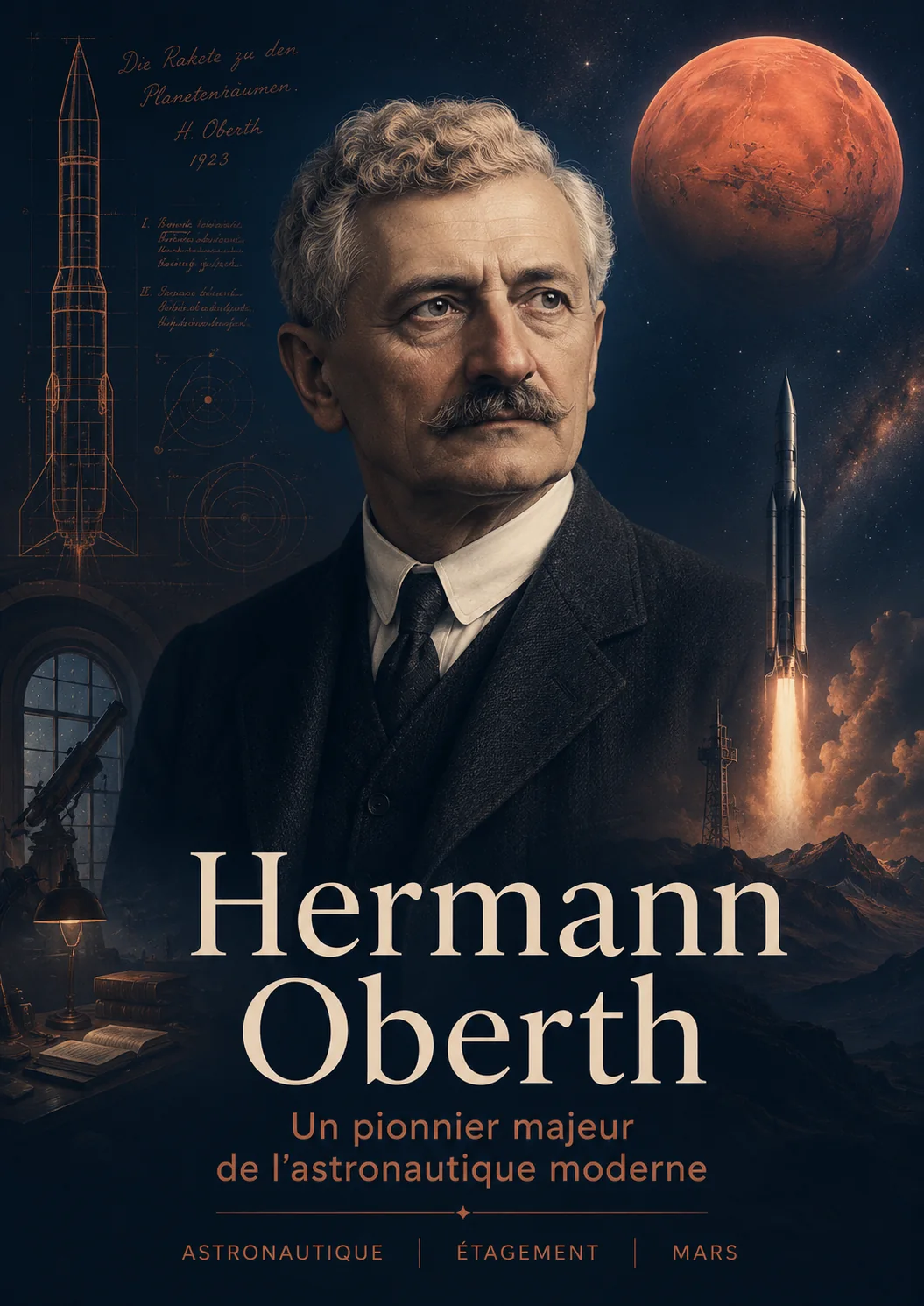
1930: the Kegeldüse and the transition from equations to a certified liquid-engine test
The film-related effort led Oberth and assistants into liquid-propellant engine testing. Wernher von Braun, Klaus Riedel and Rudolf Nebel became part of this experimental environment. NASA describes a crude and dangerous ignition arrangement, but a 1930 combustion-chamber test using gasoline and liquid oxygen produced stable thrust for roughly ninety seconds and was witnessed or certified by a technical authority. NASA Science — von Braun Deutsche Biographie
The test mattered because it showed that Oberth was not exclusively a theorist. The engine was modest, but it closed an experimental loop: calculation, design, fabrication, combustion and measurement. The conical nozzle became a physical demonstration that liquid rocketry deserved serious investigation. NASA — Evolution of Rockets
Success did not guarantee durable funding. Oberth returned to teaching while Nebel and others continued experiments. The community he had helped create was becoming partly independent of him. That is a sign of intellectual maturity: the field could survive the movement of one individual. Smithsonian
Raketenflugplatz Berlin: when enthusiasts built a collective laboratory
Beginning around 1930 members of the VfR used the Raketenflugplatz at Berlin-Reinickendorf to test liquid engines and small rockets. Smithsonian accounts describe the site as an important center for early rocket-society activity before military authorities eventually absorbed or suppressed independent work. It occupied a middle ground between amateur workshop and government range. Smithsonian — Early Rocket Societies
Participants learned skills that no book could supply completely: propellant handling, instrumentation, ignition, chamber fabrication, recovery and division of labor. Progress was uneven, but experimental culture spread. Several people who later became significant engineers encountered practical rocket work in this environment. Smithsonian Rolf Engel Collection
That history shows why communities matter. A theory can inspire; a test site creates practitioners. Mars settlement will require a similar transition. Large numbers of people must acquire real operational skill with life-support, power, repair and logistics long before permanent off-world infrastructure becomes routine. Smithsonian
Oberth and Wernher von Braun: mentor, student and two very different routes to spaceflight
The relationship with Wernher von Braun is one of the central threads of Oberth’s biography. Von Braun encountered Oberth’s writing as a young student and applied himself to mathematics in order to understand the physics. He joined the VfR, met Oberth and helped with early engine tests. NASA explicitly credits Oberth’s 1923 work as a major influence that pushed von Braun toward serious rocket study. NASA — Wernher von Braun
Their paths then diverged. Oberth remained primarily a theorist, teacher and consultant. Von Braun accepted the German Army’s offer, acquired substantial resources and eventually led large organizations. The contrast demonstrates two forms of influence. Oberth spread an idea and created community; von Braun converted related ambitions into industrial programs, within a military and political system whose history includes grave crimes. NASA
Calling Oberth von Braun’s mentor does not mean that Oberth directed Peenemünde or authored every V-2 design choice. The influence was formative and intellectual. The student would vastly surpass the mentor in organizational responsibility, while the mentor retained a foundational place in astronautical culture. Smithsonian
1932: the German Army enters the field and changes the scale of rocketry
By the early 1930s the German Army had become interested in rockets as possible military systems. Officers observed the VfR experimenters and offered von Braun access to a more structured program at Kummersdorf. NASA histories show how decisive this transition was. Rocketry moved from clubs toward an organization with money, test sites and command authority. NASA — Realizing the Dream of Flight
Oberth was not the principal architect of this militarization, but knowledge and human talent generated by the culture he helped create became available to the state. A community built around space travel could therefore see its skills redirected toward very different purposes. Technology does not automatically preserve the moral goal of its original promoters. Smithsonian
The VfR story is thus a warning about dual-use technology. Engines designed in the language of spaceflight and ballistic missiles share physical principles. A complete Oberth biography must connect the enthusiasm of late-1920s rocket clubs with the political reality that followed, without assigning one theorist responsibility for an entire military apparatus he did not command. NASA
The 1930s: teaching, scattered technical work and a continent moving toward militarization
After the Berlin experiments Oberth returned to teaching and other work, including periods in Romania. His career was not a continuous climb toward one great laboratory. It alternated between public prominence, consultation, teaching and technical projects. The discontinuity contrasts with the rapid expansion of the Army rocket program under von Braun and his colleagues. Deutsche Biographie
This difference demonstrates that a pioneer’s influence may become stronger in other people’s institutions than in his own hardware. Engineers who had read Oberth and passed through the VfR now had access to larger test programs. The author of the 1923 book no longer needed to be physically present at every experiment for his intellectual legacy to continue. Smithsonian Archives
European politics were also changing rapidly. Rearmament and authoritarian government absorbed more scientific capacity. The romantic astronautics of clubs was increasingly transformed into strategic technology. That political rupture forms the necessary background for Oberth’s later work and cannot be separated from the technical narrative. NASA History
The Second World War: participation in the German rocket ecosystem and historical responsibility
Institutional sources indicate that Oberth again worked in the German rocket environment during the Second World War. ESA summarizes his renewed work with von Braun in connection with V-2 development. A detailed biography must describe this period precisely, without turning Oberth into the leader of Peenemünde and without pretending that a technology used by the Nazi state existed outside politics. ESA
The V-2 program was part of warfare and its production became associated with forced labor under murderous conditions. Individual responsibilities varied sharply according to position, place and decision-making authority. Oberth’s role was not identical to those of von Braun, Dornberger or managers of the production system, but his presence in the technical ecosystem prevents a clean separation between “space dream” and wartime reality. NASA History
Historical method therefore requires categories: documented fact, technical function, institutional authority and moral responsibility. Saying that Oberth simply “created the V-2” would be false; erasing all connection would also be misleading. The important story is how knowledge promoted for space travel became partly incorporated into a weapons system and later fed postwar American and Soviet programs. ESA
1945–1955: a new world in which states finally possessed the resources early pioneers had lacked
After 1945 the scale of rocket development changed completely. The United States and Soviet Union captured German hardware, documents and personnel. Ballistic missiles became strategic priorities. Oberth, who had written about rockets when the field was marginal, now watched governments create budgets, ranges and organizations far beyond anything the VfR could imagine. NASA — Origins of 21st-Century Space Travel
The transformation created a paradox. Space pioneers had long wanted resources for exploration; the resources arrived first because missiles had military value. Institutional spaceflight grew partly from the convergence of interplanetary imagination and geopolitical competition. Oberth belonged to the generation that experienced both the amateur club and the missile age. NASA
Later satellites and crewed missions demonstrated that strategic infrastructure could support scientific and symbolic goals. Yet the dual-use origin never disappeared. Oberth’s biography is therefore also an account of how states choose which applications of technology deserve scale. NASA
1955–1958: Huntsville and the mentor’s place inside American missile industrialization
In the mid-1950s von Braun brought Oberth to the United States to work in the Army Ballistic Missile Agency environment at Huntsville, Alabama. Smithsonian archives preserve material from this period and NASA imagery shows Oberth with von Braun and other officials. At more than sixty years old, he entered an organization representing the industrialized form of a discipline he had helped theorize decades earlier. Smithsonian Oberth Collection NASA — Oberth and von Braun
His role was no longer that of principal designer. American missile programs had specialized engineers, computing resources, factories and management systems. Oberth worked more as a consultant and intellectual elder. The change was natural: the field had become too large to depend on one pioneer. NASA
The historical scene nevertheless has great symbolic force. The student who once struggled through Oberth’s equations now led an organization capable of building missiles and soon space launchers. The mentor saw his intellectual influence transformed into institutions that had developed far beyond his own working methods. NASA — Wernher von Braun
Sputnik, Explorer and the Space Race: a generation’s hypothesis becomes national policy
Sputnik in 1957 publicly validated the central proposition defended by Tsiolkovsky, Goddard and Oberth: an artificial machine could be sent beyond the atmosphere and remain in orbit. Explorer 1 followed on the American side. For Oberth the change must have been extraordinary. A subject rejected as unsuitable for a dissertation had become a strategic priority of superpowers. NASA
The Space Race also transformed public culture. In the 1920s rocket societies had to persuade people that spaceflight was not a joke. By the 1960s governments broadcast launches and invested heavily in infrastructure. The imagery that Oberth, Ley and others helped popularize became part of national politics. NASA History
The transition shows how ideas can survive long enough to be realized in a radically different context. Oberth’s interplanetary rocket was not Saturn V, but his work helped create a generation for whom Saturn V became thinkable. NASA
From theoretical station to Salyut, Skylab, Mir and the ISS
Oberth’s orbital-station concepts became more meaningful after the 1970s. Salyut and Skylab demonstrated that crews could live in orbit for extended periods. Mir lengthened operational experience and the International Space Station turned permanent human presence into a multinational routine. The real stations differed greatly from 1920s concepts, but they validated the category: space can be a place of residence rather than only a path. NASA — Early Space Station Activities
Artificial gravity by rotation was not adopted on these stations, largely because structural complexity and microgravity research objectives favored nonrotating designs. That outcome is instructive. An idea can remain physically valid without becoming the preferred architecture. Cost, risk and mission priorities determine whether a concept is selected. NASA
Long-duration Mars travel may return the question to the foreground. If partial gravity materially reduces medical risk, rotating habitats could become attractive. Oberth did not solve the design, but he helped place the problem in astronautical thought. NASA
Romanian context, Transylvanian German identity and later German citizenship
Oberth’s nationality is frequently summarized inconsistently. He was born in Transylvania when it belonged to Austria-Hungary, within a German-speaking community. The region became part of Romania after the First World War. He taught and worked in Romania and Germany, and Smithsonian archival material states that he received German citizenship in 1941. Simply calling him “German” without chronology erases a historically complex legal and cultural trajectory. Smithsonian
The complexity is typical of twentieth-century Central Europe, where borders and states changed around individuals. Scientific communities did not map neatly onto national borders. Oberth wrote in German, influenced German readers and worked across several states. His scientific identity was transnational even when later histories placed him inside national narratives. Deutsche Biographie
This is why biography metadata should never infer citizenship from language or workplace. It should follow documented legal and historical changes. Oberth is an unusually clear example of the value of that discipline. Smithsonian
Honoring a pioneer without hagiography: writing Oberth after the history of the V-2
Oberth deserves a major place in astronautical history because his books, teaching and role in rocket societies deeply influenced European rocketry. That tribute cannot stop in 1930. The skills of his generation later entered German military programs, and networks formed around early space enthusiasm became part of weapons development. NASA
The objective is not to assign every crime of the Nazi state equally to every engineer who worked around rockets. Precision is the opposite of collective accusation. Who made decisions? Who supervised? What was known? Where did the person work? What authority did the role carry? Those questions prevent two opposite distortions: laundering all involvement through the language of space dreams or assigning identical responsibility to everyone in the technical chain. ESA
A hundred-thousand-word open biography is exactly the format in which this precision becomes possible. Readers can admire the intellectual power of The Rocket into Interplanetary Space while also understanding that European rocket history passed through extreme violence. Mature history keeps both truths visible. NASA History
Oberth and Mars: from the interplanetary rocket to permanent infrastructure
Oberth’s Mars relevance begins with the category change he imposed on space travel. Reaching another planet ceased to be only an imagined voyage and became a problem of velocity, mass and life support. His books helped convince a generation that planets were physical destinations accessible to machines if engineering constraints could be solved. Smithsonian
His station concepts added a second layer. An interplanetary civilization would require persistent infrastructure: depots, orbital habitats, observatories, transfer stations or construction facilities. Such architecture remains debated today, but long-term scenarios repeatedly rediscover the value of infrastructure that does not begin every mission from Earth’s surface. NASA
The mentor relationship with von Braun also connects Oberth indirectly to later twentieth-century Mars planning. Von Braun developed his own large Mars architectures after the war. Those designs were not Oberth’s work, yet the intellectual lineage demonstrates how a book published in 1923 could influence thinking decades later. NASA
The deepest legacy: building a community that could turn equations into institutions
Oberth can be read as theorist, limited experimenter and public advocate. His deepest legacy combines all three. He produced writing serious enough to be studied, accessible enough to spread and concrete enough to encourage hardware tests. That mixture turned astronautics from a private interest into collective activity. NASA
A technical community often precedes an industry. People need shared vocabulary, reference texts and common problems before firms or agencies can recruit specialists. The VfR performed that function. Members learned together, criticized designs, built hardware and attracted stronger institutions. Oberth therefore acted as an intellectual multiplier whose influence extended far beyond components he personally built. Smithsonian
The lesson applies directly to Mars settlement. Hardware alone is insufficient. A community must understand, maintain, criticize and teach the systems. Building that culture can begin decades before permanent settlement, just as the VfR culture preceded mature rocket programs. NASA
Later decades: recognition and the role of a living patriarch of astronautics
In later life Oberth remained a prominent figure in the space community, receiving recognition and being grouped with Tsiolkovsky and Goddard among the founders of astronautics. His status had reversed completely. He was no longer the author whose dissertation topic was dismissed, but a living witness to a technological revolution. Smithsonian Archives
His longevity gave him an experience unavailable to Goddard or Tsiolkovsky. He lived to see humans walk on the Moon, orbital stations operate and robotic spacecraft explore multiple planets. He could watch central propositions of his youth become infrastructure. ESA records his death in 1989, near the end of the Cold War space era. ESA
Later interests and opinions sometimes moved beyond the strongest scientific parts of his legacy. A comprehensive biography should document them with appropriate sourcing without giving speculation the same epistemic weight as his verified contributions to rocketry and station theory. The hierarchy remains important: science, opinion and speculation are different categories. Smithsonian

1989: the death of a man whose rejected topic had become a global industry
Hermann Oberth died on 29 December 1989. The historical contrast is striking. Sixty-seven years earlier a university had rejected work centered on interplanetary rockets. By 1989 hundreds of satellites orbited Earth, humans had walked on the Moon, robotic spacecraft had visited the outer planets and orbital stations had supported long missions. The marginal subject had become a strategic and scientific sector. ESA
This does not mean the academic institution was wrong about every technical detail in the original dissertation. It means that the value of a question can be underestimated when no infrastructure yet exists to study it. Entire disciplines sometimes begin at the edge of academic legitimacy before becoming central. Smithsonian
Oberth’s legacy is therefore visible as much in people as in books. He helped create a chain in which reading led to calculation, calculation to clubs, clubs to engine tests, and engine culture eventually to industrial and governmental programs. That chain is one of the defining technological stories of the twentieth century. NASA
What Oberth got right, what changed, and why his method still matters
Oberth correctly identified several foundational categories: liquid propellants offered a path to high performance, human spaceflight was physically possible, orbital stations could have scientific and logistical value, and infrastructure in space could support later voyages. Those successes do not imply that every dimension or scenario in his books was correct. Materials, data and physiological knowledge changed dramatically. NASA
His value lies less in perfect prophecy than in formulating a work program. He decomposed the space dream into questions that could be calculated or tested. The same method remains useful for Mars proposals: what propulsion performance is required, what mass must move, how is a crew supported, what can be resupplied, what risks dominate and which assumptions are actually demonstrated? NASA
A long biography should preserve that hierarchy. Verifiable science comes first, historical and cultural projections second, and speculation is labeled as speculation. Oberth then becomes more interesting than a prophet. He becomes one of the people who taught a technical public to turn a vision into an engineering problem. Smithsonian
Why Oberth can sustain a true deep documentary open biography
Oberth sits at the intersection of histories often told separately: Transylvanian and Romanian science, German-language technical culture, speculative literature, amateur rocket societies, early European liquid propulsion, Fritz Lang’s cinema, von Braun’s formation, German militarization, postwar transfer and the emergence of the Space Race. Each dimension can be expanded with real documentation rather than filler because it has its own actors, sources and consequences. Smithsonian Archives
Reaching one hundred thousand words should never become a mechanical target. Length matters only when it allows more documentation: correspondence, successive editions, detailed VfR history, biographies of collaborators, Romanian context, funding, individual career paths after 1933 and international reception. The page should behave like a book in which every chapter opens another layer of understanding. Deutsche Biographie
That ambition fits Oberth’s own legacy. Much of his influence came from making astronautics interesting enough that readers returned, learned and joined a community. A free, deeply sourced online biography can reproduce that mechanism today: curiosity becomes sustained study, and sustained study can become competence. Smithsonian
1931: a Romanian patent and early launches as theory searched for a stable vehicle
ESA records that Oberth obtained a Romanian patent for a liquid-propellant rocket in 1931 and associates him with an early launch near Berlin on 7 May. These milestones show a career unwilling to remain purely literary. After the book and the static engine, Oberth sought an autonomous vehicle. Results were far below the military systems that would appear later, but the progression of evidence mattered: calculation, engine and flight hardware. ESA
The patent also exposes the transnational character of his work. A German-speaking scientist born in Austria-Hungary, living between Romania and Germany, protected an invention in a Romanian legal context while participating in Berlin experiments. European astronautics does not fit the neat national stories written later. People, books and patents crossed borders more easily than institutions. Smithsonian Archives
Early launches further demonstrated that stable flight is harder than stationary combustion. A chamber can produce thrust on a stand while the full vehicle fails through guidance, structure, center-of-gravity or feed-system problems. VfR experimenters learned that difference by doing. A propulsion technology becomes a flight technology only when it can leave the test stand. NASA — Evolution of Rockets
Book reception: why a treatise can be more historically powerful than a prototype
Technology history often privileges hardware: engine, rocket, satellite. In Oberth’s case a book produced an effect comparable to a prototype. The Rocket into Interplanetary Space offered readers intellectual evidence that spaceflight deserved study. It supplied equations, orders of magnitude and vocabulary. One experimental motor might convince a handful of witnesses; a book could recruit hundreds of future engineers. Smithsonian
This diffusion explains why Oberth’s influence is disproportionate to the number of major vehicles he personally built. He acted as a multiplier. Willy Ley popularized the ideas, Max Valier carried them into public campaigning and von Braun used them as a mathematical entry point. The book became a network node rather than merely a publication. NASA
The parallel with an open Mars library is direct. A hundred-thousand-word page has value only if it helps readers understand a problem deeply enough to join a community or evaluate a project. The objective is not length for its own sake but the possibility of changing a student’s trajectory in the way Oberth changed von Braun’s. NASA — Wernher von Braun
Artificial-gravity calculation: what it actually means to rotate a station
Oberth proposed rotating a station to create artificial gravity. The basic centripetal relationship is a = ω²r, where a is acceleration in m/s², ω angular velocity in radians per second and r radius in meters. To produce approximately 9.81 m/s² with a radius of 100 meters, ω = √(9.81/100) ≈ 0.313 rad/s. Multiplying by 60 and dividing by 2π gives roughly 2.99 revolutions per minute. NASA — Early Space Station Activities
At a radius of only 25 meters, the same acceleration requires ω = √(9.81/25) ≈ 0.626 rad/s, almost 5.98 rpm. The structure is smaller but the crew experiences faster rotation and stronger head-to-foot acceleration gradients. Oberth’s apparently simple idea therefore creates a real architectural trade: radius, structural mass, rotation rate and human comfort interact. NASA
A Mars transit vehicle might target partial gravity rather than 1 g. For about 0.38 g, near Martian surface gravity, required acceleration is roughly 3.73 m/s². At the same radius, rotation can be slower. Whether such partial gravity provides sufficient medical benefit remains an experimental question, but the mathematics shows why a century-old Oberth concept still appears in long-duration spacecraft studies. NASA
Oberth and Goddard: correspondence, competition and opposite cultures of innovation
Smithsonian material notes that Goddard corresponded with Oberth but viewed the European pioneer with suspicion as a competitor. The relationship is revealing. Both men worked on related problems, yet developed very different research cultures. Goddard guarded patents and experimental detail; Oberth published broadly and participated in public rocket organizations. Smithsonian Pioneers of Flight
Goddard’s strategy favored personal technical control and intellectual-property protection. Oberth’s favored circulation and informal school-building. Neither was perfect. Goddard achieved the first liquid-propellant flight but sometimes limited direct dissemination of his methods. Oberth built fewer revolutionary vehicles but inspired a generation able to continue without him. NASA History
Later space programs combined both cultures: secrecy around some systems and open scientific training around others. A future Mars economy will face the same boundary. Companies may protect processes while common safety standards and fundamental knowledge need to circulate. Oberth and Goddard offer historical examples of the costs of both extremes. Smithsonian Archives
Oberth and Tsiolkovsky: independent work, priority questions and convergence under the same physics
Tsiolkovsky published fundamental results before Oberth, but Russian-language work circulated only weakly in Western Europe while the young Transylvanian developed his own ideas. The historical result was substantial independent invention. NASA and museums regularly group Tsiolkovsky, Goddard and Oberth among the great pioneers because they converged on the rocket as the solution to spaceflight in different environments. Smithsonian
The convergence is scientifically meaningful. The three could differ on specific architectures and working methods, yet high exhaust velocity and liquid propulsion repeatedly appeared because they followed from mechanics and energy. Physical law strongly constrains the space of viable solutions. NASA
For the reader, the comparison discourages obsession with a single “inventor of the rocket.” Modern astronautics grew from several lineages that later intersected in societies, armies and agencies. The more useful question is which ideas were calculated, demonstrated, diffused and industrialized, and through what networks. NASA Origins
The teacher behind the pioneer: earning a living when no astronautics chair existed
Oberth spent significant parts of his career teaching, including in Romania. The reality parallels Tsiolkovsky’s life. The discipline they wanted to practice did not yet provide a stable labor market. Teaching mathematics or science financed private research and kept them close to fundamentals. Deutsche Biographie
The profession also fits Oberth’s historical contribution. He knew how to explain. His books were not private notebooks; they attempted to persuade and guide readers. Pedagogy became a technology of diffusion. Von Braun did not merely receive an equation. He received a text compelling enough to make him learn the mathematics needed to understand it. NASA
A Mars settlement will need the same function as strongly as it needs designers. A colony cannot depend forever on specialists sent from Earth. It must train technicians, doctors, engineers and operators locally. Oberth’s history reminds us that transferring competence can be as structurally important as building a prototype. NASA
A Mars architecture in the Oberth spirit: think in networks rather than one giant rocket
Applying Oberth’s logic to Mars begins by separating vehicle from infrastructure. Earth launchers place mass in orbit. Depots can receive propellant. A transfer habitat can be reused. Communications relays maintain connectivity. A Mars-orbit node may connect surface vehicles and interplanetary transport. Each function can be optimized for its phase and linked to the others. NASA
This approach has a higher initial cost than a one-off expedition because assets have to be built before they generate repeated value. It becomes increasingly attractive when missions recur. Infrastructure amortizes mass and cost over multiple rotations. That is the difference between an expedition and a transportation system. Oberth’s early focus on permanent stations belongs to the second logic. NASA Origins
If Mars settlement occurs, repetition will be unavoidable. Crews, spares, vehicles and resources will circulate. Oberth’s station ideas do not provide a final blueprint, but they teach the appropriate unit of analysis: not “a rocket to Mars,” but a network of capabilities that continues operating after the first journey. NASA
What future passes still need to find in the Oberth archives
Despite this expansion, the open biography remains far from final documentary depth. Smithsonian collections list correspondence, photographs, articles and books connected with Oberth. Future work should mine those holdings more systematically, compare successive editions of his major books and reconstruct the chronology of his relationships with Valier, Ley, Nebel, Riedel and von Braun. Smithsonian Oberth Collection
The Romanian and Transylvanian context also deserves much more attention. Schools, universities, family history, local scientific networks and changing borders are often compressed into a few sentences in American rocket histories. Developing that material will give the biography human depth beyond the engine story. Deutsche Biographie
Finally, the 1933–1955 period needs more archival precision to separate jobs, movements and responsibilities during dictatorship and war. The objective is neither accusation nor exoneration, but traceability. A true biographical “Bible” is credible only when readers can see what documents establish and what remains uncertain. ESA
When popular culture becomes technical infrastructure: the case of Frau im Mond
Oberth’s participation in Fritz Lang’s Frau im Mond is often treated as a colorful anecdote. It matters more than that. In the late 1920s cinema gave astronautical ideas an audience no technical journal could match. The film presented a rocket, launch sequence and lunar journey with an unusual effort toward plausibility. Oberth acted as an adviser, and the project was even associated with an attempt to build a small promotional rocket. Smithsonian — Woman in the Moon
Three levels must nevertheless be separated. The first is the cinematic image, designed to tell a story. The second is scientific popularization, which simplifies in order to explain. The third is flight hardware, subject to tests, margins and constraints that do not forgive approximation. Oberth moved among these worlds, and that movement helped make the rocket culturally imaginable before it was an operational transport system.
The countdown associated with the film illustrates how culture and operations can interact. Even when a convention is born or popularized in a cultural setting, it can become operational language because it organizes collective attention around a synchronized event. Modern launch programs depend on shared languages of this kind: countdown sequences, go/no-go states, abort procedures and standardized communications. Culture is not simply the opposite of engineering; it can supply forms that engineering later formalizes.
Mars exploration shows the same process today. Artistic images of settlements influence what the public and decision-makers imagine possible. They can attract engineers, funding and political interest, but they can also hide less photogenic necessities such as waste processing, radiation shielding, maintenance and spare-parts inventories. Oberth’s career helps explain why a spacefaring civilization needs imagination while also learning not to confuse a mobilizing image with a system-definition document.
This tension is part of Oberth’s historical importance. Tsiolkovsky developed a powerful cosmic vision that circulated for years within a constrained linguistic and institutional environment. Goddard experimented in relative secrecy. Oberth helped make astronautics a public subject in the German-speaking world. His books, disciples, societies and work with film created an ecosystem in which spaceflight became an ambition that could be debated, criticized and eventually financed. Smithsonian — Early Rocket Societies
From club to institution: why the VfR could not industrialize rocketry by itself
The Verein für Raumschiffahrt — Society for Space Travel — demonstrates both the power and the limits of an enthusiast community. It brought together people able to read the same equations, build prototypes and persuade a growing public. Berlin’s Raketenflugplatz became an improvised laboratory where members learned by doing. Yet resources were limited, safety was imperfect and standardization weak. A society can reveal talent without possessing the industrial capacity required for a major launch vehicle. Smithsonian
The shift toward German military funding therefore changed the scale. Test stands, workshops, metallurgy, instrumentation, protected sites and specialized personnel became available. The problem is that institutional power is never neutral. The Army’s objectives were not those of a club dreaming about the Moon. Rocketry became a weapon technology, and technical organization expanded inside a regime that would lead Europe into war and commit mass crimes.
Oberth did not hold the same operational position as von Braun at Peenemünde, but his trajectory belongs to this historical transition. An idea may emerge in a civilian environment and then be captured by an institution with the resources to develop it for very different purposes. This is a general lesson in technology policy: money accelerates technology, but the source of money shapes mission, governance and ethical choices. NASA — Wernher von Braun
A future Mars infrastructure will face an analogous tension even outside military contexts. Private companies, national agencies, universities and international coalitions may pursue different goals. A transport provider may seek profitability; a science funder may prioritize protection of sites; a state may seek prestige or strategic autonomy. Material architecture will encode these priorities.
The VfR therefore matters not because it directly built the modern space program, but because it shows how a community turns theory into human skill. Young people who learn to calculate, machine, test and argue become available to larger institutions later. Human capital often precedes heavy infrastructure. On Mars, building a community of technicians able to maintain a settlement may prove as important as designing the first vehicle. Smithsonian — Pioneers of Flight
The book as a laboratory: when publication creates engineers before it creates a rocket
For Oberth, the book functioned almost as research infrastructure. Die Rakete zu den Planetenräumen and later Wege zur Raumschiffahrt offered readers not only a promise of space travel but arguments they could debate, correct and extend. In a field where large test stands did not yet exist, a well-constructed publication could synchronize dispersed people around the same problems. ESA
This helps explain why Oberth’s influence exceeds the hardware he personally flew. A young reader might never meet the author and still choose a field of study, join a society or propose an experiment because of a book. Technology therefore spreads through intellectual objects as well as machines. Equations, drawings and scenarios become reproducible equipment at tiny cost compared with a rocket.
The lesson applies directly to an open Martian library. A very long page has value only if readers can understand mechanisms, recover sources and return repeatedly to continue learning. Accumulating one hundred thousand words without structure would create the opposite failure: abundant material with poor transmission. Oberth shows that the power of technical writing lies in its ability to create a community of readers capable of acting afterward. Smithsonian — Hermann Oberth Collection
This is also why his story belongs fully to the history of Mars. The first habitats will not be built only by people who designed engines. They will depend on generations trained through courses, manuals, simulations and technical narratives. Before physical infrastructure comes cognitive infrastructure: shared vocabulary, calculation methods and memory of previous errors. Oberth helped build that infrastructure unusually early.
Building a community before building an industry
Oberth’s contribution can also be measured by the number of problems he made collectively discussable. An isolated idea may disappear with its author; an idea taken up by students, societies, journalists and engineers becomes a field. The VfR embodied that transition: readers became experimenters and debate generated new questions. Smithsonian
A durable human presence on Mars will require the same transition from exploit to profession. As long as an operation can be understood only by a few pioneers, it remains fragile. Maturity appears when procedures, training and standards allow new crews to take over the system. Oberth therefore belongs to astronautical history not only for calculations but because he helped turn a minority passion into a transmissible technical community.
From debate to standards
A technical community becomes more powerful when members stop redefining every concept for every project. Shared terminology, calculation methods, comparable tests and common interfaces accelerate learning. The early rocket societies associated with Oberth represent an early stage of this informal standardization process. Smithsonian
On Mars, standards will be vital: fluid connectors, electrical voltages, emergency protocols, data formats and EVA procedures must work across equipment from different manufacturers. A community’s legacy is therefore not only what it invents but also the common language it leaves to those who come after.
Future expansions will also preserve the distinction between intellectual influence, direct participation in a program and later reuse of ideas. That distinction prevents a complex genealogy from becoming an overly simple heroic narrative.
Primary and institutional sources
Verification rule: this biography prioritizes institutional, archival and primary sources. Statements about living people or active programs are dated and attributed; uncertain or disputed points must remain explicitly qualified.
- ESA — 29 December: Hermann Oberth
- ESA — Hermann Oberth (1894–1989)
- NASA — Professor Oberth and Dr. von Braun, 1961
- ESA — 29 December: Hermann Oberth
- NASA History — Realizing the Dream of Flight
- NASA History — Origins of 21st-Century Space Travel
- Smithsonian NASM — Early Rocket Societies
- NASA History — Early Space Station Activities
- Smithsonian NASM Archives — Hermann Oberth Collection
- Smithsonian NASM — Innovative People in Early Rocketry
- Smithsonian NASM — Willy Ley Papers / Woman in the Moon context
- ESA — Hermann Oberth (1894–1989)
- NASA Glenn — Rocket History: Oberth and early rocketry
- NASA — Wernher von Braun
- NASA — Professor Oberth and Dr. von Braun, 1961
- Smithsonian — Rolf Engel Collection
- Smithsonian — Peenemünde Document Collection
Sources checked for this version on 17 August 2026. Future targets are dated and kept distinct from demonstrated capabilities.