Course compass
Question directrice : What do eˣ and ln do, how are they read, why are they inverse, and why does ln appear in the ideal rocket equation?
Key idea
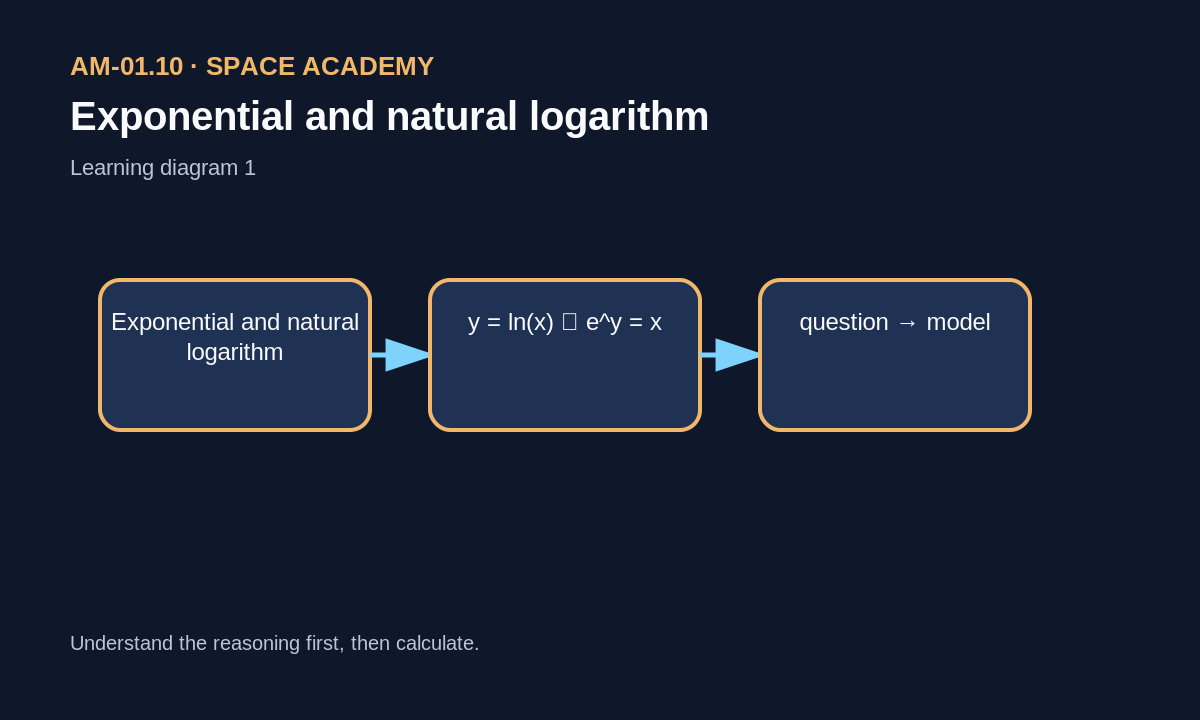
Exponential and natural logarithm: repeated multiplication and its inverse. Question directrice : What do eˣ and ln do, how are they read, why are they inverse, and why does ln appear in the ideal rocket equation? The rest of the course turns that idea into an auditable line of reasoning: explicit units, stated assumptions, reproducible calculations, order-of-magnitude checks and interpretation limits. A result is useful only when the reader can explain what it measures, where every input came from and which engineering decision it can support.
Starting synthesis: derivations, examples, limitations and sources are developed in the course body.
Key concepts before you begin
equation · logarithm · unit · assumption · velocity
1 — Exponential change: multiply rather than add the same amount
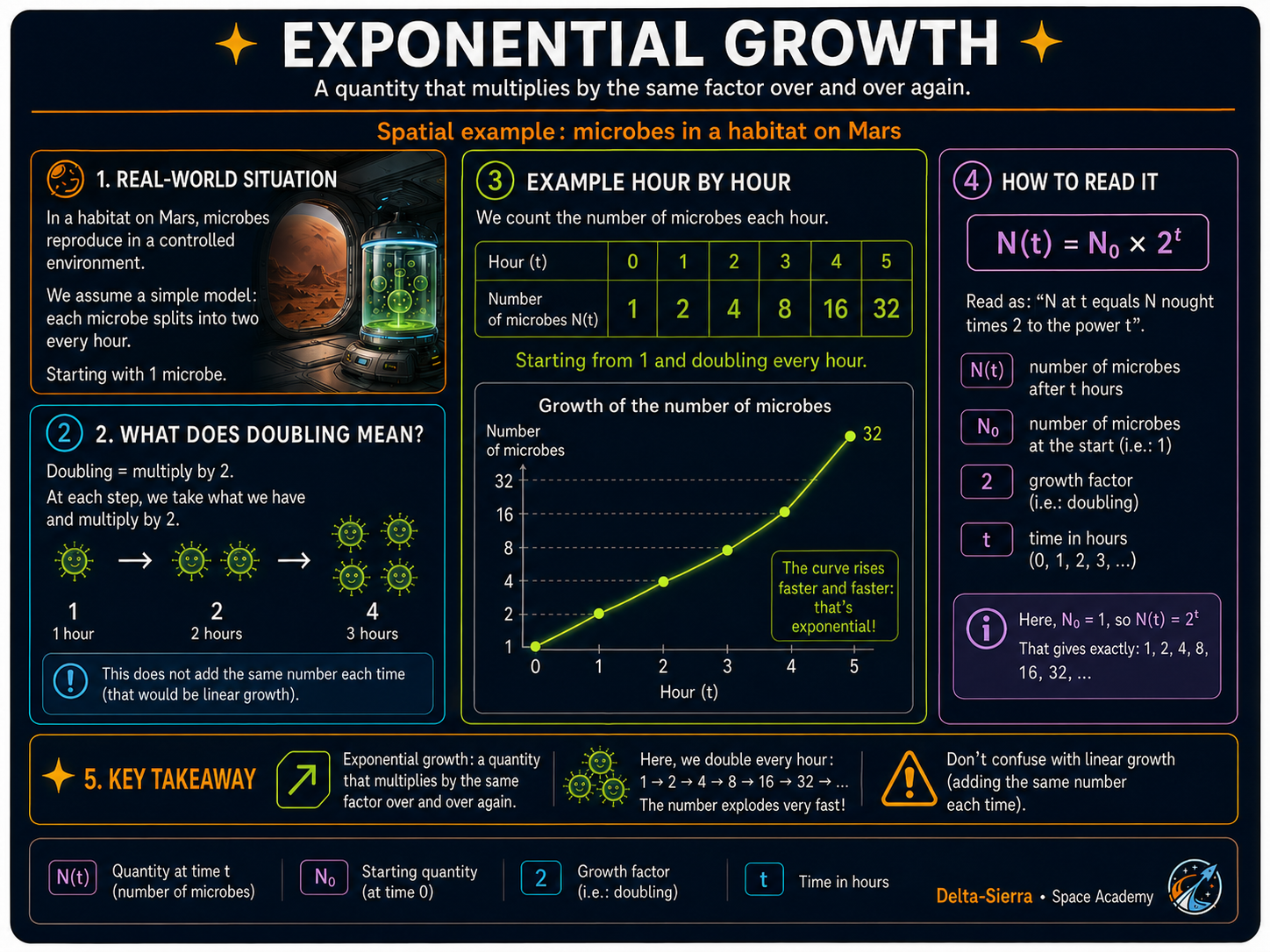
If a reserve gains exactly 10 kg each hour, it grows by +10, +10, +10. Exponential growth is different: the change depends on what is already there. A culture that doubles goes 1, 2, 4, 8, 16.
2 — What does eˣ mean and how is it read?
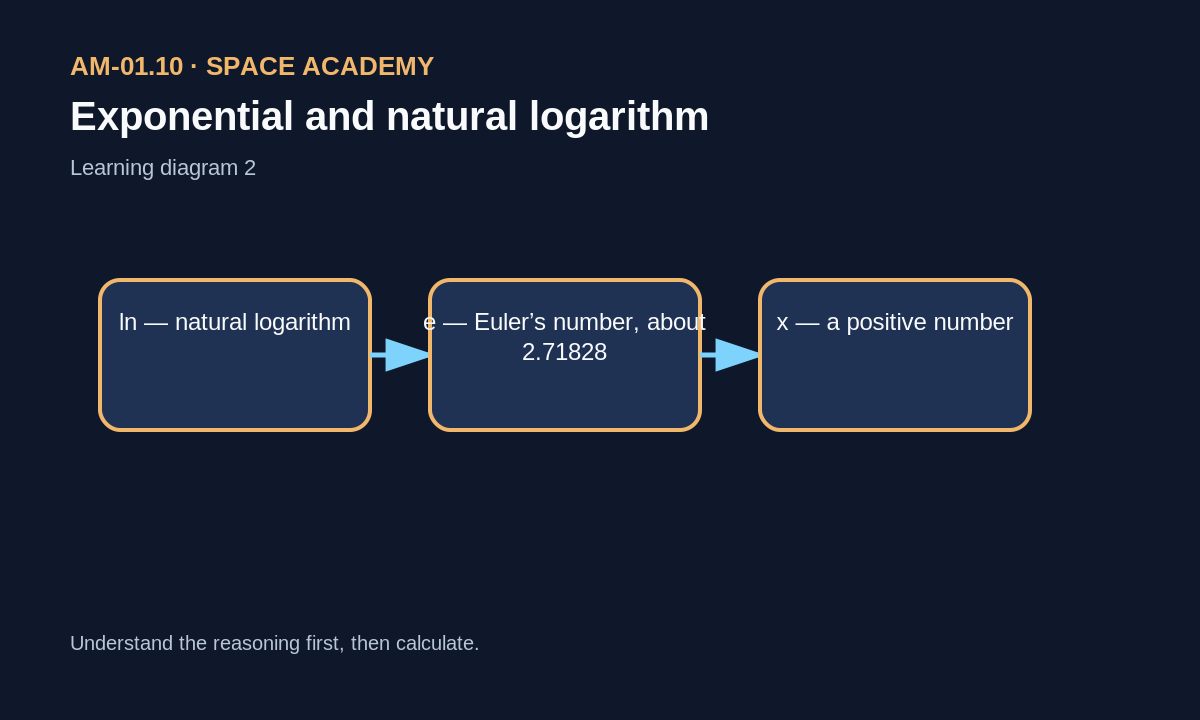
eˣ is read “e to the power x”. The number e is approximately 2.71828 and appears naturally in continuous-change models.
You do not need to memorize its digits. Think of eˣ as turning an exponent x into a multiplication factor.
3 — Natural logarithm: the inverse question
If we know the final factor and want the exponent that produced it, the natural logarithm, written ln, answers that question.
Read: “if e to the power x equals N, then x equals the natural logarithm of N.”
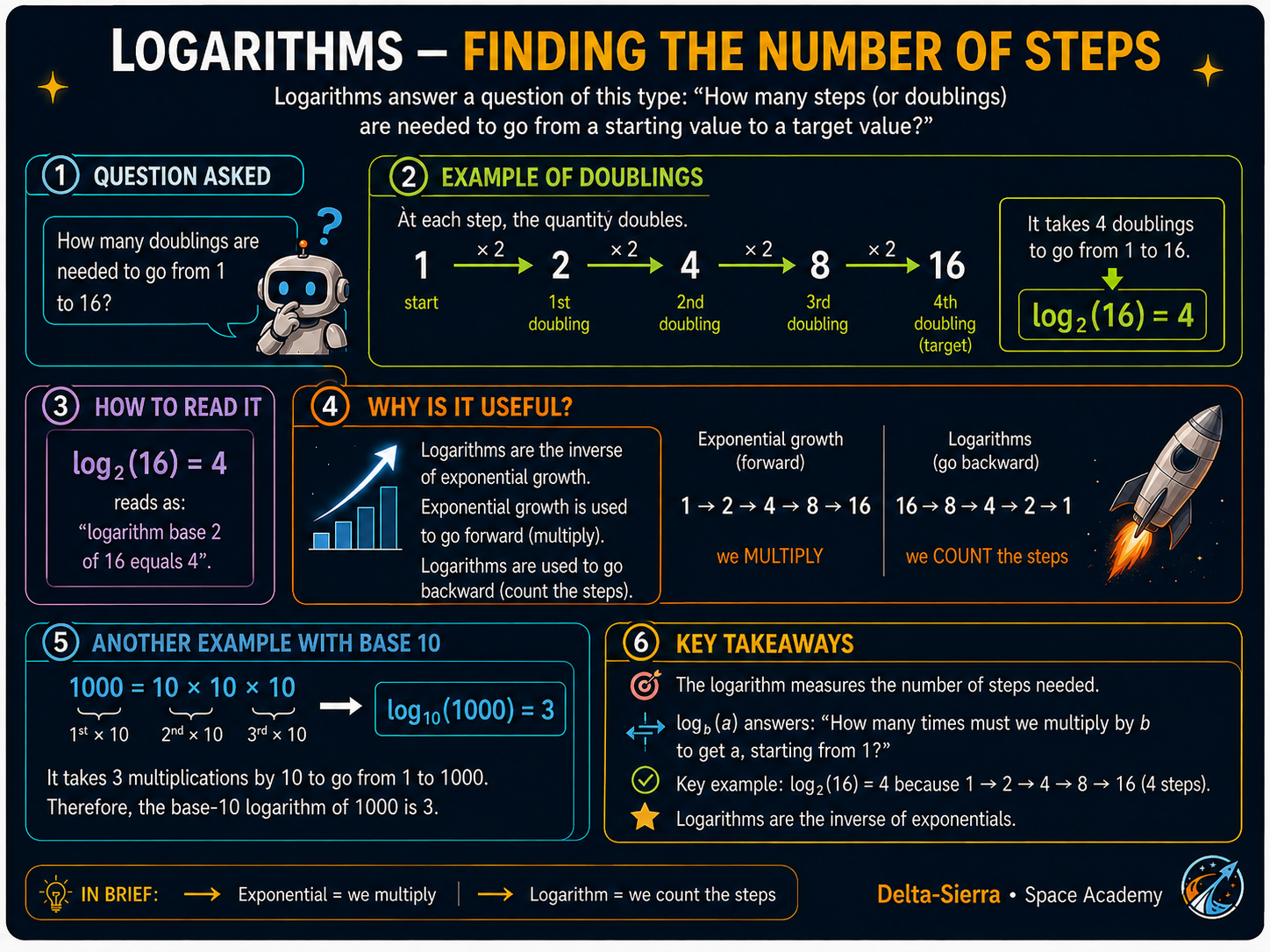
4 — Concrete example 1: how many doublings?
A culture goes 1 → 2 → 4 → 8. Reaching 8 takes three doublings because 2³=8.
Using logs: x = ln(8) ÷ ln(2) ≈ 2.079 ÷ 0.693 ≈ 3.
Because each step multiplies by 2. Dividing by ln(2) converts the natural-log measure into a number of doublings.
5 — Concrete example 2: why a logarithm appears in the ideal rocket equation
Δv is read “delta vee” and is a change in velocity. vₑ is the effective exhaust velocity in this simplified model.
If m₀/m₁=2, ln(2)≈0.693. If the mass ratio becomes 4, ln(4)≈1.386. The benefit does not grow directly in proportion to mass ratio.
6 — Why must the argument of ln be dimensionless?
In ln(m₀/m₁), both m₀ and m₁ are masses. If both use kilograms, kg/kg cancels, leaving a dimensionless ratio.
Writing ln(500 kg) without a reference quantity is not the same kind of meaningful dimensionless operation.
7 — Calculator: ln, eˣ and common mistakes
Compute ln(2): approximately 0.693. Then compute e^0.693 and you recover approximately 2.
8 — Three mental pictures
- Exponential: from exponent to multiplication factor.
- Logarithm: from factor back to exponent.
- Rocket equation: a mass ratio contributes through a logarithm, so ever larger ratios become increasingly costly.
Exercises and answers
Exercise 1
A quantity doubles four times from 1. Final value?
Exercise 2
Compute ln(2), then e^ln(2).
Exercise 3
Why is m₀/m₁ dimensionless if both masses are in kg?