Course compass
Key idea
Orbit: why a satellite keeps falling without hitting the planet. Imagine firing a ball horizontally from a very high mountain. Slowly, it falls nearby. Faster, it travels farther before the ground catches it. In Newton's thought experiment, a sufficiently fast projectile falls toward Earth while Earth's curved surface falls away beneath it. That is the essential idea of orbit: not the absence of falling, but continuous free fall… The rest of the course turns that idea into an auditable line of reasoning: explicit units, stated assumptions, reproducible calculations, order-of-magnitude checks and interpretation limits. A result is useful only when the reader can explain what it measures, where every input came from and which engineering decision it can support.
Starting synthesis: derivations, examples, limitations and sources are developed in the course body.
Key concepts before you begin
orbit · rendezvous · unit · assumption · velocity
1 — Build a mental picture before using a formula
Imagine firing a ball horizontally from a very high mountain. Slowly, it falls nearby. Faster, it travels farther before the ground catches it. In Newton's thought experiment, a sufficiently fast projectile falls toward Earth while Earth's curved surface falls away beneath it. That is the essential idea of orbit: not the absence of falling, but continuous free fall around a world.
2 — Essential vocabulary before going further
- orbit — the path of an object gravitationally bound to a body.
- free fall — motion dominated by gravity; it does not have to be vertical.
- tangential velocity — motion along the path, locally sideways.
- gravity — the attraction that continuously bends the path.
- orbital radius — distance from the body’s centre to the spacecraft.
3 — Understand the mechanism step by step
Inertia versus gravity
Without gravity the spacecraft would continue along a straight line. Gravity continuously turns its velocity toward the planet. A circular orbit is the special case in which the curvature of the path keeps altitude essentially constant.
Why astronauts float
Gravity is still strong in low orbit. Spacecraft and crew are falling together, so the floor does not provide the normal support force that creates the everyday sensation of weight. This is microgravity, not zero gravity.
Conditions for orbit
The vehicle must be above the dense atmosphere and have sufficient sideways speed. Too little speed makes the trajectory intersect the planet; enough additional energy can produce an escape trajectory. Bound orbits can be circular or elliptical.
4 — The formula, only now
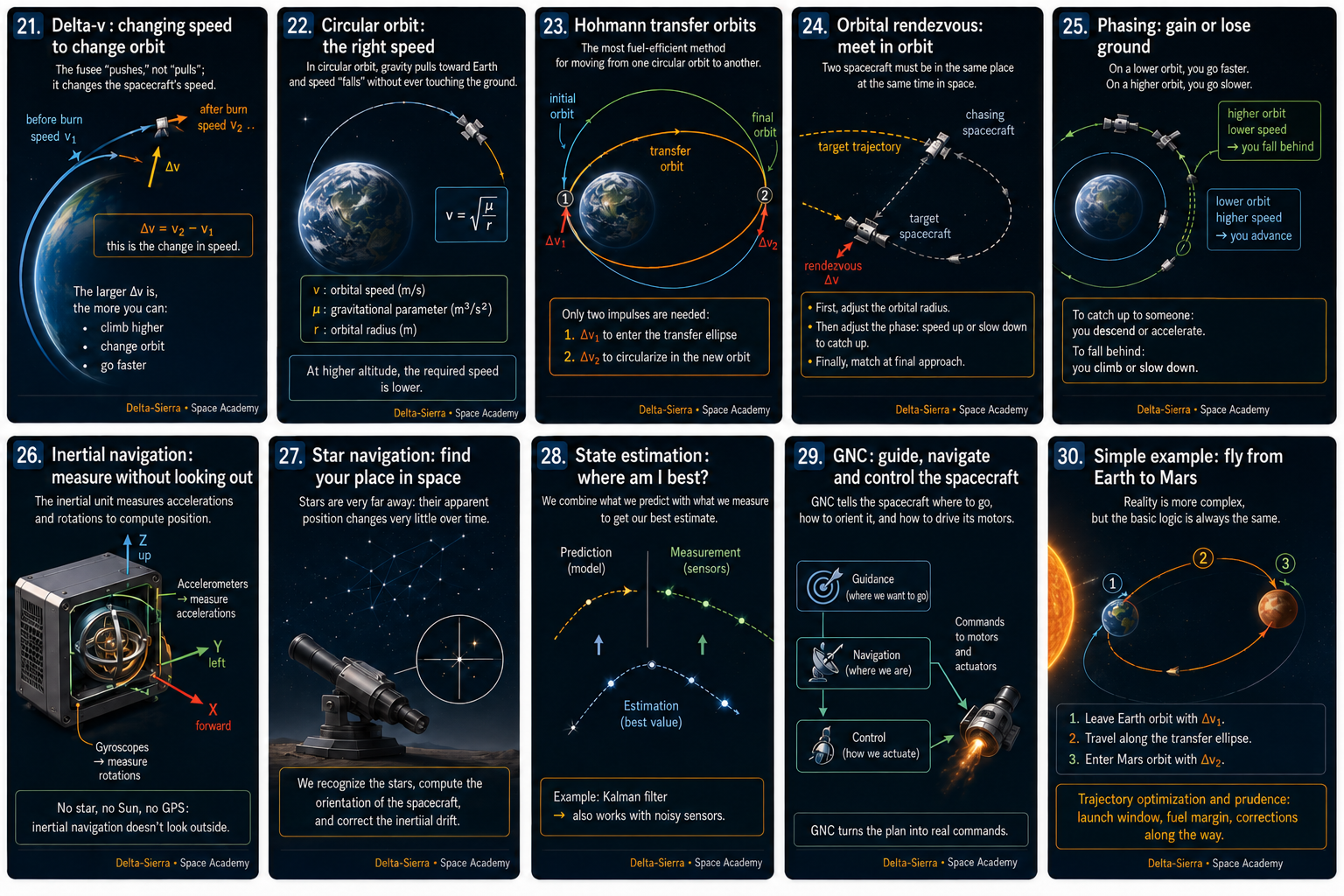
v = √(μ / r)How to read it: v is orbital speed; √ means square root; μ, pronounced 'mu', is the body's gravitational parameter; r is distance from the body's centre, not altitude alone.
Detailed calculation
For a circular orbit with r ≈ 6,778 km around Earth and μ ≈ 398,600 km³/s²: μ/r ≈ 58.81 km²/s², then √58.81 ≈ 7.67 km/s.
5 — What the units tell you
6 — Three concrete demonstrations
Example 1 — A mental projectile
The useful picture is a projectile moving sideways while falling. The exact distance fallen each second varies with geometry, but the key point is that the curved surface keeps receding beneath the moving object.
Example 2 — Low Earth orbit
At roughly 400 km altitude, an ideal circular orbit has a speed near 7.67 km/s, or about 7,670 m/s.
Example 3 — Mars
At about 400 km above Mars, the corresponding ideal circular speed is around 3.36 km/s because Mars has a smaller gravitational parameter.
7 — Why this matters for a Mars mission
Continuous free fall is the foundation for understanding parking orbits, Mars orbiters, rendezvous, transfer trajectories and orbital capture.
8 — Common traps and misleading intuitions
- using altitude in place of radius.
- thinking gravity is zero in orbit.
- assuming a spacecraft must thrust continuously in an ideal orbit.
- assuming all orbits are perfect circles.
9 — What I should be able to explain at the end
- explain the idea in ordinary words
- read and pronounce the important symbols
- repeat at least one calculation without hidden steps
- identify what the simplified model assumes and does not prove
Why an orbit is a fall that keeps missing the ground
The most useful mental model is a projectile launched horizontally from an ideal height. Gravity continuously bends its path toward the planet, but if tangential speed is high enough and atmospheric drag is negligible, the surface curves away beneath it as well. The object is therefore always falling without meeting the ground. Gravity has not disappeared; it supplies the centripetal acceleration required by the orbit.
For an ideal circular orbit around a body with gravitational parameter μ, speed is v = √(μ/r), where r is measured from the body’s center rather than from its surface. That distinction prevents a common altitude error. The two-body model also neglects drag, oblateness and third-body perturbations, all of which can matter in operations.
A very low satellite does not decay because gravity is somehow too strong. Residual atmosphere removes orbital energy. As the vehicle loses energy, it reaches denser layers and decay accelerates. Operations therefore watch altitude, drag and energy and decide whether to raise the orbit or accept re-entry.