Course compass
Key idea

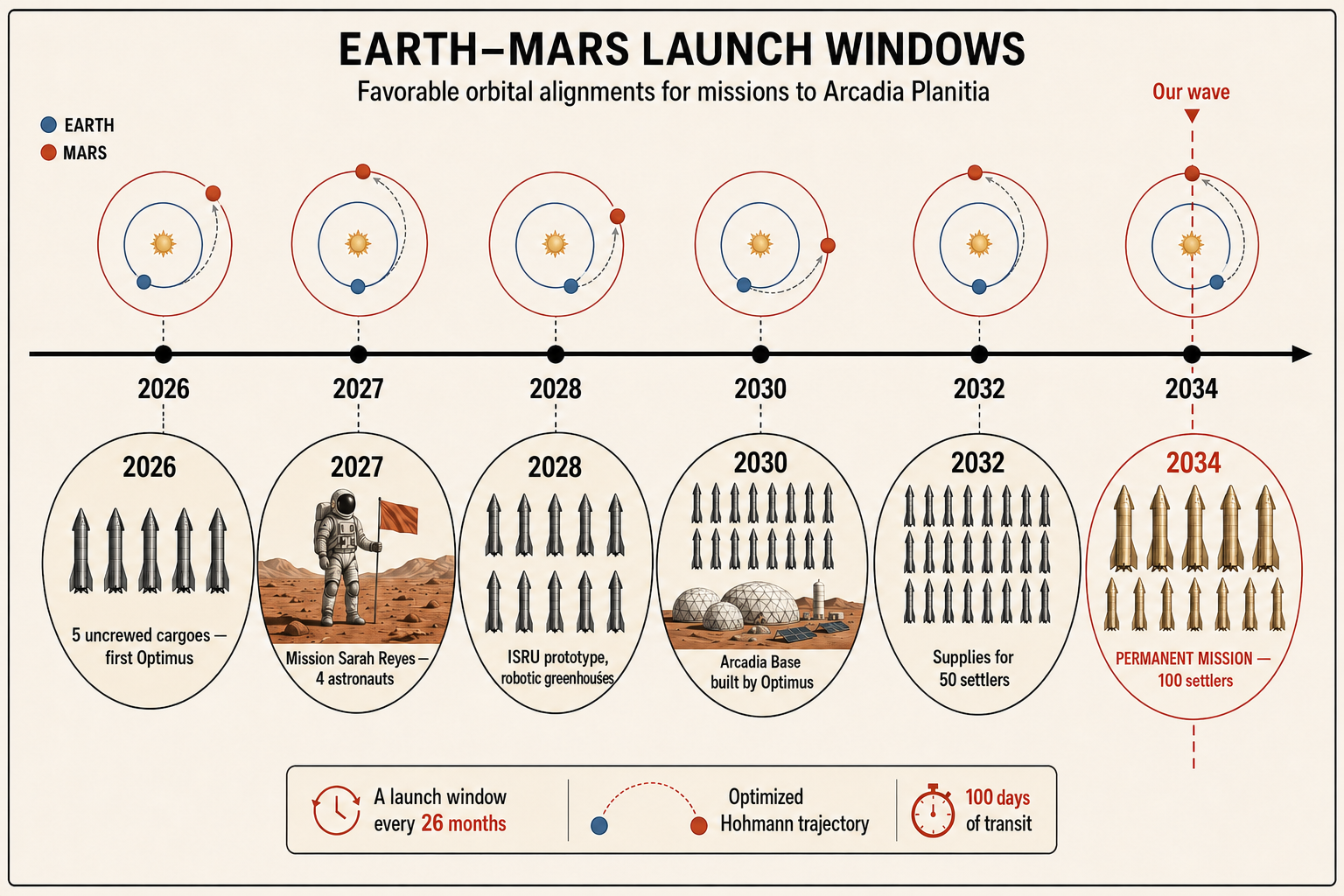
Earth–Mars launch window: why you cannot leave on just any day. Earth and Mars continuously move around the Sun. An energy-efficient mission must depart when the geometry lets Mars arrive at the trajectory intersection at the right time. A launch window is therefore a planetary rendezvous problem. The rest of the course turns that idea into an auditable line of reasoning: explicit units, stated assumptions, reproducible calculations, order-of-magnitude checks and interpretation limits. A result is useful only when the reader can explain what it measures, where every input came from and which engineering decision it can support.
Starting synthesis: derivations, examples, limitations and sources are developed in the course body.
Key concepts before you begin
launch window · unit · assumption · position · mass
1 — Build a mental picture before using a formula

Earth and Mars continuously move around the Sun. An energy-efficient mission must depart when the geometry lets Mars arrive at the trajectory intersection at the right time. A launch window is therefore a planetary rendezvous problem.
2 — Essential vocabulary before going further
- launch window — date interval satisfying mission constraints.
- planetary geometry — relative positions of planets.
- synodic period — time for similar relative geometry to recur.
- phase angle — relative angular geometry at departure.
- launch period — practical span of acceptable launch dates.
3 — Understand the mechanism step by step
You do not aim at present-day Mars
The spacecraft enters a solar orbit designed to meet Mars later.
Roughly 26 months
Favorable Earth–Mars opportunities recur about every 26 months because Earth and Mars have different orbital periods.
A window is an interval
Real launch periods span multiple days, with daily targeting adjustments and additional constraints from launcher and arrival conditions.
4 — The formula, only now
1/S = |1/Tₑ − 1/Tₘ|How to read it: S is synodic period; Tₑ and Tₘ are Earth and Mars orbital periods; vertical bars mean take the positive magnitude.
Detailed calculation
0.002738 − 0.001456 ≈ 0.001282 day⁻¹; 1/0.001282 ≈ 780 days ≈ 25.6 months.
5 — What the units tell you
6 — Three concrete demonstrations
Example 1 — Earth laps Mars
Earth's year is about 365.25 days and Mars's about 686.98 days.
Example 2 — Synodic period
1/S = |1/365.25 − 1/686.98| gives about 780 days or 25.6 months.
Example 3 — Mars 2020
Perseverance launched during a defined 2020 period and then cruised for months to Mars.
7 — Why this matters for a Mars mission
Launch cadence drives crew rotation, cargo, emergency reserves and long-term Mars logistics.
8 — Common traps and misleading intuitions
- aiming at Mars’s current location.
- confusing synodic period with flight time.
- treating a launch window as a single instant.
- assuming every 26-month opportunity has identical energy and geometry.
9 — What I should be able to explain at the end
- explain the idea in ordinary words
- read and pronounce the important symbols
- repeat at least one calculation without hidden steps
- identify what the simplified model assumes and does not prove
A launch window is geometry, not a magic calendar date
An Earth–Mars mission must depart when the relative planetary positions allow the chosen trajectory to meet Mars when the planet reaches the arrival point. The opportunity is not defined by convention; it follows from the synodic geometry and the family of trajectories accepted for energy and time of flight.
The useful phase angle depends on transfer time. Even within one opportunity, different departure days change injected mass, flight duration and arrival conditions. Mission designers therefore study a launch period rather than a single date.
The complete window also includes launcher availability, daily launch time, tracking, lighting and return or arrival constraints. Saying a window is open means a domain of acceptable compromises exists—not that every instant in it is equivalent.