Key vocabulary before you start
ECLSS · partial pressure · CO2 scrubber · closed loop · safe haven · EVA
1 — The real phenomenon
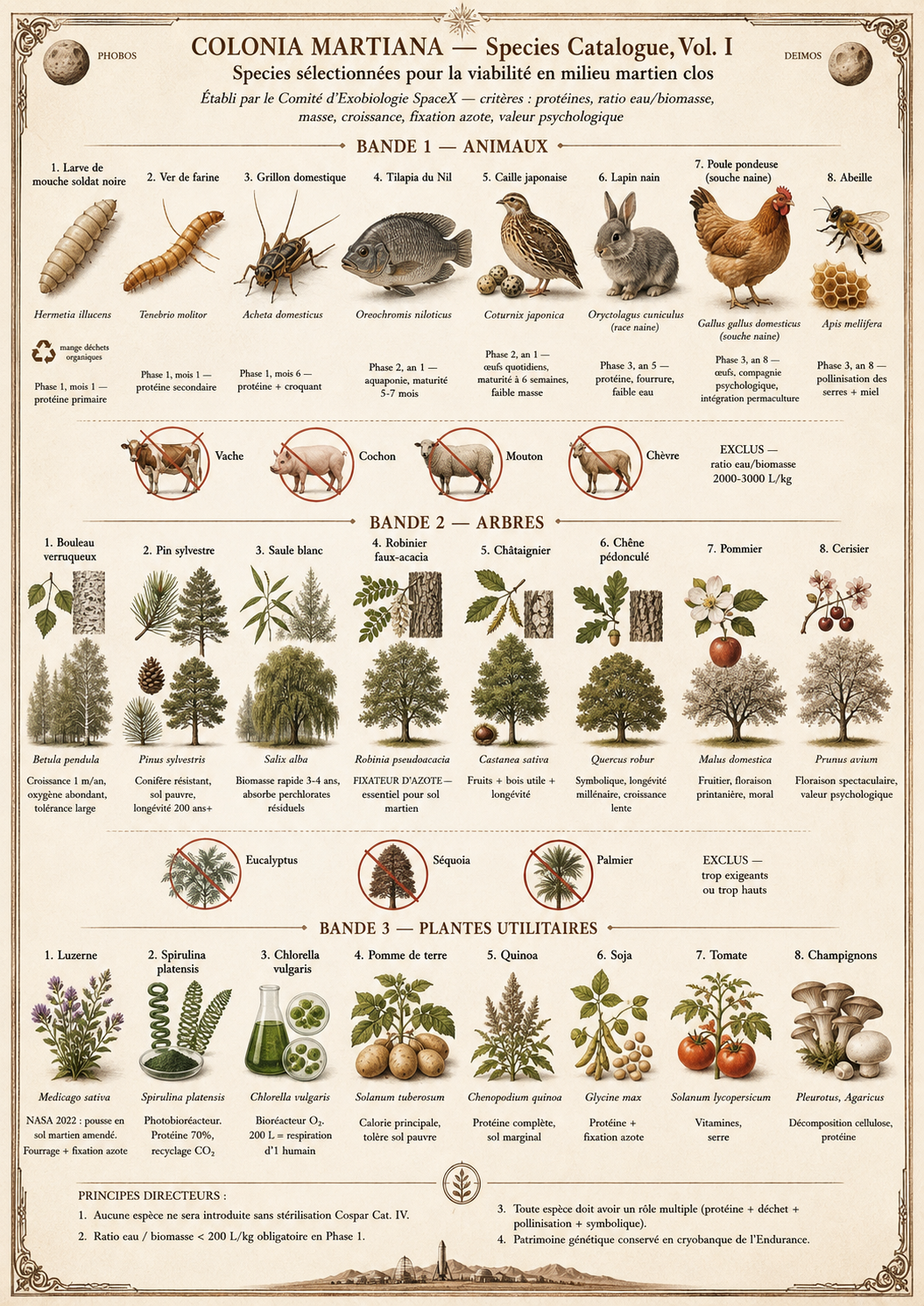
Growing plants requires light, area, root volume, water, nutrients, CO₂, temperature, sanitation, pollination or reproduction and crew labor. Plants can provide fresh food and psychological benefit and participate in water and gas exchanges, but a greenhouse is not a magical fully closed machine. One must specify what it supplies: fresh mass, calories, protein, micronutrients, oxygen or simply dietary variety.
The guiding question is: What must be calculated before claiming a greenhouse will “feed the base”? Reasoning starts with the physical or operational function before introducing the mathematical relationship. The goal is not to accumulate terminology, but to know which quantity changes, why it changes and what becomes hazardous when it leaves its domain. For “Crops on Mars: greenhouse, hydroponics, light, water and biological loops”, the first task here is therefore to identify the mechanism specific to this subject before searching for an equation or reference value.
2 — Vocabulary and problem boundary
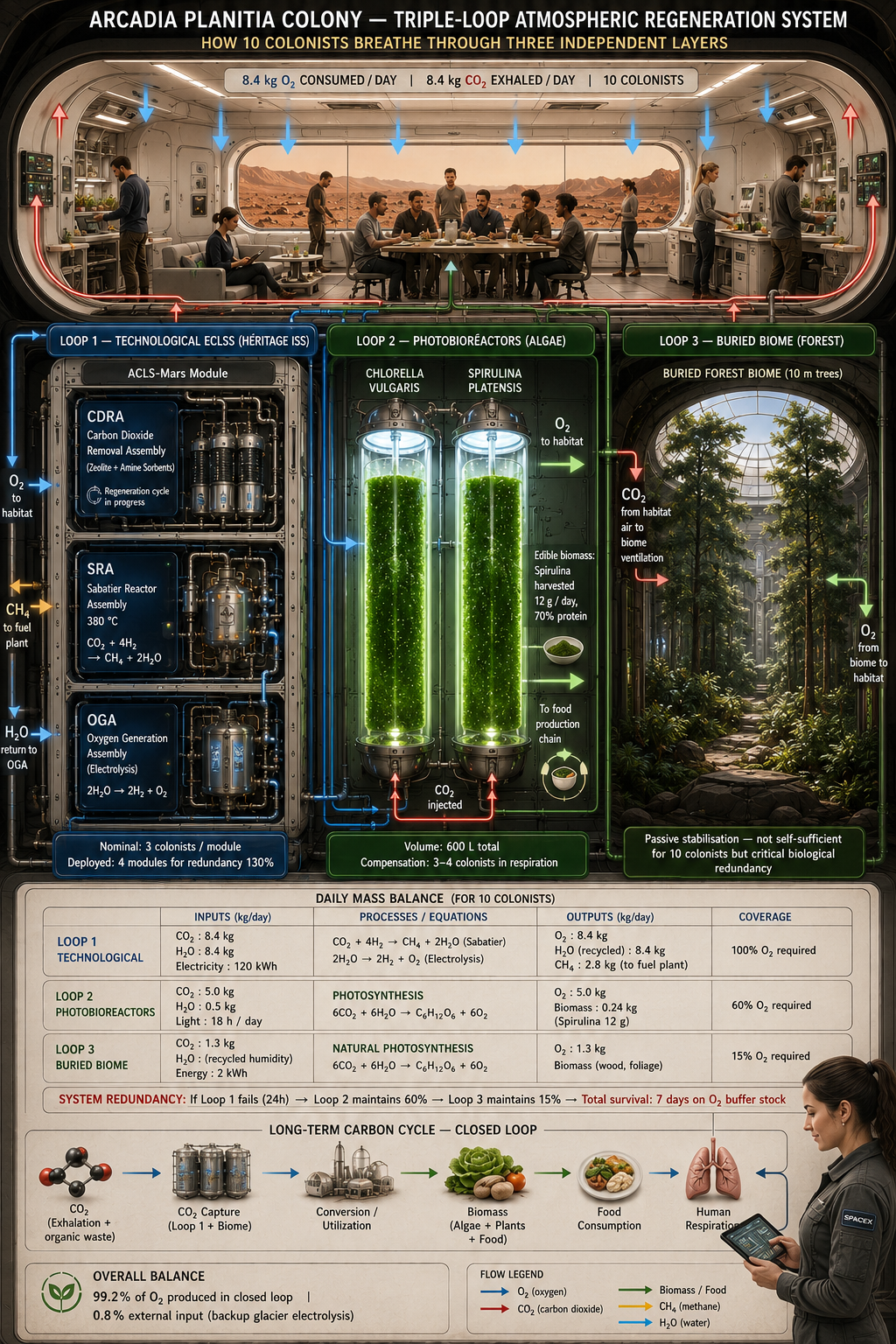
In “Crops on Mars: greenhouse, hydroponics, light, water and biological loops”, distinguish the phenomenon, available measurement, any command, the margin and the success criterion. The calculation boundary states what is included and excluded; without that boundary, a percentage, mass or time may be mathematically correct but wrong as an engineering conclusion. For “Crops on Mars: greenhouse, hydroponics, light, water and biological loops”, the chosen boundary also states what would otherwise be double-counted or omitted from a mission budget.
- Primary observable
- energy intake, protein, micronutrients, stored mass, crop yield, medical parameters and care time
- Characteristic failure
- deficiency, crop loss, degraded pharmacy, uncertain diagnosis or unavailable medical resource
- Expected evidence
- storage tests, controlled plant growth, medical simulations and rationing scenarios
3 — Course-specific system view
This lesson does not reuse one generic picture for every subject. The system view follows cause → measured quantity → decision or physical response → limit for “Crops on Mars: greenhouse, hydroponics, light, water and biological loops”. The English text remains fully equivalent while large translated illustrations are intentionally deferred until their dedicated artwork is supplied. For “Crops on Mars: greenhouse, hydroponics, light, water and biological loops”, the system view must expose inputs, outputs, measured quantity and the consequence of drift without relying on a generic module diagram.
4 — Mathematical relationship and reading the symbols
Read aloud : electrical energy E equals power P times time; a simple areal yield equals production divided by cultivated area.
Before substituting numbers, write the unit of every term, state whether the relationship is a physical law, approximation or project indicator, and check dimensional consistency. This is especially important here because “Crops on Mars: greenhouse, hydroponics, light, water and biological loops” combines quantities that do not all have the same evidence status. For “Crops on Mars: greenhouse, hydroponics, light, water and biological loops”, this relationship is chosen because of the phenomenon under study; a different dominant quantity would require a different equation or model.
5 — Worked calculations and interpretation
1. 1. Lighting
20 kW × 16 h = 320 kWh/day in this scenario
2. 2. Areal production
120 kg / 60 m² = 2 kg/m² over the chosen period
3. 3. Recovered transpiration water
50 kg/day × 90% = 45 kg/day recovered if the capture boundary reaches that rate in this example
6 — What the formula does not contain
The relationship “E = P × t ; rendement_surface = production/A” does not by itself contain all of “Crops on Mars: greenhouse, hydroponics, light, water and biological loops”. It does not automatically tell us whether a sensor is valid, a structure is aging, a resource is accessible, a command arrives in time or a secondary failure removes margin. The example 20 kW × 16 h = 320 kWh/day in this scenario therefore remains a local calculation rather than a complete architecture.
To make the model useful, explicitly add the quantities that dominate this subject: energy intake, protein, micronutrients, stored mass, crop yield, medical parameters and care time. We can then ask which variation truly changes the result, which is negligible and which forces an architectural change. For “Crops on Mars: greenhouse, hydroponics, light, water and biological loops”, this model limitation states exactly what a correct calculation still cannot establish about the real system.
7 — Instrumentation, observability and data quality
For “Crops on Mars: greenhouse, hydroponics, light, water and biological loops”, observability relies on energy intake, protein, micronutrients, stored mass, crop yield, medical parameters and care time. Each datum has a unit, acquisition rate, uncertainty, timestamp and validity domain. A value arriving without context can be more dangerous than no measurement because it creates unjustified confidence.
Consistency is checked with at least one independent piece of information when the function is critical. A trend, physical balance or second measurement principle helps distinguish a real system change from a drifting sensor. For “Crops on Mars: greenhouse, hydroponics, light, water and biological loops”, the selected instrumentation must distinguish a real physical change from sensor drift or a bad state estimate.
8 — Phenomenon-specific failures and recovery
The reference failure is not a vague “broken component.” For “Crops on Mars: greenhouse, hydroponics, light, water and biological loops”, test in particular deficiency, crop loss, degraded pharmacy, uncertain diagnosis or unavailable medical resource. Diagnosis asks which symptoms appear first, which are only consequences and which action preserves the most options.
The degraded mode must be defined before failure: minimum function, allowable duration, consumed stock, crew action, abort condition and return-to-nominal criterion. That sequence is topic-specific and cannot be replaced by one universal paragraph about redundancy. For “Crops on Mars: greenhouse, hydroponics, light, water and biological loops”, the degraded mode is defined around the minimum function specific to this subject, with an abort threshold and a return-to-nominal condition.
9 — NASA / reference case
The reference case is selected from ECLSS, NASA-STD-3001 or human-analog evidence according to the topic. The goal is not to copy the ISS onto Mars, but to identify what has been demonstrated, what is environment-dependent and what still requires qualification for a mission without rapid resupply.
The case is used only within what it actually demonstrates. Flight measurement, human-system standard, component test and architecture study are different kinds of evidence; the text therefore states what is observed, calculated, simulated or still prospective. For “Crops on Mars: greenhouse, hydroponics, light, water and biological loops”, the cited NASA case is used as targeted evidence for this phenomenon and is never turned into one universal Mars architecture.
10 — Architecture trade
A good solution for “Crops on Mars: greenhouse, hydroponics, light, water and biological loops” does not maximize one metric. Compare nominal performance, mass, energy, simplicity, maintenance, crew time, common dependencies and recoverability. An option that improves 120 kg / 60 m² = 2 kg/m² over the chosen period can still be rejected if it makes failure detection or repair much harder.
The trade is recorded together with its assumptions. If environment data, mass or mission cadence changes, we know which conclusions must be recomputed instead of silently preserving an obsolete choice. For “Crops on Mars: greenhouse, hydroponics, light, water and biological loops”, the trade is evaluated against the interfaces actually touched by this subject rather than a generic list of desirable qualities.
11 — Demonstration, testing and success criteria
The evidence strategy for “Crops on Mars: greenhouse, hydroponics, light, water and biological loops” combines storage tests, controlled plant growth, medical simulations and rationing scenarios. Every test records exact hardware, software, configuration, environment, tolerances and success criterion. A successful demonstration outside the mission domain does not replace qualification inside it.
Evidence grows by levels: analytical relationship, simulation, component, subsystem, integrated system, duration and failure. This hierarchy prevents one spectacular test from being presented as validation of the whole mission. For “Crops on Mars: greenhouse, hydroponics, light, water and biological loops”, demonstration must reproduce the constraints that make this phenomenon difficult; a spectacular test outside the mission domain is insufficient.
12 — Decision exercise
Situation: revisit “Crops on Mars: greenhouse, hydroponics, light, water and biological loops” with a 20% increase in the most penalizing quantity from the first worked example while one measurement or backup path is unavailable.
13 — What to retain without over-generalizing
- Crops on Mars: greenhouse, hydroponics, light, water and biological loops has its own observables and failure modes.
- The relationship E = P × t ; rendement_surface = production/A remains attached to its units and boundary.
- NASA evidence is cited at the phenomenon level instead of reusing one reference bundle for an entire module.
14 — Topic-specific primary sources
These references directly document the phenomenon, technology or human constraint addressed in this lesson. They do not by themselves define an official Mars architecture. For “Crops on Mars: greenhouse, hydroponics, light, water and biological loops”, the bibliography is deliberately targeted to this page so that readers can trace each claim back to the relevant primary document.