Course compass
Guiding question : How do we move from requested thrust to physical fuel and oxidizer flow?
Markers : 📏 MEASURED 📐 CONVENTION 🧮 CALCULATED 🎓 LEARNING ASSUMPTION 🚀 MISSION DATA 🏭 MANUFACTURER DATA ⚠️ APPROXIMATION
Objectives :
- define kg/s and mass flow
- explain command→actuator→flow→sensor feedback
- calculate fuel/oxidizer split
- understand choking at the throat
- distinguish command, measurement, and model
1 — What does 5 kg/s actually mean?
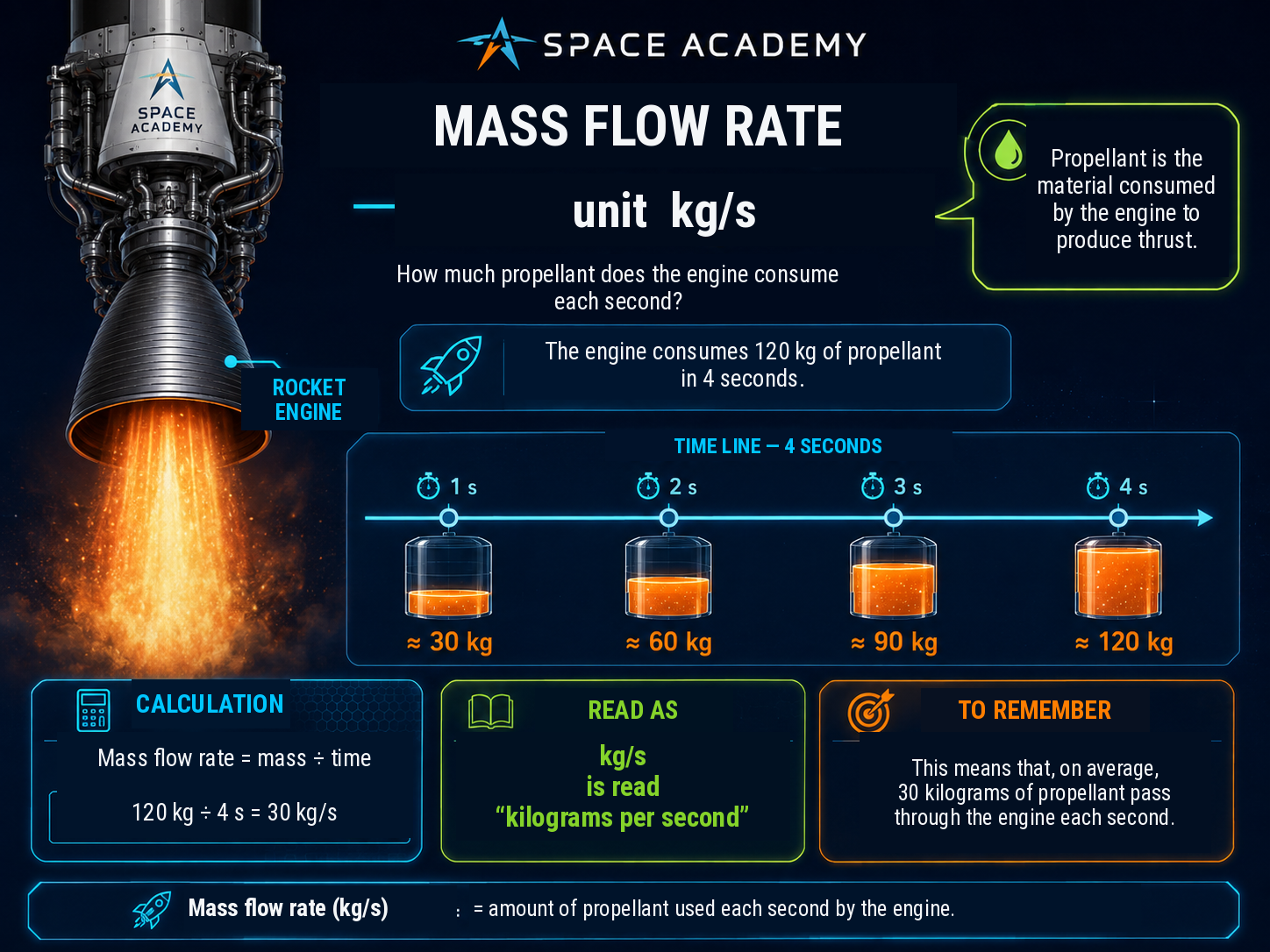
kg/s means kilograms per second. It is a rate. If 5 kg/s passes for 10 seconds, total mass is 5 × 10 = 50 kg.
ṁ is mass flow rate: mass crossing a section per unit time.
2 — The command is not the flow

A controller may receive a thrust or operating-point command. It cannot “write 5 kg/s into the pipe.” It drives actuators such as valves, pumps, and pressure regulators.
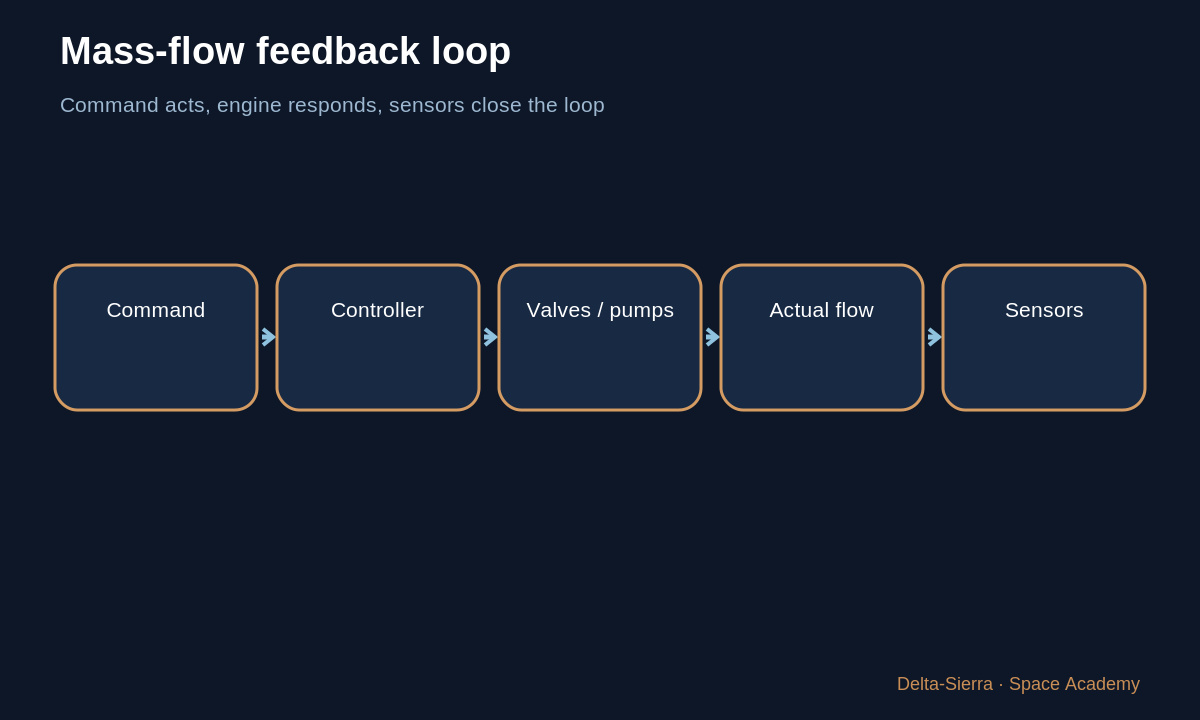
The engine responds according to physical conditions. Sensors measure that response and software corrects the error: a feedback loop.
3 — Why 50% valve opening does not guarantee 50% flow
Flow through a restriction depends on passage area, upstream/downstream pressure, density, temperature, and flow regime. The same valve position can therefore give different flow at different engine states.
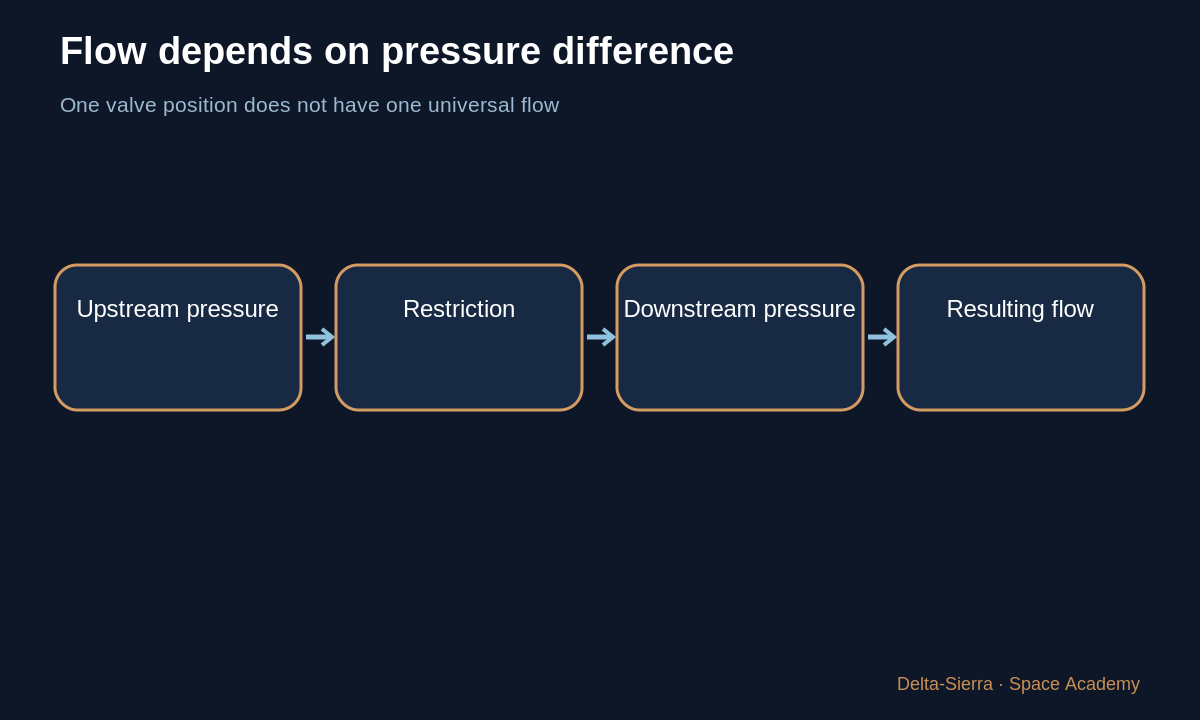
That is why real engines use maps, models, and measurements rather than a universal “valve angle = kg/s” rule.
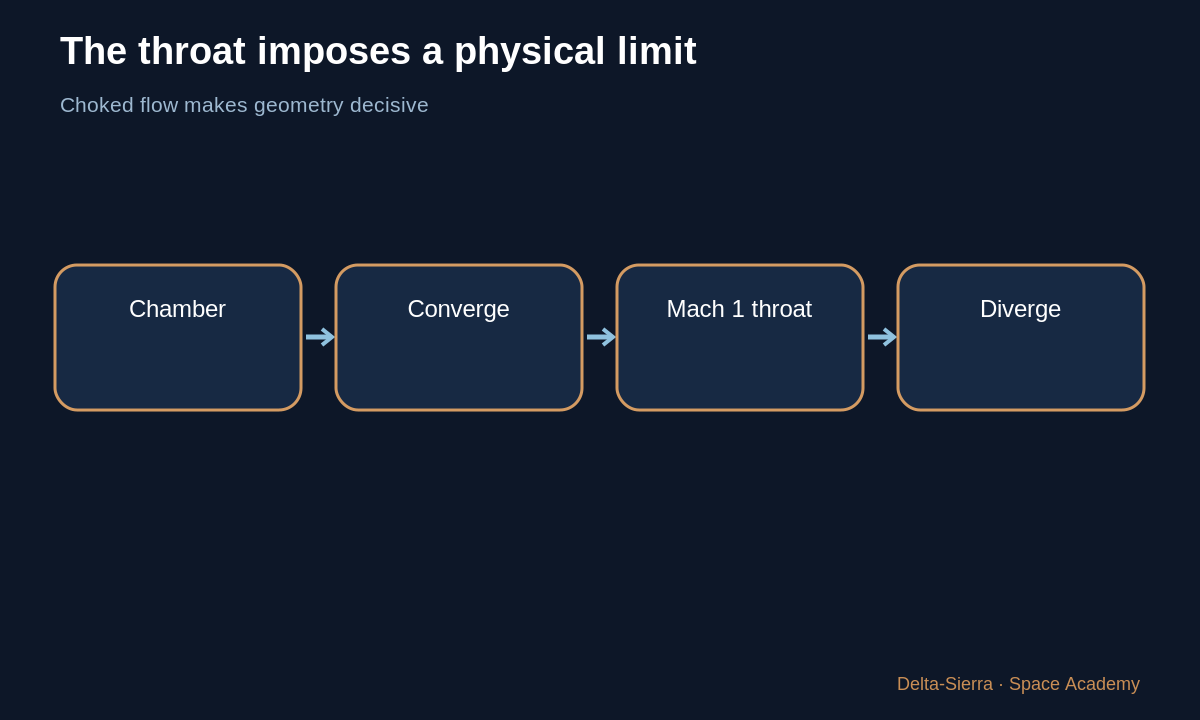
4 — The nozzle throat can choke the flow
NASA Glenn explains that compressible flow can reach Mach 1 at the throat. Once choked, chamber conditions, gas properties, and throat area strongly constrain maximum mass flow.
5 — Split total flow between propellants
Assume 🎓 LEARNING ASSUMPTION total flow 618 kg/s and mixture ratio O/F = 3.6. O/F is oxidizer mass divided by fuel mass.
Let fuel flow = x. Oxidizer = 3.6x and total = 4.6x.
4.6x = 618x = 618 ÷ 4.6 ≈ 134.35 kg/s fuel3.6 × 134.35 ≈ 483.65 kg/s oxidizer134.35 + 483.65 = 618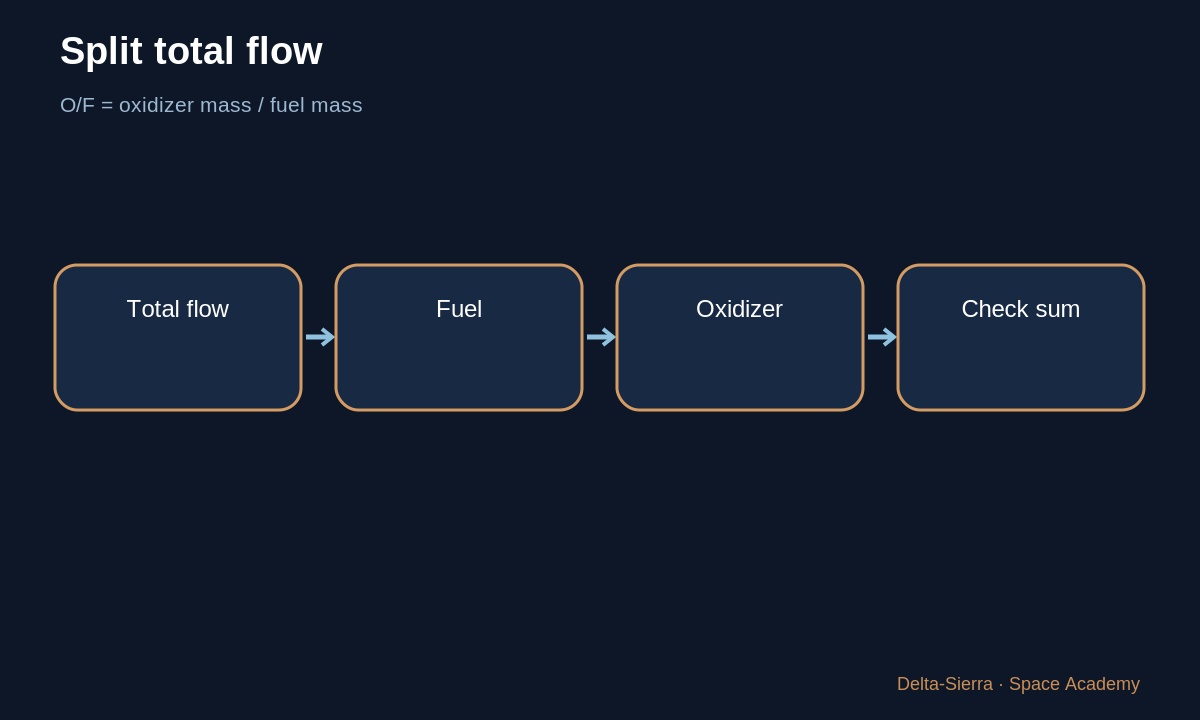
Why 3.6? Here it is a learning assumption. A real engine uses a design- and operating-point-specific value.
6 — Throttling: reduce thrust without shutting down
Throttling moves the engine to another operating point. Flow rates, pressures, and sometimes mixture ratio change inside allowed limits.
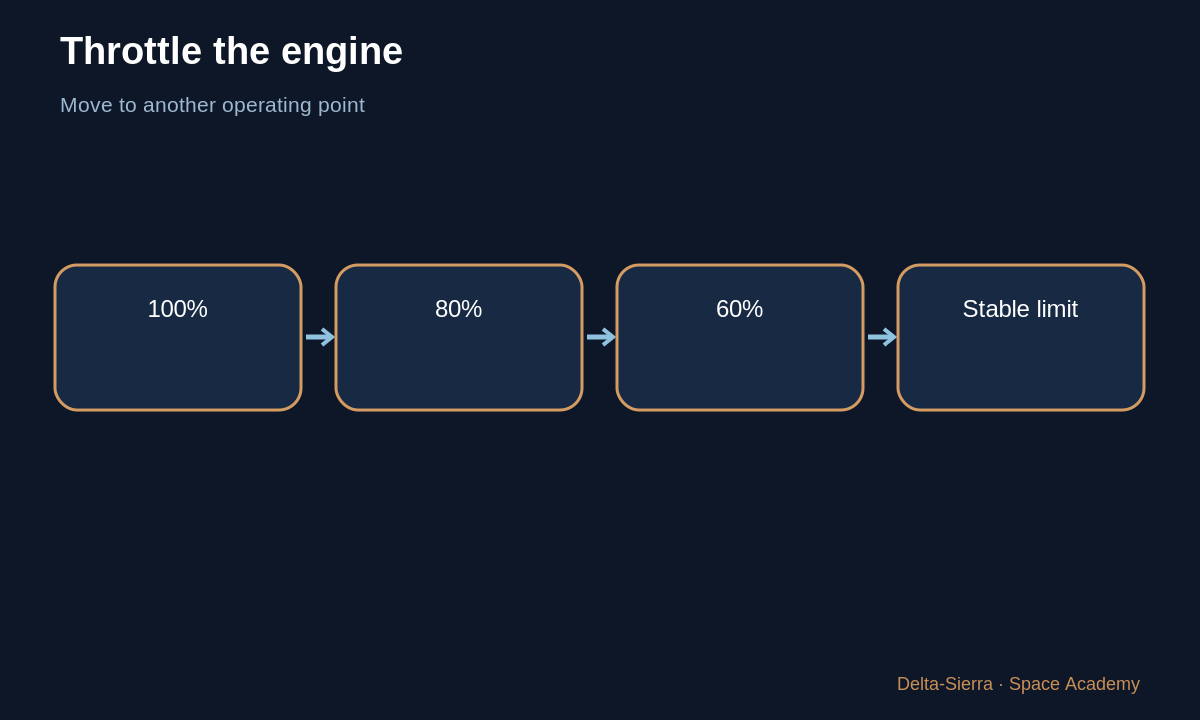
Going too low can create instability, cooling problems, or operation outside the engine map. “50% thrust” does not mean every internal variable is exactly 50%.
7 — Why multiple sensors?
One flowmeter can be wrong. Control can compare chamber pressure, feed pressures, turbopump speed, temperatures, valve positions, and direct flow measurements where available.
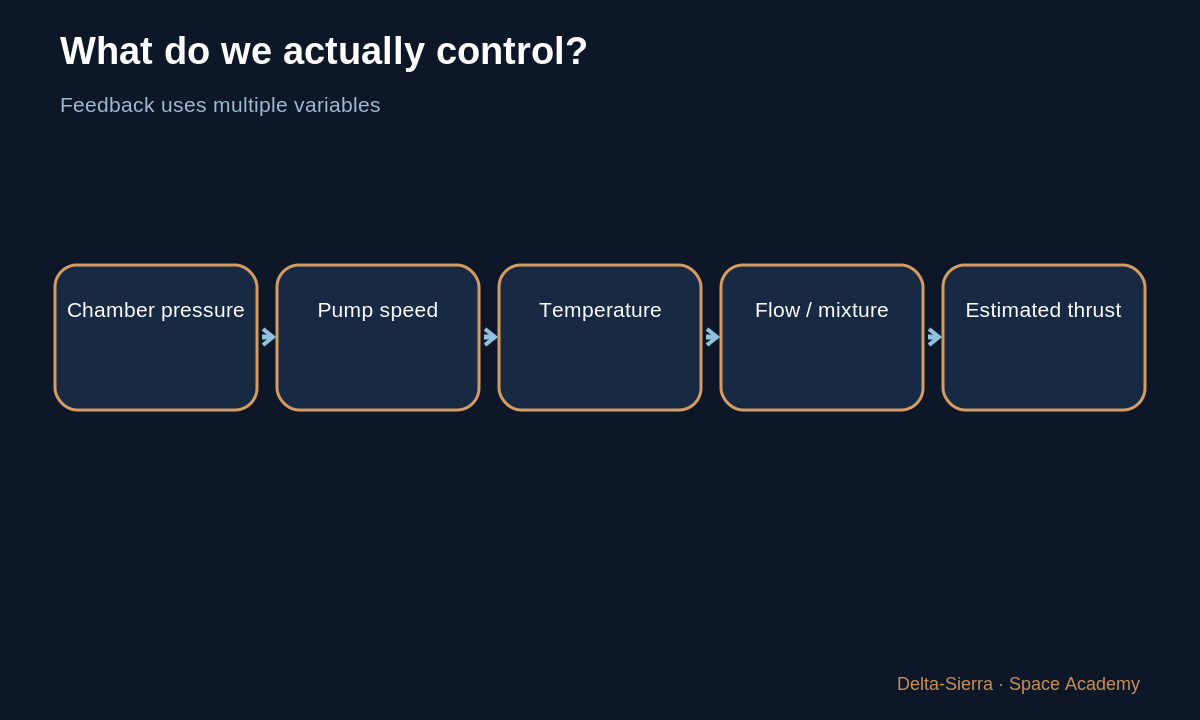
If one sensor disagrees, the system may estimate from other channels, limit operation, or shut down depending on risk.
8 — Dynamic example: upstream pressure falls
Keep the command fixed while upstream pressure drops. At unchanged valve position, flow may decrease. The controller sees lower chamber pressure or flow and may command the actuator farther—within available limits.
Control is therefore continuous correction, not one fixed setting.
9 — What this course does not claim
Exact compressible-flow laws, cavitation, turbomachinery, combustion, and nonlinear control need later courses. The goal here is to make “5 kg/s” non-magical: it is a physical rate produced, measured, and regulated by a system.
Exercises and solutions
Exercise A — total mass
A flow of 7 kg/s lasts 12 s.
Exercise B — O/F
Total flow 46 kg/s, O/F = 3.6.
Challenge — disagreeing sensor
Flowmeter reports 10% drop while chamber pressure and pump speed are stable. What next?