SPACE ACADEMY
From zero to the scientific knowledge needed to understand the work of astronauts, mission engineers and flight teams - without assuming prior knowledge.
Two ways to learn
Start at module 00 and follow the numbers.
Jump directly to a question; prerequisites are introduced just in time.
Every symbol, number, unit, convention and operation must be explainable.
This pathway does not grant a professional astronaut or engineering qualification. It makes the reasoning, calculations, systems and technical culture of spaceflight accessible.
Curriculum in learning order
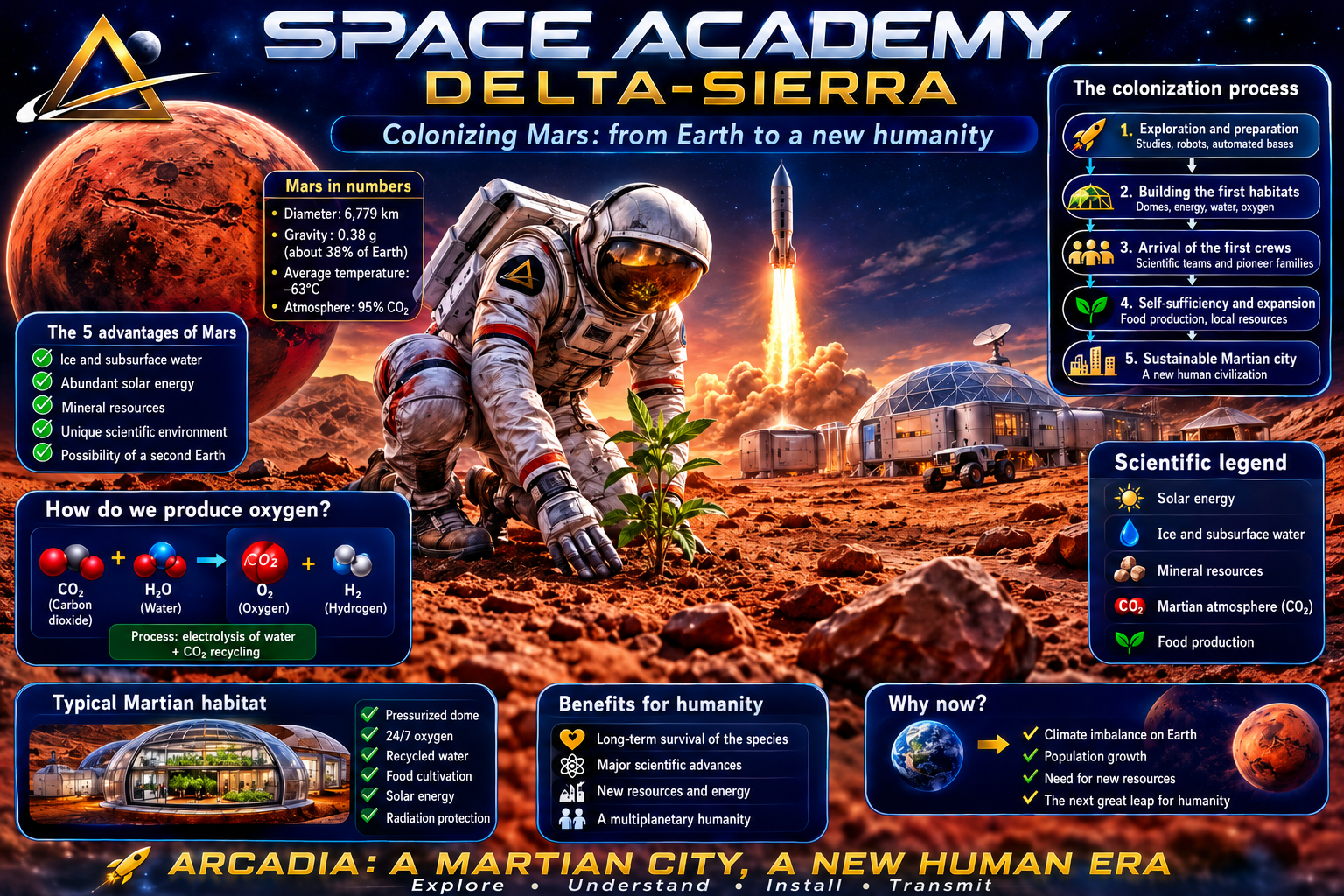
00 — I start from zero
Read formulas, recognize symbols, use a calculator, understand units and orders of magnitude.
- AM-00.01 — Use Space Academy without “going back to school”Available
- AM-00.02 — Read a formula without panickingAvailable
- AM-00.03 — The calculator: what it does and what it does not understandAvailable
- AM-00.04 — SI units: the common language that prevents confusionAvailable
- AM-00.05 — Orders of magnitude: know whether a result is plausible before the decimal pointAvailable
- AM-00.06 — Check whether a result is plausible: five tests before believing itAvailable
- AM-00.07 — The Delta-Sierra reflex: “where are the losses?”Available
01 — Useful mathematics
Fractions, percentages, powers, equations, trigonometry, vectors, derivatives and uncertainty - only when needed.
- AM-01.01 — Fractions, ratios, and proportions: compare without getting lostAvailable
- AM-01.02 — Percentages, efficiency, and losses: turn 98% into what it actually meansAvailable
- AM-01.03 — Powers of ten and scientific notation: write the huge and the tinyAvailable
- AM-01.04 — Equations: find the unknown without magical “move it to the other side” rulesAvailable
- AM-01.05 — Graphs: read change without being fooled by the axisAvailable
- AM-01.06 — Slope and rate of change: how much does it change per unit?Available
- AM-01.07 — Angles, sine, and cosine: turn a direction into componentsAvailable
- AM-01.08 — Vectors: a number that also has a directionAvailable
- AM-01.09 — Coordinates and reference frames: say where a spacecraft actually isAvailable
- AM-01.10 — Exponential and natural logarithm — why logarithms appear in rocketsAvailable
- AM-01.11 — Derivative — measure how fast a quantity changesAvailable
- AM-01.12 — Integral — calculate what accumulates in totalAvailable
- AM-01.14 — Uncertainty and error propagation — know how many digits deserve trustAvailable
02 — Fundamental physics
Motion, mass, weight, force, energy, pressure, fluids, heat, rotation, electricity and waves.
- AM-02.01 — Position, distance, and displacement: “where am I?” is not “how far did I travel?”Available
- AM-02.02 — Speed, velocity, and acceleration: how fast, which direction, and how quickly does it change?Available
- AM-02.03 — Mass, weight, and gravity: why 80 kg does not become 13 kg on the MoonAvailable
- AM-02.04 — Force and Newton’s laws: why a rocket changes motionAvailable
- AM-02.05 — Work, energy, and power: how much energy, and how fast?Available
- AM-02.06 — Momentum: why mass and velocity matter togetherAvailable
- AM-02.07 — Circular motion: why turning requires accelerationAvailable
- AM-02.08 — Gravitation and the 1/r² law: why distance is squaredAvailable
- AM-02.09 — Pressure, density, and fluids: understand what pushes in tanks and linesAvailable
- AM-02.10 — Gases, temperature and thermodynamics — track energy through a systemAvailable
- AM-02.11 — Rotation, torque and moment of inertia — make things turn without confusing force and rotationAvailable
- AM-02.14 — Electricity — voltage, current, resistance and power without magicAvailable
03 — Useful chemistry
Atoms, molecules, H₂O, O₂, CO₂, CH₄, reactions, electrolysis, Sabatier, combustion and cryogenics.
- AM-03.01 — Atom, element, nucleus, and electron: what chemical formulas already assumeAvailable
- AM-03.02 — Molecule and chemical formula: why H₂O means exactly two H for one OAvailable
- AM-03.03 — Why H₂O means two hydrogens for one oxygenAvailable
- AM-03.04 — Molar mass and the mole — count the invisible without counting atoms one by oneAvailable
- AM-03.05 — Chemical reaction and conservation: atoms rearrange; they do not vanishAvailable
- AM-03.07 — Water electrolysis — make oxygen without creating matterAvailable
- AM-03.10 — Combustion and mixture ratio: why an engine does not mix propellants randomlyAvailable
04 — Rockets & engines
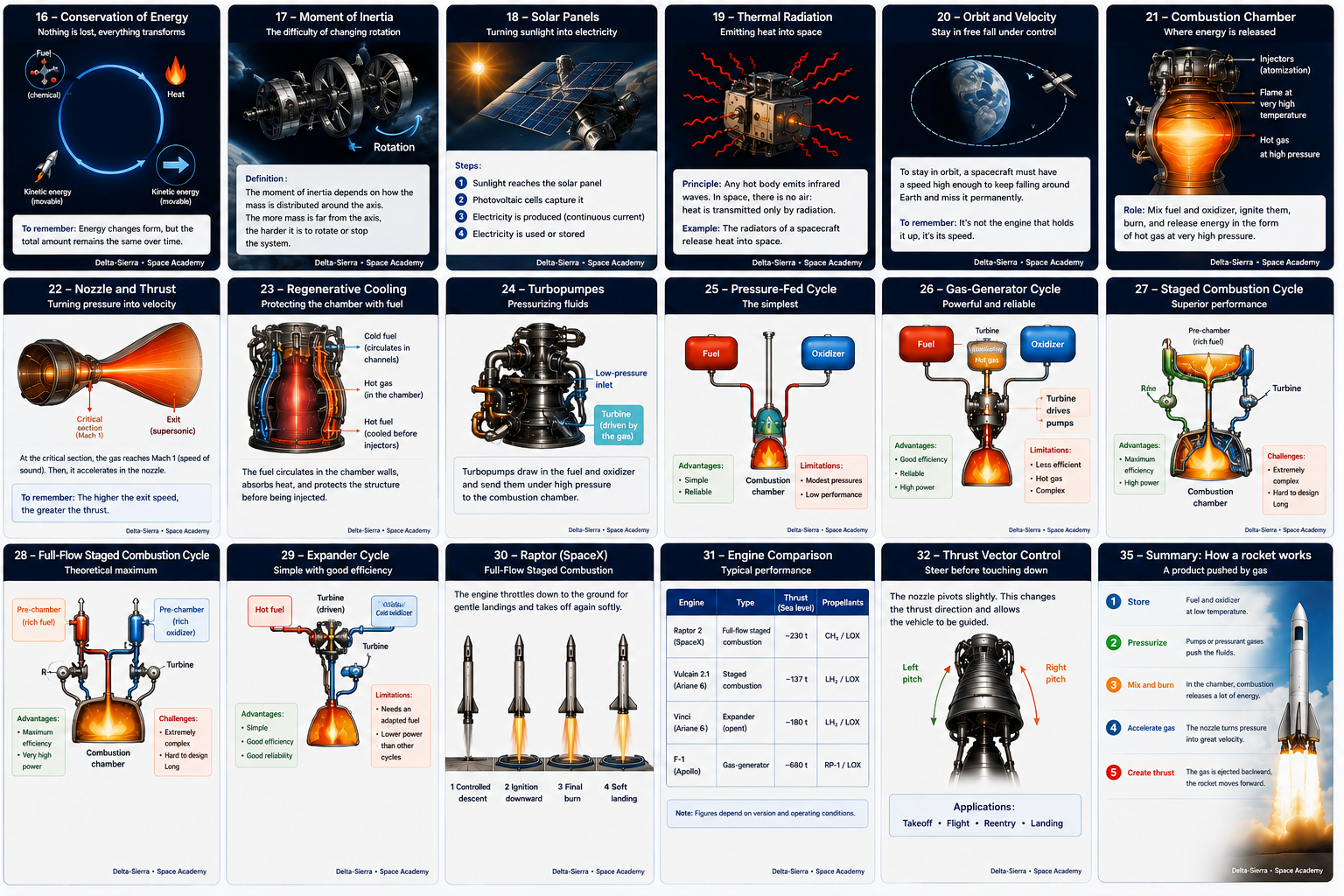
Thrust, mass flow, nozzles, rocket equation, staging, liquid engines, turbopumps, cycles, Raptor, Vulcain and Vinci.
- AM-04.04 — Calculate rocket thrust — and understand where the equation comes fromAvailable
- AM-04.19 — Understand a simple liquid rocket engine — part by partAvailable
- AM-04.20 — From pioneers to the V-2: how a rocket engine becomes a systemAvailable
- AM-04.21 — V-2 anatomy: structure, engine, guidance, and limitsAvailable
- AM-04.22 — Why does a rocket wall have that thickness?Available
- AM-04.23 — Choosing launch-vehicle materials: steel, aluminum, copper, nickel, and compositesAvailable
- AM-04.24 — Saturn V F-1: why correct average thrust is not enoughAvailable
- AM-04.25 — Vulcain and Vinci: two European engines for two different jobsAvailable
- AM-04.26 — Steering thrust: gimbals, actuators, and thrust vector controlAvailable
- AM-04.27 — The rocket tilts by 2°: how does the control loop react?Available
- AM-04.28 — How does a Falcon 9 first stage return and land?Available
- AM-04.29 — Why could a V-2 not return and land like Falcon 9?Available
- AM-04.30 — How does an actuator hold a thrusting rocket engine?Available
- AM-04.31 — Pressurizing propellant tanks: why propellant does not simply “fall” into the engineAvailable
- AM-04.32 — Valves and regulators: how a digital command becomes fluid flowAvailable
- AM-04.33 — Turbopumps: why a powerful engine needs a pump driven by a turbineAvailable
- AM-04.34 — Cavitation: when liquid begins forming bubbles where the pump needs liquidAvailable
- AM-04.35 — Injectors: turn two feed streams into a mixture that can burn stablyAvailable
- AM-04.36 — Combustion chamber: turn chemical reaction into hot gas before the nozzleAvailable
- AM-04.37 — Nozzle throat: why the flow becomes chokedAvailable
- AM-04.38 — Nozzle: turn pressure and heat into velocityAvailable
- AM-04.39 — Regenerative cooling: keep the chamber from meltingAvailable
- AM-04.40 — Ignition and start sequence: start the reaction in the right orderAvailable
- AM-04.41 — Why 5 kg/s rather than 3 or 10? How an engine really controls flowAvailable
- AM-04.42 — O/F mixture ratio: how much oxidizer for how much fuel?Available
- AM-04.43 — Throttling: reduce thrust without shutting the engine downAvailable
- AM-04.44 — Engine sensors: how the machine knows what it is doingAvailable
- AM-04.45 — Engine controller: from sensor to decisionAvailable
- AM-04.50 — Understand the Raptor engine — from simple principle to full-flow cycleAvailable
05 — Orbits
Why satellites keep falling, ellipses, orbital speed, orbital elements, delta-v, Hohmann and rendezvous.
- AM-05.01 — Orbit: why a satellite keeps falling without hitting the planetAvailable
- AM-05.02 — Orbital speed, period and altitude: what changes when you go higherAvailable
- AM-05.03 — Ellipse, periapsis, apoapsis and eccentricity: reading a non-circular orbitAvailable
- AM-05.04 — Kepler’s laws: three rules for understanding orbital motionAvailable
- AM-05.05 — Delta-v, prograde and retrograde: how a short burn reshapes an orbitAvailable
- AM-05.06 — Hohmann transfer: moving between circular orbits with two burnsAvailable
- AM-05.07 — Rendezvous and orbital phasing: meeting an object that is already movingAvailable
06 — Earth → Moon
Where to aim when the Moon moves, windows, translunar injection, corrections, Apollo navigation and return.
07 — Earth → Mars
Launch windows, interplanetary transfer, flight time, corrections, arrival and capture.
- AM-07.01 — Earth–Mars launch window: why you cannot leave on just any dayAvailable
- AM-07.02 — Calculating a simplified Earth–Mars transfer: about 259 days and 44° leadAvailable
- AM-07.03 — Trajectory correction maneuvers: why an almost perfect launch is not enoughAvailable
- AM-07.04 — Arriving at Mars: flyby, orbital capture or atmospheric entryAvailable
08 — Guidance, navigation & control
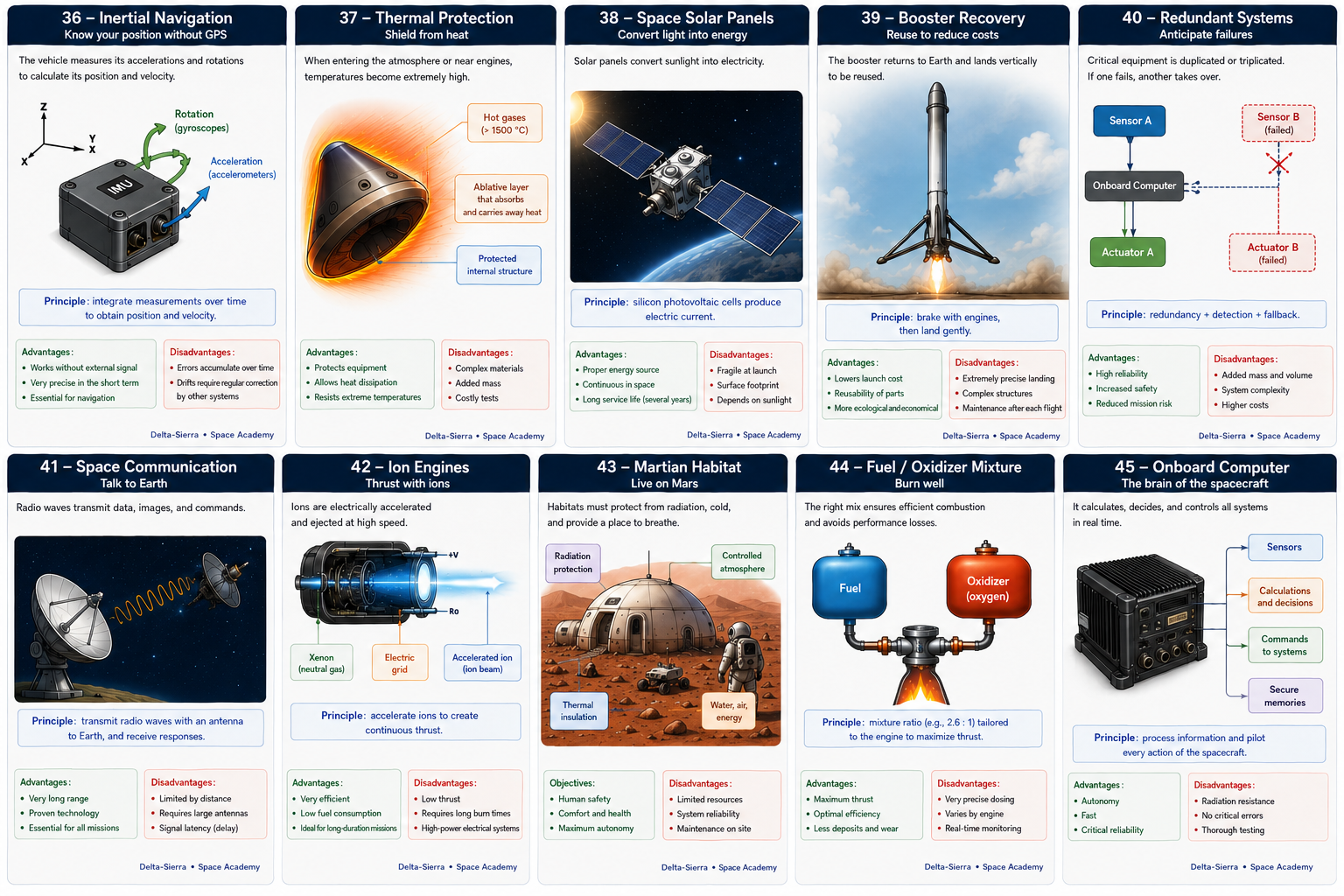
IMUs, gyros, stars, optical navigation, attitude, guidance algorithms and control.
- AM-08.01 — Space navigation: reference trajectory, orbit determination and correctionAvailable
- AM-08.02 — Deep Space Network: measuring distance and velocity with radio signalsAvailable
- AM-08.03 — Reference frames and time: state where and when before computing a trajectoryAvailable
- AM-08.04 — IMU, gyroscopes and accelerometers: sensing motion without GPSAvailable
- AM-08.05 — Star trackers and sensor fusion: finding attitude from the starsAvailable
- AM-08.06 — Optical navigation: using images, planets and terrain to locate yourselfAvailable
- AM-08.07 — Attitude: roll, pitch, yaw and why quaternions existAvailable
- AM-08.08 — Reaction wheels, thrusters and saturation: turning a spacecraft without translating its centreAvailable
- AM-08.09 — GNC: the complete loop that observes, decides and actsAvailable
09 — The spacecraft
Structure, power, thermal control, computers, secondary propulsion, mechanisms and onboard systems.
- AM-09.01 — Spacecraft anatomy: bus, payload and subsystemsAvailable
- AM-09.02 — Structure: loads, vibration, stiffness and marginsAvailable
- AM-09.03 — Electrical power: generate, store, distribute and shed loadsAvailable
- AM-09.04 — Thermal control: radiators, insulation, heaters and heat pipesAvailable
- AM-09.05 — Onboard computer and data: compute, store, command and telemeterAvailable
- AM-09.06 — Flight software, watchdog, FDIR, redundancy and safe modeAvailable
- AM-09.07 — Mechanisms: deployments, actuators and reliabilityAvailable
- AM-09.08 — In-space propulsion: manoeuvring after launchAvailable
- AM-09.09 — Integration: interfaces, budgets, verification and validationAvailable
- AM-09.10 — Design a complete spacecraft: modes, tradeoffs, margins and system decisionsAvailable
10 — Communications
Waves, frequency, Doppler, antennas, light-time, Deep Space Network and autonomy without real-time control.
- AM-10.01 — Radio waves: frequency, wavelength and why λ = c/fAvailable
- AM-10.02 — Antennas: gain, beamwidth and why a large dish must point accuratelyAvailable
- AM-10.03 — Link budget: add gains and losses all the way to the receiverAvailable
- AM-10.04 — Mars relay network: UHF to the orbiter, X-band to EarthAvailable
- AM-10.05 — Light time, latency and atomic clocks: why Mars can never be controlled in real timeAvailable
- AM-10.06 — Optical communications: sending data with a laser through deep spaceAvailable
- AM-10.07 — Modulation and error correction: how bits survive an imperfect signalAvailable
11 — Entry, descent & landing
Entry energy, heat shields, corridors, parachutes, propulsion and heavy EDL.
- AM-11.01 — Mars EDL: understand entry, descent, landing and the energy to dissipateAvailable
- AM-11.02 — Mars atmosphere, drag and dynamic pressure: braking with very little airAvailable
- AM-11.03 — Heat shield, heat flux and ablation: surviving atmospheric entryAvailable
- AM-11.04 — Ballistic coefficient, lift and entry corridor: choosing how to cross the atmosphereAvailable
- AM-11.05 — Entry guidance: bank angle, lift, range and trajectory correctionAvailable
- AM-11.06 — Supersonic parachutes on Mars: operation, loads and scaling limitsAvailable
- AM-11.07 — Supersonic retropropulsion: braking a heavy lander with enginesAvailable
- AM-11.08 — Radar, altimetry and velocimetry: knowing where you are before the groundAvailable
- AM-11.09 — Terrain-relative navigation: recognising Mars to correct positionAvailable
- AM-11.10 — Hazard detection, landing ellipse and landing-site selectionAvailable
- AM-11.11 — Terminal descent, touchdown and plume-surface interaction on MarsAvailable
- AM-11.12 — Heavy human EDL: why moving from 1 tonne to more than 20 tonnes changes the architectureAvailable
12 — Survival
Air, water, CO₂, oxygen, food, ECLSS, hygiene, medicine and radiation.
- AM-12.01 — ECLSS architecture: connecting air, water, waste, thermal control and backup in a Mars habitatAvailable
- AM-12.02 — Habitable atmosphere: total pressure, oxygen and partial pressuresAvailable
- AM-12.03 — CO₂, trace contaminants and ventilation: preventing a toxic atmosphereAvailable
- AM-12.04 — Water recovery: correctly understanding NASA’s 98% milestoneAvailable
- AM-12.05 — Humidity, condensation and microbial control: keeping a habitat dry without over-drying itAvailable
- AM-12.06 — Fire in a Mars habitat: detect, isolate, suppress and recoverAvailable
- AM-12.07 — Depressurization: detecting a leak, isolating a volume and preserving a refugeAvailable
- AM-12.08 — Radiation on Mars: dose, shielding, storm shelter and mission strategyAvailable
- AM-12.09 — Mars spacesuit: pressure, PLSS, mobility and prebreatheAvailable
- AM-12.10 — Mars EVA: airlocks, suitports, planning, return and rescueAvailable
- AM-12.11 — Mars dust: contamination, filtration, abrasion and maintenanceAvailable
- AM-12.12 — Mars nutrition: calories, protein, micronutrients, storage and appetiteAvailable
- AM-12.13 — Crops on Mars: greenhouse, hydroponics, light, water and biological loopsAvailable
- AM-12.14 — Autonomous medicine: diagnostics, pharmacy, treatment and decisions far from EarthAvailable
- AM-12.15 — Sleep, fatigue, psychology and conflict: protecting crew performanceAvailable
- AM-12.16 — Multiple failures: designing a habitat that still saves lives after several failuresAvailable
13 — Living and working elsewhere
Habitats, EVA, vehicles, power, industry, ISRU and surface life.
- AM-13.01 — ISRU: use local resources instead of bringing everything from EarthAvailable
- AM-13.02 — Closed loops: why 90% recycling does not mean autonomyAvailable
- AM-13.03 — Selecting a Mars-base site: resources, hazards and useful distancesAvailable
- AM-13.04 — Utility network: distributing power, water, oxygen and data across the baseAvailable
- AM-13.05 — Pressurized zoning: compartmentalizing the habitat and preparing expansionAvailable
- AM-13.06 — Surface mobility: rovers, cargo, routes and rescueAvailable
- AM-13.07 — Robotics and autonomy: making machines work before, with and after the crewAvailable
- AM-13.08 — ISRU industrial chain: excavation, processing, quality control and storageAvailable
- AM-13.09 — Mars construction: earthworks, regolith, protection and geometric controlAvailable
- AM-13.10 — Logistics and inventory: knowing exactly what the base ownsAvailable
- AM-13.11 — Local manufacturing: metrology, quality control and part requalificationAvailable
- AM-13.12 — Growing the base: modularity, interfaces and commissioningAvailable
14 — Design so it does not fail
Reliability, redundancy, common causes, FMEA, FDIR, maintenance, spares and rescue.
- AM-14.01 — Qualify a material: how do we know it will really survive on Mars?Available
- AM-14.02 — Additive manufacturing: why a printed part is not automatically qualifiedAvailable
- AM-14.03 — Requirements, hazards and FMEA: designing failures before they happenAvailable
- AM-14.04 — Reliability: understanding probability of success in a chain of systemsAvailable
- AM-14.05 — Redundancy and common causes: two machines do not always make two backupsAvailable
- AM-14.06 — Margins, derating and worst case: not designing at the edgeAvailable
- AM-14.07 — Fatigue, thermal cycles and dust: designing for thousands of repetitionsAvailable
- AM-14.08 — Seals, valves and tightness: controlling leaks in a pressurized worldAvailable
- AM-14.09 — Radiation, electronics and data: detecting errors before they become commandsAvailable
- AM-14.10 — Diagnostics and FDIR: detecting, isolating and recovering from anomaliesAvailable
- AM-14.11 — Maintainability: access, repair time and spare strategyAvailable
- AM-14.12 — Verification, validation, qualification and configuration: proving what fliesAvailable
15 — Work as a mission team
Procedures, checklists, mission control, human factors, decisions and autonomy.
- AM-15.01 — Roles, authority and shifts: who decides when Earth cannot answer?Available
- AM-15.02 — Procedures and checklists: guiding action without preventing thoughtAvailable
- AM-15.03 — Delayed communications: working with Earth without waiting for every replyAvailable
- AM-15.04 — Logbook and handover: transmitting the real system stateAvailable
- AM-15.05 — Alarms and decisions under stress: separating urgency, noise and cascadesAvailable
- AM-15.06 — Fatigue and workload: planning a mission humans can actually sustainAvailable
- AM-15.07 — Teamwork: communication, cross-checking and managing disagreementAvailable
- AM-15.08 — Anomaly management: commanding the incident and recovering a safe stateAvailable
- AM-15.09 — Simulation and training: learning failures before experiencing themAvailable
- AM-15.10 — Earth-Mars team: planning science, maintenance and autonomy over several daysAvailable
16 — Final missions
Complete case studies where the learner builds, calculates, critiques and defends a mission architecture.
- Design an end-to-end Earth–Mars missionAvailable
- Precursor cargo mission: deliver and activate a base before the crewAvailable
- Crewed transit: close air, water, power and maintenance budgetsAvailable
- Land a heavy payload: trade a 20–30 tonne EDL systemAvailable
- The first thirty sols: move from landing to a stable baseAvailable
- Water–oxygen–power campaign: operate a small industrial plantAvailable
- Long-range EVA: rover failure and crewmember rescueAvailable
- Dust storm and degraded power: survive one weekAvailable
- Leak plus fire: manage two emergencies that conflictAvailable
- Failure with no spare: manufacture, inspect and requalify a local partAvailable
- Medical emergency under radio delay: decide before Earth repliesAvailable
- Final mission: grow the settlement for 500 sols despite failuresAvailable
Final missions — architecture defense
Twelve integrative case studies. Each includes assumptions, calculations, an injected failure, a decision, deliverables and a scoring rubric. The goal is to defend a coherent architecture, not recite a lesson.
No account is required. stores started and acquired courses locally and lets you export/import a small JSON backup file. Optional server synchronization can be added later without changing the data model.