Key idea
Integration: interfaces, budgets, verification and validation. The question to solve is: Why do ten qualified units not automatically make a qualified spacecraft? Two boxes work separately but become incompatible together because of voltage, temperature or protocol differences. Integration creates new risks. The rest of the course turns that idea into an auditable line of reasoning: explicit units, stated assumptions, reproducible calculations, order-of-magnitude checks and interpretation limits. A result is useful only when the reader can explain what it measures, where every input came from and which engineering decision it can support.
Starting synthesis: derivations, examples, limitations and sources are developed in the course body.
Key concepts before you begin
unit · assumption · mass · power · orbit
1 — The concrete scene
Two boxes work separately but become incompatible together because of voltage, temperature or protocol differences. Integration creates new risks.
2 — Essential words, explained before using them
- ICD
- Interface Control Document.
- Verification
- Prove compliance with requirements.
- Validation
- Prove fitness for actual need.
- Configuration
- Exact hardware-software-parameter version.
- Budget
- Allocation of a limited resource.
- End-to-end
- Test crossing multiple functions.
3 — See the architecture before calculating
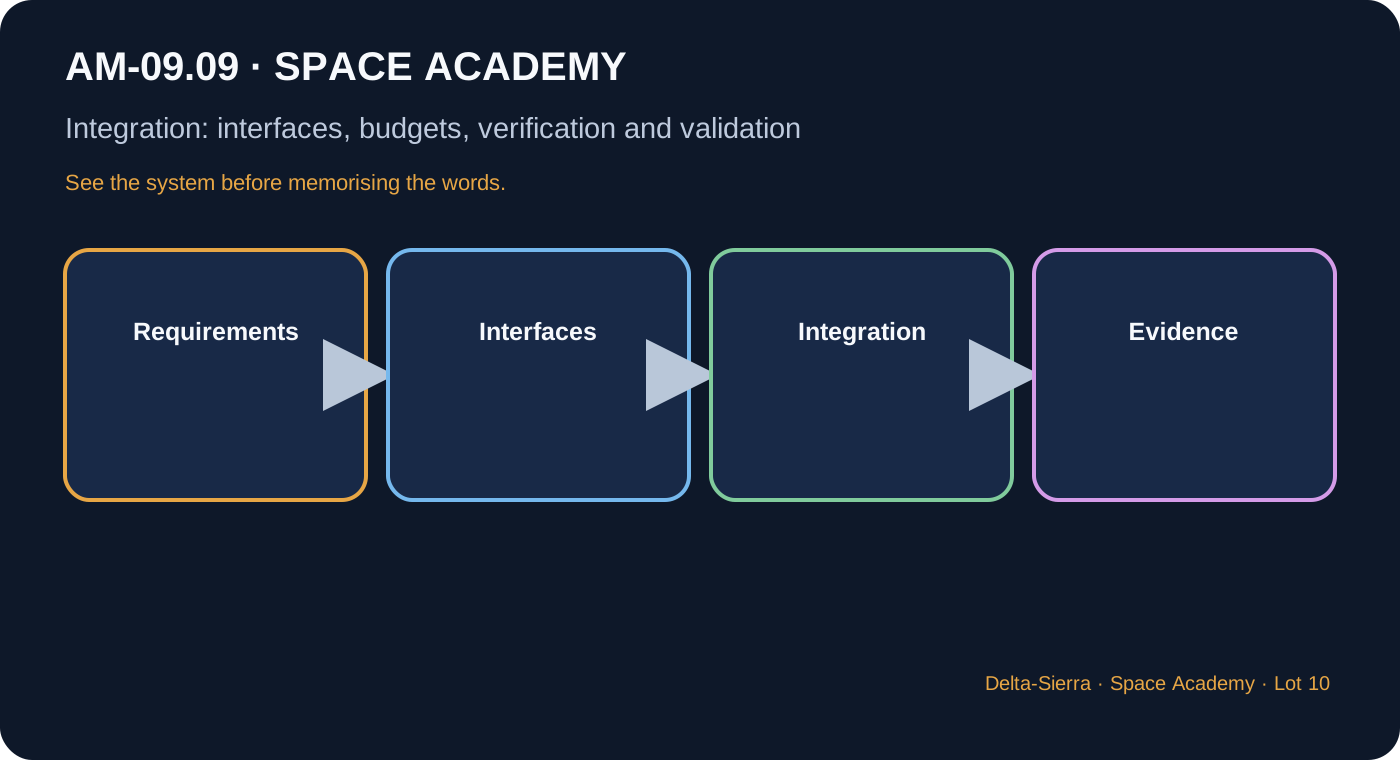
Interfaces
Write mechanical, electrical, thermal, data and software interfaces.
Progression
Unit → assembly → chain → vehicle.
Evidence
Analysis, inspection, test or demonstration by requirement.
Configuration
Evidence belongs to a specific version.
4 — Formulas, only when they answer a question
How to read it : margin equals capability minus need
Simple absolute margin; real convention must be stated.
How to read it : relative margin in percent
Teaching form, not universal.
5 — What units and margins mean
Keep each budget unit: kg, W, K, N, bit/s, dimensions and protocols do not mix.
6 — Three concrete demonstrations, calculated step by step
Power margin
Capability 1,000 W, need 850 W.
M=150 W
M%=150/850×100
≈17.6%
Thermal interface
Box 120 W, interface 100 W.
Need=120 W
Capability=100 W
M=-20 W
Configuration
Test passed in v3.2, logic changed in v3.3.
Evidence=v3.2
Configuration=v3.3
Determine what needs retest.
7 — Deepening: what the simplified diagram hides
Living ICD
Changes propagate to affected parties.
EMC
A neighbour can emit or suffer interference.
Verification / validation
Meeting a document is not always meeting actual use.
Test as you fly
Make tests and sequences as representative as reasonable.
Anomalies
Understand cause before closing the problem.
8 — Application to an Earth-Mars spacecraft
9 — Reference dossier: what a real project must still consider
Integration means managing boundaries
Two units can work separately and fail when connected. Integration verifies mechanical, electrical, thermal, software, RF, fluid and operational interfaces. Interface Control Documents formalise parameters and ownership, but their value depends on remaining current as the design changes.
Budgets evolve until late in the project
Mass, peak power, data rate and thermal predictions change as detail grows. Systems engineering tracks budgets and margins over time and defines when changes require approval and re-analysis by affected subsystems.
Verification and validation are different
Verification asks whether the system meets its requirements. Validation asks whether those requirements and the resulting system actually satisfy the mission need. Both are necessary; a perfectly compliant system can still solve the wrong problem.
Test as you fly, fly as you test
Testing should represent flight configuration and sequences as closely as practical, while flight should avoid untested modes. A complete Mars mission cannot be reproduced on Earth, so environmental tests, simulations, hardware benches and operational rehearsals are combined with explicit knowledge of what remains extrapolated.
Electromagnetic compatibility is invisible but real
Power converters, motors, radios and digital clocks can disturb other equipment through conducted or radiated noise. Cable routing, shielding, grounding and filters are integration issues, and some problems appear only in the complete configuration.
Anomaly management requires cause, not just replacement
Test anomalies must be recorded, reproduced where possible, analysed and closed with rationale. Replacing a failed part without understanding the cause can hide a systemic problem. Traceability lets similar hardware and interfaces be checked.
Mars integration becomes logistics infrastructure
Adding a module to a settlement requires compatibility with existing power, data, fluids, dimensions, software, safety and maintenance. Local interface standards, test benches, calibration references and configuration management become part of industrial autonomy.
10 — Common traps and bad intuitions
- Qualified components ≠ qualified system.
- Confusing verification and validation.
- Giving margin without definition.
Integration is where correct subsystems can fail together
Testing power, computer, radio and mechanisms separately does not prove the integrated vehicle works. Integration exposes connector, voltage, protocol, timing, mechanical reference, software and procedure mismatches that isolated benches may hide.
System budgets must use consistent configurations and modes. Mass reserve consumed by one subsystem reduces total margin; additional power can enlarge batteries and radiators; a mechanical change can affect natural frequency and pointing. Configuration control is therefore an engineering function in its own right.
Verification asks whether a specified requirement has been met. Validation asks whether the implemented system actually satisfies the mission need. A perfectly verified requirement can still be the wrong requirement.
11 — Guided exercises
Question : What question comes before choosing hardware?
Question : Why is a nominal result insufficient?
12 — What to remember
- Explain the topic in simple words before symbols.
- Connect at least four interfaces with other subsystems.
- Redo the three numerical examples without reasoning gaps.