Key idea
Design a complete spacecraft: modes, tradeoffs, margins and system decisions. The question to solve is: How do you choose between two architectures when neither is best everywhere? No subsystem can be maximised independently. More shielding adds mass; more power can require more radiator and battery; more redundancy adds mass and software; higher propulsion performance can add storage or thermal complexity. Systems engineering therefore compares architectures rather than isolated components. The rest of the course turns that idea into an auditable line of reasoning: explicit units, stated assumptions, reproducible calculations, order-of-magnitude checks and interpretation limits. A result is useful only when the reader can explain what it measures, where every input came from and which engineering decision it can support.
Starting synthesis: derivations, examples, limitations and sources are developed in the course body.
Key concepts before you begin
bus · redundancy · vibration · unit · assumption
1 — The concrete scene
2 — Essential words, explained before using them
- Tradeoff
- Balance among competing criteria.
- Mode
- Functional configuration for a phase.
- Allocation
- Assigned share of a resource.
- Risk
- Possibility and consequence according to method.
- Margin
- Reserve for uncertainty or growth.
- Traceability
- Requirement-decision-evidence link.
3 — See the architecture before calculating
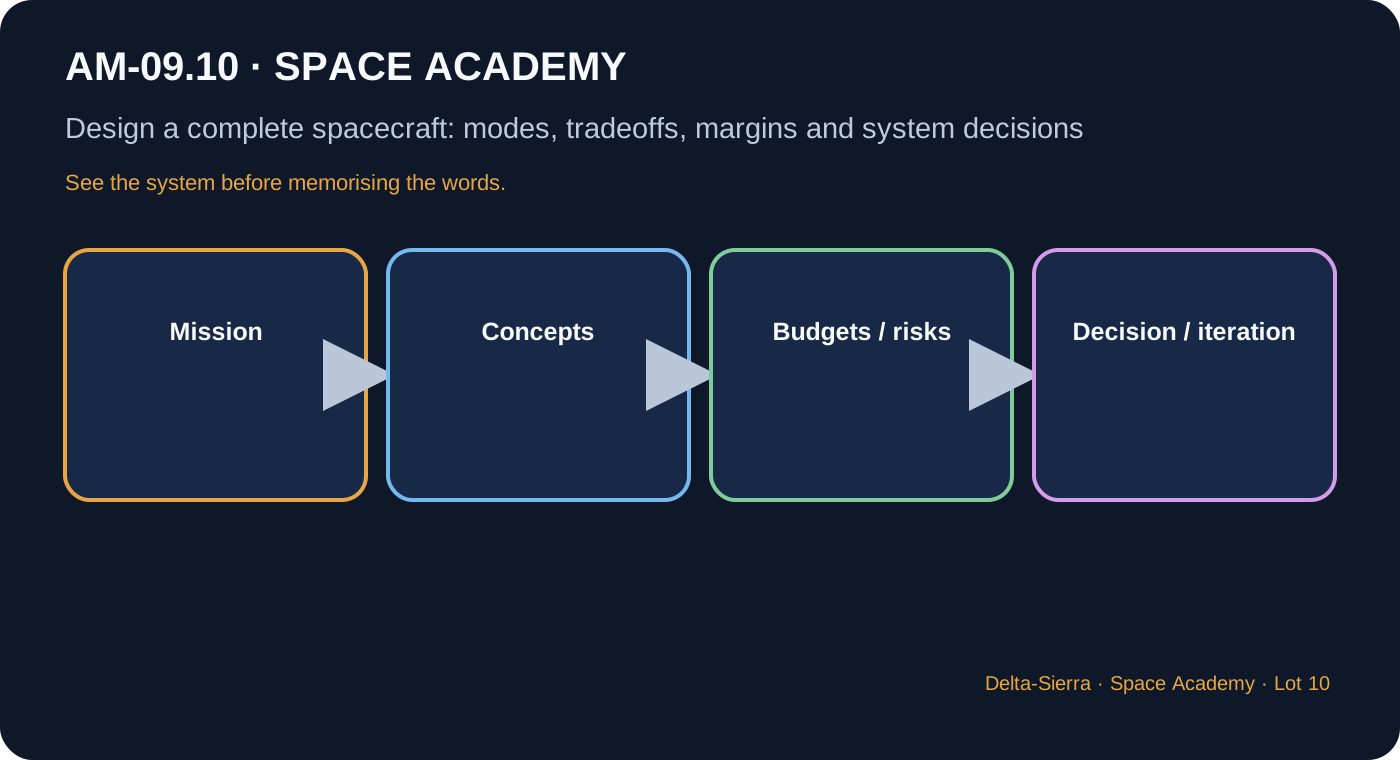
Scenarios
List launch, cruise, emergency and arrival.
Concepts
Keep multiple solutions alive long enough.
Criteria
Compare mass, power, risk, maturity and maintainability.
Iteration
A local choice moves other budgets.
4 — Formulas, only when they answer a question
How to read it : score equals sum of weight times rating
Structures a comparison but weights remain a choice to justify.
How to read it : reserve equals capability minus need
Positive mass reserve does not compensate negative power reserve.
5 — What units and margins mean
Criteria can have incompatible units; they only become addable after explicit normalisation in a decision method.
6 — Three concrete demonstrations, calculated step by step
Matrix
A: mass 8/10, robustness 4/10. B: 6/10 and 8/10. Weights 40/60.
A=0.4×8+0.6×4=5.6
B=0.4×6+0.6×8=7.2
B wins with these weights.
Mass growth
8,000 kg with 15% reserve, +600 kg growth.
Initial reserve=1,200 kg
Growth=600 kg
Remaining=600 kg
Emergency mode
Two 400 W heaters, one nominally, both in emergency.
Nominal=400 W
Emergency=800 W
Check emergency budget.
7 — Deepening: what the simplified diagram hides
Requirement hierarchy
Local optimisation must not violate system objective.
Maturity
Promising technology can increase development risk.
Maintainability
On long missions, diagnosis and repair can be worth mass.
Growth
Margins are consumed as design matures.
Irreversibility
Identify early decisions that close options.
8 — Application to an Earth-Mars spacecraft
9 — Reference dossier: what a real project must still consider
Complete spacecraft design means tradeoffs
No subsystem can be maximised independently. More shielding adds mass; more power can require more radiator and battery; more redundancy adds mass and software; higher propulsion performance can add storage or thermal complexity. Systems engineering therefore compares architectures rather than isolated components.
Requirements need traceable hierarchy
A high-level need such as safe crew return decomposes into functions and subsystem requirements. Each lower-level requirement should retain its reason for existence so the impact of mission changes can be traced across thermal, power, storage, maintenance and life support.
Technology maturity changes development risk
A high-performance technology can still be immature, difficult to manufacture or poorly tested in the relevant environment. Demonstrators and qualification campaigns reduce uncertainty before a technology becomes mission-critical. Useful innovation includes a credible path to qualification.
Margins are resources that get consumed
Early design contains high uncertainty, so projects keep reserve. As detail grows, some uncertainty falls while new needs appear. Tracking trend and remaining margin is more informative than one final number. Margin first protects against the unknown; it is not automatically free capacity for new features.
Maintainability changes with mission duration
Short missions can tolerate some non-repairable equipment. Multi-year Mars infrastructure cannot apply that philosophy everywhere. Diagnostics, access, modularity, spares, documentation, training and local manufacturing may justify additional launch mass.
Recognise irreversible decisions
Some choices are easy to change; others lock many future interfaces. Habitat diameter, bus voltage, data standards or tank architecture may shape decades of hardware. Irreversible choices deserve early analysis, while replaceable details can stay open longer.
The real mission is a set of scenarios
A spacecraft must survive launch, cruise, corrections, communications, anomalies, approach, safe mode and possibly return. Each scenario activates different functions and risks. Mode analysis, failure analysis and operational testing build a coherent system view, especially when several faults combine.
10 — Common traps and bad intuitions
- Treating a score as objective truth.
- Maximising every subsystem alone.
- Using average instead of peak modes.
Designing the complete spacecraft means managing moving trade-offs
Architecture begins with mission phases and modes: launch, cruise, maneuver, science, faults, safe mode and end of life. Different subsystems and resources are active in each mode, so the vehicle is a time-varying network of dependencies rather than a simple mass sum.
Trade-offs carry second-order effects. More battery adds energy but also mass and thermal burden; more redundancy adds interfaces and software; lighter structure can increase vibration and qualification cost. Local optimization can damage the total mission.
Design maturity appears in margins and configuration. Early uncertainty demands larger reserves. As models and tests converge, margins are consumed or released. A late change is acceptable only if its consequences propagate through all budgets and evidence.
11 — Guided exercises
Question : What question comes before choosing hardware?
Question : Why is a nominal result insufficient?
12 — What to remember
- Explain the topic in simple words before symbols.
- Connect at least four interfaces with other subsystems.
- Redo the three numerical examples without reasoning gaps.