Key idea
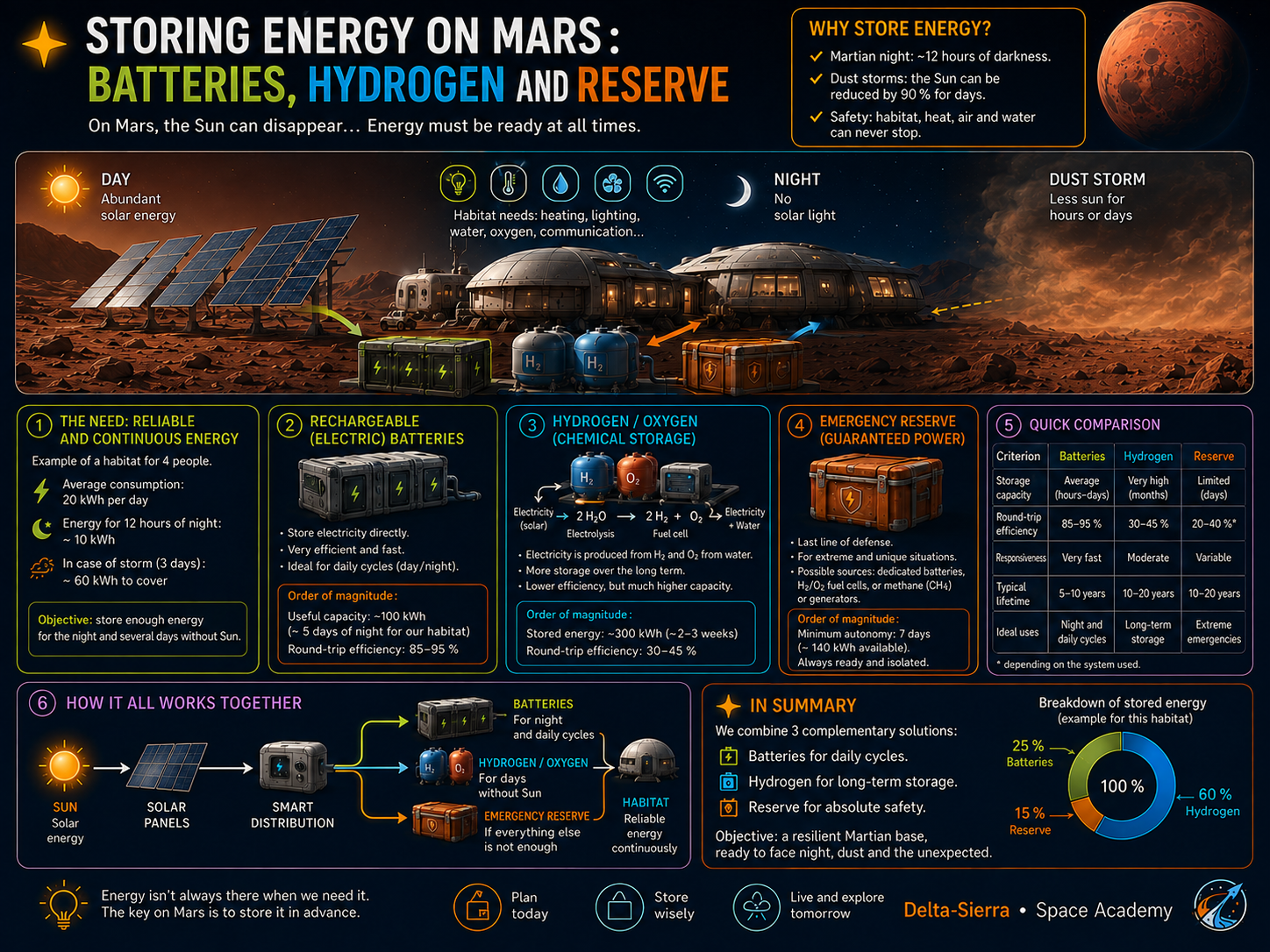
Electrical power: generate, store, distribute and shed loads. The question to solve is: How can you have enough energy without lacking power at the wrong moment? Arrays, battery and distribution must simultaneously support critical loads. A large battery does not fix an undersized converter or cable. The rest of the course turns that idea into an auditable line of reasoning: explicit units, stated assumptions, reproducible calculations, order-of-magnitude checks and interpretation limits. A result is useful only when the reader can explain what it measures, where every input came from and which engineering decision it can support.
Starting synthesis: derivations, examples, limitations and sources are developed in the course body.
Key concepts before you begin
bus · thermal control · unit · assumption · efficiency
1 — The concrete scene
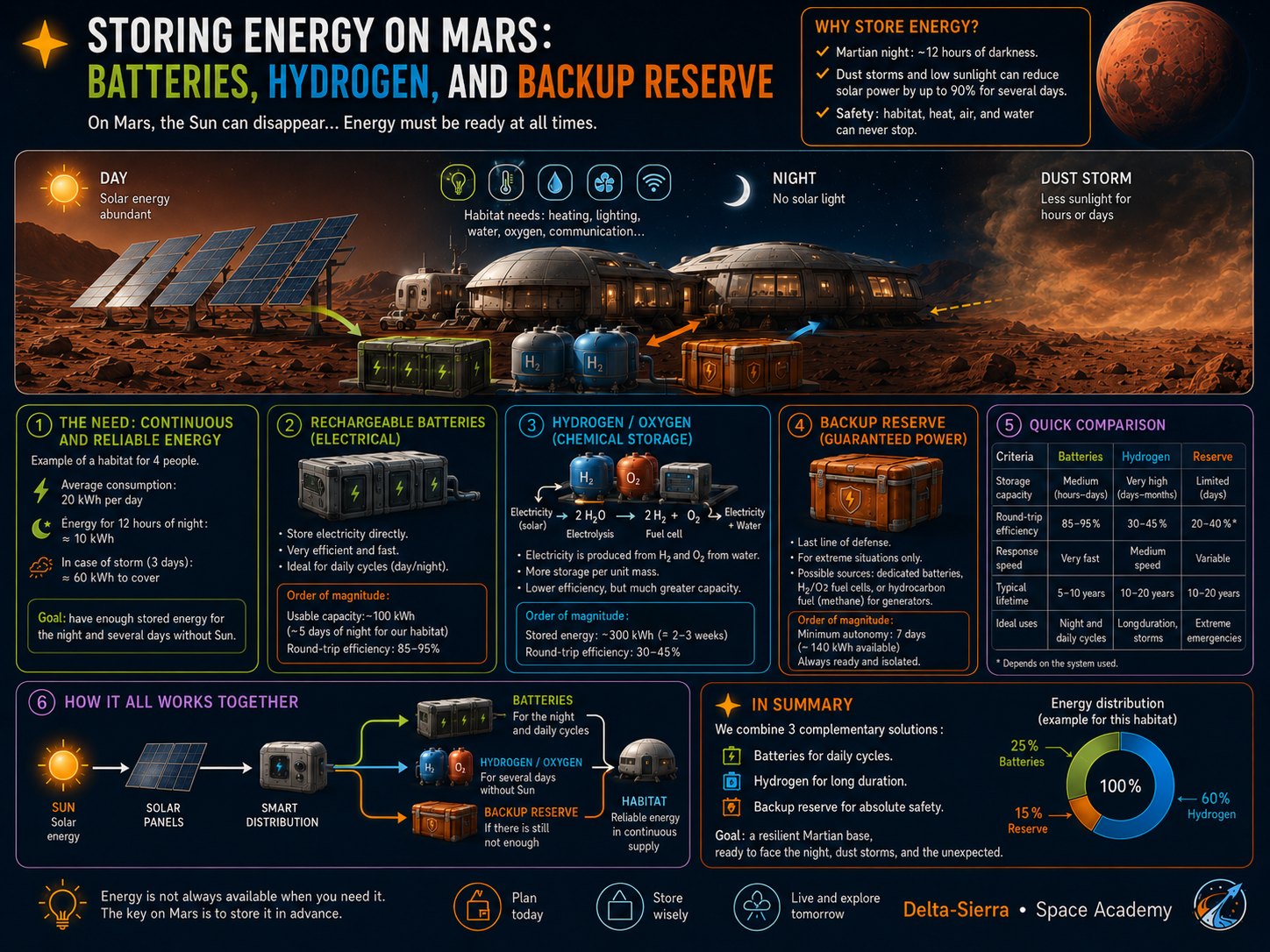
Arrays, battery and distribution must simultaneously support critical loads. A large battery does not fix an undersized converter or cable.
2 — Essential words, explained before using them
- Power
- Rate of energy transfer, in watts.
- Energy
- Amount accumulated over time.
- Power bus
- Distribution network.
- Converter
- Adapts voltage or current with losses.
- Battery
- Electrochemical storage.
- Load shedding
- Switch off lower-priority loads.
3 — See the architecture before calculating
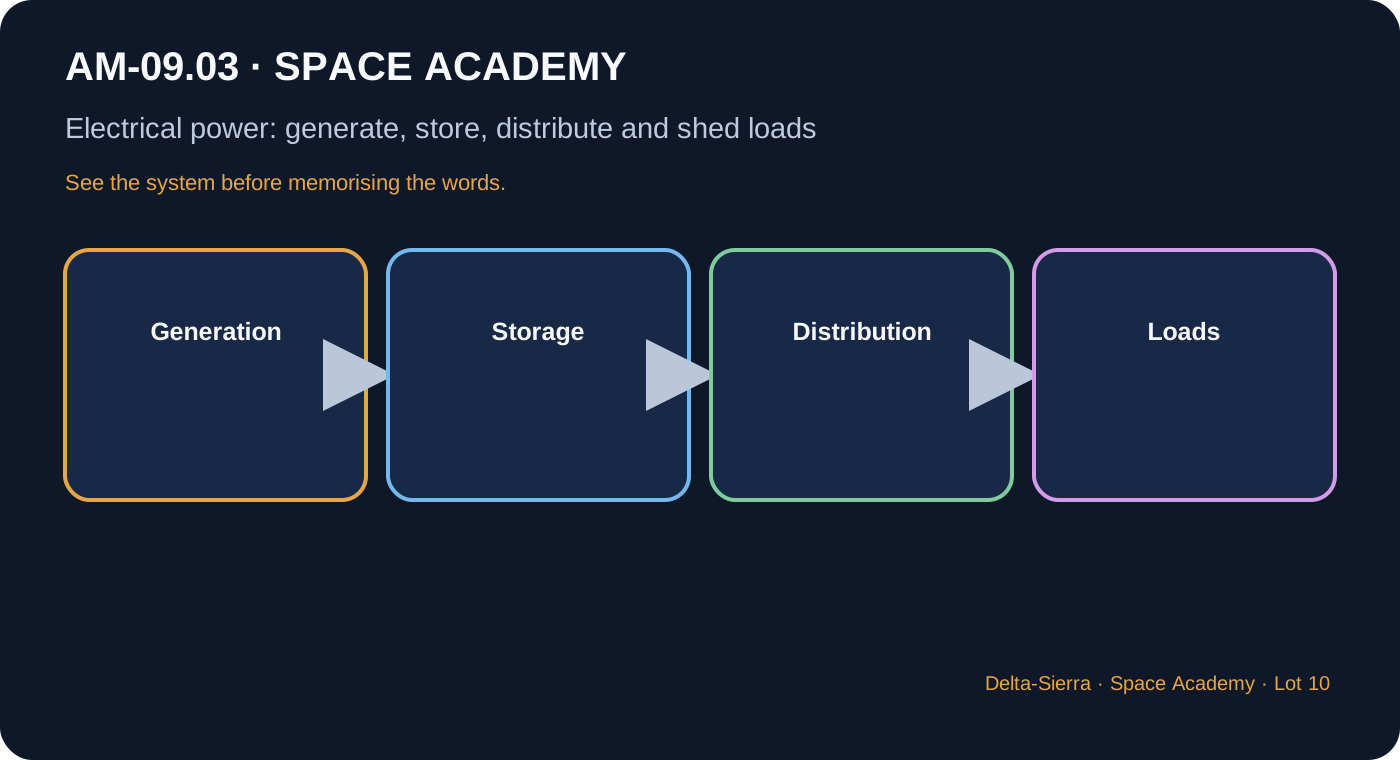
Generation
Capability depends on illumination, pointing, temperature and ageing.
Storage
State of charge and available power are different concepts.
Distribution
Wiring, protection and converters have limits.
Priorities
Degraded mode sheds non-vital loads.
4 — Formulas, only when they answer a question
How to read it : power equals voltage times current
U in volts, I in amperes.
How to read it : energy equals power times time
For constant P, Wh is W times hours.
How to read it : loss equals current squared times resistance
Doubling current quadruples this loss.
5 — What units and margins mean
V, A, W, Wh/J and Ω. 1 Wh = 3,600 J.
6 — Three concrete demonstrations, calculated step by step
Battery
300 W for 3 h.
E=300×3=900 Wh
Teaching 20% reserve=180 Wh
Total=1,080 Wh
Bus current
1,200 W on 48 V.
I=1,200/48=25 A
If R=0.02 Ω: loss=25²×0.02
=12.5 W
Load shedding
Capacity 2,000 W, demand 2,350 W.
Deficit=350 W
Shed 500 W non-critical
New demand=1,850 W
7 — Deepening: what the simplified diagram hides
Battery health
Capability ages and depends on temperature.
Protection
A short circuit must be isolated without blacking out the vehicle.
Power quality
Ripple and transients can disturb hardware.
Mode budgets
Peak often sizes the system more than average.
Thermal coupling
Electrical losses become heat to reject.
8 — Application to an Earth-Mars spacecraft
9 — Reference dossier: what a real project must still consider
Power and energy are not the same
Power is the rate at which energy is produced or consumed; energy is the accumulated amount over time. A 1,000 W load for ten seconds does not require the same battery capacity as a 200 W load for ten hours. Generation, storage and distribution therefore solve related but different problems.
Build budgets by operating mode
A useful power budget lists each load, activity mode, efficiency, duration and priority. It separates average power, transient peak and daily energy. Critical loads must often survive load shedding, so the system needs a planned order for disconnecting non-essential consumers.
A battery is not an ideal tank
Usable capacity depends on temperature, current, state of charge, depth of discharge, ageing and cycle history. Battery management monitors cells and enforces limits. For a long mission, end-of-life capacity is more important than first-day capacity.
Distribution, conversion and protection
Sources rarely provide the exact voltage needed by every load. Converters regulate power but lose energy as heat. Protection devices isolate short circuits, and branch architecture should keep one local fault from collapsing the complete bus.
Power quality and compatibility
A nominal voltage does not describe ripple, noise, inrush current or transients. Motors and switching loads can disturb sensitive sensors, so grounding, filtering, wiring and sequencing are part of system design and must be tested in the integrated configuration.
Direct coupling to thermal control
Most electrical power consumed inside the spacecraft ultimately becomes heat. A more efficient converter therefore saves energy and reduces thermal load at the same time. This is a classic system-level trade rather than an isolated subsystem improvement.
Mars production, storage and survival
Transit and surface operations have different profiles. Solar availability varies with day, season and dust, while nuclear sources have different constraints. The design must distinguish adequate average energy from guaranteed power during the worst credible period.
10 — Common traps and bad intuitions
- Confusing W and Wh.
- Assuming a battery can deliver any power.
- Ignoring losses and peaks.
Electrical power must be budgeted by mode, not by average
Generation, storage, conversion, distribution, protection and loads form one power system. Solar arrays might provide enough energy over a day while still being unable to support a short peak without batteries. A large battery likewise cannot compensate for insufficient generation over many days.
Power in watts and energy in watt-hours must be separated. Each operating mode combines continuous and temporary loads, conversion losses and margin. End-of-life cases can be harder than beginning-of-life because solar cells and batteries degrade.
Load shedding is a safety function. When generation or storage is inadequate, non-critical users are removed first so computing, minimum thermal control, communications and recovery functions remain powered. The priority must exist before the emergency.
11 — Guided exercises
Question : What question comes before choosing hardware?
Question : Why is a nominal result insufficient?
12 — What to remember
- Explain the topic in simple words before symbols.
- Connect at least four interfaces with other subsystems.
- Redo the three numerical examples without reasoning gaps.