Key idea
Structure: loads, vibration, stiffness and margins. The question to solve is: Why must spacecraft structure be light without becoming fragile or too flexible? During launch a structure sees acceleration, vibration and shock. In cruise loads drop but alignment and thermal expansion still matter. The rest of the course turns that idea into an auditable line of reasoning: explicit units, stated assumptions, reproducible calculations, order-of-magnitude checks and interpretation limits. A result is useful only when the reader can explain what it measures, where every input came from and which engineering decision it can support.
Starting synthesis: derivations, examples, limitations and sources are developed in the course body.
Key concepts before you begin
vibration · unit · assumption · percentage · acceleration
1 — The concrete scene
During launch a structure sees acceleration, vibration and shock. In cruise loads drop but alignment and thermal expansion still matter.
2 — Essential words, explained before using them
- Load
- Applied demand: tension, compression, bending, vibration or shock.
- Stress
- Force divided by area.
- Stiffness
- Ability to limit deformation.
- Natural frequency
- Natural vibration frequency.
- Resonance
- Amplification near a natural frequency.
- Buckling
- Loss of stability of a compressed member.
3 — See the architecture before calculating
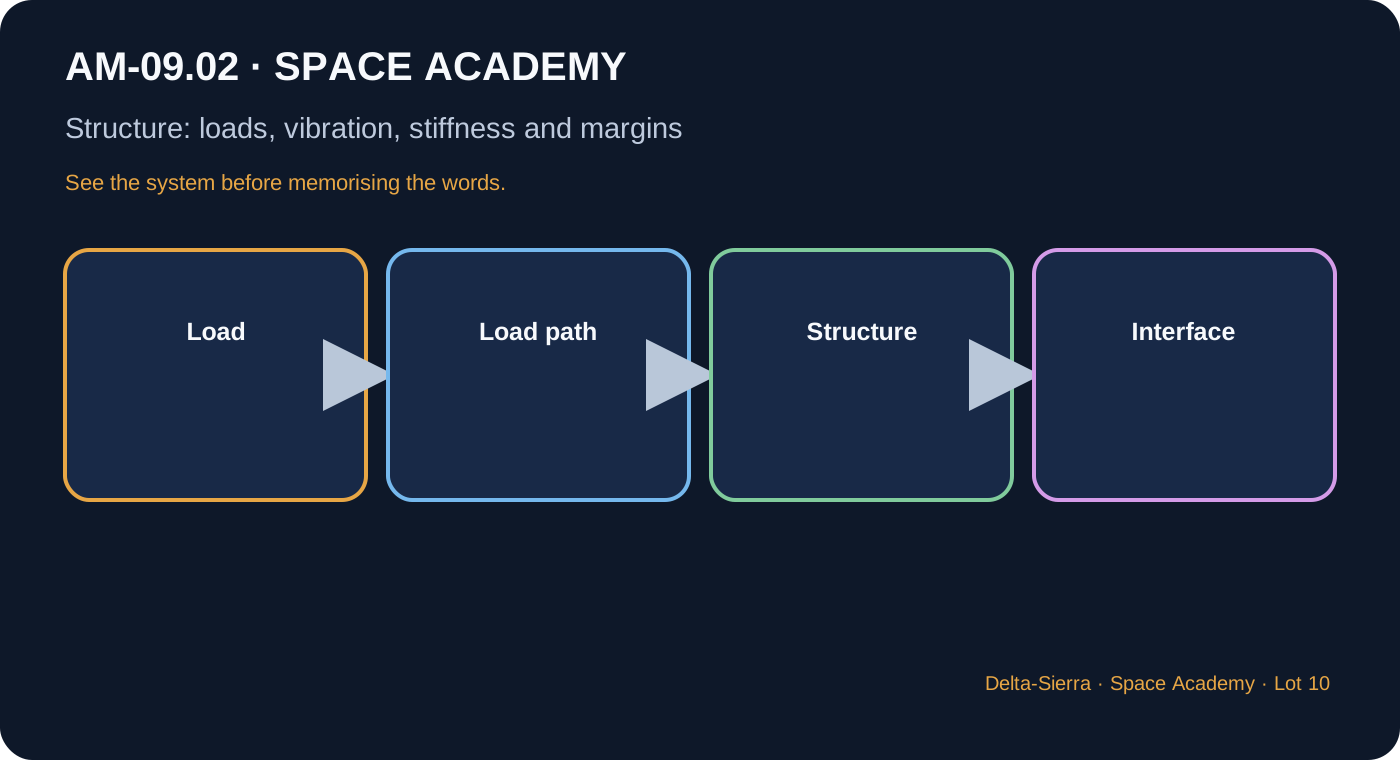
Load path
Load must travel continuously to supports.
Stiffness before failure
An instrument can lose alignment without material breaking.
Vibration
Natural modes interact with launcher or mechanisms.
Thermal
Different materials expand differently.
4 — Formulas, only when they answer a question
How to read it : sigma equals force divided by area
Simple average stress; geometric details create concentrations.
How to read it : force equals mass times acceleration
First inertial load estimate, not a complete vibration model.
5 — What units and margins mean
N for force, Pa or MPa for stress, Hz for frequency, m or mm for deformation.
6 — Three concrete demonstrations, calculated step by step
Inertial load
50 kg at 6 g, g=9.81 m/s².
a=58.86 m/s²
F=50×58.86=2,943 N
≈2.94 kN
Average stress
20 kN through 400 mm².
400 mm²=0.0004 m²
σ=20,000/0.0004
σ=50 MPa
Expansion
2 m aluminium, ΔT=60 K, α=23×10⁻⁶/K.
ΔL=αLΔT
=23×10⁻⁶×2×60
=2.76 mm
7 — Deepening: what the simplified diagram hides
Primary / secondary
Primary structure carries critical loads; secondary supports equipment.
Buckling
A member can lose stability before simple material strength.
Fatigue
Cycles accumulate damage.
Modal tests
Tests correlate vibration models.
Interfaces
A small fastener can be more critical than a large panel.
8 — Application to an Earth-Mars spacecraft
9 — Reference dossier: what a real project must still consider
Space structure is more than static weight
Spacecraft experience acceleration, vibration, acoustic, pressure, manoeuvre and thermal loads. During launch, even a light box can create large forces because acceleration multiplies inertia. Loads travel through equipment, fasteners, panels, frames and the launch adapter. A small insert or bolt may therefore control a much larger assembly. Start by identifying load paths, not by simply making panels thicker.
Strength, stiffness and stability are different
A part can remain unbroken yet become unusable. Excess deformation can spoil antenna pointing or jam a mechanism. Stiffness controls deformation and natural frequencies; stability includes buckling, where a compressed shell may suddenly deform before the material reaches a simple strength limit. Margins must therefore be assessed for each relevant failure mode.
Why launch vibration matters
Launch vibration and acoustics excite structural natural frequencies. Excitation near a mode can amplify response through resonance. Modal models and tests are used to check real frequencies and damping. Even a modest mass change can move a natural frequency, so mechanical configuration must stay controlled through integration.
Fatigue makes repeated small loads important
Failure can grow from repeated cycles rather than one extreme load. Thermal cycles, pressure cycles, mechanisms and vibration can initiate and propagate cracks. Long Mars missions increase some cycle counts, making stress concentrations, manufacturing quality and inspection important.
Thermal expansion becomes structural
Different materials expand differently. Rigidly joining aluminium, composites, optics and electronics can create thermal stress or misalignment. Flexible mounts, controlled clearances or compatible materials are therefore used. Structural analysis and thermal analysis cannot be isolated from each other.
A positive margin is not automatic safety
Every margin depends on assumptions about loads, material properties, factors, geometry, temperature and manufacturing scatter. A large numerical margin is meaningless if the load case is wrong. Data provenance and combined worst cases matter.
Test and model correlation
Finite-element analysis remains a model. Vibration tests, static tests, modal measurements and inspection compare reality with prediction. Differences are used to update the model before extrapolation. This analysis-test-correlation loop turns a theoretical model into a trusted engineering tool.
10 — Common traps and bad intuitions
- Confusing strength and stiffness.
- Using F=ma as a full vibration environment.
- Ignoring buckling and stress concentrations.
Space structures must survive contradictory environments
During launch the structure carries acceleration, vibration, acoustics and interface loads. In cruise it becomes a precision reference that must keep antennas, sensors and mechanisms aligned through thermal cycles and aging. Added stiffness can improve pointing while increasing mass and transmitting vibration.
Natural frequencies matter because excitation near a structural mode can amplify response. Modal analysis and vibration testing protect against resonance. Buckling is a different instability: a thin compressed member can lose its shape before the material reaches its simple strength limit.
Margins are therefore attached to specific load cases, uncertainties, materials and fatigue assumptions rather than one universal percentage. Final evidence combines analysis, correlated models and environmental tests.
11 — Guided exercises
Question : What question comes before choosing hardware?
Question : Why is a nominal result insufficient?
12 — What to remember
- Explain the topic in simple words before symbols.
- Connect at least four interfaces with other subsystems.
- Redo the three numerical examples without reasoning gaps.