Course compass
Delta-v, prograde and retrograde: how a short burn reshapes an orbit. The lesson starts from a concrete situation, defines every term and symbol, then introduces formulas and mission use.
Key idea
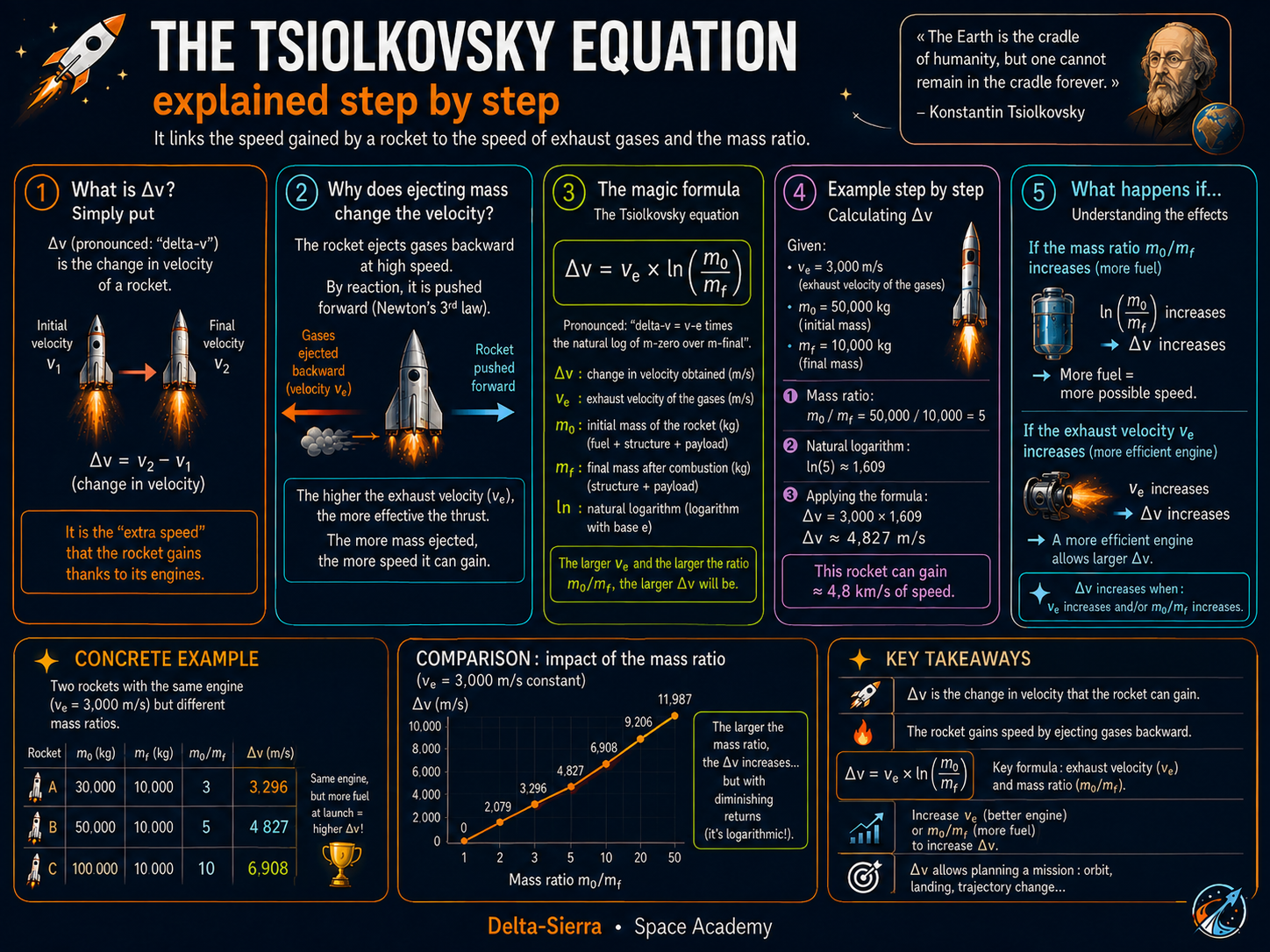
Delta-v, prograde and retrograde: how a short burn reshapes an orbit. Delta-v , prograde and retrograde: how a short burn reshapes an orbit. The lesson starts from a concrete situation, defines every term and symbol, then introduces formulas and mission use. The rest of the course turns that idea into an auditable line of reasoning: explicit units, stated assumptions, reproducible calculations, order-of-magnitude checks and interpretation limits. A result is useful only when the reader can explain what it measures, where every input came from and which engineering decision it can support.
Starting synthesis: derivations, examples, limitations and sources are developed in the course body.
Key concepts before you begin
orbit · periapsis · apoapsis · delta-v · rendezvous
1 — Build a mental picture before using a formula
Orbital mechanics often asks not 'how fast are we going?' but 'how much must we change velocity?' That required change is delta-v. A short burn can reshape an entire orbit.
2 — Essential vocabulary before going further
- delta-v — required change in velocity.
- Δ — Greek letter delta, commonly meaning change.
- prograde — in the direction of orbital motion.
- retrograde — opposite orbital motion.
- impulsive burn — simplification treating a short burn as an almost instantaneous velocity change.
3 — Understand the mechanism step by step
Delta-v is not travel speed
A 1 km/s delta-v budget does not mean the spacecraft travels at 1 km/s.
Prograde burn
Adding speed raises orbital energy and generally raises the opposite side of the orbit.
Retrograde burn
Removing speed lowers orbital energy and can lower the opposite side or prepare deorbit/capture maneuvers.
4 — The formula, only now
Δv = |v₂ − v₁|How to read it: Read 'delta vee'. v₁ is before, v₂ after in a one-dimensional example; the vertical bars denote magnitude. Real velocity is a vector.
Detailed calculation
If v₁ = 3,400 m/s and v₂ = 3,420 m/s, the difference is 20 m/s.
5 — What the units tell you
6 — Three concrete demonstrations
Example 1 — Small burn
3,400 m/s plus a 20 m/s prograde burn gives about 3,420 m/s immediately after the burn.
Example 2 — Braking
A 50 m/s retrograde maneuver has a 50 m/s delta-v magnitude, with direction explicitly stated.
Example 3 — Budget
120 + 40 + 25 = 185 m/s of scalar maneuver budget, before propellant mass is computed.
7 — Why this matters for a Mars mission
Delta-v is the common currency of launch, injection, correction, capture, rendezvous and landing.
8 — Common traps and misleading intuitions
- confusing delta-v with absolute speed.
- ignoring direction.
- thinking prograde thrust instantly moves the vehicle upward.
- adding differently oriented velocity vectors as simple signed numbers.
9 — What I should be able to explain at the end
- explain the idea in ordinary words
- read and pronounce the important symbols
- repeat at least one calculation without hidden steps
- identify what the simplified model assumes and does not prove
Why a short impulse can reshape an entire orbit
Delta-v is the integrated velocity change delivered by propulsion. In orbit, direction matters as much as magnitude. A prograde burn raises the opposite side of the orbit; a retrograde burn lowers it. A normal burn changes orbital plane and is usually expensive in delta-v.
Burn location is therefore strategic. To raise apoapsis, burn near periapsis; to raise periapsis, burn near apoapsis. The rule follows from orbital energy and geometry rather than from a memorized recipe.
Missions keep a delta-v budget with margin for injection dispersion, corrections, rendezvous, collision avoidance and contingencies. A few tens of meters per second can be trivial for one stage and mission-ending for a small spacecraft with limited propellant.