Course compass
Key idea
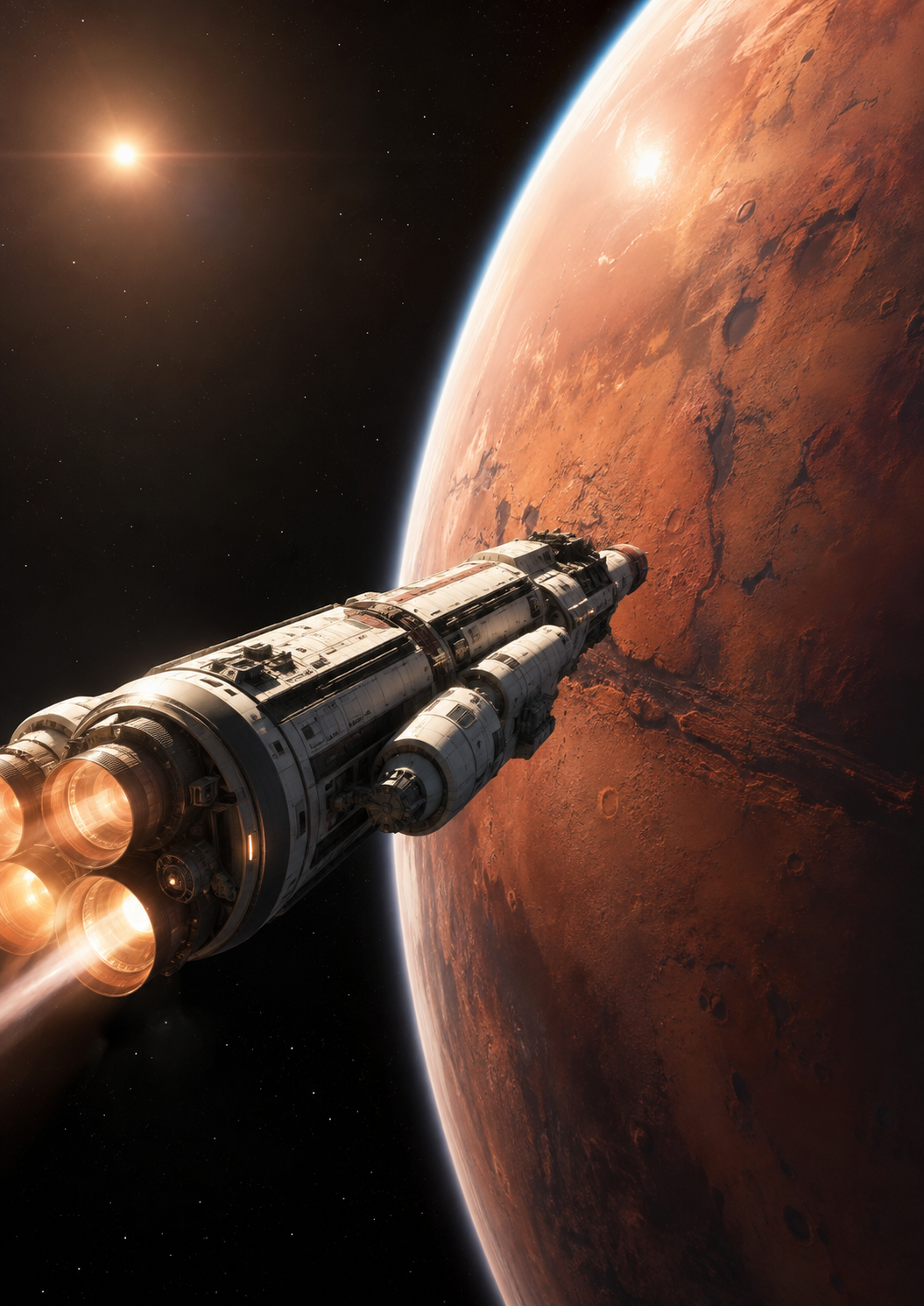
Arriving at Mars: flyby, orbital capture or atmospheric entry. Reaching Mars is not the same as being captured or landed. A spacecraft arrives with substantial relative velocity. Without enough energy removal it can simply fly past. Flyby, orbital capture and atmospheric entry are fundamentally different outcomes. The rest of the course turns that idea into an auditable line of reasoning: explicit units, stated assumptions, reproducible calculations, order-of-magnitude checks and interpretation limits. A result is useful only when the reader can explain what it measures, where every input came from and which engineering decision it can support.
Starting synthesis: derivations, examples, limitations and sources are developed in the course body.
Key concepts before you begin
delta-v · unit · assumption · velocity · mass
1 — Build a mental picture before using a formula
Reaching Mars is not the same as being captured or landed. A spacecraft arrives with substantial relative velocity. Without enough energy removal it can simply fly past. Flyby, orbital capture and atmospheric entry are fundamentally different outcomes.
2 — Essential vocabulary before going further
- flyby — passage without lasting capture.
- orbital capture — energy reduction sufficient to remain gravitationally bound.
- orbit insertion — braking maneuver to establish an orbit.
- atmospheric entry — controlled high-speed passage into the atmosphere.
- entry corridor — acceptable range of entry conditions.
3 — Understand the mechanism step by step
Flyby
Without sufficient braking, a hyperbolic arrival leaves Mars again.
Orbital capture
An orbiter burns at a carefully targeted time to reduce relative speed and establish a bound orbit; MRO later used aerobraking to reshape its orbit.
Entry, descent and landing
A lander converts kinetic energy through atmospheric drag and heat, then uses thermal protection, parachutes and/or propulsion. Light-time prevents real-time Earth piloting during the critical minutes.
4 — The formula, only now
E_k = ½ m v²How to read it: Kinetic energy depends on mass m and the square of speed v; doubling speed quadruples kinetic energy at the same mass.
Detailed calculation
Halving speed from 5 km/s to 2.5 km/s reduces v² by a factor of four, illustrating why arrival energy management dominates EDL design.
5 — What the units tell you
6 — Three concrete demonstrations
Example 1 — Missed capture
If a required insertion burn does not occur, the vehicle may continue past Mars.
Example 2 — MRO
NASA describes an approximately 25-minute Mars orbit insertion burn followed by months of aerobraking.
Example 3 — Perseverance
Perseverance entered at roughly 20,000 km/h and completed EDL in about seven minutes while one-way communication delay exceeded eleven minutes.
7 — Why this matters for a Mars mission
Arrival architecture depends on whether the mission needs science orbit, cargo delivery or human landing.
8 — Common traps and misleading intuitions
- equating Mars arrival with capture.
- assuming one heat shield solves heavy landing.
- ignoring radio delay during EDL.
- generalizing one vehicle’s entry speed to all missions.
9 — What I should be able to explain at the end
- explain the idea in ordinary words
- read and pronounce the important symbols
- repeat at least one calculation without hidden steps
- identify what the simplified model assumes and does not prove
Three fundamentally different ways to arrive at Mars
An interplanetary trajectory can be designed for a flyby, orbital capture or direct atmospheric entry. A flyby requires little intervention but does not remain at Mars. Propulsive capture consumes delta-v, while atmospheric capture or entry exchanges propellant for heating, aerodynamic dispersion and guidance demands.
The correct choice follows from the next mission phase. An orbiter needs a useful science or relay orbit; a lander may enter directly; a crewed architecture may separate the transit vehicle from a heavy lander. There is no single arrival speed that defines all these systems.
Arrival configuration is prepared months before the event: navigation state, attitude, separation, batteries, thermal state and autonomous sequencing. Earth cannot command a Mars entry second by second because of light-time delay.