Course compass
Guiding question: How can an electronic command open, close, or modulate fluid flow when software never physically touches the propellant?
Markers: 📏 MEASURED · 📐 CONVENTION · 🧮 CALCULATED · 🎓 TEACHING ASSUMPTION · ⚠️ APPROXIMATION
- distinguish command position flow
- understand actuator
- understand regulation
- reason about failure
Key idea
Valves and regulators: how a digital command becomes fluid flow. The question to solve is: How can an electronic command open, close, or modulate fluid flow when software never physically touches the propellant? Markers: 📏 MEASURED · 📐 CONVENTION · 🧮 CALCULATED · 🎓 TEACHING ASSUMPTION · ⚠️ APPROXIMATION distinguish command position flow understand actuator understand regulation reason about failure? A valve creates, closes, or modulates a passage. It does not determine flow by itself; flow also depends on pressures, fluid, and the rest of the circuit. The rest of the course turns that idea into an auditable line of reasoning: explicit units, stated assumptions, reproducible calculations, order-of-magnitude checks and interpretation limits. A result is useful only when the reader can explain what it measures, where every input came from and which engineering decision it can support.
Starting synthesis: derivations, examples, limitations and sources are developed in the course body.
Key concepts before you begin
propellant · mass flow rate · cavitation · unit · assumption
1 — A valve changes flow area
A valve creates, closes, or modulates a passage. It does not determine flow by itself; flow also depends on pressures, fluid, and the rest of the circuit.
Valve position is therefore a system variable, not “50% open = 50% flow”.
2 — An actuator turns energy into motion
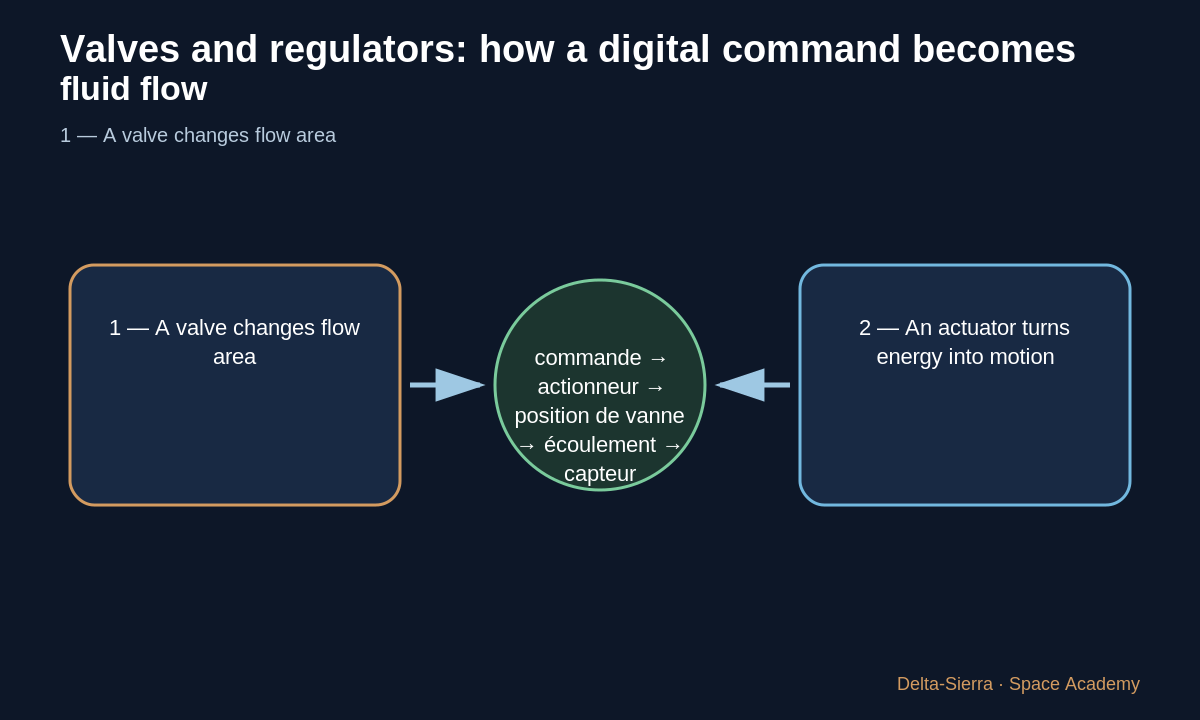
A solenoid, electric motor, or hydraulic system can move a mechanical element. The controller sends a command; the actuator produces position or force.
Position sensors can confirm whether the command was physically executed.
3 — A regulator targets a downstream quantity
A mechanical or commanded regulator adjusts opening to maintain pressure or another condition within a range.
It responds to a difference between desired and measured/mechanical state.
4 — Failure is not only “open/closed”
A valve can move slowly, leak, stick partly open, receive a wrong command, or lack driving pressure.
Diagnosis separates command, actuator, mechanism, and fluid problems.
Three complete examples: change one assumption to understand
Before each calculation, identify where every number comes from and whether it is measured, conventional, assumed, or calculated.
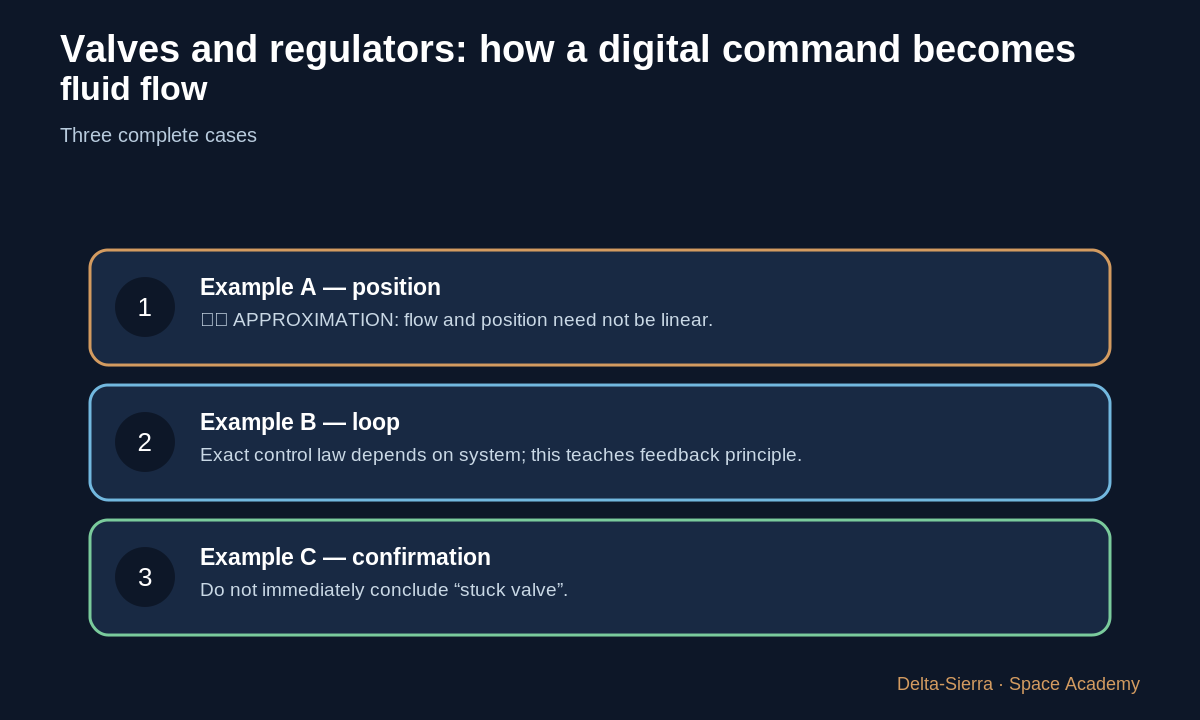
Example A — position
A conceptual command changes from 0 to 25%. That means “request position,” not “obtain 25% of nominal flow.”
⚠️ APPROXIMATION: flow and position need not be linear.
Example B — loop
Setpoint 100 units, measurement 92: error=100−92=8. Controller may request positive correction.
Exact control law depends on system; this teaches feedback principle.
Example C — confirmation
Command says “open,” position sensor remains at 0: the fault may lie in command reception, actuator, mechanism, or sensor.
Do not immediately conclude “stuck valve”.
Inverse calculation
If setpoint is 100 and measured error is 8, measurement is 100−8=92 under this sign convention. Inverse calculation checks sign definition.
Common trap and result check
Trap: treating “valve at 50%” as a flow rate. Mechanical position and flow are different quantities linked by the fluid system.
In a real engine system, a conceptual result must later be checked against fluid properties, margins, tests, and qualification.
Exercises and answers
Function
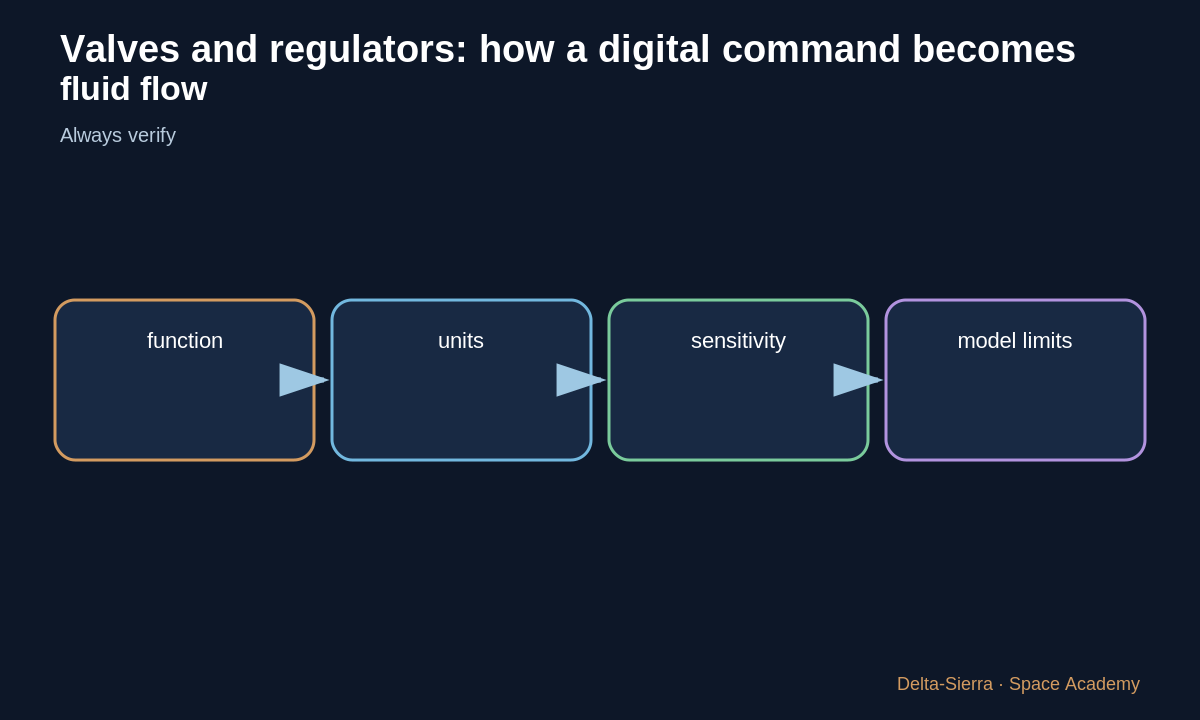
Explain the function of each block without jargon.
Sensitivity
Halve one assumption and predict the consequence.
Limit
Name one reason the teaching model is insufficient for a real engine.