Course compass
Guiding question: What does tank pressurization do, and why must it be controlled as liquid level changes?
Markers: 📏 MEASURED · 📐 CONVENTION · 🧮 CALCULATED · 🎓 TEACHING ASSUMPTION · ⚠️ APPROXIMATION
- understand pressurization function
- connect pressure and load
- identify structure-feed trade
- understand regulation loop
Key idea
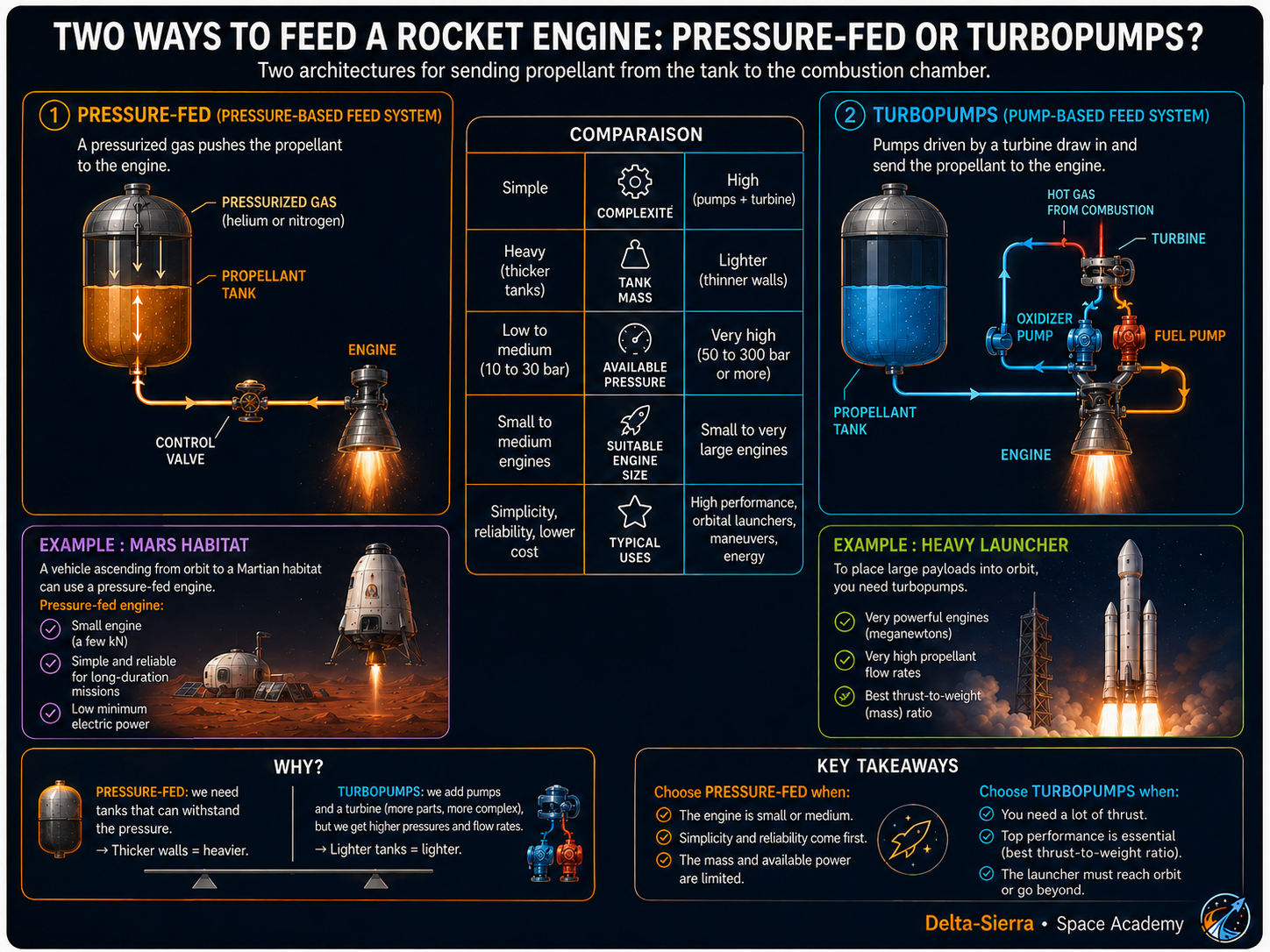
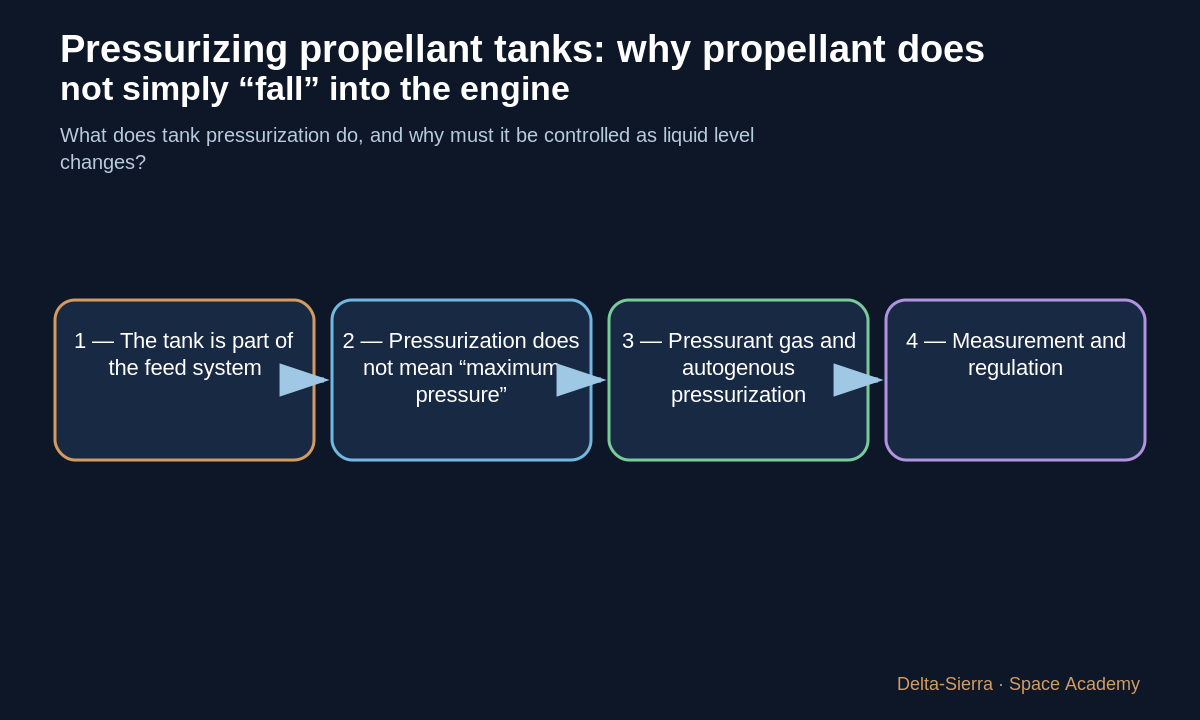
Pressurizing propellant tanks: why propellant does not simply “fall” into the engine. The question to solve is: What does tank pressurization do, and why must it be controlled as liquid level changes? Markers: 📏 MEASURED · 📐 CONVENTION · 🧮 CALCULATED · 🎓 TEACHING ASSUMPTION · ⚠️ APPROXIMATION understand pressurization function connect pressure and load identify structure-feed trade understand regulation loop? A tank does more than store propellant. It must keep fluid state and pressure compatible with downstream feed requirements. The rest of the course turns that idea into an auditable line of reasoning: explicit units, stated assumptions, reproducible calculations, order-of-magnitude checks and interpretation limits. A result is useful only when the reader can explain what it measures, where every input came from and which engineering decision it can support.
Starting synthesis: derivations, examples, limitations and sources are developed in the course body.
Key concepts before you begin
propellant · mass flow rate · cavitation · unit · assumption
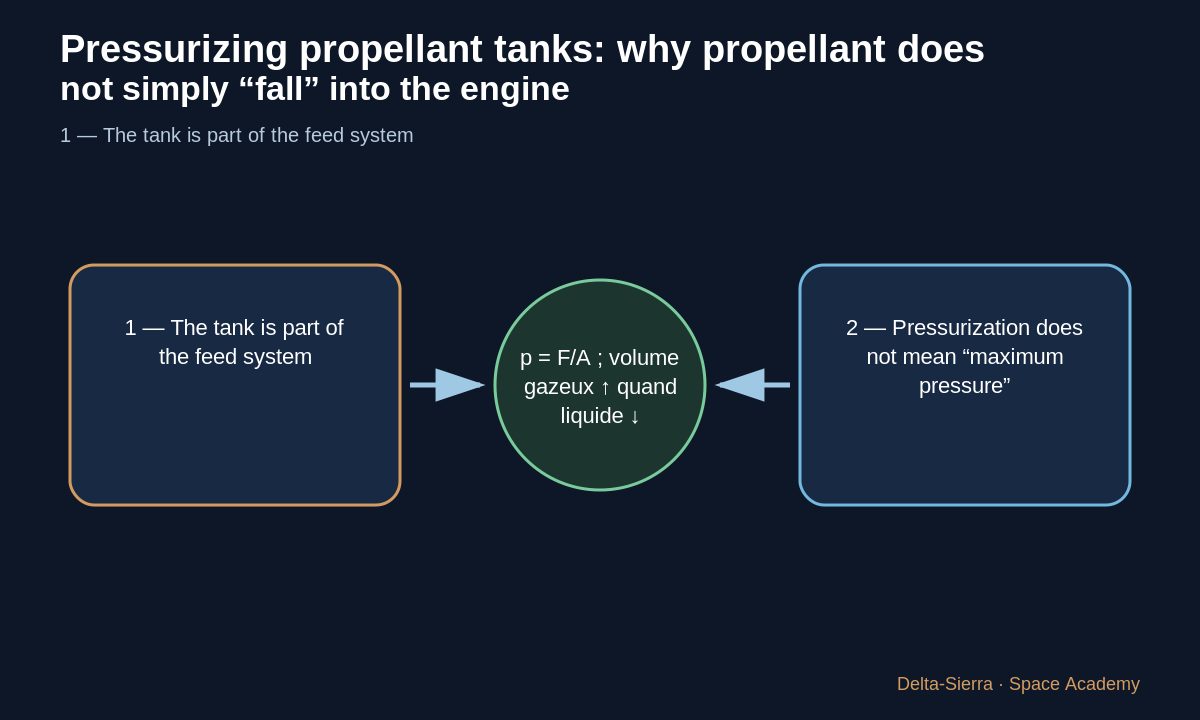
1 — The tank is part of the feed system
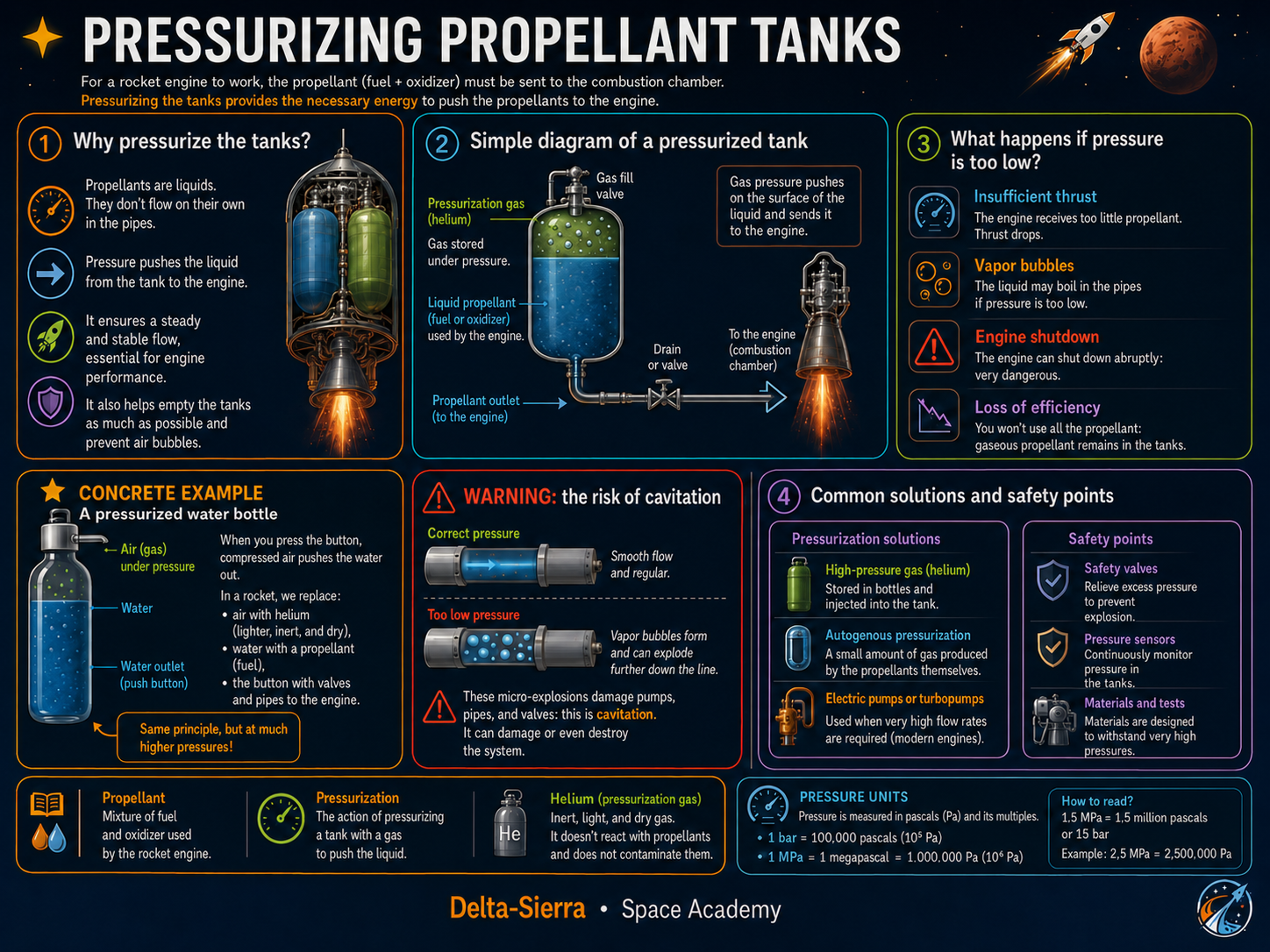
A tank does more than store propellant. It must keep fluid state and pressure compatible with downstream feed requirements.
As propellant leaves, gas volume appears or grows; pressure must remain within a controlled range.
2 — Pressurization does not mean “maximum pressure”
Too little pressure can degrade pump inlet conditions; too much pressure increases structural loads.
The appropriate range is therefore a fluid-system and structural trade.
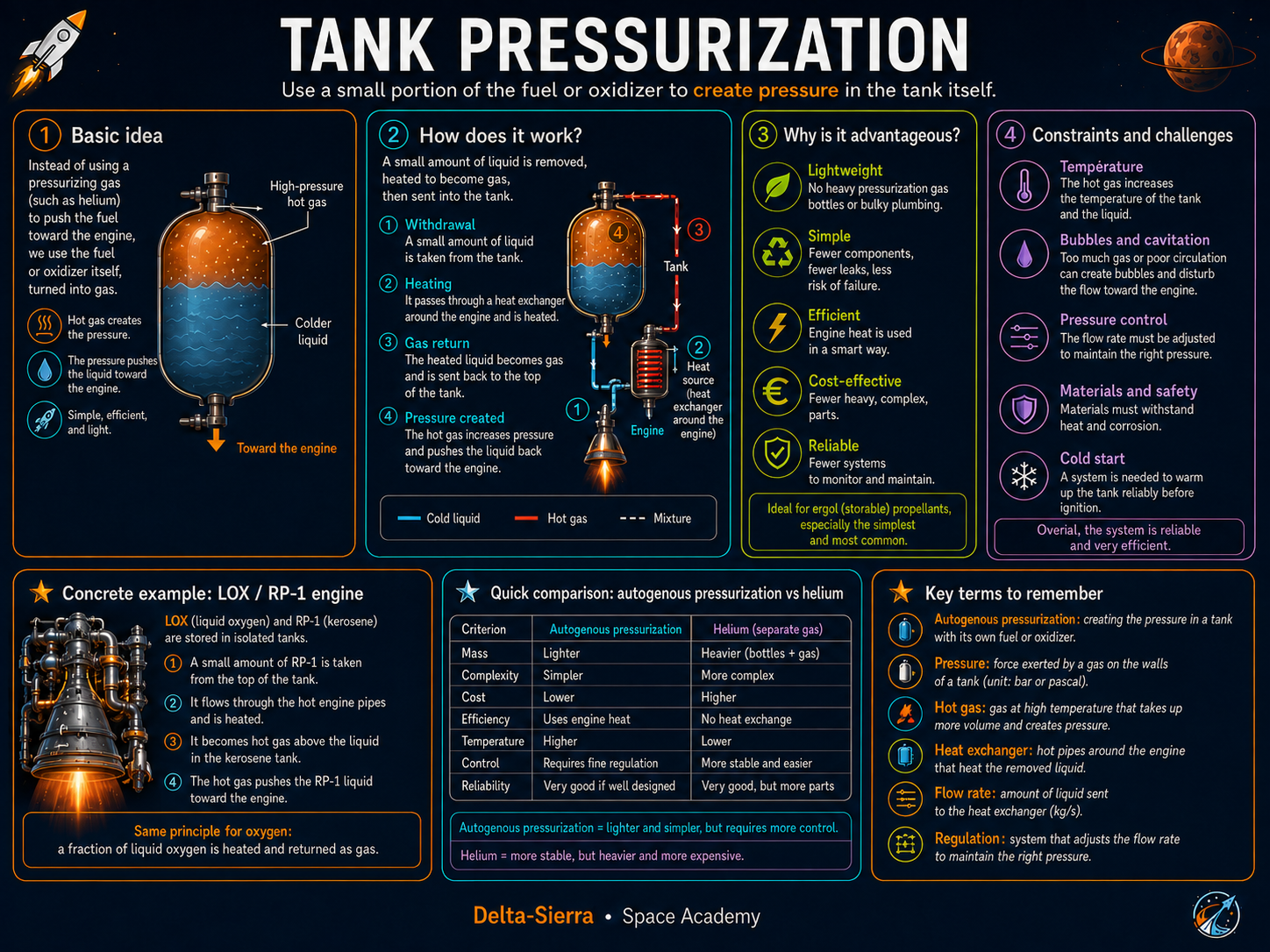
3 — Pressurant gas and autogenous pressurization
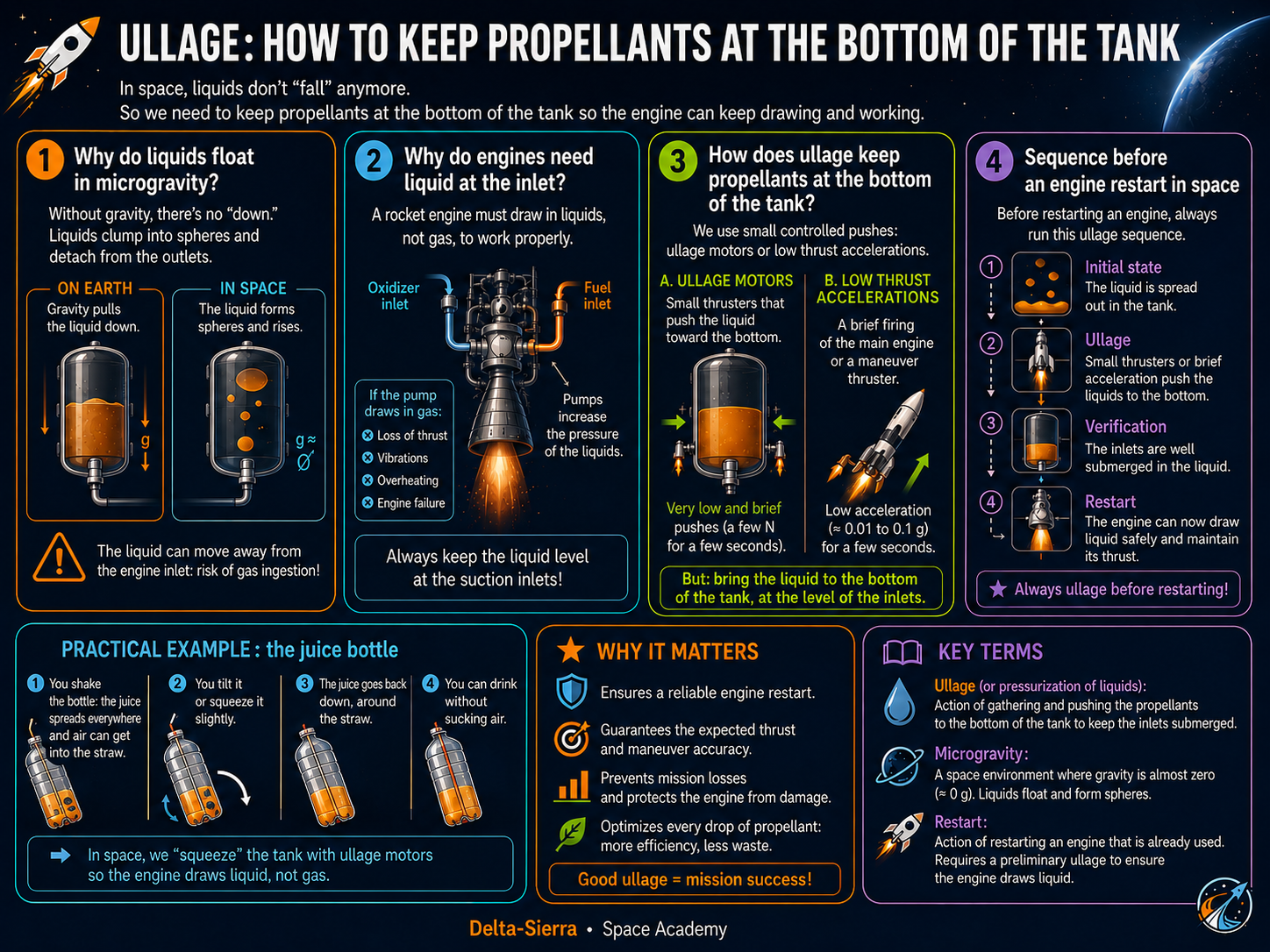
Some architectures use stored pressurant gas; others use heated or vaporized propellant. Choices affect mass, complexity, and thermal management.
Space Academy compares functions without providing flight settings or procedures.
4 — Measurement and regulation
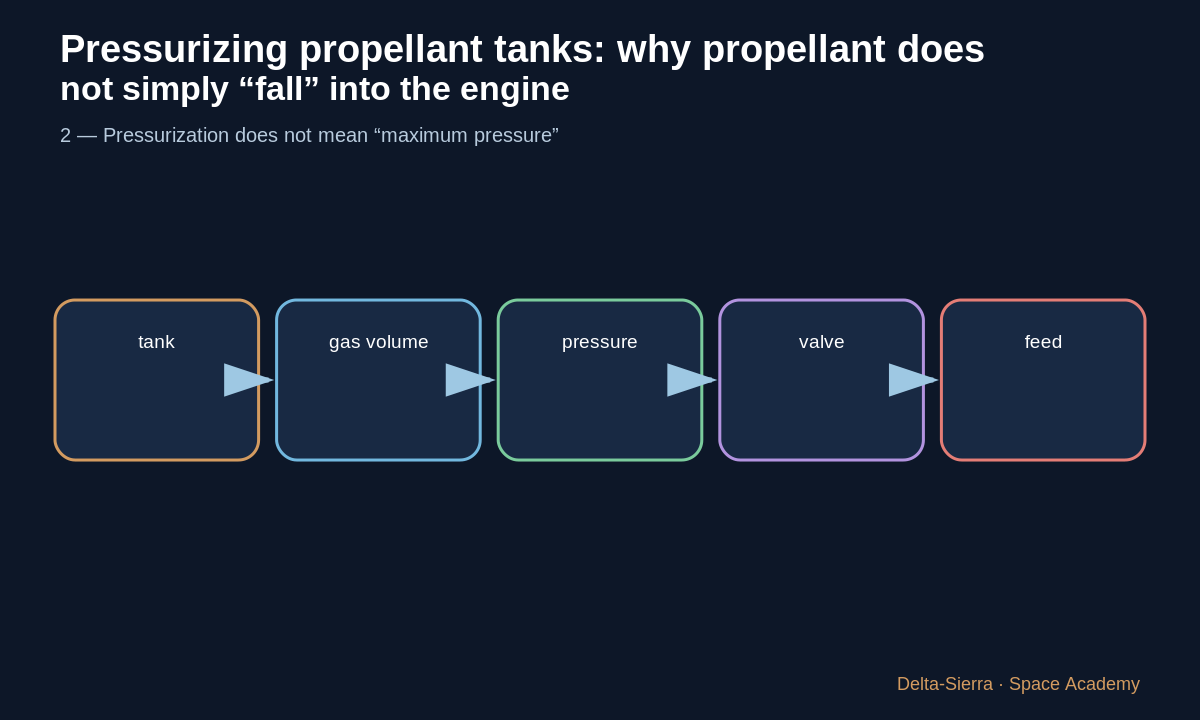
Pressure sensors, valves, and control logic maintain the requested range. Measurement itself must be monitored because a bad sensor can command a bad action.
Pressurization is a control-fluid-structure loop.
Three complete examples: change one assumption to understand
Before each calculation, identify where every number comes from and whether it is measured, conventional, assumed, or calculated.
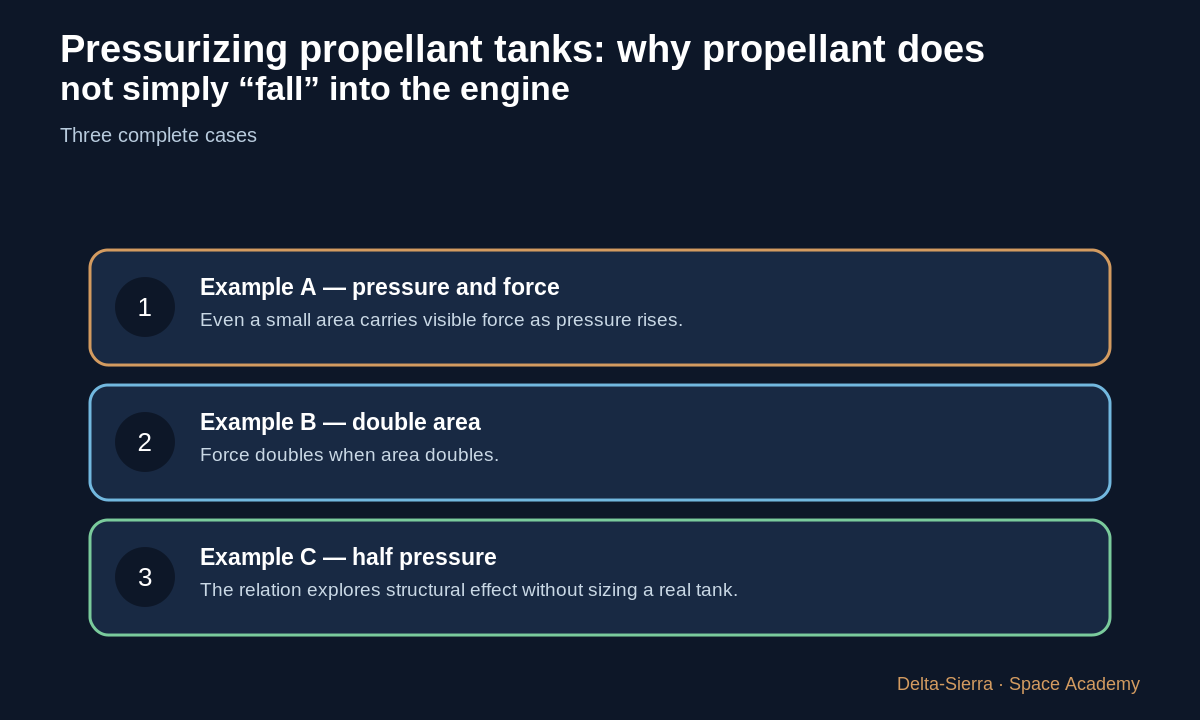
Example A — pressure and force
p=0.20 MPa=200,000 Pa over A=0.01 m² gives F=pA=2,000 N.
Even a small area carries visible force as pressure rises.
Example B — double area
Same p over A=0.02 m² gives 4,000 N.
Force doubles when area doubles.
Example C — half pressure
p=100,000 Pa over 0.02 m² gives 2,000 N.
The relation explores structural effect without sizing a real tank.
Inverse calculation
If a 0.01 m² area is limited to 1,500 N in this model, p=F/A=150,000 Pa=0.15 MPa. This only illustrates pressure-load relation.
Common trap and result check
Trap: assuming tank pressure can be chosen from structure alone. Pump inlet conditions, fluid properties, and transients also matter.
In a real engine system, a conceptual result must later be checked against fluid properties, margins, tests, and qualification.
Exercises and answers
Function
Explain the function of each block without jargon.
Sensitivity
Halve one assumption and predict the consequence.
Limit
Name one reason the teaching model is insufficient for a real engine.