Course compass
Guiding question : How do I turn an intimidating line of symbols into a sequence of small questions I can answer?
Markers : 📏 MEASURED 📐 CONVENTION 🧮 CALCULATED 🎓 LEARNING ASSUMPTION 🚀 MISSION DATA 🏭 MANUFACTURER DATA ⚠️ APPROXIMATION
Objectives :
- read a formula aloud
- separate symbols, numbers, units, and operations
- ask “why this number?”
- distinguish measurement, convention, assumption, and calculation
- check units and order of magnitude
1 — A formula is not a hieroglyph
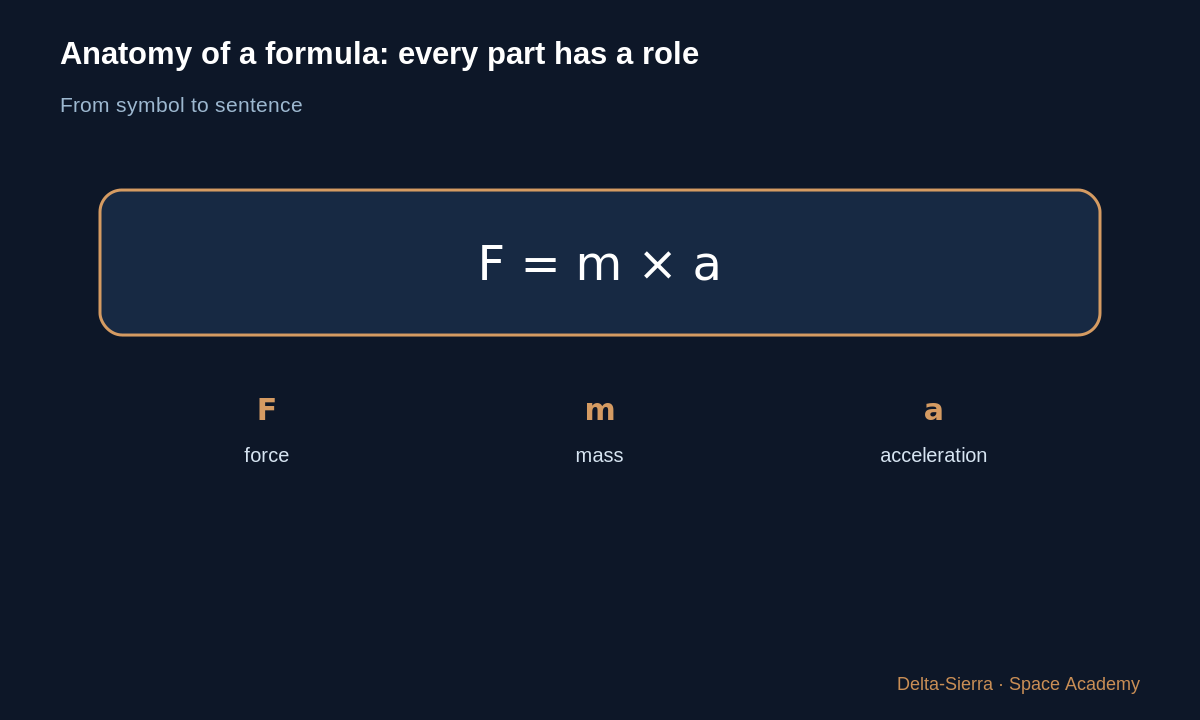
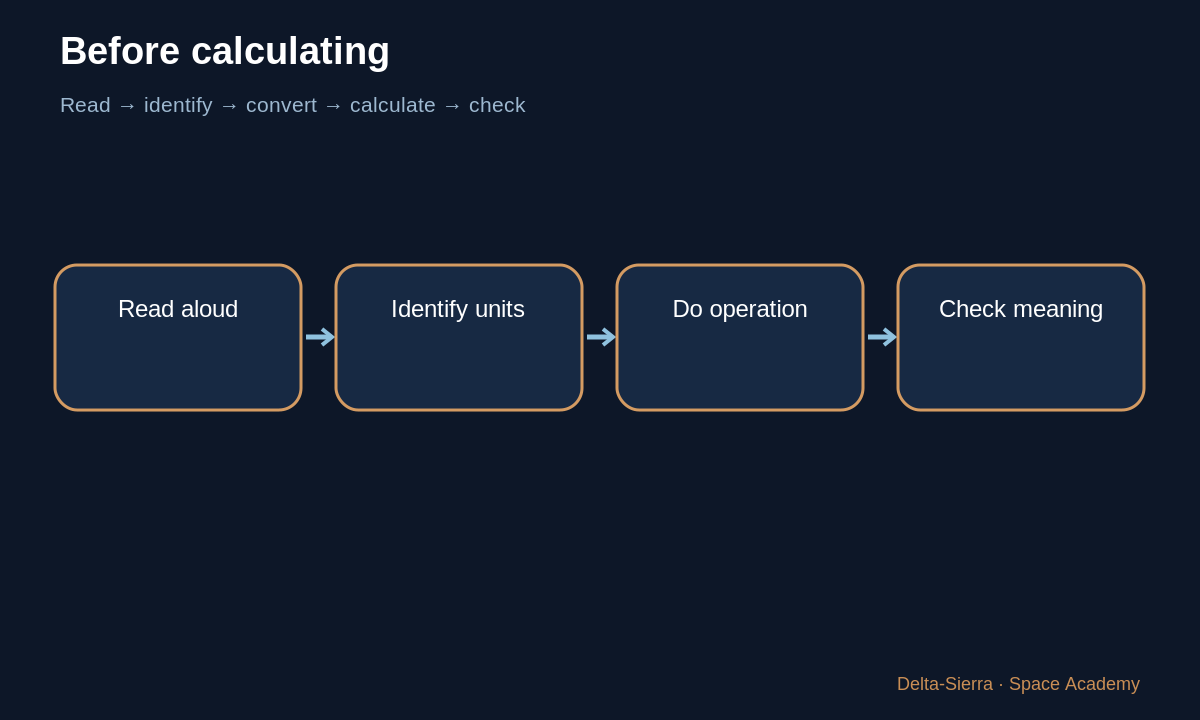
An engineer uses a formula to compress a sentence. Take F = m × a. Read it as: “force F equals mass m multiplied by acceleration a.” Before calculating, learn how every symbol is pronounced, what it means, and what unit belongs to it.
2 — The absolute rule: “why this number?”
Numbers can have very different status. 27.32166 days can be an astronomical measurement; 360° is a human convention; 3 days may be a learning assumption; 39.5° may be a calculated result. Mixing those categories turns assumptions into fake laws of nature.
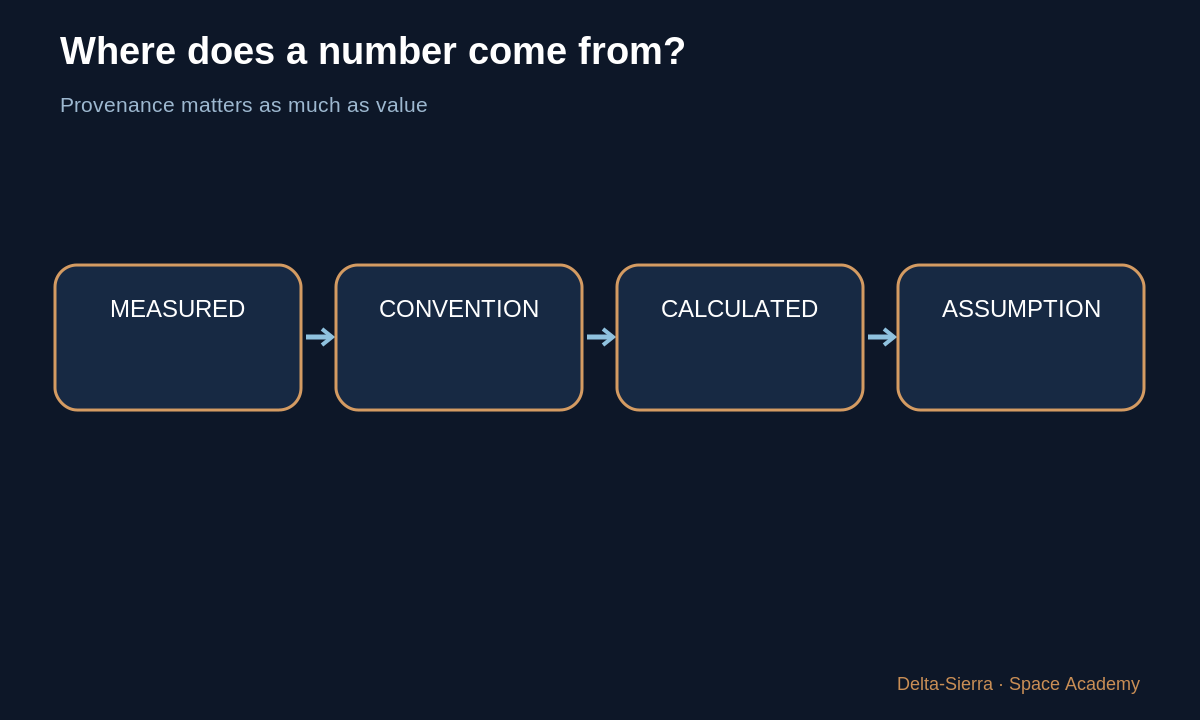
The course therefore labels provenance. 📏 MEASURED means measured; 📐 CONVENTION a shared human choice; 🎓 LEARNING ASSUMPTION a value chosen for learning; 🧮 CALCULATED a calculated result.
3 — Units are conventions too… and still essential
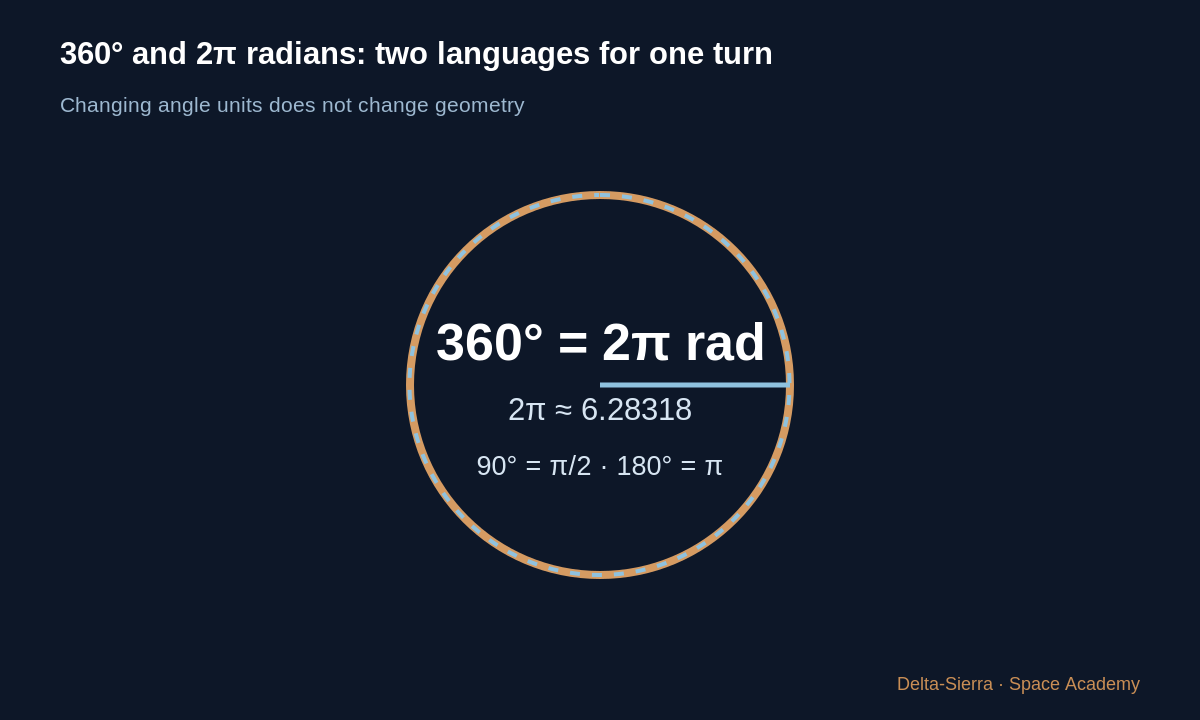
Distance can be expressed in metres or kilometres. Angle can be expressed in degrees or radians. Changing unit does not change reality, but an incorrect conversion changes the number and can ruin the calculation.
4 — Why this operation rather than another?
If a car covers 120 kilometres in 2 hours and we want kilometres per hour, divide: 120 km ÷ 2 h = 60 km/h. Division answers “how much per unit time?”
If speed is 60 km/h for 3 hours, multiply: 60 km/h × 3 h = 180 km. Hours cancel: km/h × h = km.
5 — The calculator: faithful servant, poor teacher
A calculator does not know whether your model makes sense. It accepts 360 ÷ 27.3, 27.3 ÷ 360, or 360 × 27.3 with equal obedience. Understanding must come before keystrokes.
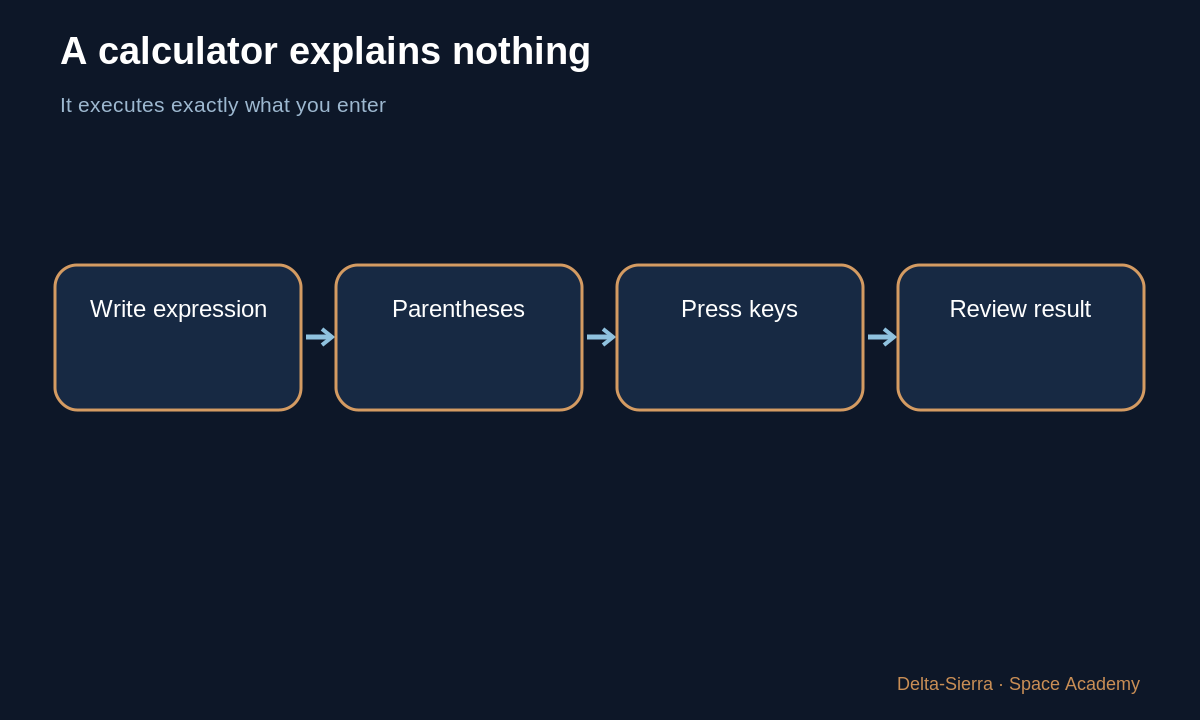
Write
(1200 ÷ 30) × 0.85.1. Enter
1200 ÷ 30 = → 40.2. Enter
× 0.85 = → 34.3. Ask: 34 what? The unit must come from the problem.
6 — Check whether the answer makes sense
Compare the answer with expected scale, sign, and units. If an Earth-Moon trip comes out as 0.003 second or 900 years, the calculator may be flawless; your model, unit conversion, or entry is probably wrong.
Repeat an approximate mental version. If 1,198 ÷ 29.7 should be near 40, a display of 4,000 is an immediate warning.
Exercises and solutions
Exercise A — classify values
Classify 360°, 27.32166 days, 13.18°/day, and 3 days chosen for an example.
Exercise B — explain the operation
Why does 60 km/h × 2 h produce distance?
Challenge — the unit matters
100 km ÷ 50 km/h = 2. What is the unit?