


Survival & ECLSS: close loops without hiding failures

ECLSS is a system of life-support functions, not one machine. It must maintain air, water, temperature, and quality while remaining controllable after faults.
The module separates ISS-demonstrated performance, long-duration goals, and Mars teaching scenarios.
1. Start from life-support functions
ECLSS is not one box but a set of functions: breathable atmosphere, potable water, thermal control, hygiene, waste processing, and monitoring. Equipment may change while the required function remains.
For each function, track inventory, flow, quality, and time to consequence. CO₂ sensor failure and pressure-shell rupture evolve on different timescales and demand different responses.
System intuition
A vital system should be described as a measurable function before hardware is chosen. For each function, define the controlled variable, acceptable domain, sensor, action, backup path, and recovery criterion. This prevents a hardware item from being confused with the survival function it performs.
Critical-stock endurance
- 1 — Concrete question
- What operational question does this relation answer for critical-stock endurance?
- 2 — Intuition without symbols
- Compare the verified usable reserve with the rate at which it is consumed to obtain a protection duration.
- 3 — Quantities first
- S is usable stock, q is consumption rate, and t is endurance.
- 4 — Formula
- t = S / q
- 5 — Read aloud
- Read the relation aloud term by term: t = S / q.
- 6 — Symbols and meaning
- S is usable stock, q is consumption rate, and t is endurance.
- 7 — Pronunciation
- The “Read aloud” line above is the oral reference for “Critical-stock endurance”. Any subscript, exponent or grouping that changes the meaning of the relation should be spoken explicitly.
- 8 — Units
- Use one resource unit for stock and the same resource unit per time for the rate; endurance is in that time unit.
- 9 — Convention
- For “Critical-stock endurance”, substitute values without changing the reference frame, time basis, system boundary or sign convention halfway through the calculation. Stated units: Use one resource unit for stock and the same resource unit per time for the rate; endurance is in that time unit.
- 10 — Why this operation
- Compare the verified usable reserve with the rate at which it is consumed to obtain a protection duration.
- 11 — Assumptions
- The relation “t = S / q” applies here only to the scenario described by the card. Inputs must be mutually consistent and satisfy the physical assumptions associated with “Critical-stock endurance”.
- 12 — Unit check
- Use one resource unit for stock and the same resource unit per time for the rate; endurance is in that time unit. Verify that units reduce to the unit of the requested quantity.
- 13 — Numerical case
- Teaching example: with usable stock S = 120 L and consumption q = 8 L/day, endurance is t = 120/8 = 15 days.
- 14 — Why the calculation works
- Compare the verified usable reserve with the rate at which it is consumed to obtain a protection duration.
- 15 — Algebra check
- Quick check: multiplying the result by the denominator should reconstruct the numerator of “Critical-stock endurance” within rounding.
- 16 — Mental estimate
- Before calculating “Critical-stock endurance” precisely, round the inputs to one useful digit and predict the sign and order of magnitude. The detailed result should remain consistent with that estimate.
- 17 — Interpretation
- The result is useful only as an operational statement about critical-stock endurance under the declared assumptions.
- 18 — What the result does not prove
- For “Critical-stock endurance”, the number obtained answers only the model “t = S / q” under the stated scenario. It does not by itself validate the input data or the model outside those conditions.
- 19 — Sensitivity
- Vary one input at a time around the nominal case to identify what drives the result of “Critical-stock endurance” and whether that variation can change the mission decision.
- 20 — Guided and autonomous practice
Guided exercise. Usable stock increases by 10% while consumption remains 8 L/day. Recompute endurance.
Detailed guided correction — open after attempting
Detailed correction. The new stock is 120 × 1.10 = 132 L. Keep q = 8 L/day. Therefore t = 132/8 = 16.5 days. A 10% increase in the numerator increases endurance by 10%, from 15 to 16.5 days.
Autonomous exercise. Build a second numerical scenario for “Critical-stock endurance” by changing at least two inputs in
t = S / q. Compute the result, check units and order of magnitude, then state whether the mission decision should change.Autonomous correction — specific criteria
Autonomous correction. The answer must show substitution into
t = S / q, produce a value with its unit or an explicit logical result, compare it with the reference case, and justify the following decision: Trigger resupply, rationing or repair before endurance reaches the protected reserve.- 21 — Mission decision
- Trigger resupply, rationing or repair before endurance reaches the protected reserve.
Functional safety chain
- 1 — Concrete question
- What operational question does this relation answer for functional safety chain?
- 2 — Intuition without symbols
- A vital function is robust only when the crew knows what to monitor, when to act, how to fall back, and how to recover.
- 3 — Quantities first
- The six terms are successive safety functions rather than numerical variables.
- 4 — Formula
- robust function: identified variable → known limit → measurement → action → backup → recovery
- 5 — Read aloud
- Read the relation aloud term by term: robust function: identified variable → known limit → measurement → action → backup → recovery.
- 6 — Symbols and meaning
- The six terms are successive safety functions rather than numerical variables.
- 7 — Pronunciation
- The “Read aloud” line above is the oral reference for “Functional safety chain”. Any subscript, exponent or grouping that changes the meaning of the relation should be spoken explicitly.
- 8 — Units
- This is a logical chain and has no single physical unit.
- 9 — Convention
- For “Functional safety chain”, substitute values without changing the reference frame, time basis, system boundary or sign convention halfway through the calculation. Stated units: This is a logical chain and has no single physical unit.
- 10 — Why this operation
- A vital function is robust only when the crew knows what to monitor, when to act, how to fall back, and how to recover.
- 11 — Assumptions
- The relation “robust function: identified variable → known limit → measurement → action → backup → recovery” applies here only to the scenario described by the card. Inputs must be mutually consistent and satisfy the physical assumptions associated with “Functional safety chain”.
- 12 — Unit check
- This is a logical chain and has no single physical unit. Verify that units reduce to the unit of the requested quantity.
- 13 — Numerical case
- Teaching example: oxygen partial pressure is measured at 18.8 kPa while the declared operational limit is 19.5 kPa. The safety chain must connect measurement < limit, alarm, backup action, then verified recovery above 19.5 kPa.
- 14 — Why the calculation works
- A vital function is robust only when the crew knows what to monitor, when to act, how to fall back, and how to recover.
- 15 — Algebra check
- Quick check: invert “robust function: identified variable → known limit → measurement → action → backup → recovery” when possible, or use a second calculation path, and confirm the same order of magnitude for “Functional safety chain”.
- 16 — Mental estimate
- Before calculating “Functional safety chain” precisely, round the inputs to one useful digit and predict the sign and order of magnitude. The detailed result should remain consistent with that estimate.
- 17 — Interpretation
- The result is useful only as an operational statement about functional safety chain under the declared assumptions.
- 18 — What the result does not prove
- For “Functional safety chain”, the number obtained answers only the model “robust function: identified variable → known limit → measurement → action → backup → recovery” under the stated scenario. It does not by itself validate the input data or the model outside those conditions.
- 19 — Sensitivity
- Vary one input at a time around the nominal case to identify what drives the result of “Functional safety chain” and whether that variation can change the mission decision.
- 20 — Guided and autonomous practice
Guided exercise. An oxygen measurement drops from 20.5 kPa to 18.8 kPa with a declared limit of 19.5 kPa. Decide whether the safety chain must activate and state the expected recovery condition.
Detailed guided correction — open after attempting
Detailed correction. 18.8 kPa < 19.5 kPa, so the threshold is crossed and alarm plus backup action must trigger. Recovery is not proved by the action alone: a verified measurement must return above the declared threshold, for example 20.0 kPa > 19.5 kPa.
Autonomous exercise. Build a second numerical scenario for “Functional safety chain” by changing at least two inputs in
robust function: identified variable → known limit → measurement → action → backup → recovery. Compute the result, check units and order of magnitude, then state whether the mission decision should change.Autonomous correction — specific criteria
Autonomous correction. The answer must show substitution into
robust function: identified variable → known limit → measurement → action → backup → recovery, produce a value with its unit or an explicit logical result, compare it with the reference case, and justify the following decision: Reject an architecture that has measurement without action, backup without independence, or recovery without evidence.- 21 — Mission decision
- Reject an architecture that has measurement without action, backup without independence, or recovery without evidence.
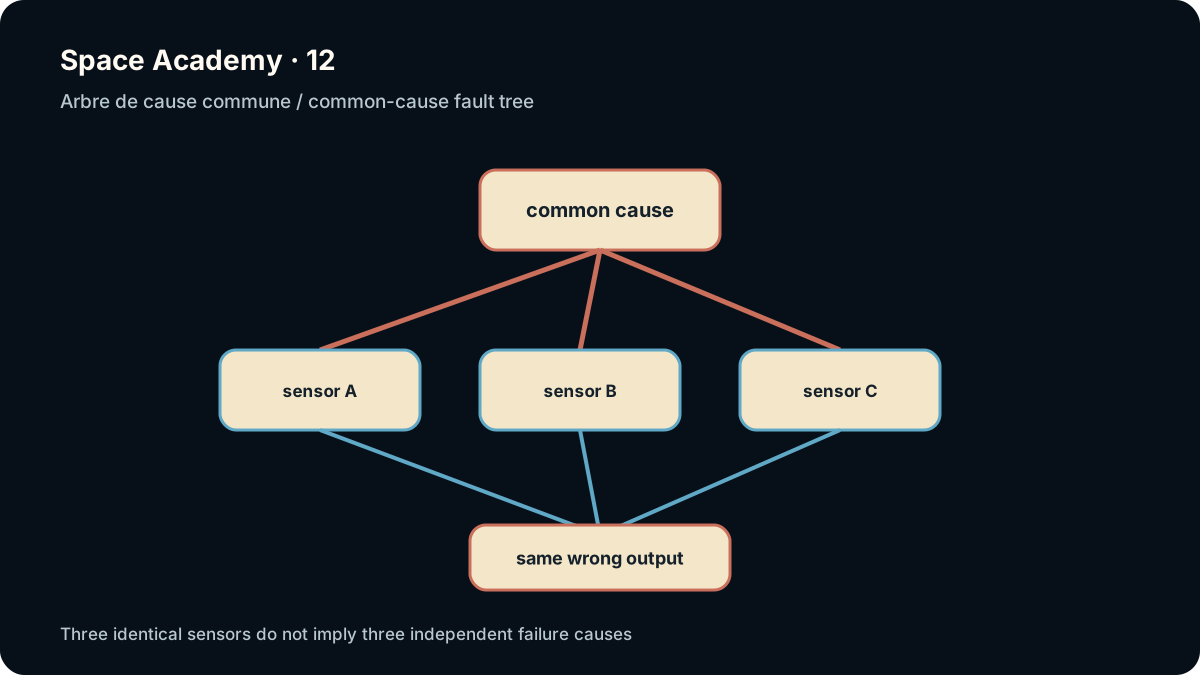
One hardware item can support several functions; that interconnection must remain visible in common-cause analysis.
Design case — function and backup
Take the function “remove CO₂.” Write the sensor that detects drift, nominal removal capacity, saturation signal, backup path, and criterion for returning to normal mode. If the backup uses the same fan or power bus, it is not independent. This simple sheet turns a hardware list into a verifiable survival architecture.
Decision check. A useful design review asks whether the function can be demonstrated end to end: can the sensor detect the state, can the controller decide, can an actuator restore the variable, and can the crew verify recovery? Writing that chain for every vital function exposes hidden dependencies before hardware names dominate the discussion.
2. Atmosphere means pressure plus composition
A habitable atmosphere has total pressure and partial pressures. O₂, CO₂, water vapor, and contaminants must be monitored; correct total pressure can coexist with dangerous composition.
Pressure is also structural load. A 70 kPa difference over 1 m² produces 70 kN ideal resultant force. The atmosphere is both a life resource and a mechanical load.
Quantified balance
Total pressure and composition are insufficient when considered separately. An atmosphere can have correct total pressure but inadequate oxygen partial pressure, or the reverse. Sensors must therefore distinguish pressure, gas fractions, temperature, humidity, and contaminants rather than reducing “air” to one reading.
Partial pressure in a gas mixture
- 1 — Concrete question
- What operational question does this relation answer for partial pressure in a gas mixture?
- 2 — Intuition without symbols
- The fraction of one gas in the mixture applies the same fraction to total pressure to give that constituent pressure.
- 3 — Quantities first
- p_i is constituent partial pressure, y_i is mole fraction, and p_total is total pressure.
- 4 — Formula
- p_i = y_i p_total
- 5 — Read aloud
- Read the relation aloud term by term: p_i = y_i p_total.
- 6 — Symbols and meaning
- p_i is constituent partial pressure, y_i is mole fraction, and p_total is total pressure.
- 7 — Pronunciation
- The “Read aloud” line above is the oral reference for “Partial pressure in a gas mixture”. Any subscript, exponent or grouping that changes the meaning of the relation should be spoken explicitly.
- 8 — Units
- p_i and p_total use the same pressure unit; y_i is dimensionless.
- 9 — Convention
- For “Partial pressure in a gas mixture”, substitute values without changing the reference frame, time basis, system boundary or sign convention halfway through the calculation. Stated units: p_i and p_total use the same pressure unit; y_i is dimensionless.
- 10 — Why this operation
- The fraction of one gas in the mixture applies the same fraction to total pressure to give that constituent pressure.
- 11 — Assumptions
- The relation “p_i = y_i p_total” applies here only to the scenario described by the card. Inputs must be mutually consistent and satisfy the physical assumptions associated with “Partial pressure in a gas mixture”.
- 12 — Unit check
- p_i and p_total use the same pressure unit; y_i is dimensionless. Verify that units reduce to the unit of the requested quantity.
- 13 — Numerical case
- Teaching example: for y_i = 0.21 and p_total = 70 kPa, p_i = 0.21 × 70 = 14.7 kPa.
- 14 — Why the calculation works
- The fraction of one gas in the mixture applies the same fraction to total pressure to give that constituent pressure.
- 15 — Algebra check
- Quick check: invert “p_i = y_i p_total” when possible, or use a second calculation path, and confirm the same order of magnitude for “Partial pressure in a gas mixture”.
- 16 — Mental estimate
- Before calculating “Partial pressure in a gas mixture” precisely, round the inputs to one useful digit and predict the sign and order of magnitude. The detailed result should remain consistent with that estimate.
- 17 — Interpretation
- The result is useful only as an operational statement about partial pressure in a gas mixture under the declared assumptions.
- 18 — What the result does not prove
- For “Partial pressure in a gas mixture”, the number obtained answers only the model “p_i = y_i p_total” under the stated scenario. It does not by itself validate the input data or the model outside those conditions.
- 19 — Sensitivity
- Vary one input at a time around the nominal case to identify what drives the result of “Partial pressure in a gas mixture” and whether that variation can change the mission decision.
- 20 — Guided and autonomous practice
Guided exercise. Total pressure increases by 10%, from 70 to 77 kPa, while mole fraction remains 0.21. Recompute p_i.
Detailed guided correction — open after attempting
Detailed correction. p_i = y_i p_total = 0.21 × 77 = 16.17 kPa. Because mole fraction is unchanged, a 10% rise in total pressure produces a 10% rise in partial pressure: 14.7 → 16.17 kPa.
Autonomous exercise. Build a second numerical scenario for “Partial pressure in a gas mixture” by changing at least two inputs in
p_i = y_i p_total. Compute the result, check units and order of magnitude, then state whether the mission decision should change.Autonomous correction — specific criteria
Autonomous correction. The answer must show substitution into
p_i = y_i p_total, produce a value with its unit or an explicit logical result, compare it with the reference case, and justify the following decision: Compare partial pressure with physiological limits rather than relying on total pressure alone.- 21 — Mission decision
- Compare partial pressure with physiological limits rather than relying on total pressure alone.
A pressure change shifts every partial pressure even if mole fractions remain temporarily unchanged.
Calculation case — atmosphere
Assume 70 kPa with 30% O₂ and 0.6% CO₂ in a teaching case. Partial pressures are 21 kPa O₂ and 0.42 kPa CO₂. If total pressure falls to 60 kPa with fractions temporarily unchanged, they become 18 kPa and 0.36 kPa. The same percentage therefore does not represent the same physiological state when total pressure changes.
Decision check. For atmosphere control, the practical test is to calculate at least one off-nominal state. Change total pressure, oxygen fraction, and CO₂ independently and observe which sensor would first show unacceptable conditions. That exercise prevents one “green” indicator from being mistaken for proof that the whole atmosphere is safe.
3. CO₂, humidity, and contaminants accumulate
Crew continuously produces CO₂ and water vapor. Removal systems need capacity for nominal operation, activity peaks, restarts, and some partial failures. Treatment flow must be compared with production flow.
Measurement is a barrier. A good scrubber with a bad sensor can allow silent drift. Calibration, redundancy, and cross-checks therefore belong to life support.
Degraded mode
CO₂, water vapor, and contaminants are continuous source terms. Sizing must compare plausible maximum production with available removal and include regeneration, sorbent changeout, and maintenance intervals. Nominal capacity exactly equal to production leaves no margin for drift or an extra crew member.
Dynamic inventory balance
- 1 — Concrete question
- What operational question does this relation answer for dynamic inventory balance?
- 2 — Intuition without symbols
- An inventory rises when generation exceeds removal and falls when removal exceeds generation.
- 3 — Quantities first
- dM/dt is inventory change rate; generation and removal are mass-flow terms on the same boundary.
- 4 — Formula
- dM/dt = generation − removal
- 5 — Read aloud
- Read the relation aloud term by term: dM/dt = generation − removal.
- 6 — Symbols and meaning
- dM/dt is inventory change rate; generation and removal are mass-flow terms on the same boundary.
- 7 — Pronunciation
- The “Read aloud” line above is the oral reference for “Dynamic inventory balance”. Any subscript, exponent or grouping that changes the meaning of the relation should be spoken explicitly.
- 8 — Units
- All rates use the same mass-per-time unit.
- 9 — Convention
- For “Dynamic inventory balance”, substitute values without changing the reference frame, time basis, system boundary or sign convention halfway through the calculation. Stated units: All rates use the same mass-per-time unit.
- 10 — Why this operation
- An inventory rises when generation exceeds removal and falls when removal exceeds generation.
- 11 — Assumptions
- The relation “dM/dt = generation − removal” applies here only to the scenario described by the card. Inputs must be mutually consistent and satisfy the physical assumptions associated with “Dynamic inventory balance”.
- 12 — Unit check
- All rates use the same mass-per-time unit. Verify that units reduce to the unit of the requested quantity.
- 13 — Numerical case
- Teaching example: generation of 6 kg/day and removal of 8 kg/day gives dM/dt = 6 − 8 = −2 kg/day, so inventory decreases.
- 14 — Why the calculation works
- An inventory rises when generation exceeds removal and falls when removal exceeds generation.
- 15 — Algebra check
- Quick check: multiplying the result by the denominator should reconstruct the numerator of “Dynamic inventory balance” within rounding.
- 16 — Mental estimate
- Before calculating “Dynamic inventory balance” precisely, round the inputs to one useful digit and predict the sign and order of magnitude. The detailed result should remain consistent with that estimate.
- 17 — Interpretation
- The result is useful only as an operational statement about dynamic inventory balance under the declared assumptions.
- 18 — What the result does not prove
- For “Dynamic inventory balance”, the number obtained answers only the model “dM/dt = generation − removal” under the stated scenario. It does not by itself validate the input data or the model outside those conditions.
- 19 — Sensitivity
- Vary one input at a time around the nominal case to identify what drives the result of “Dynamic inventory balance” and whether that variation can change the mission decision.
- 20 — Guided and autonomous practice
Guided exercise. Generation increases by 10%, from 6 to 6.6 kg/day, while removal remains 8 kg/day. Recompute the balance.
Detailed guided correction — open after attempting
Detailed correction. dM/dt = 6.6 − 8 = −1.4 kg/day. The balance is still negative, but the resource debt is 0.6 kg/day smaller than the initial −2 kg/day case. Corrective action is still required if the trend persists.
Autonomous exercise. Build a second numerical scenario for “Dynamic inventory balance” by changing at least two inputs in
dM/dt = generation − removal. Compute the result, check units and order of magnitude, then state whether the mission decision should change.Autonomous correction — specific criteria
Autonomous correction. The answer must show substitution into
dM/dt = generation − removal, produce a value with its unit or an explicit logical result, compare it with the reference case, and justify the following decision: Treat a sustained negative balance as a measurable resource debt.- 21 — Mission decision
- Treat a sustained negative balance as a measurable resource debt.
A large cabin or buffer can slow concentration rise without correcting the flow imbalance.
Drift case — contaminant
A loop generates 0.25 kg/h of an equivalent contaminant and removes 0.24 kg/h. The difference looks tiny: 0.01 kg/h. Yet it accumulates 0.24 kg in 24 h and 7.2 kg in 30 days. The exercise shows why flow balance must close at adequate precision and why a small persistent drift can become a slow emergency.
4. Oxygen, electrolysis, and Sabatier
Water electrolysis produces O₂ and H₂. Removed CO₂ can react with H₂ through Sabatier chemistry to produce CH₄ and H₂O; recovered water can return toward electrolysis.
Sabatier stoichiometry
- 1 — Concrete question
- What operational question does this relation answer for sabatier stoichiometry?
- 2 — Intuition without symbols
- The reaction rearranges the same atoms between reactants and products, fixing ideal material proportions.
- 3 — Quantities first
- CO₂ is carbon dioxide, H₂ hydrogen, CH₄ methane, and H₂O water; coefficients are stoichiometric.
- 4 — Formula
- CO₂ + 4 H₂ → CH₄ + 2 H₂O
- 5 — Read aloud
- Read the relation aloud term by term: CO₂ + 4 H₂ → CH₄ + 2 H₂O.
- 6 — Symbols and meaning
- CO₂ is carbon dioxide, H₂ hydrogen, CH₄ methane, and H₂O water; coefficients are stoichiometric.
- 7 — Pronunciation
- The “Read aloud” line above is the oral reference for “Sabatier stoichiometry”. Any subscript, exponent or grouping that changes the meaning of the relation should be spoken explicitly.
- 8 — Units
- Coefficients are dimensionless; amounts are in moles and masses follow from molar masses.
- 9 — Convention
- For “Sabatier stoichiometry”, substitute values without changing the reference frame, time basis, system boundary or sign convention halfway through the calculation. Stated units: Coefficients are dimensionless; amounts are in moles and masses follow from molar masses.
- 10 — Why this operation
- The reaction rearranges the same atoms between reactants and products, fixing ideal material proportions.
- 11 — Assumptions
- The relation “CO₂ + 4 H₂ → CH₄ + 2 H₂O” applies here only to the scenario described by the card. Inputs must be mutually consistent and satisfy the physical assumptions associated with “Sabatier stoichiometry”.
- 12 — Unit check
- Coefficients are dimensionless; amounts are in moles and masses follow from molar masses. Verify that units reduce to the unit of the requested quantity.
- 13 — Numerical case
- Ideal stoichiometric case: 44 kg CO₂ reacts with 8 kg H₂ to produce 16 kg CH₄ and 36 kg H₂O.
- 14 — Why the calculation works
- The reaction rearranges the same atoms between reactants and products, fixing ideal material proportions.
- 15 — Algebra check
- Quick check: invert “CO₂ + 4 H₂ → CH₄ + 2 H₂O” when possible, or use a second calculation path, and confirm the same order of magnitude for “Sabatier stoichiometry”.
- 16 — Mental estimate
- Before calculating “Sabatier stoichiometry” precisely, round the inputs to one useful digit and predict the sign and order of magnitude. The detailed result should remain consistent with that estimate.
- 17 — Interpretation
- The result is useful only as an operational statement about sabatier stoichiometry under the declared assumptions.
- 18 — What the result does not prove
- For “Sabatier stoichiometry”, the number obtained answers only the model “CO₂ + 4 H₂ → CH₄ + 2 H₂O” under the stated scenario. It does not by itself validate the input data or the model outside those conditions.
- 19 — Sensitivity
- Vary one input at a time around the nominal case to identify what drives the result of “Sabatier stoichiometry” and whether that variation can change the mission decision.
- 20 — Guided and autonomous practice
Guided exercise. CO₂ is increased by 10% to 48.4 kg, but only 8 kg H₂ remains available. Identify the limiting reactant and ideal products.
Detailed guided correction — open after attempting
Detailed correction. The ideal ratio requires 8 kg H₂ for 44 kg CO₂. With only 8 kg H₂, hydrogen remains limiting, so only 44 kg CO₂ can react. Products remain 16 kg CH₄ and 36 kg H₂O, with 48.4 − 44 = 4.4 kg CO₂ left over. Increasing a non-limiting reactant does not increase output.
Autonomous exercise. Build a second numerical scenario for “Sabatier stoichiometry” by changing at least two inputs in
CO₂ + 4 H₂ → CH₄ + 2 H₂O. Compute the result, check units and order of magnitude, then state whether the mission decision should change.Autonomous correction — specific criteria
Autonomous correction. The answer must show substitution into
CO₂ + 4 H₂ → CH₄ + 2 H₂O, produce a value with its unit or an explicit logical result, compare it with the reference case, and justify the following decision: Size flows from the limiting reactant and keep real yield separate from ideal stoichiometry.- 21 — Mission decision
- Size flows from the limiting reactant and keep real yield separate from ideal stoichiometry.
Integration increases recovery but also creates interfaces. Safe design needs isolation so catalyst, compressor, or separator faults do not simultaneously compromise potable water and oxygen generation.
Safety reading
Oxygen can come from stored inventory, electrolysis, or a chain coupled to CO₂ processing. Each path has different dependencies on water, power, compression, and consumables. A safe architecture must isolate a failed subsystem without contaminating or stopping the entire loop.
Electrolysis-Sabatier coupling
- 1 — Concrete question
- What operational question does this relation answer for electrolysis-sabatier coupling?
- 2 — Intuition without symbols
- Water can supply hydrogen and oxygen, then hydrogen can feed Sabatier together with carbon dioxide.
- 3 — Quantities first
- H₂O, H₂, O₂, CO₂ and CH₄ are linked by two atom-conserving reactions.
- 4 — Formula
- 2H₂O → 2H₂ + O₂ ; CO₂ + 4H₂ → CH₄ + 2H₂O
- 5 — Read aloud
- Read the relation aloud term by term: 2H₂O → 2H₂ + O₂ ; CO₂ + 4H₂ → CH₄ + 2H₂O.
- 6 — Symbols and meaning
- H₂O, H₂, O₂, CO₂ and CH₄ are linked by two atom-conserving reactions.
- 7 — Pronunciation
- The “Read aloud” line above is the oral reference for “Electrolysis-Sabatier coupling”. Any subscript, exponent or grouping that changes the meaning of the relation should be spoken explicitly.
- 8 — Units
- Use moles for stoichiometric coupling, then convert to mass or flow with molar masses.
- 9 — Convention
- For “Electrolysis-Sabatier coupling”, substitute values without changing the reference frame, time basis, system boundary or sign convention halfway through the calculation. Stated units: Use moles for stoichiometric coupling, then convert to mass or flow with molar masses.
- 10 — Why this operation
- Water can supply hydrogen and oxygen, then hydrogen can feed Sabatier together with carbon dioxide.
- 11 — Assumptions
- The relation “2H₂O → 2H₂ + O₂ ; CO₂ + 4H₂ → CH₄ + 2H₂O” applies here only to the scenario described by the card. Inputs must be mutually consistent and satisfy the physical assumptions associated with “Electrolysis-Sabatier coupling”.
- 12 — Unit check
- Use moles for stoichiometric coupling, then convert to mass or flow with molar masses. Verify that units reduce to the unit of the requested quantity.
- 13 — Numerical case
- Ideal case: 36 kg water gives 4 kg H₂ and 32 kg O₂ by electrolysis. Those 4 kg H₂ are half the 8 kg H₂ required for 44 kg CO₂ in the Sabatier reaction.
- 14 — Why the calculation works
- Water can supply hydrogen and oxygen, then hydrogen can feed Sabatier together with carbon dioxide.
- 15 — Algebra check
- Quick check: invert “2H₂O → 2H₂ + O₂ ; CO₂ + 4H₂ → CH₄ + 2H₂O” when possible, or use a second calculation path, and confirm the same order of magnitude for “Electrolysis-Sabatier coupling”.
- 16 — Mental estimate
- Before calculating “Electrolysis-Sabatier coupling” precisely, round the inputs to one useful digit and predict the sign and order of magnitude. The detailed result should remain consistent with that estimate.
- 17 — Interpretation
- The result is useful only as an operational statement about electrolysis-sabatier coupling under the declared assumptions.
- 18 — What the result does not prove
- For “Electrolysis-Sabatier coupling”, the number obtained answers only the model “2H₂O → 2H₂ + O₂ ; CO₂ + 4H₂ → CH₄ + 2H₂O” under the stated scenario. It does not by itself validate the input data or the model outside those conditions.
- 19 — Sensitivity
- Vary one input at a time around the nominal case to identify what drives the result of “Electrolysis-Sabatier coupling” and whether that variation can change the mission decision.
- 20 — Guided and autonomous practice
Guided exercise. Increase electrolyzed water by 10% to 39.6 kg. Compute H₂ and O₂ output, then the amount of CO₂ compatible with all produced H₂ in Sabatier.
Detailed guided correction — open after attempting
Detailed correction. 39.6/36 = 1.10, so ideal electrolysis gives 4 × 1.10 = 4.4 kg H₂ and 32 × 1.10 = 35.2 kg O₂. Sabatier consumes 44/8 = 5.5 kg CO₂ per kg H₂, so 4.4 × 5.5 = 24.2 kg CO₂. Associated ideal products are 8.8 kg CH₄ and 19.8 kg H₂O.
Autonomous exercise. Build a second numerical scenario for “Electrolysis-Sabatier coupling” by changing at least two inputs in
2H₂O → 2H₂ + O₂ ; CO₂ + 4H₂ → CH₄ + 2H₂O. Compute the result, check units and order of magnitude, then state whether the mission decision should change.Autonomous correction — specific criteria
Autonomous correction. The answer must show substitution into
2H₂O → 2H₂ + O₂ ; CO₂ + 4H₂ → CH₄ + 2H₂O, produce a value with its unit or an explicit logical result, compare it with the reference case, and justify the following decision: Never count the same recycled molecule twice in the overall material balance.- 21 — Mission decision
- Never count the same recycled molecule twice in the overall material balance.
Stoichiometry gives ideal masses; it does not give electrical efficiency, purity, or catalyst life.
Material case — oxygen
In an ideal balance, electrolyzing 72 kg water yields 8 kg H₂ and 64 kg O₂. If the 8 kg H₂ feeds Sabatier with 44 kg CO₂, the reaction makes 36 kg water and 16 kg CH₄; only half the original hydrogen returns after re-electrolysis of that water. The loop therefore still has an open boundary that must be identified.
5. Water: understand the 98% milestone
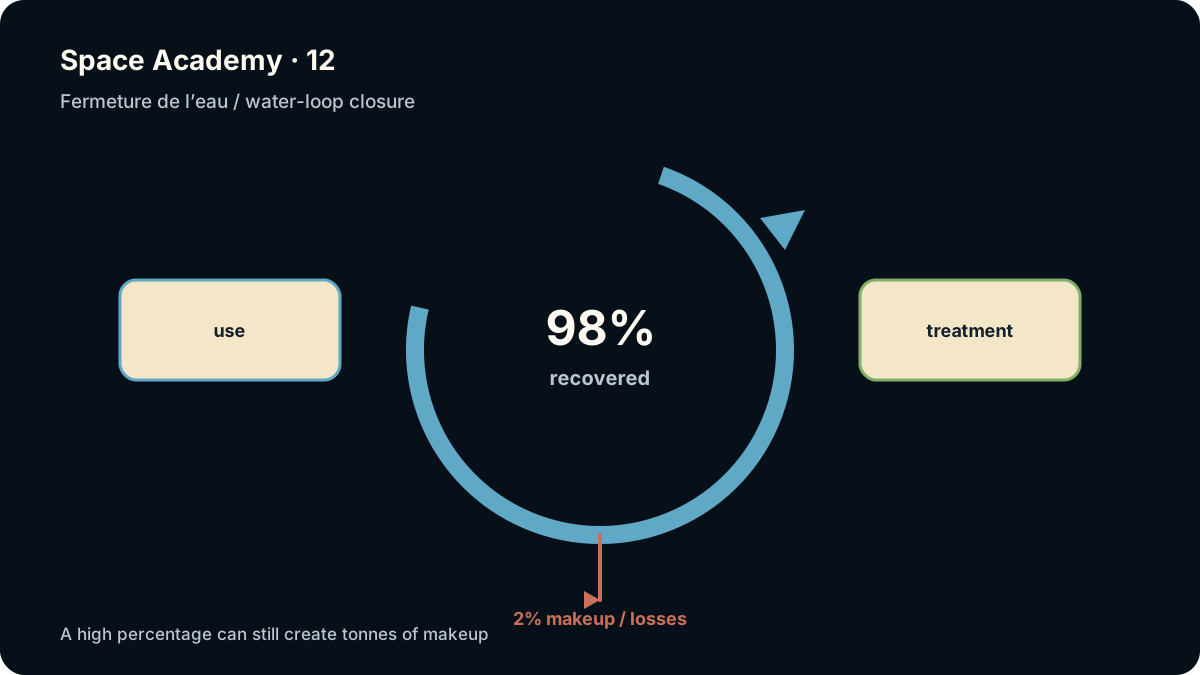
NASA reported ISS ECLSS demonstrated about 98% total water recovery with the Brine Processor Assembly, compared with roughly 93–94% beforehand. The aggregate result does not mean every stream recovers 98%.
Teaching case: q = 20 kg/person/day gross processed flow. For 100 people, 2,000 kg/day passes through the model. At R = 0.98, makeup = 40 kg/day; at 0.94, 120 kg/day. Difference = 80 kg/day or 29.2 t/year.
Make-up demand with recovery
- 1 — Concrete question
- What operational question does this relation answer for make-up demand with recovery?
- 2 — Intuition without symbols
- Gross crew demand is reduced by the fraction actually recovered, and only the unrecovered part needs make-up.
- 3 — Quantities first
- q is gross demand per person, N crew count, R recovery fraction, and M_makeup external make-up per time.
- 4 — Formula
- M_makeup = q × N × (1 − R)
- 5 — Read aloud
- Read the relation aloud term by term: M_makeup = q × N × (1 − R).
- 6 — Symbols and meaning
- q is gross demand per person, N crew count, R recovery fraction, and M_makeup external make-up per time.
- 7 — Pronunciation
- The “Read aloud” line above is the oral reference for “Make-up demand with recovery”. Any subscript, exponent or grouping that changes the meaning of the relation should be spoken explicitly.
- 8 — Units
- If q is kg per person per day, M_makeup is kg/day; R is dimensionless.
- 9 — Convention
- For “Make-up demand with recovery”, substitute values without changing the reference frame, time basis, system boundary or sign convention halfway through the calculation. Stated units: If q is kg per person per day, M_makeup is kg/day; R is dimensionless.
- 10 — Why this operation
- Gross crew demand is reduced by the fraction actually recovered, and only the unrecovered part needs make-up.
- 11 — Assumptions
- The relation “M_makeup = q × N × (1 − R)” applies here only to the scenario described by the card. Inputs must be mutually consistent and satisfy the physical assumptions associated with “Make-up demand with recovery”.
- 12 — Unit check
- If q is kg per person per day, M_makeup is kg/day; R is dimensionless. Verify that units reduce to the unit of the requested quantity.
- 13 — Numerical case
- Teaching example: q = 20 kg/person/day, N = 20, and R = 0.98 gives M_makeup = 20 × 20 × 0.02 = 8 kg/day.
- 14 — Why the calculation works
- Gross crew demand is reduced by the fraction actually recovered, and only the unrecovered part needs make-up.
- 15 — Algebra check
- Quick check: for any non-zero factor, dividing the result by that factor should recover the other expected contribution in “Make-up demand with recovery”.
- 16 — Mental estimate
- Before calculating “Make-up demand with recovery” precisely, round the inputs to one useful digit and predict the sign and order of magnitude. The detailed result should remain consistent with that estimate.
- 17 — Interpretation
- The result is useful only as an operational statement about make-up demand with recovery under the declared assumptions.
- 18 — What the result does not prove
- For “Make-up demand with recovery”, the number obtained answers only the model “M_makeup = q × N × (1 − R)” under the stated scenario. It does not by itself validate the input data or the model outside those conditions.
- 19 — Sensitivity
- Vary one input at a time around the nominal case to identify what drives the result of “Make-up demand with recovery” and whether that variation can change the mission decision.
- 20 — Guided and autonomous practice
Guided exercise. Increase q by 10%, from 20 to 22 kg/person/day, keeping N = 20 and R = 0.98. Recompute make-up demand.
Detailed guided correction — open after attempting
Detailed correction. M_makeup = 22 × 20 × (1 − 0.98) = 440 × 0.02 = 8.8 kg/day. A 10% increase in gross demand produces a 10% increase in make-up here, from 8 to 8.8 kg/day.
Autonomous exercise. Build a second numerical scenario for “Make-up demand with recovery” by changing at least two inputs in
M_makeup = q × N × (1 − R). Compute the result, check units and order of magnitude, then state whether the mission decision should change.Autonomous correction — specific criteria
Autonomous correction. The answer must show substitution into
M_makeup = q × N × (1 − R), produce a value with its unit or an explicit logical result, compare it with the reference case, and justify the following decision: Size make-up inventory from demonstrated real-mode recovery, not the best laboratory figure.- 21 — Mission decision
- Size make-up inventory from demonstrated real-mode recovery, not the best laboratory figure.
Exercise 5
For 1,000 people, q = 20 kg/day and R = 0.98: yearly makeup?
Solution: 400 kg/day × 365 = 146,000 kg = 146 t/year. q is a teaching assumption.
The 146 t/year result shows why 98% recovery is not autonomy. At 1,000 people the remaining two percent becomes a major logistics flow, and q must stay explicitly labeled as a teaching assumption.
Integrated case — 98% recovery does not eliminate losses
NASA demonstrated roughly 98% total water recovery on the ISS, compared with about 93–94% before the brine processor milestone. Use a teaching gross flow of 20 kg/person/day. For 20 people, gross flow is 400 kg/day. At 98% recovery, ideal makeup from unrecovered fraction alone is 8 kg/day or about 2.92 t/year. At 94%, it is 24 kg/day or 8.76 t/year. Four percentage points therefore change annual makeup by 5.84 t in this example.
Do not turn the teaching flow into a NASA requirement for a Mars colonist: 20 kg/person/day is only a loop-throughput assumption. Leaks, maintenance losses, rejected water, water embodied in processes or food, and contingency inventory sit outside that simple calculation. A headline recovery percentage never replaces a stream-by-stream balance.
Recovery-efficiency leverage
- 1 — Concrete question
- What operational question does this relation answer for recovery-efficiency leverage?
- 2 — Intuition without symbols
- A small drop in recovery percentage can multiply the make-up mass that must be supplied over a long mission.
- 3 — Quantities first
- The comparison uses the same crew demand while changing only the recovery fraction.
- 4 — Formula
- at 98%: 8 kg/day; at 94%: 24 kg/day; annual difference = 5.84 t
- 5 — Read aloud
- Read the relation aloud term by term: at 98%: 8 kg/day; at 94%: 24 kg/day; annual difference = 5.84 t.
- 6 — Symbols and meaning
- The comparison uses the same crew demand while changing only the recovery fraction.
- 7 — Pronunciation
- The “Read aloud” line above is the oral reference for “Recovery-efficiency leverage”. Any subscript, exponent or grouping that changes the meaning of the relation should be spoken explicitly.
- 8 — Units
- Daily make-up is kg/day and the annualized difference is kg/year or tonnes/year.
- 9 — Convention
- For “Recovery-efficiency leverage”, substitute values without changing the reference frame, time basis, system boundary or sign convention halfway through the calculation. Stated units: Daily make-up is kg/day and the annualized difference is kg/year or tonnes/year.
- 10 — Why this operation
- A small drop in recovery percentage can multiply the make-up mass that must be supplied over a long mission.
- 11 — Assumptions
- The relation “at 98%: 8 kg/day; at 94%: 24 kg/day; annual difference = 5.84 t” applies here only to the scenario described by the card. Inputs must be mutually consistent and satisfy the physical assumptions associated with “Recovery-efficiency leverage”.
- 12 — Unit check
- Daily make-up is kg/day and the annualized difference is kg/year or tonnes/year. Verify that units reduce to the unit of the requested quantity.
- 13 — Numerical case
- Teaching example: for 400 kg/day gross flow, 98% recovery requires 8 kg/day make-up while 94% requires 24 kg/day. The 16 kg/day gap is 5,840 kg/year, or 5.84 t/year.
- 14 — Why the calculation works
- A small drop in recovery percentage can multiply the make-up mass that must be supplied over a long mission.
- 15 — Algebra check
- Quick check: multiplying the result by the denominator should reconstruct the numerator of “Recovery-efficiency leverage” within rounding.
- 16 — Mental estimate
- Before calculating “Recovery-efficiency leverage” precisely, round the inputs to one useful digit and predict the sign and order of magnitude. The detailed result should remain consistent with that estimate.
- 17 — Interpretation
- The result is useful only as an operational statement about recovery-efficiency leverage under the declared assumptions.
- 18 — What the result does not prove
- For “Recovery-efficiency leverage”, the number obtained answers only the model “at 98%: 8 kg/day; at 94%: 24 kg/day; annual difference = 5.84 t” under the stated scenario. It does not by itself validate the input data or the model outside those conditions.
- 19 — Sensitivity
- Vary one input at a time around the nominal case to identify what drives the result of “Recovery-efficiency leverage” and whether that variation can change the mission decision.
- 20 — Guided and autonomous practice
Guided exercise. With the same 400 kg/day gross flow, let recovery fall from 98% to 97%. Compute the new make-up and annual difference relative to 98%.
Detailed guided correction — open after attempting
Detailed correction. At 97%, the unrecovered fraction is 3%, so make-up is 400 × 0.03 = 12 kg/day. Compared with 8 kg/day at 98%, the difference is +4 kg/day. Over 365 days: 4 × 365 = 1,460 kg/year, or 1.46 t/year extra.
Autonomous exercise. Build a second numerical scenario for “Recovery-efficiency leverage” by changing at least two inputs in
at 98%: 8 kg/day; at 94%: 24 kg/day; annual difference = 5.84 t. Compute the result, check units and order of magnitude, then state whether the mission decision should change.Autonomous correction — specific criteria
Autonomous correction. The answer must show substitution into
at 98%: 8 kg/day; at 94%: 24 kg/day; annual difference = 5.84 t, produce a value with its unit or an explicit logical result, compare it with the reference case, and justify the following decision: Treat a few lost recovery points as a major logistics consequence on a long mission.- 21 — Mission decision
- Treat a few lost recovery points as a major logistics consequence on a long mission.
System intuition
The ISS 98% milestone is demonstrated overall recovery in a specific architecture, not a promise that every Mars loop will lose exactly 2%. For engineering, convert the percentage into makeup mass, then add storage, quality control, maintenance losses, and outage scenarios.
The flow q must be defined: drinking water alone, total processed water, or loop throughput produce very different answers.
Logistics case — water
For 100 people, use a teaching processed flow of 20 kg/person/day. At 98% recovery, ideal makeup is 40 kg/day; at 94%, 120 kg/day. Over a year the difference is 29.2 tonnes. This does not define a real settlement flow; it shows the logistics sensitivity to a few recovery points at larger population.
6. Recovered water still needs qualification
NASA describes ISS processing with filtration, catalytic treatment, quality sensors, and reprocessing of unacceptable water. A recovery loop is therefore also a continuous quality-control system.
A false “good” sensor indication can be more dangerous than a filter that fails visibly. Sampling, calibration, acceptance criteria, and buffer storage limit propagation of one bad measurement.
Quantified balance
Water quality is separate from mass recovery. A highly efficient loop that passes a critical contaminant is unusable. Define quality parameters, sampling frequency, sensors, confirmatory analyses, reprocessing capacity, and quarantine volume for suspect batches.
Produced-water acceptance
- 1 — Concrete question
- What operational question does this relation answer for produced-water acceptance?
- 2 — Intuition without symbols
- Producing water is not enough: it enters usable inventory only after the required quality criteria are met.
- 3 — Quantities first
- Produced water is the process output; acceptance criteria represent the required verified quality conditions.
- 4 — Formula
- accepted water = produced water ∩ quality criteria
- 5 — Read aloud
- Read the relation aloud term by term: accepted water = produced water ∩ quality criteria.
- 6 — Symbols and meaning
- Produced water is the process output; acceptance criteria represent the required verified quality conditions.
- 7 — Pronunciation
- The “Read aloud” line above is the oral reference for “Produced-water acceptance”. Any subscript, exponent or grouping that changes the meaning of the relation should be spoken explicitly.
- 8 — Units
- This is a logical acceptance relation; individual quality measurements keep their own units.
- 9 — Convention
- For “Produced-water acceptance”, substitute values without changing the reference frame, time basis, system boundary or sign convention halfway through the calculation. Stated units: This is a logical acceptance relation; individual quality measurements keep their own units.
- 10 — Why this operation
- Producing water is not enough: it enters usable inventory only after the required quality criteria are met.
- 11 — Assumptions
- The relation “accepted water = produced water ∩ quality criteria” applies here only to the scenario described by the card. Inputs must be mutually consistent and satisfy the physical assumptions associated with “Produced-water acceptance”.
- 12 — Unit check
- This is a logical acceptance relation; individual quality measurements keep their own units. Verify that units reduce to the unit of the requested quantity.
- 13 — Numerical case
- Teaching qualification example: a 120 L batch meets a pedagogical conductivity limit of 5 µS/cm at 4.8 µS/cm, but total organic carbon is 0.70 mg/L against a pedagogical limit of 0.50 mg/L. Volume is sufficient, yet the batch remains rejected because one criterion fails.
- 14 — Why the calculation works
- Producing water is not enough: it enters usable inventory only after the required quality criteria are met.
- 15 — Algebra check
- Quick check: invert “accepted water = produced water ∩ quality criteria” when possible, or use a second calculation path, and confirm the same order of magnitude for “Produced-water acceptance”.
- 16 — Mental estimate
- Before calculating “Produced-water acceptance” precisely, round the inputs to one useful digit and predict the sign and order of magnitude. The detailed result should remain consistent with that estimate.
- 17 — Interpretation
- The result is useful only as an operational statement about produced-water acceptance under the declared assumptions.
- 18 — What the result does not prove
- For “Produced-water acceptance”, the number obtained answers only the model “accepted water = produced water ∩ quality criteria” under the stated scenario. It does not by itself validate the input data or the model outside those conditions.
- 19 — Sensitivity
- Vary one input at a time around the nominal case to identify what drives the result of “Produced-water acceptance” and whether that variation can change the mission decision.
- 20 — Guided and autonomous practice
Guided exercise. After reprocessing, the same 120 L batch measures 4.6 µS/cm and 0.40 mg/L against the same pedagogical limits. Apply the acceptance rule.
Detailed guided correction — open after attempting
Detailed correction. Conductivity: 4.6 < 5 µS/cm, PASS. Total organic carbon: 0.40 < 0.50 mg/L, PASS. Both declared criteria are satisfied; in this teaching scenario limited to those two criteria, the batch can be accepted. This calculation is not a real drinking-water standard.
Autonomous exercise. Build a second numerical scenario for “Produced-water acceptance” by changing at least two inputs in
accepted water = produced water ∩ quality criteria. Compute the result, check units and order of magnitude, then state whether the mission decision should change.Autonomous correction — specific criteria
Autonomous correction. The answer must show substitution into
accepted water = produced water ∩ quality criteria, produce a value with its unit or an explicit logical result, compare it with the reference case, and justify the following decision: Keep produced, tested, and accepted water separate in both physical routing and inventory records.- 21 — Mission decision
- Keep produced, tested, and accepted water separate in both physical routing and inventory records.
A compliant measurement does not prove every possible contaminant was measured; the control plan must connect risk with analytical method.
Qualification case — water
Imagine a processor producing 500 L/day while 2% of batches are temporarily off specification. Even with excellent mass recovery, operations need buffer volume to isolate, reprocess, or analyze those batches. If laboratory confirmation takes 12 h, the buffer cannot be sized only from average consumption.
7. Food and waste: partial closure
Food combines calories, protein, micronutrients, water, shelf life, and acceptability. Crops can supply fresh food and contribute to gas exchange without instantly removing food logistics.
Waste retains water, carbon, nitrogen, phosphorus, and materials. Recovery requires energy, reactors, sanitation controls, and maintenance. Optimum closure can remain below 100% when marginal recovery costs exceed its value.
Degraded mode
Food creates a trade among shipped mass, water content, nutritional stability, crew time, fresh crops, and waste. Plants can provide variety and micronutrients without making the habitat automatically calorie-self-sufficient. The balance must count lighting energy, water, nutrients, volume, maintenance, and crop losses.
Wet-food mass from dry matter
- 1 — Concrete question
- What operational question does this relation answer for wet-food mass from dry matter?
- 2 — Intuition without symbols
- Dry matter is only the non-water fraction of food; total food mass must include the water fraction.
- 3 — Quantities first
- m_food is total wet-food mass, m_dry dry matter, and f_water the water mass fraction.
- 4 — Formula
- m_food = m_dry / (1 − f_water)
- 5 — Read aloud
- Read the relation aloud term by term: m_food = m_dry / (1 − f_water).
- 6 — Symbols and meaning
- m_food is total wet-food mass, m_dry dry matter, and f_water the water mass fraction.
- 7 — Pronunciation
- The “Read aloud” line above is the oral reference for “Wet-food mass from dry matter”. Any subscript, exponent or grouping that changes the meaning of the relation should be spoken explicitly.
- 8 — Units
- m_food and m_dry use the same mass unit; f_water is dimensionless.
- 9 — Convention
- For “Wet-food mass from dry matter”, substitute values without changing the reference frame, time basis, system boundary or sign convention halfway through the calculation. Stated units: m_food and m_dry use the same mass unit; f_water is dimensionless.
- 10 — Why this operation
- Dry matter is only the non-water fraction of food; total food mass must include the water fraction.
- 11 — Assumptions
- The relation “m_food = m_dry / (1 − f_water)” applies here only to the scenario described by the card. Inputs must be mutually consistent and satisfy the physical assumptions associated with “Wet-food mass from dry matter”.
- 12 — Unit check
- m_food and m_dry use the same mass unit; f_water is dimensionless. Verify that units reduce to the unit of the requested quantity.
- 13 — Numerical case
- Teaching example: with m_dry = 6 kg and f_water = 0.60, m_food = 6/(1 − 0.60) = 15 kg.
- 14 — Why the calculation works
- Dry matter is only the non-water fraction of food; total food mass must include the water fraction.
- 15 — Algebra check
- Quick check: multiplying the result by the denominator should reconstruct the numerator of “Wet-food mass from dry matter” within rounding.
- 16 — Mental estimate
- Before calculating “Wet-food mass from dry matter” precisely, round the inputs to one useful digit and predict the sign and order of magnitude. The detailed result should remain consistent with that estimate.
- 17 — Interpretation
- The result is useful only as an operational statement about wet-food mass from dry matter under the declared assumptions.
- 18 — What the result does not prove
- For “Wet-food mass from dry matter”, the number obtained answers only the model “m_food = m_dry / (1 − f_water)” under the stated scenario. It does not by itself validate the input data or the model outside those conditions.
- 19 — Sensitivity
- Vary one input at a time around the nominal case to identify what drives the result of “Wet-food mass from dry matter” and whether that variation can change the mission decision.
- 20 — Guided and autonomous practice
Guided exercise. Increase water fraction by 10% relatively, from 0.60 to 0.66, while keeping 6 kg dry matter. Recompute total mass.
Detailed guided correction — open after attempting
Detailed correction. 1 − 0.66 = 0.34, so m_food = 6/0.34 = about 17.65 kg. Extra water raises wet mass while dry matter remains 6 kg: 15.0 → 17.65 kg.
Autonomous exercise. Build a second numerical scenario for “Wet-food mass from dry matter” by changing at least two inputs in
m_food = m_dry / (1 − f_water). Compute the result, check units and order of magnitude, then state whether the mission decision should change.Autonomous correction — specific criteria
Autonomous correction. The answer must show substitution into
m_food = m_dry / (1 − f_water), produce a value with its unit or an explicit logical result, compare it with the reference case, and justify the following decision: Separate nutritional dry mass from total logistics mass before sizing stores and waste flows.- 21 — Mission decision
- Separate nutritional dry mass from total logistics mass before sizing stores and waste flows.
Reducing food mass can shift demand into water or energy; the optimum must be judged at system level.
System case — food
A 2.0 kg/day prepackaged ration at 46% water contains 1.08 kg dry matter. At 30% water, the same dry matter would weigh 1.54 kg/day. Shipped mass falls by about 0.46 kg/day, but the water loop must supply more at use. The system boundary must move rather than counting the saving twice.
Decision check. Food also couples to waste handling. Packaging, uneaten material, plant residues, nutrient solution, and sanitation loads become flows that consume storage and processing capacity. A crop system that reduces imported food mass can still increase electrical load and crew time, so the trade must remain multi-resource.
8. Fire, depressurization, safe haven
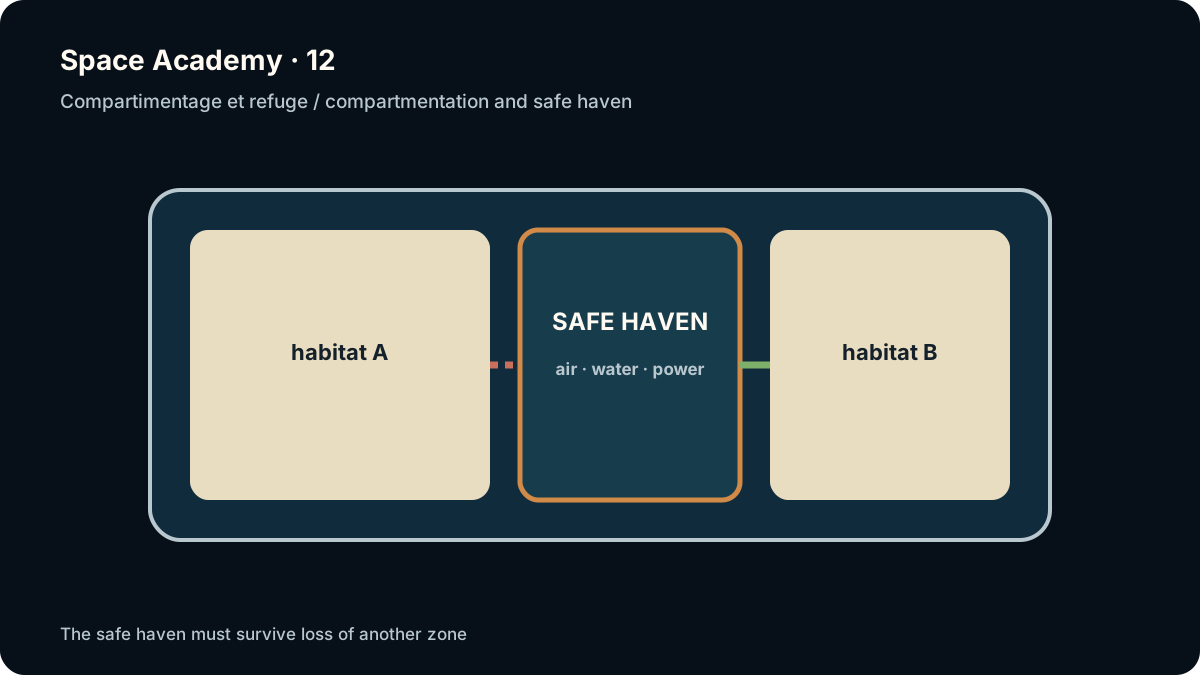
Fire combines heat, smoke, and toxic gases; depressurization combines atmosphere loss with structural danger. Both can require leaving nominal operation locally through compartmentation, hatches, masks, extinguishers, reserves, and safe haven.
A safe haven needs independent air, water, power, and communications for a defined duration covering detection, isolation, diagnosis, and repair. Emergency consumables should not share the same failure path they protect against.
Safe-haven scenario — 72 hours without external resources
Imagine an isolated refuge for six people over 72 hours. Start with functions rather than an arbitrary mass: pressure, oxygen, CO₂ removal, drinking water, temperature, control power, minimum lighting, communication, medical care, and sanitation. Give each function a stock or capacity, margin, and exit criterion. A refuge is not merely a stronger room; it is an isolatable miniature life-support system.
For direct drinking water, if a teaching scenario assumes 4 kg/person/day, arithmetic baseline is 6×4×3=72 kg before margin. Adding 25% gives 90 kg. That mass does not include fire suppression or medical uses. A critical electrical load averaging 1.5 kW for 72 h requires 108 kWh useful; with an 85% storage chain, upstream stored energy is about 127 kWh. Two functions, two budgets, and two explicitly separate assumptions.
Three-day refuge water and energy
- 1 — Concrete question
- What operational question does this relation answer for three-day refuge water and energy?
- 2 — Intuition without symbols
- A refuge must cover both crew demand and critical energy for the whole protected duration, with an explicit margin.
- 3 — Quantities first
- N is crew count, q essential water per person per day, t duration, k contingency factor, P critical power, and eta usable storage efficiency.
- 4 — Formula
- M_water = N q t k ; E_storage = P t / η
- 5 — Read aloud
- Read the relation aloud term by term: M_water = N q t k ; E_storage = P t / η.
- 6 — Symbols and meaning
- N is crew count, q essential water per person per day, t duration, k contingency factor, P critical power, and eta usable storage efficiency.
- 7 — Pronunciation
- The “Read aloud” line above is the oral reference for “Three-day refuge water and energy”. Any subscript, exponent or grouping that changes the meaning of the relation should be spoken explicitly.
- 8 — Units
- Water is in kg or L; energy is in kWh when power is kW and time is hours; eta is dimensionless.
- 9 — Convention
- For “Three-day refuge water and energy”, substitute values without changing the reference frame, time basis, system boundary or sign convention halfway through the calculation. Stated units: Water is in kg or L; energy is in kWh when power is kW and time is hours; eta is dimensionless.
- 10 — Why this operation
- A refuge must cover both crew demand and critical energy for the whole protected duration, with an explicit margin.
- 11 — Assumptions
- The relation “M_water = N q t k ; E_storage = P t / η” applies here only to the scenario described by the card. Inputs must be mutually consistent and satisfy the physical assumptions associated with “Three-day refuge water and energy”.
- 12 — Unit check
- Water is in kg or L; energy is in kWh when power is kW and time is hours; eta is dimensionless. Verify that units reduce to the unit of the requested quantity.
- 13 — Numerical case
- Teaching example: N = 6, q = 4 kg/person/day, t = 3 days, and k = 1.25 gives M_water = 6 × 4 × 3 × 1.25 = 90 kg. For P = 1.5 kW over 72 h with η = 0.85, E_storage = 1.5 × 72 / 0.85 = 127.1 kWh.
- 14 — Why the calculation works
- A refuge must cover both crew demand and critical energy for the whole protected duration, with an explicit margin.
- 15 — Algebra check
- Quick check: multiplying the result by the denominator should reconstruct the numerator of “Three-day refuge water and energy” within rounding.
- 16 — Mental estimate
- Before calculating “Three-day refuge water and energy” precisely, round the inputs to one useful digit and predict the sign and order of magnitude. The detailed result should remain consistent with that estimate.
- 17 — Interpretation
- The result is useful only as an operational statement about three-day refuge water and energy under the declared assumptions.
- 18 — What the result does not prove
- For “Three-day refuge water and energy”, the number obtained answers only the model “M_water = N q t k ; E_storage = P t / η” under the stated scenario. It does not by itself validate the input data or the model outside those conditions.
- 19 — Sensitivity
- Vary one input at a time around the nominal case to identify what drives the result of “Three-day refuge water and energy” and whether that variation can change the mission decision.
- 20 — Guided and autonomous practice
Guided exercise. Increase refuge duration by 10%, from 3 to 3.3 days, keeping all other assumptions unchanged. Recompute required water and stored energy.
Detailed guided correction — open after attempting
Detailed correction. Water: M_water = 6 × 4 × 3.3 × 1.25 = 99 kg. Energy: 3.3 days = 79.2 h; E_storage = 1.5 × 79.2 / 0.85 = about 139.8 kWh. Both needs rise by 10% because duration enters both relations linearly.
Autonomous exercise. Build a second numerical scenario for “Three-day refuge water and energy” by changing at least two inputs in
M_water = N q t k ; E_storage = P t / η. Compute the result, check units and order of magnitude, then state whether the mission decision should change.Autonomous correction — specific criteria
Autonomous correction. The answer must show substitution into
M_water = N q t k ; E_storage = P t / η, produce a value with its unit or an explicit logical result, compare it with the reference case, and justify the following decision: Approve the refuge only if water, energy, air, communications, and access remain independent of the primary failure.- 21 — Mission decision
- Approve the refuge only if water, energy, air, communications, and access remain independent of the primary failure.
Safety reading
Fire and depressurization demand different responses in some respects: fire can require confinement, ventilation isolation, or suppression, while a leak requires volume isolation and pressure-loss management. A safe haven must remain habitable during repair without depending on the failure that triggered the emergency.
Refuge endurance
- 1 — Concrete question
- What operational question does this relation answer for refuge endurance?
- 2 — Intuition without symbols
- Useful refuge duration is set by the critical resource that is exhausted first in emergency mode.
- 3 — Quantities first
- stocks is verified emergency inventory; emergency-use rate is the corresponding consumption rate; t_refuge is endurance.
- 4 — Formula
- t_refuge = stocks / emergency-use rate
- 5 — Read aloud
- Read the relation aloud term by term: t_refuge = stocks / emergency-use rate.
- 6 — Symbols and meaning
- stocks is verified emergency inventory; emergency-use rate is the corresponding consumption rate; t_refuge is endurance.
- 7 — Pronunciation
- The “Read aloud” line above is the oral reference for “Refuge endurance”. Any subscript, exponent or grouping that changes the meaning of the relation should be spoken explicitly.
- 8 — Units
- Stock divided by stock-per-time gives time.
- 9 — Convention
- For “Refuge endurance”, substitute values without changing the reference frame, time basis, system boundary or sign convention halfway through the calculation. Stated units: Stock divided by stock-per-time gives time.
- 10 — Why this operation
- Useful refuge duration is set by the critical resource that is exhausted first in emergency mode.
- 11 — Assumptions
- The relation “t_refuge = stocks / emergency-use rate” applies here only to the scenario described by the card. Inputs must be mutually consistent and satisfy the physical assumptions associated with “Refuge endurance”.
- 12 — Unit check
- Stock divided by stock-per-time gives time. Verify that units reduce to the unit of the requested quantity.
- 13 — Numerical case
- Teaching example: a verified 90 kg stock consumed at 30 kg/day gives t_refuge = 90/30 = 3 days.
- 14 — Why the calculation works
- Useful refuge duration is set by the critical resource that is exhausted first in emergency mode.
- 15 — Algebra check
- Quick check: multiplying the result by the denominator should reconstruct the numerator of “Refuge endurance” within rounding.
- 16 — Mental estimate
- Before calculating “Refuge endurance” precisely, round the inputs to one useful digit and predict the sign and order of magnitude. The detailed result should remain consistent with that estimate.
- 17 — Interpretation
- The result is useful only as an operational statement about refuge endurance under the declared assumptions.
- 18 — What the result does not prove
- For “Refuge endurance”, the number obtained answers only the model “t_refuge = stocks / emergency-use rate” under the stated scenario. It does not by itself validate the input data or the model outside those conditions.
- 19 — Sensitivity
- Vary one input at a time around the nominal case to identify what drives the result of “Refuge endurance” and whether that variation can change the mission decision.
- 20 — Guided and autonomous practice
Guided exercise. Increase stock by 10%, from 90 to 99 kg, keeping emergency consumption at 30 kg/day. Recompute endurance.
Detailed guided correction — open after attempting
Detailed correction. t_refuge = 99/30 = 3.3 days. With the rate unchanged, +10% stock gives +10% endurance: 3.0 → 3.3 days.
Autonomous exercise. Build a second numerical scenario for “Refuge endurance” by changing at least two inputs in
t_refuge = stocks / emergency-use rate. Compute the result, check units and order of magnitude, then state whether the mission decision should change.Autonomous correction — specific criteria
Autonomous correction. The answer must show substitution into
t_refuge = stocks / emergency-use rate, produce a value with its unit or an explicit logical result, compare it with the reference case, and justify the following decision: Use the minimum of water, energy, oxygen, and critical-consumable endurance as the refuge endurance.- 21 — Mission decision
- Use the minimum of water, energy, oxygen, and critical-consumable endurance as the refuge endurance.
NASA’s 30-day safe-haven concept is a studied architecture, not a universal duration; each mission must demonstrate its own recovery time.
Emergency case — safe haven
For eight people over 30 days, a 3 kW average vital load requires 2,160 kWh if no generation is available. With 80% usable stored energy and 90% conversion efficiency, nominal storage becomes 2,160/(0.8×0.9)≈3,000 kWh. The exercise separates useful demand, usable depth, and conversion loss.
9. Martian dust: measurable contamination
In July 2026 NASA established a preliminary requirement of 0.1 mg/m³ as a 24-hour average for Martian particles below 10 µm in specified exposure scenarios up to 30 days. Uncertainty remains because authentic airborne Mars dust has not been returned for full human toxicology.
At that concentration, 100 m³ contains 10 mg suspended on average. Small mass can still matter for fine-particle inhalation, so airlocks, suit handling, cleaning, filtration, and monitoring form layered control.
EVA scenario — dust, airlock, cross-contamination
NASA published in July 2026 a preliminary requirement for Martian particles below 10 µm: 24-hour time-weighted average below 0.1 mg/m³ for certain exposure scenarios up to 30 days. In a 150 m³ habitat that concentration corresponds to 15 mg of airborne mass at that average. A very small total mass can therefore matter when dispersed as respirable fine particles.
Contamination architecture aims to prevent dust from reaching habitable air: dirty and clean zones, suit cleaning, cleanable surfaces, filtration, measurement, and post-EVA procedures. Because authentic airborne Martian dust has not been returned to Earth, NASA explicitly describes uncertainty in the initial limit. Design should therefore preserve the ability to measure and revise rather than treating 0.1 mg/m³ as an immutable biological constant.
Total dust loading
- 1 — Concrete question
- What operational question does this relation answer for total dust loading?
- 2 — Intuition without symbols
- Concentration multiplied by the affected air volume gives the total mass present in that volume.
- 3 — Quantities first
- C is dust concentration, V air volume, and m total dust mass.
- 4 — Formula
- m = C × V
- 5 — Read aloud
- Read the relation aloud term by term: m = C × V.
- 6 — Symbols and meaning
- C is dust concentration, V air volume, and m total dust mass.
- 7 — Pronunciation
- The “Read aloud” line above is the oral reference for “Total dust loading”. Any subscript, exponent or grouping that changes the meaning of the relation should be spoken explicitly.
- 8 — Units
- mg/m³ multiplied by m³ gives mg.
- 9 — Convention
- For “Total dust loading”, substitute values without changing the reference frame, time basis, system boundary or sign convention halfway through the calculation. Stated units: mg/m³ multiplied by m³ gives mg.
- 10 — Why this operation
- Concentration multiplied by the affected air volume gives the total mass present in that volume.
- 11 — Assumptions
- The relation “m = C × V” applies here only to the scenario described by the card. Inputs must be mutually consistent and satisfy the physical assumptions associated with “Total dust loading”.
- 12 — Unit check
- mg/m³ multiplied by m³ gives mg. Verify that units reduce to the unit of the requested quantity.
- 13 — Numerical case
- Teaching example: C = 0.10 mg/m³ across V = 150 m³ gives m = 0.10 × 150 = 15 mg suspended material.
- 14 — Why the calculation works
- Concentration multiplied by the affected air volume gives the total mass present in that volume.
- 15 — Algebra check
- Quick check: for any non-zero factor, dividing the result by that factor should recover the other expected contribution in “Total dust loading”.
- 16 — Mental estimate
- Before calculating “Total dust loading” precisely, round the inputs to one useful digit and predict the sign and order of magnitude. The detailed result should remain consistent with that estimate.
- 17 — Interpretation
- The result is useful only as an operational statement about total dust loading under the declared assumptions.
- 18 — What the result does not prove
- For “Total dust loading”, the number obtained answers only the model “m = C × V” under the stated scenario. It does not by itself validate the input data or the model outside those conditions.
- 19 — Sensitivity
- Vary one input at a time around the nominal case to identify what drives the result of “Total dust loading” and whether that variation can change the mission decision.
- 20 — Guided and autonomous practice
Guided exercise. Concentration increases by 10%, from 0.10 to 0.11 mg/m³, for the same 150 m³ volume. Recompute total loading.
Detailed guided correction — open after attempting
Detailed correction. m = 0.11 × 150 = 16.5 mg. A 10% rise in concentration gives a 10% rise in total loading at constant volume: 15 → 16.5 mg.
Autonomous exercise. Build a second numerical scenario for “Total dust loading” by changing at least two inputs in
m = C × V. Compute the result, check units and order of magnitude, then state whether the mission decision should change.Autonomous correction — specific criteria
Autonomous correction. The answer must show substitution into
m = C × V, produce a value with its unit or an explicit logical result, compare it with the reference case, and justify the following decision: Use this mass to plan containment, filtration, cleaning, and sampling without confusing it with inhaled dose.- 21 — Mission decision
- Use this mass to plan containment, filtration, cleaning, and sampling without confusing it with inhaled dose.
System intuition
Martian dust should be treated as a contamination flow: EVA ingress, deposition, resuspension, filtration, and removal. NASA’s new 2026 requirement provides a 24-hour average limit for particles <10 µm, while design must also address local peaks and toxicology uncertainty.
Time-weighted average exposure
- 1 — Concrete question
- What operational question does this relation answer for time-weighted average exposure?
- 2 — Intuition without symbols
- Each exposure level matters in proportion to how long it lasts, so the average must weight concentration by time.
- 3 — Quantities first
- C_i is concentration during interval i, Delta t_i its duration, and C_TWA the time-weighted average.
- 4 — Formula
- C_TWA = (Σ C_i Δt_i)/(Σ Δt_i)
- 5 — Read aloud
- Read the relation aloud term by term: C_TWA = (Σ C_i Δt_i)/(Σ Δt_i).
- 6 — Symbols and meaning
- C_i is concentration during interval i, Delta t_i its duration, and C_TWA the time-weighted average.
- 7 — Pronunciation
- The “Read aloud” line above is the oral reference for “Time-weighted average exposure”. Any subscript, exponent or grouping that changes the meaning of the relation should be spoken explicitly.
- 8 — Units
- Concentration-times-time divided by time returns concentration.
- 9 — Convention
- For “Time-weighted average exposure”, substitute values without changing the reference frame, time basis, system boundary or sign convention halfway through the calculation. Stated units: Concentration-times-time divided by time returns concentration.
- 10 — Why this operation
- Each exposure level matters in proportion to how long it lasts, so the average must weight concentration by time.
- 11 — Assumptions
- The relation “C_TWA = (Σ C_i Δt_i)/(Σ Δt_i)” applies here only to the scenario described by the card. Inputs must be mutually consistent and satisfy the physical assumptions associated with “Time-weighted average exposure”.
- 12 — Unit check
- Concentration-times-time divided by time returns concentration. Verify that units reduce to the unit of the requested quantity.
- 13 — Numerical case
- Teaching example: 4 h at 0.10 mg/m³ followed by 4 h at 0.20 mg/m³ gives C_TWA = (0.10×4 + 0.20×4)/8 = 0.15 mg/m³.
- 14 — Why the calculation works
- Each exposure level matters in proportion to how long it lasts, so the average must weight concentration by time.
- 15 — Algebra check
- Quick check: multiplying the result by the denominator should reconstruct the numerator of “Time-weighted average exposure” within rounding.
- 16 — Mental estimate
- Before calculating “Time-weighted average exposure” precisely, round the inputs to one useful digit and predict the sign and order of magnitude. The detailed result should remain consistent with that estimate.
- 17 — Interpretation
- The result is useful only as an operational statement about time-weighted average exposure under the declared assumptions.
- 18 — What the result does not prove
- For “Time-weighted average exposure”, the number obtained answers only the model “C_TWA = (Σ C_i Δt_i)/(Σ Δt_i)” under the stated scenario. It does not by itself validate the input data or the model outside those conditions.
- 19 — Sensitivity
- Vary one input at a time around the nominal case to identify what drives the result of “Time-weighted average exposure” and whether that variation can change the mission decision.
- 20 — Guided and autonomous practice
Guided exercise. Increase the second-interval concentration by 10%, from 0.20 to 0.22 mg/m³, with durations unchanged. Recompute the time-weighted average.
Detailed guided correction — open after attempting
Detailed correction. Numerator = 0.10×4 + 0.22×4 = 0.40 + 0.88 = 1.28 mg·h/m³. Total duration = 8 h. Therefore C_TWA = 1.28/8 = 0.16 mg/m³. A 10% increase during only half the exposure raises TWA by 0.01 mg/m³.
Autonomous exercise. Build a second numerical scenario for “Time-weighted average exposure” by changing at least two inputs in
C_TWA = (Σ C_i Δt_i)/(Σ Δt_i). Compute the result, check units and order of magnitude, then state whether the mission decision should change.Autonomous correction — specific criteria
Autonomous correction. The answer must show substitution into
C_TWA = (Σ C_i Δt_i)/(Σ Δt_i), produce a value with its unit or an explicit logical result, compare it with the reference case, and justify the following decision: Compare average and peaks separately: an acceptable average does not make an extreme peak acceptable.- 21 — Mission decision
- Compare average and peaks separately: an acceptable average does not make an extreme peak acceptable.
An acceptable average can hide a large airlock peak; sensor location and sampling strategy matter.
Exposure case — dust
A 24-hour time-weighted average can combine 0.20 mg/m³ for 2 h near the airlock and 0.05 mg/m³ for 22 h. The average is 0.0625 mg/m³. It is below 0.1 mg/m³ in this example, but the 0.20 peak can still matter operationally and for sampling strategy.
10. Radiation, EVA, and return time
Background radiation and solar events create shielding and exposure-time problems. EVA adds vacuum, dust, fatigue, thermal control, and suit dependence. These risks belong in schedules and return plans.
A better-shielded zone and decision rules can support radiation events. EVA needs consumables margin and a return path after credible faults. Survival is partly management of available time.
Quantified balance
Radiation and EVA become a time-to-shielding problem. A distant sortie adds return delay, mobility dependence, and possible simultaneous failure. Procedures must connect forecast, alarm, distance, degraded speed, accumulated dose, and shelter capability.
Degraded-mode return time
- 1 — Concrete question
- What operational question does this relation answer for degraded-mode return time?
- 2 — Intuition without symbols
- Distance to travel divided by the speed actually sustainable in degraded mode gives the minimum return time.
- 3 — Quantities first
- d is return distance, v_degraded degraded speed, and t_return return time.
- 4 — Formula
- t_return = d / v_degraded
- 5 — Read aloud
- Read the relation aloud term by term: t_return = d / v_degraded.
- 6 — Symbols and meaning
- d is return distance, v_degraded degraded speed, and t_return return time.
- 7 — Pronunciation
- The “Read aloud” line above is the oral reference for “Degraded-mode return time”. Any subscript, exponent or grouping that changes the meaning of the relation should be spoken explicitly.
- 8 — Units
- Distance divided by distance-per-time gives time.
- 9 — Convention
- For “Degraded-mode return time”, substitute values without changing the reference frame, time basis, system boundary or sign convention halfway through the calculation. Stated units: Distance divided by distance-per-time gives time.
- 10 — Why this operation
- Distance to travel divided by the speed actually sustainable in degraded mode gives the minimum return time.
- 11 — Assumptions
- The relation “t_return = d / v_degraded” applies here only to the scenario described by the card. Inputs must be mutually consistent and satisfy the physical assumptions associated with “Degraded-mode return time”.
- 12 — Unit check
- Distance divided by distance-per-time gives time. Verify that units reduce to the unit of the requested quantity.
- 13 — Numerical case
- Teaching example: at d = 18 km from shelter and v_degraded = 6 km/h, t_return = 18/6 = 3 h.
- 14 — Why the calculation works
- Distance to travel divided by the speed actually sustainable in degraded mode gives the minimum return time.
- 15 — Algebra check
- Quick check: multiplying the result by the denominator should reconstruct the numerator of “Degraded-mode return time” within rounding.
- 16 — Mental estimate
- Before calculating “Degraded-mode return time” precisely, round the inputs to one useful digit and predict the sign and order of magnitude. The detailed result should remain consistent with that estimate.
- 17 — Interpretation
- The result is useful only as an operational statement about degraded-mode return time under the declared assumptions.
- 18 — What the result does not prove
- For “Degraded-mode return time”, the number obtained answers only the model “t_return = d / v_degraded” under the stated scenario. It does not by itself validate the input data or the model outside those conditions.
- 19 — Sensitivity
- Vary one input at a time around the nominal case to identify what drives the result of “Degraded-mode return time” and whether that variation can change the mission decision.
- 20 — Guided and autonomous practice
Guided exercise. Distance increases by 10%, from 18 to 19.8 km, while degraded speed remains 6 km/h. Recompute return time.
Detailed guided correction — open after attempting
Detailed correction. t_return = 19.8/6 = 3.3 h, or 3 h 18 min. At constant speed, +10% distance gives +10% return time: 3.0 → 3.3 h.
Autonomous exercise. Build a second numerical scenario for “Degraded-mode return time” by changing at least two inputs in
t_return = d / v_degraded. Compute the result, check units and order of magnitude, then state whether the mission decision should change.Autonomous correction — specific criteria
Autonomous correction. The answer must show substitution into
t_return = d / v_degraded, produce a value with its unit or an explicit logical result, compare it with the reference case, and justify the following decision: Limit excursions so degraded return retains margin on oxygen, energy, thermal control, and fatigue.- 21 — Mission decision
- Limit excursions so degraded return retains margin on oxygen, energy, thermal control, and fatigue.
Travel-time calculation does not directly convert a radiation event into dose; it defines the operational response window.
Return case — EVA
A crew works 24 km from shelter. At 12 km/h nominal, return takes 2 h. If a failure cuts speed to 6 km/h, return takes 4 h. An excursion rule based on nominal speed can therefore double exposure time precisely when degraded operation is required. Distance limits must use credible degraded modes.
Decision check. A return-time rule should be written for nominal and degraded mobility. If a rover loses half its usable energy or a wheel failure halves speed, the allowed excursion radius may need to shrink before the EVA begins. The rule is therefore an operational control derived from physics, not a fixed distance painted on a map.
11. Medicine and human factors
Earth-Mars delay prevents instant telemedicine. Crew must recognize, stabilize, and treat conditions locally. Medical capability depends on water, power, sterilization, pharmacy, cold storage, and waste.
Fatigue, sleep, conflict, and maintenance workload affect risk. Technical redundancy can still fail operationally if each fault consumes too many hours of scarce expert labor.
Degraded mode
Mission medicine must classify what can be diagnosed locally, what can wait for Earth expertise, and what requires immediate action. Medical inventory is therefore a portfolio of capabilities: drugs, consumables, sterilization, imaging, blood or substitutes, procedures, and human skill.
Local clinical autonomy
- 1 — Concrete question
- What operational question does this relation answer for local clinical autonomy?
- 2 — Intuition without symbols
- If the medical action window closes before remote help can arrive, capability and authority must already exist locally.
- 3 — Quantities first
- The comparison is between the clinically useful action window and the communications/support delay.
- 4 — Formula
- available clinical time < communication delay ⇒ local autonomy
- 5 — Read aloud
- Read the relation aloud term by term: available clinical time < communication delay ⇒ local autonomy.
- 6 — Symbols and meaning
- The comparison is between the clinically useful action window and the communications/support delay.
- 7 — Pronunciation
- The “Read aloud” line above is the oral reference for “Local clinical autonomy”. Any subscript, exponent or grouping that changes the meaning of the relation should be spoken explicitly.
- 8 — Units
- Both sides of the comparison use the same time unit.
- 9 — Convention
- For “Local clinical autonomy”, substitute values without changing the reference frame, time basis, system boundary or sign convention halfway through the calculation. Stated units: Both sides of the comparison use the same time unit.
- 10 — Why this operation
- If the medical action window closes before remote help can arrive, capability and authority must already exist locally.
- 11 — Assumptions
- The relation “available clinical time < communication delay ⇒ local autonomy” applies here only to the scenario described by the card. Inputs must be mutually consistent and satisfy the physical assumptions associated with “Local clinical autonomy”.
- 12 — Unit check
- Both sides of the comparison use the same time unit. Verify that units reduce to the unit of the requested quantity.
- 13 — Numerical case
- Teaching example: a clinical action must be decided within 20 min while usable remote support can respond only in 30 min. Because 20 < 30, the crew requires local clinical autonomy.
- 14 — Why the calculation works
- If the medical action window closes before remote help can arrive, capability and authority must already exist locally.
- 15 — Algebra check
- Quick check: invert “available clinical time < communication delay ⇒ local autonomy” when possible, or use a second calculation path, and confirm the same order of magnitude for “Local clinical autonomy”.
- 16 — Mental estimate
- Before calculating “Local clinical autonomy” precisely, round the inputs to one useful digit and predict the sign and order of magnitude. The detailed result should remain consistent with that estimate.
- 17 — Interpretation
- The result is useful only as an operational statement about local clinical autonomy under the declared assumptions.
- 18 — What the result does not prove
- For “Local clinical autonomy”, the number obtained answers only the model “available clinical time < communication delay ⇒ local autonomy” under the stated scenario. It does not by itself validate the input data or the model outside those conditions.
- 19 — Sensitivity
- Vary one input at a time around the nominal case to identify what drives the result of “Local clinical autonomy” and whether that variation can change the mission decision.
- 20 — Guided and autonomous practice
Guided exercise. The clinical window increases by 10%, from 20 to 22 min, while support delay remains 30 min. Does the rule change?
Detailed guided correction — open after attempting
Detailed correction. 22 min < 30 min, so the condition remains true. The larger window is still too short for remote support; local clinical autonomy remains required. If usable support were available in 18 min, the comparison would change.
Autonomous exercise. Build a second numerical scenario for “Local clinical autonomy” by changing at least two inputs in
available clinical time < communication delay ⇒ local autonomy. Compute the result, check units and order of magnitude, then state whether the mission decision should change.Autonomous correction — specific criteria
Autonomous correction. The answer must show substitution into
available clinical time < communication delay ⇒ local autonomy, produce a value with its unit or an explicit logical result, compare it with the reference case, and justify the following decision: Pre-identify actions that must be autonomous and train at least one qualified backup.- 21 — Mission decision
- Pre-identify actions that must be autonomous and train at least one qualified backup.
Communication delay varies with geometry; the architecture must tolerate the range of delays and outages rather than one fixed value.
Clinical case — autonomy
A medical decision procedure requires four exchanges with an Earth specialist. At 18 min one way, a minimum question-answer cycle takes 36 min; four cycles can exceed 2 h 20 before human decision time. Any emergency with a shorter treatment window therefore requires local procedures, skill, and equipment.
Decision check. Medical autonomy can be decomposed into prevention, diagnosis, stabilization, definitive treatment, and recovery. Each layer has a different demand for training, consumables, sterile equipment, imaging, and communication. Mapping conditions to those layers is more useful than a single statement that the base “has a clinic.”
12. Redundancy and common cause
Two identical units sharing power or software are not independent barriers. Common power, contamination, configuration, or procedural errors can defeat both.
A degraded mode is deliberately less capable but stable: zones isolated, experiments postponed, consumption reduced. Defining these states early makes reserves and procedures concrete.
Safety reading
Useful redundancy separates causes. Two units on the same power bus, in the same dusty compartment, and running the same software can fail together. Diversity, isolation, independent monitoring, and repairability can matter more than unit count.
Common-cause risk
- 1 — Concrete question
- What operational question does this relation answer for common-cause risk?
- 2 — Intuition without symbols
- Two barriers are not truly independent when the same failure, operator, or environment can defeat both together.
- 3 — Quantities first
- System risk depends on both individual failures and dependencies between barriers.
- 4 — Formula
- system risk ≠ product of individual risks when common causes exist
- 5 — Read aloud
- Read the relation aloud term by term: system risk ≠ product of individual risks when common causes exist.
- 6 — Symbols and meaning
- System risk depends on both individual failures and dependencies between barriers.
- 7 — Pronunciation
- The “Read aloud” line above is the oral reference for “Common-cause risk”. Any subscript, exponent or grouping that changes the meaning of the relation should be spoken explicitly.
- 8 — Units
- Probability is dimensionless, but this relation is primarily a dependency warning rather than a numerical formula.
- 9 — Convention
- For “Common-cause risk”, substitute values without changing the reference frame, time basis, system boundary or sign convention halfway through the calculation. Stated units: Probability is dimensionless, but this relation is primarily a dependency warning rather than a numerical formula.
- 10 — Why this operation
- Two barriers are not truly independent when the same failure, operator, or environment can defeat both together.
- 11 — Assumptions
- The relation “system risk ≠ product of individual risks when common causes exist” applies here only to the scenario described by the card. Inputs must be mutually consistent and satisfy the physical assumptions associated with “Common-cause risk”.
- 12 — Unit check
- Probability is dimensionless, but this relation is primarily a dependency warning rather than a numerical formula. Verify that units reduce to the unit of the requested quantity.
- 13 — Numerical case
- Teaching example: two pumps each have a 1% individual failure risk over the period, but they share a power bus with a 5% loss risk. The naive product 1% × 1% = 0.01% therefore does not represent system risk because the common bus alone contributes at least 5%.
- 14 — Why the calculation works
- Two barriers are not truly independent when the same failure, operator, or environment can defeat both together.
- 15 — Algebra check
- Quick check: invert “system risk ≠ product of individual risks when common causes exist” when possible, or use a second calculation path, and confirm the same order of magnitude for “Common-cause risk”.
- 16 — Mental estimate
- Before calculating “Common-cause risk” precisely, round the inputs to one useful digit and predict the sign and order of magnitude. The detailed result should remain consistent with that estimate.
- 17 — Interpretation
- The result is useful only as an operational statement about common-cause risk under the declared assumptions.
- 18 — What the result does not prove
- For “Common-cause risk”, the number obtained answers only the model “system risk ≠ product of individual risks when common causes exist” under the stated scenario. It does not by itself validate the input data or the model outside those conditions.
- 19 — Sensitivity
- Vary one input at a time around the nominal case to identify what drives the result of “Common-cause risk” and whether that variation can change the mission decision.
- 20 — Guided and autonomous practice
Guided exercise. Keep individual pump risk at 1% but reduce common-bus loss risk from 5% to 2%. Compare again with the naive product of individual risks.
Detailed guided correction — open after attempting
Detailed correction. The naive product remains 0.01%. Yet the common bus alone still contributes 2% simultaneous-loss risk, 200 times 0.01%. The system therefore still cannot be represented by the product of individual risks; the common cause must be modeled explicitly.
Autonomous exercise. Build a second numerical scenario for “Common-cause risk” by changing at least two inputs in
system risk ≠ product of individual risks when common causes exist. Compute the result, check units and order of magnitude, then state whether the mission decision should change.Autonomous correction — specific criteria
Autonomous correction. The answer must show substitution into
system risk ≠ product of individual risks when common causes exist, produce a value with its unit or an explicit logical result, compare it with the reference case, and justify the following decision: Search explicitly for shared power, sensors, software, operators, and locations before crediting redundancy.- 21 — Mission decision
- Search explicitly for shared power, sensors, software, operators, and locations before crediting redundancy.
Independent probabilistic calculations are conditional models, never proof that common causes have vanished.
Common-cause case
Two backup pumps occupy the same compartment and share one controller. A liquid contamination event or software error can disable both. Adding a third identical pump in the same place increases component count without creating real diversity. The useful exercise is to identify physical or functional separation that breaks the common cause.
Decision check. A strong redundancy review also asks whether maintenance can create common cause. Two channels may be independent in normal operation yet become coupled when the same technician, calibration standard, software update, or spare batch services both. Configuration control is therefore part of resilience.
13. Scale: 4, 20, 100, 1,000 people
At four people, one unit and reserve may cover a function. At twenty, spares and maintenance shape organization. At one hundred, medical, workshop, water quality, and multi-zone redundancy become infrastructure. At one thousand, 2% of a large stream becomes hundreds of kilograms per day.
Larger population adds skills while also increasing networks, interfaces, and common-contamination consequences. A settlement is not a mission multiplied by one factor.
14. Integrated exercise: 72 h without water recovery
Scenario: 100 people, emergency net demand 4 kg/person/day, zero recovery, separate 1,500 kg reserve. Demand = 400 kg/day. Three days consume 1,200 kg, leaving 300 kg or 18 hours at the same rate.
The number opens the real questions: can demand be reduced, is reserve quality verified, can repair finish before the deadline, is reserve physically independent, and what nonessential loads shut down automatically?
Scaling — when a loop becomes infrastructure
With four people, a single device may be watched directly by the whole crew. At twenty, the system becomes a service with scheduled maintenance and dedicated spares. At one hundred, a loop failure can affect people who do not operate it; distribution, isolation, compartmentation, and documentation become central. At one thousand, multiple trains, strategic inventories, workshops, and specialist teams become plausible, while new common causes appear: shared software, shared power, shared filters, or shared metrology errors.
Scaling is therefore not simply multiplying power by population. Take a teaching pump MTTR of eight hours. One pump makes the function unavailable for those eight hours after a fault. Two genuinely isolatable trains can preserve partial service, but not if both are disabled by contaminated common water or the same electrical failure. Useful redundancy requires independence of failure causes as well as duplicated machines.
- 4: integrated crew, simple stocks, little human depth.
- 20: specialization and first dedicated redundancies.
- 100: distributed services, compartmentation, institutional maintenance.
- 1,000: multiple trains, support industry, common-cause control.
End-of-module project — seven days in controlled degraded mode
A 20-person base loses one water-processing unit and must operate for seven days on inventory and reduced capacity. The teaching scenario assumes 5 kg/person/day of direct non-deferrable need and 3 kg/person/day of deferrable use. Minimum vital requirement is 20×5×7 = 700 kg. Deferrable uses would add 420 kg. That separation immediately creates degraded-mode logic: 700 kg belongs to a vital function while 420 kg can be reduced or postponed according to the scenario.
Available inventory is 1,050 kg, of which 150 kg is reserved for medical and unforeseen events. That leaves 900 kg for routine operations. The 700 kg vital need leaves 200 kg, insufficient for all 420 kg deferrable uses. About 220 kg must therefore be rationed across seven days, or 31.4 kg/day. This does not mean people simply drink less; the scenario first reduces uses explicitly classified as non-vital. A safety rule emerges from the material balance before it becomes an organizational rule.
At the same time, the main CO₂-removal train is unavailable for ten hours while a backup provides 70% of nominal capacity. Without a detailed metabolic model, we do not invent a concentration. Instead, list the required information: CO₂ generation per person, habitable volume, ventilation, sorbent capacity, thresholds, and sensor dynamics. Knowing when the data are insufficient for a numerical answer is a safety skill. Inventing a metabolic rate merely to fill an equation would be less rigorous than declaring the missing input.
An unscheduled EVA then introduces a dust load. The base must isolate the airlock, clean the suit, monitor air, and replace a filter without shutting down the entire life-support system. Look for a common cause: if the same electrical bus feeds both main filtration and airlock filtration, one electrical fault can defeat functional separation. Redundancy on a diagram matters only when power, sensors, software, and consumables do not recreate a single failure point.
The final worksheet therefore has five columns: function, normal capacity, degraded capacity, buffer resource, and return-to-normal criterion. Water returns after repair and loop qualification; atmosphere after main train recovery and sensor confirmation; dust after cleaning, measurement, and consumable replacement. The project succeeds when the team can explain why the base remains inside a safe envelope for seven days, which activities are suspended, and which additional event would force refuge or evacuation.
| Function | Nominal | Degraded | Buffer / decision |
|---|---|---|---|
| Water | 8 kg/p/d in this scenario | 5 kg/p/d vital | 900 kg routine +150 kg reserved |
| CO₂ | main train | 70% backup | watch trend, limit activity if needed |
| Dust | airlock + filtration | local isolation | filter, cleaning, air check |
| Power | full network | critical loads | shed deferrable functions |
Protected vital-water reserve
- 1 — Concrete question
- What operational question does this relation answer for protected vital-water reserve?
- 2 — Intuition without symbols
- Vital reserve is sized from minimum demand, crew count, and the duration that must remain protected independently of nominal operation.
- 3 — Quantities first
- N is crew count, q_vital essential water per person per day, and t_protected protected days.
- 4 — Formula
- M_vital = N q_vital t_protected
- 5 — Read aloud
- Read the relation aloud term by term: M_vital = N q_vital t_protected.
- 6 — Symbols and meaning
- N is crew count, q_vital essential water per person per day, and t_protected protected days.
- 7 — Pronunciation
- The “Read aloud” line above is the oral reference for “Protected vital-water reserve”. Any subscript, exponent or grouping that changes the meaning of the relation should be spoken explicitly.
- 8 — Units
- People times kg/person/day times day gives kg.
- 9 — Convention
- For “Protected vital-water reserve”, substitute values without changing the reference frame, time basis, system boundary or sign convention halfway through the calculation. Stated units: People times kg/person/day times day gives kg.
- 10 — Why this operation
- Vital reserve is sized from minimum demand, crew count, and the duration that must remain protected independently of nominal operation.
- 11 — Assumptions
- The relation “M_vital = N q_vital t_protected” applies here only to the scenario described by the card. Inputs must be mutually consistent and satisfy the physical assumptions associated with “Protected vital-water reserve”.
- 12 — Unit check
- People times kg/person/day times day gives kg. Verify that units reduce to the unit of the requested quantity.
- 13 — Numerical case
- Teaching example: N = 5 people, q_vital = 20 kg/person/day, and t_protected = 7 days gives M_vital = 5 × 20 × 7 = 700 kg.
- 14 — Why the calculation works
- Vital reserve is sized from minimum demand, crew count, and the duration that must remain protected independently of nominal operation.
- 15 — Algebra check
- Quick check: invert “M_vital = N q_vital t_protected” when possible, or use a second calculation path, and confirm the same order of magnitude for “Protected vital-water reserve”.
- 16 — Mental estimate
- Before calculating “Protected vital-water reserve” precisely, round the inputs to one useful digit and predict the sign and order of magnitude. The detailed result should remain consistent with that estimate.
- 17 — Interpretation
- The result is useful only as an operational statement about protected vital-water reserve under the declared assumptions.
- 18 — What the result does not prove
- For “Protected vital-water reserve”, the number obtained answers only the model “M_vital = N q_vital t_protected” under the stated scenario. It does not by itself validate the input data or the model outside those conditions.
- 19 — Sensitivity
- Vary one input at a time around the nominal case to identify what drives the result of “Protected vital-water reserve” and whether that variation can change the mission decision.
- 20 — Guided and autonomous practice
Guided exercise. Increase protected duration by 10%, from 7 to 7.7 days, with crew and vital demand unchanged. Recompute the reserve.
Detailed guided correction — open after attempting
Detailed correction. M_vital = 5 × 20 × 7.7 = 770 kg. A 10% increase in protected duration raises the reserve by 70 kg, exactly 10% above the initial 700 kg.
Autonomous exercise. Build a second numerical scenario for “Protected vital-water reserve” by changing at least two inputs in
M_vital = N q_vital t_protected. Compute the result, check units and order of magnitude, then state whether the mission decision should change.Autonomous correction — specific criteria
Autonomous correction. The answer must show substitution into
M_vital = N q_vital t_protected, produce a value with its unit or an explicit logical result, compare it with the reference case, and justify the following decision: Prevent routine loads from consuming the protected reserve without explicit emergency authority.- 21 — Mission decision
- Prevent routine loads from consuming the protected reserve without explicit emergency authority.
Corrected drill set — independent check
1. 20 people, 10 kg/day/person gross flow, 98% recovery: makeup?
Gross flow is 200 kg/day; 2% loss is 4 kg/day. Across 365 days that is 1,460 kg, for this teaching flow assumption and this loss mechanism alone.
2. Why may two identical filters fail to provide useful redundancy?
Shared power, software, consumable batch, or common contamination can disable both. Physical duplication must be paired with functional independence.
3. A 300 kg reserve is consumed at 25 kg/day. Endurance?
Twelve days if flow stays constant and all reserve is usable. Medical reserves or minimum tank thresholds would reduce available inventory.
4. What must be checked after a water-loop repair?
More than whether the pump runs: flow, pressure, leakage, sensors, water quality, and stable return to nominal operation. A life-critical function is qualified by useful output.
5. Why does dust connect health with maintenance?
It can affect human exposure, seals, filters, surfaces, sensors, and EVA procedures. Contamination barriers therefore span several systems.
Deep practice workshop
For each survival scenario, identify the life-critical function and its time margin first: how long before pressure, CO₂, water, temperature, or medical capability leaves the acceptable range? Then build the resource balance and recovery path. The solutions emphasize operational decisions: detect, isolate, enter a degraded mode, repair, and requalify.
1. Water at 98%
20 people, 20 kg/person/day, 98% recovery. Makeup?
Reasoned solution: 20×20×0.02=8 kg/day; 2,920 kg/year.
2. CO₂-equivalent drift
Production 4.0 kg/day, removal 3.95 kg/day for 60 days.
Reasoned solution: Accumulation=0.05×60=3 kg.
A daily mismatch of only 0.05 kg appears tiny, yet integration over sixty days creates 3 kg of unremoved CO₂. Habitats therefore track cumulative imbalance as well as instantaneous flow.
3. Partial pressure
70 kPa at 30% O₂.
Reasoned solution: 21 kPa.
4. Dust
0.1 mg/m³ in 120 m³ perfectly mixed volume.
Reasoned solution: 12 mg airborne at the stated average.
The 12 mg is airborne mass in 120 m³ at the selected average concentration. It does not specify distribution near an airlock, inhaled fraction, or an individual crew member’s exposure duration.
5. Safe haven
20 people, 30 days, 2 kg/person/day water makeup.
Reasoned solution: 1,200 kg makeup in this degraded-mode scenario.
The 1,200 kg comes from a degraded requirement of 2 kg per person per day for thirty days. A real safe-haven reserve also needs losses, medical uses, fire response, restart needs, and duration uncertainty.
6. Sensor vote
p=0.01 independent, 2-of-3 vote.
Reasoned solution: 3p²(1-p)+p³=0.000298=0.0298%.
Two-out-of-three voting greatly reduces independent one-percent errors, but the formula depends on that independence. Shared power, software, or calibration can fail all three sensors together and erase the theoretical benefit.
7. Delay
22 min one way: minimum question-answer loop.
Reasoned solution: 44 min before added decision or transmission delays.
Forty-four minutes is only the light-time round trip when each leg takes 22 minutes. A medical or engineering decision adds observation, human analysis, message preparation, and possibly another question cycle.
8. Combined-failure capstone
A 20-person base loses its main water processor for 72 h. Emergency mode recovers 90% of a 15 kg/person/day flow. What ideal minimum makeup stock is needed, and why is it insufficient for a procedure?
Reasoned solution: Deficit=20×15×0.10=30 kg/day, or 90 kg over 3 days. A real procedure must add margin, non-potable needs, fire and medical demand, startup, repair uncertainty, and the possibility that power or sensing fails too. Ninety kilograms is a calculation baseline, not a final safety reserve.
The 90 kg three-day deficit is the first line of a contingency budget, not the final reserve. The scenario also has to protect non-potable functional water and retain restart margin.
Additional advanced problems
1. Water buffer
Deficit 25 kg/day, repair estimate 5 days, 2-day margin.
Reasoned solution: Scenario minimum=25×7=175 kg.
2. Atmosphere
60 kPa, O₂ 32%. pO₂?
Reasoned solution: 19.2 kPa.
3. Dust TWA
0.2 mg/m³ for 2 h then 0.05 for 22 h. 24 h average?
Reasoned solution: (0.2×2+0.05×22)/24=0.0625 mg/m³.
The 24-hour weighted average is below the two-hour peak because the other twenty-two hours carry more weight. A compliant mean still does not describe a local peak or particle-size distribution by itself.
4. Safe-haven mini-project
8 people, 30 days, total vital load 3 kW average. Energy with no generation?
Reasoned solution: Crew count does not enter if 3 kW is already total load: 3×24×30=2,160 kWh. Efficiency, reserve, and peak power must then be added.
The 2,160 kWh assumes 3 kW is already the total safe-haven load. Population affects other consumables but not this multiplication; defining the boundary avoids counting the number of people twice.
ECLSS incident laboratory — preserve life while the loop is degraded
Define the life-support boundary and minimum safe state
A closed-loop life-support system is a network of atmosphere, water, thermal, waste and monitoring functions. During an anomaly, the first task is not to restore nominal efficiency; it is to define the minimum safe state for the crew. That means identifying acceptable cabin atmosphere, protected water inventory, thermal limits, contamination boundaries and the time available before any limit is approached. The safe state becomes the anchor for troubleshooting.
Separate storage from regeneration capacity
A settlement can survive a temporary process outage only if stored reserves and alternate paths cover the repair time. A high nominal recovery rate does not remove the need for tanks, compressed gases, sorbent capacity or emergency consumables. Conversely, a large tank does not compensate for a process that cannot be restored before the reserve is exhausted. Reliability analysis must connect inventory, failure detection, isolation, repair time and restart verification.
Treat sensor disagreement as an information problem
When two oxygen, carbon-dioxide or water-quality sensors disagree, selecting the convenient value is unsafe. Check sensor health, calibration status, location and response time, then seek an independent measurement or process indicator. The disagreement itself is operational evidence. Procedures should define when the system enters a conservative degraded mode because the true state is uncertain, even if no limit has yet been confirmed as exceeded.
Prevent cross-contamination during maintenance
Life-support maintenance can connect clean and dirty sides of a system through tools, hoses, gloves or temporary bypasses. Before opening hardware, define the contamination boundary and the post-maintenance acceptance test. Water quality, trace contaminants and microbial control require evidence after the repair, not only mechanical proof that the pump turns. Similar logic applies to cabin-air filters and condensate paths.
Manage crew workload as part of the failure
A degraded ECLSS mode can consume crew attention through manual sampling, valve operations, water rationing and repeated checks. That workload can become a common cause for mistakes elsewhere. The incident plan should assign roles, reduce nonessential tasks, preserve sleep and create clear handover records. A technically survivable system can still fail operationally if the crew cannot sustain the required manual workload.
Recover through evidence gates
Restart should proceed in stages: isolate the fault, verify the repair, test locally, reconnect to a protected buffer if possible, confirm stable trends and only then return the full loop to nominal service. Each gate needs measurable criteria. This prevents a repaired component from immediately contaminating or destabilizing the rest of the habitat. The goal is controlled recovery, not the fastest possible return to the original configuration.
Progressive mastery drills — eight linked checks
Drill 1 — Atmosphere control
Define which oxygen, carbon-dioxide and pressure measurements establish a minimum safe cabin state.
Expected reasoning for “Drill 1 — Atmosphere control”: explain the physical meaning, units or evidence path, state at least one assumption, and say which operational decision would change if the result or evidence were different.
Drill 2 — Water recovery
Separate recovered quantity, verified potable quantity and stored emergency reserve.
Expected reasoning for “Drill 2 — Water recovery”: explain the physical meaning, units or evidence path, state at least one assumption, and say which operational decision would change if the result or evidence were different.
Drill 3 — Waste and hygiene
Explain how waste handling can become a contamination path into clean water or living areas.
Expected reasoning for “Drill 3 — Waste and hygiene”: explain the physical meaning, units or evidence path, state at least one assumption, and say which operational decision would change if the result or evidence were different.
Drill 4 — Dust control
Map a dust path from EVA suit to airlock to cabin and identify barriers that interrupt it.
Expected reasoning for “Drill 4 — Dust control”: explain the physical meaning, units or evidence path, state at least one assumption, and say which operational decision would change if the result or evidence were different.
Drill 5 — Radiation shelter
Connect alert, crew travel time and shelter readiness into one survivability chain.
Expected reasoning for “Drill 5 — Radiation shelter”: explain the physical meaning, units or evidence path, state at least one assumption, and say which operational decision would change if the result or evidence were different.
Drill 6 — Medical autonomy
Identify what changes when evacuation to Earth is not an immediate option.
Expected reasoning for “Drill 6 — Medical autonomy”: explain the physical meaning, units or evidence path, state at least one assumption, and say which operational decision would change if the result or evidence were different.
Drill 7 — Common-cause failure
Give an example where two redundant components can fail because they share power, environment or maintenance error.
Expected reasoning for “Drill 7 — Common-cause failure”: explain the physical meaning, units or evidence path, state at least one assumption, and say which operational decision would change if the result or evidence were different.
Drill 8 — 72-hour degraded mode
Build a shift-by-shift monitoring and conservation plan that the crew can actually sustain.
Expected reasoning for “Drill 8 — 72-hour degraded mode”: explain the physical meaning, units or evidence path, state at least one assumption, and say which operational decision would change if the result or evidence were different.
Integrated exercise — Plan 72 hours without nominal water recovery
Assume a training habitat has a verified potable reserve and the main water-recovery processor must remain isolated for 72 hours. Build a response plan that separates drinking and food preparation, hygiene, medical uses, cleaning, contingency reserve, sampling and repair activities. Identify what evidence is required before recovered water can re-enter the potable inventory.
Reasoned solution. A strong answer establishes the initial verified inventory, protects a non-negotiable emergency fraction, reduces or suspends deferrable uses, tracks every withdrawal, prevents unverified recovered water from mixing with the clean tank, schedules repair and independent sampling, and defines acceptance criteria for chemistry and microbiological control before reconnection.
Primary sources for this section. NASA — Environmental Control and Life Support System (ECLSS) NASA — ISS water recovery milestone NASA — Deep Space Habitation Systems. Use these references to verify the assumptions, limits and values that apply to the mission context.
Sources and references
The references document operational ECLSS, the water-recovery milestone, and the preliminary dust limit. Safe-haven budgets are sizing exercises rather than NASA operational prescriptions.
- NASA — Environmental Control and Life Support System — Operational ISS life-support architecture.
- NASA — ISS 98% water recovery milestone — Demonstrated total water recovery milestone and prior 93–94% level.
- NASA — Deep Space Habitation Systems — Long-duration habitation and life-support context.
- NASA — Martian dust exposure limits — 2026 preliminary exposure requirement for Martian particles under 10 µm.
- NASA NTRS — Safe Haven Configurations — Primary or institutional source used for definitions, technology status, or module data.
- NASA NTRS — Space Crop Considerations — Primary or institutional source used for definitions, technology status, or module data.
- NASA-STD-3001 Volume 2 — Primary or institutional source used for definitions, technology status, or module data.
First Man ECLSS closure dossier — survive the degraded loop, not only the nominal diagram
A life-support system is not a box labelled ‘air and water’. It is a set of coupled inventories, processors, sensors, valves, contamination barriers, power paths and crew actions. The training objective is to keep people safe when one part is uncertain, isolated or unavailable.
Close inventories before trusting percentages
The NASA — Environmental Control and Life Support System describes major life-support functions. A recovery percentage is useful only when attached to the underlying flows. Water accounting should distinguish gross crew demand, recovered stream, reject stream, unrecovered losses, verified potable storage and emergency reserve. A high recovery percentage cannot compensate for an empty or contaminated verified tank.
NASA has reported high ISS water-recovery performance; NASA — ISS water recovery milestone provides context. Mars operations add long resupply delays and different maintenance constraints, so the lesson is to understand the balance and evidence rather than copy one performance number into a future architecture.
Separate detection, isolation and recovery
An abnormal sensor reading should not trigger an undirected scramble. First confirm whether the signal is credible, then identify which branch may be affected, isolate it if the risk warrants, preserve a verified supply path and collect evidence. Repair is only one part of the response; return to service needs proof that the hazard is removed and that the system is stable after reconnection.
This is especially important for microbial or chemical contamination because quantity can remain normal while quality fails. A tank may be full yet unusable. Operational displays should therefore distinguish inventory state from quality state rather than collapsing both into one green icon.

Safe haven is an independent function, not spare floor area
A safe haven must preserve enough atmosphere, thermal control, water, power, communications and monitoring to keep the crew alive while the main volume is unavailable. NASA NTRS — Safe Haven Configurations is a useful primary source for safe-haven thinking. Independence matters: a refuge that shares the same failed power bus or contaminated air loop may add no real resilience.
The review question is not ‘do we have a refuge?’ but ‘which failures can it survive independently, for how long, with which crew workload and which path back to normal operations?’ That answer should be demonstrated before a mission phase depends on it.
Human factors are part of the life-support loop
Life support depends on people who monitor, sample, repair, clean and reconfigure equipment. NASA-STD-3001 Volume 2, available through NASA-STD-3001 Volume 2, provides human-systems context. A nominal architecture can still fail if emergency procedures demand more simultaneous expert actions than the crew can perform.
Design emergency modes around simplified priorities: protect atmosphere, verified water, thermal survivability and communications; shed nonessential loads; minimize new contamination; and create time for diagnosis. Training should include handover, independent cross-checks and the possibility that the first diagnosis is wrong.

Degraded mode needs an exit criterion
Teams often describe how to enter safe mode but not how to leave it. Return to service should require stable sensor trends, required samples or checks, restored redundancy where specified, and an explicit owner who accepts residual risk. If a bypass is left installed, that temporary configuration must be recorded so future operators do not assume the system is fully restored.
A long-duration Mars mission should also track recovery debt: maintenance deferred during the event, consumables used, reserve depleted, crew fatigue accumulated and redundant paths still unavailable. Mission capability is not fully restored until those debts are understood and accepted.
Three-failure ECLSS exercise — protect verified functions while diagnosis is incomplete
Failure A begins with a conductivity excursion in one water branch. The crew does not yet know whether the cause is contamination, sensor drift or a maintenance configuration error. The first objective is to preserve verified potable supply while preventing suspect water from mixing with trusted inventory. Isolate the branch, place affected storage in a clearly identified status, take confirmation samples and calculate verified-water endurance before deciding how aggressively to ration.
Failure B occurs six hours later when one carbon-dioxide removal train trips offline. The remaining train is available but crew workload is already elevated by the water investigation. The response now has two coupled limits: atmosphere-processing capacity and human attention. Nonessential maintenance and science are postponed; carbon-dioxide trend and crew symptoms are monitored; the team avoids creating a third failure by rushing maintenance without the correct isolation and cross-check.
Failure C is a temporary loss of one cooling loop that raises equipment temperature but does not immediately threaten the habitat. The correct priority is not automatically ‘fix the newest alarm first’. The board compares time-to-limit for each function: verified water endurance, carbon-dioxide trend, thermal rise, repair duration and crew workload. The event with the shortest credible safe horizon receives priority while other systems are placed in stable degraded configurations.
| Function | Evidence clock | Protected action | Return-to-service gate |
|---|---|---|---|
| Water | Verified stock / net deficit | Isolate suspect branch | Quality sample + stable loop |
| CO₂ control | Trend to exposure threshold | Reduce load / restore train | Stable concentration with redundancy |
| Thermal | Time to equipment limit | Shed heat / reroute coolant | Temperature and flow stable |
| Crew | Person-hour saturation | Defer nonessential work | Backup coverage restored |
Return-to-service review — proving that normal mode is actually normal
After the repairs, the crew should not close the event because alarms disappeared. It checks valve line-up, sensor plausibility, sample results, redundancy state, temporary jumpers or bypasses, consumables used and maintenance still deferred. If the water loop is restored but the backup pump remains unavailable, the function may be restored while redundancy is not. The mission state should reflect that distinction.
The final event record should also identify what the incident revealed about the design. Did one sensor create too much ambiguity? Were isolation points difficult to access? Did two systems compete for the same specialist? Was the safe-haven stock truly independent? These lessons become design inputs for the next configuration rather than disappearing into an operations log.
Review drills — move from explanation to operational judgement
- Isolation drill. Write a three-step response to a suspect potable-water sample while preserving verified supply.
- Safe-haven drill. List five functions that must remain independent enough for a refuge to be credible.
- Recovery-debt drill. After a 24-hour emergency, identify at least four debts that can remain after the alarm clears.
- Sensor drill. Explain why one normal pressure sensor cannot prove atmosphere quality.
Verified-water endurance during a recovery shortfall
- 1 — Concrete question
- What operational question does this relation answer for verified-water endurance during a recovery shortfall?
- 2 — Intuition without symbols
- When recovery no longer covers essential demand, verified storage supplies the remaining daily deficit until depletion.
- 3 — Quantities first
- V_verified is verified usable water, N crew count, q_essential essential demand per person per day, and q_recovery verified recovery per day.
- 4 — Formula
- t = V_verified / (N q_essential − q_recovery)
- 5 — Read aloud
- Read the relation aloud term by term: t = V_verified / (N q_essential − q_recovery).
- 6 — Symbols and meaning
- V_verified is verified usable water, N crew count, q_essential essential demand per person per day, and q_recovery verified recovery per day.
- 7 — Pronunciation
- The “Read aloud” line above is the oral reference for “Verified-water endurance during a recovery shortfall”. Any subscript, exponent or grouping that changes the meaning of the relation should be spoken explicitly.
- 8 — Units
- Litres divided by litres/day gives days, provided the net deficit is positive.
- 9 — Convention
- For “Verified-water endurance during a recovery shortfall”, substitute values without changing the reference frame, time basis, system boundary or sign convention halfway through the calculation. Stated units: Litres divided by litres/day gives days, provided the net deficit is positive.
- 10 — Why this operation
- When recovery no longer covers essential demand, verified storage supplies the remaining daily deficit until depletion.
- 11 — Assumptions
- The relation “t = V_verified / (N q_essential − q_recovery)” applies here only to the scenario described by the card. Inputs must be mutually consistent and satisfy the physical assumptions associated with “Verified-water endurance during a recovery shortfall”.
- 12 — Unit check
- Litres divided by litres/day gives days, provided the net deficit is positive. Verify that units reduce to the unit of the requested quantity.
- 13 — Numerical case
- Teaching example: V_verified = 120 L, Nq_essential = 72 L/day, and q_recovery = 64 L/day gives an 8 L/day deficit and t = 120/8 = 15 days.
- 14 — Why the calculation works
- When recovery no longer covers essential demand, verified storage supplies the remaining daily deficit until depletion.
- 15 — Algebra check
- Quick check: multiplying the result by the denominator should reconstruct the numerator of “Verified-water endurance during a recovery shortfall” within rounding.
- 16 — Mental estimate
- Before calculating “Verified-water endurance during a recovery shortfall” precisely, round the inputs to one useful digit and predict the sign and order of magnitude. The detailed result should remain consistent with that estimate.
- 17 — Interpretation
- The result is useful only as an operational statement about verified-water endurance during a recovery shortfall under the declared assumptions.
- 18 — What the result does not prove
- For “Verified-water endurance during a recovery shortfall”, the number obtained answers only the model “t = V_verified / (N q_essential − q_recovery)” under the stated scenario. It does not by itself validate the input data or the model outside those conditions.
- 19 — Sensitivity
- Vary one input at a time around the nominal case to identify what drives the result of “Verified-water endurance during a recovery shortfall” and whether that variation can change the mission decision.
- 20 — Guided and autonomous practice
Guided exercise. Verified recovery falls by 10%, from 64 to 57.6 L/day, while essential demand remains 72 L/day. Recompute endurance.
Detailed guided correction — open after attempting
Detailed correction. The new deficit is 72 − 57.6 = 14.4 L/day. Therefore t = 120/14.4 = about 8.33 days. A 10% drop in recovered flow cuts endurance from 15 to 8.33 days because it acts on a small deficit in the denominator.
Autonomous exercise. Build a second numerical scenario for “Verified-water endurance during a recovery shortfall” by changing at least two inputs in
t = V_verified / (N q_essential − q_recovery). Compute the result, check units and order of magnitude, then state whether the mission decision should change.Autonomous correction — specific criteria
Autonomous correction. The answer must show substitution into
t = V_verified / (N q_essential − q_recovery), produce a value with its unit or an explicit logical result, compare it with the reference case, and justify the following decision: Set repair, rationing, and fallback thresholds before the protected vital reserve is consumed.- 21 — Mission decision
- Set repair, rationing, and fallback thresholds before the protected vital reserve is consumed.
Final ECLSS review — prove the crew remains safe while the diagnosis is wrong
- Are verified inventory and total inventory displayed separately?
- Can a suspect branch be isolated without losing every supply path?
- Does safe haven survive the same common-cause failure?
- Are sensor confirmation and quality sampling included in recovery?
- Is crew workload part of the degraded-mode model?
- Does return to service require evidence rather than disappearance of alarms?
The key stress test is uncertainty. For several hours, the team may not know whether the problem is sensor drift, contamination, configuration error or real process loss. A resilient life-support architecture preserves safe options while evidence is collected and keeps a clock on the resources that are actually verified.
Primary sources used in this section
- NASA — Environmental Control and Life Support System
- NASA — ISS water recovery milestone
- NASA NTRS — Safe Haven Configurations
- NASA-STD-3001 Volume 2
Closure rule. An ECLSS recovery is complete only when the protected function, quality evidence, redundancy state and residual recovery debt are known.