


Fundamental physics: motion, energy, pressure, and heat
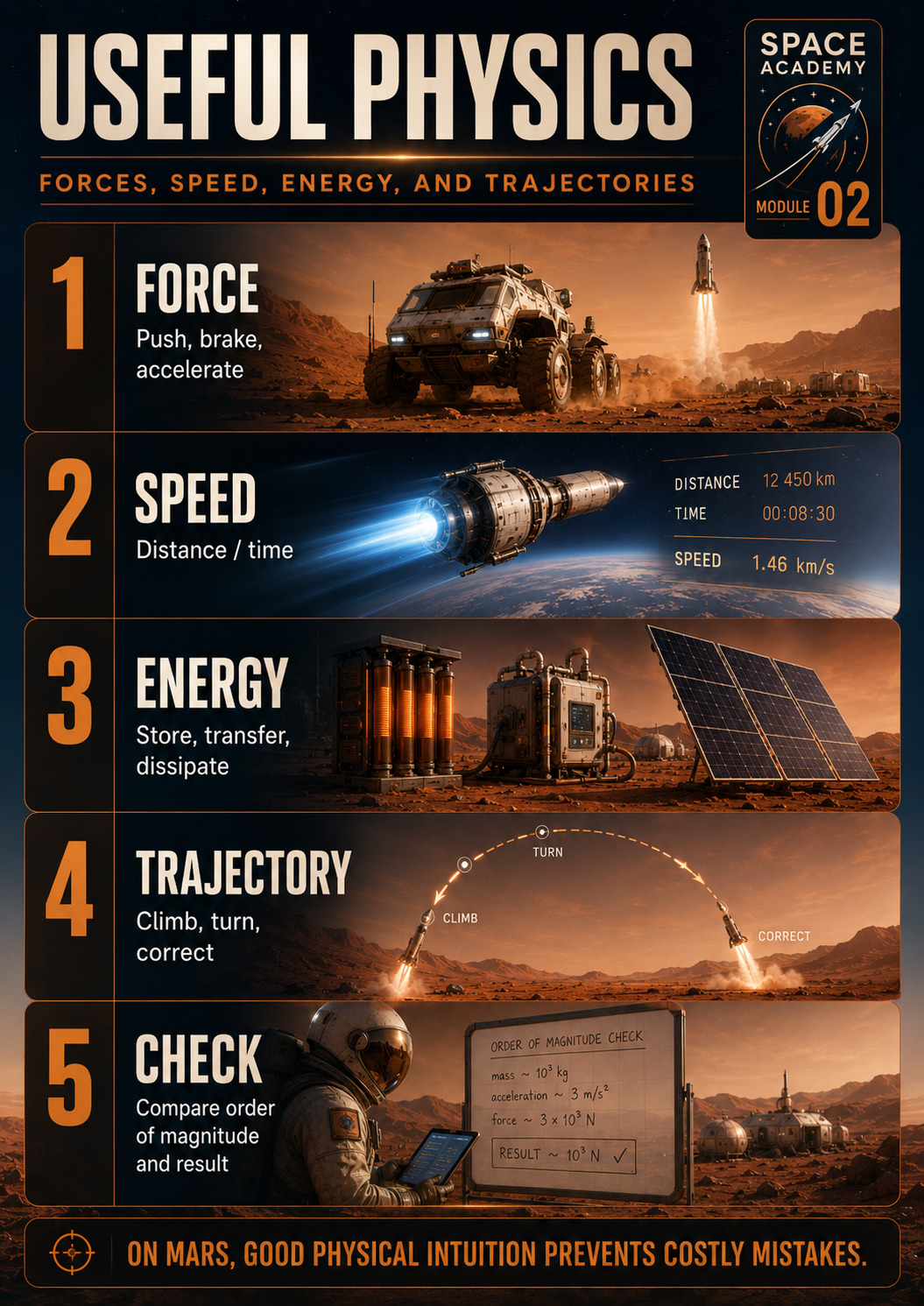
Physics connects numbers and mathematics to observable behavior. Every equation is treated as a model with a domain of validity, not as an incantation.
The goal is to identify dominant quantities and know what an elementary calculation proves—and what it does not.
1. Position, velocity, acceleration
Position locates an object in a frame. Velocity is change of position per time; acceleration is change of velocity per time. Constant high velocity can have zero acceleration, while uniform circular motion is accelerated because direction changes.
Average velocity and average acceleration
- 1 — Concrete question
- How do displacement and a change in velocity become measurable rates over a time interval?
- 2 — Intuition without symbols
- Velocity tells how much position changes per unit time; acceleration tells how quickly velocity itself changes.
- 3 — Quantities first
v: average velocity;Δx: displacement;Δt: elapsed time;a: average acceleration;Δv: change in velocity.- 4 — Formula
v = Δx/Δt ; a = Δv/Δt- 5 — Read aloud
- Read the relation by naming every quantity and operation:
v = Δx/Δt ; a = Δv/Δt. - 6 — Symbols and meaning
Δmeans “final value minus initial value.” Both ratios use the same idea: a change divided by the corresponding elapsed time.- 7 — Pronunciation
- The “Read aloud” line above is the oral reference for “Average velocity and average acceleration”. Any subscript, exponent or grouping that changes the meaning of the relation should be spoken explicitly.
- 8 — Units
vin m/s,Δxin m,Δtin s;ain m/s² andΔvin m/s.- 9 — Convention
- Choose an axis and keep its positive direction throughout the calculation; a negative change means motion or change in the opposite direction.
- 10 — Why this operation
- Dividing by elapsed time converts a total change into an average rate per unit time.
- 11 — Assumptions
- These relations give interval averages; they do not describe instantaneous changes inside the interval.
- 12 — Unit check
m/sfor velocity;(m/s)/s = m/s²for acceleration.- 13 — Numerical case
- A rover covers 120 m in 10 s:
v = 12 m/s. Its velocity then rises from 2 to 8 m/s in 3 s:a = 2 m/s². - 14 — Why the calculation works
- The first division relates displacement to time; the second relates velocity change to time. Both are rates, but they describe different quantities.
- 15 — Algebra check
Δx = vΔtandΔv = aΔtreconstruct a change when rate and duration are known.- 16 — Mental estimate
- 120 m in roughly ten seconds is about 12 m/s; gaining 6 m/s in 3 s should be about 2 m/s².
- 17 — Interpretation
- These rates help check whether a trajectory, braking event or maneuver stays within vehicle capability.
- 18 — What it does not prove
- An average can hide a peak acceleration or brief stop; it does not replace a detailed time history or sensor trace.
- 19 — Sensitivity or limit case
- For a fixed change, doubling elapsed time halves the average rate; for fixed time, doubling the change doubles the rate.
- 20 — Guided and autonomous practice
Guided exercise. A vehicle covers 300 m in 25 s. Find its average velocity.
Guided correction — open after attempting the exercise
v = 300/25 = 12 m/s. Units reduce to m/s.Autonomous exercise. Velocity rises from 5 to 17 m/s in 6 s. Find average acceleration.
Autonomous correction — open after attempting the exercise
Δv = 12 m/s, soa = 12/6 = 2 m/s².- 21 — Mission decision
- Compare these rates with traction, braking and crew-comfort limits before authorizing the maneuver.
Exercise 1
A rover goes from 0 to 6 m/s in 12 s. Average acceleration? Quantitative reference
Solution: (6−0)/12 = 0.5 m/s². Quantitative reference
An average acceleration of 0.5 m/s² means velocity increases by half a metre per second each second over the interval. It does not describe traction peaks, wheel slip, or the time history of acceleration.
Why this matters
Position, velocity, and acceleration answer different questions: where am I, how fast is position changing, and how fast is velocity changing. Mixing them creates braking, rendezvous, and control errors.
A rover going from 0 to 6 m/s in 12 s has an average acceleration of 0.5 m/s². At a constant 6 m/s for 50 s it travels 300 m. The calculation below is a consistency test, not a complete truth. Quantitative reference
Average acceleration does not describe a traction spike or impact; the relevant time scale depends on the system.
2. Forces and Newton’s second law
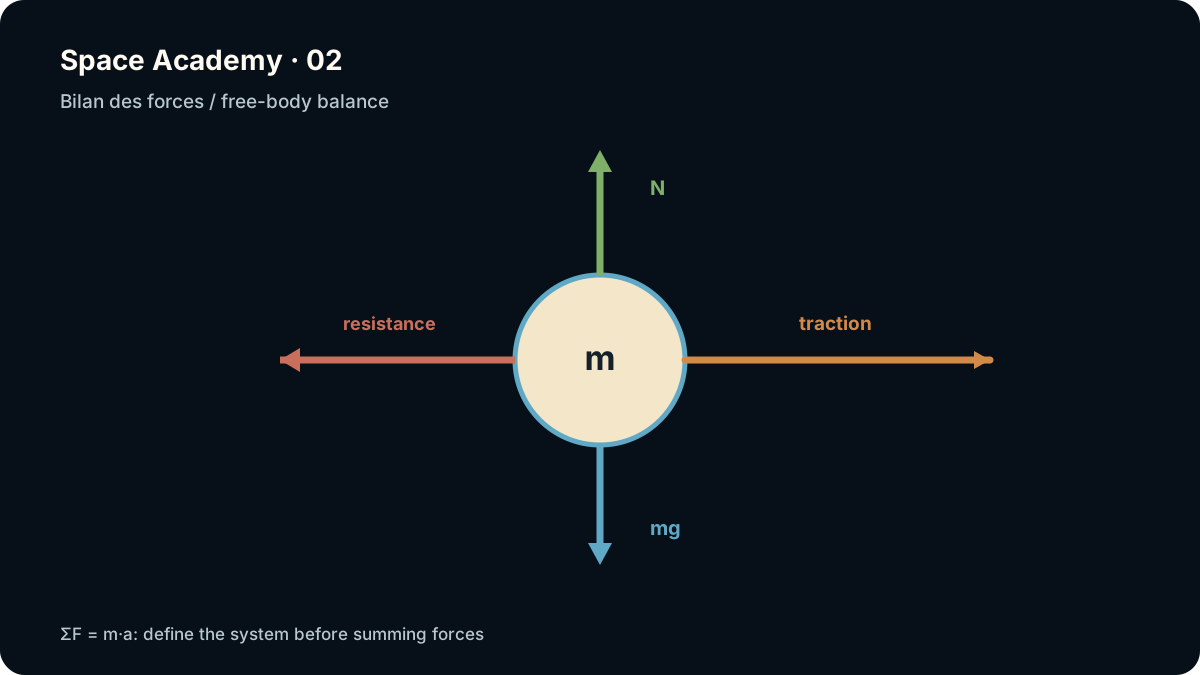
Net force follows F = ma in the Newtonian model. The same force accelerates a smaller mass more strongly. When forces balance, net acceleration is zero even if individual forces are large. Quantitative reference
A Mars rover combines traction, slope, rolling resistance, and inertia. The elementary equation frames the problem but does not replace wheel-soil interaction models. Quantitative reference
Case study — accelerate a loaded cart
A 600 kg cart experiences a net horizontal force of 900 N. From F = ma, ideal acceleration is 1.5 m/s². After 8 s from rest at constant acceleration it would reach 12 m/s and travel 48 m. The calculation is deliberately ideal: a real vehicle is limited by traction, motor torque, losses, stability, and the need to stop safely. Quantitative reference
The word “net” is essential. If the drive produces 1,200 N while resistive forces total 300 N, the force used in F = ma is 900 N. Ignoring opposing forces overestimates acceleration; treating every force as a loss can hide balancing contributions. A force diagram therefore comes before arithmetic when the system is more complicated than one object on one axis. Quantitative reference
Newton's second law: net force and acceleration
- 1 — Concrete question
- What acceleration does a known net force produce on a given mass?
- 2 — Intuition without symbols
- A larger net force changes motion faster; a larger mass responds less to the same force.
- 3 — Quantities first
ΣForF_net: vector sum of forces;m: mass;a: acceleration.- 4 — Formula
ΣF = ma ; a = F_net/m- 5 — Read aloud
- Read the relation by naming every quantity and operation:
ΣF = ma ; a = F_net/m. - 6 — Symbols and meaning
Σmeans forces must be added with their signs/directions.a=F_net/mis the same law rearranged for acceleration.- 7 — Pronunciation
- The “Read aloud” line above is the oral reference for “Newton's second law: net force and acceleration”. Any subscript, exponent or grouping that changes the meaning of the relation should be spoken explicitly.
- 8 — Units
- Force in newtons (N), mass in kg, acceleration in m/s².
- 9 — Convention
- Define the positive axis before summing forces; an opposing force gets the opposite sign.
- 10 — Why this operation
- The net force determines the change in motion; dividing by mass gives the vehicle dynamic response.
- 11 — Assumptions
- Use a frame where the classical form of Newton’s second law is appropriate and treat mass as constant over the interval.
- 12 — Unit check
N/kg = (kg·m/s²)/kg = m/s².- 13 — Numerical case
F_net = 900 Nonm = 600 kggivesa = 1.5 m/s². Held for 8 s from rest, that acceleration ideally reaches 12 m/s.- 14 — Why the calculation works
- Summing forces establishes the mechanical balance first; dividing by mass converts that balance into acceleration.
- 15 — Algebra check
F_net = marecovers the required force when target acceleration is imposed.- 16 — Mental estimate
- 900/600 is about 1.5, so acceleration should be a few m/s², not tens.
- 17 — Interpretation
- The result links propulsion, resistance and mass directly to maneuver performance.
- 18 — What it does not prove
- It does not by itself model traction, actuator saturation, rotation or time-varying forces.
- 19 — Sensitivity or limit case
- At fixed net force, doubling mass halves acceleration; at fixed mass, acceleration scales linearly with net force.
- 20 — Guided and autonomous practice
Guided exercise. A 1,200 N net force acts on 800 kg. Find acceleration.
Guided correction — open after attempting the exercise
a=1200/800=1.5 m/s².Autonomous exercise. What net force is required to accelerate 1,500 kg at 0.8 m/s²?
Autonomous correction — open after attempting the exercise
F=ma=1500×0.8=1,200 N.- 21 — Mission decision
- Verify propulsion and structure can deliver this force with margin.
Physical reading
Newton’s second law links net force to acceleration of mass. Net force is a vector sum: traction, resistance, slope, and contact can act simultaneously.
For 2,000 kg and net acceleration of 0.25 m/s², net force is 500 N. If 300 N of resistance opposes motion, the actuator must provide about 800 N in this model. Quantitative reference
The point-mass model ignores traction, load transfer, soil deformation, and torque limits; it first provides a force balance.
3. Mass and weight are different
Mass measures inertia and remains 80 kg from Earth to Mars. Weight is W = mg. Using 9.81 m/s² on Earth and 3.71 m/s² as a Mars calculation value, 80 kg corresponds to about 785 N and 297 N respectively. Quantitative reference
Lower weight changes vertical load and traction, not inertia. A 500 kg machine still resists rapid lateral acceleration. Quantitative reference
Move into calculation
Mass measures inertia and is expressed in kilograms; weight is a gravitational force in newtons. On Mars an object keeps the same mass while its weight is roughly 0.38 of its terrestrial value.
An 80 kg person weighs about 80×3.71=297 N on Mars versus about 785 N at g=9.81 m/s² on Earth. The teaching value is seeing units turn into a decision. Quantitative reference
Mass and weight in a gravitational field
- 1 — Concrete question
- What weight does a given mass exert on Mars or Earth?
- 2 — Intuition without symbols
- Mass describes amount of matter; weight is the gravitational force acting on that mass.
- 3 — Quantities first
F_g: gravitational force (weight);m: mass;g: local gravitational acceleration.- 4 — Formula
F_g = mg- 5 — Read aloud
- Read the relation by naming every quantity and operation:
F_g = mg. - 6 — Symbols and meaning
- Mass does not change when the object moves between worlds;
gchanges with location, soF_gchanges. - 7 — Pronunciation
- The “Read aloud” line above is the oral reference for “Mass and weight in a gravitational field”. Any subscript, exponent or grouping that changes the meaning of the relation should be spoken explicitly.
- 8 — Units
F_gin N,min kg,gin m/s².- 9 — Convention
- Use local
gand state whether vertical sign is handled separately from weight magnitude. - 10 — Why this operation
- Multiplying mass by gravitational acceleration applies Newton’s second law to gravity.
- 11 — Assumptions
- The calculation assumes variation of
gacross the object height is negligible. - 12 — Unit check
kg×m/s² = N.- 13 — Numerical case
- For 80 kg: Earth
80×9.81=784.8 N; Mars80×3.71=296.8 N. - 14 — Why the calculation works
- Multiplication applies the same gravitational acceleration to each kilogram of mass.
- 15 — Algebra check
m=F_g/grecovers mass from weight and local gravity.- 16 — Mental estimate
- Mars gravity is about 38% of Earth gravity, so weight should be about 38% of Earth weight.
- 17 — Interpretation
- This difference affects traction, handling and support loads without changing inertia associated with mass.
- 18 — What it does not prove
- Lower weight does not mean a massive object becomes easy to accelerate or stop.
- 19 — Sensitivity or limit case
- Gravitational force scales linearly with mass and with
g. - 20 — Guided and autonomous practice
Guided exercise. Find the Mars weight of a 120 kg payload using
g=3.71 m/s².Guided correction — open after attempting the exercise
F_g=120×3.71=445.2 N.Autonomous exercise. What mass corresponds to a Mars weight of 742 N?
Autonomous correction — open after attempting the exercise
m=742/3.71=200 kg.- 21 — Mission decision
- Size supports and handling with local weight, but braking and acceleration with actual mass.
Lower gravity reduces weight but not the kinetic energy required to accelerate the same mass sideways to the same speed.
4. Work and kinetic energy
Work by a constant aligned force is W = Fd. Kinetic energy is Eₖ = ½mv². Because speed is squared, doubling speed quadruples kinetic energy. Quantitative reference
Kinetic energy
- 1 — Concrete question
- How much motion energy does a moving mass carry at a given speed?
- 2 — Intuition without symbols
- A heavier object carries more kinetic energy, and speed matters even more because it is squared.
- 3 — Quantities first
E_k: kinetic energy;m: mass;v: speed.- 4 — Formula
E_k = ½mv²- 5 — Read aloud
- Read the relation by naming every quantity and operation:
E_k = ½mv². - 6 — Symbols and meaning
½is one half;v²means velocity magnitude multiplied by itself.- 7 — Pronunciation
- The “Read aloud” line above is the oral reference for “Kinetic energy”. Any subscript, exponent or grouping that changes the meaning of the relation should be spoken explicitly.
- 8 — Units
E_kin J,min kg,vin m/s.- 9 — Convention
- Use speed in a clearly stated reference frame; kinetic energy depends on that frame.
- 10 — Why this operation
- The square of speed reflects the work accumulated while accelerating the mass from rest.
- 11 — Assumptions
- Classical nonrelativistic formula with constant mass.
- 12 — Unit check
kg×(m/s)² = kg·m²/s² = J.- 13 — Numerical case
- For 200 kg at 10 m/s:
E_k=0.5×200×100=10,000 J = 10 kJ. - 14 — Why the calculation works
- Square the speed first, then multiply by mass and one half.
- 15 — Algebra check
v=√(2E_k/m)recovers speed from energy.- 16 — Mental estimate
- 200 kg at 10 m/s: half of 200×100 is immediately about 10,000 J.
- 17 — Interpretation
- This energy sets the scale for braking, impacts and energy recovery.
- 18 — What it does not prove
- It does not give stopping distance without a force, traction or braking model.
- 19 — Sensitivity or limit case
- Doubling mass doubles energy; doubling speed multiplies it by four.
- 20 — Guided and autonomous practice
Guided exercise. Find kinetic energy for 500 kg at 4 m/s.
Guided correction — open after attempting the exercise
E_k=0.5×500×16=4,000 J.Autonomous exercise. At what speed does 1,000 kg carry 18 kJ?
Autonomous correction — open after attempting the exercise
v=√(2×18000/1000)=6 m/s.- 21 — Mission decision
- Use this energy to size braking, safety zones and collision protection.
Work by a constant aligned force
- 1 — Concrete question
- How much mechanical work does a constant force perform over an aligned displacement?
- 2 — Intuition without symbols
- Applying a force over distance transfers energy; larger force or distance increases that transfer.
- 3 — Quantities first
W: mechanical work;F: force component aligned with displacement;d: displacement.- 4 — Formula
W = Fd- 5 — Read aloud
- Read “work equals force times displacement along the force direction.”
- 6 — Symbols and meaning
W: mechanical work;F: force component aligned with displacement;d: displacement.- 7 — Pronunciation
- Do not confuse symbol
Wfor work with watt, the unit of power. - 8 — Units
Win joules (J),Fin newtons (N),din meters (m).- 9 — Convention
- Work sign depends on the relative direction of force and displacement.
- 10 — Why this operation
- Force times distance accumulates mechanical energy transfer along the path.
- 11 — Assumptions
- Constant force aligned with displacement for this simple form.
- 12 — Unit check
N×m=J.- 13 — Numerical case
- A 500 N force over 8 m gives
W=4,000 J. - 14 — Why the calculation works
- Multiplication sums the same force contribution over the traveled distance.
- 15 — Algebra check
F=W/dandd=W/F.- 16 — Mental estimate
- A few hundred newtons over a few meters gives a few kilojoules.
- 17 — Interpretation
- Positive work adds mechanical energy; negative work removes it.
- 18 — What it does not prove
- This simple form does not cover varying force, changing angle or unmodeled dissipative losses.
- 19 — Sensitivity or limit case
- At fixed force, doubling distance doubles work; at fixed distance, work scales with force component.
- 20 — Guided and autonomous practice
Guided exercise. 300 N over 5 m: find W.
Guided correction — open after attempting
W=300×5=1,500 J.Autonomous exercise. What displacement corresponds to 2,400 J under 600 N?
Autonomous correction — open after attempting
d=2400/600=4 m.- 21 — Mission decision
- Compare work with kinetic-energy change and losses before concluding about a maneuver.
Exercise 4
Kinetic energy of a 1,000 kg vehicle at 10 m/s?
Solution: 0.5 × 1,000 × 100 = 50,000 J = 50 kJ. At 20 m/s: 200 kJ. Quantitative reference
Control point
Work transfers energy when force acts through a displacement. Kinetic energy scales with speed squared, making higher speeds rapidly more demanding for braking and safety.
A 1,000 kg vehicle at 5 m/s has 12.5 kJ of kinetic energy; at 10 m/s it has 50 kJ, four times more for twice the speed. An engineer keeps numerical result, margin, and validity domain separate. Quantitative reference
This balance excludes rolling resistance, slope, and motor efficiency; battery energy will therefore exceed the kinetic-energy change.
Physics check for 4. Work and kinetic energy. Repeat the calculation with one boundary condition changed, then explain which conservation law or constitutive relation makes the answer move. Check whether the new value is physically possible before trusting the arithmetic, and identify the measurement that would most efficiently discriminate between the two cases.
5. Power, duration, efficiency
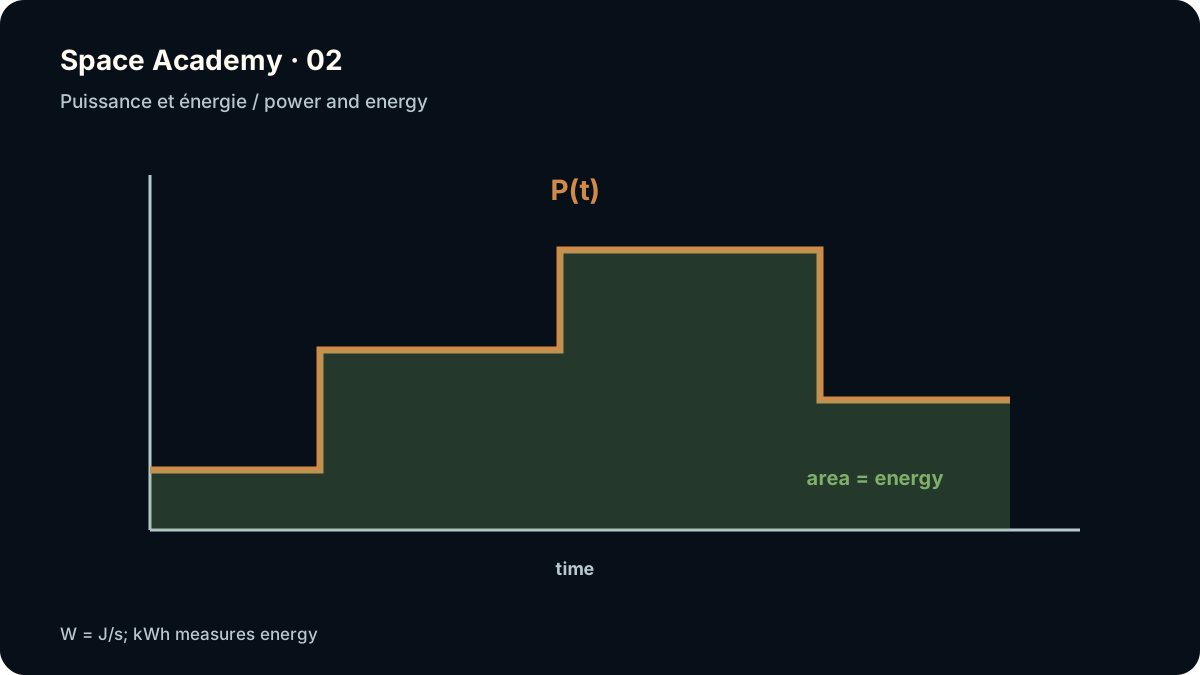
Power is an energy rate: P = E/t. A 5 kW device ideally transfers 5 kJ each second. Efficiency compares useful output with input and makes losses explicit. Quantitative reference
Power-conversion efficiency
- 1 — Concrete question
- What fraction of input power becomes useful output?
- 2 — Intuition without symbols
- A real system loses part of what it receives; efficiency compares useful output with input.
- 3 — Quantities first
η: efficiency;P_useful: useful output power;P_input: input power.- 4 — Formula
η = P_useful/P_input- 5 — Read aloud
- Read the relation by naming every quantity and operation:
η = P_useful/P_input. - 6 — Symbols and meaning
- Efficiency is a ratio: 1 means 100%, 0.9 means 90%.
- 7 — Pronunciation
- The “Read aloud” line above is the oral reference for “Power-conversion efficiency”. Any subscript, exponent or grouping that changes the meaning of the relation should be spoken explicitly.
- 8 — Units
ηis dimensionless; both powers use the same unit, W or kW.- 9 — Convention
- Compare average powers over the same interval and system boundary.
- 10 — Why this operation
- Division measures what share of input emerges as the desired output.
- 11 — Assumptions
- Powers must refer to the same operating regime and excluded losses must be declared.
- 12 — Unit check
kW/kW = 1: units cancel.- 13 — Numerical case
4.5 kW / 5.0 kW = 0.90 = 90%.- 14 — Why the calculation works
- Dividing useful output by input normalizes performance independently of system size.
- 15 — Algebra check
P_input=P_useful/ηandP_useful=ηP_input.- 16 — Mental estimate
- 4.5 is nine tenths of 5, so efficiency should be near 90%.
- 17 — Interpretation
- Efficiency sets both waste heat and upstream power requirement.
- 18 — What it does not prove
- High efficiency does not prove the system can meet peak power or lifetime requirements.
- 19 — Sensitivity or limit case
- At fixed useful output, lower efficiency increases required input power.
- 20 — Guided and autonomous practice
Guided exercise. A converter receives 8 kW and delivers 6.8 kW useful. Find η.
Guided correction — open after attempting the exercise
η=6.8/8=0.85=85%.Autonomous exercise. What input power is needed for 9 kW useful at 75% efficiency?
Autonomous correction — open after attempting the exercise
P_input=9/0.75=12 kW.- 21 — Mission decision
- Apply real efficiency when sizing source power and thermal rejection.
Mechanical and electrical losses often become heat. Power budgeting and thermal control are therefore coupled.
Interpretation
Power is a rate of energy transfer. It sizes converters, cables, and actuators, while integrated energy sizes batteries, fuel, or thermal storage.
A 5 kW heater operating for 10 h provides 50 kWh useful. At 90% overall efficiency, about 55.6 kWh electrical input is required. The formula is useful because it makes a system dependency visible. Quantitative reference
Input energy with efficiency
- 1 — Concrete question
- How much source energy is required to deliver useful power for a specified duration?
- 2 — Intuition without symbols
- Useful energy accumulates with time; if the system loses part of the input, the source must provide more.
- 3 — Quantities first
E_input: source energy;P_useful: useful power;t: duration;η: efficiency.- 4 — Formula
E_input = P_useful t/η- 5 — Read aloud
- Read the relation by naming every quantity and operation:
E_input = P_useful t/η. - 6 — Symbols and meaning
P_useful tis useful energy; division byηrecovers input energy.- 7 — Pronunciation
- The “Read aloud” line above is the oral reference for “Input energy with efficiency”. Any subscript, exponent or grouping that changes the meaning of the relation should be spoken explicitly.
- 8 — Units
kW×h=kWhorW×s=J;ηdimensionless.- 9 — Convention
- Use efficiency as a decimal and time units compatible with the desired energy unit.
- 10 — Why this operation
- Multiplication gives useful energy; division accounts for conversion losses.
- 11 — Assumptions
- Power and efficiency are representative of the interval; transients are neglected.
- 12 — Unit check
kW·h / 1 = kWh.- 13 — Numerical case
5 kW×10 h/0.90 = 55.6 kWh.- 14 — Why the calculation works
- Compute useful energy first to avoid mixing power and energy; then correct for efficiency to obtain actual source demand.
- 15 — Algebra check
t=E_inputη/P_usefulgives ideal endurance.- 16 — Mental estimate
- 50 kWh useful at 90% must require a little more than 50 kWh, about 56.
- 17 — Interpretation
- Compare this value with actually usable battery or source energy.
- 18 — What it does not prove
- It does not automatically include reserve, aging, temperature or power limits.
- 19 — Sensitivity or limit case
- At fixed power and time, input energy scales as
1/η. - 20 — Guided and autonomous practice
Guided exercise. 4 kW useful for 8 h at η=0.8: find input energy.
Guided correction — open after attempting the exercise
E=4×8/0.8=40 kWh.Autonomous exercise. A battery provides 60 kWh to a 75%-efficient system delivering 6 kW useful. What ideal duration?
Autonomous correction — open after attempting the exercise
t=60×0.75/6=7.5 h.- 21 — Mission decision
- Then add reserve and degradation before declaring mission endurance.
A system can have enough total energy yet fail if the battery or converter cannot deliver peak power. Quantitative reference
Physics check for 5. Power, duration, efficiency.
6. Pressure: force distributed over area
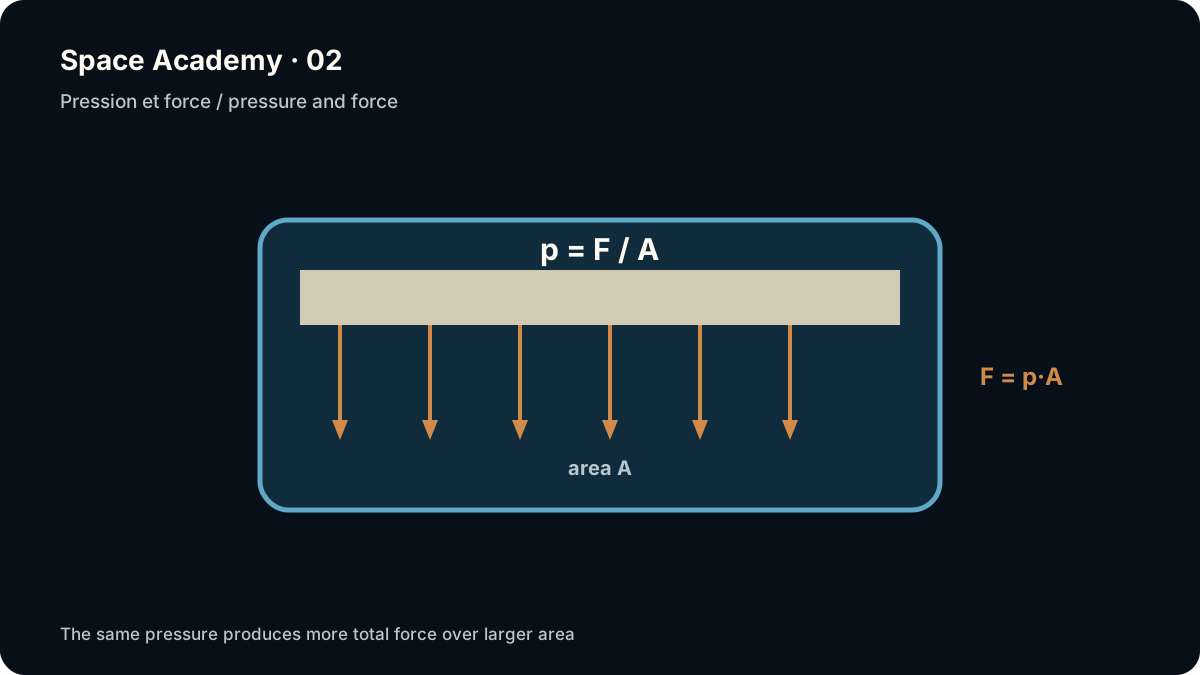
Pressure p = F/A is measured in pascals, 1 Pa = 1 N/m². A 70 kPa pressure difference over 1 m² corresponds to 70,000 N ideal resultant force; over 2 m² it is 140 kN. Quantitative reference
Shell sizing still needs geometry, stress, openings, fatigue, materials, and safety factors. The simple calculation reveals the load scale.
Case study — pressure load on a wall
A 2 m² wall separates a habitat at 70 kPa from an exterior close to vacuum. Ideal resultant force from pressure difference is ΔP×A = 70,000×2 = 140,000 N, or 140 kN. Pressure can look modest when written in kilopascals, yet over a large area it becomes a major structural load. Quantitative reference
That force alone does not size the wall. Geometry, supports, stress concentrations, pressure cycles, temperature, defects, and safety factors still matter. The pressure calculation is the first step in a structural chain, not a certification. It does provide an immediate scale check when a hatch, airlock, or window changes area.
Force from a pressure difference
- 1 — Concrete question
- What net force does a pressure difference exert on a door or wall?
- 2 — Intuition without symbols
- Pressure acts over every part of an area; a larger area produces a larger total force.
- 3 — Quantities first
F: resultant normal force;ΔP: pressure difference across the surface;A: loaded area.- 4 — Formula
F = ΔP·A- 5 — Read aloud
- Read the relation by naming every quantity and operation:
F = ΔP·A. - 6 — Symbols and meaning
- If the other side is near vacuum,
ΔPis almost internal pressure; otherwise subtract the two pressures. - 7 — Pronunciation
- The “Read aloud” line above is the oral reference for “Force from a pressure difference”. Any subscript, exponent or grouping that changes the meaning of the relation should be spoken explicitly.
- 8 — Units
ΔPin Pa = N/m²,Ain m²,Fin N.- 9 — Convention
- Use the pressure difference relevant to structural loading and the appropriate projected area.
- 10 — Why this operation
- Multiplying N/m² by m² sums pressure load over the full area.
- 11 — Assumptions
- Pressure is treated as uniform over the area and normal to the surface.
- 12 — Unit check
(N/m²)×m²=N.- 13 — Numerical case
ΔP=70,000 PaandA=2 m²giveF=140,000 N = 140 kN.- 14 — Why the calculation works
- Pressure is force per area; multiplying by area reconstructs total force.
- 15 — Algebra check
ΔP=F/AandA=F/ΔP.- 16 — Mental estimate
- 70 kPa over 2 m²: 70 kN per square meter times two, about 140 kN.
- 17 — Interpretation
- This load can dominate the design of doors, airlocks, windows and seals.
- 18 — What it does not prove
- The relation does not give local stress, stress concentrations or buckling modes.
- 19 — Sensitivity or limit case
- At fixed area, +10% ΔP gives +10% force; at fixed pressure, force scales linearly with area.
- 20 — Guided and autonomous practice
Guided exercise. Find force on 1.5 m² at ΔP=60 kPa.
Guided correction — open after attempting the exercise
F=60,000×1.5=90,000 N=90 kN.Autonomous exercise. What area corresponds to 100 kN at ΔP=50 kPa?
Autonomous correction — open after attempting the exercise
A=100,000/50,000=2 m².- 21 — Mission decision
- Use the calculated load as an input to structural sizing with appropriate safety factors.
Field reasoning
Pressure creates large structural forces because it acts over entire surfaces. A habitat at moderate pressure therefore carries loads far larger than the word “air” suggests. Quantitative reference
At ΔP=70 kPa, a 2 m² panel sees an ideal resultant of 140 kN. That is roughly the Earth weight of 14 tonnes, without the panel itself having that mass. Quantitative reference
The real structure distributes load through a shell, frames, and attachments; F=PA does not directly give local stress. Quantitative reference
7. Fluids, density, and flow
Volumetric flow Q has units m³/s; mass flow ṁ has kg/s. Density connects them: ṁ = ρQ. For water near 1,000 kg/m³, 1 L/s is approximately 1 kg/s. Quantitative reference
Real loops add pressure drop, viscosity, pipes, valves, and pumps. Mass balance remains accumulation = inflow − outflow. Quantitative reference
Why this matters
Density, mass flow, and volumetric flow track a fluid without confusing amount of matter with occupied volume. Pumps and pipes also add pressure loss, cavitation, viscosity, and thermal limits.
For water at ρ≈1,000 kg/m³, 0.002 m³/s corresponds to about 2 kg/s. Ten minutes at that flow moves about 1,200 kg. The calculation below is a consistency test, not a complete truth. Quantitative reference
Mass flow from volumetric flow
- 1 — Concrete question
- How much fluid mass passes through a line each second from density and volumetric flow?
- 2 — Intuition without symbols
- Each transported volume contains mass set by density; multiplying volume per second by mass per volume gives mass per second.
- 3 — Quantities first
ṁ: mass flow rate;ρ: density;Q: volumetric flow rate.- 4 — Formula
ṁ = ρQ- 5 — Read aloud
- Read the relation by naming every quantity and operation:
ṁ = ρQ. - 6 — Symbols and meaning
- The dot over
mdenotes a time derivative, meaning mass per unit time. - 7 — Pronunciation
- The “Read aloud” line above is the oral reference for “Mass flow from volumetric flow”. Any subscript, exponent or grouping that changes the meaning of the relation should be spoken explicitly.
- 8 — Units
ṁin kg/s,ρin kg/m³,Qin m³/s.- 9 — Convention
- Use density at the relevant fluid temperature, pressure and composition.
- 10 — Why this operation
- Density converts each transported cubic meter into transported kilograms.
- 11 — Assumptions
- The fluid is sufficiently uniform for one representative average density.
- 12 — Unit check
(kg/m³)(m³/s)=kg/s.- 13 — Numerical case
ρ=1000 kg/m³andQ=0.002 m³/sgiveṁ=2 kg/s.- 14 — Why the calculation works
- Multiplication applies mass per unit volume to the volume passing each second.
- 15 — Algebra check
Q=ṁ/ρandρ=ṁ/Q.- 16 — Mental estimate
- Two liters per second of water is about two kilograms per second.
- 17 — Interpretation
- Mass flow sizes consumables, pumps, lines and resource balances.
- 18 — What it does not prove
- The formula alone does not give pressure drop, flow regime or cavitation.
- 19 — Sensitivity or limit case
- At fixed density, mass flow scales linearly with volumetric flow.
- 20 — Guided and autonomous practice
Guided exercise. A liquid at 800 kg/m³ flows at 0.005 m³/s. Find ṁ.
Guided correction — open after attempting the exercise
ṁ=800×0.005=4 kg/s.Autonomous exercise. What volumetric flow is needed for 3 kg/s of a 750 kg/m³ fluid?
Autonomous correction — open after attempting the exercise
Q=3/750=0.004 m³/s.- 21 — Mission decision
- Size the fluid chain for peak mass flow and margin, not volume alone.
Dynamic inventory mass balance
- 1 — Concrete question
- How quickly does an inventory rise or fall when material enters and leaves simultaneously?
- 2 — Intuition without symbols
- An inventory changes only by the difference between what crosses its boundary in and out.
- 3 — Quantities first
dm/dt: inventory change rate;ṁ_in: mass inflow;ṁ_out: mass outflow.- 4 — Formula
dm/dt = ṁ_in − ṁ_out- 5 — Read aloud
- Read “inventory rate of change equals inflow minus outflow.”
- 6 — Symbols and meaning
dm/dt: inventory change rate;ṁ_in: mass inflow;ṁ_out: mass outflow.- 7 — Pronunciation
- The dot over
mdenotes change per unit time. - 8 — Units
- All flow rates in kg/s, kg/h or kg/day on the same time basis.
- 9 — Convention
- Choose positive inflow and negative outflow, then keep the sign convention.
- 10 — Why this operation
- The difference between what enters and leaves is exactly what accumulates or depletes.
- 11 — Assumptions
- System boundary must be defined and all flows use the same time basis.
- 12 — Unit check
kg/s − kg/s = kg/s.- 13 — Numerical case
- With 5 kg/h in and 3.5 kg/h out, inventory rises at
1.5 kg/h. - 14 — Why the calculation works
- Subtracting outflow from inflow gives the net inventory-change rate.
- 15 — Algebra check
- At steady state,
dm/dt=0impliesṁ_in=ṁ_out. - 16 — Mental estimate
- If inflow and outflow are nearly equal, accumulation should be small relative to each flow.
- 17 — Interpretation
- The sign shows whether inventory rises or falls.
- 18 — What it does not prove
- The balance alone does not explain flow causes, capacity limits, unmeasured leaks or phase changes.
- 19 — Sensitivity or limit case
- A small persistent mismatch between inflow and outflow accumulates over time.
- 20 — Guided and autonomous practice
Guided exercise. 4.2 kg/h enters and 5.0 kg/h leaves: rate of change?
Guided correction — open after attempting
dm/dt=−0.8 kg/h: inventory decreases.Autonomous exercise. Inventory must remain constant with 7 kg/h outflow. Required inflow?
Autonomous correction — open after attempting
ṁ_in=7 kg/h.- 21 — Mission decision
- Use inventory sign and trend to trigger makeup, load shedding or leak diagnosis.
Density depends on temperature and composition; for compressible gases a fixed density across a large pressure change is poor modelling.
Physics check for 7. Fluids, density, and flow.
8. Ideal gases and absolute temperature
The model pV = nRT connects pressure, volume, amount, and temperature. At fixed n and V, absolute pressure rises with absolute temperature. Use kelvins: T(K) = θ(°C) + 273.15. Quantitative reference
Ideal gas: pressure, volume, amount and temperature
- 1 — Concrete question
- What pressure results from a given amount of gas in a volume at an absolute temperature?
- 2 — Intuition without symbols
- Heating confined gas or adding molecules increases wall collisions; increasing volume spreads them out.
- 3 — Quantities first
p: absolute pressure;V: volume;n: amount of substance;R: ideal-gas constant;T: absolute temperature.- 4 — Formula
pV = nRT- 5 — Read aloud
- Read the relation by naming every quantity and operation:
pV = nRT. - 6 — Symbols and meaning
R=8.314 J·mol⁻¹·K⁻¹in SI units. At constantnandV,p₂/p₁=T₂/T₁.- 7 — Pronunciation
- The “Read aloud” line above is the oral reference for “Ideal gas: pressure, volume, amount and temperature”. Any subscript, exponent or grouping that changes the meaning of the relation should be spoken explicitly.
- 8 — Units
pin Pa,Vin m³,nin mol,Tin K.- 9 — Convention
- Always use absolute pressure and temperature in kelvins.
- 10 — Why this operation
nRTsets the gas molecular energy scale; dividing by volume gives pressure.- 11 — Assumptions
- The gas must be dilute enough for ideal-gas behavior to be a reasonable approximation.
- 12 — Unit check
mol×J/(mol·K)×K = J = Pa·m³, sopVandnRTmatch dimensionally.- 13 — Numerical case
n=10 mol,T=300 K,V=0.10 m³givep≈249,420 Pa = 249.4 kPa.- 14 — Why the calculation works
- Multiplying n, R and T gives
pV; dividing by V isolates pressure. - 15 — Algebra check
p=nRT/V,V=nRT/p,T=pV/(nR).- 16 — Mental estimate
- 10×8.314×300 ≈ 24.9 kJ; dividing by 0.10 m³ gives about 249 kPa, consistent with the precise calculation.
- 17 — Interpretation
- The relation predicts pressure in a pressurized volume as temperature or gas inventory changes.
- 18 — What it does not prove
- It does not capture real-gas effects at high pressure, thermal gradients or reacting mixtures.
- 19 — Sensitivity or limit case
- At fixed n and V, pressure scales with T; at fixed n and T, it scales as 1/V.
- 20 — Guided and autonomous practice
Guided exercise. Find p for 2 mol, 300 K and 0.05 m³.
Guided correction — open after attempting the exercise
p=2×8.314×300/0.05≈99,768 Pa≈99.8 kPa.Autonomous exercise. At constant volume and amount, what does 70 kPa at 280 K become at 300 K?
Autonomous correction — open after attempting the exercise
p₂=70×300/280=75 kPa.- 21 — Mission decision
- Use absolute pressure and measured temperature to verify tank and habitat margins.
The ideal model has limits but is a powerful consistency check for stored gases and closed volumes.
Physical reading
The ideal-gas model links pressure, volume, amount of substance, and absolute temperature. It is a useful consistency check for atmospheres, tanks, and processes even though real gases can deviate.
At fixed volume and amount, warming from 293 K to 303 K ideally raises pressure by 303/293≈1.034, about 3.4%. Quantitative reference
Temperature must be in kelvins; using Celsius directly in a gas-law ratio gives a meaningless result.
Physics check for 8. Ideal gases and absolute temperature.
9. Heat and thermal transfer
Without phase change, sensible heating is approximated by Q = mcΔT. Heat moves through conduction, convection, and radiation. Quantitative reference
Mars’s thin external atmosphere changes external convection while a pressurized habitat creates internal convection. Radiators and heat exchangers are therefore functional parts of survival and industrial systems.
Case study — connect thermal power and stored energy
Suppose a habitat loses an average 5 kW of heat during a ten-hour cold period. Maintaining temperature requires at least 50 kWh of useful heat in this simplified model. If an electrical heating path delivers 90% of input electricity as useful heat at the point of interest, electrical energy required is about 55.6 kWh. Efficiency belongs on the correct side of the equation: divide useful demand by 0.90. Quantitative reference
A real balance includes internal gains, sunlight, machinery, temperature gradients, and thermal storage. The simple model already separates power from energy. Five kilowatts is an instantaneous rate; fifty kilowatt-hours is an amount integrated across ten hours. Storage is sized in energy while converters must also tolerate peak power. Quantitative reference
Critical-load energy requirement
- 1 — Concrete question
- How much energy must a source deliver to a critical load for a specified duration?
- 2 — Intuition without symbols
- A constant power draw accumulates proportionally more energy as time increases.
- 3 — Quantities first
E: required energy;P: average power;t: duration.- 4 — Formula
E = Pt- 5 — Read aloud
- Read the relation by naming every quantity and operation:
E = Pt. - 6 — Symbols and meaning
- Power is an energy rate: multiplying that rate by time reconstructs total energy.
- 7 — Pronunciation
- The “Read aloud” line above is the oral reference for “Critical-load energy requirement”. Any subscript, exponent or grouping that changes the meaning of the relation should be spoken explicitly.
- 8 — Units
kW×h=kWhorW×s=J.- 9 — Convention
- Use average load power representative of the interval and compatible time units.
- 10 — Why this operation
- Multiplication accumulates energy consumed during each unit of time.
- 11 — Assumptions
- The calculation assumes constant average power and excludes losses or reserve unless added separately.
- 12 — Unit check
kW·h=kWh.- 13 — Numerical case
P=3.2 kWfor5 hgivesE=16 kWh.- 14 — Why the calculation works
- Multiplying power by duration accumulates consumption over the interval.
- 15 — Algebra check
t=E/PandP=E/t.- 16 — Mental estimate
- 3 kW for 5 h is about 15 kWh, so 16 kWh is plausible.
- 17 — Interpretation
- Compare the calculated energy with actually usable source capacity.
- 18 — What it does not prove
- A nominal 16 kWh battery does not automatically guarantee five hours: power limit, efficiency, temperature and depth of discharge matter.
- 19 — Sensitivity or limit case
- At fixed time, +25% power gives +25% energy; at fixed power, energy scales linearly with duration.
- 20 — Guided and autonomous practice
Guided exercise. A 1.8 kW critical heater runs for 6 h. Find E.
Guided correction — open after attempting the exercise
E=1.8×6=10.8 kWh.Autonomous exercise. A load is 4.5 kW for 2 h then 2.5 kW for 8 h. Find total energy.
Autonomous correction — open after attempting the exercise
4.5×2 + 2.5×8 = 9 + 20 = 29 kWh.- 21 — Mission decision
- Compare this requirement with repair, load-shedding or source-transfer time.
Move into calculation
Heat is energy transferred because of a temperature difference. Mars systems must distinguish thermal storage, conduction through structures, convection inside a habitat, and radiation to the environment.
Heating 100 kg of water by 20 K with c≈4.18 kJ/(kg·K) ideally needs 8.36 MJ, about 2.32 kWh, before losses. The teaching value is seeing units turn into a decision. Quantitative reference
Sensible heat
- 1 — Concrete question
- How much heat is required to change the temperature of a mass without a phase change?
- 2 — Intuition without symbols
- More mass takes more heat to warm; some materials also require more energy per kilogram per degree.
- 3 — Quantities first
Q: heat transferred;m: mass;c: specific heat capacity;ΔT: temperature change.- 4 — Formula
Q = mcΔT- 5 — Read aloud
- Read the relation by naming every quantity and operation:
Q = mcΔT. - 6 — Symbols and meaning
ΔT=T_final−T_initial; the sign of Q depends on the chosen heat-in/heat-out convention.- 7 — Pronunciation
- The “Read aloud” line above is the oral reference for “Sensible heat”. Any subscript, exponent or grouping that changes the meaning of the relation should be spoken explicitly.
- 8 — Units
Qin J,min kg,cin J/(kg·K),ΔTin K or °C for a difference.- 9 — Convention
- Use specific heat appropriate to the material and temperature range.
- 10 — Why this operation
- Each kilogram requires
cjoules per kelvin; multiplying by mass and temperature change gives total heat. - 11 — Assumptions
- No phase change, constant specific heat and negligible environmental losses.
- 12 — Unit check
kg×J/(kg·K)×K=J.- 13 — Numerical case
m=10 kg,c=900 J/(kg·K),ΔT=20 KgiveQ=180 kJ.- 14 — Why the calculation works
- Multiplication accumulates the energy required for every kilogram and every degree of change.
- 15 — Algebra check
ΔT=Q/(mc).- 16 — Mental estimate
- 10×900≈9,000 J/K; over 20 K, about 180,000 J.
- 17 — Interpretation
- This energy sets ideal heating/cooling power and duration.
- 18 — What it does not prove
- The calculation excludes radiation, structural conduction, convection and latent heat.
- 19 — Sensitivity or limit case
- Q scales linearly with m, c and ΔT.
- 20 — Guided and autonomous practice
Guided exercise. Find Q for 5 kg, c=800 J/(kg·K), ΔT=30 K.
Guided correction — open after attempting the exercise
Q=5×800×30=120,000 J=120 kJ.Autonomous exercise. What ΔT results from 90 kJ in 10 kg with c=900 J/(kg·K)?
Autonomous correction — open after attempting the exercise
ΔT=90,000/(10×900)=10 K.- 21 — Mission decision
- Add real losses before sizing heaters, coolers and stored energy.
Sensible heat excludes phase changes and heat lost to the environment; those terms can dominate a real process.
10. Rotation and centripetal acceleration
For angular speed ω and radius r, centripetal acceleration is a = ω²r. Rotating artificial-gravity concepts use this trade: larger radius permits lower angular speed for the same acceleration. Quantitative reference
Centripetal acceleration and angular speed
- 1 — Concrete question
- What rotation rate produces a target artificial-gravity acceleration at a given radius?
- 2 — Intuition without symbols
- Faster rotation or larger radius increases inward centripetal acceleration.
- 3 — Quantities first
a: centripetal acceleration;ω: angular speed;r: radius.- 4 — Formula
a = ω²r ; ω = √(a/r)- 5 — Read aloud
- Read the relation by naming every quantity and operation:
a = ω²r ; ω = √(a/r). - 6 — Symbols and meaning
ω²means acceleration depends on angular speed squared; solving forωrequires a square root.- 7 — Pronunciation
- The “Read aloud” line above is the oral reference for “Centripetal acceleration and angular speed”. Any subscript, exponent or grouping that changes the meaning of the relation should be spoken explicitly.
- 8 — Units
ain m/s²,ωin rad/s,rin m.- 9 — Convention
- Use radius to the point where acceleration is evaluated; convert rad/s to rpm only afterward if needed.
- 10 — Why this operation
- Circular motion requires inward acceleration proportional to radius and angular speed squared.
- 11 — Assumptions
- Uniform rotation and circular geometry; human factors and radial gradients are handled separately.
- 12 — Unit check
(rad/s)²×m = m/s², with radian dimensionless in SI.- 13 — Numerical case
- For
a=3.71 m/s²andr=40 m,ω=0.3045 rad/s≈2.91 rpm. - 14 — Why the calculation works
- Divide target acceleration by radius first, then take the square root to recover ω.
- 15 — Algebra check
r=a/ω²gives required radius for a fixed angular speed.- 16 — Mental estimate
- At 40 m, an acceleration of a few m/s² requires a few tenths of a radian per second.
- 17 — Interpretation
- The result links rotating-habitat size and rotation rate for a target artificial gravity.
- 18 — What it does not prove
- It does not prove the rotation rate is physiologically acceptable or structurally feasible.
- 19 — Sensitivity or limit case
- At fixed acceleration, quadrupling radius halves ω; at fixed radius, doubling ω quadruples a.
- 20 — Guided and autonomous practice
Guided exercise. Find ω for a=3.71 m/s² and r=10 m.
Guided correction — open after attempting the exercise
ω=√(3.71/10)=0.609 rad/s≈5.82 rpm.Autonomous exercise. What radius is required for a=3.71 m/s² at ω=0.25 rad/s?
Autonomous correction — open after attempting the exercise
r=3.71/0.25²≈59.4 m.- 21 — Mission decision
- Choose radius, rotation rate, structural loads and human tolerance together.
The equation does not solve motion sickness, body gradients, or structural mass. It exposes only the first geometric trade.
Case study — rotation and artificial gravity
For a centrifuge radius of 10 m targeting 3.71 m/s² centripetal acceleration, comparable to Mars surface gravity, a = ω²r gives ω = √(3.71/10) ≈ 0.609 rad/s. Frequency is ω/(2π) ≈ 0.0969 Hz, about 5.8 revolutions per minute. This calculation does not establish physiological acceptability; it only converts a target acceleration into rotation rate for a chosen radius. Quantitative reference
Increasing radius to 40 m for the same acceleration reduces rotation rate to about 2.9 rpm. The trade becomes visible: larger radius lowers rotation rate but increases structural size and mass. Vestibular effects, head-to-foot gradients, and mechanical costs require additional models. Fundamental physics gives the relationship needed to pose the problem without pretending it is solved.
Control point
Rotation provides centripetal acceleration a=ω²r. It supports artificial-gravity studies, but physiology also depends on rotation rate and gradients along the body. Quantitative reference
For a=3.71 m/s² and r=10 m, ω≈0.609 rad/s, about 5.8 rpm. At r=40 m the same acceleration needs about 2.9 rpm. An engineer keeps numerical result, margin, and validity domain separate. Quantitative reference
The calculation does not define a medically acceptable threshold; it converts an acceleration target into geometry and rotation rate.
11. Electricity: voltage, current, resistance, power
For a simplified ohmic component, V = RI. Electrical power is P = VI. A 120 V bus at 10 A transfers 1,200 W or 1.2 kW. Quantitative reference
Ohm's law and electrical power
- 1 — Concrete question
- What voltage and power correspond to current through a resistance?
- 2 — Intuition without symbols
- Resistance requires voltage to drive current; voltage times current gives transferred electrical power.
- 3 — Quantities first
V: voltage;R: resistance;I: current;P: power.- 4 — Formula
V = RI ; P = VI- 5 — Read aloud
- Read the relation by naming every quantity and operation:
V = RI ; P = VI. - 6 — Symbols and meaning
V=RIrelates a resistive operating point;P=VIconverts that point into power.- 7 — Pronunciation
- The “Read aloud” line above is the oral reference for “Ohm's law and electrical power”. Any subscript, exponent or grouping that changes the meaning of the relation should be spoken explicitly.
- 8 — Units
Vin volts,Rin ohms,Iin amperes,Pin watts.- 9 — Convention
- Use voltage and current signs consistent with the circuit source/load convention.
- 10 — Why this operation
- The first relation describes resistive voltage drop; the second measures electrical energy rate.
- 11 — Assumptions
- Component is approximately ohmic at the operating point.
- 12 — Unit check
Ω×A=VandV×A=W.- 13 — Numerical case
R=4 Ω,I=3 AgiveV=12 VthenP=36 W.- 14 — Why the calculation works
- Multiply R by I for voltage; then multiply V by I for power at the same operating point.
- 15 — Algebra check
I=V/RandR=V/I.- 16 — Mental estimate
- 4 Ω at 3 A gives about a dozen volts and a few tens of watts.
- 17 — Interpretation
- These relations size bus voltage, current, wiring and protection.
- 18 — What it does not prove
- They do not describe nonlinear, transient, inductive or capacitive behavior.
- 19 — Sensitivity or limit case
- At fixed R, V scales with I and P with I² because P=RI².
- 20 — Guided and autonomous practice
Guided exercise. R=6 Ω and I=2 A: find V and P.
Guided correction — open after attempting the exercise
V=12 V, thenP=24 W.Autonomous exercise. A 48 V load uses 240 W. What average current?
Autonomous correction — open after attempting the exercise
I=P/V=240/48=5 A.- 21 — Mission decision
- Verify peak current, voltage drop and heating before selecting wiring and protection.
Real systems add conversion, protection, wiring, transients, grounding, and redundancy. The basic equations remain useful branch-level checks.
Interpretation
Voltage, current, resistance, and power describe a simple electrical network before converters, batteries, protection, and transients are added. Resistive losses scale as I²R.
A 2.4 kW load at 120 V draws an ideal 20 A. A total line resistance of 0.05 Ω then dissipates I²R=20 W. The formula is useful because it makes a system dependency visible. Quantitative reference
Resistive Joule losses
- 1 — Concrete question
- How much power is dissipated as heat by resistance carrying current?
- 2 — Intuition without symbols
- Increasing current heats a conductor rapidly because current enters quadratically.
- 3 — Quantities first
P_loss: dissipated heat power;I: current;R: resistance.- 4 — Formula
P_loss = I²R- 5 — Read aloud
- Read the relation by naming every quantity and operation:
P_loss = I²R. - 6 — Symbols and meaning
I²means current is multiplied by itself before multiplying by R.- 7 — Pronunciation
- The “Read aloud” line above is the oral reference for “Resistive Joule losses”. Any subscript, exponent or grouping that changes the meaning of the relation should be spoken explicitly.
- 8 — Units
P_lossin W,Iin A,Rin Ω.- 9 — Convention
- Use effective resistance at operating temperature and RMS current for periodic current.
- 10 — Why this operation
- Electrical dissipation is VI; substituting V=RI gives I²R.
- 11 — Assumptions
- Representative ohmic resistance and an operating regime where the selected current value is meaningful.
- 12 — Unit check
A²×Ω = W.- 13 — Numerical case
I=50 A,R=0.02 ΩgiveP_loss=50 W.- 14 — Why the calculation works
- Squaring I captures the quadratic current effect; multiplying by R applies path resistance.
- 15 — Algebra check
I=√(P_loss/R).- 16 — Mental estimate
- 50²=2,500; times 0.02 gives 50 W.
- 17 — Interpretation
- Losses create a thermal load and reduce electrical-distribution efficiency.
- 18 — What it does not prove
- The relation alone does not determine cable temperature or cooling.
- 19 — Sensitivity or limit case
- Doubling current quadruples losses; doubling R doubles losses.
- 20 — Guided and autonomous practice
Guided exercise. I=20 A and R=0.1 Ω: find losses.
Guided correction — open after attempting the exercise
P=20²×0.1=40 W.Autonomous exercise. What maximum resistance limits losses to 25 W at 10 A?
Autonomous correction — open after attempting the exercise
R=25/10²=0.25 Ω.- 21 — Mission decision
- Reduce current or resistance if losses exceed thermal or energy budgets.
The same transmitted power at higher voltage uses less current, but insulation, converters, and safety create other trade-offs.
Physics check for 11. Electricity: voltage, current, resistance, power.
12. Integrated case: move and pressurize
A 500 kg unit accelerated at 0.4 m/s² needs 200 N net force. At 4 m/s its kinetic energy is 4,000 J. A motor drawing 2 kW for 10 s receives 20 kJ, so input energy clearly does not become kinetic energy with 100% efficiency. Quantitative reference
A 2 m² panel under 70 kPa pressure difference carries 140 kN ideal resultant force, far larger than the small equipment acceleration force. Physics helps identify dominant effects. Quantitative reference
Guided project — a pressurized rover as a physical system
Consider a 4,000 kg pressurized vehicle on Mars. With g≈3.71 m/s², its weight is about 14.8 kN while its mass remains 4,000 kg. A net horizontal acceleration of 0.20 m/s² requires F=ma=800 N, independent of vertical weight in this simplified model. Keeping these quantities separate prevents substituting weight for mass in acceleration equations. Quantitative reference
The vehicle has a 1.2 m² door and an internal pressure 70 kPa above the exterior. Ideal normal load on the door is about 84 kN. That is far larger than the horizontal traction force calculated above. It does not mean the door is 'harder' than propulsion; the loads act in different mechanical architectures. The calculation exposes scale and prevents comparison of newtons without structural context. Quantitative reference
For a 30 km traverse at 10 km/h average, driving time is three hours. If average electrical power for traction and auxiliaries is 18 kW, energy is 54 kWh. Add 4 kW for thermal and life-support functions during the same three hours: another 12 kWh, total 66 kWh. A battery with 100 kWh genuinely usable cannot cover an identical return trip requiring another 66 kWh without recharge, lower loads, more storage, or changed assumptions. Range in kilometres cannot be separated from the power profile. Quantitative reference
Suppose regenerative braking returns 20% of kinetic energy during selected stops. At 10 m/s, vehicle kinetic energy is 0.5×4,000×10² = 200 kJ, only 0.0556 kWh. Recovering 20% returns about 0.011 kWh per braking event from that speed. The order of magnitude shows that hours of cruise energy do not disappear because a vehicle has regenerative braking. Quantitative reference
A thermal balance and peak-power limit must still be added before design conclusions. The project demonstrates how elementary laws combine: gravity for weight, Newton for acceleration, pressure for structure, integrated power for energy, kinetic energy for transients. None is difficult alone; engineering skill lies in putting them in the right order and refusing to make an equation answer a question it does not describe. Quantitative reference
13. End-of-module check
- I distinguish velocity, acceleration, mass, and weight.
- I connect force, work, energy, and power.
- I calculate pressure force.
- I connect mass and volume flow.
- I use absolute temperature for gases.
- I connect voltage, current, and power.
Corrected drill set — independent check
1. Mass 80 kg: weight on Mars with g=3.71 m/s²? Quantitative reference
W=mg=80×3.71≈296.8 N. Mass remains 80 kg while weight changes with gravitational field. Quantitative reference
2. A net 600 N acts on 300 kg. Acceleration? Quantitative reference
a=F/m=2 m/s². “Net” means relevant forces have already been combined vectorially. Quantitative reference
3. A 0.5 m² wall sees 60 kPa pressure difference. Force? Quantitative reference
F=PA=60,000×0.5 = 30,000 N = 30 kN. Moderate pressure over area creates a large load. Quantitative reference
4. 10 kW for 3 h, then 2 kW for 5 h: energy?
10×3 + 2×5 = 40 kWh. Adding powers alone is wrong; each interval must be weighted by its duration. Quantitative reference
5. Why does 80% efficiency increase required input energy?
If a function requires useful energy E, input must be E/0.8. Losses mean more energy enters than reaches the useful function.
Deep practice workshop
For every physics problem, draw the system boundary first: what enters, what leaves, and which forces or forms of energy cross that boundary? Then write the physical law with units before inserting values. Each solution checks the arithmetic, sign, order of magnitude, and physical meaning of the result.
1. Acceleration
0→8 m/s in 16 s: average acceleration? Quantitative reference
Reasoned solution: 0.5 m/s².
2. Net force
1,500 kg at 0.3 m/s² with 250 N resistance: motor force? Quantitative reference
Reasoned solution: ma=450 N; motor≈700 N including resistance. Quantitative reference
The 450 N force produces the requested acceleration only before resistance is included. Adding 250 N exposes the model boundary: motor and structure need roughly 700 N before any additional margin. Quantitative reference
3. Mars weight
250 kg on Mars at g=3.71? Quantitative reference
Reasoned solution: W≈927.5 N. Mass remains 250 kg. Quantitative reference
Weight changes with local gravity whereas mass does not. The 927.5 N value is the Martian gravitational force on 250 kg; the inertia that must be accelerated or stopped still corresponds to 250 kg. Quantitative reference
4. Kinetic energy
800 kg at 12 m/s?
Reasoned solution: E=0.5×800×144=57,600 J=57.6 kJ. Quantitative reference
The v² dependence is the key result: doubling speed quadruples kinetic energy. A modest vehicle can therefore create rapidly growing braking and safety requirements as speed rises. Quantitative reference
5. Pressure
65 kPa over 0.8 m²? Quantitative reference
Reasoned solution: F=65,000×0.8=52,000 N=52 kN. Quantitative reference
Converting 65 kPa to 65,000 Pa makes the units compatible with square metres. The 52 kN is total force on the selected area; real structure must distribute it through geometry and attachments. Quantitative reference
6. Flow
0.0015 m³/s water for 20 min? Quantitative reference
Reasoned solution: V=1.8 m³; mass≈1,800 kg. Quantitative reference
7. Gas
At fixed volume, 280 K→300 K: pressure ratio? Quantitative reference
Reasoned solution: p₂/p₁=300/280≈1.071, about +7.1% ideally. Quantitative reference
At fixed volume and gas amount, absolute pressure follows absolute temperature. The 7.1% rise is valid only under those assumptions and while ideal-gas behavior remains adequate.
8. Energy capstone
A rover uses 14 kW traction +3 kW habitat for 5 h. Usable battery nameplate is 100 kWh and 20% reserve is required. Feasible without recharge? Quantitative reference
Reasoned solution: Need=17×5=85 kWh. With 20% reserve, only 80 kWh is available. No: the mission is short by 5 kWh even before losses and variability. Reduce duration/power, increase capacity, or recharge. Quantitative reference
The 5 kWh shortfall exists before efficiency, cold conditions, ageing, or power peaks, so the scenario already fails its stated reserve constraint. Reserve must survive the arithmetic all the way to the decision. Quantitative reference
Additional advanced problems
1. Braking
1,200 kg from 10 to 0 m/s: kinetic energy to dissipate?
Reasoned solution: 0.5×1,200×100=60 kJ before slope and wheel rotation. Quantitative reference
2. Pump power
A pump provides 2 kW hydraulic at 70% efficiency. Ideal electrical input? Quantitative reference
Reasoned solution: 2/0.70≈2.86 kW. Quantitative reference
Dividing useful hydraulic power by 0.70 works backward to electrical input power. Efficiency must remain between zero and one; the difference becomes losses and heat that the system must reject.
3. Heat water
50 kg water, +30 K, c=4.18 kJ/kg/K. Quantitative reference
Reasoned solution: Q≈6.27 MJ≈1.74 kWh before losses. Quantitative reference
The heat calculation uses Q=m·c·ΔT with c treated as constant. The 6.27 MJ is ideal thermal energy; insulation, plumbing losses, and heater efficiency would increase electrical demand. Quantitative reference
4. Electrical mini-project
3 kW load on 120 V bus for 4 h: ideal current and energy? Quantitative reference
Reasoned solution: I=P/V=25 A; E=12 kWh. Cable sizing follows current/transients while battery sizing follows energy and power. Quantitative reference
Current and energy constrain different hardware. The 25 A drives cable and protection sizing; the 12 kWh drives stored-energy capacity. A battery system has to satisfy both at the same time. Quantitative reference
Physics laboratory — connect forces, energy, fluids and heat into one system
Draw the system boundary first
A physics problem changes meaning when the system boundary changes. For a rover, the boundary may include vehicle, payload and wheels but not the ground. For a pressurized habitat, the boundary may include the gas and pressure vessel but not the external atmosphere. Drawing the boundary forces the learner to identify which forces, energy transfers and mass flows cross it. This prevents equations from being selected by keyword rather than by mechanism. Quantitative reference
Use force and momentum for transients
Newton's laws are most useful when something accelerates or changes momentum. A static load case and a dynamic stopping case can have the same mass but very different peak forces. In landing, docking, lifting and mobility, the relevant question is often not only how much force is required but how quickly the momentum must change. If the stopping time is uncertain, explore a range rather than reporting one apparently exact force. Quantitative reference
Separate power from energy
Power is a rate; energy is the accumulated result of that rate over time. A 5 kW heater running for two hours uses 10 kWh in the idealized constant-power case. A battery sized only from the 5 kW number is incomplete because duration and usable state-of-charge matter. Conversely, an energy store with adequate total kilowatt-hours can still fail if it cannot deliver the peak power. This distinction recurs in almost every settlement subsystem. Quantitative reference
Read pressure as distributed force
Pressure becomes operational when multiplied by area. A modest pressure difference acting over a large hatch can create a large resultant force, which then has to be carried by hinges, latches, seals and structure. The simple force-from-pressure calculation is a first check, not a complete structural design, because real load paths and stress concentrations require more detailed analysis. Still, it immediately shows why seemingly small pressure differences cannot be dismissed. Quantitative reference
Use fluid and gas relations within their validity range
Density, volumetric flow, mass flow and pressure are related but not interchangeable. For gases, density changes strongly with pressure and temperature, so a flow stated only in litres per minute may be ambiguous unless the reference condition is known. The ideal-gas relation is a useful first-order model when its assumptions are acceptable, but real system design must also account for humidity, gas mixtures, pressure drops, compressor behaviour and sensor uncertainty.
Treat heat as an energy balance
Temperature is a state variable; heat is energy in transfer. A thermal-control calculation should identify internal generation, external inputs, stored thermal energy and rejection paths. In a thin Martian atmosphere, convection behaves differently from terrestrial intuition, so radiation and conduction paths become especially important in many designs. The learner should always ask where the heat ultimately goes and what happens if the preferred rejection path is degraded. Quantitative reference
Progressive mastery drills — eight linked checks
Drill 1 — Kinematics
Separate position, velocity and acceleration in a rover braking event and identify what must be measured.
Expected reasoning for “Drill 1 — Kinematics”: explain the physical meaning, units or evidence path, state at least one assumption, and say which operational decision would change if the result or evidence were different.
Drill 2 — Newton law
Build a free-body diagram for a suspended load and explain which forces belong on the chosen body.
Expected reasoning for “Drill 2 — Newton law”: explain the physical meaning, units or evidence path, state at least one assumption, and say which operational decision would change if the result or evidence were different.
Drill 3 — Momentum
Explain why stopping the same mass in a shorter time usually increases the required average force.
Expected reasoning for “Drill 3 — Momentum”: explain the physical meaning, units or evidence path, state at least one assumption, and say which operational decision would change if the result or evidence were different.
Drill 4 — Work and energy
Compare lifting a mass slowly and quickly: the ideal gravitational energy is similar but power demand differs.
Expected reasoning for “Drill 4 — Work and energy”: explain the physical meaning, units or evidence path, state at least one assumption, and say which operational decision would change if the result or evidence were different.
Drill 5 — Pressure
Turn a pressure difference across a hatch into a resultant force and identify why that is only a first structural check.
Expected reasoning for “Drill 5 — Pressure”: explain the physical meaning, units or evidence path, state at least one assumption, and say which operational decision would change if the result or evidence were different.
Drill 6 — Fluid flow
Distinguish volumetric flow from mass flow and state when density is required to convert between them.
Expected reasoning for “Drill 6 — Fluid flow”: explain the physical meaning, units or evidence path, state at least one assumption, and say which operational decision would change if the result or evidence were different.
Drill 7 — Gas state
Explain how a gas density estimate changes when pressure falls or absolute temperature rises.
Expected reasoning for “Drill 7 — Gas state”: explain the physical meaning, units or evidence path, state at least one assumption, and say which operational decision would change if the result or evidence were different.
Drill 8 — Thermal balance
List heat generation, storage and rejection terms for an electronics bay during a temporary radiator restriction.
Expected reasoning for “Drill 8 — Thermal balance”: explain the physical meaning, units or evidence path, state at least one assumption, and say which operational decision would change if the result or evidence were different.
Integrated exercise — Close a simple power-and-heat transient
An electronics rack draws 2.4 kW for 45 minutes during a diagnostic sequence. Assume, for this training problem, that all electrical energy ultimately becomes heat inside the habitat. Calculate the electrical energy consumed in kWh and the same amount in MJ. Explain what additional information is required to predict the cabin temperature rise. Quantitative reference
Reasoned solution. Energy is 2.4 kW × 0.75 h = 1.8 kWh, which is 6.48 MJ. That does not by itself determine temperature rise. You would need the effective thermal capacitance of the cabin and contents, the heat-rejection rate during the interval, heat transfer to other zones, and the initial thermal state. Quantitative reference
Primary sources for this section. NIST — Definitions of SI base units NASA Glenn — Newton's laws of motion NASA Glenn — Air pressure. Use these references to verify the assumptions, limits and values that apply to the mission context.
Sources and references
The sources anchor physical definitions and Mars context. Cart, wall, heater, and centrifuge cases are explicitly simplified teaching models.
- NIST — Definitions of SI Base Units — SI base units and exact defining constants.
- NASA Glenn — Newton and forces — Newtonian force and motion fundamentals.
- NASA Glenn — Pressure — Pressure as force distributed over area.
- NASA Glenn — Equation of State — Ideal-gas relation and state variables.
- NASA Glenn — Mars — Primary or institutional source used for definitions, technology status, or module data.
First Man physics closure dossier — connect forces, energy, pressure and heat
Physics becomes useful when the learner can move between a verbal situation, a free-body or energy picture, an equation, a numerical estimate and an operational consequence. This dossier deliberately connects the major ideas instead of teaching them as isolated chapters.
Start every dynamics problem with a system boundary
Newton’s laws describe how forces change motion, but the first practical question is: what object or collection of objects are we analysing? The NASA Glenn — Newton’s laws of motion gives the formal background. For a rover on a slope, a useful boundary might include the rover but not the ground; gravity, wheel-ground forces and tow forces then cross the boundary. If the boundary changes, the force inventory changes too.
A free-body diagram is a bookkeeping device. Draw only forces acting on the chosen system, label directions and avoid inventing a ‘force of motion’. Velocity is not a force. Acceleration comes from the vector sum of real forces divided by mass.
Energy and power answer different planning questions
Energy tells how much capability is consumed or transferred; power tells how fast. A 20 kWh battery can support 2 kW for about ten hours in an idealized calculation, or 10 kW for about two hours. Confusing kW with kWh is therefore a mission-planning error, not a notation error. Quantitative reference
Efficiency must be attached to the correct side of the balance. If a load requires 8 kWh and the conversion chain is 80% efficient, the source must provide more than 8 kWh. Multiplying when division is required can create an impossible design that appears to gain energy through losses. Quantitative reference

Pressure is distributed force and also a state variable
Pressure can be introduced mechanically as force divided by area and thermodynamically as part of a gas state. NASA Glenn — Air pressure provides a starting point for pressure, while NASA Glenn — Equation of state connects pressure, density and temperature for idealized gas behaviour. In a habitat, pressure therefore affects structural loads, atmosphere inventory and life-support operation simultaneously.
A pressure reading is never enough by itself to declare an atmosphere safe. Total pressure may be nominal while oxygen partial pressure, carbon dioxide or contaminants are unacceptable. Physics supplies the state variables; operations must define the acceptance envelope. Quantitative reference
Heat moves because of temperature differences, but control depends on paths
A warm component does not automatically cool at an acceptable rate. Heat must travel through conduction, convection where a fluid is present, and radiation. In vacuum outside a spacecraft, radiation becomes especially important; inside a pressurized habitat, internal convection and forced circulation matter. The thermal path can therefore fail even when a radiator exists and has adequate theoretical area. Quantitative reference
Thermal analysis should separate heat generation, storage, transport and rejection. During a short disturbance, thermal mass may buy time. During a long disturbance, accumulated heat eventually forces a load reduction or shutdown unless rejection is restored.

Mars changes numbers, not the laws of physics
The same equations apply on Earth and Mars, but boundary conditions differ. The NASA Glenn — Mars summarizes important Martian environmental context. Weight is lower for the same mass because gravitational acceleration is lower; atmospheric density and pressure are much lower; dust and temperature cycles alter thermal and mechanical conditions. A learner must therefore keep universal laws separate from local parameters. Quantitative reference
This distinction is a powerful review habit: ask which parts of an equation are physical laws, which are material properties, which are environmental inputs and which are design choices. That classification makes it easier to update a model when the mission changes.
Integrated physics case — airlock repressurization and power
Consider an airlock that must be repressurized after an EVA. The operation touches pressure, gas inventory, flow, power and time. The pressure rise tells the crew whether the target state is being approached; the gas source and regulator determine the flow path; compressors or valves may require electrical power; heat can be produced by compression and equipment operation. A single gauge reading therefore belongs to a coupled process rather than an isolated chapter on pressure. Quantitative reference
Suppose a transfer pump draws 2.4 kW for 18 minutes. Convert 18 minutes to 0.30 h before calculating energy: 2.4 × 0.30 = 0.72 kWh. If the same operation must be repeated ten times in a maintenance cycle, the electrical energy is 7.2 kWh before conversion losses. A student who multiplies 2.4 kW by 18 and writes 43.2 kWh has mixed hours and minutes. The unit line catches the mistake instantly. Quantitative reference
During repressurization, pressure should not be used as a proxy for atmosphere composition. The crew also needs composition measurements and circulation. A stable total pressure can coexist with poor oxygen fraction or high carbon dioxide. The operational release therefore combines physics evidence: pressure trend, leak check, atmosphere composition, temperature and valve configuration. Quantitative reference
Integrated mechanics case — rover pull on a slope
A disabled rover is pulled uphill. Before calculating, draw the system boundary around the disabled rover. Gravity acts downward, the surface supplies a normal reaction, rolling resistance opposes motion and the tow line applies tension. If the rover accelerates, the component of net force along the slope equals mass times acceleration. If it climbs at nearly constant speed, acceleration is close to zero and the uphill towing force must approximately balance the downhill resistance components. Quantitative reference
The exercise should then separate force from energy. A large force applied over a short distance and a smaller force applied over a long distance can require similar work. Power adds time: climbing the hill quickly requires more average power than doing the same mechanical work slowly, ignoring losses. This chain—force → work → power—helps the learner avoid treating the three terms as synonyms. Quantitative reference
| Layer | Question | Typical unit |
|---|---|---|
| Force | What changes the motion? | N |
| Work / energy | How much mechanical energy is transferred? | J or kWh |
| Power | How fast is energy transferred? | W or kW |
| Thermal consequence | Where do losses become heat? | W, J, K |
Review drills — move from explanation to operational judgement
- Free-body drill. List forces on a rover being towed uphill and identify which are external to the chosen rover boundary.
- Pressure drill. Explain why nominal total cabin pressure does not by itself prove a safe atmosphere.
- Thermal drill. Separate heat generation, transport and rejection for an avionics rack.
- Energy drill. For a variable load profile, explain why one average power number can hide a dangerous peak even if total energy is correct.
Final physics review — trace the mechanism from cause to consequence
- Is the system boundary drawn or stated?
- Are all external forces accounted for without inventing a force of motion?
- Are power and energy kept distinct?
- Does pressure evidence include composition when atmosphere safety is at stake?
- Is the thermal path identified from source to rejection?
- Were Mars-specific parameters separated from universal physical laws?
The review should be understandable as a chain: mechanism, equation, units, estimate, measurement and operational consequence. When one link is missing, a plausible-looking number can hide a wrong model. Physics becomes mission-ready thinking only when the learner can explain why the equation applies here and what observation would falsify the assumption.
Primary sources used in this section
- NASA Glenn — Newton’s laws of motion
- NASA Glenn — Air pressure
- NASA Glenn — Equation of state
- NASA Glenn — Mars
Closure rule. A physics result is accepted only when the system boundary, units, governing mechanism and operational consequence remain consistent.