


Useful chemistry: from the mole to H₂/O₂/CO₂ loops
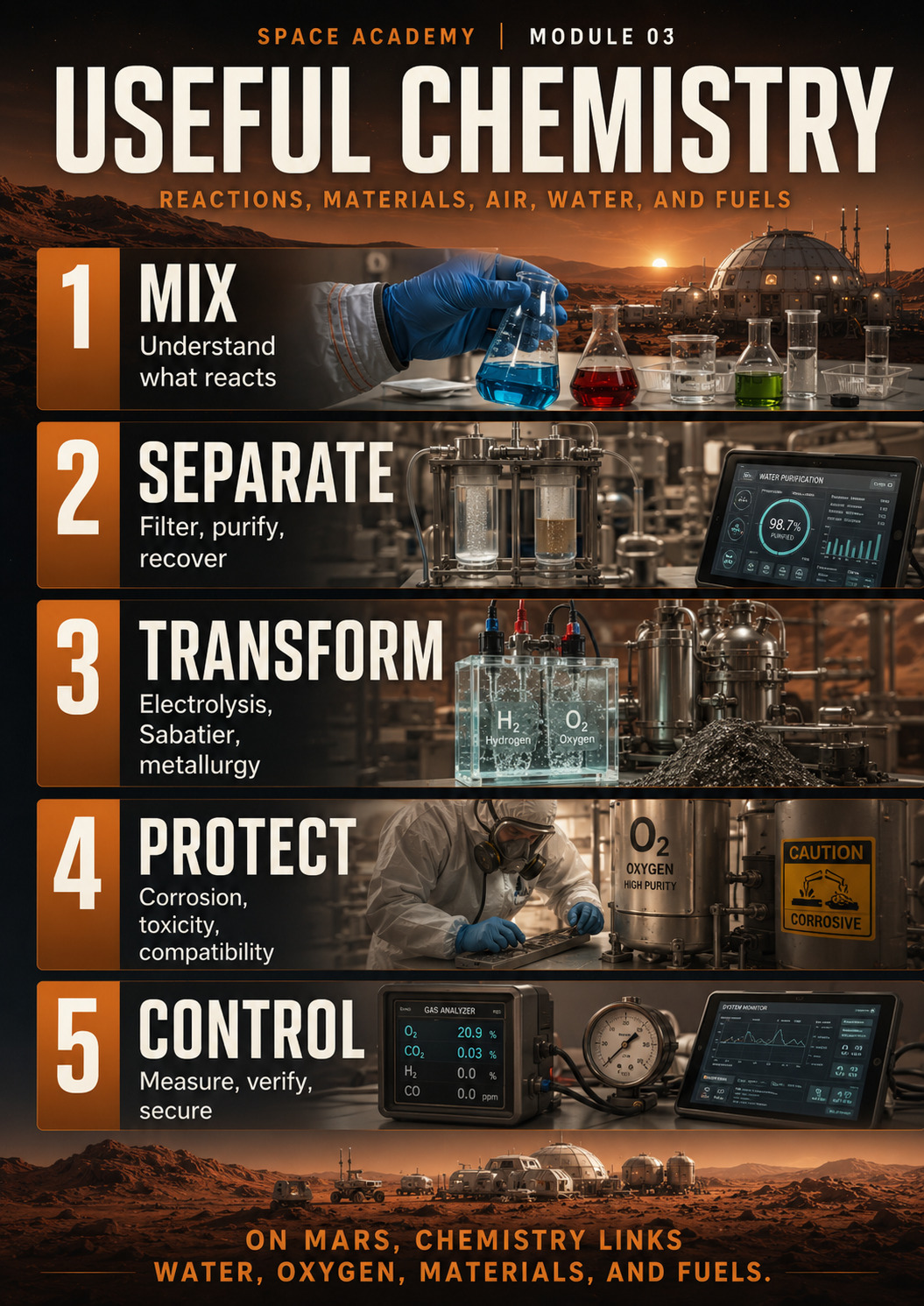
Chemistry is material bookkeeping. On Mars it connects air, water, propellants, materials, and local resources.
A balanced equation does not specify power, purity, kinetics, or lifetime, so the module separates stoichiometry from industrial architecture. Quantitative reference
1. Atoms, elements, and chemical species
An element is defined by proton count. An atom can gain or lose electrons and become an ion. A molecule combines atoms in a defined structure. O₂ and O₃ are therefore different species made from the same element. Quantitative reference
Engineering balances must identify the species unambiguously. “Oxygen” can refer to element O or molecular oxygen O₂. The distinction prevents molar-mass and balancing errors.
Why this matters
Chemistry starts by separating element, isotope, molecule, ion, and chemical species. A process does not conserve vague “matter”; it conserves atoms and charge under the reaction model. Quantitative reference
CO₂ contains one carbon and two oxygen atoms per molecule. Two moles of CO₂ contain two moles of C atoms and four moles of O atoms even though gas volume depends on p and T. The calculation below is a consistency test, not a complete truth.
Counting atoms from molecular coefficients
- 1 — Concrete question
- How many moles of oxygen atoms are contained in a given amount of CO₂?
- 2 — Intuition without symbols
- Each carbon-dioxide molecule contains two oxygen atoms, so the oxygen-atom count is doubled.
- 3 — Quantities first
n(O atoms): moles of O atoms;n(CO₂): moles of CO₂ molecules;2: oxygen atoms per molecule.- 4 — Formula
n(O atoms) = 2·n(CO₂)- 5 — Read aloud
- Read the relation by naming every quantity and operation:
n(O atoms) = 2·n(CO₂). - 6 — Symbols and meaning
- The factor 2 comes directly from the chemical formula CO₂, not from a measurement.
- 7 — Pronunciation
- The “Read aloud” line above is the oral reference for “Counting atoms from molecular coefficients”. Any subscript, exponent or grouping that changes the meaning of the relation should be spoken explicitly.
- 8 — Units
- Both amounts are in mol; the factor 2 is dimensionless.
- 9 — Convention
- Distinguish moles of molecules from moles of atoms in labels.
- 10 — Why this operation
- Each molecule contributes two O atoms, so each mole of CO₂ contributes two moles of O atoms.
- 11 — Assumptions
- Count atoms within correctly identified CO₂ molecules.
- 12 — Unit check
2×mol = mol.- 13 — Numerical case
- 5 mol CO₂ contain
10 molof O atoms. - 14 — Why the calculation works
- Multiplying by the atomic subscript converts molecule count to atom count for the selected element.
- 15 — Algebra check
n(CO₂)=n(O atoms)/2.- 16 — Mental estimate
- Two O atoms per molecule means exactly twice as many O atoms.
- 17 — Interpretation
- This counting underpins elemental conservation in reaction balances.
- 18 — What it does not prove
- It does not give mass without a molar-mass conversion.
- 19 — Sensitivity or limit case
- The result scales linearly with amount of CO₂.
- 20 — Guided and autonomous practice
Guided exercise. How many moles of O atoms are in 3 mol CO₂?
Guided correction — open after attempting the exercise
2×3=6 mol.Autonomous exercise. If 14 mol of O atoms are present only in CO₂, how many mol CO₂?
Autonomous correction — open after attempting the exercise
14/2=7 mol.- 21 — Mission decision
- Always verify atomic subscripts before converting molecular resources into elemental inventory.
Confusing molar mass with atom count breaks material balances; mole is a count, kilogram is mass.
2. The mole links particles and measurable mass
One mole contains exactly 6.02214076 × 10²³ specified elementary entities in the SI. Amount of substance is n in mol. Molar mass M connects measured mass with amount: n = m/M when units are consistent. Quantitative reference
Water has molar mass about 18.015 g/mol. A mole is not one universal mass: one mole of water and one mole of CO₂ contain the same entity count but different masses. Quantitative reference
Physical reading
The mole makes enormous particle counts manageable. Under the redefined SI, one mole contains exactly 6.02214076×10²³ specified entities. Associated mass depends on the species molar mass. Quantitative reference
With M(O₂)=32 g/mol, 64 g O₂ is 2 mol. With M(CO₂)=44 g/mol, 88 g is also 2 mol, but those are not the same molecules. Quantitative reference
Amount of substance from mass
- 1 — Concrete question
- How many moles are contained in a known mass of a chemical species?
- 2 — Intuition without symbols
- A mole is a fixed amount of entities; molar mass tells how much one mole of the species weighs.
- 3 — Quantities first
n: amount of substance;m: mass;M: molar mass.- 4 — Formula
n = m/M- 5 — Read aloud
- Read the relation by naming every quantity and operation:
n = m/M. - 6 — Symbols and meaning
- Mass and molar mass must use compatible units, such as g and g/mol.
- 7 — Pronunciation
- The “Read aloud” line above is the oral reference for “Amount of substance from mass”. Any subscript, exponent or grouping that changes the meaning of the relation should be spoken explicitly.
- 8 — Units
nin mol,min g or kg,Min g/mol or kg/mol using the same mass basis.- 9 — Convention
- Always associate M with the exact chemical species and formula.
- 10 — Why this operation
- Dividing total mass by mass per mole counts how many moles are present.
- 11 — Assumptions
- Sample identity is known and molar mass matches composition.
- 12 — Unit check
g/(g/mol)=mol.- 13 — Numerical case
- 180 g of water at
M=18 g/molgivesn=10 mol. - 14 — Why the calculation works
- Division compares available mass with the mass corresponding to one mole.
- 15 — Algebra check
m=nMandM=m/n.- 16 — Mental estimate
- 180/18 is exactly 10.
- 17 — Interpretation
- Amount of substance connects measured masses to stoichiometric coefficients.
- 18 — What it does not prove
- The calculation does not give purity or actual reaction conversion.
- 19 — Sensitivity or limit case
- At fixed M, n scales with m; at fixed mass, larger M reduces n.
- 20 — Guided and autonomous practice
Guided exercise. Find n for 44 g CO₂ with M=44 g/mol.
Guided correction — open after attempting the exercise
n=44/44=1 mol.Autonomous exercise. What mass is 3 mol O₂ at M=32 g/mol?
Autonomous correction — open after attempting the exercise
m=3×32=96 g.- 21 — Mission decision
- Convert mass inventories to moles before checking reaction stoichiometry.
Engineering molar masses have finite precision and real products contain impurities and mixtures; stoichiometric calculation is an ideal balance.
Chemistry check for 2. The mole links particles and measurable mass. Recalculate the material balance after changing one feed composition or process yield. Track the change in moles before converting back to mass, and state explicitly which species becomes limiting. Then identify one impurity or side process that the ideal equation omits but a Mars plant would have to monitor.
3. Balancing a reaction conserves atoms
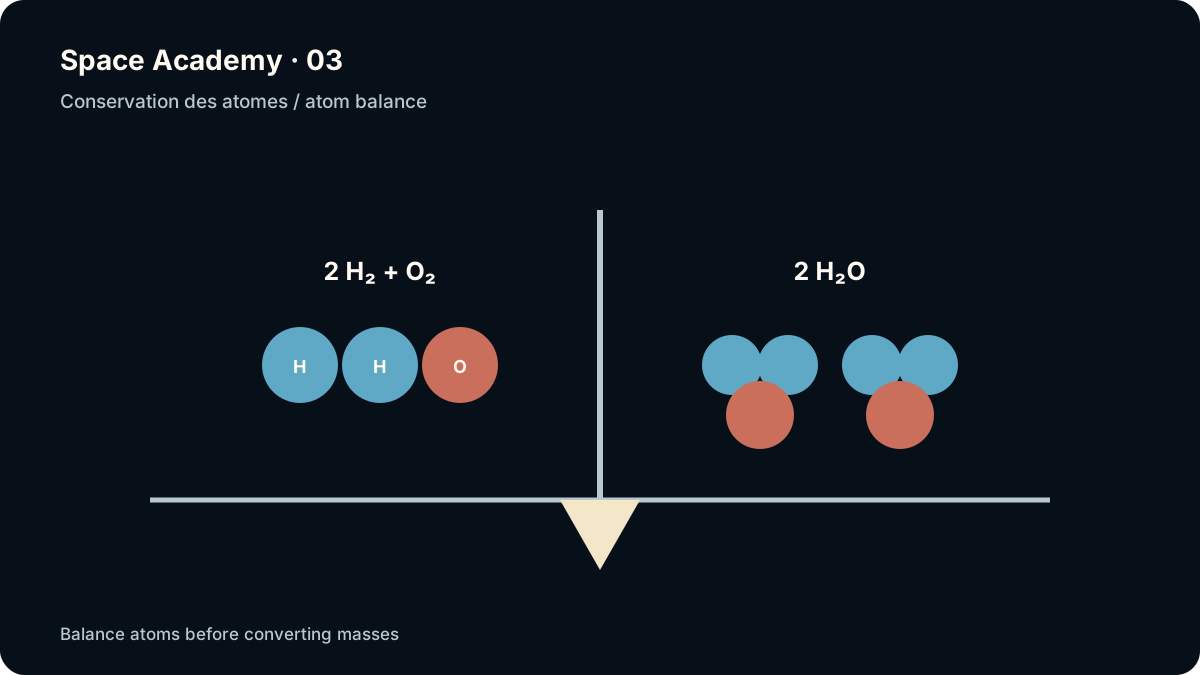
Water electrolysis is 2 H₂O → 2 H₂ + O₂. Four hydrogen atoms and two oxygen atoms appear on each side. Coefficients are mole ratios, not direct kilograms. Quantitative reference
Balancing water electrolysis
- 1 — Concrete question
- Does the water-electrolysis equation conserve H and O atoms?
- 2 — Intuition without symbols
- A chemical reaction rearranges atoms but does not create or destroy them; coefficients must balance each element.
- 3 — Quantities first
2H₂O: two molecules or moles of water;2H₂: two of hydrogen;O₂: one of oxygen.- 4 — Formula
2H₂O → 2H₂ + O₂- 5 — Read aloud
- Read the relation by naming every quantity and operation:
2H₂O → 2H₂ + O₂. - 6 — Symbols and meaning
- Left: 4 H and 2 O. Right: 4 H in 2H₂ and 2 O in O₂.
- 7 — Pronunciation
- The “Read aloud” line above is the oral reference for “Balancing water electrolysis”. Any subscript, exponent or grouping that changes the meaning of the relation should be spoken explicitly.
- 8 — Units
- Stoichiometric coefficients are dimensionless ratios between molecules or moles.
- 9 — Convention
- Never change molecular subscripts to balance a reaction; change only coefficients before species.
- 10 — Why this operation
- The 2:2:1 coefficients are the smallest integers that conserve both H and O.
- 11 — Assumptions
- This represents only the ideal overall stoichiometry of electrolysis.
- 12 — Unit check
- Two moles water produce two moles H₂ and one mole O₂; the atomic balance closes.
- 13 — Numerical case
- 2 mol H₂O contain 4 mol H atoms and 2 mol O atoms; products contain exactly the same amounts.
- 14 — Why the calculation works
- Counting H and O separately on each side tests the balance unambiguously.
- 15 — Algebra check
- Multiplying all coefficients by the same factor preserves balance but is not the minimal integer form.
- 16 — Mental estimate
- Two waters contain four H and two O; two H₂ plus one O₂ visibly reproduces that count.
- 17 — Interpretation
- A balanced equation provides molar ratios needed for mass balances.
- 18 — What it does not prove
- It does not give real electrical energy, efficiency, kinetics or product purity.
- 19 — Sensitivity or limit case
- Changing processed moles scales all stoichiometric amounts proportionally.
- 20 — Guided and autonomous practice
Guided exercise. For 6 mol H₂O, how many mol H₂ and O₂ ideally?
Guided correction — open after attempting the exercise
The 2:2:1 ratio gives
6 mol H₂and3 mol O₂.Autonomous exercise. How many mol H₂O are ideally required to produce 5 mol O₂?
Autonomous correction — open after attempting the exercise
Two moles water per mole O₂:
10 mol H₂O.- 21 — Mission decision
- Do not use a downstream mass balance until atomic conservation is verified.
With rounded molar masses, 36 g water corresponds ideally to 4 g hydrogen plus 32 g oxygen. The 36 = 4 + 32 check closes the ideal mass balance. Quantitative reference
Move into calculation
Balancing a chemical equation conserves each atom type. Coefficients express molar ratios, not equal masses. They become an engineering tool when converted to kilograms.
For 2H₂+O₂→2H₂O, 4 g H₂ ideally reacts with 32 g O₂ to produce 36 g water. Total mass is conserved. The teaching value is seeing units turn into a decision. Quantitative reference
A balanced equation gives no reaction rate, temperature, yield, or purity; it only fixes ideal stoichiometry. Quantitative reference
4. Limiting reagent, conversion, yield, purity
A reaction stops when a necessary reactant becomes limiting. Conversion tracks how much reactant is consumed; yield compares desired product with the theoretical amount; purity describes how much of an output stream is the desired species. Quantitative reference
These metrics answer different questions. High purity can coexist with low throughput, while high conversion can still have separation losses. One generic efficiency percentage cannot describe an industrial process.
Control point
The limiting reagent sets maximum production. Conversion, selectivity, yield, and purity then describe what the real process obtains relative to that limit. These concepts are not interchangeable.
If stoichiometry allows 100 kg but the process delivers only 82 kg pure product, yield relative to the maximum is 82%. If a batch is only 90% useful product, 82 kg mixture contains 73.8 kg useful material. An engineer keeps numerical result, margin, and validity domain separate.
Usable mass from feed purity
- 1 — Concrete question
- How much usable material is contained in a batch of known purity?
- 2 — Intuition without symbols
- An impure batch provides only a fraction of total mass as the desired reactant or product.
- 3 — Quantities first
m_usable: mass of desired material;m_batch: total batch mass;w: mass-fraction purity.- 4 — Formula
m_usable = m_batch·w- 5 — Read aloud
- Read the relation by naming every quantity and operation:
m_usable = m_batch·w. - 6 — Symbols and meaning
w=0.85means 85% of batch mass is the desired species.- 7 — Pronunciation
- The “Read aloud” line above is the oral reference for “Usable mass from feed purity”. Any subscript, exponent or grouping that changes the meaning of the relation should be spoken explicitly.
- 8 — Units
- Both masses in the same unit;
wdimensionless between 0 and 1. - 9 — Convention
- Convert percent to a decimal fraction before calculation: 85% → 0.85.
- 10 — Why this operation
- Multiplication applies the usable fraction to total mass.
- 11 — Assumptions
- Purity is representative of the batch and defined on a mass basis.
- 12 — Unit check
kg×1=kg.- 13 — Numerical case
100 kg×0.85=85 kgusable material.- 14 — Why the calculation works
- Multiplying by a fraction below 1 reduces total mass to the desired component.
- 15 — Algebra check
m_batch=m_usable/w.- 16 — Mental estimate
- 85% of 100 kg is immediately 85 kg.
- 17 — Interpretation
- This usable mass, not gross batch mass, should feed the real stoichiometric balance.
- 18 — What it does not prove
- Purity alone does not describe chemical conversion or downstream recovery.
- 19 — Sensitivity or limit case
- At fixed batch mass, usable mass scales linearly with w.
- 20 — Guided and autonomous practice
Guided exercise. A 250 kg batch is 92% pure. What usable mass?
Guided correction — open after attempting the exercise
250×0.92=230 kg.Autonomous exercise. What gross batch mass is needed for 180 kg usable at 75% purity?
Autonomous correction — open after attempting the exercise
180/0.75=240 kg.- 21 — Mission decision
- Size extraction and transport on gross mass, but reaction on usable mass.
Yield above 100% usually signals an inconsistent basis, moisture, impurities, or measurement error.
5. Gas mixtures and partial pressure
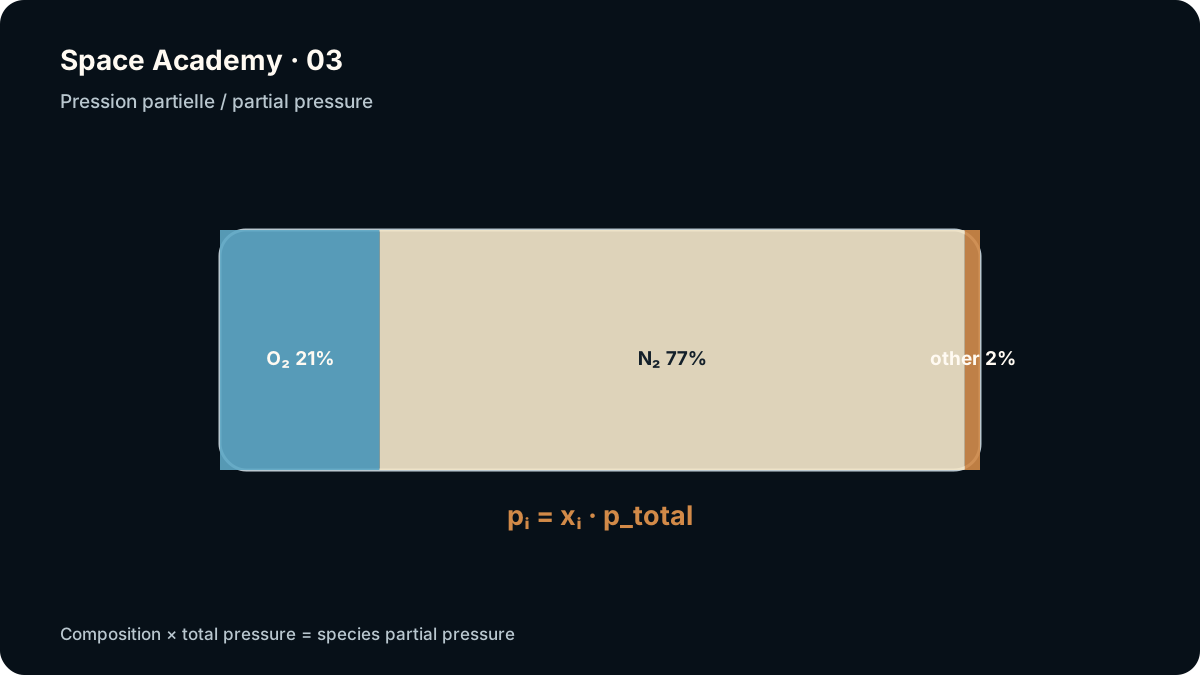
In an ideal mixture, each gas contributes partial pressure and the partial pressures sum to total pressure. A 70 kPa habitat atmosphere is not fully defined until O₂, CO₂, water vapor, and contaminant fractions are known. Quantitative reference
pV = nRT connects amount, absolute temperature, volume, and pressure. Chemistry makes molecules; engineering must then store, circulate, purify, and measure them at defined conditions. Quantitative reference
Interpretation
In an ideal gas mixture, each gas contributes to total pressure according to mole fraction. Partial pressure links composition to physiology: the same oxygen fraction does not have the same effect at different total pressures.
At 70 kPa and 30 mol% O₂, pO₂≈21 kPa. At 50 kPa total, about 42% O₂ would be needed to keep 21 kPa in this idealized calculation. The formula is useful because it makes a system dependency visible. Quantitative reference
Partial pressure in a gas mixture
- 1 — Concrete question
- What partial pressure does a species exert when it has a known mole fraction in a gas mixture?
- 2 — Intuition without symbols
- In an ideal mixture, each species contributes to total pressure in proportion to its share of molecules.
- 3 — Quantities first
p_i: partial pressure of species i;y_i: mole fraction;p_total: total pressure.- 4 — Formula
p_i = y_i p_total- 5 — Read aloud
- Read the relation by naming every quantity and operation:
p_i = y_i p_total. - 6 — Symbols and meaning
- Mole fractions sum to 1 and partial pressures ideally sum to total pressure.
- 7 — Pronunciation
- The “Read aloud” line above is the oral reference for “Partial pressure in a gas mixture”. Any subscript, exponent or grouping that changes the meaning of the relation should be spoken explicitly.
- 8 — Units
p_iandp_totalin the same pressure unit;y_idimensionless.- 9 — Convention
- Use mole fraction, not mass fraction, unless explicitly converted.
- 10 — Why this operation
- Multiplication applies the species mole fraction to total mixture pressure.
- 11 — Assumptions
- Mixture is close enough to ideal-gas behavior.
- 12 — Unit check
1×kPa=kPa.- 13 — Numerical case
y_i=0.95andp_total=70 kPagivep_i=66.5 kPa.- 14 — Why the calculation works
- Multiplying by mole fraction isolates the species contribution to the total.
- 15 — Algebra check
y_i=p_i/p_total.- 16 — Mental estimate
- 95% of 70 kPa should be slightly below 70, about 66.5 kPa.
- 17 — Interpretation
- Partial pressure supports checks for breathing, condensation, reactions and safety limits.
- 18 — What it does not prove
- It does not by itself capture nonideal effects or local composition gradients.
- 19 — Sensitivity or limit case
- At fixed total pressure, p_i scales linearly with y_i.
- 20 — Guided and autonomous practice
Guided exercise. y=0.21 in a 70 kPa habitat: find p_i.
Guided correction — open after attempting the exercise
0.21×70=14.7 kPa.Autonomous exercise. What mole fraction gives 20 kPa in an 80 kPa mixture?
Autonomous correction — open after attempting the exercise
y=20/80=0.25.- 21 — Mission decision
- Verify each critical partial pressure, not total habitat pressure alone.
Real safety must also consider fire risk, humidity, CO₂, contaminants, and physiological limits; matching pO₂ alone does not define a safe atmosphere.
6. Electrolysis: material balance plus energy cost
Electrolysis separates water into H₂ and O₂ using electrical energy. Stoichiometry fixes the ideal mass relation but not electrical efficiency, cell voltage, heat rejection, drying, separation, or lifetime.
Ideal mass balance of electrolysis
- 1 — Concrete question
- What ideal masses of hydrogen and oxygen come from 36 kg of water?
- 2 — Intuition without symbols
- The balanced reaction fixes molar ratios; molar masses then convert those ratios into kilograms.
- 3 — Quantities first
36 kg H₂O: reference water mass;4 kg H₂and32 kg O₂: ideal stoichiometric product masses.- 4 — Formula
36 kg H₂O → 4 kg H₂ + 32 kg O₂- 5 — Read aloud
- Read the relation by naming every quantity and operation:
36 kg H₂O → 4 kg H₂ + 32 kg O₂. - 6 — Symbols and meaning
- Values come from 2 mol H₂O = 36 g, 2 mol H₂ = 4 g and 1 mol O₂ = 32 g, then scale linearly.
- 7 — Pronunciation
- The “Read aloud” line above is the oral reference for “Ideal mass balance of electrolysis”. Any subscript, exponent or grouping that changes the meaning of the relation should be spoken explicitly.
- 8 — Units
- All masses may use g, kg or t as long as the same mass unit is used throughout.
- 9 — Convention
- Distinguish ideal stoichiometric yield from actual electrolyzer yield.
- 10 — Why this operation
- Product masses follow directly from molar ratios and molar masses in the balanced equation.
- 11 — Assumptions
- Ideal complete reaction, pure products and no process losses.
- 12 — Unit check
4+32=36 kg: total mass is conserved.- 13 — Numerical case
- 72 kg H₂O would ideally give
8 kg H₂ + 64 kg O₂. - 14 — Why the calculation works
- Scaling all products by the same factor preserves the stoichiometric balance.
- 15 — Algebra check
- For water mass
m, ideal H₂ =m×4/36and O₂ =m×32/36. - 16 — Mental estimate
- Oxygen is about 89% of water mass and hydrogen about 11%.
- 17 — Interpretation
- This balance sets mass ceilings before electrical efficiency, separation and storage.
- 18 — What it does not prove
- It does not give energy demand, purity, losses or real throughput.
- 19 — Sensitivity or limit case
- Product masses scale linearly with water feed mass.
- 20 — Guided and autonomous practice
Guided exercise. What ideal products from 18 kg water?
Guided correction — open after attempting the exercise
2 kg H₂ + 16 kg O₂.Autonomous exercise. How much water is ideally required for 24 kg O₂?
Autonomous correction — open after attempting the exercise
24×36/32=27 kg H₂O.- 21 — Mission decision
- Then apply efficiency and storage capacity before claiming usable production.
Exercise 6
In the ideal balance, how much O₂ corresponds to 9 kg water?
Solution: 9 kg is one quarter of 36; ideal O₂ is 32/4 = 8 kg. Quantitative reference
The mass ratio comes from water stoichiometry rather than an empirical percentage. Scaling the reference batch by one quarter preserves the ideal proportions; yield and purity are applied only after the atomic balance.
Case study — electrolyse a mass of water
The ideal equation 2 H₂O → 2 H₂ + O₂ gives a simple mass balance. Two moles of water are about 36 g and ideally yield about 4 g H₂ and 32 g O₂. At the scale of 36 kg of perfectly converted water, stoichiometry becomes 4 kg hydrogen plus 32 kg oxygen. Total mass remains 36 kg because atoms, and therefore mass in this ideal closed system, are conserved. Quantitative reference
This balance says nothing about electrical demand, cell efficiency, purity, storage pressure, or electrode life. Moving from reaction to equipment requires energy, kinetics, separation, thermal management, and maintenance. Stoichiometry still sets a physical boundary: a system cannot promise 40 kg O₂ from 36 kg water without another oxygen source.
Field reasoning
Water electrolysis turns electrical energy into chemical separation. Stoichiometry fixes the H₂/O₂ ratio; real energy depends on overpotential, resistance, temperature, pressure, purity, and auxiliary equipment.
36 kg water ideally corresponds to 4 kg H₂ and 32 kg O₂. If a teaching scenario assumes 55 kWh per kg H₂, producing 4 kg would require 220 kWh electrical input before other auxiliaries. Quantitative reference
The selected energy figure is a scenario assumption; it must not be presented as universal electrolyzer performance.
7. Sabatier connects CO₂, H₂, CH₄, and water
CO₂ + 4 H₂ → CH₄ + 2 H₂O converts carbon dioxide and hydrogen into methane and water. Rounded mass balance: 44 kg CO₂ + 8 kg H₂ → 16 kg CH₄ + 36 kg H₂O. Quantitative reference
Sabatier stoichiometric mass balance
- 1 — Concrete question
- What ideal methane and water masses correspond to 44 kg CO₂ and 8 kg H₂?
- 2 — Intuition without symbols
- A balanced equation fixes molecular proportions and, through molar masses, a closed mass balance.
- 3 — Quantities first
CO₂,H₂: reactants;CH₄,H₂O: products; coefficients 1:4:1:2.- 4 — Formula
CO₂ + 4H₂ → CH₄ + 2H₂O ; 44+8 → 16+36- 5 — Read aloud
- Read the relation by naming every quantity and operation:
CO₂ + 4H₂ → CH₄ + 2H₂O ; 44+8 → 16+36. - 6 — Symbols and meaning
- One mole CO₂ (44 g) with four moles H₂ (8 g) ideally gives one mole CH₄ (16 g) and two moles H₂O (36 g).
- 7 — Pronunciation
- The “Read aloud” line above is the oral reference for “Sabatier stoichiometric mass balance”. Any subscript, exponent or grouping that changes the meaning of the relation should be spoken explicitly.
- 8 — Units
- Molar ratios in mol; mass balance may use g, kg or t consistently.
- 9 — Convention
- Identify the limiting reactant before applying actual conversion/yield.
- 10 — Why this operation
- Coefficients balance C, H and O; molar masses then close 52 kg in = 52 kg out.
- 11 — Assumptions
- Ideal overall reaction, complete conversion and no side reactions.
- 12 — Unit check
44+8=52 kgand16+36=52 kg.- 13 — Numerical case
- With 88 kg CO₂ and 16 kg H₂, ideal products are
32 kg CH₄ + 72 kg H₂O. - 14 — Why the calculation works
- Verify molar ratio first, then scale all masses by the same factor.
- 15 — Algebra check
- With CO₂ limiting, ideal CH₄ =
m_CO₂×16/44. - 16 — Mental estimate
- 16/44≈0.36: 100 kg CO₂ can give only about 36 kg ideal CH₄.
- 17 — Interpretation
- The balance links CO₂ capture, H₂ demand, CH₄ production and water recovery.
- 18 — What it does not prove
- It does not give real conversion, catalyst behavior, temperature, pressure, separation or energy use.
- 19 — Sensitivity or limit case
- Production is limited by whichever reactant is smallest relative to its stoichiometric requirement.
- 20 — Guided and autonomous practice
Guided exercise. With 22 kg CO₂ and excess H₂, what ideal CH₄ mass?
Guided correction — open after attempting the exercise
22×16/44=8 kg CH₄.Autonomous exercise. How much H₂ is ideally required for 110 kg CO₂?
Autonomous correction — open after attempting the exercise
110×8/44=20 kg H₂.- 21 — Mission decision
- Size inventories and recycle around the limiting reactant, not one nominal flow alone.
Recovered water can feed electrolysis, but integration adds compressors, catalyst, separation, storage, and common dependencies. A closed mass balance is not automatically a reliable architecture.
Case study — Sabatier and partial closure
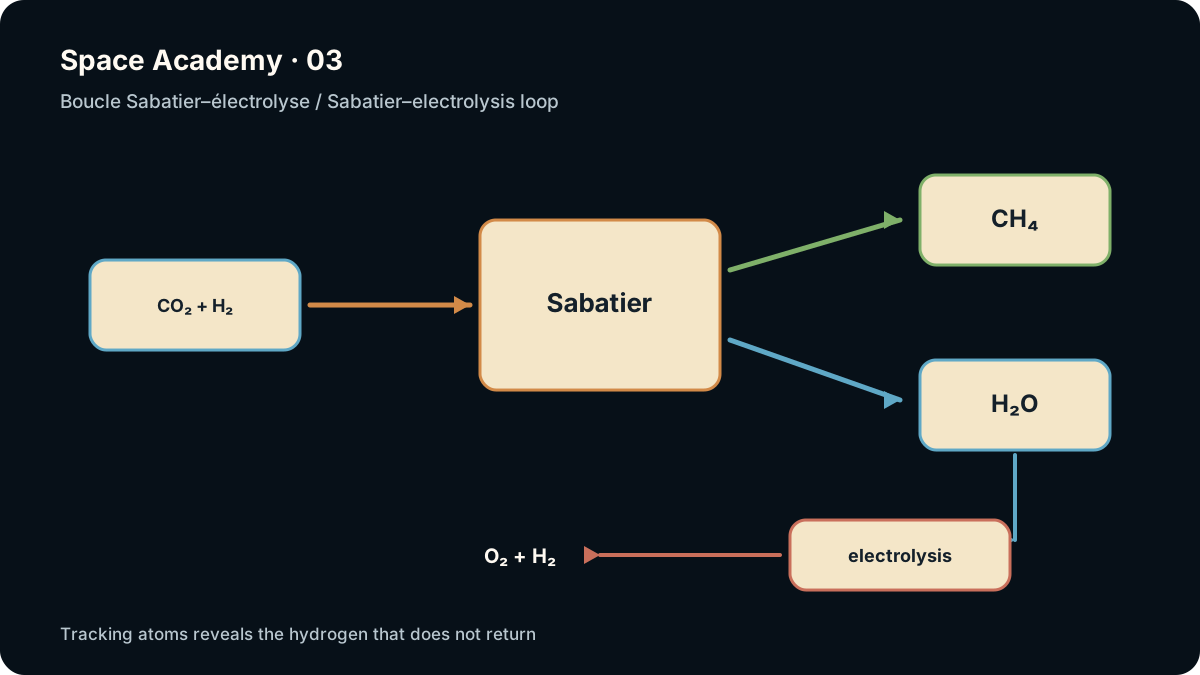
CO₂ + 4 H₂ → CH₄ + 2 H₂O gives, using rounded molar masses, 44 kg CO₂ + 8 kg H₂ → 16 kg CH₄ + 36 kg H₂O. If the water is then electrolysed ideally, 36 kg water yields 4 kg H₂ and 32 kg O₂. Only half the hydrogen fed to Sabatier therefore returns as hydrogen in this ideal sequence: 4 kg returns from the 8 kg input. Quantitative reference
The methane contains the other hydrogen. Depending on architecture it may be stored as useful product, burned as fuel, or become an output that prevents complete hydrogen-loop closure. The word “recycling” must therefore identify which species returns, with what yield, and where losses go. A chemical loop is judged by a complete material balance, not by the fact that water appears somewhere downstream. Quantitative reference
Why this matters
The Sabatier reaction couples CO₂, hydrogen, methane, and water. In a closed architecture its value cannot be judged in isolation: it depends on hydrogen source, methane use, water recovery, and losses.
44 kg CO₂ and 8 kg H₂ ideally produce 16 kg CH₄ and 36 kg H₂O. Re-electrolyzing 36 kg water ideally returns 4 kg H₂, only half of the 8 kg H₂ fed to Sabatier. The calculation below is a consistency test, not a complete truth.
Saying “the loop recycles hydrogen” without a quantified balance hides makeup demand or the need for another recovery step.
8. Methane-oxygen combustion
Ideal CH₄ + 2 O₂ → CO₂ + 2 H₂O gives about 16 kg methane + 64 kg oxygen → 44 kg CO₂ + 36 kg water. Both sides total 80 kg. Quantitative reference
A real engine adds mixture ratio, pressure, temperature, combustion stability, cooling, nozzle behavior, and efficiency. Chemistry gives a stoichiometric boundary, not finished propulsion hardware. Quantitative reference
Physical reading
Methane-oxygen combustion partly reverses the synthesis logic: it releases energy and produces CO₂ and water. Stoichiometric ratios support tank sizing and recycle balances.
CH₄+2O₂→CO₂+2H₂O means 16 kg CH₄ for 64 kg O₂, ideally producing 44 kg CO₂ and 36 kg water. Quantitative reference
Stoichiometric methane combustion
- 1 — Concrete question
- How much oxygen is ideally required to burn methane without stoichiometric deficit or excess?
- 2 — Intuition without symbols
- One methane molecule contains one carbon and four hydrogens; enough oxygen is needed to form one CO₂ and two waters.
- 3 — Quantities first
CH₄: methane;O₂: oxygen;CO₂: carbon dioxide;H₂O: water.- 4 — Formula
CH₄ + 2O₂ → CO₂ + 2H₂O- 5 — Read aloud
- Read the relation by naming every quantity and operation:
CH₄ + 2O₂ → CO₂ + 2H₂O. - 6 — Symbols and meaning
- The coefficient 2 before O₂ supplies four O atoms: two for CO₂ and two for 2H₂O.
- 7 — Pronunciation
- The “Read aloud” line above is the oral reference for “Stoichiometric methane combustion”. Any subscript, exponent or grouping that changes the meaning of the relation should be spoken explicitly.
- 8 — Units
- Coefficients are molar ratios; proportional masses follow from molar masses.
- 9 — Convention
- Separate ideal stoichiometric ratio from the mixture ratio actually used by an engine or burner.
- 10 — Why this operation
- Coefficients conserve one C, four H and four O atoms.
- 11 — Assumptions
- Complete combustion to CO₂ and H₂O, with no CO or intermediates.
- 12 — Unit check
- 16 g CH₄ + 64 g O₂ → 44 g CO₂ + 36 g H₂O; 80 g on each side.
- 13 — Numerical case
- 16 kg CH₄ ideally require
64 kg O₂and produce 44 kg CO₂ + 36 kg H₂O. - 14 — Why the calculation works
- Balancing atoms fixes the molar ratio; molar masses then convert that ratio to mass.
- 15 — Algebra check
- Ideal O₂ =
4×m_CH₄on a mass basis for this reaction. - 16 — Mental estimate
- Oxygen mass is four times methane mass in the ideal balance.
- 17 — Interpretation
- The ratio sets baseline O₂ demand and CO₂/H₂O production.
- 18 — What it does not prove
- A real engine often uses a different mixture ratio for temperature, stability and performance.
- 19 — Sensitivity or limit case
- All masses scale linearly with methane amount while O₂ remains available.
- 20 — Guided and autonomous practice
Guided exercise. What ideal O₂ for 5 kg CH₄?
Guided correction — open after attempting the exercise
5×4=20 kg O₂.Autonomous exercise. How much CH₄ can ideally burn with 128 kg O₂?
Autonomous correction — open after attempting the exercise
128/4=32 kg CH₄.- 21 — Mission decision
- Use the system’s actual mixture ratio operationally, while keeping stoichiometry as the balance reference.
A real engine uses a mixture ratio chosen for performance, temperature, and stability; stoichiometry alone does not define operating point.
Chemistry check for 8. Methane-oxygen combustion.
9. MOXIE: Mars demonstration, not a factory
NASA reports MOXIE produced 122 g total oxygen across 16 Mars runs, reaching 12 g/h and at least 98% purity at its best. Extracting O₂ from Martian CO₂ has therefore been demonstrated at small scale.
A hypothetical 1,000 kg/day requirement equals 41.7 kg/h. Compared with 0.012 kg/h demonstrated peak, the throughput ratio is above 3,400. That is a scale comparison, not a proposal to copy 3,400 identical MOXIE units. Quantitative reference
Case study — scale MOXIE toward an industrial demand
NASA reports that MOXIE produced 122 g of oxygen in total on Mars, reached up to 12 g/h, and achieved at least 98% purity at its best. Take a teaching demand of 1,000 kg O₂ per day. That is 41.7 kg/h on average, about 3,475 times the demonstrated 0.012 kg/h peak. The ratio exposes a scale change; it does not mean that 3,475 copies of the instrument form an industrial design.
A plant changes compressors, cell area, electrical supply, heat rejection, storage, controls, maintenance, spares, and availability. A nominal 50 kg/h plant available only 80% of the time averages 40 kg/h. Availability can therefore matter as much as nameplate capacity. Scientific status must remain explicit: MOXIE demonstrated the principle on Mars; industrial oxygen production remains future engineering. Quantitative reference
Convert daily throughput to hourly rate and unit count
- 1 — Concrete question
- How many units are needed to process a daily target at a known per-unit rate?
- 2 — Intuition without symbols
- A daily target must first be converted to the same time basis as one machine capacity before comparing them.
- 3 — Quantities first
M_day: mass target per day;ṁ_h: required hourly rate;q_unit: one-unit throughput;N: ideal unit count.- 4 — Formula
ṁ_h = M_day/24 ; N = ṁ_h/q_unit- 5 — Read aloud
- Read the relation by naming every quantity and operation:
ṁ_h = M_day/24 ; N = ṁ_h/q_unit. - 6 — Symbols and meaning
- The first division converts day→hour; the second compares required rate with one-unit capacity.
- 7 — Pronunciation
- The “Read aloud” line above is the oral reference for “Convert daily throughput to hourly rate and unit count”. Any subscript, exponent or grouping that changes the meaning of the relation should be spoken explicitly.
- 8 — Units
M_dayin kg/day,ṁ_handq_unitin kg/h,Ndimensionless.- 9 — Convention
- Use the same availability and time basis for target and units before rounding N.
- 10 — Why this operation
- Dividing by 24 gives average hourly demand; dividing by one-unit capacity gives the ideal number of units.
- 11 — Assumptions
- Continuous 24 h/day operation and constant per-unit throughput for this simplified calculation.
- 12 — Unit check
(kg/day)/(24 h/day)=kg/h, then(kg/h)/(kg/h)=1.- 13 — Numerical case
1,000 kg/day÷24=41.67 kg/h. At0.012 kg/hper unit:N≈3472.2, so at least 3,473 ideal units before margin.- 14 — Why the calculation works
- Converting time bases first prevents division of rates expressed on incompatible bases.
- 15 — Algebra check
M_day=24 N q_unitfor continuous operation.- 16 — Mental estimate
- 42 kg/h divided by 0.012 kg/h gives a few thousand units, consistent with ~3,500.
- 17 — Interpretation
- The result immediately shows whether a demonstration technology can be scaled directly.
- 18 — What it does not prove
- Availability, maintenance, redundancy, ramp-up and scale effects are excluded.
- 19 — Sensitivity or limit case
- N scales linearly with target and inversely with per-unit throughput.
- 20 — Guided and autonomous practice
Guided exercise. 500 kg/day at 0.5 kg/h per unit: how many ideal units?
Guided correction — open after attempting the exercise
500/24=20.83 kg/h, then20.83/0.5=41.67: at least 42 units.Autonomous exercise. 1,000 kg/day, but unit throughput doubles to 0.024 kg/h: how many units?
Autonomous correction — open after attempting the exercise
41.67/0.024≈1736.1: at least 1,737 units.- 21 — Mission decision
- Do not extrapolate a demonstration to a factory without availability and industrial architecture.
Move into calculation
MOXIE is a real Mars demonstration of oxygen production from atmospheric CO₂. Its importance is the process demonstrated in the actual environment, not a claim that a small instrument was already a propellant factory.
NASA reports 122 g O₂ total, up to 12 g/h, at least 98% purity. A 2 kg/h plant would theoretically make 17.52 t/year at 100% availability but 12.264 t/year at 70%. The teaching value is seeing units turn into a decision. Quantitative reference
Annual production with availability
- 1 — Concrete question
- What annual production follows from nominal throughput and a stated availability?
- 2 — Intuition without symbols
- A machine does not necessarily produce all year; availability reduces nominal time to productive time.
- 3 — Quantities first
M_annual: annual mass;ṁ: hourly throughput;8760 h: hours in a 365-day year;A: availability.- 4 — Formula
M_annual = ṁ·8760 h·A- 5 — Read aloud
- Read the relation by naming every quantity and operation:
M_annual = ṁ·8760 h·A. - 6 — Symbols and meaning
A=0.90means 90% of nominal time is available for production.- 7 — Pronunciation
- The “Read aloud” line above is the oral reference for “Annual production with availability”. Any subscript, exponent or grouping that changes the meaning of the relation should be spoken explicitly.
- 8 — Units
ṁin kg/h, time in h, A dimensionless, result in kg/year.- 9 — Convention
- Define what counts as unavailable: maintenance, failures, cleaning, resource wait.
- 10 — Why this operation
- Throughput multiplied by productive time gives total produced mass.
- 11 — Assumptions
- Constant throughput while available and a standard 365-day year.
- 12 — Unit check
kg/h×h×1=kg.- 13 — Numerical case
41.7 kg/h×8760 h×0.90≈328,763 kg/year, about 329 t/year.- 14 — Why the calculation works
- Multiply annual time by availability for productive hours; then multiply by throughput for mass.
- 15 — Algebra check
ṁ=M_annual/(8760A).- 16 — Mental estimate
- 42 kg/h for roughly 8,000 productive hours gives about 336 t/year, close to the precise result.
- 17 — Interpretation
- Annual production compares industrial capacity with annual mission demand.
- 18 — What it does not prove
- The calculation hides seasonality, throughput degradation and long correlated outages.
- 19 — Sensitivity or limit case
- Annual mass scales linearly with throughput and availability.
- 20 — Guided and autonomous practice
Guided exercise. 10 kg/h at 80% availability: annual production?
Guided correction — open after attempting the exercise
10×8760×0.8=70,080 kg/year.Autonomous exercise. What throughput is needed for 100 t/year at 85% availability?
Autonomous correction — open after attempting the exercise
100000/(8760×0.85)≈13.43 kg/h.- 21 — Mission decision
- Size capacity using demonstrated availability and credible maintenance margin.
Scaling requires compression, filtration, thermal control, power, maintenance, and storage; multiplying flow rate is not plant design.
10. Corrosion, materials, contamination
Surface chemistry depends on water, oxygen, salts, temperature, and material. “Stainless” does not mean corrosion is impossible. Seals, coatings, alloys, cleaning, and inspection must match a defined environment.
Perchlorate-bearing materials and Martian dust add contamination problems requiring characterization and separation rules. “Martian soil” is not one chemically uniform substance.
Case study — contamination and acceptance criteria
A chemical product is not defined only by its name. Water containing 50 mg/L of a contaminant is not equivalent to water at 0.5 mg/L, even though both are “water.” If an 800 L tank contains 2 mg/L of a dissolved species, total mass of that species is 1,600 mg or 1.6 g. The calculation converts concentration into inventory and helps size purification or monitoring. Quantitative reference
Measurement must match a relevant limit and an analytical method capable of testing it. A sensor with insufficient sensitivity can report “not detected” without proving the concentration acceptable. Mars industrial chemistry therefore links composition, measurement method, detection limit, sampling interval, and response to exceedance. Purity is measured evidence, not a label. Quantitative reference
Contaminant mass from concentration
- 1 — Concrete question
- What contaminant mass corresponds to a known concentration in a given volume?
- 2 — Intuition without symbols
- Concentration is mass per volume; multiplying by total volume reconstructs contained mass.
- 3 — Quantities first
m: contaminant mass;C: mass concentration;V: solution or fluid volume.- 4 — Formula
m = C·V- 5 — Read aloud
- Read the relation by naming every quantity and operation:
m = C·V. - 6 — Symbols and meaning
- The volume basis in C must match the unit used for V.
- 7 — Pronunciation
- The “Read aloud” line above is the oral reference for “Contaminant mass from concentration”. Any subscript, exponent or grouping that changes the meaning of the relation should be spoken explicitly.
- 8 — Units
Cin mg/L,Vin L, result in mg; or any consistent unit set.- 9 — Convention
- Convert volume or concentration before multiplication if units do not match.
- 10 — Why this operation
- Each liter contains C milligrams; V liters therefore contain C times V.
- 11 — Assumptions
- Uniform concentration representative of the considered volume.
- 12 — Unit check
(mg/L)×L=mg.- 13 — Numerical case
2 mg/L×800 L=1,600 mg=1.6 g.- 14 — Why the calculation works
- Multiplication implicitly sums the same mass per liter over the full volume.
- 15 — Algebra check
C=m/VandV=m/C.- 16 — Mental estimate
- 2 mg/L over 1,000 L would give 2 g; over 800 L, 1.6 g is plausible.
- 17 — Interpretation
- Total mass helps assess filter loading, toxicity, recovery or cleanup.
- 18 — What it does not prove
- A volume average may hide higher local contamination.
- 19 — Sensitivity or limit case
- At fixed C, m scales with V; at fixed V, it scales with C.
- 20 — Guided and autonomous practice
Guided exercise. 3 mg/L in 500 L: what mass?
Guided correction — open after attempting the exercise
1,500 mg=1.5 g.Autonomous exercise. What concentration corresponds to 2 g in 400 L?
Autonomous correction — open after attempting the exercise
2,000 mg/400 L=5 mg/L.- 21 — Mission decision
- Compare total mass and local concentration with filtration and health limits.
Control point
Corrosion and contamination describe surface or material changes that can alter strength, sealing, electrical contact, or cleanliness. A settlement must connect environmental chemistry, material choice, and inspection method. Quantitative reference
If a wall loses 0.05 mm/year uniformly in a simplified model, a 0.5 mm allowance corresponds to ten years. Localized pitting can penetrate much earlier despite the same average loss. An engineer keeps numerical result, margin, and validity domain separate.
Lifetime of a corrosion thickness margin
- 1 — Concrete question
- How long does extra thickness protect a component under an assumed steady corrosion rate?
- 2 — Intuition without symbols
- If a surface loses the same thickness each year, lifetime is available margin divided by yearly loss.
- 3 — Quantities first
t_margin: covered time;e_margin: sacrificial thickness;v_corrosion: thickness-loss rate.- 4 — Formula
t_margin = e_margin/v_corrosion- 5 — Read aloud
- Read the relation by naming every quantity and operation:
t_margin = e_margin/v_corrosion. - 6 — Symbols and meaning
- Rate must use the same thickness basis as the margin, for example mm/year.
- 7 — Pronunciation
- The “Read aloud” line above is the oral reference for “Lifetime of a corrosion thickness margin”. Any subscript, exponent or grouping that changes the meaning of the relation should be spoken explicitly.
- 8 — Units
ein mm,vin mm/year, result in years.- 9 — Convention
- Use a conservative rate representative of material, environment and actual protection.
- 10 — Why this operation
- Dividing thickness reserve by thickness consumed each year gives years of coverage.
- 11 — Assumptions
- Constant uniform corrosion rate with no accelerated pitting.
- 12 — Unit check
mm/(mm/year)=year.- 13 — Numerical case
2 mm / 0.05 mm/year = 40 years.- 14 — Why the calculation works
- Division compares thickness inventory with its consumption rate.
- 15 — Algebra check
e_margin=t_margin v_corrosion.- 16 — Mental estimate
- 0.05 mm/year means 1 mm in 20 years; 2 mm gives about 40 years.
- 17 — Interpretation
- The result gives a scale for inspection, replacement or design margin.
- 18 — What it does not prove
- Real corrosion may be localized, variable, galvanic or accelerated by coating damage.
- 19 — Sensitivity or limit case
- Doubling margin doubles lifetime; doubling corrosion rate halves it.
- 20 — Guided and autonomous practice
Guided exercise. 1.5 mm margin at 0.03 mm/year: lifetime?
Guided correction — open after attempting the exercise
1.5/0.03=50 years.Autonomous exercise. What margin is needed for 25 years at 0.08 mm/year?
Autonomous correction — open after attempting the exercise
25×0.08=2 mm.- 21 — Mission decision
- Combine this calculation with inspection, coupons, sensors and localized-corrosion margin.
A corrosion rate measured in one environment must not be transferred without validation to another mixture, temperature, or surface condition. Quantitative reference
11. Concentration needs units and definition
Concentration may be reported as mg/L, mol/m³, mole fraction, mass fraction, or other forms. The numerical value is incomplete without the definition and unit. Quantitative reference
Health or process limits can also depend on averaging time and sampling method. Copying the number alone discards essential specification context.
Interpretation
A concentration must state its basis: mass per volume, amount per volume, mass fraction, mole fraction, or ppm. Without the definition, numerically similar values can describe different things. Quantitative reference
Dissolving 5 g solute to a final volume of 2 L gives 2.5 g/L. If the statement means “2 L solvent plus solute” rather than final solution volume, the exact concentration can differ. The formula is useful because it makes a system dependency visible.
Mass concentration
- 1 — Concrete question
- What mass concentration results from a solute mass distributed in a solution volume?
- 2 — Intuition without symbols
- Concentration relates an amount of mass to the volume in which it is distributed.
- 3 — Quantities first
C_m: mass concentration;m_solute: solute mass;V_solution: final solution volume.- 4 — Formula
C_m = m_solute/V_solution- 5 — Read aloud
- Read the relation by naming every quantity and operation:
C_m = m_solute/V_solution. - 6 — Symbols and meaning
- Volume is the final solution volume, not necessarily initial solvent volume.
- 7 — Pronunciation
- The “Read aloud” line above is the oral reference for “Mass concentration”. Any subscript, exponent or grouping that changes the meaning of the relation should be spoken explicitly.
- 8 — Units
- Examples: g/L, mg/L or kg/m³.
- 9 — Convention
- Keep a consistent volume basis and convert prefixes before comparing limits.
- 10 — Why this operation
- Dividing distributed mass by volume gives mass per unit volume.
- 11 — Assumptions
- Uniform mixture and known final volume.
- 12 — Unit check
g/Lor equivalent mass-per-volume unit.- 13 — Numerical case
5 g / 2 L = 2.5 g/L.- 14 — Why the calculation works
- Division normalizes mass by volume size.
- 15 — Algebra check
m_solute=C_mV_solution.- 16 — Mental estimate
- 5 g in roughly 2 L should give a few g/L, here 2.5.
- 17 — Interpretation
- This concentration can be compared with process, health or quality specifications.
- 18 — What it does not prove
- An average concentration does not guarantee local uniformity or absence of precipitation.
- 19 — Sensitivity or limit case
- At fixed mass, doubling volume halves C_m.
- 20 — Guided and autonomous practice
Guided exercise. 12 g in 3 L: concentration?
Guided correction — open after attempting the exercise
4 g/L.Autonomous exercise. What mass is needed for 1.5 g/L in 8 L?
Autonomous correction — open after attempting the exercise
1.5×8=12 g.- 21 — Mission decision
- Use actual measured concentration to decide filtration, dosing or rejection.
ppm is not universally mg/L; the approximate equivalence depends on density and definition.
Chemistry check for 11. Concentration needs units and definition.
12. Combined loop: identify what does not return
Ideal Sabatier uses 44 kg CO₂ and 8 kg H₂ to make 36 kg H₂O. Ideal electrolysis of that water returns about 4 kg H₂ and 32 kg O₂. Only half of the 8 kg hydrogen used returns through the water.
The cycle therefore needs additional hydrogen or a different architecture. Atom bookkeeping prevents circular diagrams from creating material by implication.
Guided project — follow atoms through an oxygen-methane-water loop
Build an ideal batch from 88 kg CO₂ and 16 kg H₂. The ratio is twice the Sabatier equation, yielding ideally 32 kg CH₄ and 72 kg H₂O. Total input is 104 kg and total output is 104 kg. If all water is electrolysed, 72 kg ideally yields 8 kg H₂ and 64 kg O₂. Only 8 kg of the original 16 kg hydrogen feed therefore returns as hydrogen; the other half is bound into methane.
Now assume a 90% overall Sabatier conversion for the exercise, without modelling side reactions. You cannot simply multiply every output by 0.90 and make the rest disappear: the unconverted 10% remains as reactants or other species that must appear in the balance. A teaching approximation is to treat 90% of the batch as ideally converted and 10% as unreacted. That gives 28.8 kg CH₄ and 64.8 kg H₂O while about 8.8 kg CO₂ and 1.6 kg H₂ remain for separation, recycle, or purge. Quantitative reference
Ideal electrolysis of 64.8 kg water would yield 7.2 kg H₂ and 57.6 kg O₂. If electrolysis converts only 95% of water per pass, instantaneous streams differ again. Recycle loops return unconverted material but add separators, pumps, sensors, and energy. '90% efficiency' is incomplete language unless it says chemical conversion, energy efficiency, material recovery, or product purity.
Add quality next: oxygen for a habitable atmosphere and oxygen for propulsion can have different pressure, purity, contamination, and storage requirements. A flow measurement of 10 kg/h proves nothing about composition. Conversely, 99.9% purity does not prove adequate throughput. Industrial processes track flow, composition, temperature, pressure, energy, availability, and equipment condition simultaneously. Quantitative reference
Finish with a boundary balance: which species enter from Mars or inventory, which return to the loop, which are consumed, and which losses require makeup? That table matters more than a slogan about a 'closed cycle.' Closure exists only for a defined boundary, time period, and set of species.
Sabatier–electrolysis loop: net balance
- 1 — Concrete question
- What is actually recovered and consumed when ideal Sabatier and electrolysis are chained?
- 2 — Intuition without symbols
- Chaining two reactions reveals which species return to the loop and which leave as net products.
- 3 — Quantities first
88 CO₂and16 H₂: Sabatier feed;32 CH₄and72 H₂O: products; water electrolysis:8 H₂recyclable and64 O₂.- 4 — Formula
88 CO₂ + 16 H₂ → 32 CH₄ + 72 H₂O → 8 H₂ + 64 O₂- 5 — Read aloud
- Read the relation by naming every quantity and operation:
88 CO₂ + 16 H₂ → 32 CH₄ + 72 H₂O → 8 H₂ + 64 O₂. - 6 — Symbols and meaning
- After ideal recycle of 8 kg H₂, external net H₂ demand falls from 16 kg to 8 kg for this batch, while CH₄ and O₂ are net products.
- 7 — Pronunciation
- The “Read aloud” line above is the oral reference for “Sabatier–electrolysis loop: net balance”. Any subscript, exponent or grouping that changes the meaning of the relation should be spoken explicitly.
- 8 — Units
- All mass-balance values use the same unit, here kg.
- 9 — Convention
- Distinguish internal recycle streams from external consumed or produced streams.
- 10 — Why this operation
- Adding steps then canceling recycled species reveals the net loop balance.
- 11 — Assumptions
- Ideal reactions, complete water/H₂ recovery, no purge or loss.
- 12 — Unit check
- Sabatier: 104 kg in =104 kg out. Electrolysis: 72 kg H₂O =8+64 kg. Recycle redistributes without creating mass.
- 13 — Numerical case
- The batch ideally gives 32 kg CH₄ and 64 kg O₂, recycles 8 kg H₂ and therefore needs 8 kg net external H₂.
- 14 — Why the calculation works
- Writing each reaction separately then identifying the stream returned to feed avoids double-counting recycle.
- 15 — Algebra check
- With ideal recycle, net external H₂ = Sabatier H₂ demand − H₂ recovered by electrolysis.
- 16 — Mental estimate
- Electrolysis of 72 kg water recovers 8 kg H₂, half of the initial 16 kg demand.
- 17 — Interpretation
- The loop reduces net imported hydrogen demand while co-producing oxygen and methane.
- 18 — What it does not prove
- Real efficiencies, purge, separation, compression and energy use reduce effective loop closure.
- 19 — Sensitivity or limit case
- H₂ recovery below 100% directly increases external makeup demand.
- 20 — Guided and autonomous practice
Guided exercise. If only 75% of the 8 kg produced H₂ is recovered, what net external makeup is needed?
Guided correction — open after attempting the exercise
Recycled H₂ = 6 kg; net makeup =
16−6=10 kg.Autonomous exercise. At 50% H₂ recovery, what net external makeup?
Autonomous correction — open after attempting the exercise
Recycle 4 kg; net makeup
12 kg.- 21 — Mission decision
- Size storage and imports using demonstrated recycle efficiency, not the ideal loop.
13. End-of-module check
- I know what a mole measures.
- I balance a simple reaction.
- I distinguish conversion, yield, and purity.
- I check electrolysis/Sabatier/combustion balances.
- I distinguish MOXIE demonstration from industrial plant.
- I keep concentration definition and units.
Corrected drill set — independent check
1. How many moles are in 36 g water with M≈18 g/mol? Quantitative reference
n=m/M=36/18=2 mol. The mole converts measurable mass into amount of substance without counting individual molecules. Quantitative reference
2. Why balance an equation before calculating masses?
Balanced coefficients express conservation of atoms. Mass calculations on an unbalanced equation create an impossible material balance.
3. 44 kg CO₂ but only 4 kg H₂ for Sabatier: limiting reactant?
The ideal equation needs 8 kg H₂ for 44 kg CO₂. With only 4 kg H₂, hydrogen limits and only about half the CO₂ can react in the ideal model.
4. A 50 kg product is 98% pure. Impurity mass? Quantitative reference
Impure fraction is 2%, so 50×0.02 = 1 kg. The calculation does not identify impurity species or whether they are acceptable. Quantitative reference
5. Why does 95% recycling not automatically close a loop?
A 5% loss per pass still requires makeup and can accumulate over time. Species, purge streams, contaminants, and immobilized inventories also matter. Quantitative reference
Deep practice workshop
Treat each chemistry exercise as a material balance. Balance the species first, convert masses or gas quantities to moles when needed, identify the limiting reagent, and apply yield or purity only at the end. The solutions explicitly separate ideal stoichiometry, measured process performance, and engineering assumptions.
1. Moles
How many moles are in 96 g O₂?
Reasoned solution: 96/32=3 mol. Quantitative reference
2. Balancing
Balance H₂+O₂→H₂O. Quantitative reference
Reasoned solution: 2H₂+O₂→2H₂O. Quantitative reference
3. Limiting reagent
4 mol H₂ and 1 mol O₂: which limits? Quantitative reference
Reasoned solution: 1 mol O₂ needs 2 mol H₂. O₂ limits and 2 mol H₂ remains. Quantitative reference
The limiting reagent is the species exhausted first according to the balanced coefficients. Here one mole of O₂ can consume only two moles of H₂, so the remaining two moles must remain in the balance.
4. Purity
50 kg mixture at 92% useful product.
Reasoned solution: 46 kg useful product.
5. Partial pressure
25% O₂ at 80 kPa. Quantitative reference
Reasoned solution: pO₂=20 kPa. Quantitative reference
A 25% mole fraction gives 20 kPa only because total pressure is 80 kPa. Changing total pressure would change partial pressure even if composition stayed identical. Quantitative reference
6. Sabatier
88 kg CO₂ with enough H₂: ideal CH₄?
Reasoned solution: 44 kg CO₂→16 kg CH₄, so 88→32 kg CH₄. Quantitative reference
The 44 kg CO₂ to 16 kg CH₄ relation is ideal Sabatier stoichiometry with sufficient hydrogen. A real unit must also state conversion, selectivity, methane purity, and unreacted recycle streams. Quantitative reference
7. Combustion
How much ideal O₂ for 32 kg CH₄?
Reasoned solution: Ratio 16:64, so 128 kg O₂.
8. Loop capstone
A Sabatier unit receives 44 kg CO₂ and 8 kg H₂, then all produced water is electrolyzed. What ideal H₂/O₂ balance remains? Quantitative reference
Reasoned solution: Sabatier makes 36 kg H₂O and 16 kg CH₄. Electrolyzing 36 kg water returns 4 kg H₂ and 32 kg O₂. Only half the original H₂ returns, so 4 kg H₂ makeup or another recovery path is still required.
The capstone exposes the open hydrogen loop: electrolysis returns only 4 kg H₂ from the 8 kg initially injected. The missing 4 kg remains bound in methane unless another recovery route is added.
Additional advanced problems
1. Electrolyzed water
18 kg H₂O ideally gives how much H₂ and O₂?
Reasoned solution: Half the 36 kg balance: 2 kg H₂ and 16 kg O₂.
Half the water batch gives half the ideal products because this stoichiometric scaling is linear. That linearity should not be assumed for real machine efficiency at partial load.
2. Mole fraction
2 mol O₂ + 8 mol N₂, O₂ fraction? Quantitative reference
Reasoned solution: 2/10=0.20=20%. Quantitative reference
3. Yield
Maximum 250 kg, actual 210 kg.
Reasoned solution: 84%.
4. MOXIE mini-project
At 12 g/h for 10 h, production? Why not scale directly to a factory?
Reasoned solution: 120 g. A factory adds availability, power, compression, thermal control, filtration, maintenance, and storage; flow alone is not architecture. Quantitative reference
The 120 g is cumulative production at a fixed demonstrated rate for ten hours. It does not turn MOXIE into a plant; an industrial system also needs availability, compression, thermal control, filtration, storage, and maintenance.
Chemistry laboratory — track atoms, purity and process losses
Start with the chemical inventory, not the equipment
A process diagram is easier to reason about when every stream has a defined chemical composition, flow basis and purity. The learner should track atoms through reactions before discussing compressors, reactors or separators. Stoichiometry tells what is theoretically required; equipment performance tells how closely the real process approaches that limit. Confusing those two levels leads to impossible mass balances and hidden makeup requirements. Quantitative reference
Use the mole to connect microscopic chemistry and plant-scale mass
The mole lets chemical equations become quantitative. Coefficients in a balanced reaction describe molar ratios, not directly kilograms. Converting between moles and mass requires molar mass. This distinction is essential when comparing oxygen, hydrogen, carbon dioxide and methane streams because equal numbers of moles do not have equal masses. Every worked reaction should therefore show at least one explicit conversion between amount of substance and mass.
Close electrolysis and Sabatier as coupled loops
Water electrolysis can provide oxygen and hydrogen; the Sabatier reaction can combine hydrogen with carbon dioxide to produce methane and water. Coupling the processes creates useful recirculation, but it does not create a perfectly closed loop. Separation losses, purge streams, maintenance, contamination and the intended export of oxygen or methane all change the inventory. The correct engineering question is which atoms leave the defined boundary and at what rate.
Separate reaction yield from product purity
A reactor may convert a high fraction of the limiting reactant while still producing a stream that requires substantial purification. Yield, conversion, selectivity and purity answer different questions. For life-support or propellant use, downstream specifications may matter more than the reactor headline number. A robust design therefore includes sampling points, off-spec storage or recycle routes and a decision rule for when product is acceptable for its intended use. Quantitative reference
Treat contamination as chemistry plus operations
Corrosion products, lubricants, dust, cleaning agents and microbial films can alter process chemistry even when the nominal reaction is correct. Materials compatibility and cleanliness control belong in the chemical flowsheet. A maintenance action that opens a clean line to the workshop environment may create more risk than a small change in reaction efficiency. The process boundary must therefore include interfaces where contamination can enter. Quantitative reference
Use demonstration results at the correct scale
A successful technology demonstration establishes that a principle can operate under defined conditions; it does not automatically establish settlement-scale capacity, reliability or maintainability. Scaling requires throughput, duty cycle, energy, thermal rejection, feed variability, spare parts and quality control to be closed together. The learner should state clearly whether a cited result is a laboratory result, a flight demonstration or an operational production requirement.
Progressive mastery drills — eight linked checks
Drill 1 — Mole and molar mass
Convert between amount of substance and mass without treating one mole of different gases as equal mass.
Expected reasoning for “Drill 1 — Mole and molar mass”: explain the physical meaning, units or evidence path, state at least one assumption, and say which operational decision would change if the result or evidence were different.
Drill 2 — Balanced reaction
Use coefficients in a balanced reaction to define theoretical reactant ratios before applying real conversion efficiency.
Expected reasoning for “Drill 2 — Balanced reaction”: explain the physical meaning, units or evidence path, state at least one assumption, and say which operational decision would change if the result or evidence were different.
Drill 3 — Gas composition
Explain why percent composition must state whether it is molar, mass or another basis.
Expected reasoning for “Drill 3 — Gas composition”: explain the physical meaning, units or evidence path, state at least one assumption, and say which operational decision would change if the result or evidence were different.
Drill 4 — Electrolysis
List the electrical, water-quality and gas-separation information needed to turn electrolysis chemistry into a plant balance.
Expected reasoning for “Drill 4 — Electrolysis”: explain the physical meaning, units or evidence path, state at least one assumption, and say which operational decision would change if the result or evidence were different.
Drill 5 — Sabatier loop
Trace carbon and hydrogen atoms through carbon dioxide, hydrogen, methane and water, including what leaves the boundary.
Expected reasoning for “Drill 5 — Sabatier loop”: explain the physical meaning, units or evidence path, state at least one assumption, and say which operational decision would change if the result or evidence were different.
Drill 6 — Combustion
Separate stoichiometric requirement from operational mixture ratio and explain why excess reactant changes exhaust composition.
Expected reasoning for “Drill 6 — Combustion”: explain the physical meaning, units or evidence path, state at least one assumption, and say which operational decision would change if the result or evidence were different.
Drill 7 — Purity and yield
Describe a case where reactor conversion is high but product cannot yet be released for use.
Expected reasoning for “Drill 7 — Purity and yield”: explain the physical meaning, units or evidence path, state at least one assumption, and say which operational decision would change if the result or evidence were different.
Drill 8 — Contamination control
Explain how maintenance materials or dust can enter a chemical process and which acceptance check should catch the problem.
Expected reasoning for “Drill 8 — Contamination control”: explain the physical meaning, units or evidence path, state at least one assumption, and say which operational decision would change if the result or evidence were different.
Integrated exercise — Audit a simplified oxygen-production chain
A training process receives a carbon-dioxide-rich feed, separates the required fraction, converts part of it to oxygen and stores product only after a purity check. List at least six quantities that must be recorded to close the material and quality balance. Do not assume the reactor conversion alone is sufficient. Quantitative reference
Reasoned solution. A defensible list includes feed mass or molar flow, feed composition, accepted inlet fraction, reactor conversion, product oxygen flow, off-gas flow, water or other co-products where relevant, product purity, rejected/off-spec product, recycle flow, operating time and uncertainty. The exact list depends on the chosen process boundary, which must be stated. Quantitative reference
Primary sources for this section. NIST — SI unit for amount of substance NASA Glenn — Equation of state NASA — Environmental Control and Life Support System (ECLSS). Use these references to verify the assumptions, limits and values that apply to the mission context.
Sources and references
The sources separate chemical laws, constants, and demonstrated technology. Plant-scale flows used for scaling exercises are teaching scenarios, not announced capabilities.
- NIST — SI Units: Amount of Substance — Exact definition of the mole and Avogadro constant.
- NASA Glenn — Equation of State — Ideal-gas relation and state variables.
- NASA — Environmental Control and Life Support System — Operational ISS life-support architecture.
- NASA/JPL — MOXIE completes Mars mission — 122 g total O2, up to 12 g/h, at least 98% purity.
- NASA TechPort — MARS-C — Primary or institutional source used for definitions, technology status, or module data.
First Man chemistry closure dossier — balances, purity and process evidence
Chemistry in a Mars system is operational accounting of matter. Atoms do not disappear because a process is convenient. Feed composition, conversion, selectivity, purity, contaminants, storage and analytical evidence all have to close before a product can be released for use.
Moles connect microscopic composition to engineering quantities
The mole is the bridge between particle count and measurable mass. NIST — SI units: amount of substance defines amount of substance in the SI framework. In practical process work, molar relationships tell us how much reactant is theoretically required and how much product could be formed if the reaction and separation were ideal.
Beginners should keep three layers separate: chemical equation, amount of substance and mass. Balancing the equation gives stoichiometric ratios in moles; molar masses then convert those amounts to grams or kilograms. Skipping directly from coefficients to kilograms is a common error.
A process balance distinguishes feed, reacted material and released product
Real systems have losses. The feed may contain impurities, only part of the usable feed may react, side reactions may consume material, and the separation train may fail to recover all desired product. A single ‘efficiency’ number can hide these mechanisms. It is better to write a chain: feed mass → usable fraction → converted fraction → recovered on-spec product. Quantitative reference
This chain also exposes where evidence belongs. Feed purity comes from incoming material characterization; conversion may come from reactor measurements; recovered mass comes from the separator; final product quality comes from analytical verification. A process is not qualified merely because the mass balance looks plausible. Quantitative reference

Gas chemistry is a mixture problem as well as a pressure problem
A habitat atmosphere contains multiple gases. The total pressure is the sum of partial pressures, while physiological and flammability concerns often depend on individual constituents. Carbon dioxide control, oxygen addition and inert-gas inventory therefore require composition measurements, not just one pressure gauge. Quantitative reference
Life-support systems combine chemistry, adsorption, catalysis, phase change and fluid handling. The NASA — Environmental Control and Life Support System provides mission-system context. When teaching a reaction or sorbent model, always state whether the number is a stoichiometric ideal, an observed performance value or a design assumption.
ISRU turns local material into a qualified process stream
MOXIE demonstrated oxygen production from the Martian atmosphere, providing a concrete example of in-situ resource utilization. The NASA/JPL — MOXIE completes Mars mission describes the experiment. The correct lesson is not that oxygen production is ‘solved’; it is that a process chain can be demonstrated, measured and progressively scaled while tracking power, throughput, purity, thermal conditions and degradation.
Scale-up introduces new questions: feed conditioning, dust tolerance, heat rejection, maintenance access, spare parts, quality control and storage. A chemistry module must therefore connect reaction equations to plant behaviour rather than stopping after stoichiometry.

Release criteria turn a chemical batch into usable inventory
A product becomes mission inventory only after its identity and quality are demonstrated. NASA technology work such as NASA TechPort — MARS-C illustrates how local-resource concepts must be integrated into broader systems. In a settlement, an oxygen stream, cleaning fluid or construction reagent may have different allowable impurity limits depending on use. Quantitative reference
A strong release record states the specification, sample method, instrument, calibration status, result, uncertainty and disposition. Material that is chemically close to target but outside a critical impurity limit may be reprocessed, downgraded to another use or rejected rather than silently mixed into good stock. Quantitative reference
Worked process dossier — oxygen production is more than reaction yield
Imagine a local oxygen-production plant receives a carbon-dioxide-rich feed. The chemistry may suggest a theoretical oxygen yield, but the plant review must also account for feed composition, compressor performance, reactor conversion, separator losses, product purity, storage, sensor calibration and contaminants. Each stage has a different failure mode. A mass balance that closes does not prove that the oxygen meets a breathing, propulsion or industrial specification. Quantitative reference
The operator should therefore maintain two ledgers. The quantity ledger follows mass through feed, reaction, recycle, reject and storage. The quality ledger follows composition, water content, trace species, sampling method and release status. Material can exist physically in a tank while remaining unavailable to the mission because its quality has not been verified. Conversely, a high-purity batch may be too small to satisfy the required reserve. Quantity and quality are independent gates.
| Stage | Evidence | Possible disposition |
|---|---|---|
| Feed | Composition / pressure / dust control | Accept, condition, reject |
| Reaction | Temperature / conversion / stability | Continue, derate, stop |
| Separation | Recovery / contaminant carryover | Recycle or reprocess |
| Product | Identity / purity / quantity | Release, downgrade, quarantine |
Chemical release scenario — a batch that is almost right
A batch meets its required oxygen quantity but one impurity exceeds the limit. The wrong response is to average the result with a previous good batch unless the procedure explicitly allows blending and the resulting mixture can be verified. The defensible response is to quarantine the batch, confirm the analytical result, investigate the process step that could create the impurity and decide whether the material can be reprocessed or used for a less demanding function. Quantitative reference
This scenario teaches a broad principle: specifications are not suggestions. If several limits apply, passing four of five does not create an 80% pass. Some criteria are hard gates because failure creates a hazard or invalidates downstream assumptions. The student should learn to distinguish a continuous performance metric from a binary release criterion.
Review drills — move from explanation to operational judgement
- Stoichiometry drill. Balance a simple reaction before converting coefficients into masses.
- Purity drill. Explain why 100 kg of 80% feed is not equivalent to 100 kg pure reactant.
- Atmosphere drill. Describe why total pressure can remain stable while CO₂ concentration becomes unacceptable.
- Release drill. Write a disposition for an oxygen batch that meets quantity but misses a purity requirement.
Real product mass with purity, conversion and recovery
- 1 — Concrete question
- How much recoverable product results when feed is impure, conversion incomplete and recovery imperfect?
- 2 — Intuition without symbols
- Stoichiometry sets an ideal ceiling; each real-world imperfection successively reduces recoverable product.
- 3 — Quantities first
m_P: recovered product mass;m_feed: gross feed mass;w: purity;X: conversion;ν_P/ν_R: stoichiometric molar ratio;M_P/M_R: mole-to-mass factor;Y: final recovery.- 4 — Formula
m_P = m_feed·w·X·(ν_P/ν_R)·(M_P/M_R)·Y- 5 — Read aloud
- Read the relation by naming every quantity and operation:
m_P = m_feed·w·X·(ν_P/ν_R)·(M_P/M_R)·Y. - 6 — Symbols and meaning
- Factors w, X and Y lie between 0 and 1; stoichiometric and molar-mass ratios encode reaction chemistry.
- 7 — Pronunciation
- The “Read aloud” line above is the oral reference for “Real product mass with purity, conversion and recovery”. Any subscript, exponent or grouping that changes the meaning of the relation should be spoken explicitly.
- 8 — Units
m_feedandm_Puse the same mass unit; all other factors are compatible ratios.- 9 — Convention
- Apply factors traceably and do not confuse chemical conversion with physical product recovery.
- 10 — Why this operation
- Each multiplication removes an unavailable fraction or converts reactant to product through stoichiometry.
- 11 — Assumptions
- One reference reactant limits production and all factors represent the same batch.
- 12 — Unit check
- Fractions and ratios are dimensionless, so the result retains the feed mass unit.
- 13 — Numerical case
- For 1,000 kg gross CO₂ at w=0.90, X=0.80, CH₄/CO₂ mass ratio 16/44 and Y=0.95:
m_CH₄≈248.7 kg. - 14 — Why the calculation works
- Purity isolates available reactant, X applies converted fraction, the mass ratio gives product ceiling, and Y keeps the recovered fraction.
- 15 — Algebra check
- Overall yield relative to gross feed is the product of all multiplicative factors.
- 16 — Mental estimate
- The 16/44 ratio is about 0.36; with three factors below 1, final product must be well below 360 kg per gross tonne.
- 17 — Interpretation
- This relation links resource quality, reactor performance and separation directly to recoverable production.
- 18 — What it does not prove
- It does not replace a multi-reactant balance, kinetics, or a full energy/recycle model.
- 19 — Sensitivity or limit case
- A 10% relative decrease in w, X or Y causes a 10% relative product decrease if other factors stay fixed.
- 20 — Guided and autonomous practice
Guided exercise. 500 kg gross CO₂, w=0.8, X=0.9, Y=1: recoverable CH₄ at 16/44?
Guided correction — open after attempting the exercise
500×0.8×0.9×16/44≈130.9 kg.Autonomous exercise. Repeat the 1,000 kg case with Y=0.80. What CH₄ mass?
Autonomous correction — open after attempting the exercise
1000×0.9×0.8×16/44×0.8≈209.5 kg.- 21 — Mission decision
- Use recoverable production, not the stoichiometric ceiling, to close mission demand.
The mass-basis method is tied to a named reaction rather than a generic retained fraction. See NIST on amount of substance for the mole basis and NASA MOXIE mission context for Mars oxygen-production relevance.
Final chemistry review — quantity, identity and quality must all close
- Is the chemical equation balanced before mass conversion?
- Are feed purity, conversion and recovery treated separately?
- Are percentages entered as fractions in calculations?
- Does atmosphere analysis distinguish total pressure from composition?
- Is a product batch quarantined until its release evidence is complete?
- Can reject, recycle and off-spec material be traced?
The strongest habit in process chemistry is refusing to call material usable merely because it exists. A tank can contain enough mass and still fail identity or purity. Conversely, excellent purity does not satisfy an inventory requirement if the quantity is too small. The release decision must close both ledgers. Quantitative reference
Primary sources used in this section
- NIST — SI units: amount of substance
- NASA — Environmental Control and Life Support System
- NASA/JPL — MOXIE completes Mars mission
- NASA TechPort — MARS-C
Closure rule. A chemical batch is mission-usable only when quantity and quality gates both close with traceable analytical evidence.