


Starting from zero: numbers, units, and orders of magnitude

This module assumes mathematics may be a distant memory. On Mars, a factor-of-one-thousand error can distort inventory, filtration, or power budgets, so the course begins by reading numbers together with their units.
The method is straightforward: identify the quantity, keep the unit, convert explicitly, estimate magnitude, then calculate. It turns the calculator into a checking instrument rather than an oracle.
1. Read the quantity before calculating
A number becomes useful only when you know what it measures. Three kilograms, three metres, and three kilowatts answer different questions. Keep the unit attached to the value. Decimal punctuation and thousands separators must never hide the physical scale.
0.1 is one tenth, 0.01 one hundredth, and 0.001 one thousandth. The gap between 0.003 and 3,000 is a factor of one million. Scale matters more than the number of digits shown.
Exercise 1
Order 0.003, 0.3, 3, 30, and 3,000, then calculate the ratio between the extremes.
Solution: 0.003 < 0.3 < 3 < 30 < 3,000; 3,000 / 0.003 = 1,000,000, six orders of magnitude. Review “Mass contained in a volume”.
Why this matters
A numerical value becomes useful only after the physical quantity, unit, and system boundary are known. Pressure, mass, flow, concentration, and energy cannot be added because they do not have the same dimension.
NASA’s 2026 limit of 0.1 mg/m³ for Martian particles <10 µm corresponds, in a perfectly mixed 100 m³ cabin, to 10 mg of airborne dust at that average. The calculation below is a consistency test, not a complete truth. Review “Concentration converted to dust mass”.
Mass contained in a volume
- 1 — Concrete question
- What quantity must be determined in “Why this matters”, and how does this relationship calculate it without losing the physical meaning?
- 2 — Intuition without symbols
- A concentration becomes a total mass only after it is applied to the volume actually concerned
- 3 — Quantities first
- M is the contaminant mass, C is the mass concentration, and V is the air volume considered.
- 4 — Formula
- M = C×V = 0.1 mg/m³ × 100 m³ = 10 mg
- 5 — Read aloud
- Read the relationship from left to right, naming each quantity and operation: M = C×V = 0.1 mg/m³ × 100 m³ = 10 mg.
- 6 — Symbols
- M is the contaminant mass, C is the mass concentration, and V is the air volume considered.
- 7 — Pronunciation
- The “Read aloud” line above is the oral reference for “Mass contained in a volume”. Any subscript, exponent or grouping that changes the meaning of the relation should be spoken explicitly.
- 8 — Units
- M is expressed as a mass (for example mg or kg); C as mass per volume (for example mg/m³ or kg/m³); V as a volume (for example m³). C×V therefore returns a mass.
- 9 — Convention
- For “Mass contained in a volume”, substitute values without changing the reference frame, time basis, system boundary or sign convention halfway through the calculation. Stated units: M is expressed as a mass (for example mg or kg); C as mass per volume (for example mg/m³ or kg/m³); V as a volume (for example m³). C×V therefore returns a mass.
- 10 — Why this operation
- Here the operation expresses the following mechanism: the relationship directly represents the dependency studied in “Why this matters”.
- 11 — Assumptions
- This relation assumes the concentration is representative of the selected volume.
- 12 — Unit check
- M is expressed as a mass (for example mg or kg); C as mass per volume (for example mg/m³ or kg/m³); V as a volume (for example m³). C×V therefore returns a mass. The unit check must recover the physical dimension expected for the requested result.
- 13 — Numerical case
- M = C×V = 0.1 mg/m³ × 100 m³ = 10 mg
- 14 — Why each operation
- The numerical case applies “M = C×V = 0.1 mg/m³ × 100 m³ = 10 mg” directly to the stated values. The calculation is meaningful because the quantities are substituted into the same relation before the result is interpreted for “Mass contained in a volume”.
- 15 — Algebra check
- Quick check: multiplying the result by the denominator should reconstruct the numerator of “Mass contained in a volume” within rounding.
- 16 — Mental estimate
- Before calculating “Mass contained in a volume” precisely, round the inputs to one useful digit and predict the sign and order of magnitude. The detailed result should remain consistent with that estimate.
- 17 — Interpretation
- It turns a local concentration into an inventory useful for filtration, exposure or material balance.
- 18 — What it does not prove
- For “Mass contained in a volume”, the number obtained answers only the model “M = C×V = 0.1 mg/m³ × 100 m³ = 10 mg” under the stated scenario. It does not by itself validate the input data or the model outside those conditions.
- 19 — Sensitivity or limit case
- Vary one input at a time around the nominal case to identify what drives the result of “Mass contained in a volume” and whether that variation can change the mission decision.
- 20 — Guided and autonomous practice
Guided exercise. A concentration is 0.12 mg/m³ in 120 m³ of air. Calculate the total dust mass.
Guided solution — open after trying
M = C×V = 0.12×120 = 14.4 mg. The m³ cancels against /m³, leaving a mass.
Independent exercise. Repeat for 0.08 mg/m³ in 75 m³.
Independent solution — open after trying
M = 0.08×75 = 6.0 mg. Lower volume and concentration correctly give a smaller total mass.
- 21 — Mission decision
- It turns a local concentration into an inventory useful for filtration, exposure or material balance.
An average concentration does not describe a local airlock peak or the dose actually inhaled by one person.
2. SI units are a grammar
The metre measures length, kilogram mass, second time, ampere current, kelvin thermodynamic temperature, mole amount of substance, and candela luminous intensity. Derived units recombine them: N for force, J for energy, W for power, and Pa for pressure.
Units take part in reasoning. Distance divided by time gives m/s; force divided by area gives N/m² = Pa. An answer with dimensions that do not match the question is wrong before any decimal places are inspected. Review “Force from a pressure difference”.
| Quantity | Unit | Meaning |
|---|---|---|
| mass | kg | inertia |
| force | N = kg·m/s² Review “Dimensional check”. | accelerates mass |
| energy | J | transferable quantity |
| power | W = J/s Review “Dimensional check”. | energy rate |
| pressure | Pa = N/m² Review “Force from a pressure difference”. | force per area |
Workshop — keep a unit ledger
Imagine receiving three statements: a tank holds 2.4 m³ of water, a pump transfers 18 L/min, and an emergency plan requires 1,200 kg of usable water. Comparing 2.4, 18, and 1,200 directly is meaningless. Convert them into a common physical language. Using the teaching approximation 1,000 kg/m³ for water density, 2.4 m³ is about 2,400 kg. A flow of 18 L/min is 0.018 m³/min, about 18 kg/min. The tank therefore holds roughly twice the required mass, while transferring 1,200 kg would take about 66.7 minutes at constant flow. Every conclusion can be traced to a visible unit conversion. Review “Dimensional check”.
A unit ledger records symbol, physical quantity, input unit, working unit, source, and precision for each value. This feels slow only until a project combines kilograms of water, kilograms per day of loss, electrical kilowatts, and kilowatt-hours of storage. Numbers become comparable after their meaning and units have been made explicit, not because they happen to be printed in the same table.
Chain volume, density and throughput
- 1 — Concrete question
- What quantity must be determined in “2. SI units are a grammar”, and how does this relationship calculate it without losing the physical meaning?
- 2 — Intuition without symbols
- A field problem is often solved by converting volume into mass first, then mass into processing time
- 3 — Quantities first
- This worked chain uses measured quantities directly: volume, density, mass, and mass throughput. No additional symbolic variable is introduced.
- 4 — Formula
- 2.4 m³ × 1,000 kg/m³ = 2,400 kg; 1,200 kg ÷ 18 kg/min ≈ 66.7 min
- 5 — Read aloud
- Read the relationship from left to right, naming each quantity and operation: 2.4 m³ × 1,000 kg/m³ = 2,400 kg; 1,200 kg ÷ 18 kg/min ≈ 66.7 min.
- 6 — Symbols
- This worked chain uses measured quantities directly: volume, density, mass, and mass throughput. No additional symbolic variable is introduced.
- 7 — Pronunciation
- The “Read aloud” line above is the oral reference for “Chain volume, density and throughput”. Any subscript, exponent or grouping that changes the meaning of the relation should be spoken explicitly.
- 8 — Units
- Use one coherent volume unit for the first product, density as mass/volume, mass as kg, throughput as mass/time, and duration as time. m³×kg/m³ reduces to kg; kg÷(kg/min) reduces to min.
- 9 — Convention
- For “Chain volume, density and throughput”, substitute values without changing the reference frame, time basis, system boundary or sign convention halfway through the calculation. Stated units: Use one coherent volume unit for the first product, density as mass/volume, mass as kg, throughput as mass/time, and duration as time. m³×kg/m³ reduces to kg; kg÷(kg/min) reduces to min.
- 10 — Why this operation
- Here the operation expresses the following mechanism: the relationship directly represents the dependency studied in “2. SI units are a grammar”.
- 11 — Assumptions
- Each step must use compatible units and the throughput must represent the phase being studied.
- 12 — Unit check
- Use one coherent volume unit for the first product, density as mass/volume, mass as kg, throughput as mass/time, and duration as time. m³×kg/m³ reduces to kg; kg÷(kg/min) reduces to min. The unit check must recover the physical dimension expected for the requested result.
- 13 — Numerical case
- 2.4 m³ × 1,000 kg/m³ = 2,400 kg; 1,200 kg ÷ 18 kg/min ≈ 66.7 min
- 14 — Why each operation
- The numerical case applies “2.4 m³ × 1,000 kg/m³ = 2,400 kg; 1,200 kg ÷ 18 kg/min ≈ 66.7 min” directly to the stated values. The calculation is meaningful because the quantities are substituted into the same relation before the result is interpreted for “Chain volume, density and throughput”.
- 15 — Algebra check
- Quick check: multiplying the result by the denominator should reconstruct the numerator of “Chain volume, density and throughput” within rounding.
- 16 — Mental estimate
- Before calculating “Chain volume, density and throughput” precisely, round the inputs to one useful digit and predict the sign and order of magnitude. The detailed result should remain consistent with that estimate.
- 17 — Interpretation
- The chain checks whether a resource-processing task fits inside the available time.
- 18 — What it does not prove
- For “Chain volume, density and throughput”, the number obtained answers only the model “2.4 m³ × 1,000 kg/m³ = 2,400 kg; 1,200 kg ÷ 18 kg/min ≈ 66.7 min” under the stated scenario. It does not by itself validate the input data or the model outside those conditions.
- 19 — Sensitivity or limit case
- Vary one input at a time around the nominal case to identify what drives the result of “Chain volume, density and throughput” and whether that variation can change the mission decision.
- 20 — Guided and autonomous practice
Guided exercise. A tank contains 3.0 m³ of water at 1,000 kg/m³. Transfer 1,500 kg at 25 kg/min. Find contained mass, then transfer time.
Guided solution — open after trying
M = 3.0×1,000 = 3,000 kg. For the requested transfer, t = 1,500/25 = 60 min. The two relations are chained without mixing units.
Independent exercise. Repeat with 1.8 m³ of water and transfer 900 kg at 15 kg/min.
Independent solution — open after trying
M = 1.8×1,000 = 1,800 kg; t = 900/15 = 60 min. Available mass is correctly greater than transferred mass.
- 21 — Mission decision
- The chain checks whether a resource-processing task fits inside the available time.
Physical reading
SI provides a shared grammar: metre for length, kilogram for mass, second for time, ampere for current, kelvin for thermodynamic temperature, mole for amount of substance, and candela for luminous intensity. Derived units keep physical relationships visible.
A pressure difference of 70 kPa is 70,000 Pa, or 70,000 N/m². Across a 1.2 m² hatch, the ideal pressure force is 84 kN. Review “Force from a pressure difference”.
Force from a pressure difference
- 1 — Concrete question
- What quantity must be determined in “Physical reading”, and how does this relationship calculate it without losing the physical meaning?
- 2 — Intuition without symbols
- Pressure acting over an area creates a total mechanical load that a door, wall or attachment must withstand
- 3 — Quantities first
- F is the force on the surface, ΔP is the pressure difference across it, and A is the loaded area.
- 4 — Formula
- F = ΔP×A = 70 000 Pa × 1.2 m² = 84 000 N
- 5 — Read aloud
- Read the relationship from left to right, naming each quantity and operation: F = ΔP×A = 70 000 Pa × 1.2 m² = 84 000 N.
- 6 — Symbols
- F is the force on the surface, ΔP is the pressure difference across it, and A is the loaded area.
- 7 — Pronunciation
- The “Read aloud” line above is the oral reference for “Force from a pressure difference”. Any subscript, exponent or grouping that changes the meaning of the relation should be spoken explicitly.
- 8 — Units
- F is in newtons (N), ΔP in pascals (Pa = N/m²), and A in square metres (m²). Pa×m² reduces to N.
- 9 — Convention
- For “Force from a pressure difference”, substitute values without changing the reference frame, time basis, system boundary or sign convention halfway through the calculation. Stated units: F is in newtons (N), ΔP in pascals (Pa = N/m²), and A in square metres (m²). Pa×m² reduces to N.
- 10 — Why this operation
- The mathematical choice is direct: the relationship directly represents the dependency studied in “Physical reading”.
- 11 — Assumptions
- The pressure difference must be the one actually acting across the selected surface.
- 12 — Unit check
- F is in newtons (N), ΔP in pascals (Pa = N/m²), and A in square metres (m²). Pa×m² reduces to N. The unit check must recover the physical dimension expected for the requested result.
- 13 — Numerical case
- F = ΔP×A = 70 000 Pa × 1.2 m² = 84 000 N
- 14 — Why each operation
- The numerical case applies “F = ΔP×A = 70 000 Pa × 1.2 m² = 84 000 N” directly to the stated values. The calculation is meaningful because the quantities are substituted into the same relation before the result is interpreted for “Force from a pressure difference”.
- 15 — Algebra check
- Quick check: for any non-zero factor, dividing the result by that factor should recover the other expected contribution in “Force from a pressure difference”.
- 16 — Mental estimate
- Before calculating “Force from a pressure difference” precisely, round the inputs to one useful digit and predict the sign and order of magnitude. The detailed result should remain consistent with that estimate.
- 17 — Interpretation
- The calculation converts an atmospheric condition into a structural or mechanism requirement.
- 18 — What it does not prove
- For “Force from a pressure difference”, the number obtained answers only the model “F = ΔP×A = 70 000 Pa × 1.2 m² = 84 000 N” under the stated scenario. It does not by itself validate the input data or the model outside those conditions.
- 19 — Sensitivity or limit case
- Vary one input at a time around the nominal case to identify what drives the result of “Force from a pressure difference” and whether that variation can change the mission decision.
- 20 — Guided and autonomous practice
Guided exercise. A 1.5 m² hatch sees a 65 kPa pressure difference. Calculate the ideal force.
Guided solution — open after trying
65 kPa = 65,000 Pa. F = ΔP×A = 65,000×1.5 = 97,500 N, or 97.5 kN.
Independent exercise. Calculate the force for 50 kPa on 0.8 m².
Independent solution — open after trying
F = 50,000×0.8 = 40,000 N = 40 kN. A smaller area proportionally reduces the force.
- 21 — Mission decision
- The calculation converts an atmospheric condition into a structural or mechanism requirement.
The calculation gives a resultant force, not detailed stress in hinges, seals, or reinforcements.
3. Prefixes and thousand-fold steps
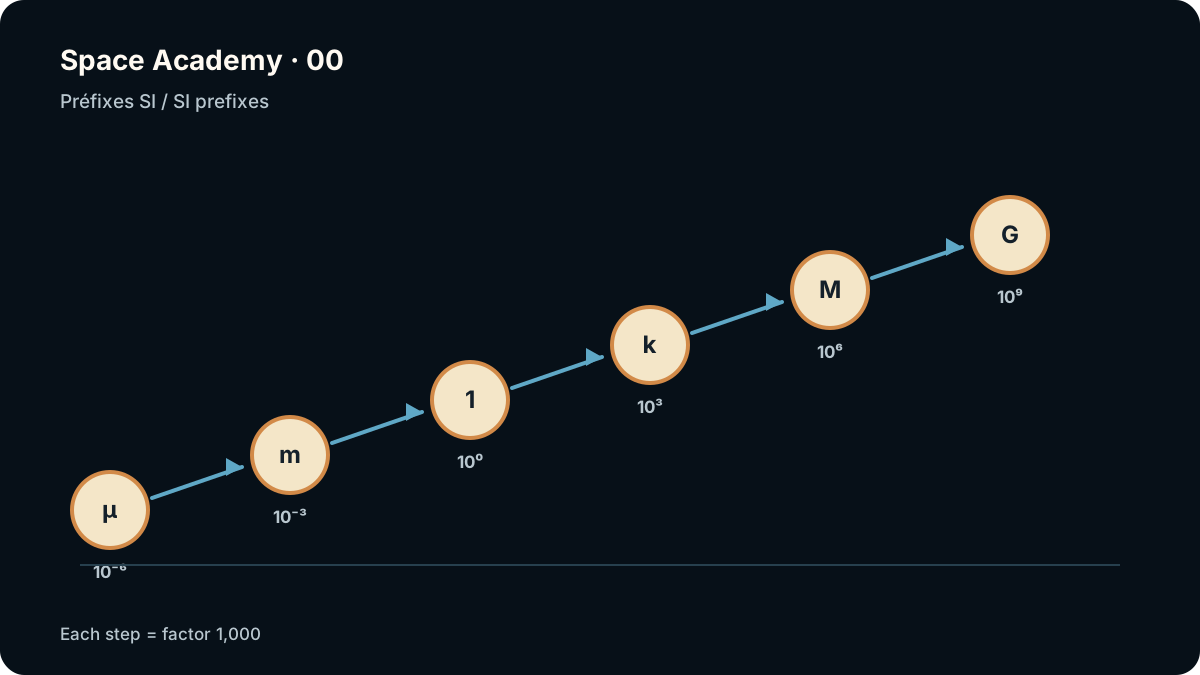
milli means 10⁻³, kilo 10³, mega 10⁶, and giga 10⁹. Case matters: mW and MW differ by a factor of one billion. Convert using factors equal to one: 2.5 kg × (1,000 g / 1 kg) = 2,500 g. Review “Normalized scientific notation”.
Conversion by unit factor
- 1 — Concrete question
- What quantity must be determined in “3. Prefixes and thousand-fold steps”, and how does this relationship calculate it without losing the physical meaning?
- 2 — Intuition without symbols
- A reliable conversion changes the unit without changing the physical quantity
- 3 — Quantities first
- This conversion uses a unit factor equal to one: the same mass is written first in kilograms and then in grams.
- 4 — Formula
- 2.5 kg × (1,000 g / 1 kg) = 2,500 g
- 5 — Read aloud
- Read the relationship from left to right, naming each quantity and operation: 2.5 kg × (1,000 g / 1 kg) = 2,500 g.
- 6 — Symbols
- This conversion uses a unit factor equal to one: the same mass is written first in kilograms and then in grams.
- 7 — Pronunciation
- The “Read aloud” line above is the oral reference for “Conversion by unit factor”. Any subscript, exponent or grouping that changes the meaning of the relation should be spoken explicitly.
- 8 — Units
- The starting mass is in kg; the conversion factor is g/kg; the kilograms cancel and the result is in g.
- 9 — Convention
- For “Conversion by unit factor”, substitute values without changing the reference frame, time basis, system boundary or sign convention halfway through the calculation. Stated units: The starting mass is in kg; the conversion factor is g/kg; the kilograms cancel and the result is in g.
- 10 — Why this operation
- Here the operation expresses the following mechanism: the relationship directly represents the dependency studied in “3. Prefixes and thousand-fold steps”.
- 11 — Assumptions
- The conversion factor must equal one exactly and the units must cancel explicitly.
- 12 — Unit check
- The starting mass is in kg; the conversion factor is g/kg; the kilograms cancel and the result is in g. The unit check must recover the physical dimension expected for the requested result.
- 13 — Numerical case
- 2.5 kg × (1,000 g / 1 kg) = 2,500 g
- 14 — Why each operation
- The numerical case applies “2.5 kg × (1,000 g / 1 kg) = 2,500 g” directly to the stated values. The calculation is meaningful because the quantities are substituted into the same relation before the result is interpreted for “Conversion by unit factor”.
- 15 — Algebra check
- Quick check: multiplying the result by the denominator should reconstruct the numerator of “Conversion by unit factor” within rounding.
- 16 — Mental estimate
- Before calculating “Conversion by unit factor” precisely, round the inputs to one useful digit and predict the sign and order of magnitude. The detailed result should remain consistent with that estimate.
- 17 — Interpretation
- This discipline prevents a scale error from contaminating a mass, dose or consumption budget.
- 18 — What it does not prove
- For “Conversion by unit factor”, the number obtained answers only the model “2.5 kg × (1,000 g / 1 kg) = 2,500 g” under the stated scenario. It does not by itself validate the input data or the model outside those conditions.
- 19 — Sensitivity or limit case
- Vary one input at a time around the nominal case to identify what drives the result of “Conversion by unit factor” and whether that variation can change the mission decision.
- 20 — Guided and autonomous practice
Guided exercise. Convert 3.2 kg to grams with a unit factor.
Guided solution — open after trying
3.2 kg×(1,000 g/1 kg) = 3,200 g. The factor equals one physically, so the quantity is unchanged.
Independent exercise. Convert 4.6 L to millilitres.
Independent solution — open after trying
4.6 L×(1,000 mL/1 L) = 4,600 mL. L cancels exactly.
- 21 — Mission decision
- This discipline prevents a scale error from contaminating a mass, dose or consumption budget.
The same method handles compound units and prevents memorized shortcuts from silently reversing a conversion.
Move into calculation
Prefixes prevent long strings of zeros but become dangerous when treated as typography. Milli means 10⁻³, micro 10⁻⁶, kilo 10³, and mega 10⁶. The multiplier applies to the whole unit. Review “Dimensional check”.
0.1 mg/m³ equals 100 µg/m³. An 80 kWh battery stores 80,000 Wh; in joules, 80×3.6 MJ = 288 MJ. The teaching value is seeing units turn into a decision. Review “Concentration converted to dust mass”.
Prefixes, energy and decimal scales
- 1 — Concrete question
- What quantity must be determined in “Move into calculation”, and how does this relationship calculate it without losing the physical meaning?
- 2 — Intuition without symbols
- Prefixes and derived units let you change scale without losing the physical quantity's order of magnitude
- 3 — Quantities first
- The first equality converts energy between kilowatt-hours and megajoules; the second converts mass between milligrams and micrograms.
- 4 — Formula
- 1 kWh = 3.6 MJ ; 0.1 mg = 100 µg
- 5 — Read aloud
- Read the relationship from left to right, naming each quantity and operation: 1 kWh = 3.6 MJ ; 0.1 mg = 100 µg.
- 6 — Symbols
- The first equality converts energy between kilowatt-hours and megajoules; the second converts mass between milligrams and micrograms.
- 7 — Pronunciation
- The “Read aloud” line above is the oral reference for “Prefixes, energy and decimal scales”. Any subscript, exponent or grouping that changes the meaning of the relation should be spoken explicitly.
- 8 — Units
- kWh and MJ are both energy units; mg and µg are both mass units. Only the scale changes, not the physical dimension.
- 9 — Convention
- For “Prefixes, energy and decimal scales”, substitute values without changing the reference frame, time basis, system boundary or sign convention halfway through the calculation. Stated units: kWh and MJ are both energy units; mg and µg are both mass units. Only the scale changes, not the physical dimension.
- 10 — Why this operation
- This operation is used because the relationship directly represents the dependency studied in “Move into calculation”.
- 11 — Assumptions
- The conversion must preserve physical dimension and use an exact or explicitly defined factor.
- 12 — Unit check
- kWh and MJ are both energy units; mg and µg are both mass units. Only the scale changes, not the physical dimension. The unit check must recover the physical dimension expected for the requested result.
- 13 — Numerical case
- 1 kWh = 3.6 MJ ; 0.1 mg = 100 µg
- 14 — Why each operation
- The numerical case applies “1 kWh = 3.6 MJ ; 0.1 mg = 100 µg” directly to the stated values. The calculation is meaningful because the quantities are substituted into the same relation before the result is interpreted for “Prefixes, energy and decimal scales”.
- 15 — Algebra check
- Quick check: invert “1 kWh = 3.6 MJ ; 0.1 mg = 100 µg” when possible, or use a second calculation path, and confirm the same order of magnitude for “Prefixes, energy and decimal scales”.
- 16 — Mental estimate
- Before calculating “Prefixes, energy and decimal scales” precisely, round the inputs to one useful digit and predict the sign and order of magnitude. The detailed result should remain consistent with that estimate.
- 17 — Interpretation
- The goal is to compare data from instruments or documents expressed in different units.
- 18 — What it does not prove
- For “Prefixes, energy and decimal scales”, the number obtained answers only the model “1 kWh = 3.6 MJ ; 0.1 mg = 100 µg” under the stated scenario. It does not by itself validate the input data or the model outside those conditions.
- 19 — Sensitivity or limit case
- Vary one input at a time around the nominal case to identify what drives the result of “Prefixes, energy and decimal scales” and whether that variation can change the mission decision.
- 20 — Guided and autonomous practice
Guided exercise. Convert 60 kWh to MJ and 0.25 mg to µg.
Guided solution — open after trying
60×3.6 = 216 MJ. For mass, 0.25 mg×1,000 = 250 µg. Both conversions use explicit decimal factors.
Independent exercise. Convert 12 kWh to MJ and 0.035 mg to µg.
Independent solution — open after trying
12×3.6 = 43.2 MJ; 0.035×1,000 = 35 µg.
- 21 — Mission decision
- The goal is to compare data from instruments or documents expressed in different units.
Confusing kW and kWh mixes a rate of energy transfer with an amount of energy and can mis-size a battery or power converter.
4. Powers of ten and orders of magnitude
Scientific notation writes a number as a × 10ⁿ, with |a| between 1 and 10. 45,000 = 4.5 × 10⁴ and 0.00045 = 4.5 × 10⁻⁴. Multiplication adds the exponents of powers of ten. Review “Normalized scientific notation”.
Before using a calculator, replace 198 × 51 with 200 × 50 ≈ 10,000. A screen result near 100 or ten million should trigger review. Review “Mass contained in a volume”.
Exercise 4
Write 6,500,000 and 0.000072 in scientific notation. Review “Normalized scientific notation”.
Solution: 6.5 × 10⁶ and 7.2 × 10⁻⁵. Review “Normalized scientific notation”.
Workshop — estimate the scale before the digits
Suppose a construction system must move 287,000 kg of regolith and actually processes 243 kg/h. Before exact division, round to 300,000 kg and 250 kg/h: 300,000 ÷ 250 ≈ 1,200 h. Exact division gives about 1,181 h. Both answers tell the same engineering story: the job is of order one thousand hours, not ten hours or one hundred thousand hours. An entry such as 118.1 h or 11,810 h should therefore trigger immediate review. Review “Duration from mass and throughput”.
Order-of-magnitude thinking also decides which uncertainties deserve attention. If uncertainty in bulk density moves the mass estimate by ±20%, debating the third decimal place of throughput is wasted precision. Start with the parameters that can materially move the answer. Estimation is not permission to be vague; it is a way to spend measurement effort where it changes decisions.
Order-of-magnitude estimate of duration
- 1 — Concrete question
- What quantity must be determined in “Exercise 4”, and how does this relationship calculate it without losing the physical meaning?
- 2 — Intuition without symbols
- A rough estimate tells you immediately whether a detailed calculation lies in the right decade
- 3 — Quantities first
- The numerator is the total mass to process and the denominator is the processing rate; the quotient is the required duration. The rounded values give an order-of-magnitude check before the precise division.
- 4 — Formula
- 300,000 / 250 ≈ 1.2 × 10³ h; exact: 287,000 / 243 ≈ 1.18 × 10³ h
- 5 — Read aloud
- Read the relationship from left to right, naming each quantity and operation: 300,000 / 250 ≈ 1.2 × 10³ h; exact: 287,000 / 243 ≈ 1.18 × 10³ h.
- 6 — Symbols
- The numerator is the total mass to process and the denominator is the processing rate; the quotient is the required duration. The rounded values give an order-of-magnitude check before the precise division.
- 7 — Pronunciation
- The “Read aloud” line above is the oral reference for “Order-of-magnitude estimate of duration”. Any subscript, exponent or grouping that changes the meaning of the relation should be spoken explicitly.
- 8 — Units
- Use mass in kg and throughput in kg/h. kg÷(kg/h) reduces to h, so the duration is expressed in hours.
- 9 — Convention
- For “Order-of-magnitude estimate of duration”, substitute values without changing the reference frame, time basis, system boundary or sign convention halfway through the calculation. Stated units: Use mass in kg and throughput in kg/h. kg÷(kg/h) reduces to h, so the duration is expressed in hours.
- 10 — Why this operation
- This operation is used because the relationship directly represents the dependency studied in “Exercise 4”.
- 11 — Assumptions
- Rounded values must remain close to the actual inputs and serve only as an independent check.
- 12 — Unit check
- Use mass in kg and throughput in kg/h. kg÷(kg/h) reduces to h, so the duration is expressed in hours. The unit check must recover the physical dimension expected for the requested result.
- 13 — Numerical case
- 300,000 / 250 ≈ 1.2 × 10³ h; exact: 287,000 / 243 ≈ 1.18 × 10³ h
- 14 — Why each operation
- The numerical case applies “300,000 / 250 ≈ 1.2 × 10³ h; exact: 287,000 / 243 ≈ 1.18 × 10³ h” directly to the stated values. The calculation is meaningful because the quantities are substituted into the same relation before the result is interpreted for “Order-of-magnitude estimate of duration”.
- 15 — Algebra check
- Quick check: multiplying the result by the denominator should reconstruct the numerator of “Order-of-magnitude estimate of duration” within rounding.
- 16 — Mental estimate
- Before calculating “Order-of-magnitude estimate of duration” precisely, round the inputs to one useful digit and predict the sign and order of magnitude. The detailed result should remain consistent with that estimate.
- 17 — Interpretation
- A quick estimate catches a factor-of-ten error before it enters a mission decision.
- 18 — What it does not prove
- For “Order-of-magnitude estimate of duration”, the number obtained answers only the model “300,000 / 250 ≈ 1.2 × 10³ h; exact: 287,000 / 243 ≈ 1.18 × 10³ h” under the stated scenario. It does not by itself validate the input data or the model outside those conditions.
- 19 — Sensitivity or limit case
- Vary one input at a time around the nominal case to identify what drives the result of “Order-of-magnitude estimate of duration” and whether that variation can change the mission decision.
- 20 — Guided and autonomous practice
Guided exercise. Estimate, then calculate, 420,000 kg processed at 350 kg/h.
Guided solution — open after trying
Order of magnitude: 4.2×10⁵ / 3.5×10² ≈ 1.2×10³ h. Exact: 420,000/350 = 1,200 h. They agree.
Independent exercise. Estimate 96,000 kg at 480 kg/h.
Independent solution — open after trying
≈10⁵/(5×10²)≈2×10² h; exact: 96,000/480 = 200 h.
- 21 — Mission decision
- A quick estimate catches a factor-of-ten error before it enters a mission decision.
Control point
Scientific notation separates the significant number from its scale. It makes 3×10² kg, 3×10⁵ kg, and 3×10⁸ kg easy to compare without losing the three orders of magnitude between each step. Review “Normalized scientific notation”.
Three hundred tonnes of regolith are 3×10⁵ kg. At 250 kg/h, an ideal system needs 1.2×10³ h, or about 50 continuous days. An engineer keeps numerical result, margin, and validity domain separate. Review “Normalized scientific notation”.
Duration from mass and throughput
- 1 — Concrete question
- What quantity must be determined in “Control point”, and how does this relationship calculate it without losing the physical meaning?
- 2 — Intuition without symbols
- Dividing the quantity to process by the processing rate gives the ideal required time
- 3 — Quantities first
- t is the processing duration. The numerator is the mass to be processed and the denominator is the mass throughput.
- 4 — Formula
- t = 3×10⁵ kg / (2.5×10² kg/h) = 1.2×10³ h
- 5 — Read aloud
- Read the relationship from left to right, naming each quantity and operation: t = 3×10⁵ kg / (2.5×10² kg/h) = 1.2×10³ h.
- 6 — Symbols
- t is the processing duration. The numerator is the mass to be processed and the denominator is the mass throughput.
- 7 — Pronunciation
- The “Read aloud” line above is the oral reference for “Duration from mass and throughput”. Any subscript, exponent or grouping that changes the meaning of the relation should be spoken explicitly.
- 8 — Units
- t is in hours here; mass is in kg; throughput is in kg/h. kg÷(kg/h)=h.
- 9 — Convention
- For “Duration from mass and throughput”, substitute values without changing the reference frame, time basis, system boundary or sign convention halfway through the calculation. Stated units: t is in hours here; mass is in kg; throughput is in kg/h. kg÷(kg/h)=h.
- 10 — Why this operation
- The calculation is structured this way because the relationship directly represents the dependency studied in “Control point”.
- 11 — Assumptions
- The throughput must remain applicable over the calculated period and downtime must be handled separately.
- 12 — Unit check
- t is in hours here; mass is in kg; throughput is in kg/h. kg÷(kg/h)=h. The unit check must recover the physical dimension expected for the requested result.
- 13 — Numerical case
- t = 3×10⁵ kg / (2.5×10² kg/h) = 1.2×10³ h
- 14 — Why each operation
- The numerical case applies “t = 3×10⁵ kg / (2.5×10² kg/h) = 1.2×10³ h” directly to the stated values. The calculation is meaningful because the quantities are substituted into the same relation before the result is interpreted for “Duration from mass and throughput”.
- 15 — Algebra check
- Quick check: multiplying the result by the denominator should reconstruct the numerator of “Duration from mass and throughput” within rounding.
- 16 — Mental estimate
- Before calculating “Duration from mass and throughput” precisely, round the inputs to one useful digit and predict the sign and order of magnitude. The detailed result should remain consistent with that estimate.
- 17 — Interpretation
- This relation checks whether a production or processing campaign closes within the available window.
- 18 — What it does not prove
- For “Duration from mass and throughput”, the number obtained answers only the model “t = 3×10⁵ kg / (2.5×10² kg/h) = 1.2×10³ h” under the stated scenario. It does not by itself validate the input data or the model outside those conditions.
- 19 — Sensitivity or limit case
- Vary one input at a time around the nominal case to identify what drives the result of “Duration from mass and throughput” and whether that variation can change the mission decision.
- 20 — Guided and autonomous practice
Guided exercise. Calculate the time to process 240,000 kg at 300 kg/h.
Guided solution — open after trying
t = M/q = 240,000/300 = 800 h. kg cancels, leaving hours.
Independent exercise. Calculate the time for 150,000 kg at 250 kg/h.
Independent solution — open after trying
t = 150,000/250 = 600 h.
- 21 — Mission decision
- This relation checks whether a production or processing campaign closes within the available window.
Order-of-magnitude reasoning does not replace detailed calculation; it catches impossible results before they are trusted.
5. Fractions, ratios, and percentages
A percentage is a fraction per hundred. 98% = 0.98, leaving 1 − 0.98 = 0.02 unrecovered. That small residual often drives makeup logistics. Review “Makeup demand of a recovery loop”.
Residual fraction after recovery
- 1 — Concrete question
- What quantity must be determined in “5. Fractions, ratios, and percentages”, and how does this relationship calculate it without losing the physical meaning?
- 2 — Intuition without symbols
- What remains after recovery is the initial amount that was not recovered
- 3 — Quantities first
- Residual is the unrecovered quantity, the initial quantity is the amount before recovery, and the recovery fraction is the dimensionless share recovered between 0 and 1.
- 4 — Formula
- Residual = initial quantity × (1 − recovery fraction)
- 5 — Read aloud
- Read the relationship from left to right, naming each quantity and operation: residual = initial quantity × (1 − recovery fraction).
- 6 — Symbols
- Residual is the unrecovered quantity, the initial quantity is the amount before recovery, and the recovery fraction is the dimensionless share recovered between 0 and 1.
- 7 — Pronunciation
- The “Read aloud” line above is the oral reference for “Residual fraction after recovery”. Any subscript, exponent or grouping that changes the meaning of the relation should be spoken explicitly.
- 8 — Units
- Residual and initial quantity use the same physical unit (for example kg or L); the recovery fraction and 1−recovery fraction are dimensionless.
- 9 — Convention
- For “Residual fraction after recovery”, substitute values without changing the reference frame, time basis, system boundary or sign convention halfway through the calculation. Stated units: Residual and initial quantity use the same physical unit (for example kg or L); the recovery fraction and 1−recovery fraction are dimensionless.
- 10 — Why this operation
- The calculation is structured this way because the relationship directly represents the dependency studied in “5. Fractions, ratios, and percentages”.
- 11 — Assumptions
- The recovery rate must be expressed as a fraction between zero and one and refer to the same stream.
- 12 — Unit check
- Residual and initial quantity use the same physical unit (for example kg or L); the recovery fraction and 1−recovery fraction are dimensionless. The unit check must recover the physical dimension expected for the requested result.
- 13 — Numerical case
- With 500 L initially and R = 0.92, the residual is 500×(1−0.92) = 40 L.
- 14 — Why each operation
- The numerical case applies “Residual = initial quantity × (1 − recovery fraction)” directly to the stated values. The calculation is meaningful because the quantities are substituted into the same relation before the result is interpreted for “Residual fraction after recovery”.
- 15 — Algebra check
- Quick check: for any non-zero factor, dividing the result by that factor should recover the other expected contribution in “Residual fraction after recovery”.
- 16 — Mental estimate
- Before calculating “Residual fraction after recovery” precisely, round the inputs to one useful digit and predict the sign and order of magnitude. The detailed result should remain consistent with that estimate.
- 17 — Interpretation
- The result helps size makeup supply, losses and contingency stocks.
- 18 — What it does not prove
- For “Residual fraction after recovery”, the number obtained answers only the model “Residual = initial quantity × (1 − recovery fraction)” under the stated scenario. It does not by itself validate the input data or the model outside those conditions.
- 19 — Sensitivity or limit case
- Vary one input at a time around the nominal case to identify what drives the result of “Residual fraction after recovery” and whether that variation can change the mission decision.
- 20 — Guided and autonomous practice
Guided exercise. A loop recovers 92% of 500 L. How much remains to be supplied?
Guided solution — open after trying
Residual = 500×(1−0.92) = 500×0.08 = 40 L.
Independent exercise. Repeat with 320 kg and 87.5% recovery.
Independent solution — open after trying
320×(1−0.875) = 320×0.125 = 40 kg.
- 21 — Mission decision
- The result helps size makeup supply, losses and contingency stocks.
Always state what a ratio compares. A language word-count ratio, a mass fraction, and an efficiency are not interchangeable.
Interpretation
A fraction describes part of a whole, a ratio compares quantities, and a percentage expresses a fraction per hundred. Before using a proportion, check that the quantity really scales linearly.
With 20 kg of process water per person per day, 98% overall recovery leaves 0.4 kg/day makeup per person; at 94%, the loss is 1.2 kg/day. For 100 people, the annual difference is 29.2 t in this teaching example. The formula is useful because it makes a system dependency visible.
Makeup demand of a recovery loop
- 1 — Concrete question
- What quantity must be determined in “Interpretation”, and how does this relationship calculate it without losing the physical meaning?
- 2 — Intuition without symbols
- Makeup demand depends on gross consumption, crew size and especially the fraction that is not recovered
- 3 — Quantities first
- M_makeup is the makeup mass required per unit time, q is the gross demand per person and per unit time, N is the number of people served, and R is the dimensionless recovery fraction.
- 4 — Formula
- M_makeup = q N (1−R)
- 5 — Read aloud
- Read the relationship from left to right, naming each quantity and operation: M_makeup = q N (1−R).
- 6 — Symbols
- M_makeup is the makeup mass required per unit time, q is the gross demand per person and per unit time, N is the number of people served, and R is the dimensionless recovery fraction.
- 7 — Pronunciation
- The “Read aloud” line above is the oral reference for “Makeup demand of a recovery loop”. Any subscript, exponent or grouping that changes the meaning of the relation should be spoken explicitly.
- 8 — Units
- If q is in kg/(person·day), N is a person count and R is dimensionless, M_makeup is in kg/day. The same structure works with L/(person·day) to obtain L/day.
- 9 — Convention
- For “Makeup demand of a recovery loop”, substitute values without changing the reference frame, time basis, system boundary or sign convention halfway through the calculation. Stated units: If q is in kg/(person·day), N is a person count and R is dimensionless, M_makeup is in kg/day. The same structure works with L/(person·day) to obtain L/day.
- 10 — Why this operation
- The mathematical choice is direct: the relationship directly represents the dependency studied in “Interpretation”.
- 11 — Assumptions
- Recovery must be measured over the same time and material boundary as consumption.
- 12 — Unit check
- If q is in kg/(person·day), N is a person count and R is dimensionless, M_makeup is in kg/day. The same structure works with L/(person·day) to obtain L/day. The unit check must recover the physical dimension expected for the requested result.
- 13 — Numerical case
- For q = 3.5 L/person/day, N = 20 and R = 0.90, M_makeup = 3.5×20×0.10 = 7 L/day.
- 14 — Why each operation
- The numerical case applies “M_makeup = q N (1−R)” directly to the stated values. The calculation is meaningful because the quantities are substituted into the same relation before the result is interpreted for “Makeup demand of a recovery loop”.
- 15 — Algebra check
- Quick check: adding the subtracted term back to the result should reconstruct the starting quantity in “Makeup demand of a recovery loop”.
- 16 — Mental estimate
- Before calculating “Makeup demand of a recovery loop” precisely, round the inputs to one useful digit and predict the sign and order of magnitude. The detailed result should remain consistent with that estimate.
- 17 — Interpretation
- This relation converts recycling performance into the mass that must actually be supplied or produced.
- 18 — What it does not prove
- For “Makeup demand of a recovery loop”, the number obtained answers only the model “M_makeup = q N (1−R)” under the stated scenario. It does not by itself validate the input data or the model outside those conditions.
- 19 — Sensitivity or limit case
- Vary one input at a time around the nominal case to identify what drives the result of “Makeup demand of a recovery loop” and whether that variation can change the mission decision.
- 20 — Guided and autonomous practice
Guided exercise. Gross use is 3.5 L/person/day for 20 people with 90% recovery. Calculate makeup demand.
Guided solution — open after trying
M_makeup = qN(1−R) = 3.5×20×0.10 = 7 L/day.
Independent exercise. With q = 4 L/person/day, N = 12 and R = 0.85, calculate makeup.
Independent solution — open after trying
4×12×0.15 = 7.2 L/day.
- 21 — Mission decision
- This relation converts recycling performance into the mass that must actually be supplied or produced.
The 20 kg/day figure is a teaching assumption, not a NASA requirement; mixing assumptions with institutional data changes the status of the result.
6. Dimensional analysis
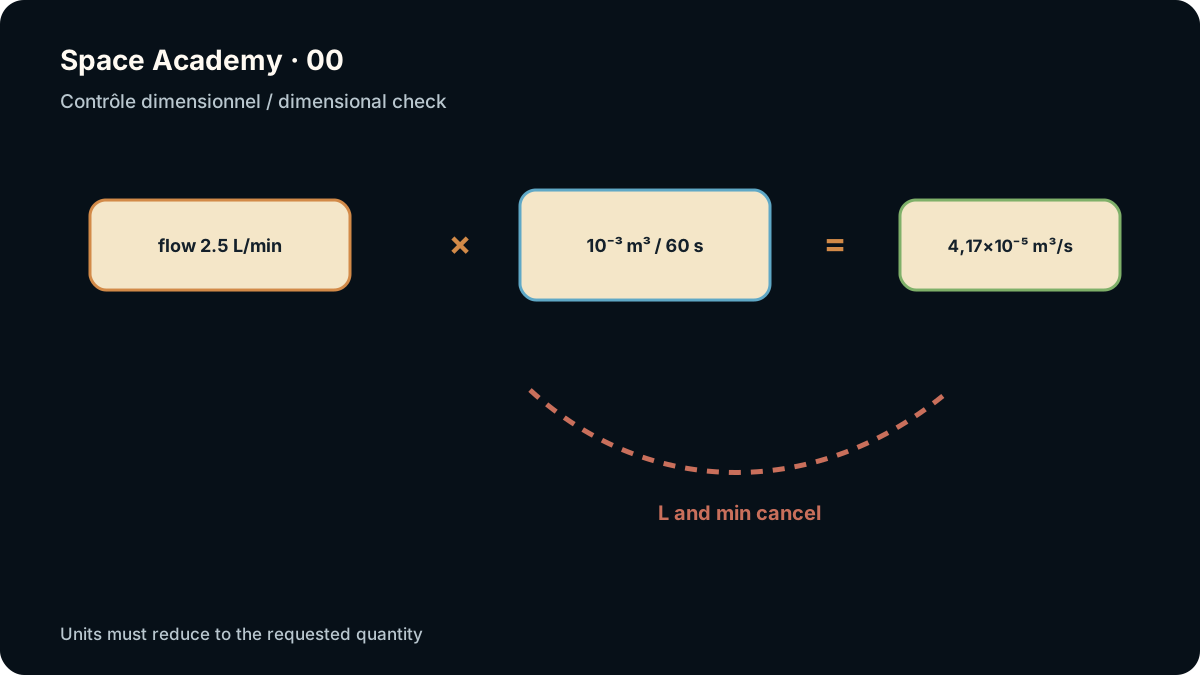
A safe conversion is a chain of factors that cancels unwanted units. 72 km/h × 1,000 m/km × 1 h/3,600 s = 20 m/s. Each removed unit appears once above and once below the fraction line. Review “Dimensional check”.
The same discipline converts flow into annual inventory, concentration into total mass, or power into energy.
Exercise 6
Convert 40 kg/day into tonnes over 365 days.
Solution: 40 × 365 = 14,600 kg = 14.6 t/year. Review “Duration from mass and throughput”.
Field reasoning
Dimensional analysis tests an equation before any numbers are inserted. If the left side is energy, the right side must reduce to joules; if the unknown is mass, the final units must reduce to kilograms.
A flow of 40 kg/day for 365 days gives 14,600 kg because days cancel. Multiplying 40 kg/day by 365 kg is physically meaningless even though a calculator will display a number.
Dimensional check
- 1 — Concrete question
- What quantity must be determined in “Field reasoning”, and how does this relationship calculate it without losing the physical meaning?
- 2 — Intuition without symbols
- Units behave like algebraic factors: they reveal immediately whether a relation can produce the intended quantity
- 3 — Quantities first
- This line manipulates units directly: kg is mass, day and s are durations, W is power, J is energy, Pa is pressure, m² is area, and N is force.
- 4 — Formula
- (kg/day)×day = kg ; W×s = J ; Pa×m² = N
- 5 — Read aloud
- Read the relationship from left to right, naming each quantity and operation: (kg/day)×day = kg ; W×s = J ; Pa×m² = N.
- 6 — Symbols
- This line manipulates units directly: kg is mass, day and s are durations, W is power, J is energy, Pa is pressure, m² is area, and N is force.
- 7 — Pronunciation
- The “Read aloud” line above is the oral reference for “Dimensional check”. Any subscript, exponent or grouping that changes the meaning of the relation should be spoken explicitly.
- 8 — Units
- (kg/day)×day reduces to kg; W×s reduces to J because 1 W=1 J/s; Pa×m² reduces to N because 1 Pa=1 N/m².
- 9 — Convention
- For “Dimensional check”, substitute values without changing the reference frame, time basis, system boundary or sign convention halfway through the calculation. Stated units: (kg/day)×day reduces to kg; W×s reduces to J because 1 W=1 J/s; Pa×m² reduces to N because 1 Pa=1 N/m².
- 10 — Why this operation
- The calculation is structured this way because the relationship directly represents the dependency studied in “Field reasoning”.
- 11 — Assumptions
- Dimensional analysis checks consistency, not the correctness of the data or the model.
- 12 — Unit check
- (kg/day)×day reduces to kg; W×s reduces to J because 1 W=1 J/s; Pa×m² reduces to N because 1 Pa=1 N/m². The unit check must recover the physical dimension expected for the requested result.
- 13 — Numerical case
- 45 kg/day × 12 day = 540 kg; day cancels. 250 W × 7,200 s = 1.8×10⁶ J.
- 14 — Why each operation
- The numerical case applies “(kg/day)×day = kg ; W×s = J ; Pa×m² = N” directly to the stated values. The calculation is meaningful because the quantities are substituted into the same relation before the result is interpreted for “Dimensional check”.
- 15 — Algebra check
- Quick check: multiplying the result by the denominator should reconstruct the numerator of “Dimensional check” within rounding.
- 16 — Mental estimate
- Before calculating “Dimensional check” precisely, round the inputs to one useful digit and predict the sign and order of magnitude. The detailed result should remain consistent with that estimate.
- 17 — Interpretation
- Before trusting a number, this check eliminates many input and formula errors.
- 18 — What it does not prove
- For “Dimensional check”, the number obtained answers only the model “(kg/day)×day = kg ; W×s = J ; Pa×m² = N” under the stated scenario. It does not by itself validate the input data or the model outside those conditions.
- 19 — Sensitivity or limit case
- Vary one input at a time around the nominal case to identify what drives the result of “Dimensional check” and whether that variation can change the mission decision.
- 20 — Guided and autonomous practice
Guided exercise. Dimension-check 45 kg/day for 12 days and 250 W for 7,200 s.
Guided solution — open after trying
45×12 = 540 kg because day cancels. 250×7,200 = 1,800,000 J = 1.8 MJ because W·s = J.
Independent exercise. Check 35 kPa applied over 0.6 m².
Independent solution — open after trying
35,000 Pa×0.6 m² = 21,000 N = 21 kN because Pa·m² = N.
- 21 — Mission decision
- Before trusting a number, this check eliminates many input and formula errors.
An equation can be dimensionally correct and still be physically wrong; the test eliminates some errors, not all.
7. Calculator discipline
A calculator executes syntax; it does not know whether your model is absurd. Predict sign, scale, and unit before each result. EXP or EE keys commonly enter powers of ten: 6.02 EE 23 represents 6.02 × 10²³. Review “Dimensional check”.
Recalculate through a different route when the result matters. Convert back to the starting unit, add recovered plus lost fractions, or divide energy by time to recover the expected power.
Why this matters
Calculator discipline starts with a mental estimate. Write the units, anticipate the scale, then enter the numbers. A calculator checks arithmetic; it does not choose the model or assumptions.
Forty kg/day for a year should be near 40×400 ≈16,000 kg. The exact 14,600 kg is plausible. A display of 146 kg or 1.46 million kg would immediately reveal a factor-of-one-hundred error. The calculation below is a consistency test, not a complete truth. Review “Duration from mass and throughput”.
Calculation checking chain
- 1 — Concrete question
- What quantity must be determined in “Why this matters”, and how does this relationship calculate it without losing the physical meaning?
- 2 — Intuition without symbols
- A trustworthy result is not merely calculated: it is estimated, dimension-checked, compared with an order of magnitude and interpreted
- 3 — Quantities first
- This is a five-step checking sequence rather than an algebraic equation: estimate, calculate, check units, check order of magnitude, then interpret the result.
- 4 — Formula
- Estimate → calculate → unit-check → order of magnitude → interpret
- 5 — Read aloud
- Read the relationship from left to right, naming each quantity and operation: estimate → calculate → unit-check → order of magnitude → interpret.
- 6 — Symbols
- This is a five-step checking sequence rather than an algebraic equation: estimate, calculate, check units, check order of magnitude, then interpret the result.
- 7 — Pronunciation
- The “Read aloud” line above is the oral reference for “Calculation checking chain”. Any subscript, exponent or grouping that changes the meaning of the relation should be spoken explicitly.
- 8 — Units
- The sequence itself has no unit. Each numerical result keeps the unit of the physical quantity being checked, and that unit must remain consistent through the chain.
- 9 — Convention
- For “Calculation checking chain”, substitute values without changing the reference frame, time basis, system boundary or sign convention halfway through the calculation. Stated units: The sequence itself has no unit. Each numerical result keeps the unit of the physical quantity being checked, and that unit must remain consistent through the chain.
- 10 — Why this operation
- The calculation is structured this way because the relationship directly represents the dependency studied in “Why this matters”.
- 11 — Assumptions
- Each check should remain as independent as possible from the main calculation.
- 12 — Unit check
- The sequence itself has no unit. Each numerical result keeps the unit of the physical quantity being checked, and that unit must remain consistent through the chain. The unit check must recover the physical dimension expected for the requested result.
- 13 — Numerical case
- For 48 kg/day over 30 days, estimate 50×30 = 1,500 kg is close to the exact 48×30 = 1,440 kg.
- 14 — Why each operation
- The numerical case applies “Estimate → calculate → unit-check → order of magnitude → interpret” directly to the stated values. The calculation is meaningful because the quantities are substituted into the same relation before the result is interpreted for “Calculation checking chain”.
- 15 — Algebra check
- Quick check: invert “Estimate → calculate → unit-check → order of magnitude → interpret” when possible, or use a second calculation path, and confirm the same order of magnitude for “Calculation checking chain”.
- 16 — Mental estimate
- Before calculating “Calculation checking chain” precisely, round the inputs to one useful digit and predict the sign and order of magnitude. The detailed result should remain consistent with that estimate.
- 17 — Interpretation
- The chain reduces the risk of using a plausible-looking but wrong number for a decision.
- 18 — What it does not prove
- For “Calculation checking chain”, the number obtained answers only the model “Estimate → calculate → unit-check → order of magnitude → interpret” under the stated scenario. It does not by itself validate the input data or the model outside those conditions.
- 19 — Sensitivity or limit case
- Vary one input at a time around the nominal case to identify what drives the result of “Calculation checking chain” and whether that variation can change the mission decision.
- 20 — Guided and autonomous practice
Guided exercise. Check 48 kg/day for 30 days using estimate → calculate → unit-check → order of magnitude.
Guided solution — open after trying
Estimate: 50×30 ≈ 1,500 kg. Exact: 48×30 = 1,440 kg. Unit is kg and the 4% difference is reasonable.
Independent exercise. Check 2.2 kW for 8 h.
Independent solution — open after trying
Estimate: 2×8≈16 kWh. Exact: 2.2×8 = 17.6 kWh. The result has the correct order of magnitude.
- 21 — Mission decision
- The chain reduces the risk of using a plausible-looking but wrong number for a decision.
Copying ten decimal places creates an illusion of precision when the inputs are known only to a few percent.
8. Uncertainty and significant digits
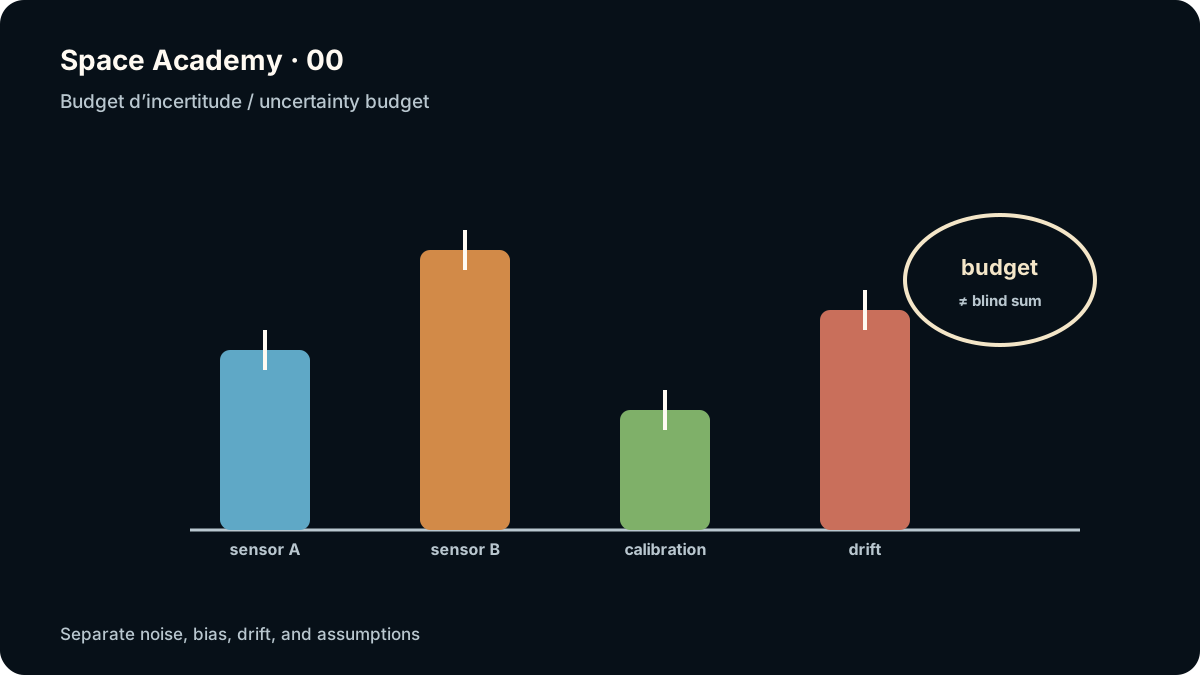
A measurement is not infinitely precise. NIST uncertainty guidance treats uncertainty as information about the dispersion reasonably attributable to a measured quantity. Extra decimal places do not reduce uncertain assumptions.
If a teaching scenario assumes 20 kg/person/day, reporting 14.600000 t/year creates false precision. Use 14.6 t/year and keep the assumption visible.
Workshop — separate precision, uncertainty, and margin
A measurement of 10.0 ± 0.2 kg is different from a requirement of at least 10 kg. The first describes an estimate and uncertainty; the second sets an acceptance threshold. Margin is different again: if calculated need is 10 kg and inventory is 12 kg, nominal margin is 2 kg or 20% of need. Treating uncertainty and margin as interchangeable hides risk.
Consider a 500 L tank with a gauge uncertainty of ±2% and an operational minimum of 430 L. Two percent of 500 L is 10 L. If the display reads 440 L, a simplified 430–450 L interval touches the operational minimum. The displayed ten-litre surplus is therefore not automatically comfortable. This simple example prepares the logic needed for engineering margins, alarm thresholds, redundant sensing, and acceptance testing.
Margin relative to a requirement
- 1 — Concrete question
- What quantity must be determined in “8. Uncertainty and significant digits”, and how does this relationship calculate it without losing the physical meaning?
- 2 — Intuition without symbols
- A margin expresses available reserve relative to the reference need, not merely the raw difference
- 3 — Quantities first
- Margin is the relative reserve above the requirement; stock is the quantity available; need is the required quantity on the same basis. In the example, L denotes litres.
- 4 — Formula
- Margin = (stock − need) / need; 500 L × 2% = 10 L
- 5 — Read aloud
- Read the relationship from left to right, naming each quantity and operation: margin = (stock − need) / need; 500 L × 2% = 10 L.
- 6 — Symbols
- Margin is the relative reserve above the requirement; stock is the quantity available; need is the required quantity on the same basis. In the example, L denotes litres.
- 7 — Pronunciation
- The “Read aloud” line above is the oral reference for “Margin relative to a requirement”. Any subscript, exponent or grouping that changes the meaning of the relation should be spoken explicitly.
- 8 — Units
- Margin is dimensionless. Stock and need must use the same unit (for example L, kg, doses, or parts). The separate 2% example uses a percentage as a dimensionless fraction and returns litres.
- 9 — Convention
- For “Margin relative to a requirement”, substitute values without changing the reference frame, time basis, system boundary or sign convention halfway through the calculation. Stated units: Margin is dimensionless. Stock and need must use the same unit (for example L, kg, doses, or parts). The separate 2% example uses a percentage as a dimensionless fraction and returns litres.
- 10 — Why this operation
- The calculation is structured this way because the relationship directly represents the dependency studied in “8. Uncertainty and significant digits”.
- 11 — Assumptions
- Stock and need must refer to the same boundary, duration and units.
- 12 — Unit check
- Margin is dimensionless. Stock and need must use the same unit (for example L, kg, doses, or parts). The separate 2% example uses a percentage as a dimensionless fraction and returns litres. The unit check must recover the physical dimension expected for the requested result.
- 13 — Numerical case
- Margin = (stock − need) / need; 500 L × 2% = 10 L
- 14 — Why each operation
- The numerical case applies “Margin = (stock − need) / need; 500 L × 2% = 10 L” directly to the stated values. The calculation is meaningful because the quantities are substituted into the same relation before the result is interpreted for “Margin relative to a requirement”.
- 15 — Algebra check
- Quick check: multiplying the result by the denominator should reconstruct the numerator of “Margin relative to a requirement” within rounding.
- 16 — Mental estimate
- Before calculating “Margin relative to a requirement” precisely, round the inputs to one useful digit and predict the sign and order of magnitude. The detailed result should remain consistent with that estimate.
- 17 — Interpretation
- A normalized margin lets you compare different-sized scenarios and set a decision threshold.
- 18 — What it does not prove
- For “Margin relative to a requirement”, the number obtained answers only the model “Margin = (stock − need) / need; 500 L × 2% = 10 L” under the stated scenario. It does not by itself validate the input data or the model outside those conditions.
- 19 — Sensitivity or limit case
- Vary one input at a time around the nominal case to identify what drives the result of “Margin relative to a requirement” and whether that variation can change the mission decision.
- 20 — Guided and autonomous practice
Guided exercise. A requirement is 600 L and planned stock is 660 L. Calculate relative margin.
Guided solution — open after trying
(660−600)/600 = 60/600 = 0.10 = 10%. Stock exceeds the requirement by 60 L.
Independent exercise. Requirement 700 L, stock 875 L: calculate margin.
Independent solution — open after trying
(875−700)/700 = 175/700 = 0.25 = 25%.
- 21 — Mission decision
- A normalized margin lets you compare different-sized scenarios and set a decision threshold.
Physical reading
A measurement is not just a value; it carries uncertainty from repeatability, calibration, the method, and sometimes the model that turns signal into a physical quantity. NIST distinguishes Type A and Type B evaluations among others.
If a flow is 10.0±0.2 kg/h, the simple relative uncertainty is 2%. Over 24 h the nominal flow is 240 kg, but a systematic 2% uncertainty does not disappear merely because the value is multiplied by 24.
Relative uncertainty
- 1 — Concrete question
- What quantity must be determined in “Physical reading”, and how does this relationship calculate it without losing the physical meaning?
- 2 — Intuition without symbols
- Dividing uncertainty by the measured value shows how large the uncertainty is relative to the signal itself
- 3 — Quantities first
- u_r is relative uncertainty, u is the absolute uncertainty on the measured quantity, and x is the measured value used as the reference scale.
- 4 — Formula
- u_r = u/x = 0.2/10.0 = 0.02 = 2 %
- 5 — Read aloud
- Read the relationship from left to right, naming each quantity and operation: u_r = u/x = 0.2/10.0 = 0.02 = 2 %.
- 6 — Symbols
- u_r is relative uncertainty, u is the absolute uncertainty on the measured quantity, and x is the measured value used as the reference scale.
- 7 — Pronunciation
- The “Read aloud” line above is the oral reference for “Relative uncertainty”. Any subscript, exponent or grouping that changes the meaning of the relation should be spoken explicitly.
- 8 — Units
- u and x must use the same physical unit, so u_r=u/x is dimensionless and may be expressed as a fraction or percentage.
- 9 — Convention
- For “Relative uncertainty”, substitute values without changing the reference frame, time basis, system boundary or sign convention halfway through the calculation. Stated units: u and x must use the same physical unit, so u_r=u/x is dimensionless and may be expressed as a fraction or percentage.
- 10 — Why this operation
- The mathematical choice is direct: the relationship directly represents the dependency studied in “Physical reading”.
- 11 — Assumptions
- The reference value must be non-zero and the uncertainty must follow a documented convention.
- 12 — Unit check
- u and x must use the same physical unit, so u_r=u/x is dimensionless and may be expressed as a fraction or percentage. The unit check must recover the physical dimension expected for the requested result.
- 13 — Numerical case
- u_r = u/x = 0.2/10.0 = 0.02 = 2 %
- 14 — Why each operation
- The numerical case applies “u_r = u/x = 0.2/10.0 = 0.02 = 2 %” directly to the stated values. The calculation is meaningful because the quantities are substituted into the same relation before the result is interpreted for “Relative uncertainty”.
- 15 — Algebra check
- Quick check: multiplying the result by the denominator should reconstruct the numerator of “Relative uncertainty” within rounding.
- 16 — Mental estimate
- Before calculating “Relative uncertainty” precisely, round the inputs to one useful digit and predict the sign and order of magnitude. The detailed result should remain consistent with that estimate.
- 17 — Interpretation
- This quantity helps decide whether a measurement is precise enough to support an operational threshold.
- 18 — What it does not prove
- For “Relative uncertainty”, the number obtained answers only the model “u_r = u/x = 0.2/10.0 = 0.02 = 2 %” under the stated scenario. It does not by itself validate the input data or the model outside those conditions.
- 19 — Sensitivity or limit case
- Vary one input at a time around the nominal case to identify what drives the result of “Relative uncertainty” and whether that variation can change the mission decision.
- 20 — Guided and autonomous practice
Guided exercise. A measurement is 25.0±0.5 kg. Calculate relative uncertainty.
Guided solution — open after trying
u_r = u/x = 0.5/25.0 = 0.02 = 2%. Units cancel.
Independent exercise. Calculate u_r for 80±1.2 L.
Independent solution — open after trying
1.2/80 = 0.015 = 1.5%.
- 21 — Mission decision
- This quantity helps decide whether a measurement is precise enough to support an operational threshold.
Random scatter and common bias must be separated: averaging many readings may reduce one without correcting the other.
9. Mars laboratory: dust, water, energy
NASA published a preliminary 2026 requirement for Martian particles under 10 µm: 0.1 mg/m³ as a 24-hour time-weighted average for specified exposure scenarios up to 30 days. In 100 m³ of air that concentration corresponds to 10 mg suspended at the average. Review “Concentration converted to dust mass”.
Concentration converted to dust mass
- 1 — Concrete question
- What quantity must be determined in “9. Mars laboratory: dust, water, energy”, and how does this relationship calculate it without losing the physical meaning?
- 2 — Intuition without symbols
- An airborne concentration alone does not give the contained mass; it must be applied to the air volume concerned
- 3 — Quantities first
- The first quantity is a dust mass concentration and the second is the sampled air volume; multiplying them gives the total dust mass in that volume.
- 4 — Formula
- 0.1 mg/m³ × 100 m³ = 10 mg
- 5 — Read aloud
- Read the relationship from left to right, naming each quantity and operation: 0.1 mg/m³ × 100 m³ = 10 mg.
- 6 — Symbols
- The first quantity is a dust mass concentration and the second is the sampled air volume; multiplying them gives the total dust mass in that volume.
- 7 — Pronunciation
- The “Read aloud” line above is the oral reference for “Concentration converted to dust mass”. Any subscript, exponent or grouping that changes the meaning of the relation should be spoken explicitly.
- 8 — Units
- Concentration is in mg/m³, volume in m³, and the m³ cancels, leaving mass in mg.
- 9 — Convention
- For “Concentration converted to dust mass”, substitute values without changing the reference frame, time basis, system boundary or sign convention halfway through the calculation. Stated units: Concentration is in mg/m³, volume in m³, and the m³ cancels, leaving mass in mg.
- 10 — Why this operation
- The mathematical choice is direct: the relationship directly represents the dependency studied in “9. Mars laboratory: dust, water, energy”.
- 11 — Assumptions
- The concentration must represent the volume and the air must be sufficiently mixed for the approximation used.
- 12 — Unit check
- Concentration is in mg/m³, volume in m³, and the m³ cancels, leaving mass in mg. The unit check must recover the physical dimension expected for the requested result.
- 13 — Numerical case
- 0.1 mg/m³ × 100 m³ = 10 mg
- 14 — Why each operation
- The numerical case applies “0.1 mg/m³ × 100 m³ = 10 mg” directly to the stated values. The calculation is meaningful because the quantities are substituted into the same relation before the result is interpreted for “Concentration converted to dust mass”.
- 15 — Algebra check
- Quick check: multiplying the result by the denominator should reconstruct the numerator of “Concentration converted to dust mass” within rounding.
- 16 — Mental estimate
- Before calculating “Concentration converted to dust mass” precisely, round the inputs to one useful digit and predict the sign and order of magnitude. The detailed result should remain consistent with that estimate.
- 17 — Interpretation
- The calculation links a dust measurement to the load filtration or cleaning must handle.
- 18 — What it does not prove
- For “Concentration converted to dust mass”, the number obtained answers only the model “0.1 mg/m³ × 100 m³ = 10 mg” under the stated scenario. It does not by itself validate the input data or the model outside those conditions.
- 19 — Sensitivity or limit case
- Vary one input at a time around the nominal case to identify what drives the result of “Concentration converted to dust mass” and whether that variation can change the mission decision.
- 20 — Guided and autonomous practice
Guided exercise. A concentration of 0.08 mg/m³ is measured in 150 m³. Calculate total mass.
Guided solution — open after trying
M = CV = 0.08×150 = 12 mg.
Independent exercise. Repeat for 0.12 mg/m³ in 80 m³.
Independent solution — open after trying
0.12×80 = 9.6 mg.
- 21 — Mission decision
- The calculation links a dust measurement to the load filtration or cleaning must handle.
For water, use a teaching assumption of 20 kg/person/day gross flow. At 100 people and 98% total recovery, theoretical makeup is 40 kg/day, or 14.6 t/year. The 20 kg value is not a NASA requirement.
Exercise 9
A 2 kW load operates for 18 h. How much energy is consumed?
Solution: 2 × 18 = 36 kWh. kW is power; kWh is energy. Review “Daily energy budget”.
Move into calculation
A good Mars exercise combines several quantities without mixing them. The goal is not to accumulate formulas but to build a dimensionally coherent chain from the observed phenomenon to an operational decision.
A 25 m³ airlock measured at 0.08 mg/m³ contains an idealized 2 mg of airborne dust. An airflow of 100 m³/h does not automatically mean 8 mg/h is removed: filter efficiency and actual mixing are still required. The teaching value is seeing units turn into a decision. Review “Concentration converted to dust mass”.
Contained mass and filtered mass
- 1 — Concrete question
- What quantity must be determined in “Move into calculation”, and how does this relationship calculate it without losing the physical meaning?
- 2 — Intuition without symbols
- The balance distinguishes what is present in a volume from what a filtration flow can remove over a given time
- 3 — Quantities first
- M_air is contaminant mass present in the air volume, C is mass concentration, V is air volume, M_filtered is captured contaminant mass, Q is volumetric airflow, η is filter efficiency, and Δt is filtration time.
- 4 — Formula
- M_air = C V ; M_filtered = C Q η Δt
- 5 — Read aloud
- Read the relationship from left to right, naming each quantity and operation: M_air = C V ; M_filtered = C Q η Δt.
- 6 — Symbols
- M_air is contaminant mass present in the air volume, C is mass concentration, V is air volume, M_filtered is captured contaminant mass, Q is volumetric airflow, η is filter efficiency, and Δt is filtration time.
- 7 — Pronunciation
- The “Read aloud” line above is the oral reference for “Contained mass and filtered mass”. Any subscript, exponent or grouping that changes the meaning of the relation should be spoken explicitly.
- 8 — Units
- M_air and M_filtered are masses; C is mass/volume; V is volume; Q is volume/time; η is dimensionless; Δt is time. C×Q×η×Δt therefore returns a mass.
- 9 — Convention
- For “Contained mass and filtered mass”, substitute values without changing the reference frame, time basis, system boundary or sign convention halfway through the calculation. Stated units: M_air and M_filtered are masses; C is mass/volume; V is volume; Q is volume/time; η is dimensionless; Δt is time. C×Q×η×Δt therefore returns a mass.
- 10 — Why this operation
- Here the operation expresses the following mechanism: the relationship directly represents the dependency studied in “Move into calculation”.
- 11 — Assumptions
- Concentration, flow, efficiency and duration must refer to the same stream and remain valid over the interval.
- 12 — Unit check
- M_air and M_filtered are masses; C is mass/volume; V is volume; Q is volume/time; η is dimensionless; Δt is time. C×Q×η×Δt therefore returns a mass. The unit check must recover the physical dimension expected for the requested result.
- 13 — Numerical case
- With C = 0.06 mg/m³ and V = 40 m³, M_air = 2.4 mg. For Q = 120 m³/h, η = 0.85 and Δt = 0.5 h, M_filtered = 0.06×120×0.85×0.5 = 3.06 mg.
- 14 — Why each operation
- The numerical case applies “M_air = C V ; M_filtered = C Q η Δt” directly to the stated values. The calculation is meaningful because the quantities are substituted into the same relation before the result is interpreted for “Contained mass and filtered mass”.
- 15 — Algebra check
- Quick check: invert “M_air = C V ; M_filtered = C Q η Δt” when possible, or use a second calculation path, and confirm the same order of magnitude for “Contained mass and filtered mass”.
- 16 — Mental estimate
- Before calculating “Contained mass and filtered mass” precisely, round the inputs to one useful digit and predict the sign and order of magnitude. The detailed result should remain consistent with that estimate.
- 17 — Interpretation
- This balance checks whether the filtration system can actually keep up with the contamination load.
- 18 — What it does not prove
- For “Contained mass and filtered mass”, the number obtained answers only the model “M_air = C V ; M_filtered = C Q η Δt” under the stated scenario. It does not by itself validate the input data or the model outside those conditions.
- 19 — Sensitivity or limit case
- Vary one input at a time around the nominal case to identify what drives the result of “Contained mass and filtered mass” and whether that variation can change the mission decision.
- 20 — Guided and autonomous practice
Guided exercise. For C = 0.06 mg/m³ and V = 40 m³, find contained mass; then with Q = 120 m³/h, η = 0.85 and Δt = 0.5 h, find filtered mass.
Guided solution — open after trying
M_air = CV = 0.06×40 = 2.4 mg. M_filtered = CQηΔt = 0.06×120×0.85×0.5 = 3.06 mg. The second term integrates airflow over time, not only the instantaneous inventory.
Independent exercise. With C = 0.04 mg/m³, Q = 90 m³/h, η = 0.90 and Δt = 1 h, calculate M_filtered.
Independent solution — open after trying
M_filtered = 0.04×90×0.90×1 = 3.24 mg.
- 21 — Mission decision
- This balance checks whether the filtration system can actually keep up with the contamination load.
A material balance requires a boundary: airlock air, filter capture, surface deposits, and resuspended dust are different inventories.
10. Five checks before believing a result
Ask whether the final unit answers the question, the sign is physically possible, the magnitude matches an estimate, the result moves in the right direction when an input changes, and the dominant uncertain assumption is visible.
An engineering calculation is a short argument: data, symbols, units, operation, result, check, and physical meaning. Speed comes later; reliable reasoning is the goal.
Final workshop — audit a complete balance
A small installation draws 4.8 kW for 20 hours of a working sol and 1.2 kW for the remaining 4 hours. Daily energy is 4.8 × 20 + 1.2 × 4 = 100.8 kWh. If usable electrical storage is 320 kWh, that is about 3.17 days at the same average consumption, assuming no generation and deliberately ignoring conversion losses. Naming that simplification is part of the answer, because it separates a teaching model from real system behaviour. Review “Daily energy budget”.
Now assume an 85% round-trip storage efficiency and interpret 320 kWh as energy stored before those losses. Deliverable energy becomes 272 kWh and autonomy falls to about 2.70 days. The answer changes because one explicit assumption changed. Check the result: the final unit is days, 272/100 must be a little below three, and lower efficiency should reduce autonomy. This is the complete discipline: data → units → operation → assumptions → scale check → physical meaning. Review “Dimensional check”.
Daily energy budget
- 1 — Concrete question
- What quantity must be determined in “10. Five checks before believing a result”, and how does this relationship calculate it without losing the physical meaning?
- 2 — Intuition without symbols
- A daily energy budget is built by adding the energy consumed during each power regime
- 3 — Quantities first
- E is total energy consumed over the accounting period; P_i is the power of operating phase i; Δt_i is that phase duration; Σ means sum over all phases.
- 4 — Formula
- E = Σ(P_i Δt_i)
- 5 — Read aloud
- Read the relationship from left to right, naming each quantity and operation: E = 4.8×20 + 1.2×4 = 100.8 kWh; 320×0.85 / 100.8 ≈ 2.70 days.
- 6 — Symbols
- E is total energy consumed over the accounting period; P_i is the power of operating phase i; Δt_i is that phase duration; Σ means sum over all phases.
- 7 — Pronunciation
- The “Read aloud” line above is the oral reference for “Daily energy budget”. Any subscript, exponent or grouping that changes the meaning of the relation should be spoken explicitly.
- 8 — Units
- E is in J, Wh, or kWh; P_i in W or kW; Δt_i in s or h. Each power×time term is an energy, so the summed terms must use compatible energy units.
- 9 — Convention
- For “Daily energy budget”, substitute values without changing the reference frame, time basis, system boundary or sign convention halfway through the calculation. Stated units: E is in J, Wh, or kWh; P_i in W or kW; Δt_i in s or h. Each power×time term is an energy, so the summed terms must use compatible energy units.
- 10 — Why this operation
- The mathematical choice is direct: the relationship directly represents the dependency studied in “10. Five checks before believing a result”.
- 11 — Assumptions
- Time intervals must not overlap and each power level must represent the actual operating regime.
- 12 — Unit check
- E is in J, Wh, or kWh; P_i in W or kW; Δt_i in s or h. Each power×time term is an energy, so the summed terms must use compatible energy units. The unit check must recover the physical dimension expected for the requested result.
- 13 — Numerical case
- Course case: 4.8 kW for 20 h followed by 1.2 kW for 4 h gives 100.8 kWh.
- 14 — Why each operation
- The numerical case applies “E = Σ(P_i Δt_i)” directly to the stated values. The calculation is meaningful because the quantities are substituted into the same relation before the result is interpreted for “Daily energy budget”.
- 15 — Algebra check
- Quick check: invert “E = Σ(P_i Δt_i)” when possible, or use a second calculation path, and confirm the same order of magnitude for “Daily energy budget”.
- 16 — Mental estimate
- Before calculating “Daily energy budget” precisely, round the inputs to one useful digit and predict the sign and order of magnitude. The detailed result should remain consistent with that estimate.
- 17 — Interpretation
- The result sizes generation, storage and endurance during loss of generation.
- 18 — What it does not prove
- For “Daily energy budget”, the number obtained answers only the model “E = Σ(P_i Δt_i)” under the stated scenario. It does not by itself validate the input data or the model outside those conditions.
- 19 — Sensitivity or limit case
- Vary one input at a time around the nominal case to identify what drives the result of “Daily energy budget” and whether that variation can change the mission decision.
- 20 — Guided and autonomous practice
Guided exercise. Calculate daily energy for 3.5 kW during 18 h, then 1.0 kW during 6 h.
Guided solution — open after trying
E = ΣP_iΔt_i = 3.5×18 + 1×6 = 63 + 6 = 69 kWh.
Independent exercise. Calculate 2.4 kW for 10 h, then 0.8 kW for 14 h.
Independent solution — open after trying
E = 2.4×10 + 0.8×14 = 24 + 11.2 = 35.2 kWh.
- 21 — Mission decision
- The result sizes generation, storage and endurance during loss of generation.
Integrated case — the Mars shift-control sheet
You take an operations shift and receive four statements: usable water inventory is shown as 8.4 t, average net loop loss is estimated at 27 kg/day, a 3.2 kW non-critical load can be shed, and the dust sensor reads 0.07 mg/m³ over a monitoring period. The first task is not fast arithmetic but putting each datum into a form that answers a question. The water inventory is 8,400 kg. At 27 kg/day with no other input, 8,400/27 is about 311 days. That is theoretical inventory endurance against this one loss stream, not total base autonomy. Review “Concentration converted to dust mass”.
Now suppose net loss may vary by ±20%. The high case is 32.4 kg/day and endurance falls to about 259 days. The low case, 21.6 kg/day, gives about 389 days. Reporting only 311 days would hide the dominant sensitivity. An operational reserve changes the question again: if sixty days must remain untouched, usable inventory under the conservative high-loss case is 8,400 − 60×32.4 = 6,456 kg. The calculation changes because the decision criterion changed. Review “Duration from mass and throughput”.
The 3.2 kW load demonstrates a different trap. Shedding it for ten hours saves 32 kWh, not 32 kW. If a battery has 180 kWh of genuinely usable energy, the saving is about 17.8% of that energy. It still says nothing about whether required peak power can be delivered. A system may have plenty of stored energy yet lack instantaneous current capability, so power and energy remain separate columns in an engineering balance.
Finally, 0.07 mg/m³ does not mean '70 percent safe.' The preliminary Mars dust criterion discussed earlier is a 24-hour time-weighted average for a particle class and defined exposure scenarios. You need the sensor averaging window, method, uncertainty, and knowledge of post-EVA peaks. The correct check is whether quantity, unit, integration period, and criterion describe the same physical object. A correct unit attached to the wrong definition still produces a bad decision. Review “Concentration converted to dust mass”.
A useful shift sheet therefore ends each line with four fields: measured datum or assumption, conversion, result with unit, and validity limit. This discipline becomes the bridge to every later module. Mathematics and physics will become more sophisticated, but the rule remains: never let a number travel without its meaning.
| Question | Minimum calculation | What it does not prove |
|---|---|---|
| Water | 8,400/27 ≈ 311 d Review “Mass contained in a volume”. | total base autonomy |
| Sensitivity | 8,400/32.4 ≈ 259 d Review “Mass contained in a volume”. | probability of high loss |
| Energy | 3.2×10 = 32 kWh Review “Daily energy budget”. | available peak power |
| Dust | 0.07 mg/m³ Review “Concentration converted to dust mass”. | compliance without time window |
Integrated mini-budget for mass, consumption and energy
- 1 — Concrete question
- What quantity must be determined in “Daily energy budget”, and how does this relationship calculate it without losing the physical meaning?
- 2 — Intuition without symbols
- A simple scenario forces several conversions to be chained without mixing mass, daily consumption and energy
- 3 — Quantities first
- This mini-budget combines three direct calculations: converting tonnes to kilograms, scaling per-person demand to a daily total, and converting power sustained over time into energy.
- 4 — Formula
- 8.4 t = 8,400 kg; 27×1.20 = 32.4 kg/day; 3.2 kW×10 h = 32 kWh
- 5 — Read aloud
- Read the relationship from left to right, naming each quantity and operation: 8.4 t = 8,400 kg; 27×1.20 = 32.4 kg/day; 3.2 kW×10 h = 32 kWh.
- 6 — Symbols
- This mini-budget combines three direct calculations: converting tonnes to kilograms, scaling per-person demand to a daily total, and converting power sustained over time into energy.
- 7 — Pronunciation
- The “Read aloud” line above is the oral reference for “Integrated mini-budget for mass, consumption and energy”. Any subscript, exponent or grouping that changes the meaning of the relation should be spoken explicitly.
- 8 — Units
- 8.4 t converts to kg; person count×kg/(person·day) gives kg/day; kW×h gives kWh. Each line keeps its own physical dimension.
- 9 — Convention
- For “Integrated mini-budget for mass, consumption and energy”, substitute values without changing the reference frame, time basis, system boundary or sign convention halfway through the calculation. Stated units: 8.4 t converts to kg; person count×kg/(person·day) gives kg/day; kW×h gives kWh. Each line keeps its own physical dimension.
- 10 — Why this operation
- Here the operation expresses the following mechanism: the relationship directly represents the dependency studied in “Daily energy budget”.
- 11 — Assumptions
- Each sub-calculation keeps its own units and the final result must be interpreted separately for each resource.
- 12 — Unit check
- 8.4 t converts to kg; person count×kg/(person·day) gives kg/day; kW×h gives kWh. Each line keeps its own physical dimension. The unit check must recover the physical dimension expected for the requested result.
- 13 — Numerical case
- 8.4 t = 8,400 kg; 27×1.20 = 32.4 kg/day; 3.2 kW×10 h = 32 kWh
- 14 — Why each operation
- The numerical case applies “8.4 t = 8,400 kg; 27×1.20 = 32.4 kg/day; 3.2 kW×10 h = 32 kWh” directly to the stated values. The calculation is meaningful because the quantities are substituted into the same relation before the result is interpreted for “Integrated mini-budget for mass, consumption and energy”.
- 15 — Algebra check
- Quick check: multiplying the result by the denominator should reconstruct the numerator of “Integrated mini-budget for mass, consumption and energy” within rounding.
- 16 — Mental estimate
- Before calculating “Integrated mini-budget for mass, consumption and energy” precisely, round the inputs to one useful digit and predict the sign and order of magnitude. The detailed result should remain consistent with that estimate.
- 17 — Interpretation
- This type of budget quickly reveals which resource becomes limiting before a mission or campaign.
- 18 — What it does not prove
- For “Integrated mini-budget for mass, consumption and energy”, the number obtained answers only the model “8.4 t = 8,400 kg; 27×1.20 = 32.4 kg/day; 3.2 kW×10 h = 32 kWh” under the stated scenario. It does not by itself validate the input data or the model outside those conditions.
- 19 — Sensitivity or limit case
- Vary one input at a time around the nominal case to identify what drives the result of “Integrated mini-budget for mass, consumption and energy” and whether that variation can change the mission decision.
- 20 — Guided and autonomous practice
Guided exercise. A stock is 6.5 t; 22 kg/day gets a 15% allowance; a 2.8 kW load runs 12 h. Find kg stock, adjusted demand, endurance and energy.
Guided solution — open after trying
6,500 kg; q = 22×1.15 = 25.3 kg/day; t = 6,500/25.3 ≈ 257 days; E = 2.8×12 = 33.6 kWh.
Independent exercise. Repeat with 5.4 t, 18 kg/day plus 20%, and 2.5 kW for 10 h.
Independent solution — open after trying
5,400 kg; q = 18×1.20 = 21.6 kg/day; endurance = 5,400/21.6 = 250 days; E = 25 kWh.
- 21 — Mission decision
- This type of budget quickly reveals which resource becomes limiting before a mission or campaign.
11. End-of-module check
- I distinguish mass, force, energy, power, and pressure.
- I convert prefixes safely.
- I read scientific notation. Review “Normalized scientific notation”.
- I turn percentages into decimal factors.
- I check dimensions and magnitude.
Final exercise
A habitat processes 1,200 kg water per day at 98% recovery. Find daily and yearly makeup and its order of magnitude.
Solution: 1,200 × 0.02 = 24 kg/day; ×365 = 8,760 kg = 8.76 t/year, roughly 10 t/year. Review “Duration from mass and throughput”.
Corrected drill set — independent check
1. Convert 0.35 t to kilograms and then grams.
0.35 t × 1,000 = 350 kg; 350 kg × 1,000 = 350,000 g. Moving tonne→kilogram→gram multiplies by one thousand twice, which supplies an immediate scale check. Review “Conversion by unit factor”.
2. A loop loses 1.5% of 800 kg each day. What makeup is required?
1.5% = 0.015; 800×0.015 = 12 kg/day. Across thirty unchanged days, makeup associated with this one loss stream is 360 kg. Review “Makeup demand of a recovery loop”.
3. A 750 W device runs for 16 h. Give energy in kWh.
750 W = 0.75 kW, so energy is 0.75×16 = 12 kWh. Multiplying 750×16 gives 12,000 Wh, the same energy expressed in a different unit. Review “Dimensional check”.
4. A measurement is 4.0 ±0.3. Is reporting 4.0000 justified?
A calculator can print the digits but the measurement does not support them. Uncertainty of 0.3 overwhelms ten-thousandth precision. Report a precision consistent with uncertainty and state what that uncertainty represents.
5. Why is 5 kg + 3 kW invalid?
Kilograms and kilowatts have different physical dimensions: mass and power. Only compatible quantities can be added. Dimensional analysis rejects the operation before arithmetic begins.
Deep practice workshop
Before calculating, name the quantity you are trying to find and convert the data into a coherent set of units. In this module, a trustworthy answer depends less on calculator speed than on catching a missing prefix, an impossible power of ten, or false precision. Estimate the order of magnitude first, then compare your reasoning with the solution.
1. Cross conversion
A pump is rated at 2.5 L/min. Convert to m³/s and estimate water mass moved in 8 h with ρ=1,000 kg/m³. Review “Conversion by unit factor”.
Reasoned solution: 2.5 L/min = 2.5×10⁻³ m³/min = 4.167×10⁻⁵ m³/s. Over 8 h the volume is 2.5×60×8=1,200 L=1.2 m³, about 1,200 kg. A few litres per minute for several hundred minutes should indeed yield roughly a thousand litres. Review “Normalized scientific notation”.
The two conversion routes are the check: volumetric flow and integrated mass should tell the same story. If density differed substantially from 1,000 kg/m³, the final mass step would have to be recomputed rather than copied. Review “Conversion by unit factor”.
2. Prefix error
A sensor reads 250 µg/m³. Express it in mg/m³ and compare with 0.1 mg/m³. Review “Concentration converted to dust mass”.
Reasoned solution: 250 µg/m³ = 0.250 mg/m³, or 2.5 times 0.1 mg/m³. This alone does not determine acceptability because the cited 2026 NASA requirement is a 24-hour time-weighted average for particles <10 µm; duration and size distribution still matter. Review “Concentration converted to dust mass”.
Comparison with a limit is meaningful only after the units match. The factor 2.5 is arithmetic; an exposure decision still depends on duration, particle size, sensor location, and measurement uncertainty.
3. Power versus energy
A load draws 3 kW for 20 min. Find energy in kWh and MJ.
Reasoned solution: 20 min = 1/3 h. E=3×1/3=1 kWh=3.6 MJ. Power is the rate; energy is what is transferred over the stated duration. Review “Daily energy budget”.
Converting minutes to hours is essential because kilowatts multiplied directly by minutes would not give the requested energy unit. The megajoule conversion provides an independent route and catches a missing factor of 3.6.
4. Loss percentage
A loop processes 5,000 kg/day and recovers 97.5%. What ideal makeup is required?
Reasoned solution: Loss is 2.5%, so 5,000×0.025=125 kg/day, or 3,750 kg in 30 days. Percentages should be translated into absolute mass before logistics are judged. Review “Duration from mass and throughput”.
A percentage becomes an operational mass when applied to throughput. That translation matters for storage and makeup: a small relative loss can become tonnes over a long campaign.
5. Relative uncertainty
A scale reports 42.0±0.6 kg. What is relative uncertainty?
Reasoned solution: 0.6/42.0≈0.0143, or 1.43%. Stating ±0.6 kg alone makes comparisons across very different measurement scales difficult. Review “Mass contained in a volume”.
Relative uncertainty lets measurements at very different scales be compared. The percentage expresses spread relative to the reading, but it does not prove absence of bias or a valid calibration.
6. Dimensional check
Why does P×t/m have units of J/kg?
Reasoned solution: P is W=J/s. Multiplying by time in seconds gives joules and dividing by kilograms gives J/kg. The check confirms specific-energy dimensions but does not by itself establish the correct physical model. Review “Dimensional check”.
7. Order of magnitude
An architecture processes 4×10⁶ kg of local material in 200 days. What average t/day is required? Review “Normalized scientific notation”.
Reasoned solution: 4×10⁶ kg=4,000 t. Dividing by 200 days gives 20 t/day. A machine processing 0.25 t/h for 16 h/day supplies only 4 t/day, so throughput, operating hours, or machine count must increase. Review “Normalized scientific notation”.
The average throughput does not describe machine availability. Comparing the required daily tonnage with one machine’s realistic output immediately shows whether more units, more operating hours, or a longer campaign are needed.
8. Capstone
Build a check sheet for a 30 m³ airlock at 0.06 mg/m³ dust, 95% filter efficiency, 180 m³/h recirculation for 15 min. Find initial airborne mass and discuss an ideal removal estimate. Review “Concentration converted to dust mass”.
Reasoned solution: M₀=0.06×30=1.8 mg. In 15 min the filter sees a nominal 45 m³, more than the airlock volume because air is recirculated. Therefore C×45×0.95 is not a valid one-pass mass removal without a dynamic mixing model; the same air can cross the filter repeatedly. The correct lesson is to recognize when a static balance must become a decay model. Review “Contained mass and filtered mass”.
The capstone separates airlock volume from recirculated air volume: a filter can process the same air more than once. Captured mass therefore depends on mixing, real efficiency, and repeated passes, not flow multiplied by time alone.
Additional advanced problems
1. Unit chain
A 1.8 kW pump runs 45 min. Energy in kWh and MJ?
Reasoned solution: 45 min=0.75 h. E=1.8×0.75=1.35 kWh=4.86 MJ. The same result is 1,800 J/s ×2,700 s=4.86 MJ. Review “Daily energy budget”.
2. Concentration margin
A limit is 0.1 mg/m³ and measurement is 0.072±0.010 mg/m³. Is the limit exceeded under a simple worst-case reading? Review “Concentration converted to dust mass”.
Reasoned solution: Upper reading=0.082 mg/m³, still below 0.1. This does not replace duration, particle-size, or sensor-bias analysis, but immediate numerical margin is 0.018 mg/m³. Review “Concentration converted to dust mass”.
3. Thousand factor
Why does 3 MW for 2 h not equal “6 MWh of power”?
Reasoned solution: MW is power and MWh is energy. Integration over two hours gives 6 MWh. Calling that “power” mixes dimensions.
4. Mini-project
Build a unit sheet for habitat water, air, energy, and dust.
Reasoned solution: A strong sheet lists variable name, symbol, SI unit, operational unit, expected range, precision, and sampling frequency. It prevents kg/day, L/min, kW, kWh, and mg/m³ from being mixed. Review “Concentration converted to dust mass”.
Operational numeracy laboratory — make every quantity auditable
This section deepens the operational reasoning already introduced in the module. The learner must explain assumptions, verify a calculation or evidence chain, and translate the result into an engineering decision.
Keep quantity, value and unit together
A number is not yet engineering information. The useful object is a quantity with a meaning, a value, a unit, a source and a time stamp when the value can change. A crew member reading 45 on a display must know whether the display represents kilopascals, litres per minute, percent state of charge or degrees Celsius before any decision is made. In a Mars settlement, this discipline prevents values from different subsystems from being copied into the same worksheet merely because they look numerically similar. The habit to build is simple: write the quantity name first, then the symbol if one is used, then the value and unit. If a value is estimated rather than measured, mark it as an estimate. If it is a limit, mark the authority or procedure that defines the limit.
Convert explicitly and preserve the chain
Unit conversion should be visible enough that another person can reconstruct it. Convert with factors equal to one, keep prefixes attached to the correct term and do not round in the middle of a chain unless the procedure explicitly requires it. For example, converting a daily water demand into an hourly average is not the same as claiming the real demand is constant every hour. The conversion changes the time basis; it does not erase peaks. This distinction matters whenever a tank, pump, battery or thermal store must absorb short-duration demand. A good calculation sheet therefore separates average rate, peak rate, stored quantity and reserve margin rather than collapsing them into a single number.
Estimate before using the calculator
Before pressing keys, predict the sign and order of magnitude. If a habitat contains tens of cubic metres of air, a result claiming billions of kilograms of gas is not a small arithmetic error; it is evidence that a prefix, exponent or unit has been mishandled. Estimation is particularly useful with scientific notation because it exposes factors of one thousand or one million immediately. The calculator should confirm a physical expectation, not create the expectation. When the exact result disagrees with the rough estimate, stop and inspect the chain before carrying the value into a downstream budget. Review “Normalized scientific notation”.
Separate precision from accuracy
A display with six digits can still be based on a poor measurement or a crude model. Report only the precision supported by the inputs and by the purpose of the decision. In a training calculation, extra digits may be kept internally to avoid cumulative rounding, but the final statement should explain the uncertainty or the practical resolution. The central question is not 'how many digits can the calculator show?' but 'how many digits can the evidence defend?' This is also why two independently measured quantities should not be forced to agree by silently adjusting one of them.
Use dimensional checks as an error detector
Dimensional analysis is a fast independent check. A duration divided by a duration must be dimensionless; a mass flow multiplied by a duration must produce a mass; power multiplied by time must produce energy. A dimensionally correct equation can still be physically wrong, but a dimensionally wrong equation cannot be rescued by a plausible numerical answer. In operational work, write at least one line that shows the unit cancellation for any calculation that will be reused by another module or inserted into a mission budget.
Turn arithmetic into a decision record
The end product of a calculation is not the number alone. Record the inputs, assumptions, method, result, margin and decision. If the answer depends on a parameter that is poorly known, identify that parameter as a measurement priority. If a decision changes when one input moves by ten percent, the system is sensitive to that input and should not be treated as robust. This final step turns elementary numeracy into engineering traceability and prepares the learner for every later Space Academy module.
Progressive mastery drills — eight linked checks
Drill 1 — Reading a quantity
A console shows 0.0065 with no unit in the exported log. Explain why the value cannot be used yet and list the metadata needed before it enters a budget.
Expected reasoning for “Drill 1 — Reading a quantity”: explain the physical meaning, units or evidence path, state at least one assumption, and say which operational decision would change if the result or evidence were different.
Drill 2 — SI-unit chain
Convert a mixed statement of litres, cubic metres and kilograms into a single consistent ledger while preserving density assumptions explicitly.
Expected reasoning for “Drill 2 — SI-unit chain”: explain the physical meaning, units or evidence path, state at least one assumption, and say which operational decision would change if the result or evidence were different.
Drill 3 — Prefixes
Audit a table containing mW, W, kW and MW and identify the type of error that could create a factor-of-one-thousand discrepancy.
Expected reasoning for “Drill 3 — Prefixes”: explain the physical meaning, units or evidence path, state at least one assumption, and say which operational decision would change if the result or evidence were different.
Drill 4 — Scientific notation
Estimate the result of multiplying 3.2×10^4 by 6×10^-3 before calculating the exact product. Review “Normalized scientific notation”.
Expected reasoning for “Drill 4 — Scientific notation”: explain the physical meaning, units or evidence path, state at least one assumption, and say which operational decision would change if the result or evidence were different.
Drill 5 — Ratios and percentages
Explain the difference between a 98% recovery fraction and a 2% daily loss when the system boundary or time basis changes.
Expected reasoning for “Drill 5 — Ratios and percentages”: explain the physical meaning, units or evidence path, state at least one assumption, and say which operational decision would change if the result or evidence were different.
Drill 6 — Dimensional analysis
Check whether a proposed calculation of energy from power divided by time can be dimensionally correct.
Expected reasoning for “Drill 6 — Dimensional analysis”: explain the physical meaning, units or evidence path, state at least one assumption, and say which operational decision would change if the result or evidence were different.
Drill 7 — Uncertainty
Two sensors report values that differ by 4%, while each has stated uncertainty. Describe how to decide whether the disagreement is significant.
Expected reasoning for “Drill 7 — Uncertainty”: explain the physical meaning, units or evidence path, state at least one assumption, and say which operational decision would change if the result or evidence were different.
Drill 8 — Inventory decision
Turn a tank volume and daily demand into a days-of-supply statement that includes protected reserve and limitations.
Expected reasoning for “Drill 8 — Inventory decision”: explain the physical meaning, units or evidence path, state at least one assumption, and say which operational decision would change if the result or evidence were different.
Integrated exercise — Audit a mixed-unit consumables statement
A training log states that a reserve tank contains 0.42 m³ of water, the planned essential demand is 38 L per person per day for four people, and the procedure requires a 20% protected reserve. Re-express all quantities on a common basis, calculate the nominal days of supply, then calculate the usable days after protecting the reserve. State every assumption and explain why the answer is only an operational estimate. Review “Margin relative to a requirement”.
Reasoned solution. Convert 0.42 m³ to 420 L. Nominal daily demand is 4 × 38 = 152 L/day, so the nominal duration is about 2.76 days. Protecting 20% leaves 336 L usable, or about 2.21 days at the assumed constant essential demand. The result does not predict real consumption peaks, leaks, inaccessible volume or water quality. Those limitations belong in the decision record. Review “Conversion by unit factor”.
Primary sources for this section. NIST — Definitions of SI base units NIST Technical Note 1297 — Measurement uncertainty NASA — ISS water recovery milestone. Use these references to verify the assumptions, limits and values that apply to the mission context.
Sources and references
These references anchor SI units, uncertainty, and the two Mars examples used in the exercises. Teaching flow assumptions are identified as such when they do not come directly from a source.
- NIST — Definitions of SI Base Units — SI base units and exact defining constants.
- NIST Technical Note 1297 — Measurement Uncertainty — Framework for expressing measurement uncertainty.
- NASA — ISS 98% water recovery milestone — Demonstrated total water recovery milestone and prior 93–94% level.
- NASA — Martian dust exposure limits — 2026 preliminary exposure requirement for Martian particles under 10 µm.
First Man foundation dossier — numbers that can survive a review board
A calculation is not trustworthy because a calculator produced digits. It becomes trustworthy when another person can identify the quantity, the unit, the source, the conversion chain, the uncertainty and the decision that depends on it. This closure dossier turns the first module into a miniature engineering review. The learner moves from reading a value to defending why a value is usable.
A quantity is more than a number
Engineers separate the physical quantity from the numerical value written beside it. ‘3.2’ is not yet useful information: it could be kilograms, kilowatts, milligrams per cubic metre, metres per second or a dimensionless ratio. The unit gives the quantity a grammar, and the context gives the unit a purpose. A reviewable record therefore keeps four items together: name of quantity, numerical value, unit and status. Status matters because a measured value, a design requirement, a forecast and a teaching assumption do not carry the same authority.
The SI system is the common language used to prevent silent conversion errors. The NIST — Definitions of SI Base Units is a primary reference for base-unit definitions. In this course, SI is not treated as a vocabulary test. It is treated as error control: if a pressure is entered in kilopascals while a program expects pascals, or a length in kilometres while a formula expects metres, the arithmetic may remain perfectly legal while the engineering conclusion becomes wrong by factors of one thousand or one million.
Conversions must leave a visible trail
A defensible conversion shows the cancellation. Converting 2.4 kilometres to metres is not a magic decimal move: 2.4 km × 1,000 m/km = 2,400 m. Writing the conversion factor makes the kilometre unit cancel visibly. The same discipline scales to density, flow, energy and dose. When several conversions are chained, each factor becomes an audit point. The chain may look slower than mental arithmetic, but it is faster than finding an error after a test, EVA or cargo manifest has already been approved. Review “Dimensional check”.
A useful habit is to estimate first, convert second, calculate third and compare the result with the estimate. If a habitat requires a few cubic metres of water, an answer of a few litres or a few million litres should trigger immediate suspicion. Orders of magnitude are therefore not an academic side topic; they are the fastest gross-error detector available to a beginner.

Precision, accuracy and uncertainty are different questions
A display can show six decimal places and still be wrong. Precision describes repeatability or numerical resolution; accuracy describes closeness to the relevant value; uncertainty describes the range within which the result is expected to lie under stated conditions. NIST Technical Note 1297 — Measurement Uncertainty provides formal guidance on expressing measurement uncertainty. The operational lesson is simpler: never let extra digits disguise weak evidence.
If a dust sensor reports 0.843 mg/m³ with an uncertainty of ±0.12 mg/m³, the decision maker should not reason from 0.843 alone. The upper plausible value is 0.963 mg/m³ under that uncertainty model. If the applicable design or exposure threshold is 0.90 mg/m³, the nominal reading looks acceptable but the uncertainty envelope crosses the limit. That is a HOLD for investigation, not a confident GO based on the central value. Review “Concentration converted to dust mass”.
Percentages must declare their reference
A percentage is always a ratio to a reference. ‘Recovery improved by 5%’ is ambiguous unless the baseline is stated. A system moving from 80% to 85% recovery gains five percentage points but improves by 6.25% relative to the original 80%. Those are not interchangeable statements. The same distinction appears in battery state of charge, filtration efficiency, spare-stock reductions and schedule growth.
Water-loop reporting is a good example. NASA has reported very high water-recovery performance on the International Space Station; the NASA — ISS water recovery milestone provides mission context. A Mars design still has to separate gross water demand, recovered water, unrecovered losses, verified potable inventory and emergency reserve. A single percentage cannot replace that inventory logic.

Numbers become mission evidence only after a decision rule
A measurement without a threshold is information, not yet a decision. An engineering record should state what happens if the value is comfortably inside the acceptable band, close to the boundary, or outside it. The rule should also identify who may release the system, what independent evidence is required and whether the decision can be reversed. This prevents teams from inventing criteria after seeing an inconvenient result.
Martian dust illustrates why the rule must be tied to evidence rather than visual intuition. Dust affects health, mechanisms, optics and seals, and relevant exposure work is documented by NASA — Martian dust exposure limits. ‘The air looks clear’ is not a measurement. The beginner should learn to ask: what was measured, with what unit, over what time, with what uncertainty, against which threshold and with which response if the threshold is approached?
Worked review packet — from raw measurement to released value
A habitat maintenance team replaces a flow sensor on a water-processing branch. The new instrument reports 82.4 L/h while the old branch model predicted 80 L/h. The correct response is not to average the two numbers and move on. The team first records instrument identity, calibration status, location, timestamp, fluid state and the conversion path used by the display. It then compares the reading with an independent timed-volume check. The point of the exercise is to make the evidence chain visible before any conclusion is attached to the number.
Suppose the timed-volume check produces 81.0 L/h with an estimated uncertainty of ±2.0 L/h. The sensor result and the independent check overlap within the uncertainty band, so the difference is not automatically a fault. The next question is operational: does the allowed process window tolerate either value? If the branch must remain between 76 and 86 L/h, both measurements support continued operation, but the work order should still record that a new sensor was installed and that the cross-check agreed within the stated uncertainty. If the allowed upper limit were 82 L/h, the same evidence would justify a HOLD until the calibration or process state was clarified.
This example illustrates why a beginner needs more than arithmetic. The final review packet should contain the original reading, independent check, units, uncertainty, acceptance band, decision, person responsible for release and the next verification date. A future operator should not have to infer why the value was accepted. That is the difference between a number in a notebook and engineering evidence.
| Record item | Example | Why it matters |
|---|---|---|
| Quantity | Water branch flow | Prevents a number being detached from its meaning |
| Primary reading | 82.4 L/h | Instrument output |
| Independent check | 81.0 ± 2.0 L/h | Challenges sensor bias |
| Acceptance band | 76–86 L/h | Connects evidence to decision |
| Disposition | GO with documented replacement | Makes ownership explicit |
Integrated zero-prerequisite challenge — one page of quantities, five traps
Review a fictional maintenance sheet containing: battery energy 48 kWh, heater power 6 kW, water stock 1.8 m³, dust concentration 0.62 mg/m³ and a recovery ratio of 94%. For each entry, write the physical meaning, convert it into a second useful unit where appropriate, state one plausible uncertainty source and name one mistake that could arise from reading the value without context. For the battery, convert 48 kWh into an ideal endurance only after a load is defined. For the water, convert 1.8 m³ to 1,800 L before comparing it with daily demand. For the recovery ratio, identify the reference stream before multiplying it by any inventory. Review “Concentration converted to dust mass”.
The point is not to produce one master number. It is to practice resisting premature calculation. Some values are stocks, some are rates, some are concentrations and some are dimensionless ratios. Putting them in the same spreadsheet column because they are all ‘numbers’ destroys the physical structure. The learner should be able to look at the five entries and immediately ask which can be added, which can be multiplied, which require time integration and which need a threshold before they support action.
Review drills — move from explanation to operational judgement
- Unit trap. A cargo list says 2.8 t while a spreadsheet column is labelled kg. Write the conversion chain and identify the error if 2.8 is entered directly.
- Reference trap. A recovery rate rises from 90% to 93%. State both the change in percentage points and the relative percentage increase.
- Uncertainty trap. Two instruments disagree by less than their displayed resolution but more than their stated uncertainty. Explain which quantity governs the engineering concern.
- Decision trap. A value is below a limit but the uncertainty band crosses it. Write a HOLD rule that specifies the next evidence required.
Decision margin with uncertainty allowance
- 1 — Concrete question
- What quantity must be determined in “Review drills — move from explanation to operational judgement”, and how does this relationship calculate it without losing the physical meaning?
- 2 — Intuition without symbols
- A limit is not truly protected if measurement uncertainty can still push a plausible value beyond the threshold
- 3 — Quantities first
- M is the remaining decision margin, L is the limiting allowance or available capacity, x is the nominal demand or estimate, and U is the uncertainty allowance added conservatively to that demand.
- 4 — Formula
- M = L − (x + U)
- 5 — Read aloud
- Read the relationship from left to right, naming each quantity and operation: M = L − (x + U).
- 6 — Symbols
- M is the remaining decision margin, L is the limiting allowance or available capacity, x is the nominal demand or estimate, and U is the uncertainty allowance added conservatively to that demand.
- 7 — Pronunciation
- The “Read aloud” line above is the oral reference for “Decision margin with uncertainty allowance”. Any subscript, exponent or grouping that changes the meaning of the relation should be spoken explicitly.
- 8 — Units
- M, L, x, and U must all use the same unit (for example kg, kWh, L, or another mission resource unit), because they are subtracted directly.
- 9 — Convention
- For “Decision margin with uncertainty allowance”, substitute values without changing the reference frame, time basis, system boundary or sign convention halfway through the calculation. Stated units: M, L, x, and U must all use the same unit (for example kg, kWh, L, or another mission resource unit), because they are subtracted directly.
- 10 — Why this operation
- This operation is used because the relationship directly represents the dependency studied in “Review drills — move from explanation to operational judgement”.
- 11 — Assumptions
- Limit, measurement and uncertainty must use the same basis and a declared uncertainty convention.
- 12 — Unit check
- M, L, x, and U must all use the same unit (for example kg, kWh, L, or another mission resource unit), because they are subtracted directly. The unit check must recover the physical dimension expected for the requested result.
- 13 — Numerical case
- If limit L = 50, measured value x = 42 and conservative uncertainty U = 3, then M_decision = 50−(42+3) = 5.
- 14 — Why each operation
- The numerical case applies “M = L − (x + U)” directly to the stated values. The calculation is meaningful because the quantities are substituted into the same relation before the result is interpreted for “Decision margin with uncertainty allowance”.
- 15 — Algebra check
- Quick check: adding the subtracted term back to the result should reconstruct the starting quantity in “Decision margin with uncertainty allowance”.
- 16 — Mental estimate
- Before calculating “Decision margin with uncertainty allowance” precisely, round the inputs to one useful digit and predict the sign and order of magnitude. The detailed result should remain consistent with that estimate.
- 17 — Interpretation
- This margin separates a measured result from a decision robust enough for operations.
- 18 — What it does not prove
- For “Decision margin with uncertainty allowance”, the number obtained answers only the model “M = L − (x + U)” under the stated scenario. It does not by itself validate the input data or the model outside those conditions.
- 19 — Sensitivity or limit case
- Vary one input at a time around the nominal case to identify what drives the result of “Decision margin with uncertainty allowance” and whether that variation can change the mission decision.
- 20 — Guided and autonomous practice
Guided exercise. A limit is 50 units, the measured value is 42 and conservative uncertainty is 3. Calculate decision margin.
Guided solution — open after trying
M_decision = L−(x+U) = 50−(42+3) = 5 units. Margin remains positive.
Independent exercise. With L = 80, x = 74 and U = 4, calculate margin.
Independent solution — open after trying
80−(74+4) = 2 units: still admissible, but with little margin.
- 21 — Mission decision
- This margin separates a measured result from a decision robust enough for operations.
Normalized scientific notation
- 1 — Concrete question
- How should “normalized scientific notation” be used without losing order of magnitude or the meaning of the calculated quantity?
- 2 — Intuition without symbols
- Separate the useful digits from decimal scale so it is immediately clear whether a value is near one, one thousand or one million.
- 3 — Quantities first
- x is the written quantity, a the normalized mantissa and n the integer exponent.
- 4 — Formula
- x = a × 10^n, with 1 ≤ |a| < 10
- 5 — Read aloud
- Read the relationship by naming every operation: x = a × 10^n, with 1 ≤ |a| < 10.
- 6 — Symbols
- x is the written quantity, a the normalized mantissa and n the integer exponent.
- 7 — Pronunciation
- Name subscripts, exponents, angles and functions explicitly before entering numbers.
- 8 — Units
- x and a carry the same unit; the power of ten is dimensionless.
- 9 — Convention
- Keep the sign, angle and significant-figure convention stated in the course.
- 10 — Why this operation
- The relationship isolates the useful mathematical structure so scale or direction is handled without ambiguity.
- 11 — Assumptions
- The mantissa stays between one inclusive and ten exclusive in absolute value, and significant figures must not exceed input precision.
- 12 — Unit check
- x and a carry the same unit; the power of ten is dimensionless. The left and right sides must describe the same physical dimension.
- 13 — Numerical case
- 6,771,000 m = 6.771 × 10^6 m.
- 14 — Why each operation
- Each operation corresponds to an explicit mathematical property; it must not be replaced by an unexplained decimal shift or calculator keystroke.
- 15 — Algebra check
- Work backward from the calculated form to the starting form to check the algebra independently of numerical entry.
- 16 — Mental estimate
- Before calculating, bound the answer with an order of magnitude or simple geometry to catch a gross error.
- 17 — Interpretation
- Use this notation to check the order of magnitude of every very large or very small mission input before using it in a calculation.
- 18 — What it does not prove
- The calculation validates neither the input data nor the physical model that led to this relationship.
- 19 — Sensitivity or limit case
- Change one input at a time to see whether the result responds linearly, quadratically or through a change of direction.
- 20 — Guided and autonomous practice
Guided exercise. Write 4,520,000 in normalized scientific notation.
Guided solution — open after trying
Move the decimal six places: 4,520,000 = 4.52×10^6, with 1≤4.52<10.
Independent exercise. Write 0.00073 in scientific notation.
Independent solution — open after trying
0.00073 = 7.3×10^-4; the exponent is negative because the value is below 1.
- 21 — Mission decision
- Use this notation to check the order of magnitude of every very large or very small mission input before using it in a calculation.
Final numeracy review — would another operator trust the number?
- Can the quantity be named without looking at the column heading?
- Is the unit explicit and compatible with every operation?
- Can every conversion be reconstructed from written factors?
- Is uncertainty separated from display precision?
- Does the decision threshold use the same basis and averaging period?
- Is the GO/HOLD disposition recorded with its evidence source?
A beginner passes this module when arithmetic becomes auditable. Before accepting a result, deliberately try to break it with a unit check, an order-of-magnitude estimate and an uncertainty question. If the answer survives all three, then connect it to the operational rule rather than stopping at the digits.
Primary sources used in this section
- NIST — Definitions of SI Base Units
- NIST Technical Note 1297 — Measurement Uncertainty
- NASA — ISS water recovery milestone
- NASA — Martian dust exposure limits
Closure rule. A numeracy review is closed only when value, unit, uncertainty, source and disposition remain traceable together.