


State budget
Understanding the cost
How Much Do Debt Interest Payments Cost?
Interest is the price of time. When the state borrows, it does not only promise to repay the principal: it also pays for using money before returning it. As long as rates stay low, the burden can seem manageable. But when rates rise, the bill grows and gradually absorbs a larger share of the budget.
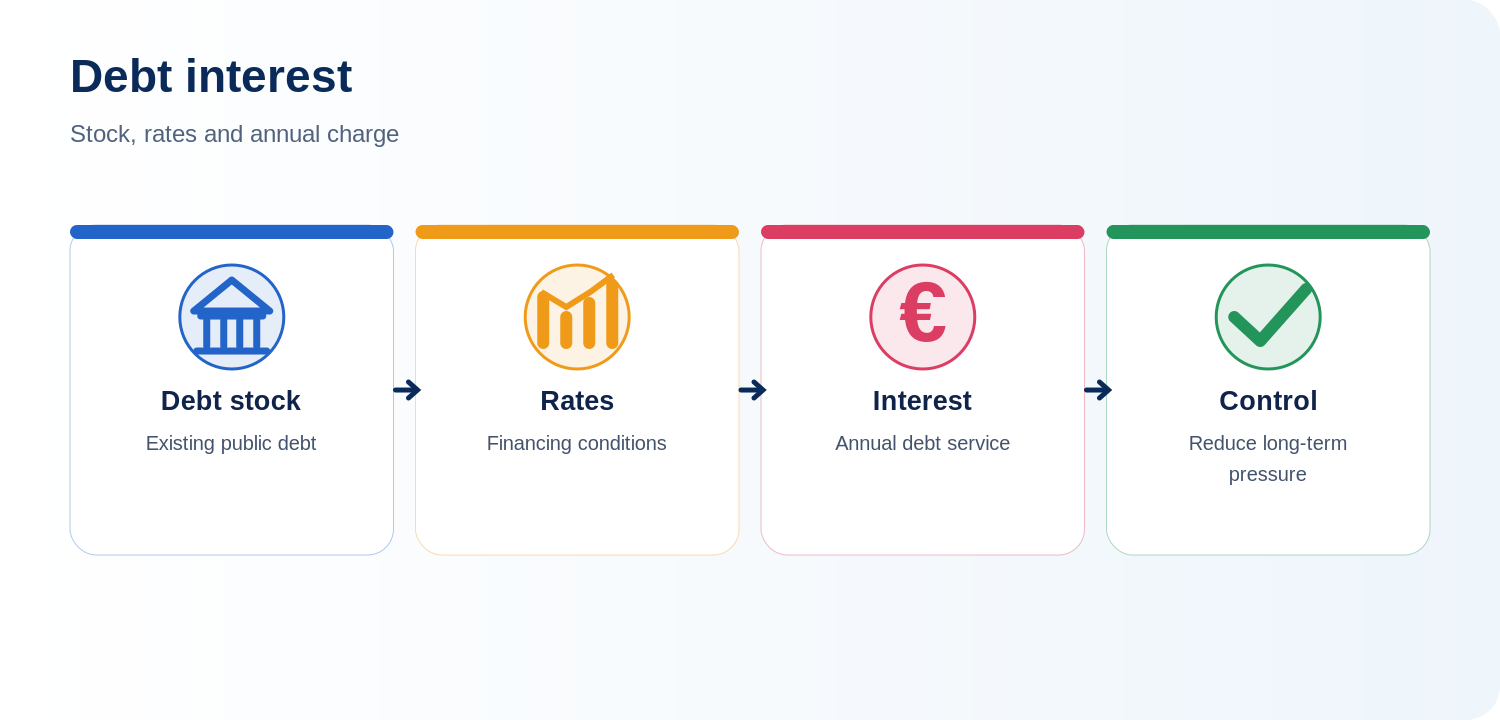
The main idea in one minute
If you borrow 100 euros at 5%, you will owe interest. For the state, the principle is identical, only on a vastly larger scale. The interest burden is the budgetary cost of servicing debt.
Why can the interest burden rise even if the debt stock does not suddenly explode?
Because public debt is made of many securities maturing at different times. When old debt matures, the state often refinances it by issuing new debt. If the new rate is higher than the old one, the budget cost rises progressively as refinancing takes place.
- Old low-rate debt matures.
- New debt is issued.
- The new rate is higher.
- The interest burden rises gradually.
What does €59.3 billion mean?
In the 2026 French state budget, the state debt interest charge is presented at around €59.3 billion. That figure refers to the central state budget, not necessarily to the total interest cost of every public administration. Precision about the perimeter is what makes an explanation credible.
Maastricht public debt
Public accounts
Why is this burden so politically important?
Because it is a rigid expenditure. A minister can adjust some programmes or postpone some projects, but the state cannot simply decide not to pay interest without severe consequences. As the burden rises, it competes with other priorities: schools, justice, hospitals, defence, local government and investment.
Why do citizens often overlook it?
Because interest does not create a visible service. It is not a school, a road or a hospital. It is the budgetary cost of past borrowing.
What determines the cost?
The debt stock
The larger the stock, the broader the base on which interest is paid or refinancing occurs.
Rate levels
Higher market rates make new issues more expensive.
Average maturity
Longer maturities can slow the transmission of a rate shock.
Fiscal credibility
More credible trajectories generally support more favourable financing conditions.
How can the burden be reduced over time?
There is no magic trick. The first condition is to slow the production of new debt. Stability, credible budgeting, growth and institutional confidence matter too, but they do not replace the need to address the underlying deficit path.
Further reading
Frequently asked questions
Does the burden rise immediately when rates rise?
Not fully. It rises gradually as maturing debt is refinanced.
Can the state stop paying interest without consequences?
No. A payment rupture would destroy confidence and trigger severe financial consequences.
Why is debt described as a loss of room for manoeuvre?
Because more of today’s budget must pay for the past instead of funding present priorities.