


Avoiding a shock
In crises, borrowing can cushion the economy and society instead of forcing brutal cuts all at once.
delta-sierra.com
David Salvan | Books, Public Policy and Mars Colonization
The shortest correct answer is this: public debt is the accumulation of past deficits. When public administrations spend more than they collect, they borrow. Repeated year after year, that mechanism produces a large stock of debt. The real problem begins when debt finances not only long-term investment, but also current spending and political promises that were never truly financed.
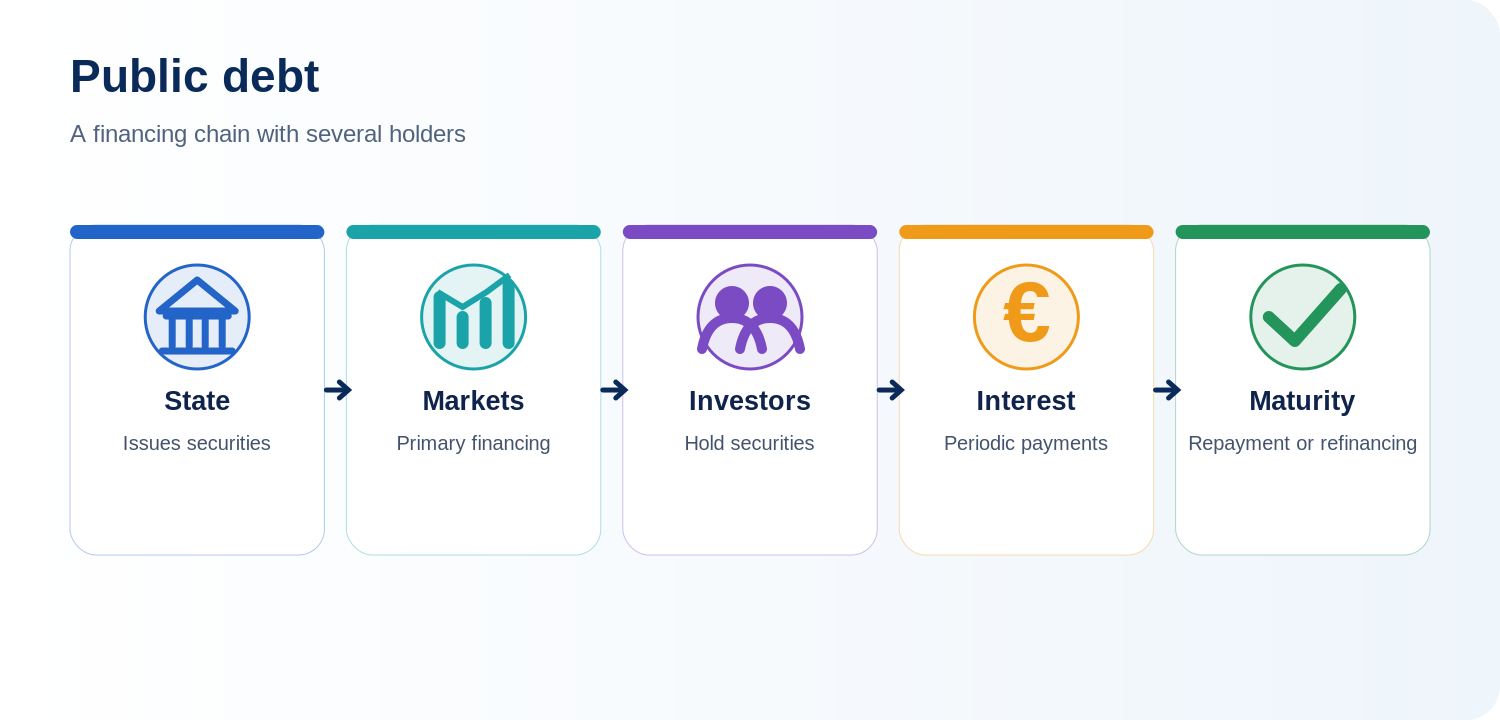
Imagine a household earning 2,000 euros per month but spending 2,200. To cover the gap, it borrows 200 euros. If it repeats that pattern month after month, debt accumulates. For a state, the principle is the same, only at a much larger scale. Public debt is what public administrations still owe.
In France, one must distinguish public debt under the Maastricht definition from the debt of the central state. The first covers all public administrations taken together. The second is only one part of that perimeter. Serious analysis always keeps that distinction clear.
The key distinction is straightforward: the deficit is an annual flow, while debt is an accumulated stock.
Because immediate adjustment is politically painful. Cutting visible spending, restructuring a programme or openly financing a promise through taxes creates immediate opposition. Borrowing spreads the cost through time. Debt is therefore often a way to finance today a decision whose bill will be paid gradually tomorrow.
In crises, borrowing can cushion the economy and society instead of forcing brutal cuts all at once.
Tax rises and spending cuts are felt immediately. Borrowing feels easier in the short run even if it stores up pressure for later.
For years money was cheap, which encouraged governments to postpone deeper reforms.
Politicians often think in terms of a mandate; debt lives on a much longer time scale.
No. Debt can finance useful investment and durable modernisation. The problem appears when debt becomes the routine way to fund current spending without solving the underlying imbalance.
| Situation | Meaning |
|---|---|
| Debt for investment | Can be justified if it creates lasting public value or productive capacity. |
| Debt for current spending | More problematic, because it finances today without correcting the structural cause. |
| Debt during an exceptional crisis | May act as a temporary buffer if followed by a credible path back. |
| Debt as routine | Usually signals that the political system is postponing adjustment year after year. |
A high debt level first reduces budget flexibility. A larger part of public money must then go to servicing the past rather than financing present priorities. Debt also makes a country more sensitive to higher rates and less credible when leaders promise more spending, lower taxes and fiscal improvement at the same time without a coherent explanation.
Insee
Insee
Budget documents
This page is designed to explain the logic. The printed book and the freely accessible public file go much further on reform measures, sequencing and structural proposals. This page is the gateway, not the replacement.
No. In practice it refinances part of it over time as securities mature.
Growth helps, but it does not solve a structural imbalance by itself.
Permanent monetary financing would create other major risks, including inflation and a loss of confidence.