DGFiP collected €11.4bn from tax audits in 2025, including €2.8bn attributed to data mining/AI. 9.06 therefore cannot add €15–25bn on top of 6.09: revenue is consolidated once under 6.09.
PUBLIC FINANCE · CATEGORY 09
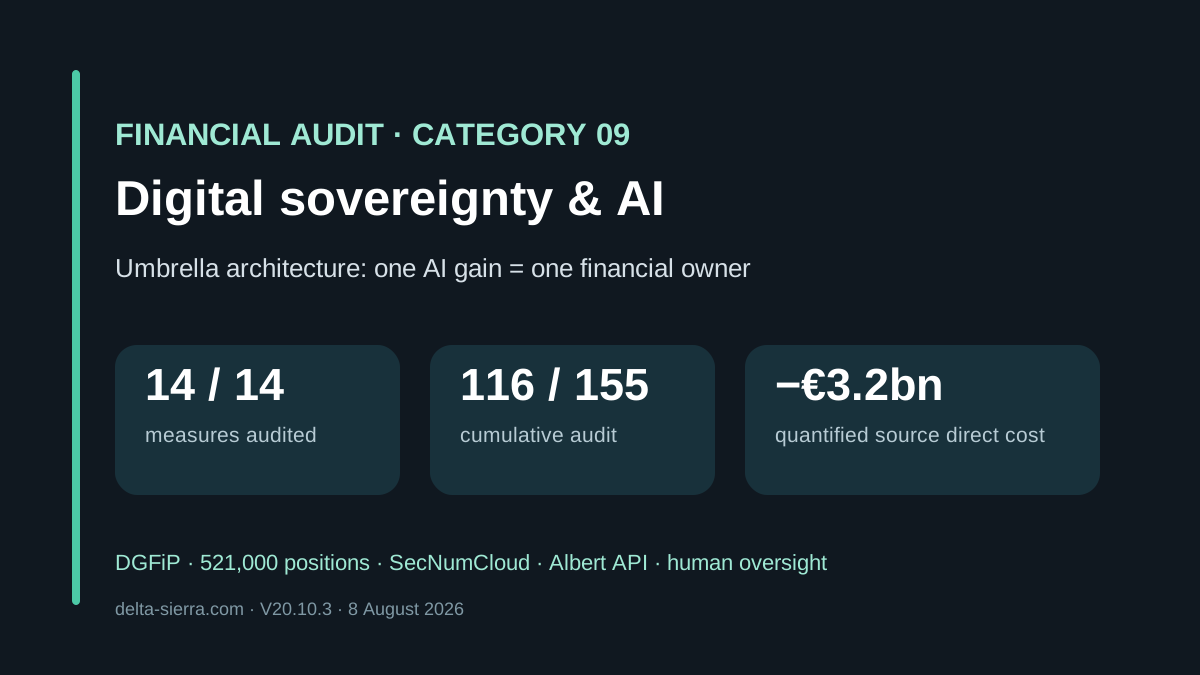
Digital sovereignty and artificial intelligence: audit of 14 measures
The AI block becomes an umbrella architecture: its use cases can no longer be added a second time to gains already assigned to the civil service, agencies, justice, health or anti-fraud measures.
The key change: the State has already begun building this architecture
Albert API is already an interministerial multi-model inference platform, used in more than 70 public projects and processing more than 100,000 requests each week. The Cloud-at-the-Centre doctrine and SecNumCloud already structure hosting. The reform should therefore no longer be costed as if government were starting from zero: it must measure expansion, generalisation, migration costs and additional outcomes.
Two spectacular figures, two counters that need locks
The target equals 8.9% of public employees excluding subsidised contracts. It remains productivity potential until a task → position → non-replacement/redeployment matrix demonstrates the fiscal effect.
The only quantified direct cost in the compendium is training under 9.05. Investments 9.03 and 9.08 remain uncosted, so −€3.2bn is not the block’s full cost.
521,000 positions: a capacity screen using natural attrition
In 2024, 136,700 new direct pensions were granted across the public service. At a constant flow, five years would represent 683,500 retirements; 521,000 would equal about 76% of that retirement-only flow. This is not a forecast: it shows that the target requires a precise horizon, occupational scope and reconciliation with measure 2.09 on non-replacement.
Human oversight: the safeguard already connects to positive law
GDPR Article 22 protects against certain solely automated decisions. The AI Act requires competent human oversight for high-risk systems and, for certain public deployments, a fundamental-rights impact assessment. Measure 9.12 is therefore framed as a general operational safeguard: no adverse decision is materialised without identifiable human validation, traceability and an appeal route.
Line-by-line audit
| Measure | Source proposal | Financial nature | Current baseline | Consolidation rule | Simulator treatment | Deduplication |
|---|---|---|---|---|---|---|
| 9.01 | Five-layer sovereign architecture Structural effect | Umbrella architecture; no autonomous financial gain | The State is no longer starting from zero: DINUM already operates an interministerial AI stack, including Albert API, while the Cloud-at-the-Centre doctrine governs hosting. Albert API mutualises several models and is already used in more than 70 public projects, with more than 100,000 weekly requests. | 9.01 becomes the umbrella architecture. Savings or revenue are assigned to the use cases that actually materialise them; the architecture itself cannot count DGFiP, justice, health, agency or civil-service gains a second time. | €0 direct; investment and operating costs are carried by 9.03, 9.08 or the owning business projects. | 2.07, 3.04, 9.03, 9.08 |
| 9.02 | Exclusive hosting with SecNumCloud-qualified providers Structural effect | Security/sovereignty requirement; migration and hosting costs must be measured | The Cloud-at-the-Centre doctrine already requires particularly sensitive data hosted in commercial cloud to use SecNumCloud or at least equivalent European qualification, with protection against extraterritorial access. ANSSI maintains the SecNumCloud 3.2 baseline and a catalogue of qualified or qualifying offers. | The measure is broader than today’s baseline if it requires SecNumCloud for every use. Sensitive/strategic data, admissible internal clouds, European equivalents, capacity and price differentials must be defined. No automatic saving. | €0 saving; migration cost + hosting OPEX delta, without double counting HDS or business platforms. | 5.06, 9.01, 9.03, 9.04 |
| 9.03 | Public multi-model inference platform Investment | Investment and operating cost; measure is partly materialised by Albert API | Albert API already constitutes an interministerial multi-model inference platform: unified API, open-weight or partner models, RAG, OCR, classification and sovereign hosting. The source measure must therefore be audited as scaling/industrialising an existing baseline, not creating it from scratch. | Cost accelerators/GPUs, hosting, possible licences, operations, cybersecurity, support and scaling. Gains from applications using the platform remain assigned to their business lines. | Investment/OPEX to be consolidated; €0 own saving. | 9.01, 9.02, 9.04, 9.08, 3.04, 4.02, 5.02 |
| 9.04 | Twelve-month contractual reversibility clause Structural effect | Contract safeguard; reduces lock-in risk, not a direct saving | The Cloud-at-the-Centre doctrine already encourages diversity of technologies, suppliers and infrastructures for continuity and recovery. Albert API uses a standardised interface compatible with OpenAI conventions, which improves technical portability without eliminating exit costs. | The 12-month period should become an exit-plan requirement: export of data, models/configuration, documentation, switchover tests, supplier assistance and capped exit fees. The benefit is primarily avoided risk. | €0 by default; avoided exit costs only after contract benchmarking. | 9.02, 9.03, 3.03 |
| 9.05 | Train 5.85 million public employees, including 2.58 million State civil servants, over five years €3.2bn per year cost — investment, B | Training investment; source cost must be rebuilt by population and format | The population baseline is now consistent with official statistics: 5.8509 million employees excluding subsidised contracts at end-2024, including 2.5840 million in the State civil service. The source cost of €3.2bn/year for five years is €16bn total, about €2,735 per employee over five years (about €547/employee/year). A three-branch civil-service AI framework negotiation started in June 2026. | Split teaching cost, paid training time, certification, replacement, infrastructure and support. Measure 2.13 (400,000 staff) is a potential subset: its cost must be subtracted if both lines are activated. | Source scenario: −€3.2bn/year for 5 years, to be replaced by bottom-up costing; mandatory deduplication with 2.13. | 2.13, 2.07, 3.04, 4.02, 5.02, 6.09, 6.10 |
| 9.06 | Deployment at the General Directorate of Public Finances €15–25bn per year — new/recovered revenue, C | DGFiP use case; consolidated tax revenue belongs to 6.09 | DGFiP has about 95,000 staff. In 2025 tax audits notified €17.1bn, collected €11.4bn, and data mining/AI enabled €2.8bn to be recovered. The €15bn lower bound therefore already exceeds total annual cash collections from 2025 tax audits: the source figure must be treated as long-term transformation potential, not immediately available incremental revenue. | Financial owner: 6.09. New revenue is additional AI-enabled cash collection above the existing baseline, net of costs, litigation, displacement and false positives. 9.06 describes the deployment domain and does not add another €15–25bn to the total. | €0 additional: revenue alias of 6.09; DGFiP productivity is separate if it actually reduces costs. | 6.09, 2.07, 9.03, 9.07, 9.14 |
| 9.07 | Automation of 521,000 administrative positions through natural attrition €30–46bn per year — productivity gain, C | Productivity potential; no budget effect without a position actually left unfilled/removed | 521,000 positions represent about 8.9% of the 5.8509 million public employees excluding subsidised contracts. In 2024, 136,700 new direct pensions were granted: at a constant flow, five years would represent 683,500 retirements, and 521,000 would equal about 76% of that retirement-only flow. This is a capacity screen, not a forecast, because natural attrition includes other exits and occupations are not interchangeable. | The target must be rebuilt task by task: automatable, assistable, retained or reinforced; then identify positions truly avoidable, redeployable or left unfilled. The same employee cannot generate savings simultaneously under 2.09, 3.04, justice, health, anti-fraud and 9.07. | Productivity account only; €0 deficit effect by default. Fiscal conversion only through an owning documented non-replacement/removal line. | 2.07, 2.09, 2.10, 2.13, 3.04, 4.02, 4.03, 4.04, 5.02, 6.09, 6.10, 8.06, 9.05, 9.06 |
| 9.08 | Interministerial mission attached to the Prime Minister Investment | Governance and steering; structural cost must be limited and deduplicated | DINUM already plays an interministerial role in State digital policy; in 2026 DGAFP is steering an AI framework negotiation across all three civil-service branches, while ANSSI owns cybersecurity baselines. A new mission must therefore not recreate existing functions. | Prefer a lean steering team built on existing structures, with explicit mandate, staffing, budget and duration. Platform costs remain under 9.03 and training under 9.05. | Investment/OPEX to be costed; €0 direct saving. | 9.01, 9.03, 10.17 |
| 9.09 | Quarterly parliamentary oversight of deployments Structural effect | Democratic oversight; no direct saving | Quarterly oversight is used to verify schedules, spending, incidents, measured benefits and safeguards. It is not itself a saving. | Reuse the same indicators as 9.11 and the same audit framework as 9.10 to avoid three parallel reporting chains. | €0; reporting/oversight costs may be isolated. | 9.10, 9.11, 10.15 |
| 9.10 | Annual public audit by the Court of Auditors Structural effect | Public audit; no autonomous financial gain | The measure must share the same audit mandate with 10.14, which already provides for a permanent annual audit mandate for the Court of Auditors. | Define one institutional owner: a single annual audit can cover AI, costs, savings, risks, service quality and rights compliance. | €0; no additional saving. | 9.09, 9.11, 10.14 |
| 9.11 | Quarterly indicators published in the Official Journal Structural effect — democratic oversight | Indicator publication; no direct saving | The measure depends on defining non-gameable indicators: AI spending, unit cost, processed volumes, time saved, positions actually redeployed/unfilled, cash revenue actually collected, incidents, appeals and corrections. | Publish source data once and reuse it for Parliament, the Court of Auditors and the transparency platform; avoid duplicate reporting costs. | €0; indicator-production cost separated. | 9.09, 9.10, 9.13, 10.14, 10.15 |
| 9.12 | Mandatory human intervention for every adverse decision Structural effect — legal safeguard | Rights safeguard; may create human-review costs, not savings | Current law already contains safeguards: GDPR Article 22 regulates solely automated decisions with legal or similarly significant effects, while the AI Act notably requires competent human oversight for high-risk systems; certain public bodies must also perform a fundamental-rights impact assessment. | The Delta-Sierra measure can become a simpler and broader rule than the legal minimum: no adverse decision is materialised without identifiable human validation, appeal route and logging. Review cost must be included in use cases. | €0 saving; human review time included in net project cost. | 4.09, 6.09, 6.10, 11.03 |
| 9.13 | Public transparency platform Structural effect — democratic oversight | Transparency tool; investment/OPEX, not direct saving | The platform should aggregate data already produced under 9.11 rather than create a parallel reporting system. It can publish use cases, suppliers, models, costs, evaluations, incidents, indicators and corrections, subject to protected secrets and cybersecurity. | A single data source feeds Parliament, the Court of Auditors and the public. Other Plan transparency platforms should reuse the same components rather than build a separate full system for every theme. | €0 saving; digital cost to be mutualised. | 9.09, 9.10, 9.11, 1.14, 11.09, 11.10 |
| 9.14 | Preventive anomaly detection in public procurement Structural effect — normative measure | Detection tool; saving/revenue only after an avoided or recovered loss | Public procurement already has national essential-data feeds: since 2024 procurement data are centralised on data.gouv.fr; in 2026 reporting thresholds remain €40,000 excluding tax under the normal regime and €25,000 under the simplified regime. This base makes large-scale statistical and algorithmic controls possible. | 9.14 is the detector. The financial effect belongs to the line that materialises the action: 6.12/8.04 if a price is reduced, 11.12 if a suspicious contract is stopped or fraud recovered. An anomaly score is never a saving. | €0 direct; savings/revenue recorded under the owning line after evidence and cash collection/price reduction. | 6.12, 8.04, 11.10, 11.12, 9.07 |
Public reusable data
JSON · CSV · Baseline JSON · Financial-ownership rules (French)
Primary / institutional sources
- Insee — L’emploi dans la fonction publique en 2024
- DGAFP — Évolution des effectifs de la fonction publique en 2024
- DGAFP — Les départs à la retraite dans la fonction publique en 2024
- DGAFP — négociation de l’accord-cadre IA dans la fonction publique, 30 juin 2026
- DINUM/DGAFP/DITP — Guide d’usage de l’IA pour les agents de l’État, 2026
- DINUM — Albert API, plateforme interministérielle d’inférence
- DINUM — infrastructure d’inférence mutualisée
- DINUM — doctrine Cloud au centre
- DINUM — transition cloud de l’État, bilan 2025 publié en 2026
- ANSSI — référentiel SecNumCloud 3.2
- ANSSI — prestataires SecNumCloud qualifiés / en qualification
- Ministère de l’Économie — bilan du contrôle fiscal 2025
- DGFiP — Rejoindre les Finances publiques, effectifs 2026
- Assemblée nationale — PLF 2026, programme 156 DGFiP
- EUR-Lex — règlement (UE) 2024/1689 sur l’intelligence artificielle
- CNIL — article 22 du RGPD, décision automatisée
- Ministère de l’Économie — données essentielles de la commande publique
- data.gouv.fr / DAJ — fichiers consolidés des données essentielles de la commande publique
Category 10 audit ·
Constitutional and fiscal rules are now consolidated without recounting substantive savings: see the 17-measure audit.