TAXATION · 13 MEASURES ·
Taxation: financial audit of 13 measures
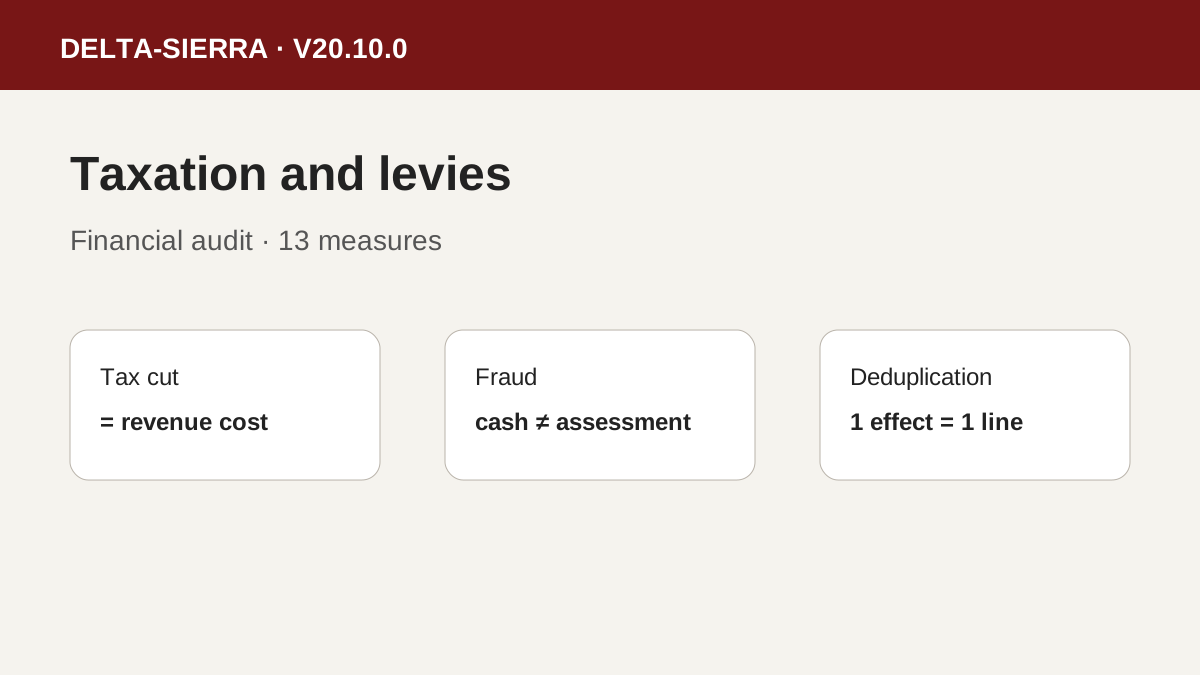
A tax cut, the removal of a tax expenditure, fraud recovery and a public-procurement saving are different financial effects. This page separates them before consolidation.
Family inheritance: updated rule
The fiscal lock
A tax cut is first a revenue loss. It becomes sustainable only when prior savings or actual additional revenue finance it. Conversely, a tax assessment is not yet cash collection.
INSEE measures compulsory levies at 43.6% of GDP in 2025. The 50% constitutional cap is therefore a safeguard; the strategic 30% target remains a separate conditional trajectory.
Four rules before consolidation
Tax cuts. Gross revenue cost first; growth and employment feedback later, never assumed automatically.
Fraud. Detected, prevented, assessed, reassessed and collected are distinct metrics.
Reinvestment. A euro recovered and then reinvested does not improve the deficit by the same euro.
Local government. Removing a local tax must show who bears the revenue loss or compensation.
Source measure and later scenarios
The historical wording of measure 6.03 remains archived at €300,000 per child for traceability, but it is no longer the current strategic rule. now sets €1m per child, €500,000 for a qualifying blended-family child with the reference tax burden divided by three above the threshold, and €1m per sibling. The earlier lifetime-pot model is retained only as a methodological archive. Measure 6.04 keeps its separate historical capital-gains wording.
The thirteen measures, separated by financial nature
| Measure | Plan effect | Current reference | Public consolidation | Simulator treatment |
|---|---|---|---|---|
| 6.01 — Constitutional cap on compulsory levies at 50 percent Legal ceiling, not an automatic saving | Structural effect — Constitution | INSEE measures compulsory levies at 43.6% of GDP in 2025. A 50% constitutional ceiling would therefore not bind today; it would act as a safeguard against future increases. | Do not confuse the 50% legal ceiling with the separate long-run 30% strategic target. The first limits how high levies may rise; the second requires actual savings and a financing lock. | €0 automatic effect. Each tax cut is simulated separately and blocked if it recreates a structural deficit. Deduplication: 10.09, 10.01, 10.03 |
| 6.02 — Reduce employer social contributions on low wages Tax cut requiring financing | Household / employment gain — GM | Since 1 January 2026, the single degressive general reduction is already maximal at the minimum wage and tapers off up to below 3 minimum wages. Any further reduction therefore starts from an already broad relief system. | A contribution cut first reduces social-security revenue. Employment, net-wage and employer-cost effects must be microsimulated before any tax feedback is counted. No debt financing. | Gross revenue cost − observable fiscal feedback + employment effect; kept separate from gains to employers and workers. Deduplication: 6.01, 9.07, 10.01, 10.03 |
| 6.03 — Protect family inheritance: €1m per child, €500k for a qualifying blended-family child, €1m per sibling Inheritance-tax reduction | Household gain — GM | 2026 law: €100,000 allowance per child and €15,932 per sibling. raises inheritance allowances by family relationship. | 6.03 — Protect family inheritance: €1m per child, €500k for a qualifying blended-family child, €1m per sibling | microsimulation: current law versus direct child, qualifying blended-family child and sibling rules. |
| 6.04 — Exempt real-estate capital gains after ten years Real-estate tax reduction | Household gain — GM | The current regime fully exempts income tax after more than 22 years of ownership and social levies after more than 30 years. Ten years would therefore accelerate exemption sharply. | The cost must be simulated using transactions, holding periods, gains, already exempt principal residences and any market-unlocking effect. The later fifteen-year strategic scenario is shown separately from the ten-year source measure. | Lost income-tax and social-levy revenue, adjusted for transaction-volume effects. Deduplication: 10.01, 10.03 |
| 6.05 — Spread development-tax payment over fifteen years Cash-flow / financing cost | Household cash-flow gain — GM | In 2026, the tax is declared within 90 days after completion; above €1,500 it can be paid in two instalments, at 90 days and nine months. Spreading it over fifteen years fundamentally changes local-government cash flow. | This is not a saving: it is implicit credit to the taxpayer, with financing, inflation, default and administration costs. For new housing, 6.05 and 6.13 cannot both apply to the same tax. | Present value of local receipts + administration + default; mutually exclusive with 6.13 for new housing. Deduplication: 6.13, 8.05 |
| 6.06 — Abolish the research tax credit for large companies Revenue from reducing tax expenditure | €5.5bn per year — revenue, level B | Budget documentation estimates the total cost of the research tax credit at €8.041bn in 2026. This is an absolute ceiling, but it does not by itself validate the €5.5bn attributed to large companies. | Before consolidation, a DGFiP breakdown is needed by company size, tax group, R&D spending band and credit actually used. Amounts redirected under 6.08 cannot simultaneously count as deficit reduction. | Gross revenue recovered − R&D behavioural effect − any 6.08 redirection. No double counting with 6.11. Deduplication: 6.07, 6.08, 6.11, 8.07, 8.08 |
| 6.07 — Reform the research tax credit for SMEs and mid-caps Tax reform requiring precise design | €2bn per year — revenue, level C | The total research tax credit is estimated at €8.041bn in 2026 and the innovation credit at €230m. A €2bn yield depends entirely on the rule chosen for SMEs and mid-caps and cannot be inferred from the total cost. | The website will require a parameterised scenario: rate, base, ceiling, group treatment, SME/mid-cap status and eligible spending. Depending on design, the measure may raise revenue, cost revenue or simply redistribute support. | Reform scenarios compared with current law; no automatic €2bn. Deduplication: 6.06, 6.08, 6.11, 8.07, 8.08 |
| 6.08 — Redirect savings toward public research Public reinvestment | Investment — IN | The Research and Higher Education mission represents more than €31bn in 2026 payment appropriations according to budget documentation. Redirecting recovered research-tax-credit revenue is new public-research spending. | Each euro allocated to 6.08 reduces by the same amount the net deficit benefit from 6.06/6.07, even if it improves scientific and economic potential. | Explicit investment spending linked to revenue actually recovered. Deduplication: 6.06, 6.07, 10.01, 10.03 |
| 6.09 — Fight tax fraud with artificial intelligence Incremental revenue, not total fraud | Net revenue — level C | In 2025, tax audits assessed €17.1bn in duties and penalties and DGFiP collected €11.4bn. This is the starting point: AI cannot claim as a gain amounts already detected or collected without it. | The model measures only the increment attributable to AI, net of false positives, litigation, IT and staffing costs. Assessed, collected and prevented amounts remain separate. | Causal additional cash collection − AI cost − audit cost − litigation. Deduplicated against 9.06. Deduplication: 2.13, 9.03, 9.05, 9.06, 9.07, 9.12, 10.03 |
| 6.10 — Fight social fraud with artificial intelligence Incremental recovery / loss prevention | Net revenue — level C | In 2025, nearly €3.1bn of social fraud was detected, prevented or reassessed. These concepts are heterogeneous and do not all equal cash collected. For example, Urssaf reassessed €1.503bn for undeclared work while collecting about €100m during the year. | The AI gain must be incremental to existing controls and split between prevented benefits, recovered contributions, overpayments, penalties and actual cash collection. | Prevented loss + additional cash collection − programme cost; no gross addition with 11.05. Deduplication: 9.03, 9.05, 9.07, 9.12, 11.03, 11.05 |
| 6.11 — Review poorly targeted tax expenditures Revenue from removing tax expenditures | Net revenue — level C | Budget documentation lists tax expenditures measure by measure. The 2026 budget bill already contained several removals and rationalisations; Delta-Sierra must therefore start from the 2026 inventory rather than an arbitrary aggregate percentage. | Each tax expenditure must have: budget cost, beneficiaries, objective, evaluation, behavioural effect, EU-law constraints and exit scenario. The research tax credit is removed from 6.11 when treated separately under 6.06/6.07. | Measure-by-measure sum after removing items already counted elsewhere and behavioural effects. Deduplication: 6.06, 6.07, 8.07, 8.08 |
| 6.12 — Cap profit margins on public procurement at 30 percent Procurement saving to be measured | €3bn–€5bn per year — direct budget saving, level C | The 30% figure appears in some procurement rules for matters unrelated to supplier profit margins, including advances or defence-contract subcontracting. It is not a general supplier-margin cap today. | Measure 6.12 directly overlaps 8.04 and must become one consolidated line. To verify €3–5bn, the margin definition must be specified, an open-book sample built, risk and competition considered, and actual purchase-price reductions measured. | Saving = counterfactual price − post-reform price − control costs; 6.12/8.04 counted once. Deduplication: 8.04, 9.14, 11.10, 11.12 |
| 6.13 — Abolish development tax on new housing Local-revenue cut / housing-cost reduction | Household gain — GM | Development tax is a local tax used in particular to finance public infrastructure required by development. Removing it on new housing lowers project cost but reduces local-government revenue unless compensated. | The website separates buyer/developer gain, lost local revenue, any state compensation and construction response. For housing exempt under 6.13, the 6.05 payment-spreading measure no longer applies. | Lost local revenue − any additional activity/revenue; mutually exclusive with 6.05 on new housing. Deduplication: 6.05, 8.05, 10.03 |
Structured data
Main public sources
- Insee — prélèvements obligatoires 1959-2025
- Insee — administrations publiques 2025
- Urssaf — réduction générale dégressive unique 2026
- CGI article 779 — abattement 100 000 €
- impots.gouv.fr — calcul des droits de succession
- Service-Public — plus-values immobilières
- Service-Public — taxe d’aménagement 2026
- Sénat — PLF 2026 Recherche
- Ministère des Finances — bilan fraudes 2025
- Direction du Budget — documents budgétaires 2026
- Loi de finances 2026
- DAJ — données essentielles de la commande publique
- Code commande publique R2393-8 — exemple du seuil 30 % sans lien avec une marge