


Ancillary function
Document search, conversion, duplicate detection and filing support without influencing legal analysis.
delta-sierra.com
David Salvan | Books, Public Policy and Mars Colonization
Artificial intelligence may support judicial tasks, but controls must increase as a tool approaches legal reasoning and decision-making.
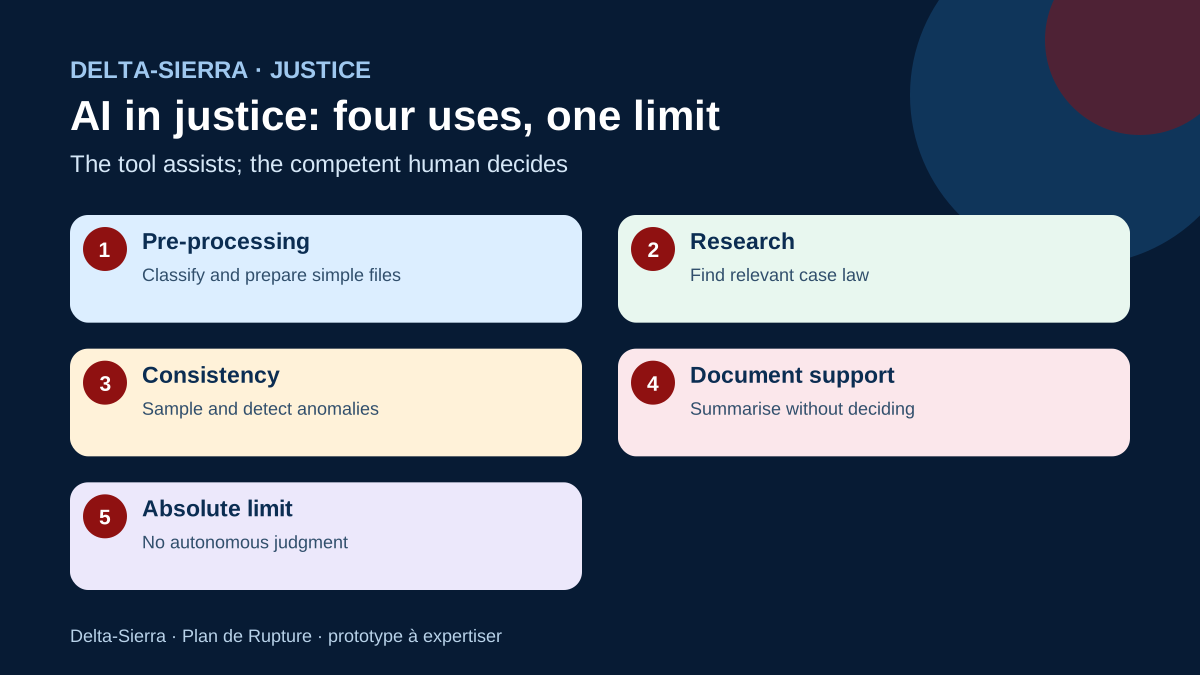
Measures 4.02 to 4.05 cover pre-processing of simple files, case-law research, consistency analysis by sampling and broader deployment in courts. These functions do not carry the same risk. Document classification is different from a system that influences the outcome of a case.
Document search, conversion, duplicate detection and filing support without influencing legal analysis.
Targeted case-law research, comparison and draft summaries. Enhanced control is required.
Scores or recommendations likely to orient the outcome. Highest safeguards apply.
Regulation 2024/1689 classifies certain systems used by or on behalf of judicial authorities to assist in researching and interpreting facts and law, or applying law to concrete facts, as high-risk. Purely ancillary administrative activities are distinguished.
High-risk obligations include risk management, data governance, documentation, logging, transparency, human oversight, accuracy, robustness and cybersecurity.
| Use | Working position | Main condition |
|---|---|---|
| Case-law research | Potentially authorised | Verifiable sources and traceable citations. |
| Document classification | Gradual deployment | Quality control and correction mechanisms. |
| File summary | Controlled experiment | Systematic verification against original documents. |
| Consistency analysis | Experiment and audit | No secret scoring or artificial uniformity. |
| Draft decision | High risk | Explicit framework, enhanced oversight and no autonomous final outcome. |
| Autonomous judgment | Excluded | Judging remains a human function. |