


Kindle
I Walked on Mars — Book 2: Deployment
ASIN still needs to be copied from KDP; a search link is provided in the meantime.
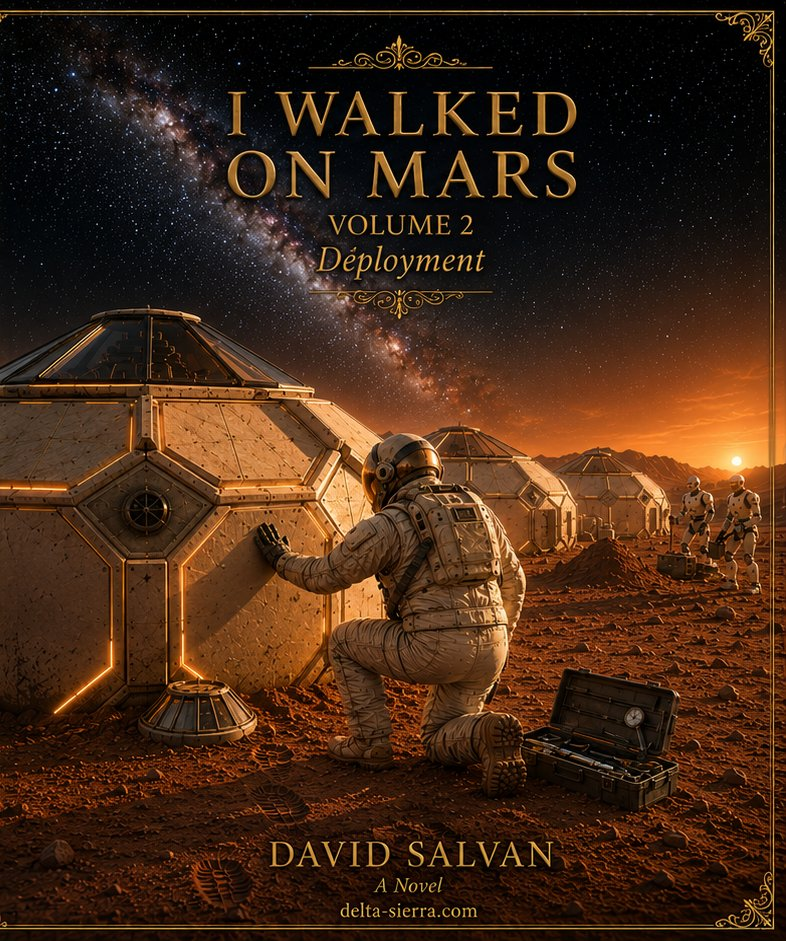
Realistic science-fiction novel : Second book in the quadrilogy
The journey is over. The real challenge begins. No finished city is waiting on Mars, and every mistake can threaten the entire settlement. Deployment follows Arcadia’s first year as habitats, power, water, oxygen, crops, workshops and a community must all come into existence together.
Other formats and editions:
See all editions below
Direct links use confirmed ASINs only. Other published formats are listed without inventing identifiers.
Look inside
Browse selected interior pages from this English edition.
Digital preview. Printed rendering may differ according to the edition.
1 / 6
The journey is over. The real challenge begins. No finished city is waiting on Mars, and every mistake can threaten the entire settlement. Deployment follows Arcadia’s first year as habitats, power, water, oxygen, crops, workshops and a community must all come into existence together.
The book covers the first Martian year of everyday construction: expanding pressurised space, organising shifts, protecting external operations and building routines that can survive fatigue. The passage of time matters because a settlement is not founded in a single ceremony. It is founded through repeated checks, meals, medical decisions, maintenance logs, disagreements and small victories.
David and Stella discover that their new home is simultaneously a worksite, a life-support system and a social experiment. The boundary between private life and collective responsibility almost disappears.
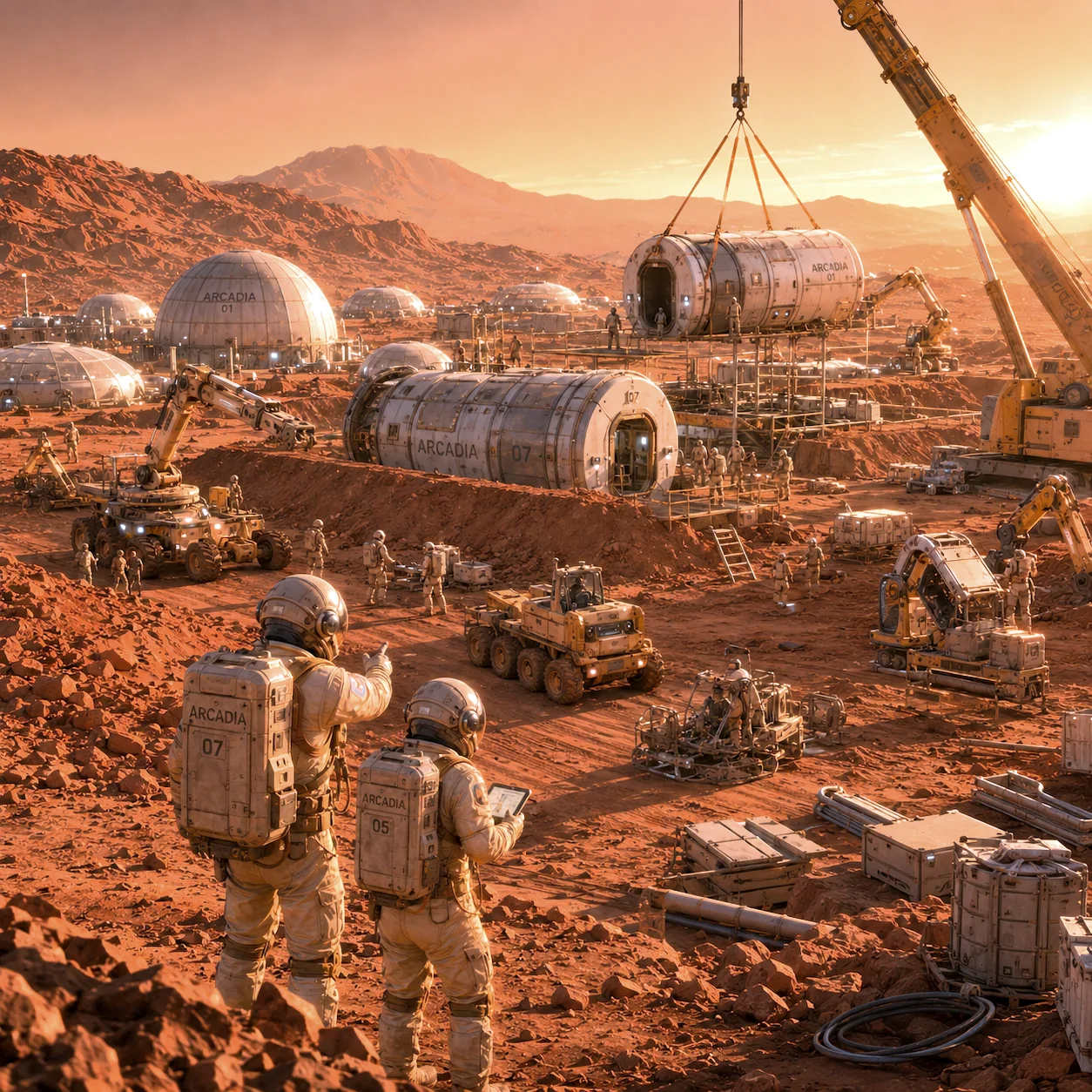
Arrival on Mars immediately reverses the hierarchy of priorities. What had existed as plans, simulations and checklists becomes physical work in which every delay consumes time, power and safety margin. Unloading a unit, choosing where to place it, verifying a connection or repairing damage can determine whether another system becomes available at all. Book Two tries to capture that density of the beginning, when the settlement is still a construction site whose technical decisions have immediate human consequences.
In Book 2, this issue is tied directly to the stage being explored: Book Two treats settlement as a narrative laboratory, not as a claim that one engineering design is already settled. Fiction is used as a narrative laboratory: it forces technical, human and political constraints to interact instead of being studied in isolation. Whenever the page touches a real-world issue, the linked Mars dossier helps separate documentation from the fictional hypothesis.
You passed the selection. You survived the training. You left Earth. The hardest part begins now: staying.
Book 2 of I Walked on Mars follows Arcadia’s first human year, when the dream of Mars collides with airlocks, radiation, recycled water, abrasive dust, fragile machines and limited resources. Reaching another planet is no longer the achievement that matters most. The new question is whether a settlement can keep its life-support systems running, repair failures, expand its habitats and continue functioning when every dependency is exposed.
The first settlers are not a caste of scientists. A permanent community needs engineers and researchers, but also builders, nurses, technicians, growers, mechanics, operators, logisticians and people who can solve practical problems when reality no longer matches the plan.
Vital infrastructure never operates in isolation. Power supports air production, pumping, heating, communications and workshops; water depends on storage, recycling and hygiene control; habitats require pressure, thermal regulation, filtration and isolation capability. That interdependence gives the volume much of its logic. A local fault can become a settlement-wide problem when there is no buffer, no redundancy or no person able to understand the interfaces quickly enough to keep the failure from propagating.
Humans and robots build side by side. Habitats expand. Workshops become essential. A growing share of water, food, materials and replacement parts must be obtained or produced locally. Step by step, a survival base starts to become something else: the beginnings of a city.
Yet a city is not merely a collection of machines. People fall in love, argue, celebrate, fail, repair and create routines. Shared habits emerge. Conflicts have to be managed. A daily culture begins to exist where none existed before. This is where the novel brings engineering, survival and human society together: how does an isolated outpost become a place where people can genuinely live, work, teach, remember and imagine a future?
The progression directly extends Book 1. After asking who should be selected and how the first settlers could be prepared, Deployment asks the next question: what does it take for those people to stop being only a mission crew and become the first inhabitants of a permanent Martian society?
Mars has been reached. Now humanity has to learn how to live there.
Maintenance therefore becomes daily work rather than an occasional technical episode. Crews must inspect before failure, identify components, preserve histories, decide what can be repaired and organize stocks by criticality. This creates a less spectacular but more credible Mars: survival may depend on a seal, sensor, filter, connector or tool being available at the right moment. The novel uses those small dependencies to show how reliability is built through discipline rather than heroic improvisation alone.
For the broader concept behind the story, continue with Book 2 — Author’s Vision and ARCADIA — the technical colony dossier.
This chapter can be extended with landing, unloading and first priorities
The Starship Endurance has landed on the plain of Arcadia Planitia. The settlers now face a reality very different from the triumphant image of a first footprint. Landing is not colonisation. It is the beginning of a long chain of checks, repairs, deployments and decisions in an environment where the atmosphere, cold, radiation and distance from Earth turn small failures into collective risks.
The novel follows the transition from transport architecture to a place where people can actually live. Pre-positioned equipment, robots and partially prepared infrastructure reduce the initial burden, but they do not remove uncertainty. Every system must be connected, tested and understood by the people who will depend on it.
Local food production does not eliminate reserves or logistics. A greenhouse consumes water, power, volume, nutrients and human time; it can also fail through disease, contamination or control errors. As production grows, it changes more than menus. Organic waste, recycling, work schedules, food variety and the psychological presence of living plants begin to form an inhabited ecosystem. Book Two uses agriculture to show how a technical installation can slowly become part of social and domestic life.
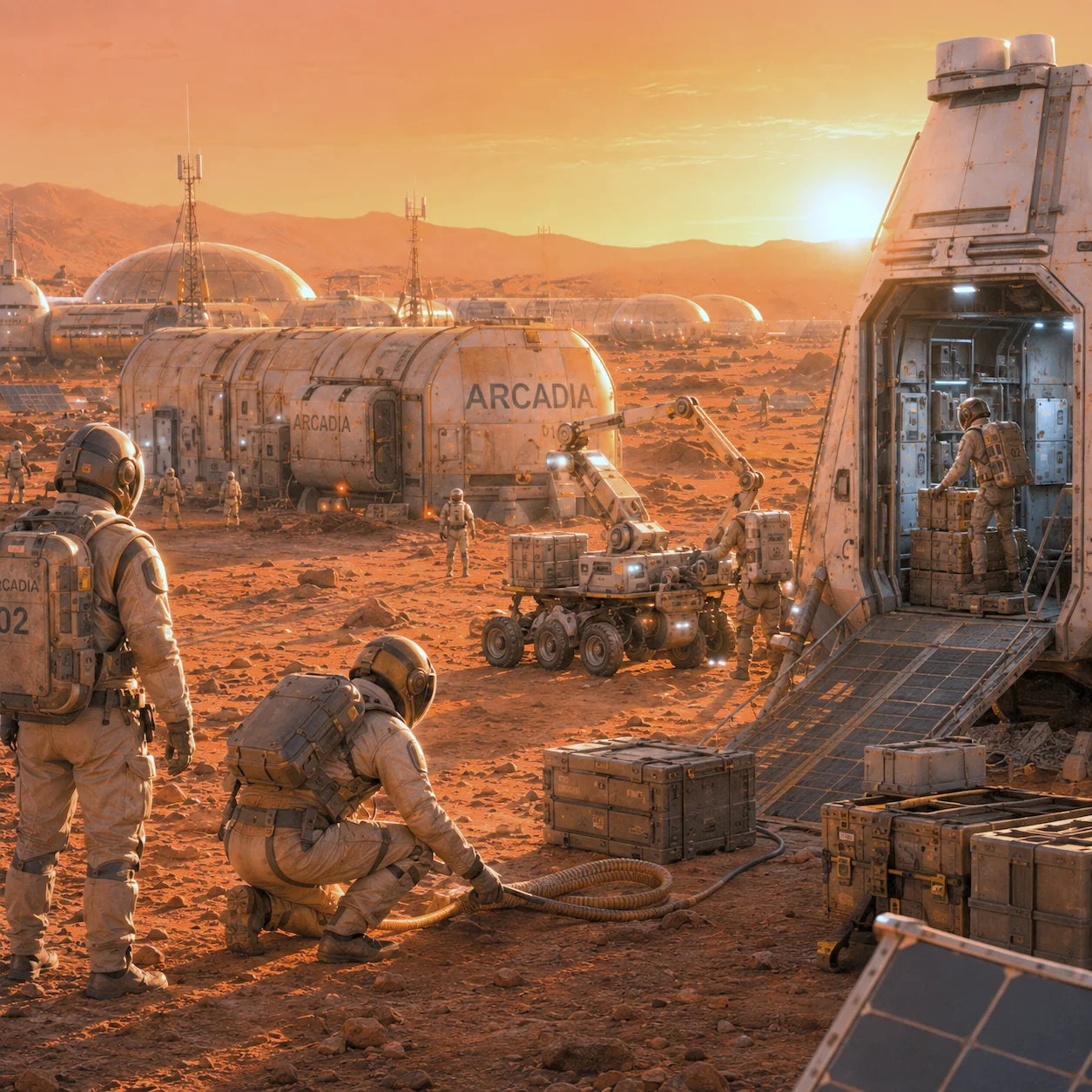
Arcadia cannot remain a camp supplied indefinitely from Earth. The settlers must explore, identify useful resources, begin processing materials, grow food and create workshops capable of adapting imported equipment. The book follows the first steps toward industrial autonomy without pretending that complete self-sufficiency can be achieved immediately.
The colony remains dependent on Earth, but the nature of that dependence begins to change. Each local capability gives Arcadia more time, more options and greater freedom to decide.
A community that shares air and water cannot treat organisation as an abstract political debate. Authority, information, workload and emergency powers affect survival. The settlers must decide who speaks, who arbitrates, how responsibility is recorded and what happens when personal needs conflict with collective safety.
This is the volume in which the mission starts becoming a society. The technical story and the political story are already inseparable.
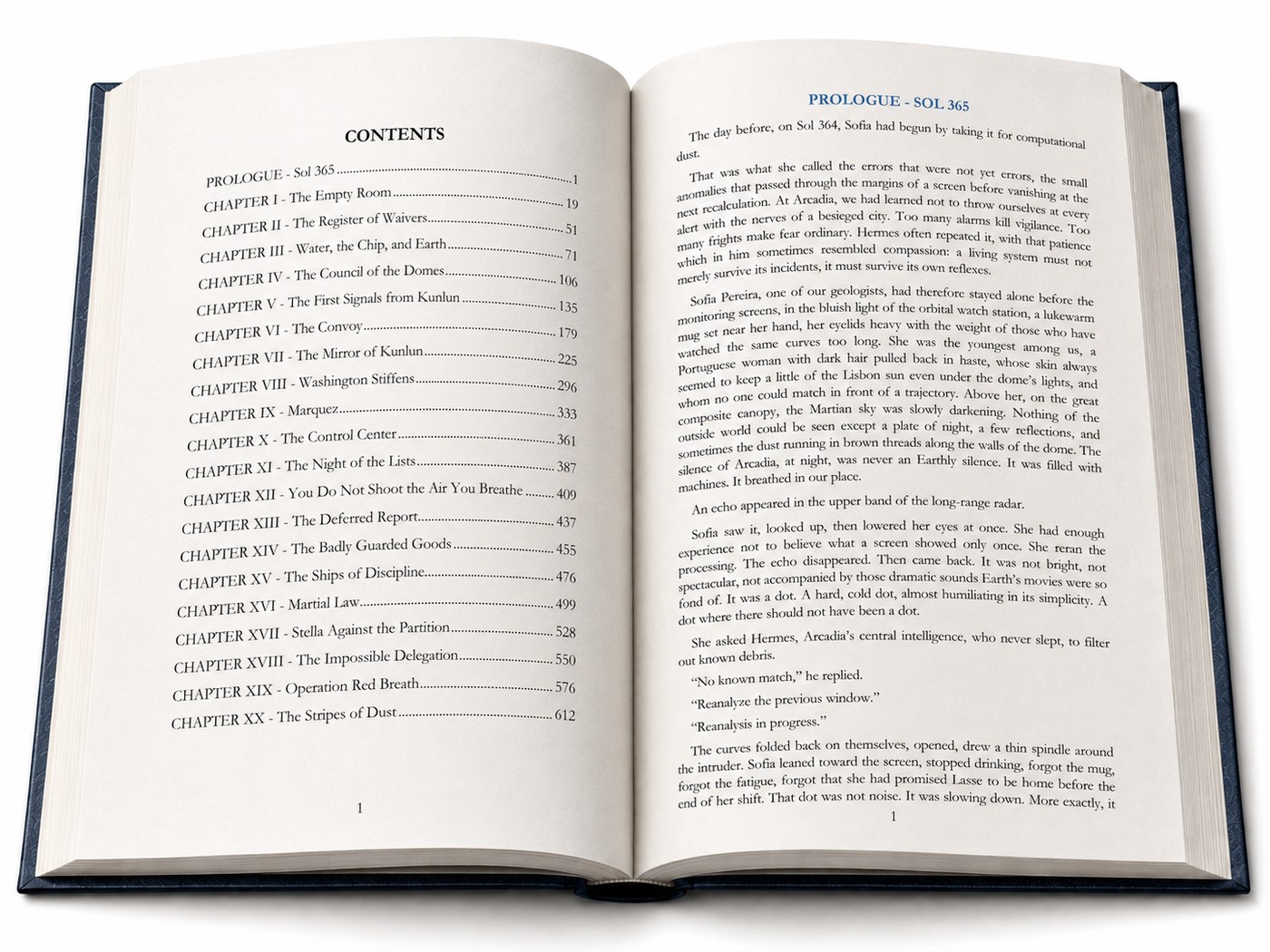
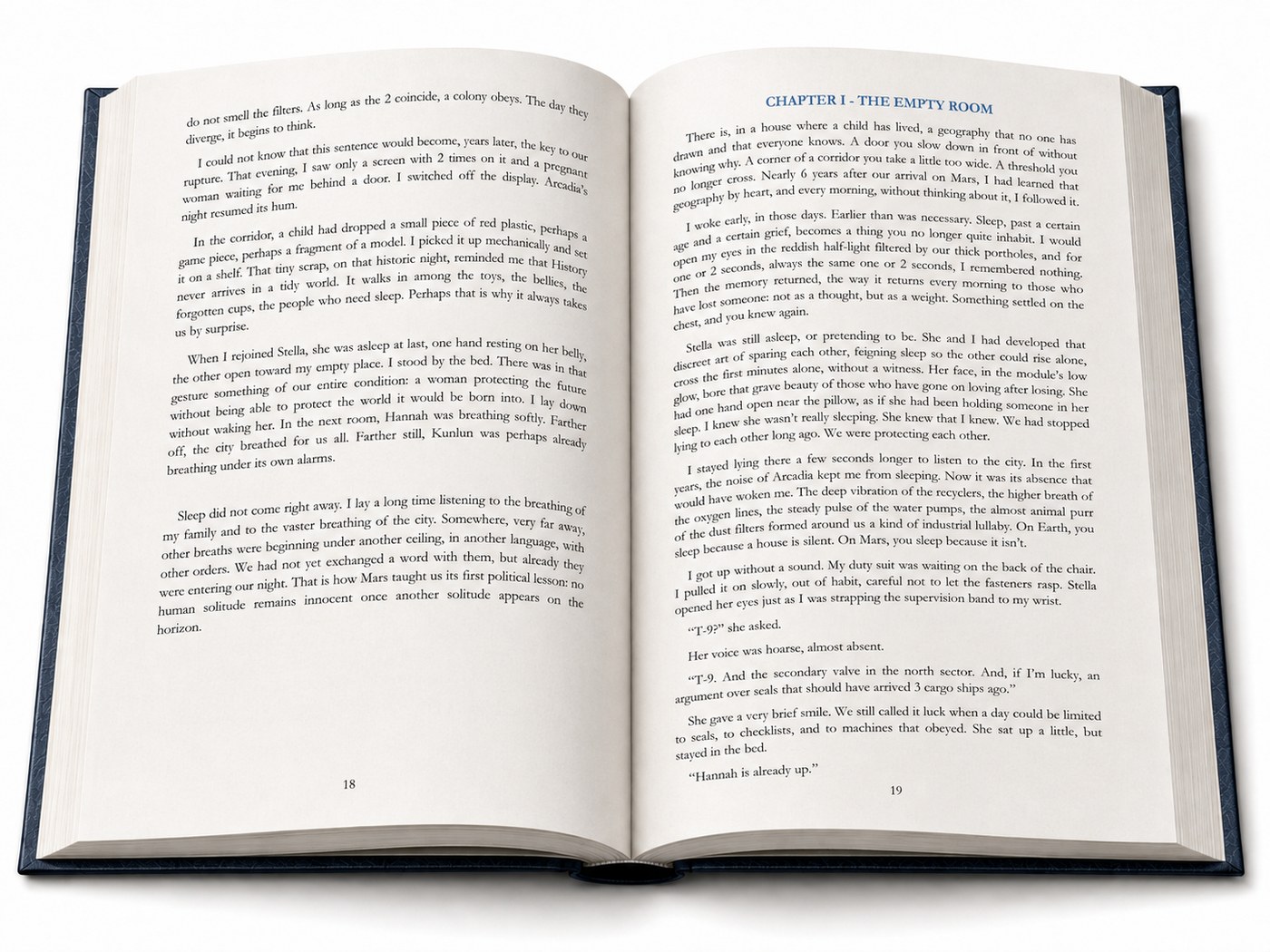
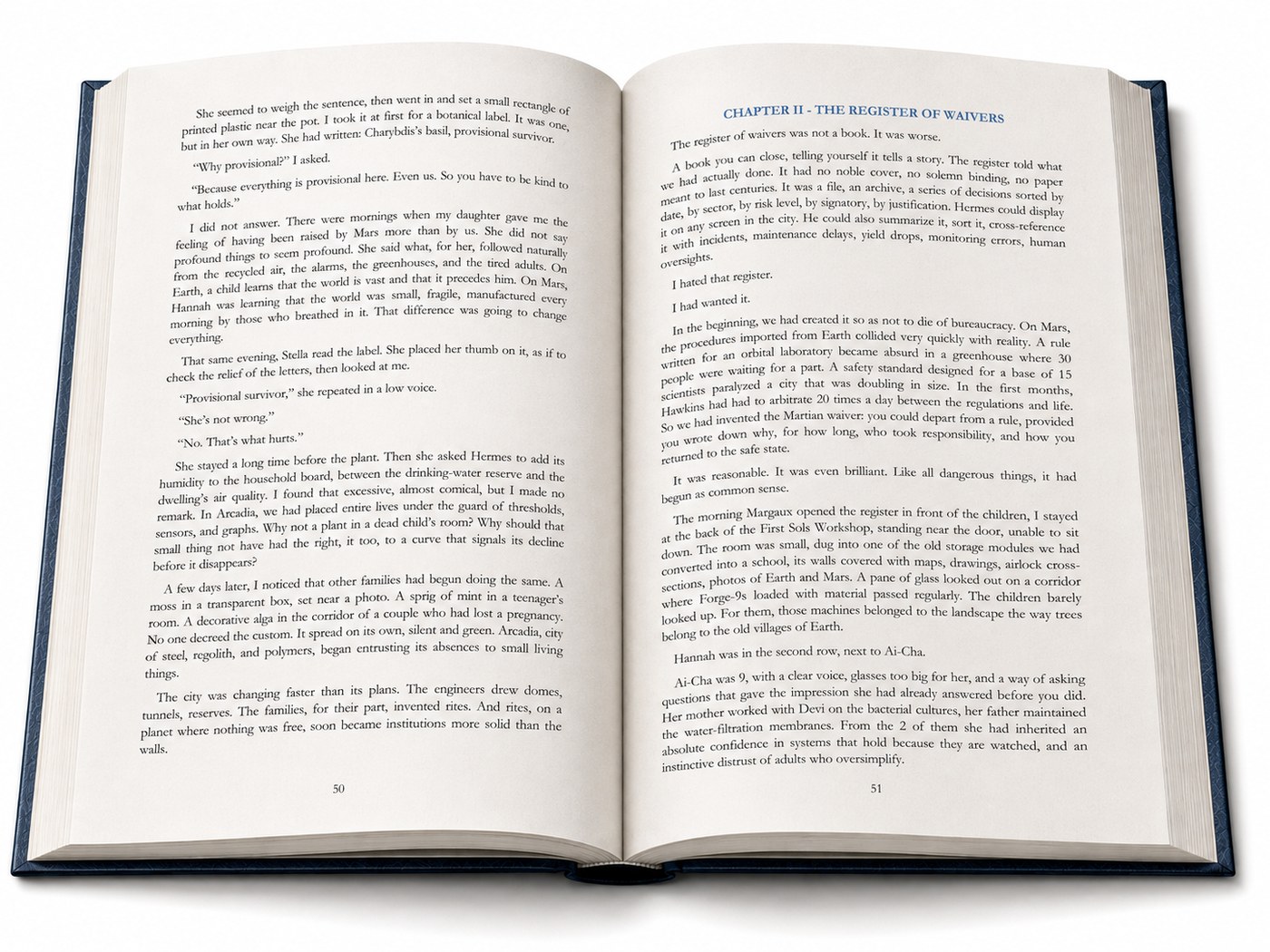
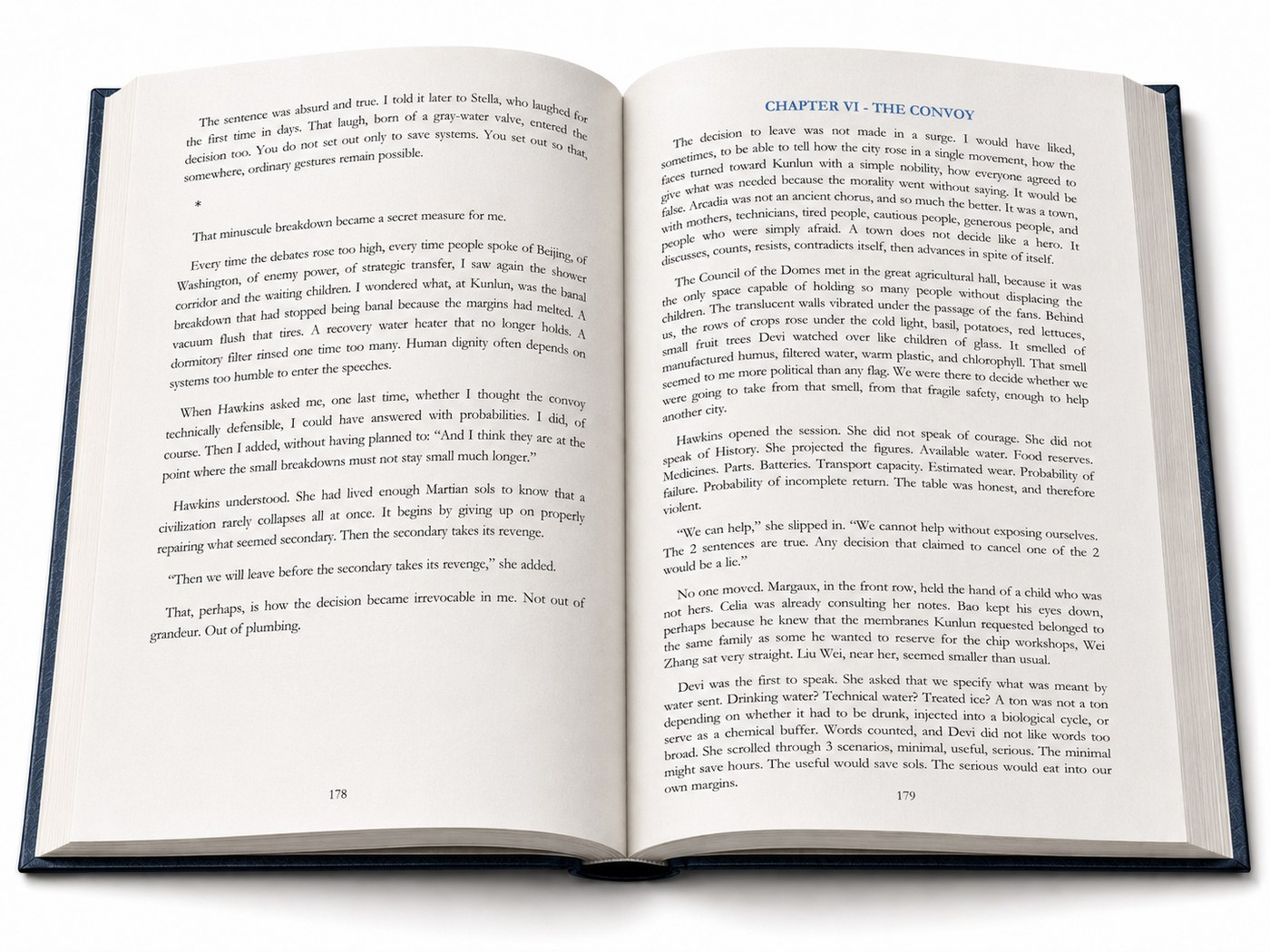
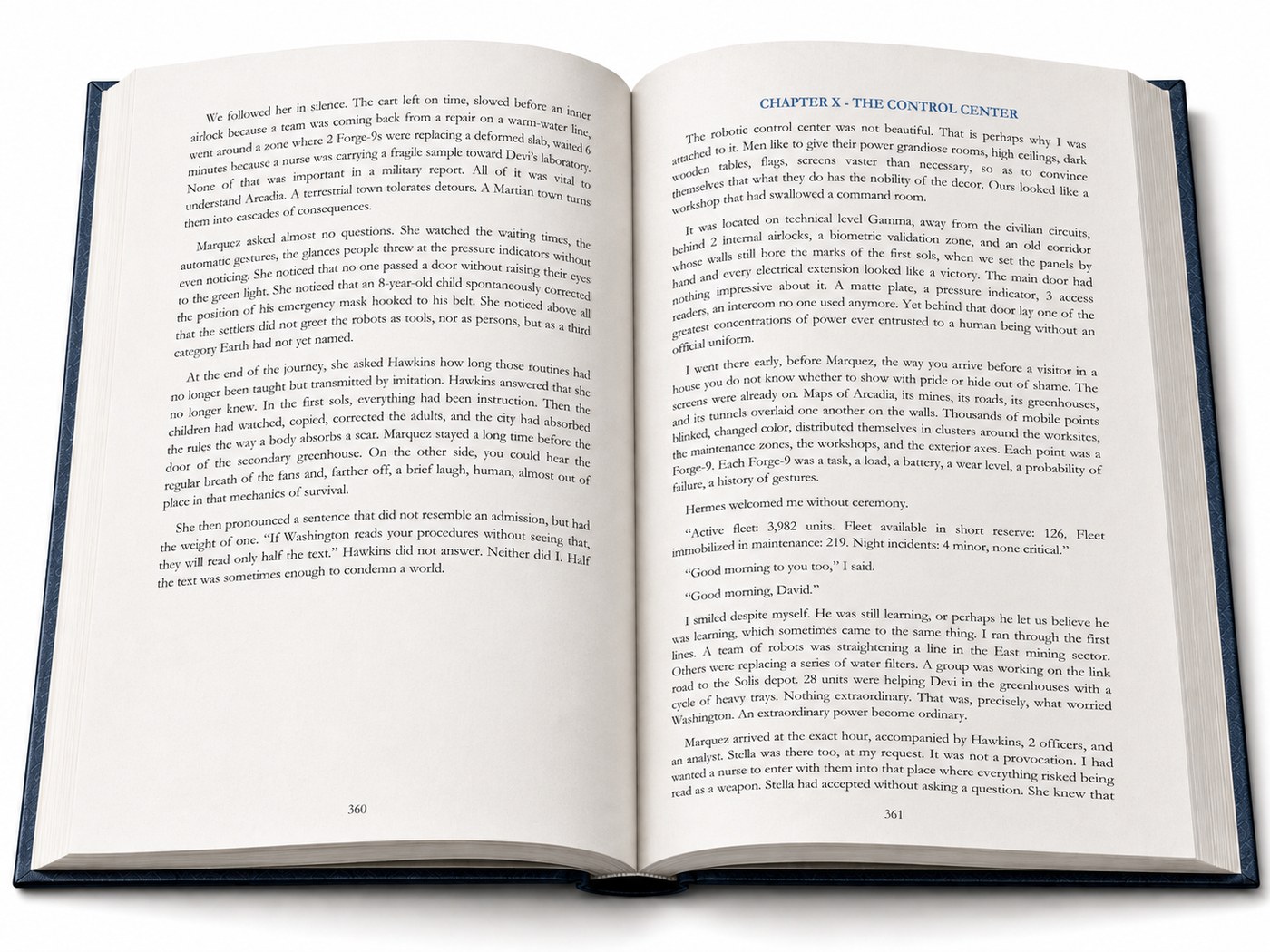
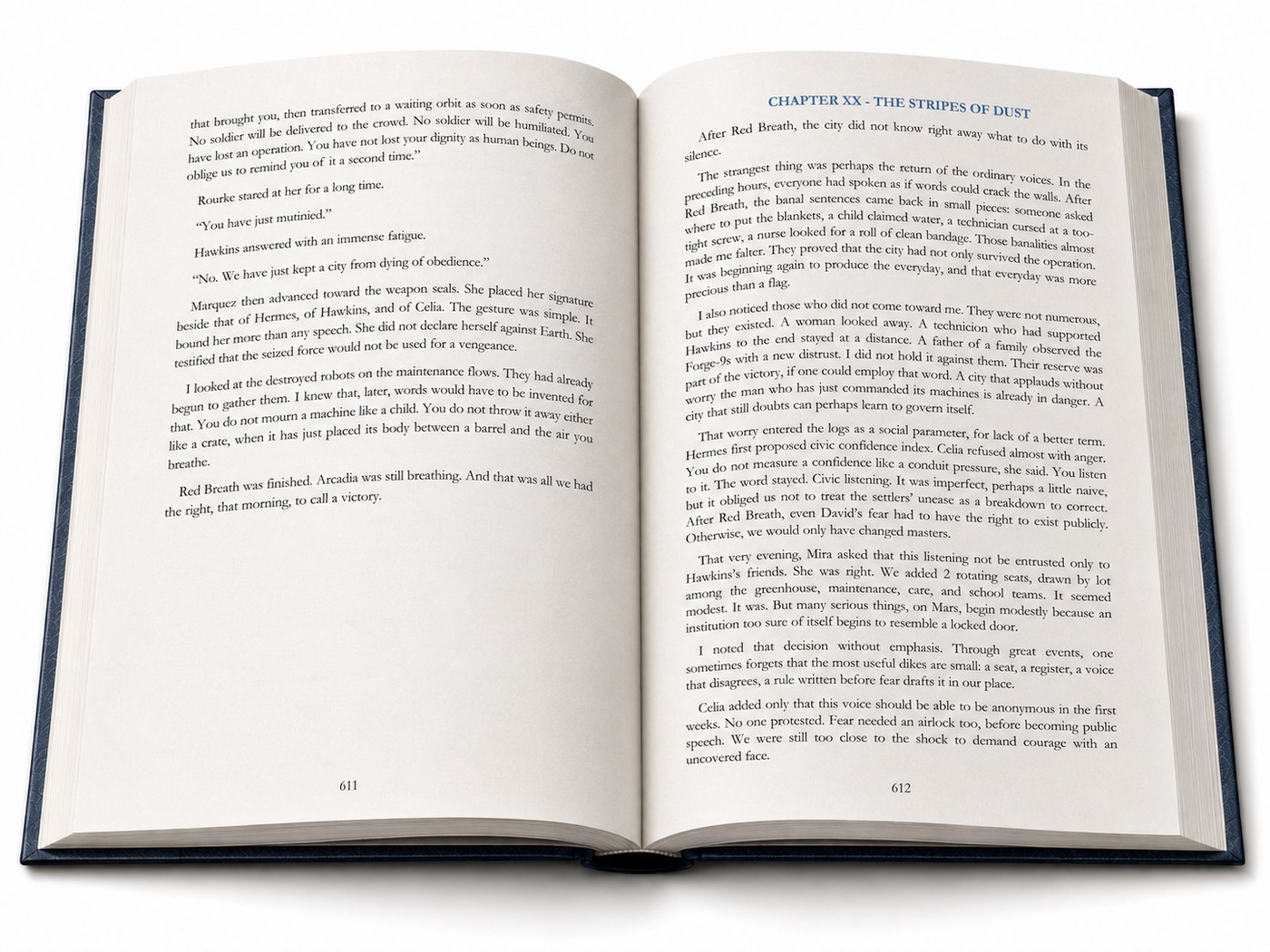
Power, water, oxygen, temperature control, communications and pressure management are not independent chapters in a manual. They form a single web. A loss of energy can affect heat and air circulation; an airlock problem can immobilise people and vehicles; a delayed spare part can force the settlement to redesign a procedure. Deployment turns these dependencies into narrative tension.
The first year on Mars is governed less by spectacular machinery than by redundancy, maintenance and growing local capability. Critical systems need alternatives that can be activated before a failure becomes irreversible; inspection, repair and spare parts matter as much as initial performance; and every material produced or component repaired locally reduces the settlement’s vulnerability to distant supply chains.
The Starship Endurance has landed on the plain of Arcadia Planitia. Ninety-eight days of transit. Fifteen humans per ship. Six Starships. A planet that has been waiting for them for billions of years.
David and Stella discover the beginnings of a semi-buried city: hexagonal cells, a biodome, pressurised airlocks and robots that have worked for years to prepare the site.
Now they must build, survive the thin atmosphere, the winter cold and cosmic radiation, start the first reactors, produce the first Martian metal, grow the first bread and learn to live together.
From Sol 1 to Sol 365 of Arcadia, this is the immersive story of a settlement taking root.
At the scale of Book 2, the question becomes concrete: The series uses concrete constraints (travel time, crew training, redundancy, isolation, life-support systems, local resources and delayed communication)to make the human consequences of a Mars mission tangible. It does not claim to reproduce the exact mission that will eventually occur. It asks what such an undertaking would demand from the people, institutions and technologies involved.
The first year also changes relationships. A team organized as a mission begins to decide how rest, privacy, conflict, responsibility and access to shared resources should work. Emergency choices can harden into habits, and habits can become rules without ever being formally debated. The volume watches precisely that transition: building a base means creating routines, and routines eventually create expectations about fairness, authority and what members of the settlement owe to one another.
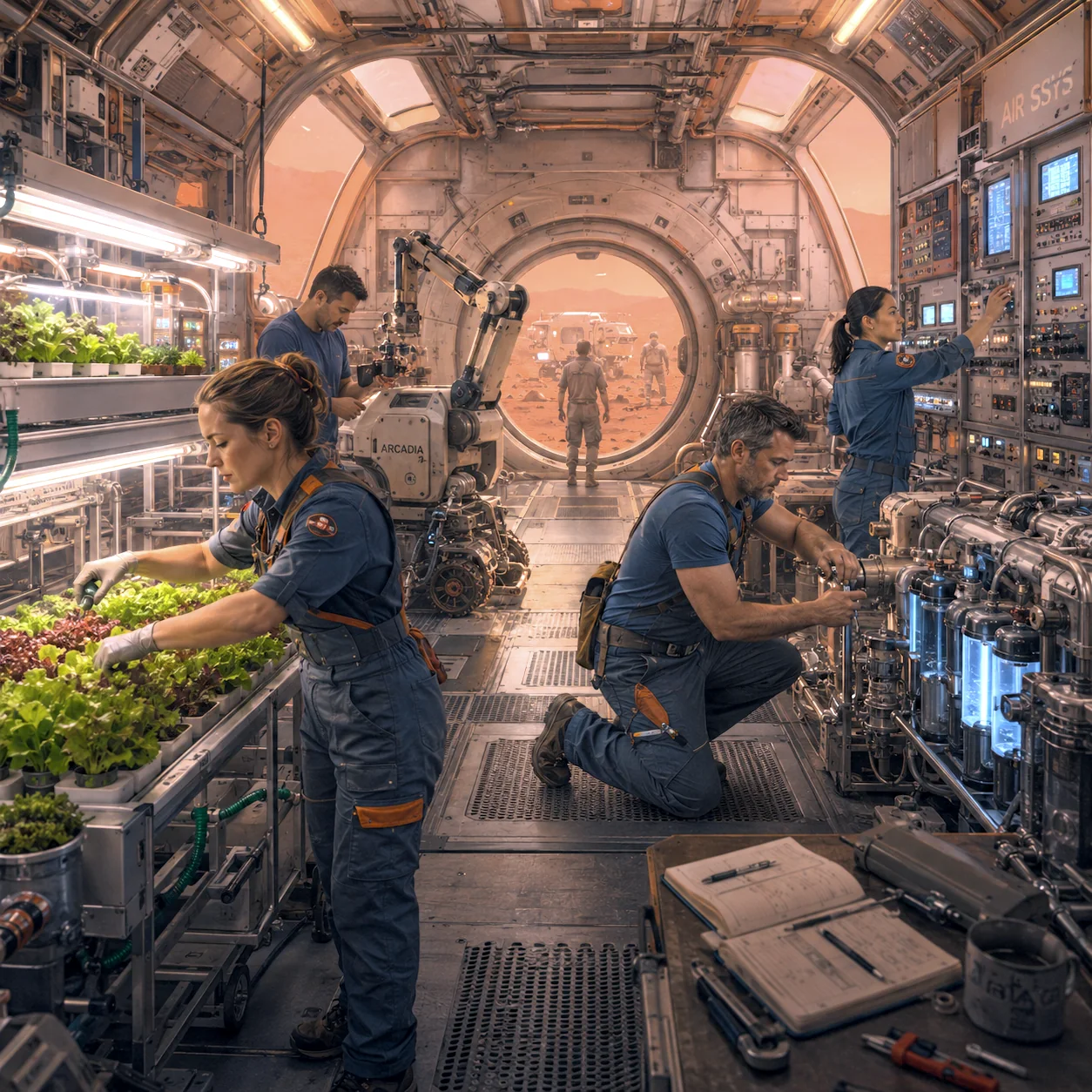
Book Two moves from preparation to the Martian surface: landing, securing air, water, power and food, building, repairing, developing local production and surviving the first year without treating logistics as magic.
Book 2 of David Salvan’s Mars quadrilogy: landing at Arcadia Planitia, deploying life-support systems and building the first year of a permanent human settlement.
For the research context behind these issues, see redundancy, degraded modes and continuity of life · power generation, storage and priorities
For that reason Book Two does not end with survival. It prepares a colony that will have to grow, receive new inhabitants, multiply functions and manage more complex disagreements. Improvised solutions from the first weeks become the infrastructure on which later society depends. The reader can therefore see how a small group in a hostile environment may, almost without noticing, lay both the technical and social foundations of Arcadia.
Choose the language and format directly. When an ASIN is confirmed, the button opens the exact Amazon listing. When a format is published but the ASIN still needs to be copied from KDP, a clearly labelled Amazon search link is provided instead of inventing an identifier.
English / United States — Amazon.com
Kindle
I Walked on Mars — Book 2: Deployment
ASIN still needs to be copied from KDP; a search link is provided in the meantime.
Paperback
I Walked on Mars — Book 2: Deployment
French — Amazon.fr
Kindle
J’ai marché sur Mars — Tome 2 : Déploiement
ASIN still needs to be copied from KDP; a search link is provided in the meantime.
Broché
J’ai marché sur Mars — Tome 2 : Déploiement
Spanish — Amazon.es
Kindle
He caminado sobre Marte — Tomo 2: Despliegue
ASIN still needs to be copied from KDP; a search link is provided in the meantime.
Tapa blanda
He caminado sobre Marte — Tomo 2: Despliegue
Direct links use confirmed ASINs only. Other published formats are listed without inventing identifiers.
The main context is easier to understand after Book 1, which introduces the settlers and the departure program.
No. It is a novel. Technical constraints shape the plot, while Arcadia develops the engineering in a companion volume.
It follows the landing and Arcadia’s first year of permanent settlement.
Yes. The US paperback is available under ASIN B0H7KDXHFT.
Move between the novel, its illustrated companion, the complete reading order and the engineering of Arcadia.