


Paperback
I Walked on Mars 2 — The Author’s Vision
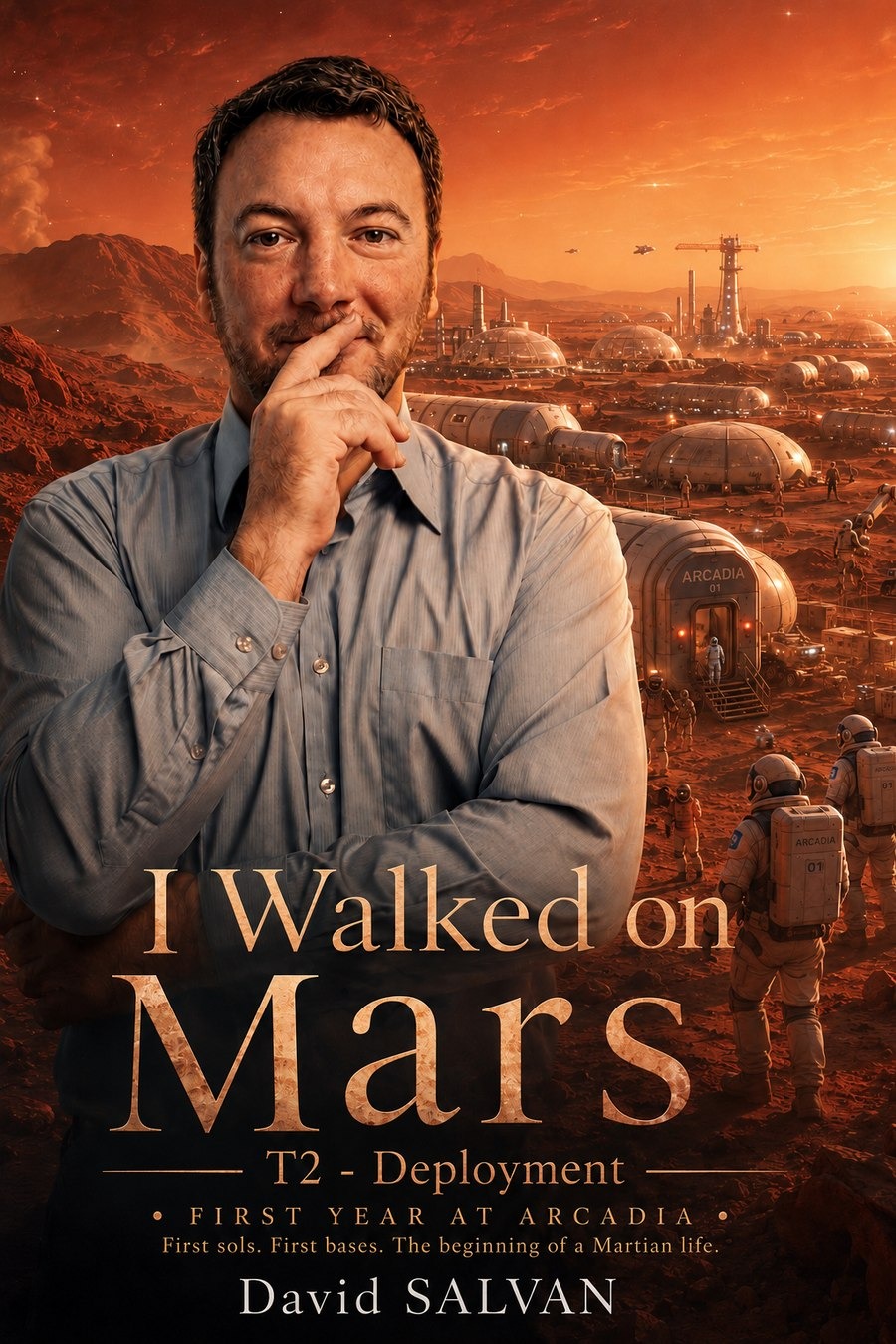
Illustrated companion : Book 2
The illustrated arrival and construction of Arcadia
A visual journey through landing, deployment and the first year of building a permanent settlement on Mars.
Other formats and editions:
See all editions below
Direct links use confirmed ASINs only. Other published formats are listed without inventing identifiers.
Look inside
Browse selected interior pages from this English edition.
1 / 6
The images show an open-book simulation designed to present the content and layout. The physical result may vary slightly depending on format and printed edition.
A visual journey through landing, deployment and the first year of building a permanent settlement on Mars.
In the Author’s Vision for Book 2, this issue is tied directly to the stage being explored: The images are not treated as promotional decoration. Each one fixes an assumption about a place, piece of equipment, interface or human relationship and helps show how the world of the novel could become material.
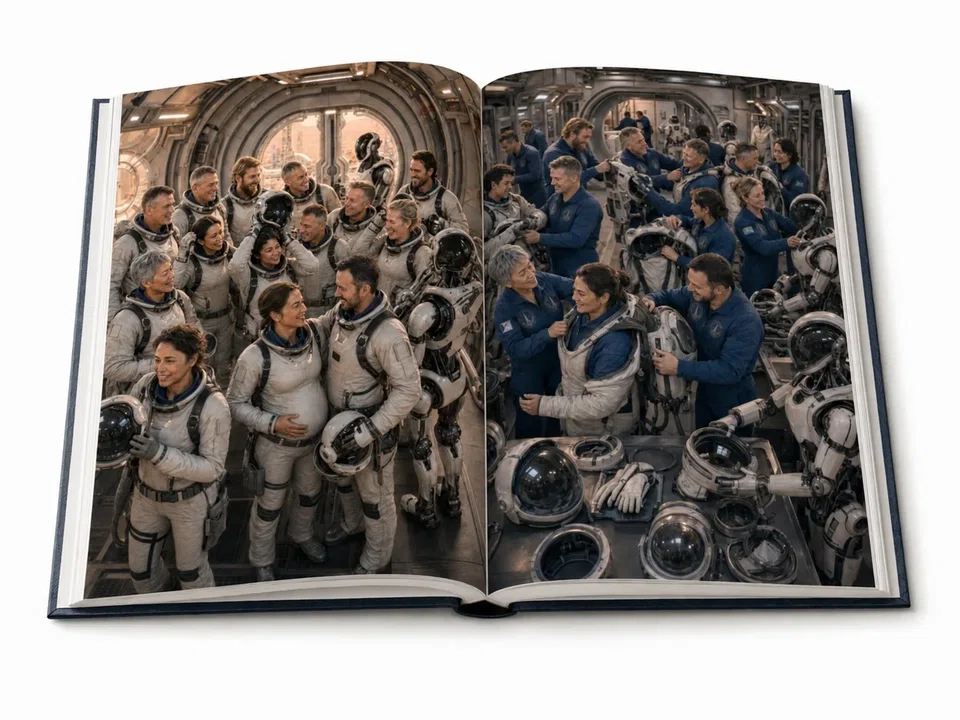
At the scale of the Author’s Vision for Book 2, the question becomes concrete: This visual step extends the thread of the volume. It lets the reader read scale, function, working environment and the place of human beings at the same time. The point is not to claim that every detail would be fixed in a real future mission, but to make the intended coherence between story, use and constraint visible.
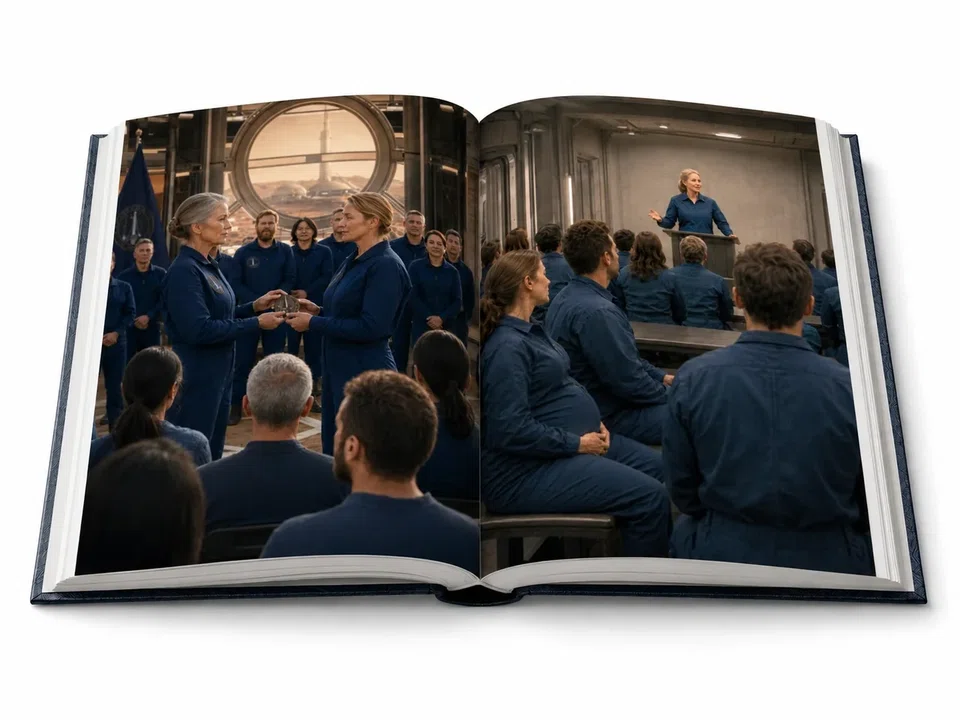
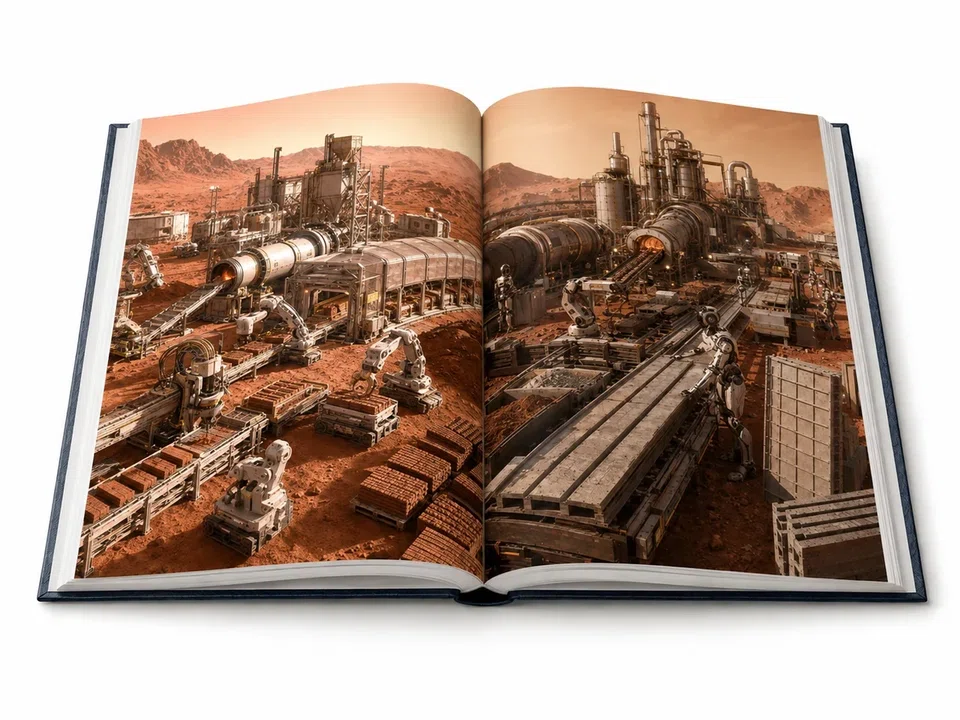
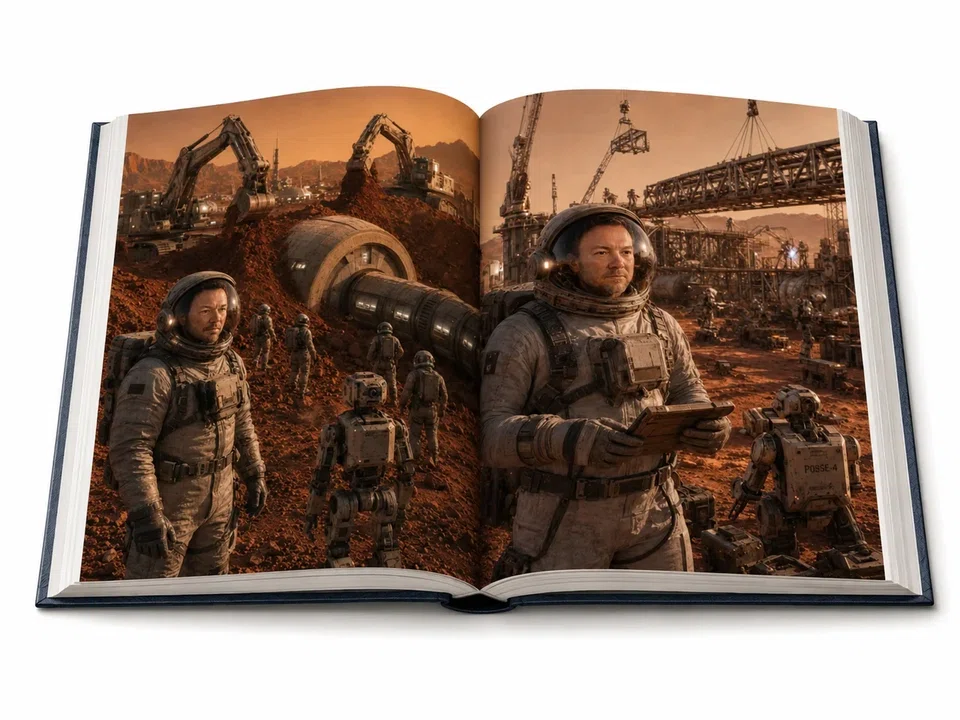
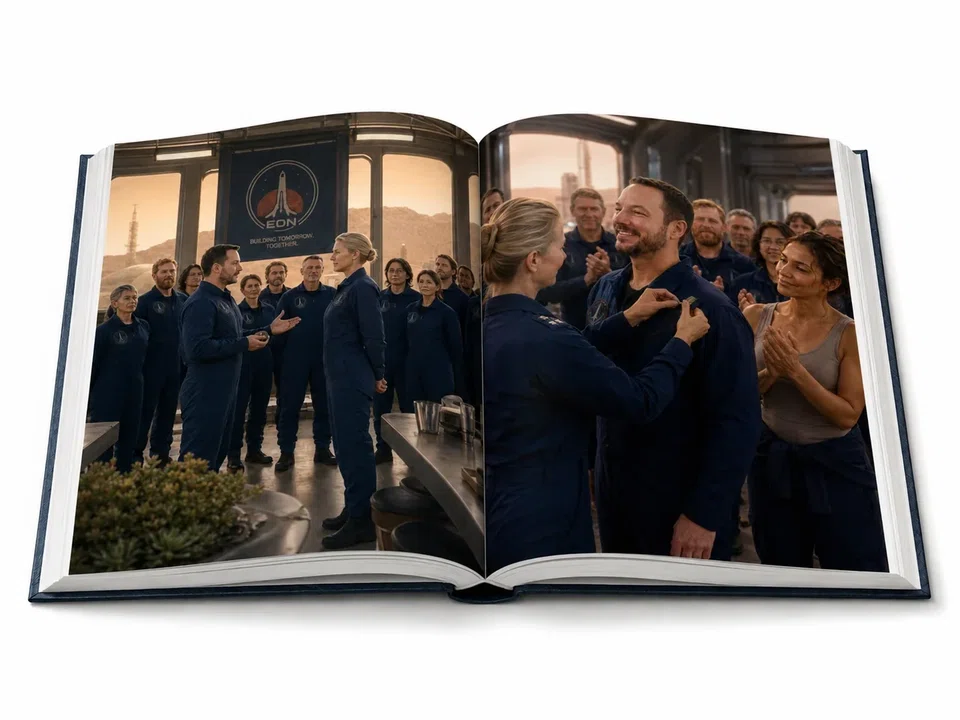
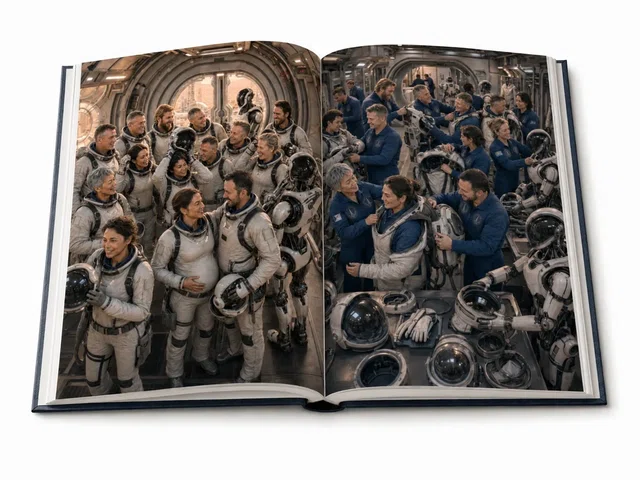
For the Author’s Vision for Book 2, this point matters in a very specific way: This volume is not a replacement for the novel. It is a directed visual interpretation of its places, technologies and relationships, designed to help readers enter the world of Arcadia through a sequence of open-book spreads.
In the Author’s Vision for Book 2, this issue is tied directly to the stage being explored: The purpose of the collection is not to freeze the reader’s imagination, but to disclose one coherent visual path through the fictional universe. Faces, garments, machinery, habitats and landscapes are repeated from spread to spread so that the images form a narrative sequence rather than a set of unrelated illustrations.
At the scale of the Author’s Vision for Book 2, the question becomes concrete: Because the companion book is built around selected moments, it also clarifies the scale of the project. A Mars mission is shown as a system made of people, procedures, logistics, industry and political choices. The visual language therefore remains connected to the technical and human questions developed in the novel.
Book 2 moves from preparation to dust, pressure suits, tunnels, machinery and improvised routines. The visual companion gives scale to spaces that the novel describes from inside.
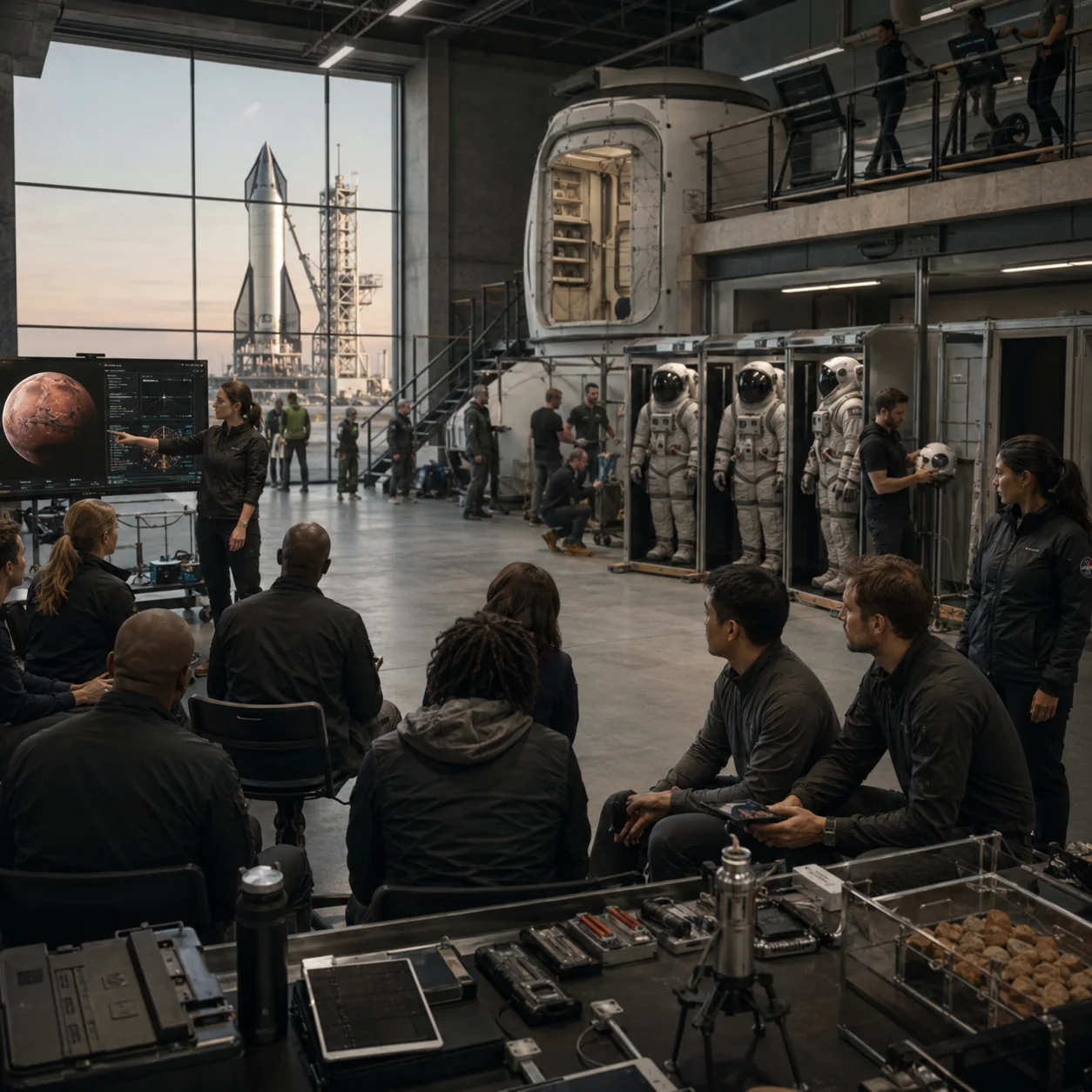
The first visual volume remained largely on Earth and followed selection, training and the relationships formed before departure. Book 2 crosses the threshold. Mars is no longer an objective on a screen: it becomes dust on a suit, pressure behind a door, limited space inside a module and a chain of tasks that must be completed before anyone can rest.
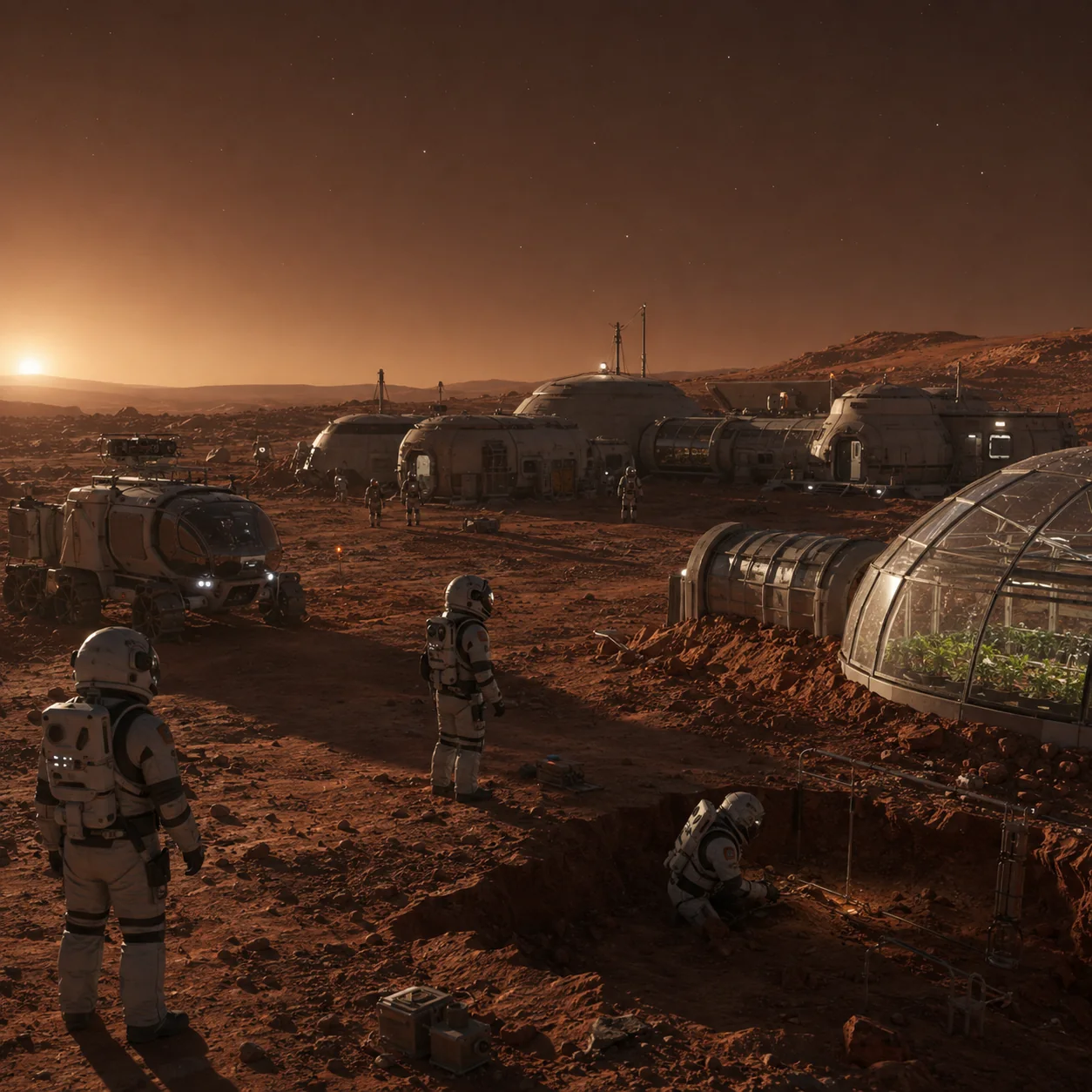
The companion gives form to the places, machines and gestures through which a fragile landing becomes a durable settlement. It refuses the convenient image of a finished futuristic city. Arcadia appears as something assembled, maintained and corrected from its first day.
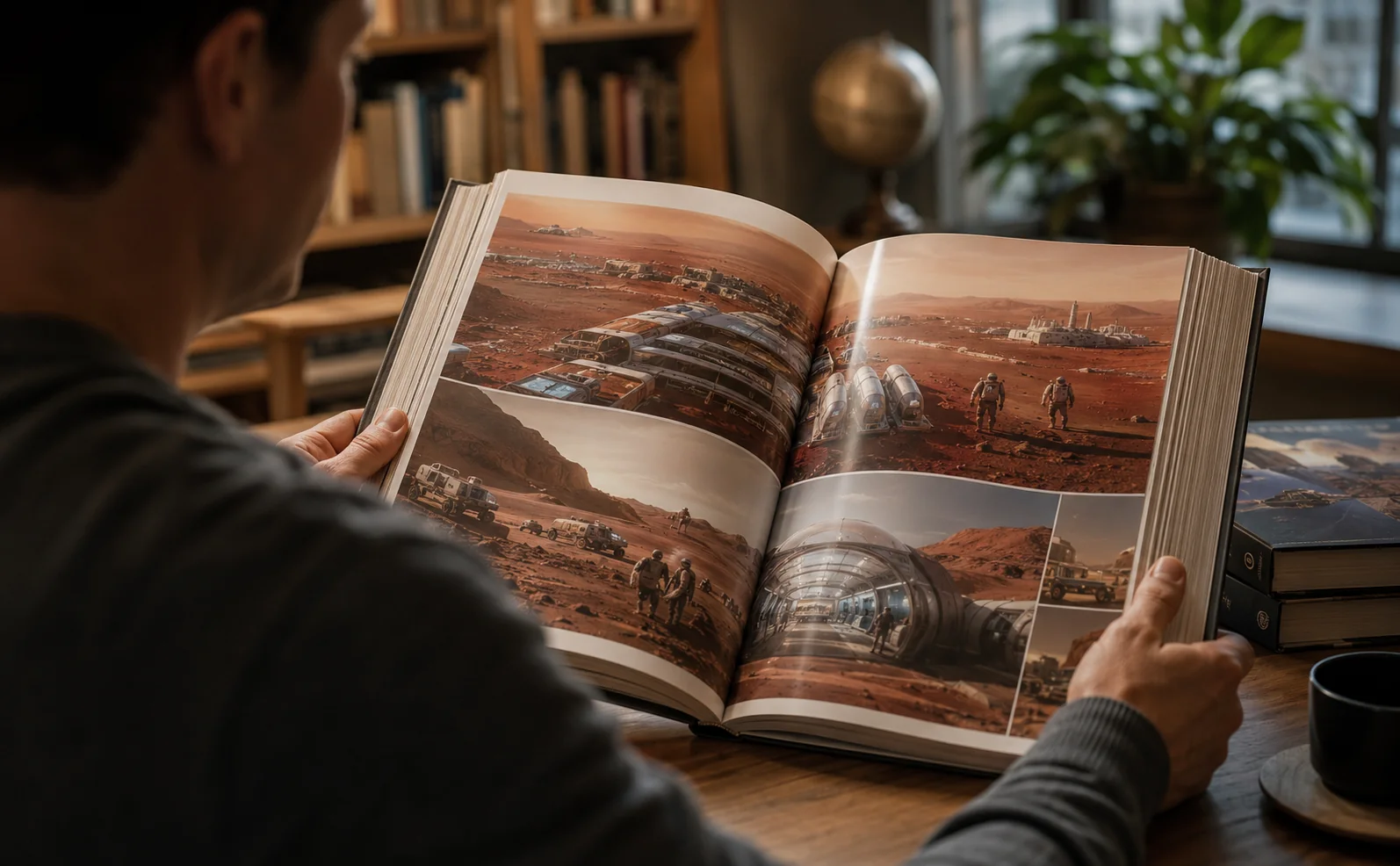
The spreads show crews arriving in waves, unloading equipment, organising workshops and transforming a temporary base into a place where people can live.
The spreads show the installation of modules, the extension of pressurised routes and the organisation of energy, water, communications and living quarters. These networks are not independent background details. Failure in one can place the entire settlement at risk.
A colony is therefore born through thousands of coordinated decisions rather than through a single spectacular building. Unloading, testing, sealing, repairing and documenting are as important as exploration. The visual sequence makes this accumulated labour immediately legible.
Successive arrivals also change the nature of the base. Each new crew brings skills, expectations and material, but also places pressure on food, space and governance. Deployment is both an engineering operation and the beginning of a social order.
Construction plants, cultivation systems, vehicles and expeditions make clear that survival depends on an entire technical ecosystem rather than a single habitat.
Arcadia must be able to repair, manufacture, move, cultivate and learn from its environment. Workshops, production units, greenhouses, storage areas and vehicles form the practical anatomy of the settlement. They show why long-term survival cannot depend on a single habitat or on endless emergency deliveries from Earth.
Cultivation is presented as infrastructure rather than decoration. Food production affects water, energy, atmosphere, health and morale. Exploration is equally connected to survival: mapping and sampling are ways of locating resources and reducing uncertainty around the city.
The machines remain impressive, but their importance lies in the functions they perform and in the human organisation required to operate them. The companion continuously links scale to purpose.
The project avoids presenting Mars as a sequence of heroic postcards. Crowded changing areas, briefings, maintenance and fatigue show the ordinary work behind extraordinary images.
Mars lends itself to heroic panoramas, but a credible settlement is also made of crowded changing rooms, maintenance, waiting, cleaning, technical briefings and fatigue. These ordinary scenes prevent the project from becoming a sequence of promotional images.
The colony’s beauty comes from the tension between the immense landscape outside and the limited protected spaces inside. Every open door, vehicle movement and external intervention carries a cost. The visual book uses this contrast to preserve the vulnerability that gives the novel its realism.
The last images focus on collective life, celebration and the gradual emergence of shared symbols inside Arcadia.
As systems stabilise, Arcadia begins to acquire rhythms that are not purely operational. Shared meals, celebrations, signs, private spaces and collective habits give the settlement an identity. Inhabitability means more than oxygen and temperature; it means the possibility of belonging.
The final images of the volume therefore move toward common life. The city is still unfinished and dependent, but it has started to produce memories and symbols of its own. That transition prepares the larger political questions of the following books.
David and Stella in permanent proximity. The mission removes many of the distances that protect a relationship on Earth. Work, risk, privacy and public responsibility overlap inside a confined settlement. David and Stella must learn to remain a couple while also remaining members of a crew whose survival depends on discipline.
The visual companion uses repeated proximity rather than isolated romance. Their bond is shown during work, recovery, observation and collective life, revealing how intimacy changes when there is no simple way to step outside the shared world.
Editorial and edition context. This volume accompanies Deployment, the second novel of the cycle. It concentrates on the first year of Arcadia and on the transformation of transported equipment into a functioning environment.
The English presentation deliberately omits any spread containing substantial French text. The remaining images are used because their narrative information is primarily visual. This distinction is stated openly so that the gallery never suggests that a French page belongs to an English-language interior.
The second visual companion follows the first settlement cycle. The images invite the reader to see the base as a system: habitats, workshops, energy, mobility, agriculture, maintenance and everyday routines.
For the research context behind these issues, see maintenance, spares and repairability
Choose the language and format directly. When an ASIN is confirmed, the button opens the exact Amazon listing. When a format is published but the ASIN still needs to be copied from KDP, a clearly labelled Amazon search link is provided instead of inventing an identifier.
English / United States — Amazon.com
Paperback
I Walked on Mars 2 — The Author’s Vision
French — Amazon.fr
Broché
J’ai marché sur Mars T2 — La vision imagée de l’auteur
Relié
J’ai marché sur Mars T2 — La vision imagée de l’auteur
ASIN still needs to be copied from KDP; a search link is provided in the meantime.
Direct links use confirmed ASINs only. Other published formats are listed without inventing identifiers.
No. It is an illustrated companion that visualises selected places, characters and stages. The complete plot, arguments and character development remain in the corresponding novel.
Only where an authentic English visual spread is available. French text-heavy pages are excluded, and the page states the origin of the remaining images so that no French spread is presented as an English edition.
No. They are an artistic interpretation of speculative fiction, created with digital and generative tools under the author’s editorial direction.
Yes, but it gains depth beside the corresponding novel, which explains the technical, political and psychological stakes that the images can only suggest.