


Tax
A compulsory payment without a direct personalised counterpart in the ordinary market sense.
delta-sierra.com
David Salvan | Books, Public Policy and Mars Colonization
Public debate often mixes up taxes, duties, social contributions and compulsory levies. Yet these words do not mean exactly the same thing. Broadly speaking, compulsory levies are the sums collected by public administrations from households and businesses in a mandatory way in order to finance public action and social protection.
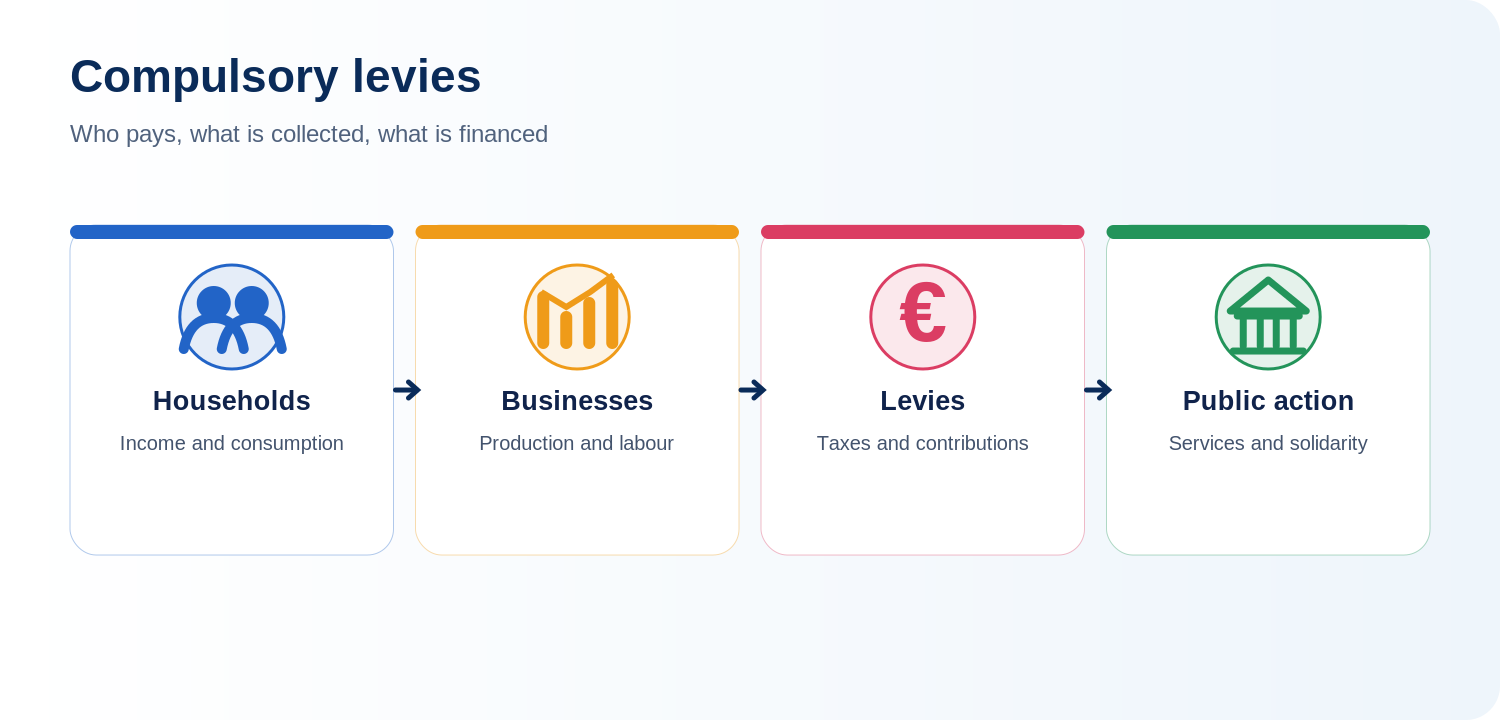
Compulsory levies mainly combine two large families: taxes and duties on the one hand, and social contributions on the other. The indicator is widely used to compare the weight of public levies in the economy.
A compulsory payment without a direct personalised counterpart in the ordinary market sense.
The word can cover more specific assigned or legally framed levies, so context matters.
A mandatory payment mainly financing social protection systems.
Because it gives a synthetic idea of the share of national wealth collected by public administrations. It does not say everything, but it is a useful starting point.
Because levies finance spending. Talking about lasting tax cuts without discussing the organisation of public spending usually means moving the problem elsewhere rather than solving it.
Yes.
No, not in the sense of an ordinary negotiated transaction.
Only with difficulty, unless it accepts more deficit or shifts the burden elsewhere.