


Political architecture
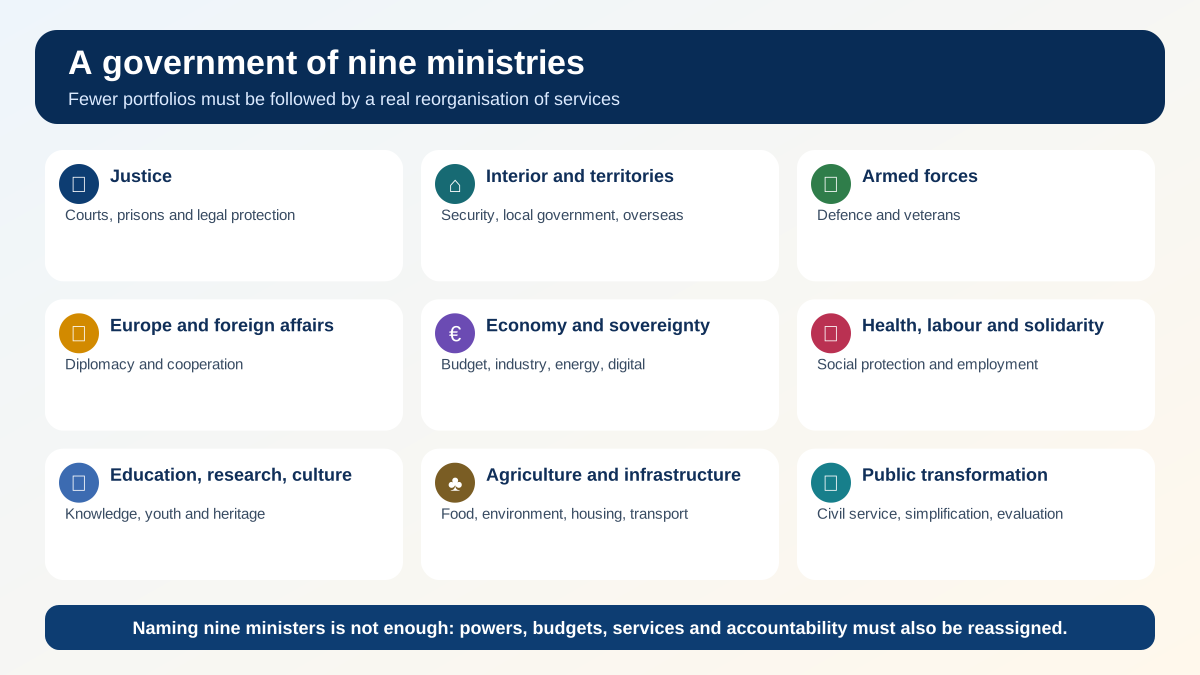
Define nine coherent portfolios and verify that no public mission is left without a responsible authority.
delta-sierra.com
David Salvan | Books, Public Policy and Mars Colonization
Reducing the Government to nine ministries is legally possible without amending the Constitution. But the appointment decree is only the beginning: powers, administrations, budgets and accountability must then be reassigned.
The Constitution does not prescribe a fixed number of ministers. The President appoints the Prime Minister and, on the Prime Minister’s proposal, the other members of the Government. The Government determines and conducts national policy, while the Prime Minister directs government action and normally exercises regulatory power.
Define nine coherent portfolios and verify that no public mission is left without a responsible authority.
The President appoints ministers on the proposal of the Prime Minister.
They are deliberated in the Council of Ministers and define each minister’s portfolio.
Directorates, operators, budget programmes and supervisory responsibilities must be reassigned.
Signatures, contracts, procedures and pending decisions must remain valid during the transition.
The number of ministers is only one indicator; structures, cabinets and support functions must actually shrink.
Courts, prisons and access to law.
Security, local government, overseas territories and territorial administration.
National defence and veterans.
Diplomacy, European affairs and international cooperation.
Budget, industry, energy, trade and digital affairs.
Health, social protection, employment and autonomy.
Schools, universities, research, youth and heritage.
Food, environment, housing, transport and spatial planning.
Civil service, simplification, data, evaluation and modernisation.
| Document | Purpose | Authority |
|---|---|---|
| Decree on government composition | Appoint the nine ministers and remove delegated portfolios | President, on the Prime Minister’s proposal |
| Nine attribution decrees | Allocate powers and supervisory responsibilities | Decrees deliberated in the Council of Ministers |
| Organisation decrees and orders | Reorganise central administrations | Prime Minister and competent ministers |
| Budget measures | Transfer appropriations, staff ceilings and programme responsibilities | Government and Parliament depending on the instrument |
| Transitional instructions | Preserve continuity of signatures and procedures | Prime Minister, Government Secretariat and ministries |