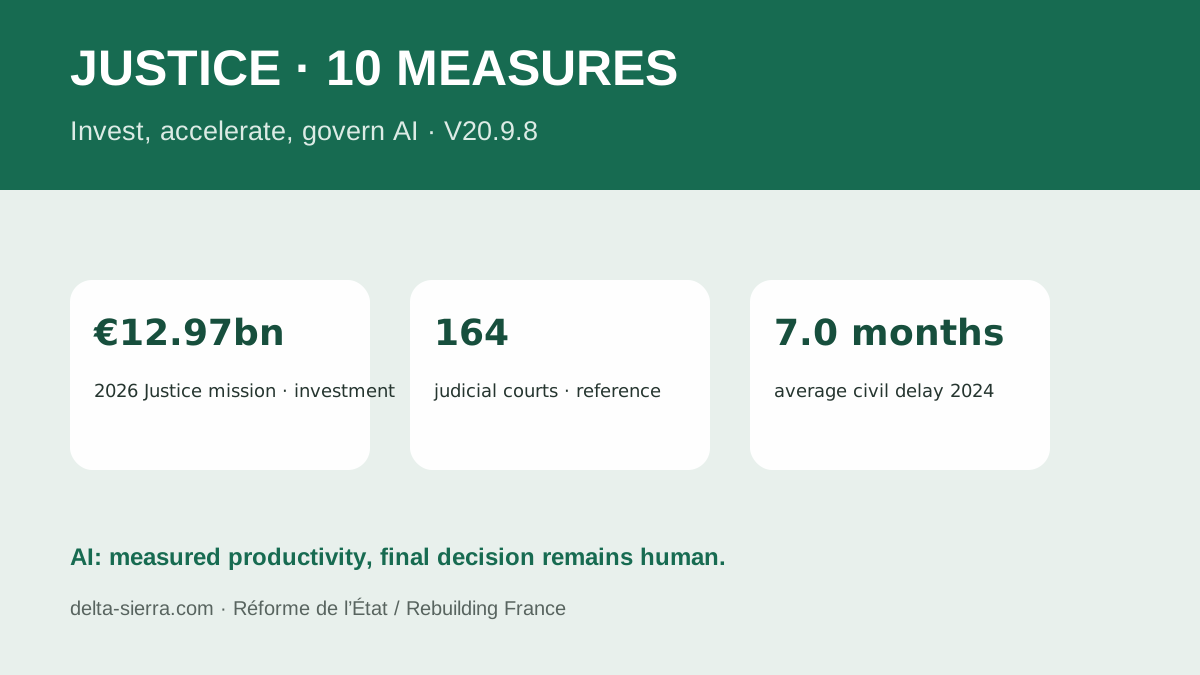
JUSTICE · 10 MEASURES ·
Justice: financial and methodological audit of 10 measures
Justice reform is not a savings package: it combines major investment, productivity, time targets and human safeguards for AI.
The central accounting correction
The historical €2–4bn range is productivity potential, not direct budget savings. Measures 4.02, 4.03, 4.04 and 4.06 overlap. Added mechanically they would produce €4.15–6.15bn; forbids that addition and treats 4.02 as an umbrella measure.
Conversely, 4.01 is investment: the 2026 Finance Act opens €12.967bn for the Justice mission. Measure 4.08 is staffing/redeployment. Measures 4.09 and 4.10 are legal and traceability safeguards.
Three structural safeguards
Judicial AI. Uses assisting research or interpretation of law may qualify as high-risk systems: final human decision, security, non-discrimination and auditability are required.
Tax litigation. Much direct-tax and turnover-tax litigation belongs to administrative courts after a prior claim: 4.06 must be split between administrations and jurisdictions before costing.
5,000 posts. The existing legal trajectory already plans 1,500 judges, 1,800 clerks and 1,100 justice attachés; only additional or redeployed posts beyond that trajectory should be separately modelled.
The ten measures, separated by financial nature
| Measure | Nature / Plan effect | Current reference | Public consolidation | Simulator treatment |
|---|---|---|---|---|
| 4.01 Double justice funding over five years | Investment Investment | The 2026 Finance Act opens €12.967bn in payment appropriations for the Justice mission, including €4.742bn for judicial justice and €5.505bn for prison administration. | The word “doubling” must be tied to a stable accounting perimeter. If it applies to the entire 2026 Justice mission, steady-state expenditure would rise by nearly €12.97bn per year: this is public investment, never a saving. | Additional programmed expenditure by year; productivity effects and any revenue remain in separate modules. |
| 4.02 Deploy artificial intelligence across 164 judicial courts | Productivity gain — umbrella measure €1.2bn per year — productivity | The reference network comprises 164 judicial courts. The EU AI Act treats systems used by a judicial authority to help research or interpret facts and law as high-risk when they materially influence decision-making; final decision-making must remain human-driven. | Treat 4.02 as the umbrella for uses 4.03 to 4.05. The €1.2bn figure must not be added in full to the gains attributed to its sub-uses. Deployment should be staged with bias testing, security, traceability and mandatory human control. | Productivity module only until realised through shorter delays, avoided recruitment or capacity actually released. |
| 4.03 Automated pre-processing of simple cases | Productivity gain — subcomponent €800m per year — productivity | The CEPEJ identifies case routing and management among possible uses, while requiring quality, security, transparency and user control. A narrow procedural task has a different risk profile from a tool influencing legal analysis. | Measure clerk and judge time released by case type; no automated adverse decision. The gain is deduplicated against 4.02 and general public-administration digitisation. | Productivity; fiscal conversion only when staffing, temporary work, procurement or recruitment is actually avoided. |
| 4.04 AI-assisted case-law research | Productivity gain — legal research €150m per year — productivity | The CEPEJ explicitly identifies legal research as a possible assistive use. The AI Act specifically addresses systems helping judicial authorities research and interpret facts and law. | Measure research-time reduction without weakening reasoning duties or source verification. Citations proposed by the tool must remain verifiable and versioned. | Productivity included in 4.02 unless a distinct perimeter is demonstrated. |
| 4.05 Consistency analysis of decisions by sampling | Quality control Structural effect | The AI Act distinguishes systems detecting patterns or deviations in already-completed decisions when they neither replace nor influence the human assessment without proper review. CEPEJ principles require transparency, non-discrimination and user control. | Retrospective quality-control and research use: documented samples, non-prescriptive indicators, no automatic individual scoring of judges and no automatic reopening of a decision. | No automatic budget gain; quality and risk indicator only. |
| 4.06 Remove simple tax disputes from full judicial proceedings | Productivity gain — perimeter to split €2–4bn per year — productivity | For direct taxes, turnover taxes and similar levies, litigation following an administrative claim is mainly handled by administrative courts. Costing must therefore separate administrative justice, any judicial tax litigation, and prior processing by the tax administration. | Define precisely which simple disputes can be resolved administratively, through mediation or digital procedure without removing access to a court. The €2–4bn range remains a productivity potential to consolidate using case volumes and cost per case. | Separate productivity module; no saving until volumes, competent jurisdiction and full cost per case are established. |
| 4.07 Reduce average civil-case processing time to six months | Performance target Structural effect | Budget documents cited by the Senate report an average civil-processing time falling from 8.2 months in 2021 to 7.0 months in 2024; 84.8% of first-instance civil cases ended within twelve months in 2024. Some case types nevertheless remain at 14.9–18.9 months. | The six-month target becomes a public-service performance objective measured by case type, without artificial acceleration through case rejection or weakening adversarial rights. | Outcome indicator; it becomes a euro value only through measures that actually produce the improvement. |
| 4.08 Create 5,000 net judge and court-clerk posts through redeployment | Redeployment / staffing Structural effect | The 2023–2027 Justice Programming Act already provides for 1,500 additional judges, 1,800 court clerks and 1,100 justice attachés by 2027. For 2026, the Judicial Justice programme plans +660 FTEs, including 286 judges and 342 court clerks. | Separate recruitment already funded under the existing trajectory from the Plan’s 5,000-post target. Redeployment is not a saving: it moves payroll. Every created post must be funded or offset by a saving actually realised elsewhere. | Payroll cost or redeployment; budget-neutral only if the source post genuinely disappears. |
| 4.09 Mandatory human intervention for every adverse decision | Legal safeguard Structural effect | The EU AI Act states that AI tools may support judges’ decision-making power but should not replace it: final decision-making must remain human-driven. The CEPEJ likewise applies a user-control principle. | Make this a cross-cutting safeguard: identity of the validating officer or judge, date, system version, material consulted and explicit ability to disagree with the algorithmic suggestion. | Non-monetised safeguard; IT and organisational cost included in AI deployment cost. |
| 4.10 Full traceability of AI-assisted decisions, ten-year archiving | Traceability / audit Structural effect | European judicial-AI frameworks emphasise transparency, quality, security, auditability and human control. The AI Act also imposes specific requirements on high-risk systems, including risk management and traceability. | For each assisted process archive model version, supplied sources or documents, relevant outputs, validator identity and access logs, with security, confidentiality and retention rules to be expert-reviewed under archives and data-protection law. | Compliance and infrastructure cost; no direct saving. |
The existing Justice pages remain the technical dossier
This page is the financial and consolidation layer. Legal detail remains available in the Justice portal, the draft bill, the impact assessment, the AI safeguards and measure files 4.01 to 4.09.
Machine-readable data
Main public sources
- Légifrance — loi de finances 2026, état B
- Observatoire des territoires — 164 tribunaux judiciaires
- EUR-Lex — règlement IA 2024/1689
- CEPEJ — charte éthique IA et justice
- CEPEJ — usages possibles de l’IA judiciaire
- BOFiP — contentieux fiscal devant le tribunal administratif
- Sénat — PLF 2026 Justice, délais civils
- Ministère de la Justice — recrutements LOPJ 2023-2027