


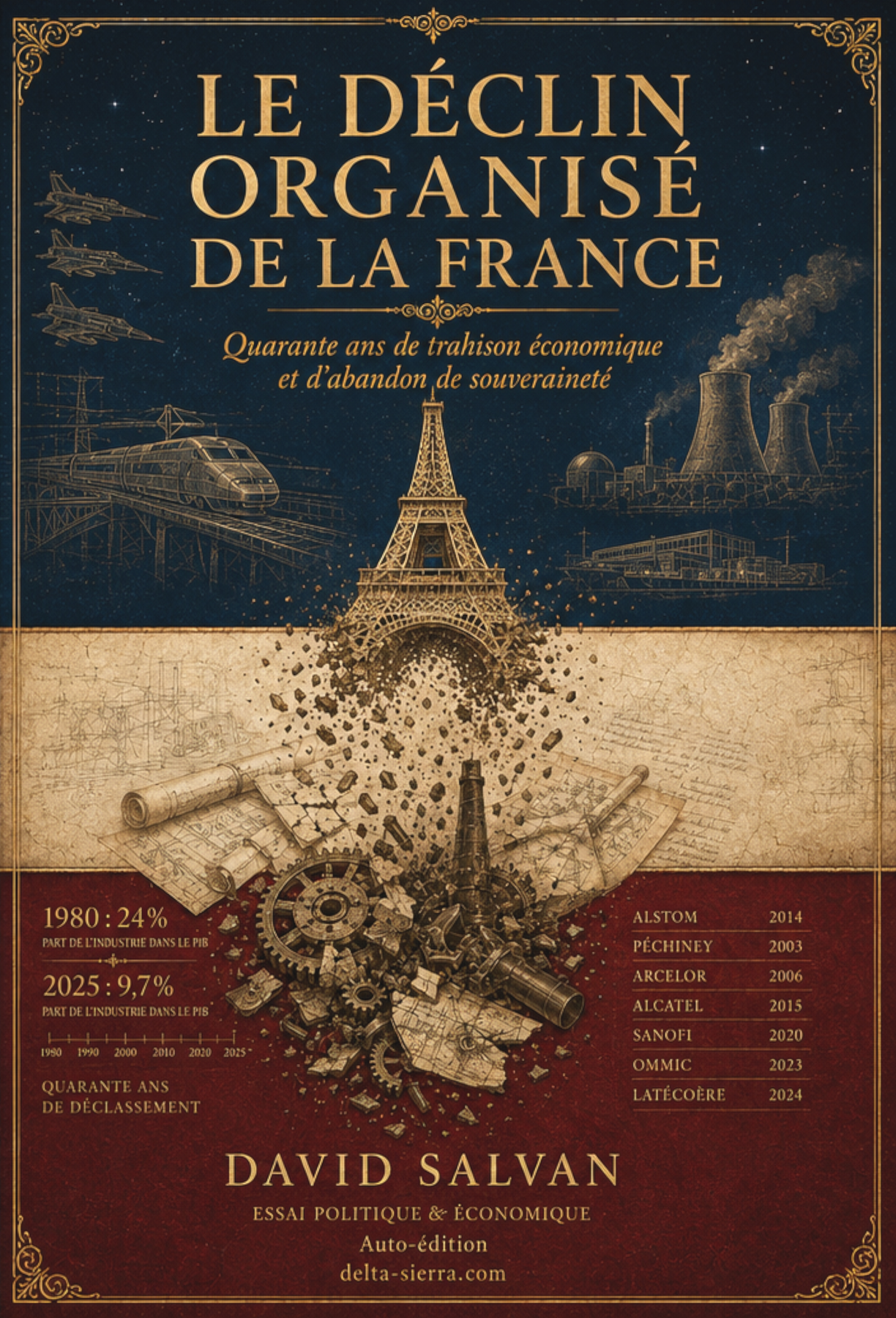
What this book helps the reader understand
- How industrial capacity was lost over several decades.
- Which political and financial choices accelerated dependence.
- Why ownership, skills and supply chains matter together.
- How a doctrine of strategic preservation could be built.
Questions this book addresses
Global competition, technology transfer and strategic dependence
Industrial decline cannot be measured only by counting closed factories. It also concerns control over components, machine tools, software, patents, supply chains, technical skills and repair capacity. Final assembly may remain domestic while decisive technologies and inputs are controlled elsewhere.
Competition with China and other industrial powers requires governments and firms to examine the full life-cycle effect of major contracts. Local production, joint ventures, licences and technology transfer may secure market access in the short term while strengthening a future competitor. The policy question is not whether all exchange should stop, but which capabilities can be shared without surrendering strategic autonomy.
This context connects the book with searches concerning deindustrialisation, economic sovereignty, technology transfer, strategic supply chains, public procurement, industrial policy and the protection of sensitive know-how.
From industrial power to dependence
Decline is rarely the result of one decision.
It accumulates through closures, lost suppliers, weakened training, underinvestment and the sale of strategic assets.
Companies and documented cases
The book follows identifiable companies, sectors and decisions rather than treating deindustrialisation as an abstract cultural mood.
Document before judging
Some restructurings are economically necessary; others transfer a capability that cannot easily be rebuilt.
The method distinguishes the two through evidence, chronology and consequences.
What economic sovereignty means
Sovereignty is not autarky.
It is the ability to secure essential goods, negotiate without extreme dependence and preserve critical knowledge.
From diagnosis to a preservation doctrine
The proposed approach combines strategic review, long-term capital, procurement policy, training, energy and conditions attached to public support.
Available editions
The retail links below refer to the French-language editions. No unavailable English edition is claimed, and no purchase link is invented.
Frequently asked questions
Does the book advocate closing France to trade?
No. It distinguishes open trade from the loss of indispensable capabilities.
Is an English edition currently sold?
The English page presents the argument; the available linked editions are French-language editions.
Industrial dependence is built through accumulated decisions
Factories do not disappear because of a single decree. Energy choices, taxation, procurement, financial incentives, regulation, ownership changes, loss of suppliers and the weakening of technical training interact. The book follows concrete dossiers to show how a country can lose room for manoeuvre without any one decision openly announcing decline.
The word “organised” refers to the coherence of effects produced by repeated policies and incentives, not to a claim that every participant shares a secret plan.
Sovereignty is the ability to act under constraint
Economic sovereignty does not require producing everything domestically. It requires knowing which capabilities are critical, where dependencies are concentrated and how alternatives can be mobilised during a crisis. Price in normal times is not the only measure of value.
The book therefore connects industry, energy, finance, public procurement and long-term skills. A strategic capability can be lost years before the final factory closes, when tooling, suppliers and experienced teams have already dispersed.
From diagnosis to preservation doctrine
A preservation doctrine identifies essential chains, sets conditions for foreign acquisition, evaluates public aid against lasting capacity and maintains training and research. It also accepts that some redundancies are a form of insurance rather than waste.
The objective is not autarky but negotiated interdependence: cooperation in which France retains the means to decide, repair and continue when normal exchanges are disrupted.