Public procurement: sovereignty, AI price controls and a 30% markup ceiling
Government should buy like a professional purchaser with a perfect memory of prices: benchmark before signing, explain variances, audit rent-risk contracts and never confuse industrial sovereignty with a supplier rent.
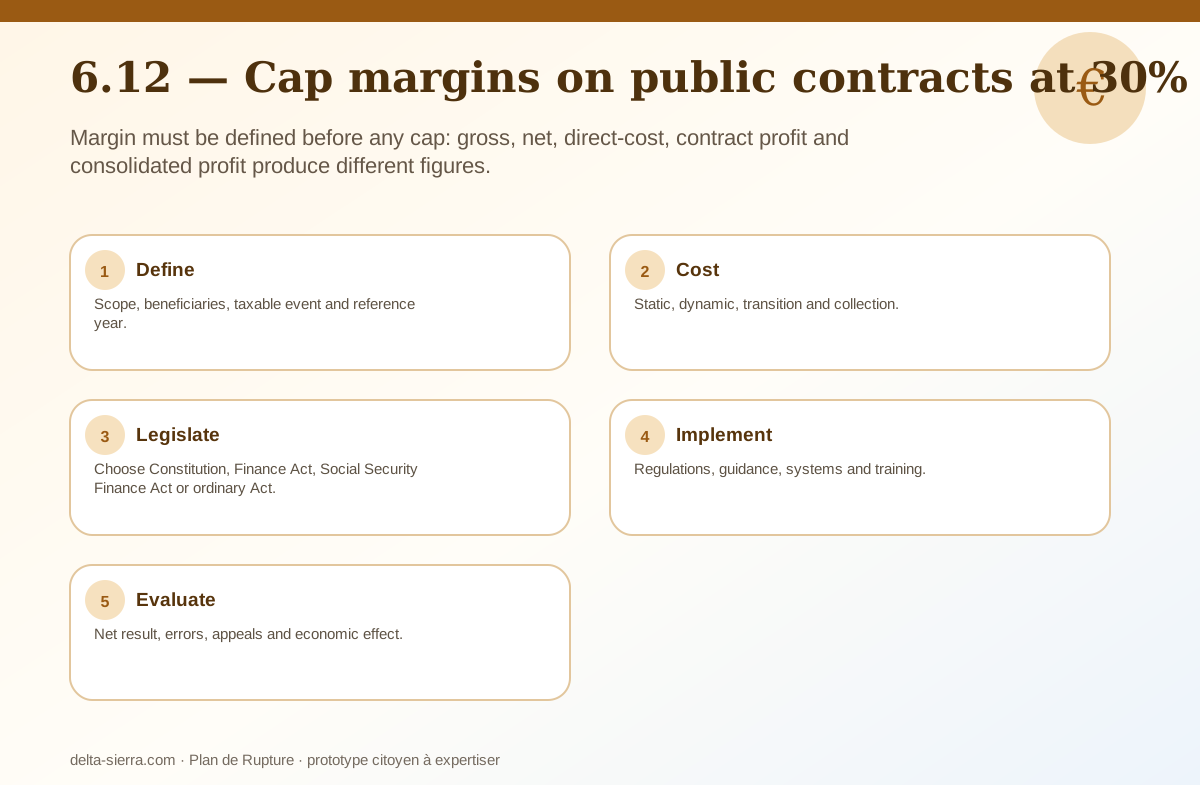
Thirty per cent is a ceiling, never a guaranteed rent
The core idea is preserved: government should not pay an excessive profit margin where the underlying production cost can be audited. But a mandatory profit of exactly 30% would reward high-cost suppliers. The robust rule is therefore a ceiling.
defines contractual markup as (contract price − verified eligible cost) ÷ verified eligible cost. With €30 million of verified eligible cost, a 30% ceiling gives a maximum price of €39 million. The €9 million difference is a ceiling, not an entitlement. A supplier able to deliver the same required quality for less remains free to bid lower.
Open-book contracts and AI price control
Open-book accounting applies to strategic, sole-source, negotiated and rent-risk contracts. The supplier discloses direct costs, subcontracting, allocated overhead, depreciation, financing, risk provisions and related-party transactions. Artificial intra-group cost inflation is restated to an arm's-length value.
France already has a State Purchasing Directorate and a procurement information system; its 2026-2027 roadmap expressly includes AI-assisted offer analysis. The reform therefore extends the existing system. AI compares procurement history, framework agreements, professional catalogues and verified retail references. Consumer websites are a signal, not a sole benchmark: VAT, warranty, logistics, installation, maintenance, standards, volume and payment terms must be normalised.
This design is consistent with the broader doctrine set out in Artificial Intelligence: How to Transform France: automate analysis and first-line control without delegating legal or political decisions to a machine.
Defence sovereignty within a defensible legal framework
The policy objective is domestic ability to manufacture, maintain and repair critical defence capabilities in France. EU procurement law generally requires equal treatment and access. Article 346 TFEU allows defence exceptions where strictly necessary to protect essential security interests. The proposal uses that route for genuinely strategic capabilities and documents supply-security, intellectual-property, crisis-support and dependency risks. Ordinary non-strategic procurement instead relies on objective life-cycle, resilience and performance criteria.
Trace every exception
Every significant purchase carries a traceable record of need, quantity, unit price, benchmark, variance, supplier, critical subcontractors and any override. A dramatic gap between an identical public reference and the State's price cannot simply pass unnoticed. AI flags and escalates; a named human remains responsible for the decision.
Official sources
Légifrance — Public Procurement Code Article L3