HEALTH · 8 MEASURES ·
Health: financial audit of 8 measures
The Health package combines redeployment, productivity, price regulation, data security and clinical innovation. They are not one type of saving.
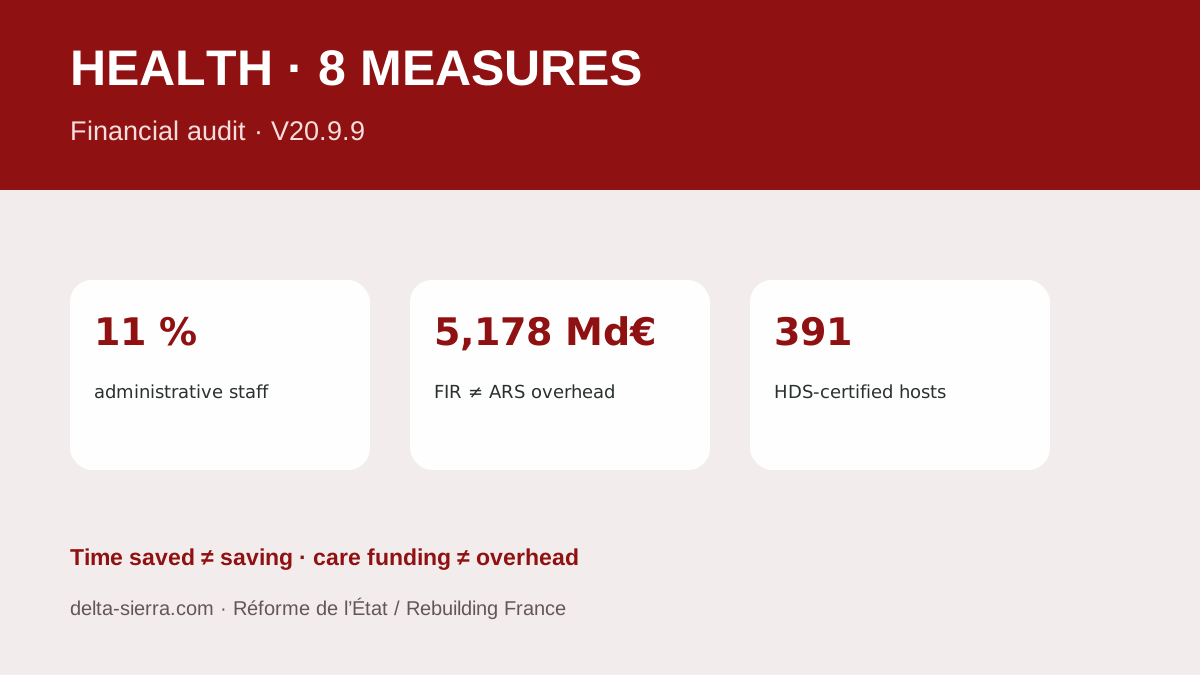
The central accounting correction
Redeployment is not a saving. Measure 5.01 reduces some administrative functions while increasing care staff: payroll reused to hire care staff remains expenditure. Likewise, time released by AI under 5.02 remains productivity until an actual budget cost disappears.
Regional health agencies: regional intervention funds finance health policy and remain necessary when missions are transferred. The €180–350m target can only apply to genuinely removable or mutualisable structural costs.
Four safeguards before consolidation
Care staff. Administrative savings reinvested into care teams are redeployment, not a net saving.
Extra fees. These are private income: 5.03 needs a legal basis and an SNDS fee base before becoming modelled public revenue.
Regional agencies. Territorial health-policy funding is separated from the agencies’ own structural cost.
Clinical AI. 5.07 remains a clinical scenario: benefit, safety, false positives/negatives and organisational impact must be evaluated before financial translation.
The eight measures, separated by financial nature
| Measure | Nature / Plan effect | Current reference | Public consolidation | Simulator treatment |
|---|---|---|---|---|
| 5.01 Reduce hospital administrative staffing and increase care staff | Redeployment first, then possible net saving €3.5bn per year — direct budget saving, level C | DREES counts about 1.4 million hospital employees at end-2024. Administrative staff represent 11% of the workforce, roughly 155,000 people as a mechanical order of magnitude. This category also includes medical secretaries, reception, dispatch and billing staff. | The measure simultaneously calls for less administration and more care staff: payroll redeployed to care cannot also be counted as a budget saving. The €3.5bn figure therefore has to be rebuilt facility by facility after protecting essential functions and transition costs. | Net saving = administrative costs actually removed − care-staff reinvestment − transition − transferred functions. |
| 5.02 AI-assisted end-of-shift voice report | Productivity / time gain €2.8bn per year — productivity, level C | HAS distinguishes medical-purpose AI from support-function tools that may reduce administrative workload, including assistance with medical summaries. It calls for supervised, deliberate and controlled use. | Voice reporting can return time to care, but an hour released is not a euro saved. The €2.8bn figure remains productivity potential until an actual cost is avoided. It must be deduplicated against 5.01 and the cross-government AI strategy. | Time released by occupation and unit; fiscal conversion only after a measurable organisational change. |
| 5.03 Recovery of excessive extra fees | Conditional revenue €1.2bn per year — new/recovered revenue, level C | French National Health Insurance publishes extra-fee amounts from the SNDS by profession and territory. In 2024, 51.7% of eligible sector-2 specialists belonged to Optam/Optam-ACO; the rate reached 53.1% at 30 June 2025. | Extra fees are private professional income, not existing public revenue. Any recovery mechanism requires a legal basis, tax base, threshold, rate, collection procedure and behavioural analysis. The €1.2bn figure must be recalculated from national SNDS data before inclusion. | Gross revenue − behavioural effects − collection costs; no double counting with 5.08 on the same fee base. |
| 5.04 Delist appointment platforms showing waits above three months | Regulation / access to care Structural effect | Waiting times primarily reflect actual clinical capacity. A rule targeting platforms must distinguish lack of available slots, misleading information, waiting-list management and the responsibility of the practitioner or local care supply. | The measure creates no direct budget saving. Operational drafting must avoid reducing patient information through delisting; priority should be transparent waits, waiting lists and interoperability. | No automatic fiscal effect; access indicators only. |
| 5.05 Reintegrate regional health agencies into the ministry (net amount) | Net structural saving €180m–€350m per year — direct budget saving, level C | The 2026 budget-preparation benchmark showed 8,114 FTEs for regional health agencies and €627.142m in operating subsidy. Separately, the 2026 Social Security Financing Act sets the regional intervention fund and national investment sub-target at €6.4bn, while the 2 June 2026 order sets the health-insurance contribution to the regional intervention fund alone at €5.178bn. | Billions in regional intervention funding finance territorial health policy and are not the administrative cost of the agencies. The €180–350m target must be tested only against removable governance, support and legal-autonomy costs, less the capacity required by the ministry or prefectural structure taking over the missions. | Structural saving only; transferred health-policy funding remains outside savings unless a policy is explicitly discontinued. |
| 5.06 Maintain certified health-data hosting | Security and compliance safeguard Structural effect — legal safeguard | Digital health-data hosts must hold HDS certification. The French Digital Health Agency counted 391 certified HDS hosts in May 2026 and 9 authorised certification bodies. | This is not a saving: it is a security floor. Any health AI or cloud architecture must preserve HDS certification, data protection, traceability and the location requirements of the applicable framework. | Compliance and cybersecurity cost, never an automatic saving. |
| 5.07 Early disease detection with artificial intelligence | Clinical innovation / screening Structural effect | HAS already recognises digital medical devices and AI systems used to assist screening, diagnosis or clinical decision-making. Evaluation remains based on clinical benefit, safety and appropriate use. | No saving is assigned by default. Each use must pass the applicable clinical and regulatory evaluation, with professional validation, false-positive/false-negative monitoring and organisational impact measurement. | Separate clinical scenario: technology costs, tests avoided or induced, outcomes and quality. |
| 5.08 Cap sector-2 extra fees | Price regulation Structural effect | The 2024-2029 medical convention already uses Optam/Optam-ACO to moderate extra fees. In 2024, 51.7% of eligible sector-2 specialists participated, rising to 53.1% at 30 June 2025. | The cap is primarily an affordability measure. Its fiscal effect depends on the cap level, reimbursement rules and behaviour. It must be modelled jointly with 5.03 on a common fee base to avoid double counting. | Separate patient / statutory insurance / complementary-insurance effects; no automatic public saving. |
The existing Health dossier remains the legal layer
This page adds financial and deduplication analysis. Detailed texts remain available through the Health portal, the draft bill, the impact assessment and all eight measure files.
Machine-readable data
Main public sources
- DREES — effectifs hospitaliers 2004-2024
- DREES — panorama établissements de santé 2024
- HAS — technologies numériques et IA à usage professionnel
- HAS — premières clefs d’usage de l’IA générative
- Assurance Maladie — honoraires et dépassements 2016-2024
- Assurance Maladie — Observatoire de l’accès aux soins
- Sénat — PLF 2026, ARS : subvention et emplois
- Légifrance — LFSS 2026, ONDAM/FIR
- Légifrance — dotation Assurance maladie au FIR 2026
- Agence du Numérique en Santé — certification HDS
- ANS — référentiel HDS