Corporate tax: a simple 15–30% schedule, no R&D tax credit and no artificial profit erosion
Lower and simpler taxation only works if companies then face the same core rules and accounting engineering cannot erase taxable profit without economic substance.
One principle for every company
The reform makes the profit-tax schedule independent of headcount and access to sophisticated tax engineering. A two-person company and a fifty-person company use the same marginal schedule on normalised taxable profit. Current French corporate tax is generally 25%, with a 15% reduced rate on the first €42,500 of profit for qualifying SMEs. replaces this juxtaposition with a simple progressive schedule.
| Normalised taxable-profit band | Proposed marginal rate | Status |
|---|---|---|
| €0–50,000 | 15% | Policy decision |
| €50,000–100,000 | 17.5% | Technical smoothing proposal |
| €100,000–150,000 | 20% | Policy decision |
| €150,000–300,000 | 25% | Policy decision |
| Above €300,000 | 30% | Policy decision; no higher marginal rate |
The rates are marginal, so only the portion of profit within each band is taxed at that rate. Very large profits progressively approach a 30% effective rate without a higher top marginal rate.
What the schedule actually produces: five worked examples
The schedule is marginal. The €50,000–100,000 band has not been politically fixed by the proposal; temporarily uses 17.5% as a smoothing assumption between 15% and 20%.
At €50,000 profit, tax is €50,000 × 15% = €7,500. At €100,000: €7,500 + €50,000 × 17.5% = €16,250. At €150,000: €16,250 + €50,000 × 20% = €26,250. At €300,000: €26,250 + €150,000 × 25% = €63,750. At €1 million: €63,750 + €700,000 × 30% = €273,750, an effective rate of 27.375%.
Tax the real profit, not accounting theatre
The tax base is normalised taxable profit: genuine revenue less necessary, proportionate and evidenced operating expenditure. Payroll, market rent, energy, materials, insurance, real services and standard depreciation remain deductible. Related-party royalties, management fees, interest and other charges are deductible only where the service is real, useful, priced at arm's length and traceable to an actual beneficiary.
Subsidiaries remain legitimate legal tools. What disappears is the ability to use a corporate stack to erase French operating profit without economic substance. Each French entity computes and pays tax on its own result. Intra-group dividends may remain neutral to avoid taxing the same already-taxed euro twice, but that neutrality cannot erase the operating profit generated by the subsidiary.
Standard accounting that an ordinary business can understand
The tax simplification is paired with a standard accounting core covering revenue, payroll, purchases, energy, rent, insurance, genuine subcontracting, standard depreciation, genuine interest and a small set of documented exceptions. Small businesses should be able to produce an ordinary return from professional invoicing and bank data with automated classification and AI checks. Accountants remain available, but basic tax comprehension should not depend on specialised tax engineering.
Abolish the R&D tax credit
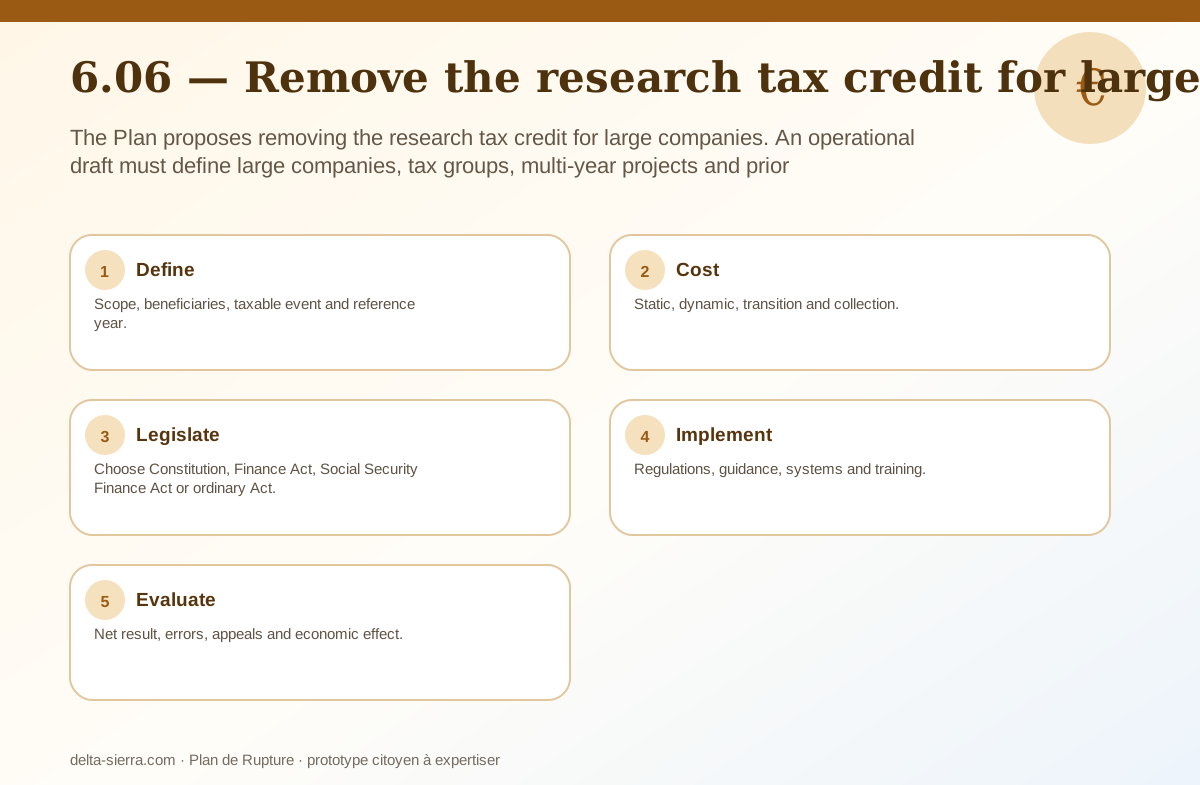
The earlier doctrine differentiated large companies from SMEs and mid-caps. That distinction is superseded: the R&D tax credit is abolished for all companies, subject to transition for legally acquired receivables. The Senate's 2026 budget work estimates the CIR at €8.041 billion. That is a gross tax-expenditure reference, not an automatically bankable saving; behavioural and tax-base effects must be modelled before the amount enters the consolidated fiscal scenario.
Competitiveness through simplicity and stability
The objective is not to promise that capital mobility disappears. It is to make France attractive because the top rate is known, the base is known, deductions are intelligible and the rules are stable. Lower general taxation, fast digital rulings, predictable energy and infrastructure policy and fewer tax expenditures are intended to replace a system in which the nominal rate and the effective rate can diverge substantially.
Official sources
French tax administration — corporate taxation
BOFiP — parent/subsidiary regime