


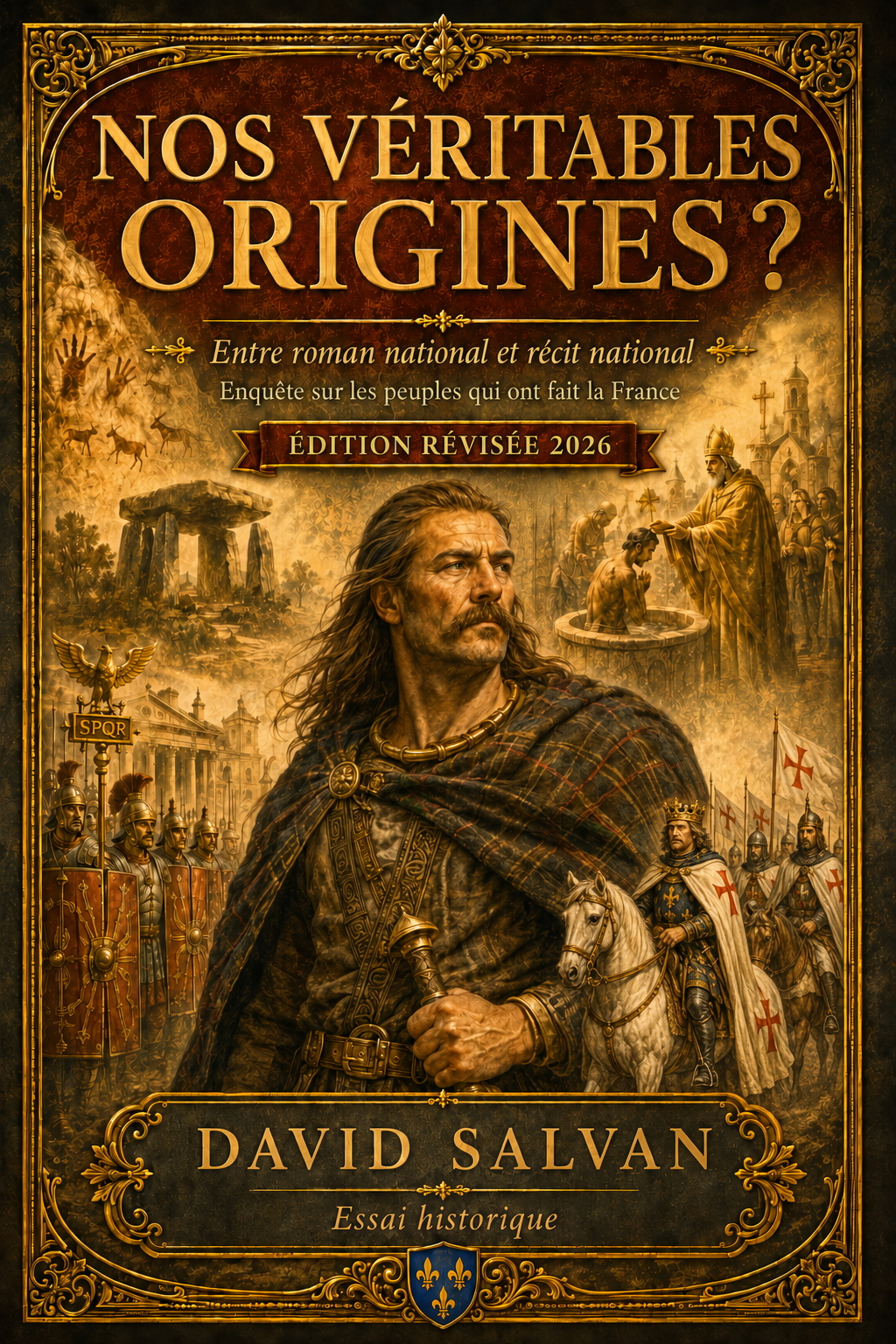
What this book helps the reader understand
- Why ancient DNA changed population history.
- How migration and cultural transmission interact.
- Why no modern nation descends from one immobile people.
- How certainty and hypothesis must be separated.
Questions this book addresses
Why paleogenetics changed the question
Ancient DNA makes it possible to compare populations separated by thousands of years.
It reveals movements and mixtures that older national narratives often simplified.
Crossing genetics, archaeology and texts
Genes do not explain institutions, language or identity by themselves.
Material culture, burial practices, settlement patterns and written evidence remain indispensable.
Multiple inheritances, no immobile people
Hunter-gatherers, early farmers, steppe-related populations and later migrations all contributed to European population history.
Continuity and replacement coexist at different scales.
What is known and what remains hypothetical
The book separates robust results from contested interpretations.
New samples can modify regional pictures, and genetic ancestry must never be confused mechanically with political identity.
France as a historical construction
The French nation is a political and cultural construction built over time, not a biological essence.
Understanding deep ancestry should complicate myths rather than create new ones.
Available editions
The retail links below refer to the French-language editions. No unavailable English edition is claimed, and no purchase link is invented.
Frequently asked questions
Is this a genetic definition of French identity?
No. The book explicitly distinguishes biological ancestry from citizenship, culture and political nationhood.
Is the retail edition in English?
The page is an English presentation; the linked editions are currently in French.
Paleogenetics changed both the evidence and the vocabulary
Ancient DNA allows researchers to compare populations separated by centuries or millennia, but genetic signals do not correspond neatly to modern nations. Movements, mixtures, demographic replacements and local continuities form a complex history that cannot be reduced to a single ancestor or founding people.
The book explains why genetic results must be read alongside archaeology, linguistics, written sources and the limits of sampling.
Identity is historical, political and cultural as well as biological
France did not emerge from an immobile population. Its territory, institutions, language, law and collective narratives were built over time through integration, conflict, migration and political decisions. Biological ancestry is part of the story, but it does not define citizenship or exhaust cultural inheritance.
The inquiry therefore rejects both a timeless homogeneous people and the idea that history contains no durable continuities.
Distinguishing established results from reconstruction
Paleogenetic studies are powerful but incomplete. Samples are uneven, labels change between disciplines and a statistical affinity is not the same thing as a named historical identity. The book marks what is directly observed, what is strongly inferred and what remains debated.
This method is intended to resist prefabricated narratives, whether they seek purity, total discontinuity or a politically convenient origin story.