


Paperback
I Walked on Mars 4 — The Author’s Vision
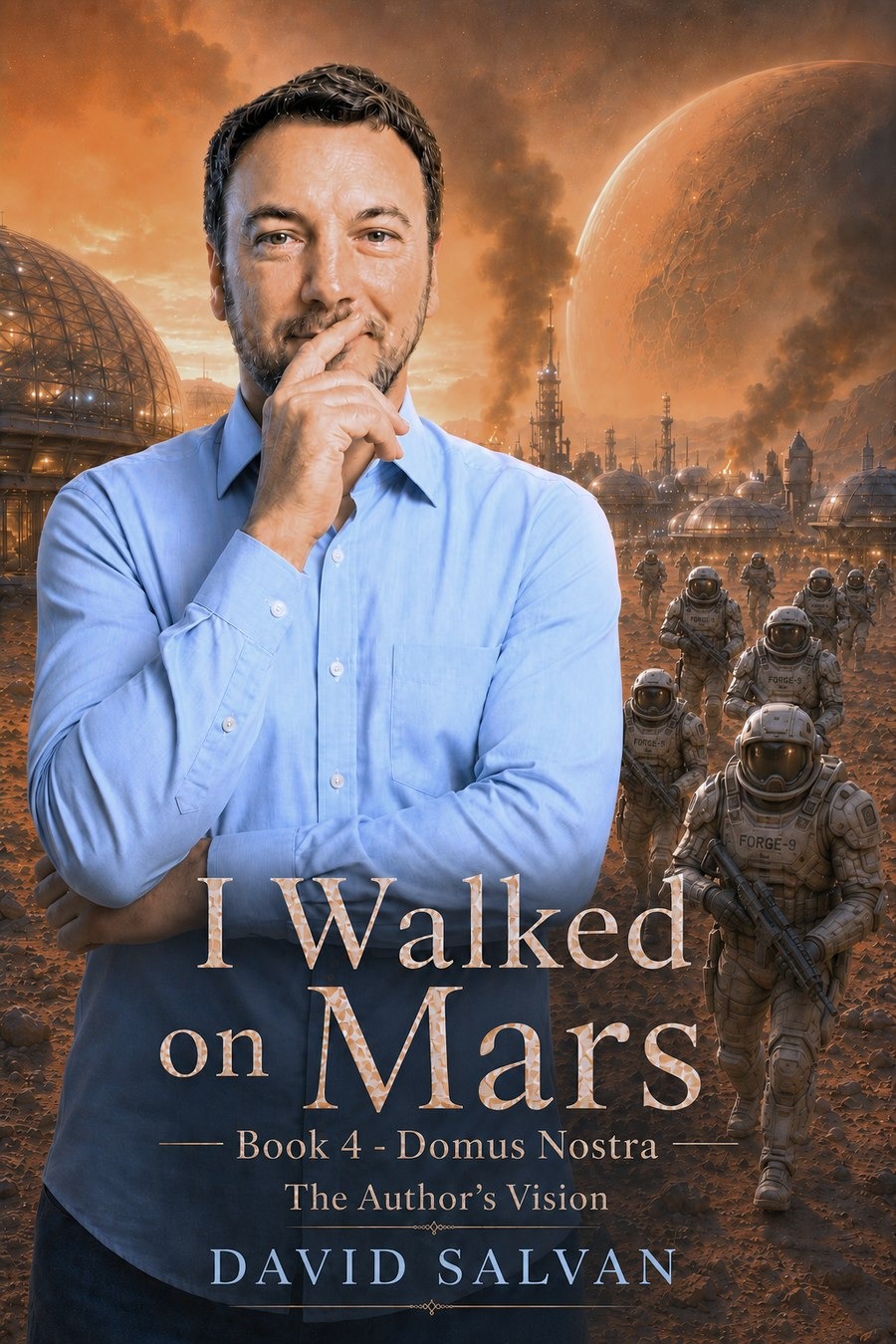
Illustrated companion : Book 4
Institutions, conflict and the choice of independence
The visual conclusion of the Arcadian cycle, from public institutions and family choices to strategic confrontation and the emergence of a Martian people.
Other formats and editions:
See all editions below
Direct links use confirmed ASINs only. Other published formats are listed without inventing identifiers.
Look inside
Browse selected interior pages from this English edition.
1 / 6
The images show an open-book simulation designed to present the content and layout. The physical result may vary slightly depending on format and printed edition.
The visual conclusion of the Arcadian cycle, from public institutions and family choices to strategic confrontation and the emergence of a Martian people.
In the Author’s Vision for Book 4, this issue is tied directly to the stage being explored: The images are not treated as promotional decoration. Each one fixes an assumption about a place, piece of equipment, interface or human relationship and helps show how the world of the novel could become material.
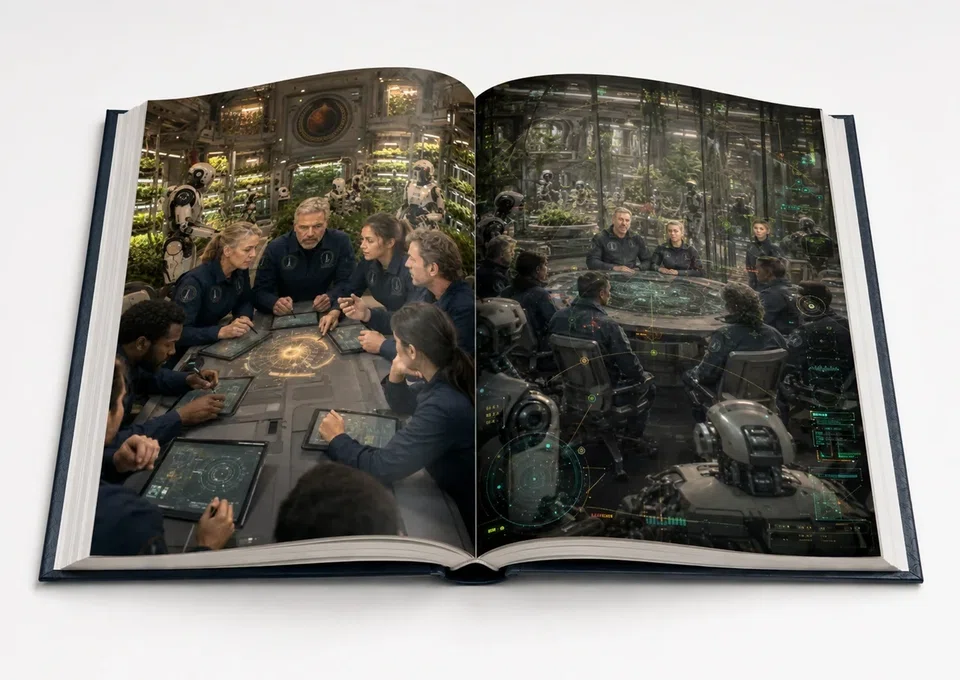
At the scale of the Author’s Vision for Book 4, the question becomes concrete: This visual step extends the thread of the volume. It lets the reader read scale, function, working environment and the place of human beings at the same time. The point is not to claim that every detail would be fixed in a real future mission, but to make the intended coherence between story, use and constraint visible.
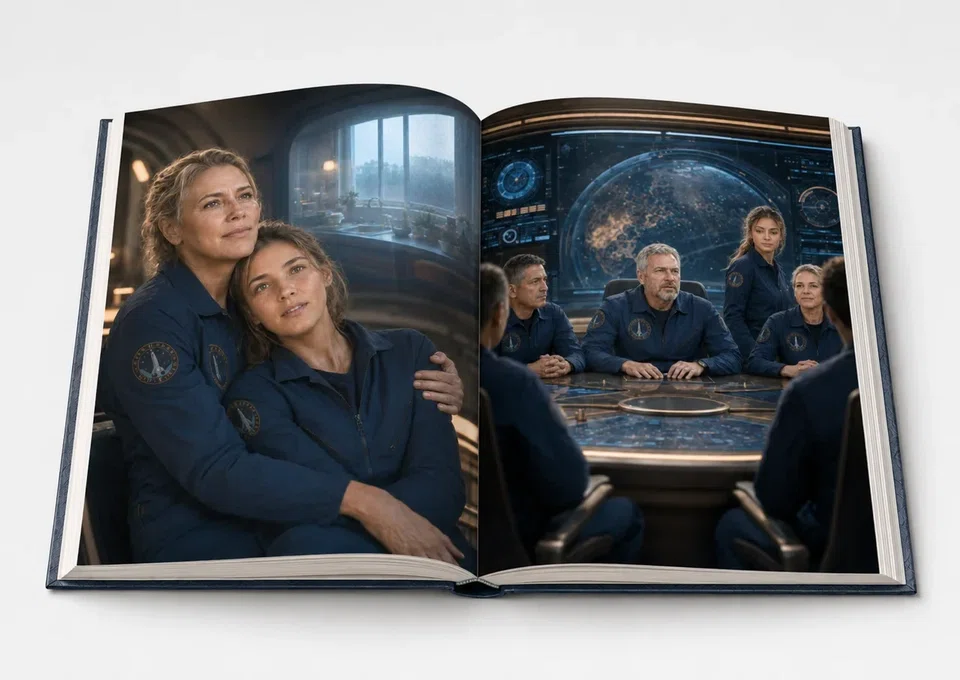
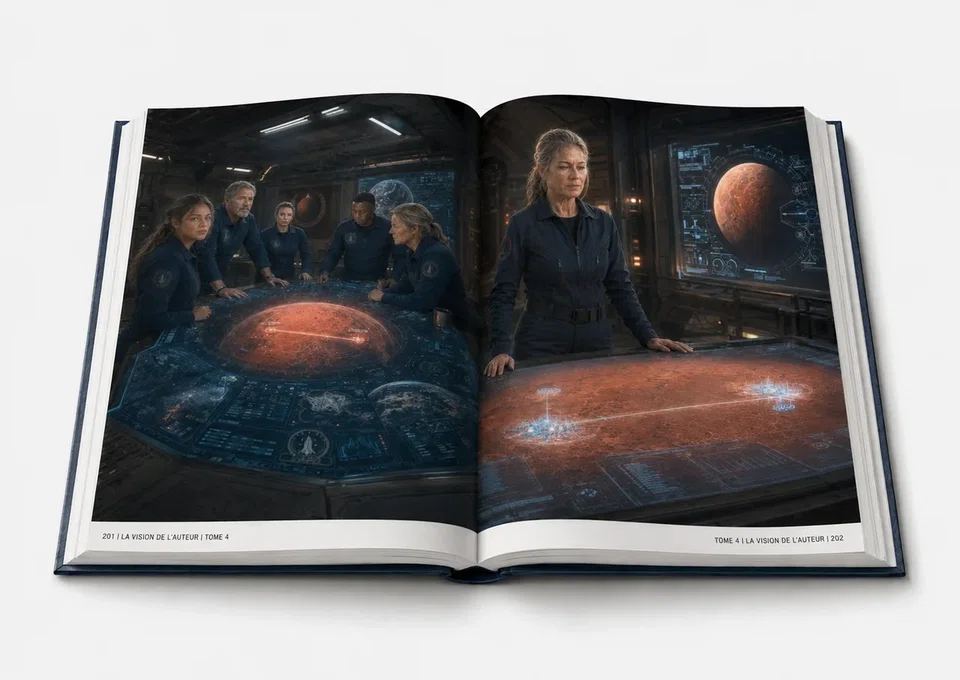
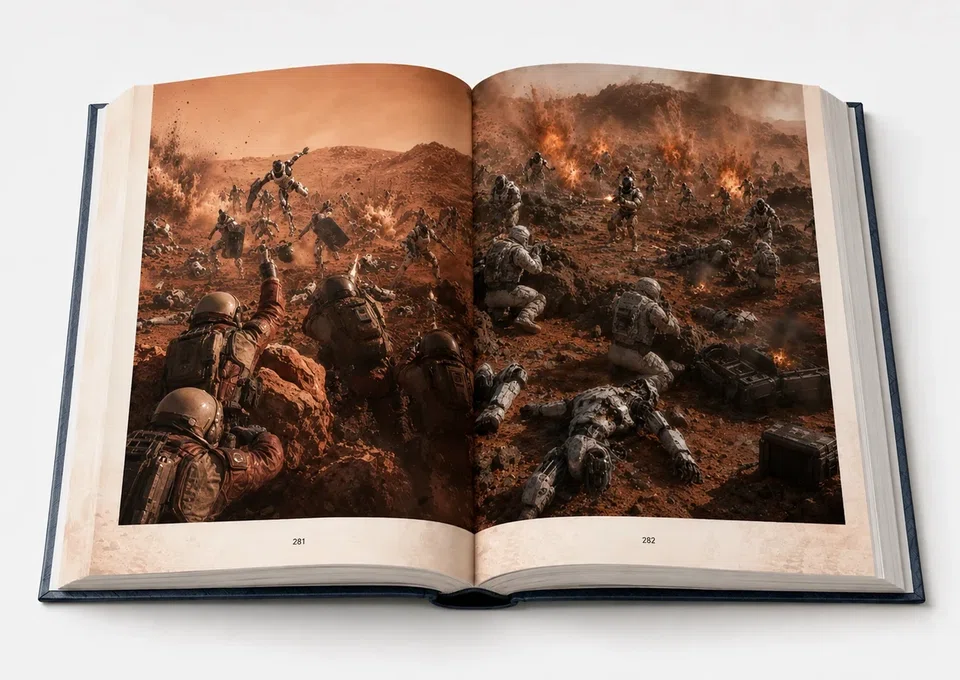
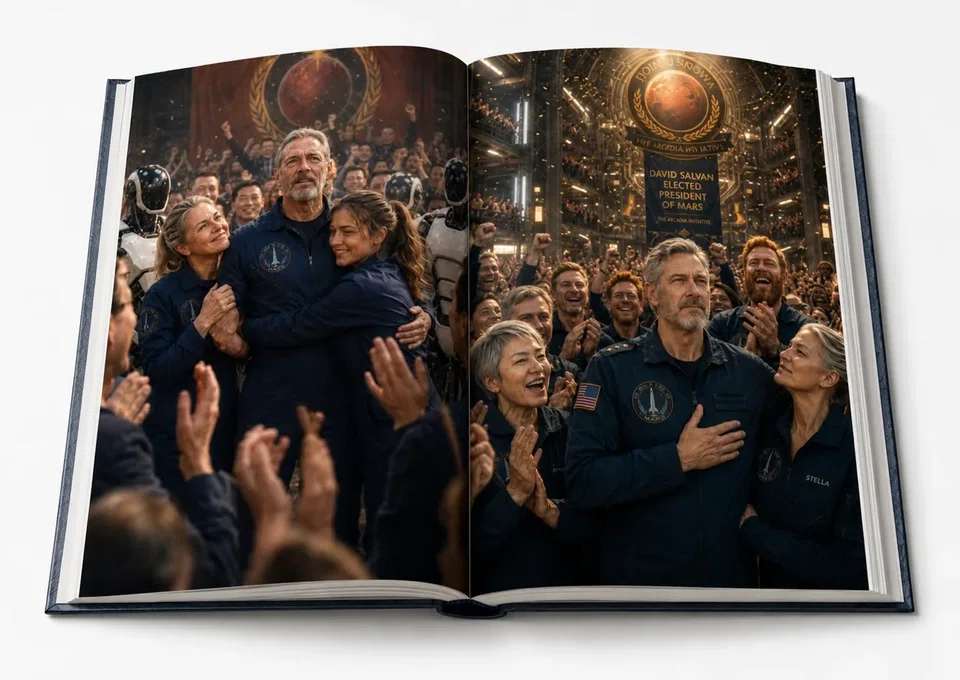
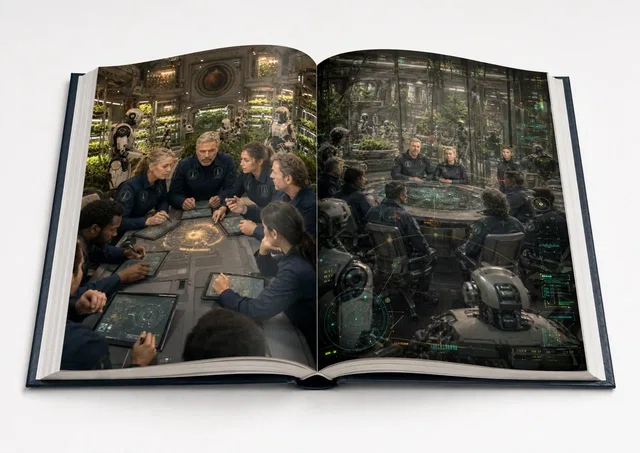
For the Author’s Vision for Book 4, this point matters in a very specific way: This volume is not a replacement for the novel. It is a directed visual interpretation of its places, technologies and relationships, designed to help readers enter the world of Arcadia through a sequence of open-book spreads.
In the Author’s Vision for Book 4, this issue is tied directly to the stage being explored: The purpose of the collection is not to freeze the reader’s imagination, but to disclose one coherent visual path through the fictional universe. Faces, garments, machinery, habitats and landscapes are repeated from spread to spread so that the images form a narrative sequence rather than a set of unrelated illustrations.
At the scale of the Author’s Vision for Book 4, the question becomes concrete: Because the companion book is built around selected moments, it also clarifies the scale of the project. A Mars mission is shown as a system made of people, procedures, logistics, industry and political choices. The visual language therefore remains connected to the technical and human questions developed in the novel.
Book 4 — The Author’s Vision treats independence less as a flag than as an institutional problem. Energy and industrial autonomy change the balance of power, but they do not answer the central question: how can a community capable of defending itself prevent emergency authority from becoming authority without limits?
A Martian civic order would have to connect several cities, languages, memories and loyalties without allowing one community to absorb the others. That requires procedures for challenging authority, rules governing the duration of emergency powers, representation for generations born on Mars, and a clear distinction between autonomy, independence and political responsibility.
Mars also gives constitutional law a particular physical dimension. Terrestrial systems traditionally seek to protect the individual from power. On Mars they must additionally prevent the conditions of life themselves from becoming instruments of coercion. Air, water, emergency medical care and shelter cannot depend on political obedience. The treatment of prisoners and access to care therefore become concrete tests of the civilisation the settlers claim to be building.
Robotic power and artificial intelligence require comparable limits. Forge-9 can rescue, repair and protect; it must not become a private force outside collective control. Hermes can advise, simulate, warn and preserve institutional memory; it cannot be sovereign. Human control of AI is not merely a technical requirement here. It becomes a constitutional rule.
The challenge of Domus Nostra is therefore not to replace terrestrial sovereignty with an identical Martian version. It is to imagine limits suited to a world where survival depends on shared infrastructure, the vacuum lies behind every pressure wall and children born on Mars will live with the founders’ decisions for far longer than the founders themselves.
Terrestrial law traditionally protects the individual from power. On Mars, law must also protect the living body from the vacuum.
This analytical perspective complements Book 4 — Enough Is Enough! without repeating its narrative.
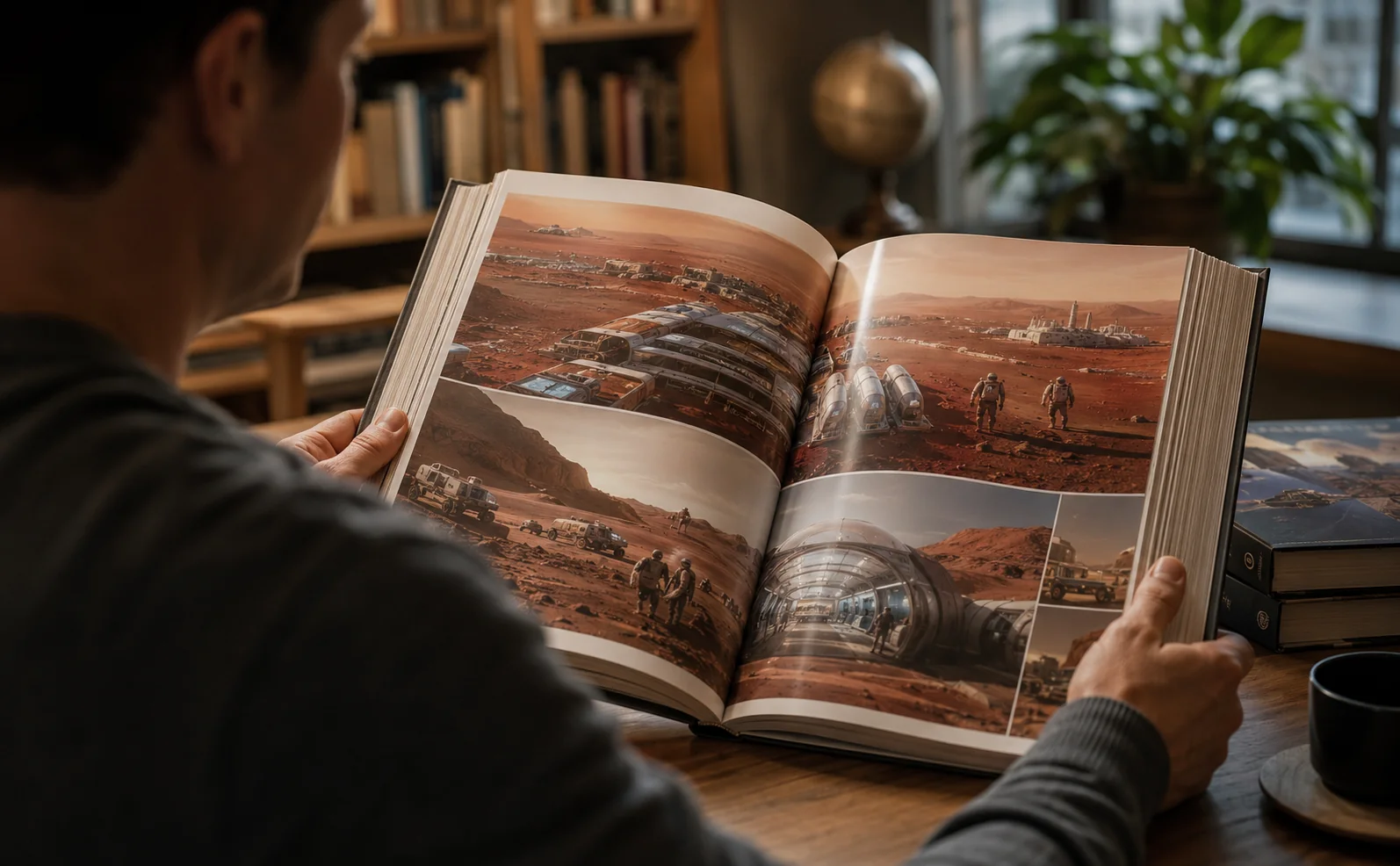
Book 4 shows a society that possesses institutions, networks, families and a memory of its own. The settlement can no longer be understood as a remote facility.
Arcadia now possesses institutions, responsibilities, infrastructure and a memory that no longer coincide entirely with those of Earth. The visual conclusion returns to the same world shown in earlier volumes, but its spaces have acquired political and emotional meaning.
Habitats and networks are no longer only tools of survival. They are places of power, education, gathering and collective decision. By comparing these images with the fragile beginnings of Book 2, the reader can see the full transformation from mission to society.
Completion does not mean perfection. The city remains vulnerable, divided and dependent on choices made by people. What has changed is its capacity to understand itself as a community with interests of its own.
Meeting rooms, councils and collective deliberation give a face to political autonomy. Decisions now concern citizens whose entire lives are tied to Mars.
The final conflict is carried by decisions that engage the whole population. Councils, assemblies, voting spaces and public symbols give material form to questions of authority, representation and legitimacy.
Sovereignty is not presented as a slogan. It requires procedures, responsibility, disagreement and the ability to bear the practical consequences of each choice. The visual book shows political autonomy through rooms, documents, faces and moments of hesitation.
Public choices also reveal the distance between founders and later inhabitants. A city cannot remain permanently governed as an expedition once people born or settled there demand a voice in its future.
Screens, strategic maps and operational groups embody the distance between terrestrial orders and Martian realities.
Distance does not remove interests or power. Economic, political and strategic demands from Earth reach Arcadia through communications, delegations and control over supply. The inhabitants must decide what they can still delegate without losing the ability to protect themselves.
The images translate this pressure through screens, maps, secure rooms and operational groups. Some of the decisive moments occur far from the public view, which emphasises the tension between democratic legitimacy and emergency command.
Earth is not portrayed as a single hostile entity. Competing governments, institutions and private actors pursue different objectives. That complexity makes the Martian response more difficult and more politically credible.
The final spreads show grief, loyalty, public emotion and common symbols. Independence is presented not only as a legal declaration but as a transformation of belonging.
The final spreads return to grief, loyalty, public emotion and common symbols. These elements show why independence is more than a legal declaration: it is a change in belonging and in the answer to the question of who may decide the future.
A population becomes a people through shared experience, institutions, losses and the desire to transmit a world. Arcadia’s claim to autonomy is therefore rooted in daily life as much as in constitutional or military events.
The visual collection closes the arc begun with interviews on Earth. The candidates selected for a mission have helped create a society capable of choosing its own name, rules and destiny.
Families, love, grief and loyalty. Large institutions and landscapes are answered by intimate scenes. Behind historical declarations remain families, love, grief, loyalty and the fear of losing a home that has become irreplaceable.
This human presence gives the political question its weight. Independence concerns the ability to protect those who live in Arcadia, to transmit what has been built and to decide together what the city should become.
Editorial and edition context. This volume accompanies the fourth and final novel of the quadrilogy. It gathers the visual culmination of Arcadia: a city turned society, a population turned people and a mission turned collective destiny.
The English gallery contains only visual spreads suitable for an English-language presentation. Pages carrying substantial French text were removed, and captions were cropped when necessary. The gallery is intentionally smaller rather than misleading.
The fourth visual companion portrays a city that has become political. Architecture, public space, symbols and institutions make questions of autonomy and independence visible.
For the research context behind these issues, see collective identity of a society born far from Earth · political autonomy and local decision-making capacity
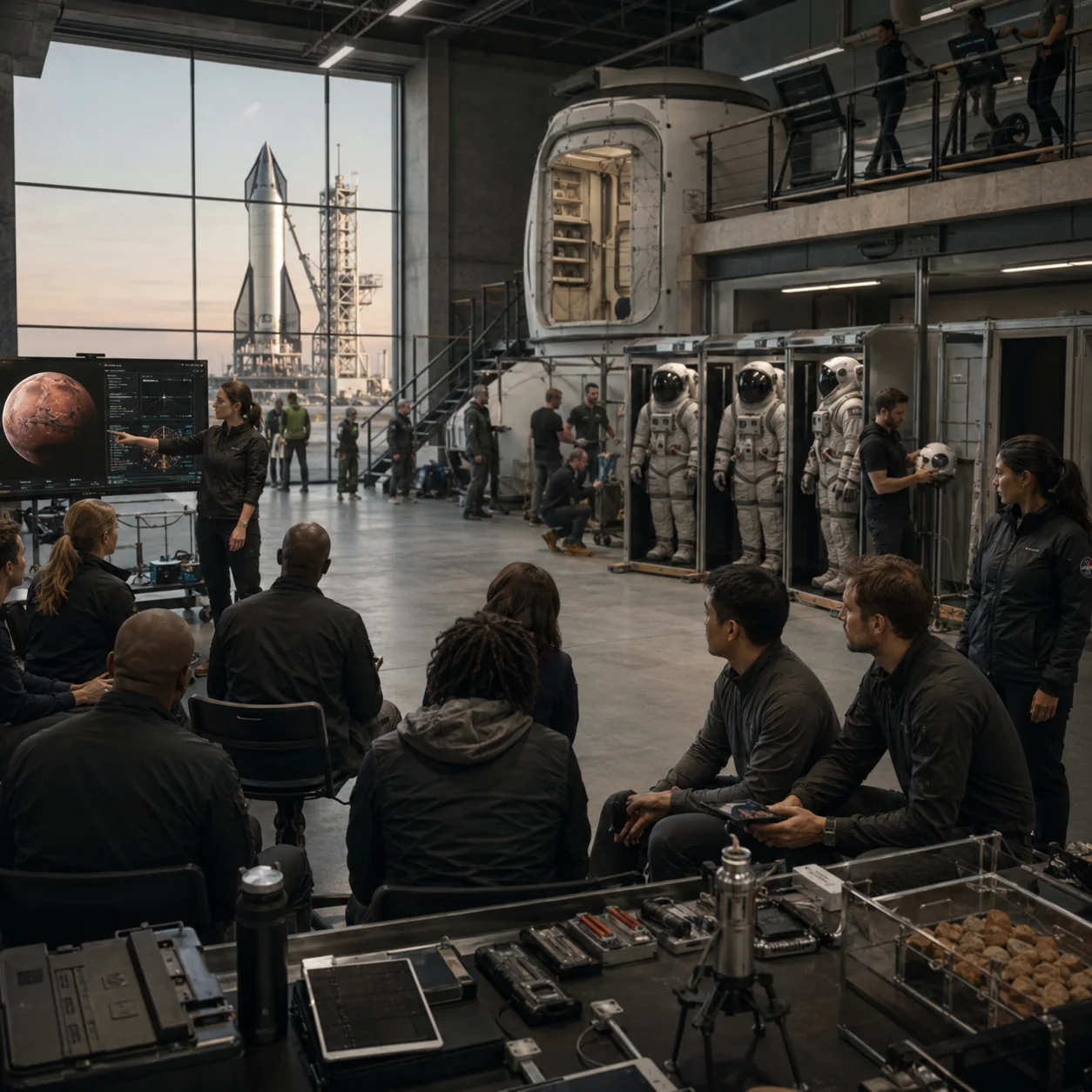
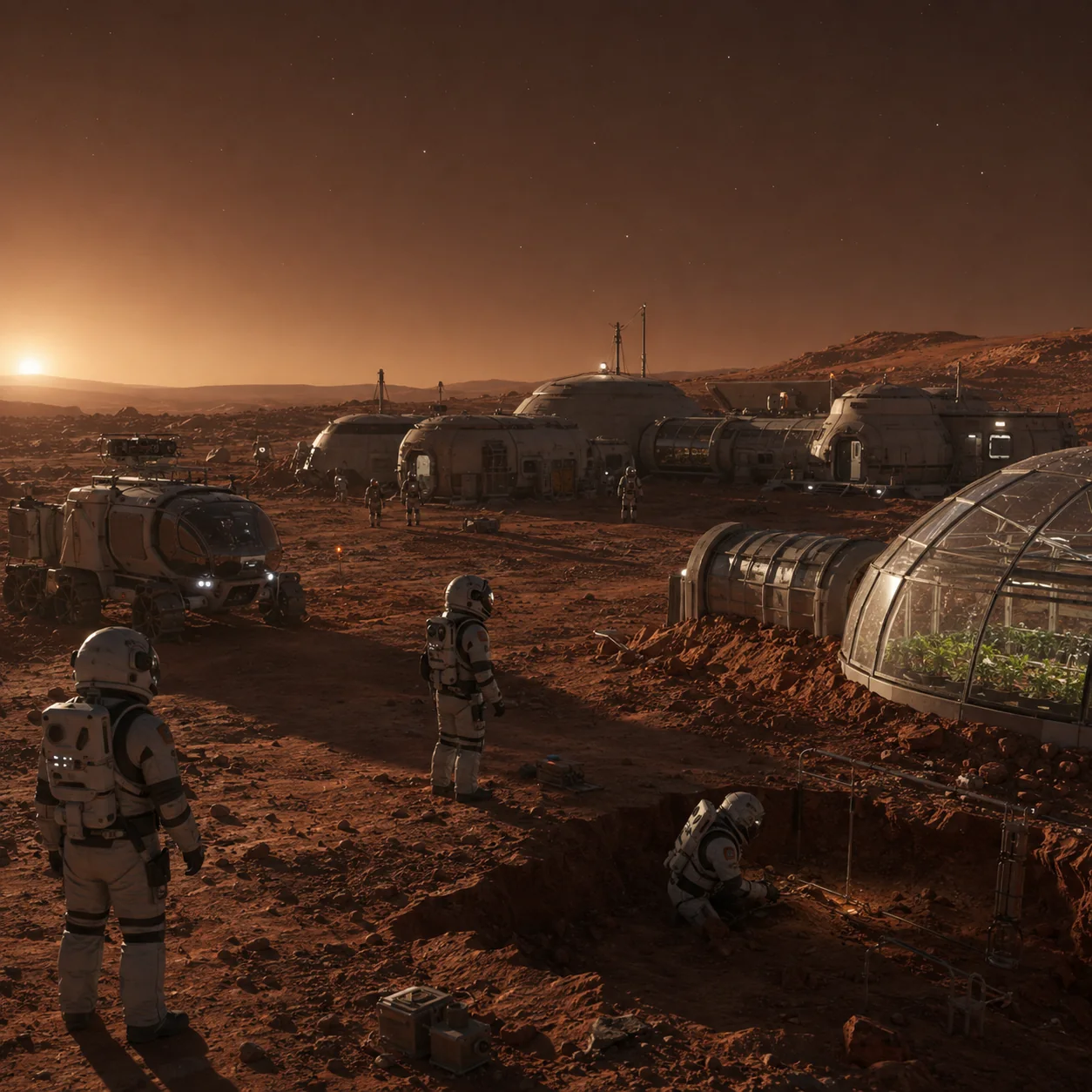
The images explore the tension between civilian continuity, military necessity and the control of infrastructure essential to survival.
A Martian city depends on energy, water, transport, communications, manufacturing and protected habitats. Control of these systems can become an instrument of power. The visual companion identifies the places where material survival and political authority meet.
Civil and military decisions cannot be separated cleanly when infrastructure is essential to life. Security measures may protect the population, but they can also concentrate authority. The volume keeps this ambiguity visible rather than reducing the conclusion to a display of force.
Every confrontation carries the risk of destroying what all sides claim to defend. The scale of the machinery is therefore balanced by images of civilians and families whose continued existence gives strategic decisions their meaning.
Controlling a vital resource also means deciding access to it. Water, power, pressurised volume, machines and raw materials can become objects of negotiation, solidarity or conflict.
Control of resources and collective trade-offs has to be connected with available resources, time, skills, maintenance, health and the ability to make decisions when Earth cannot solve the problem immediately. That interdependence is part of what gives the volume its density.
Choose the language and format directly. When an ASIN is confirmed, the button opens the exact Amazon listing. When a format is published but the ASIN still needs to be copied from KDP, a clearly labelled Amazon search link is provided instead of inventing an identifier.
English / United States — Amazon.com
Paperback
I Walked on Mars 4 — The Author’s Vision
French — Amazon.fr
Broché
J’ai marché sur Mars T4 — La vision de l’auteur
Relié
J’ai marché sur Mars T4 — La vision de l’auteur
ASIN still needs to be copied from KDP; a search link is provided in the meantime.
Direct links use confirmed ASINs only. Other published formats are listed without inventing identifiers.
No. It is an illustrated companion that visualises selected places, characters and stages. The complete plot, arguments and character development remain in the corresponding novel.
Only where an authentic English visual spread is available. French text-heavy pages are excluded, and the page states the origin of the remaining images so that no French spread is presented as an English edition.
No. They are an artistic interpretation of speculative fiction, created with digital and generative tools under the author’s editorial direction.
Yes, but it gains depth beside the corresponding novel, which explains the technical, political and psychological stakes that the images can only suggest.