


Paperback
I Walked on Mars 3 — The Author’s Vision
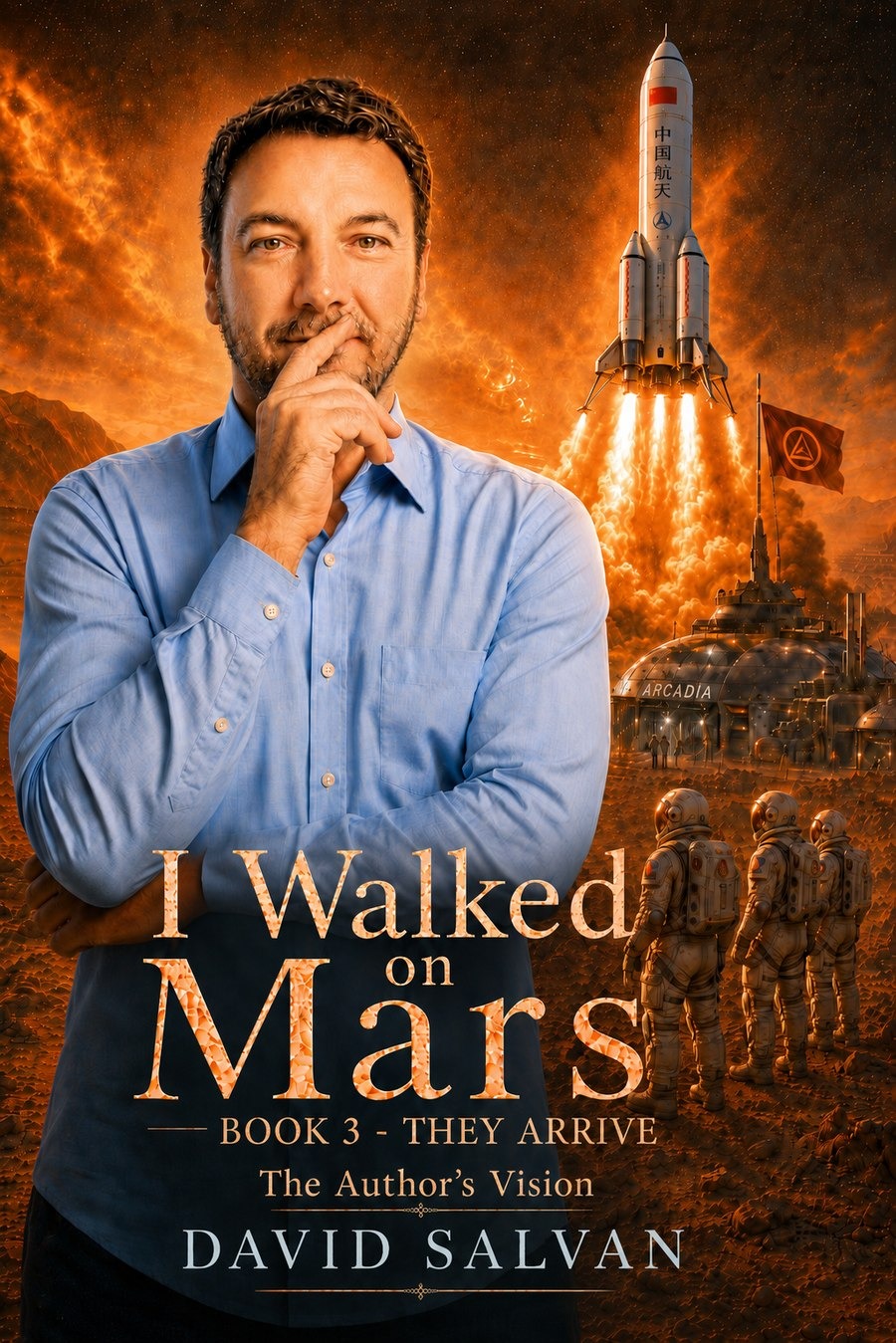
Illustrated companion : Book 3
Arcadia expands and Mars becomes geopolitical
The illustrated companion to a larger Mars: families, industry, international settlements, tensions and the first visible signs of a world no longer controlled by one mission.
Other formats and editions:
See all editions below
Direct links use confirmed ASINs only. Other published formats are listed without inventing identifiers.
Look inside
Browse selected interior pages from this English edition.
1 / 6
The images show an open-book simulation designed to present the content and layout. The physical result may vary slightly depending on format and printed edition.
The illustrated companion to a larger Mars: families, industry, international settlements, tensions and the first visible signs of a world no longer controlled by one mission.
The visual book complements the novel by making scale and coexistence visible: several communities share the same planet while no longer sharing the same interests.
They Arrive is the moment when Mars becomes a political space. The companion gives an appearance to the forces present, the sites of negotiation, the strategic installations and the communities attempting to preserve their autonomy.
The visual book does not replace the novel’s arguments or character development. It makes coexistence and scale visible: several societies now inhabit the same planet while no longer sharing the same interests, memories or definition of the future.
In the Author’s Vision for Book 3, this issue is tied directly to the stage being explored: The images are not treated as promotional decoration. Each one fixes an assumption about a place, piece of equipment, interface or human relationship and helps show how the world of the novel could become material.
At the scale of the Author’s Vision for Book 3, the question becomes concrete: This visual step extends the thread of the volume. It lets the reader read scale, function, working environment and the place of human beings at the same time. The point is not to claim that every detail would be fixed in a real future mission, but to make the intended coherence between story, use and constraint visible.
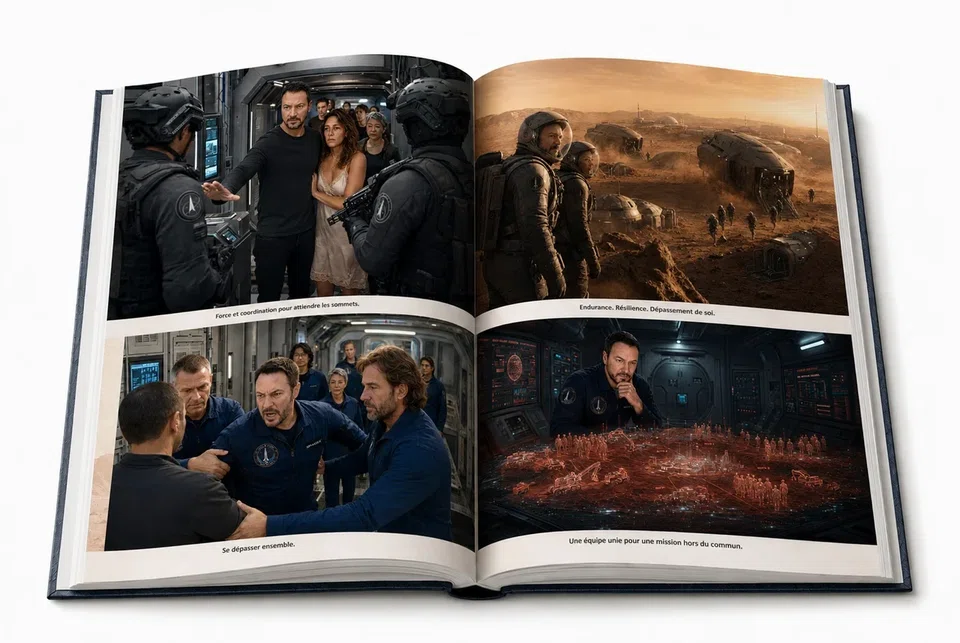
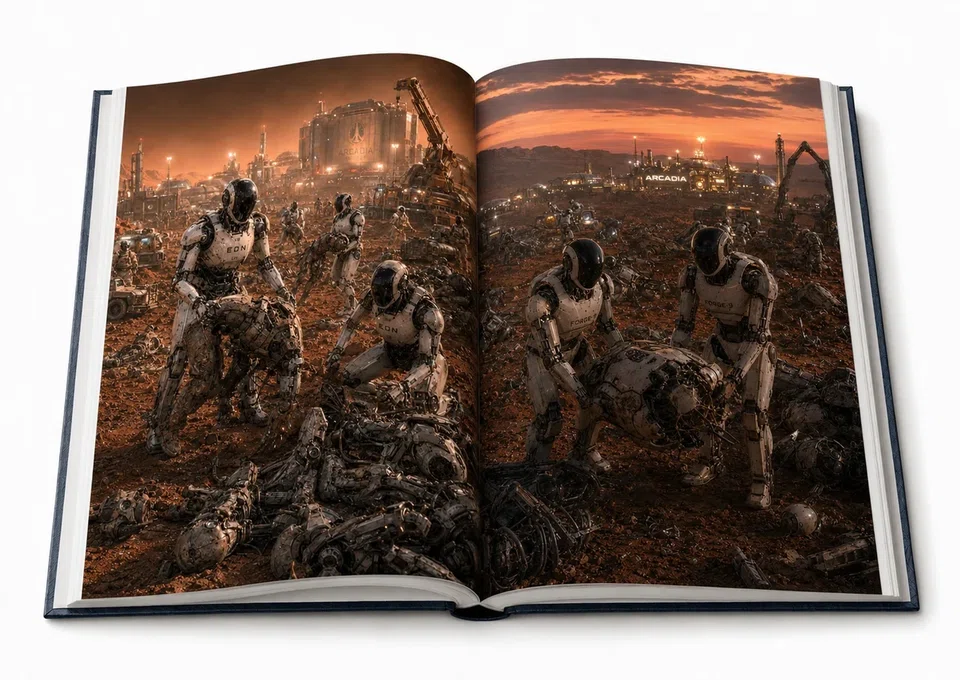
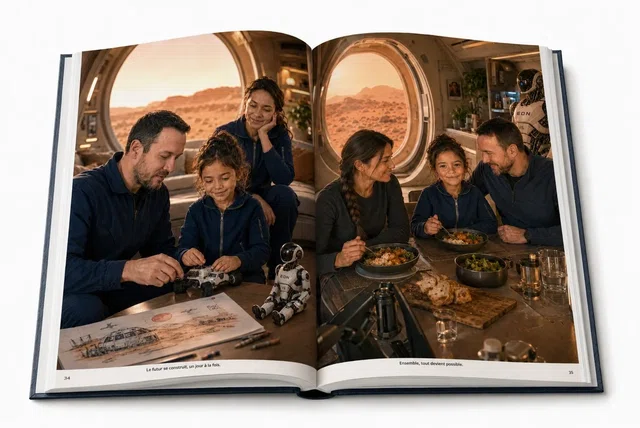
For the Author’s Vision for Book 3, this point matters in a very specific way: This volume is not a replacement for the novel. It is a directed visual interpretation of its places, technologies and relationships, designed to help readers enter the world of Arcadia through a sequence of open-book spreads.
In the Author’s Vision for Book 3, this issue is tied directly to the stage being explored: The purpose of the collection is not to freeze the reader’s imagination, but to disclose one coherent visual path through the fictional universe. Faces, garments, machinery, habitats and landscapes are repeated from spread to spread so that the images form a narrative sequence rather than a set of unrelated illustrations.
At the scale of the Author’s Vision for Book 3, the question becomes concrete: Because the companion book is built around selected moments, it also clarifies the scale of the project. A Mars mission is shown as a system made of people, procedures, logistics, industry and political choices. The visual language therefore remains connected to the technical and human questions developed in the novel.
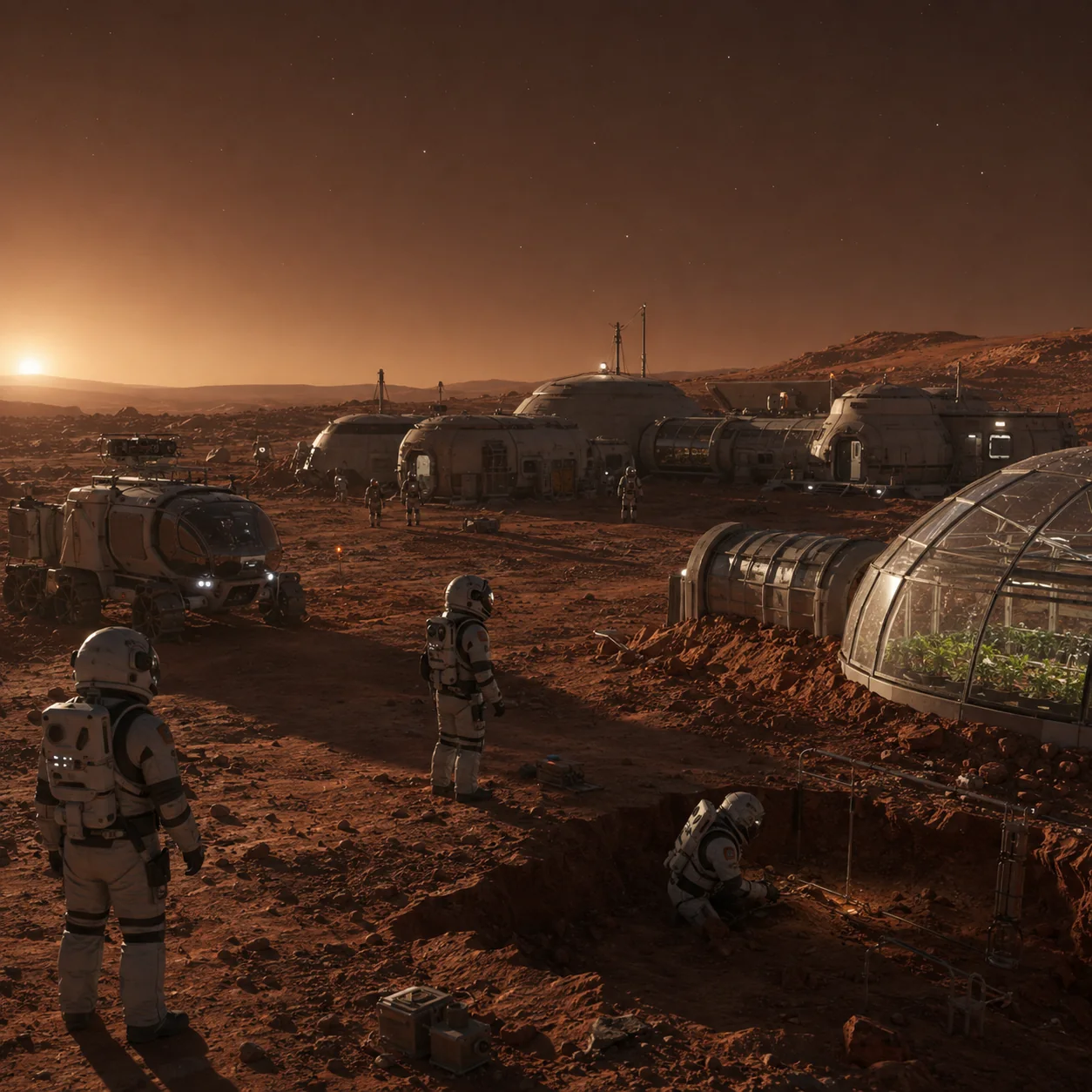
The settlement is no longer a fragile outpost. Habitats, industrial areas, schools, food production and transport systems create the visual language of a city.
The settlement is no longer a fragile cluster of modules. Habitats, workshops, medical areas, schools, agricultural systems and transport corridors now form a city whose continuity depends on institutions as much as on engineering.
Scale changes the story. A small crew can rely on personal knowledge and direct authority; a growing population requires rules, records, specialist organisations and public choices. The visual companion makes that transition visible through both panoramas and ordinary interiors.
The city also begins to affect the landscape. Routes, storage zones and industrial installations reveal a strategic depth that did not exist during the first deployment. Arcadia has become capable of projecting activity beyond its original perimeter.
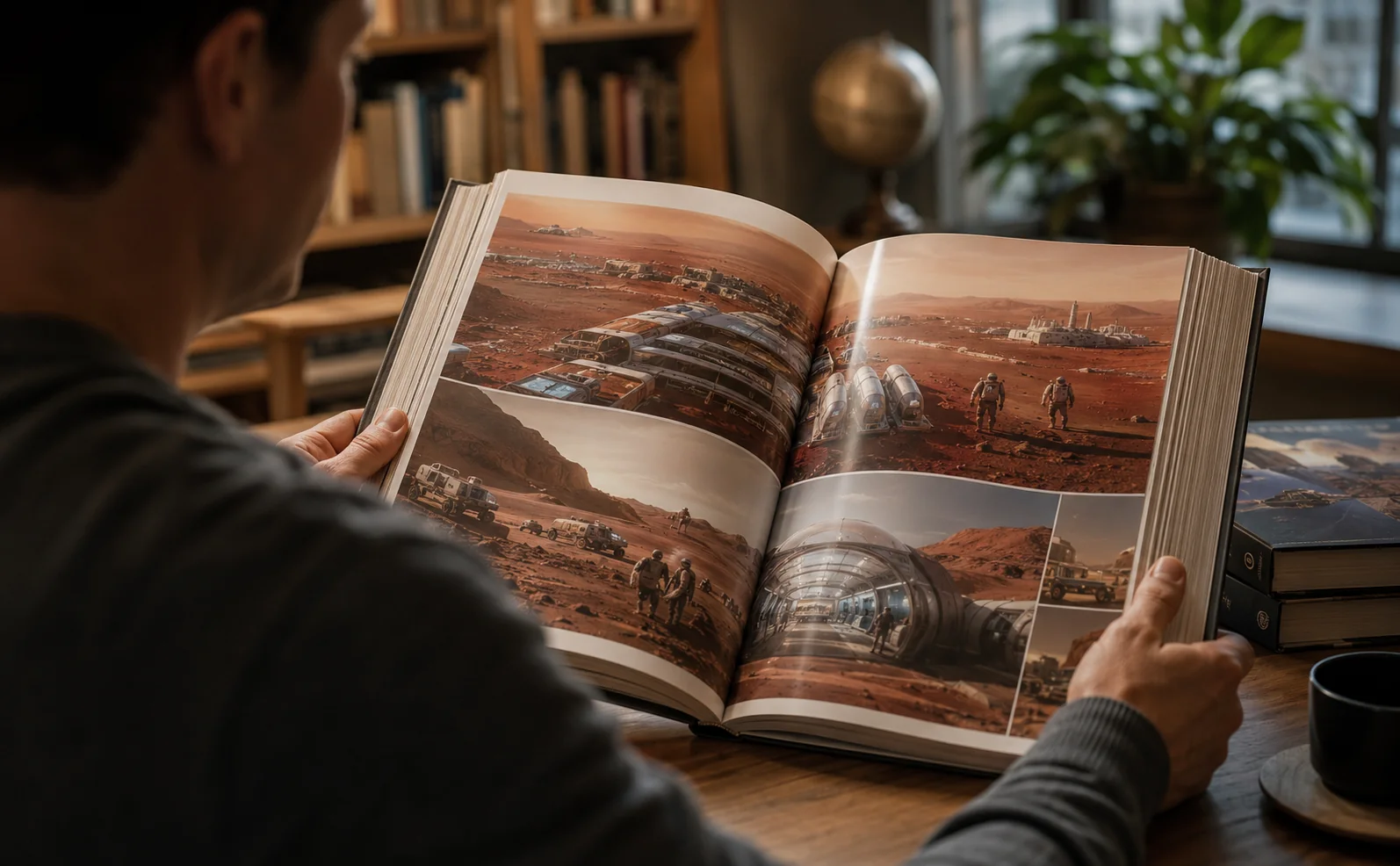
Other powers and other settlements appear. Their architecture, uniforms and priorities make the geopolitical dimension of Mars immediately legible.
New convoys and rival settlements end Arcadia’s isolation. Different powers arrive with their own architecture, uniforms, methods and political priorities. Mars becomes a shared territory before any stable agreement exists about how it should be governed.
The images avoid reducing this situation to two simple camps. Several communities possess resources and ambitions that do not coincide. They must negotiate while remaining materially interdependent, because an accident or conflict can threaten systems used by everyone.
Visual contrasts allow the reader to identify these differences immediately. The geopolitical dimension of the third novel is therefore expressed not only through meetings and maps, but through the way each settlement constructs and occupies space.
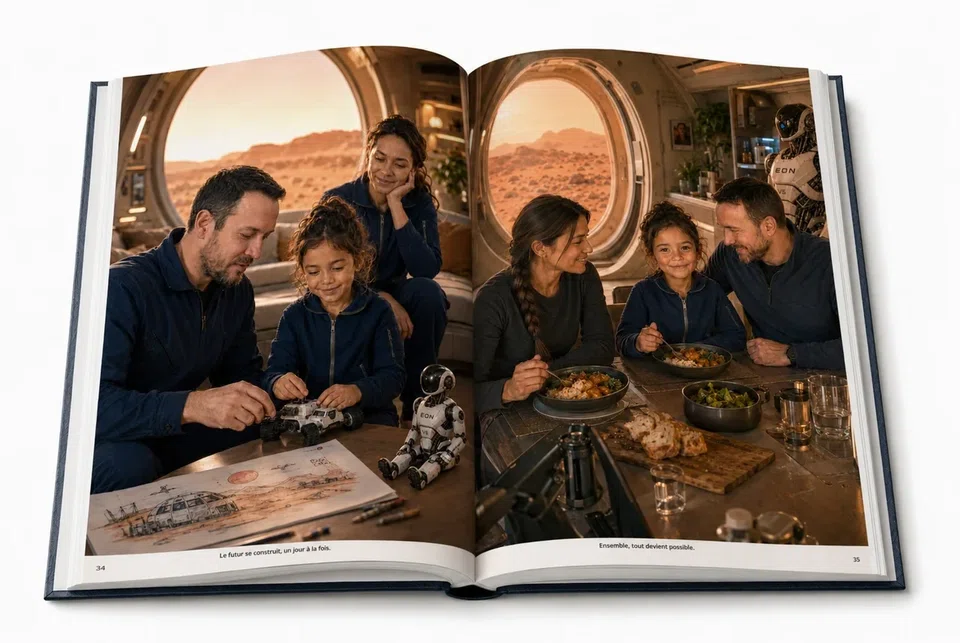
Meals, children, work and intimate moments show that population growth changes every political calculation. Mars is becoming a home rather than a deployment.
Population growth changes every calculation. Children, couples, schools, medical care and domestic routines mean that decisions are no longer made only for rotating crews. People are beginning to build lives whose horizon is Mars itself.
Meals, work and intimate scenes prevent the city from becoming an abstract model. The inhabitants experience rules, shortages and ambitions through bodies and relationships. The future of the settlement is therefore measured in the continuity of families as well as in tonnes of equipment.
The visual sequence shows this maturity without pretending that normality has erased danger. Ordinary life exists precisely because complex systems and collective discipline keep the hostile exterior at a distance.
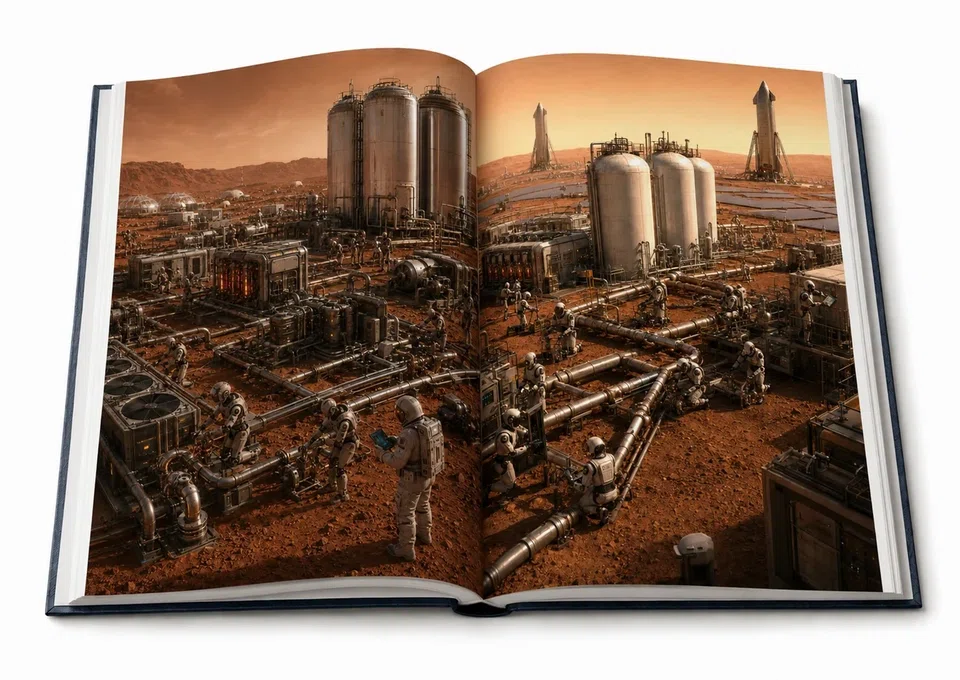
Large plants, storage areas and transport routes express the capacity to remain on Mars even when Earth is distant or divided.
Large production plants, repair facilities, storage depots and transport networks represent more than economic growth. They determine whether Arcadia can remain on Mars when Earth is delayed, divided or politically hostile.
Strategic autonomy is shown as a chain: energy supports manufacturing, manufacturing supports maintenance, maintenance supports transport and food production, and all of them depend on knowledge being transmitted to new generations. No single spectacular machine creates independence.
These images also prepare the conflict of the final volume. Infrastructure that protects life can become a political instrument when access, ownership or command is disputed.
Workshops, schools, care and cultivation. A society can be recognised by what it teaches and protects. Images of work, education, healthcare and food production show that Arcadia has moved beyond immediate survival. It can train its inhabitants, care for families and reproduce skills that were once imported from Earth.
The everyday spaces are as important as the large exterior views. Classrooms, treatment rooms and cultivation areas show how civilisation is built through repeated services, not only through founding moments.
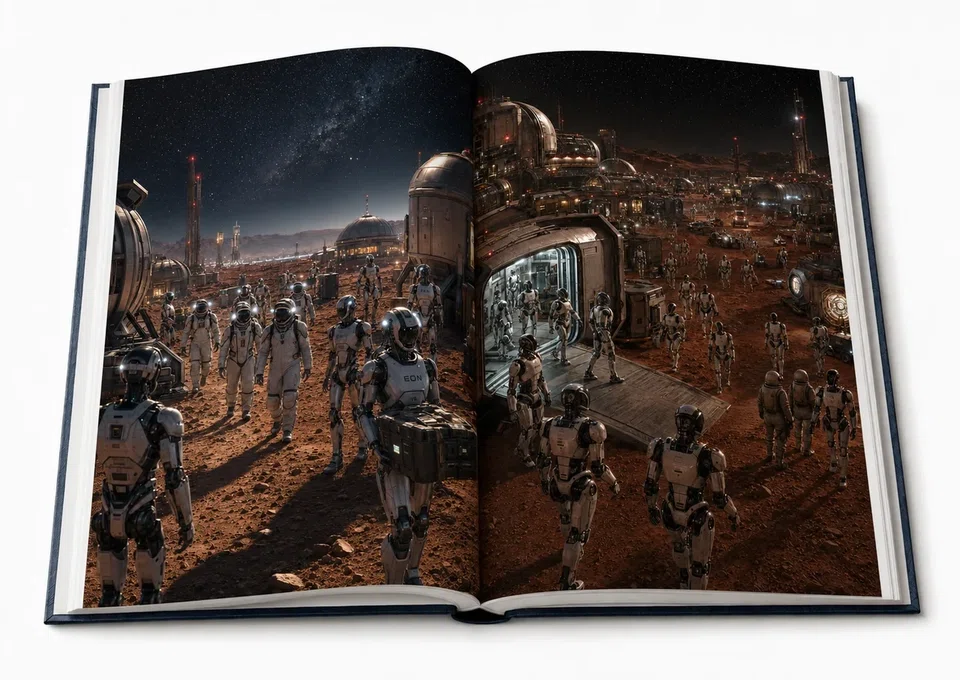
The faces of a larger world. Beside the spectacular installations, the volume returns to faces and gestures: workers, children, officials, robots and characters confronted with decisions that may be taken in silence but affect an entire population.
This human scale prevents Arcadia from becoming a model city without inhabitants. The people live inside the systems, accept or resist their rules, and discover that the world they helped create is now larger than their original intentions.
Editorial and edition context. This illustrated volume accompanies the third novel and focuses on the enlargement of Arcadia, the arrival of other powers and the emergence of a genuinely Martian geopolitical order.
The English gallery contains only spreads whose meaning is predominantly visual. French introductory text pages were removed, and small printed captions were cropped where necessary.
The third visual companion documents the change of scale: new arrivals, urban growth, differentiated districts, collective equipment, industrial work and the emergence of a Martian society.
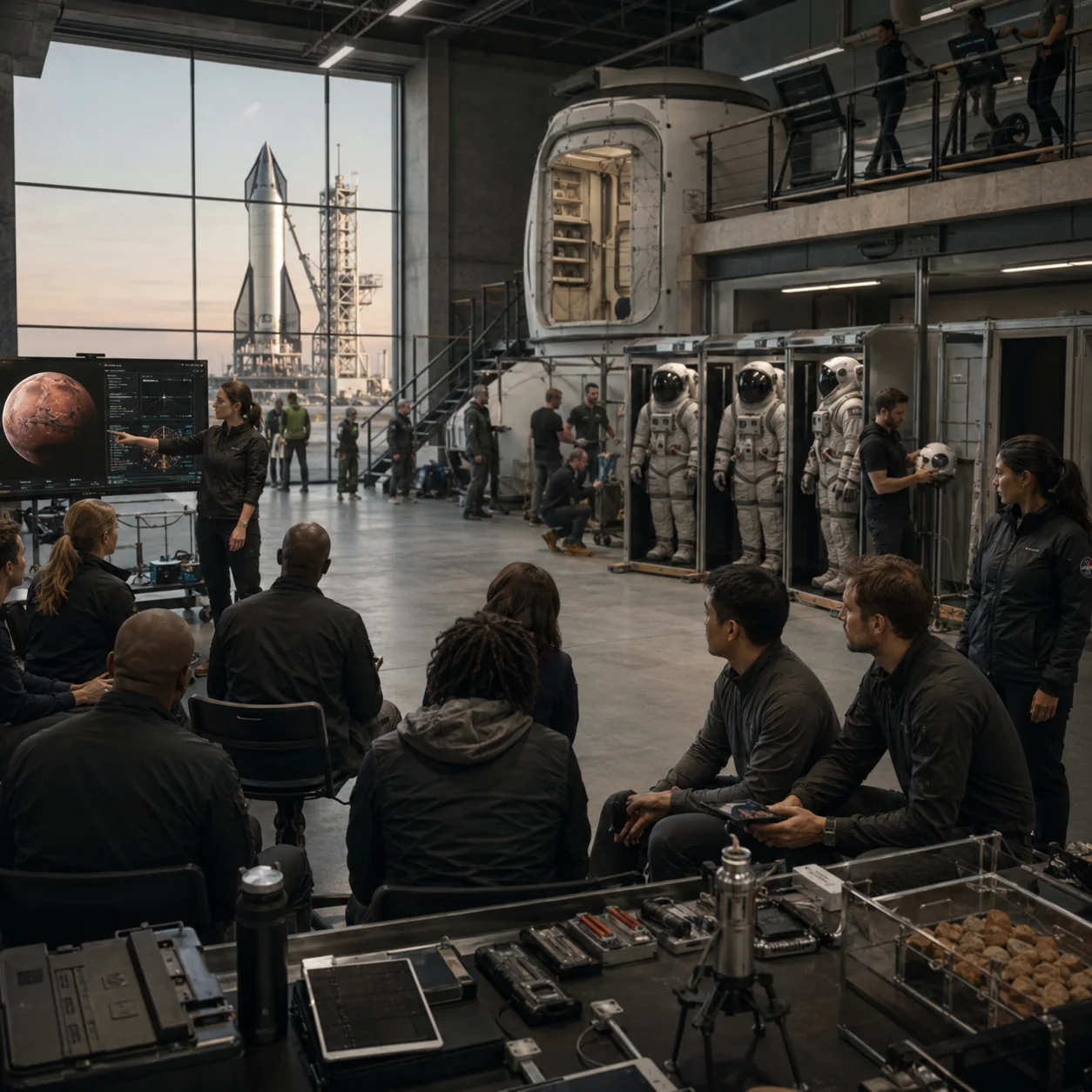
Book 3 — The Author’s Vision does not simply retell the encounter between Arcadia and Kunlun. It uses that encounter to examine a prospective question: what happens to a chain of command when the people issuing an order are tens of millions of kilometres away from those who will immediately bear its consequences?
Political autonomy does not begin with a declaration. It first requires enough industrial autonomy to make local judgement possible: energy, maintenance, replacement parts, food production, communications, transport and the transmission of skills. The more a city can repair and produce locally, the more real room it has to question, delay or reject an external instruction. That capacity, however, also creates new responsibilities.
The scenario therefore distinguishes a chain of command from a chain of competence. In an environment where a bad diagnosis can cost air, time or lives, the highest-ranking person is not necessarily the person capable of solving the problem. Institutions must preserve authority without making practical competence invisible.
Hermes is treated as a coordination and simulation tool, not a sovereign. An AI may connect data, identify expertise, translate, model consequences and propose options. It cannot become the source of political legitimacy merely because it calculates faster. The same caution applies to Forge-9: robotic power that is invaluable for construction and rescue needs explicit control rules precisely because it could also become coercive.
The existence of settlements tied to rival Earth powers also changes how rescue, translation and intercultural communication must be considered. Helping a neighbour in immediate danger may contradict a national instruction without amounting to a rejection of all sovereignty. The difficult concept is legitimate refusal: under what conditions may a community disobey to protect life without turning every constraint into an excuse for unlimited autonomy?
Enough distance does not erase terrestrial sovereignty. It does, however, change the concrete cost of obedience.
This analytical layer complements rather than duplicates the narrative of Book 3 — They Are Coming.
For the research context behind these issues, see arrival and integration of new settlers · children, education and Martian demography
Choose the language and format directly. When an ASIN is confirmed, the button opens the exact Amazon listing. When a format is published but the ASIN still needs to be copied from KDP, a clearly labelled Amazon search link is provided instead of inventing an identifier.
English / United States — Amazon.com
Paperback
I Walked on Mars 3 — The Author’s Vision
French — Amazon.fr
Broché
J’ai marché sur Mars T3 — La vision imagée de l’auteur
Relié
J’ai marché sur Mars T3 — La vision imagée de l’auteur
ASIN still needs to be copied from KDP; a search link is provided in the meantime.
Direct links use confirmed ASINs only. Other published formats are listed without inventing identifiers.
No. It is an illustrated companion that visualises selected places, characters and stages. The complete plot, arguments and character development remain in the corresponding novel.
Only where an authentic English visual spread is available. French text-heavy pages are excluded, and the page states the origin of the remaining images so that no French spread is presented as an English edition.
No. They are an artistic interpretation of speculative fiction, created with digital and generative tools under the author’s editorial direction.
Yes, but it gains depth beside the corresponding novel, which explains the technical, political and psychological stakes that the images can only suggest.