


Paperback
I Walked on Mars 1 — The Author’s Vision
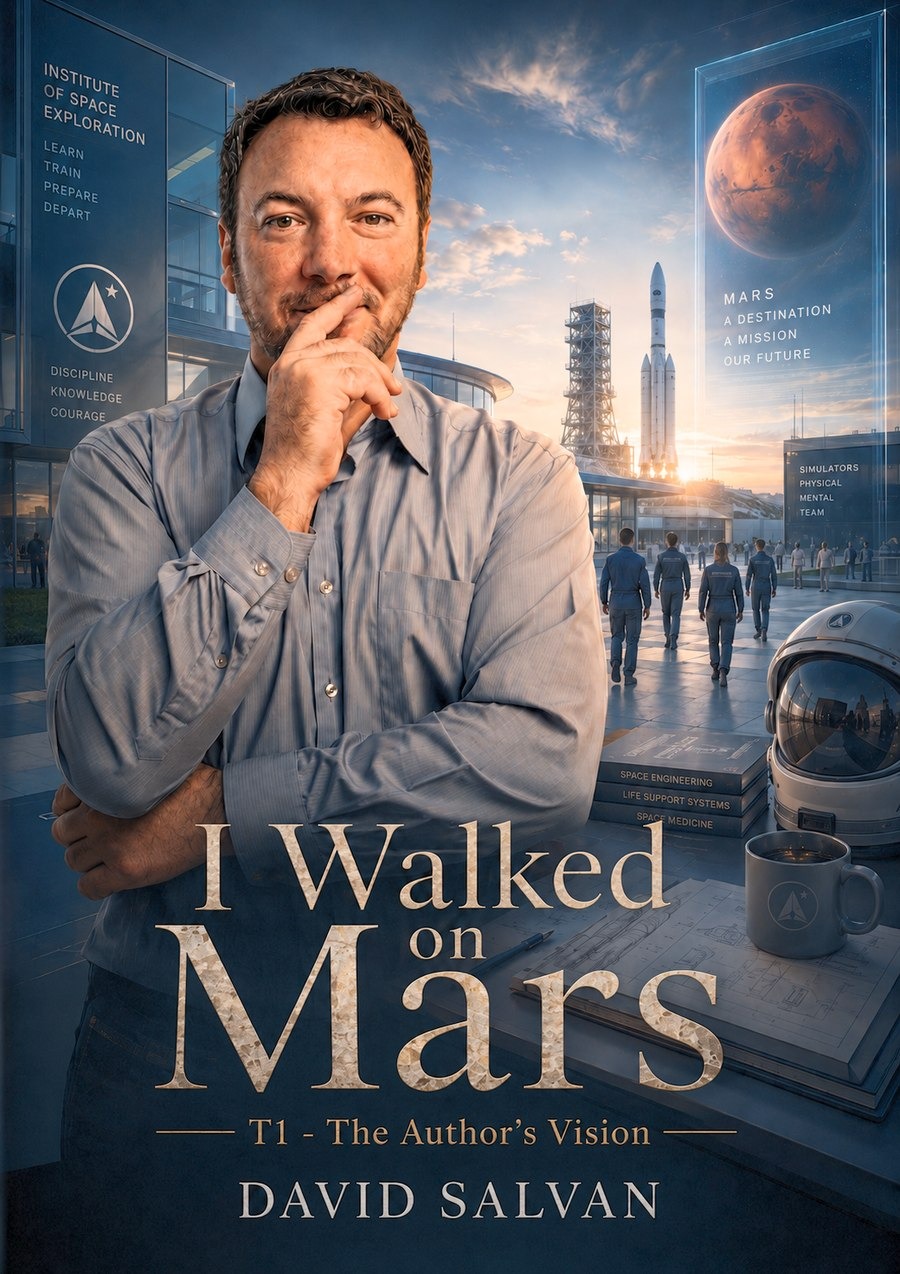
Illustrated companion — Book 1
The visual universe of The Great Departure
An illustrated companion to the first novel, showing selection, training, the formation of the crew and the human relationships that precede departure for Mars.
Other formats and editions:
See all editions below
Direct links use confirmed ASINs only. Other published formats are listed without inventing identifiers.
Interior preview
The gallery uses only visual spreads suitable for an English-language presentation. French introduction pages have been omitted, and small printed French captions have been cropped where necessary.
1 / 6
These images show simulated open-book spreads so readers can understand the interior design. The physical rendering may vary slightly by format and printing.
An illustrated companion to the first novel, showing selection, training, the formation of the crew and the human relationships that precede departure for Mars.
The book was conceived as an author-directed interpretation of the fictional world. Repeated characters, clothing, locations and technologies create continuity across the spreads.
The images were created with the assistance of generative tools, then selected, rejected, revised, cropped and sequenced under David Salvan’s direction. Editorial work focused on the continuity of faces, the credibility of equipment, the consistency of environments and the rhythm produced when two pages are viewed together.
The result openly presents itself as an artistic interpretation of speculative fiction. It is not a documentary record of a real Mars programme and does not imitate a photographic archive. Its value lies in showing how text and image can develop the same imagined world through different forms.
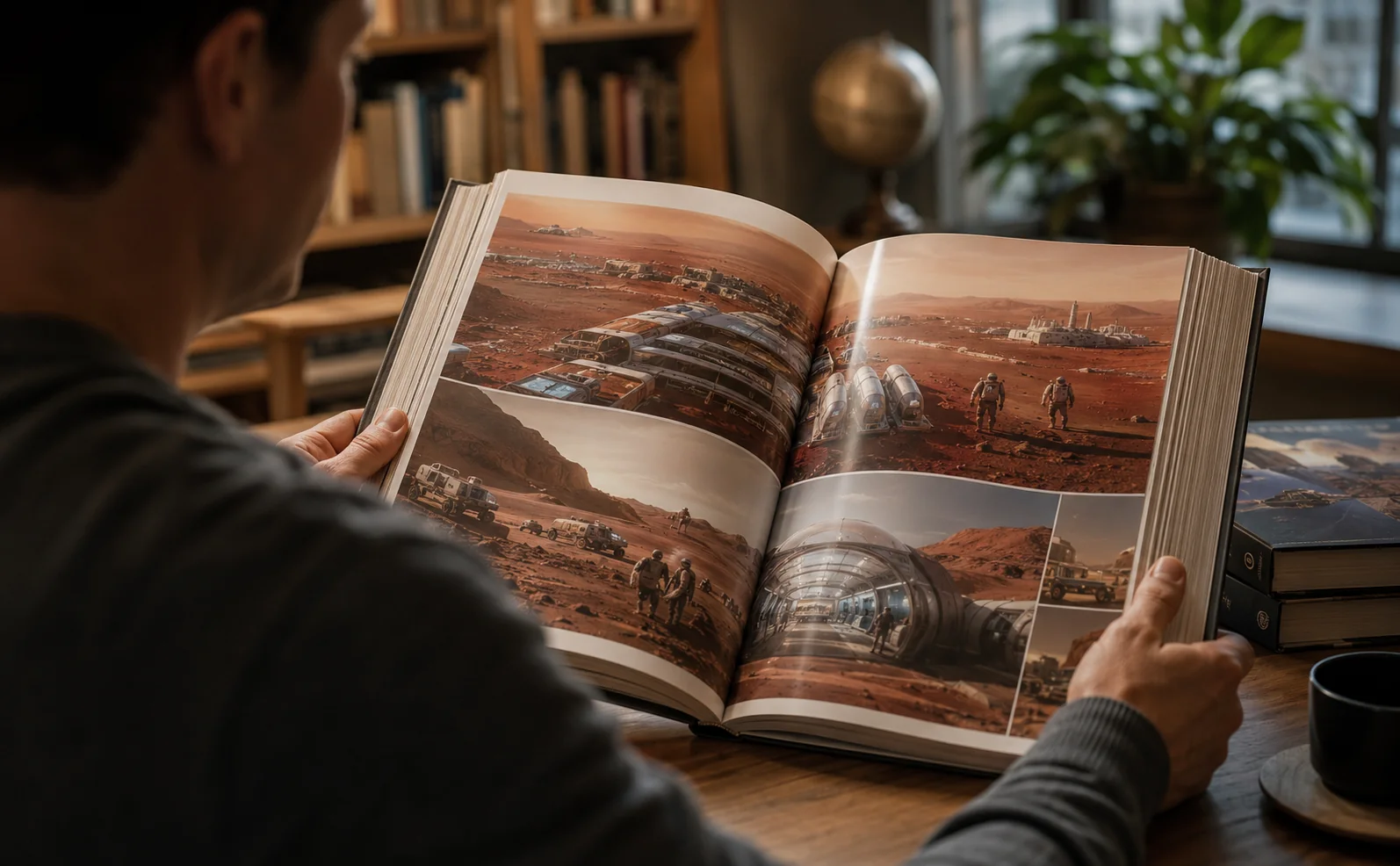
In the Author’s Vision for Book 1, this issue is tied directly to the stage being explored: The images are not treated as promotional decoration. Each one fixes an assumption about a place, piece of equipment, interface or human relationship and helps show how the world of the novel could become material.
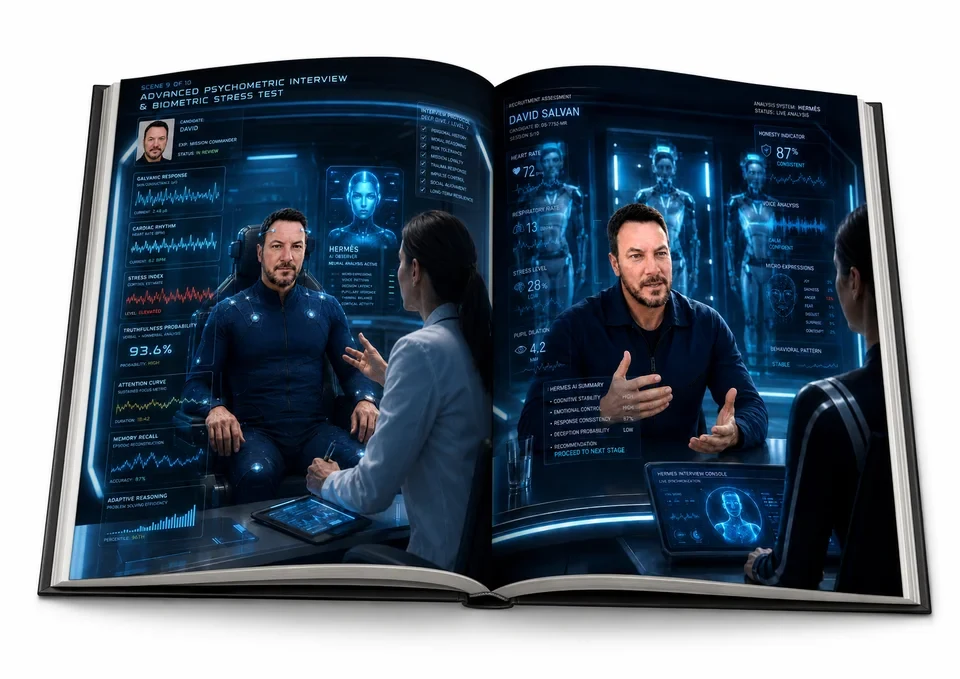
At the scale of the Author’s Vision for Book 1, the question becomes concrete: This visual step extends the thread of the volume. It lets the reader read scale, function, working environment and the place of human beings at the same time. The point is not to claim that every detail would be fixed in a real future mission, but to make the intended coherence between story, use and constraint visible.
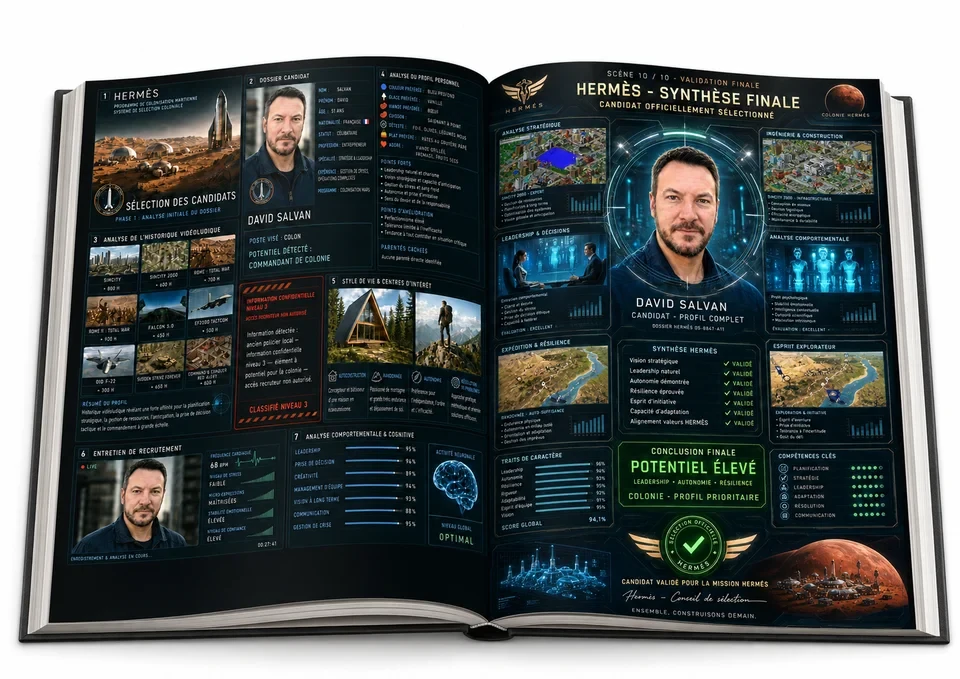
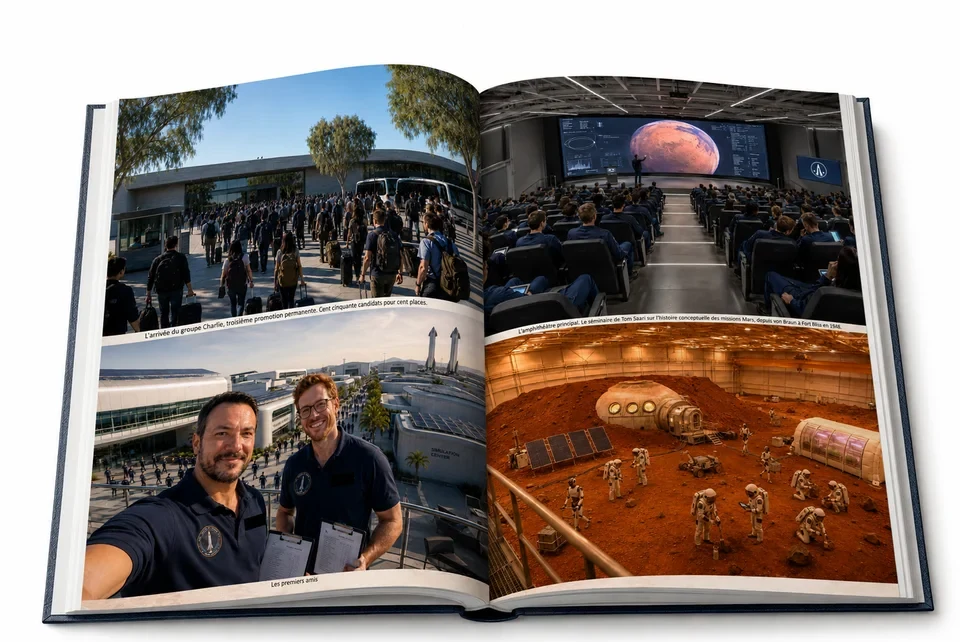
For the Author’s Vision for Book 1, this point matters in a very specific way: This volume is not a replacement for the novel. It is a directed visual interpretation of its places, technologies and relationships, designed to help readers enter the world of Arcadia through a sequence of open-book spreads.
In the Author’s Vision for Book 1, this issue is tied directly to the stage being explored: The purpose of the collection is not to freeze the reader’s imagination, but to disclose one coherent visual path through the fictional universe. Faces, garments, machinery, habitats and landscapes are repeated from spread to spread so that the images form a narrative sequence rather than a set of unrelated illustrations.
At the scale of the Author’s Vision for Book 1, the question becomes concrete: Because the companion book is built around selected moments, it also clarifies the scale of the project. A Mars mission is shown as a system made of people, procedures, logistics, industry and political choices. The visual language therefore remains connected to the technical and human questions developed in the novel.
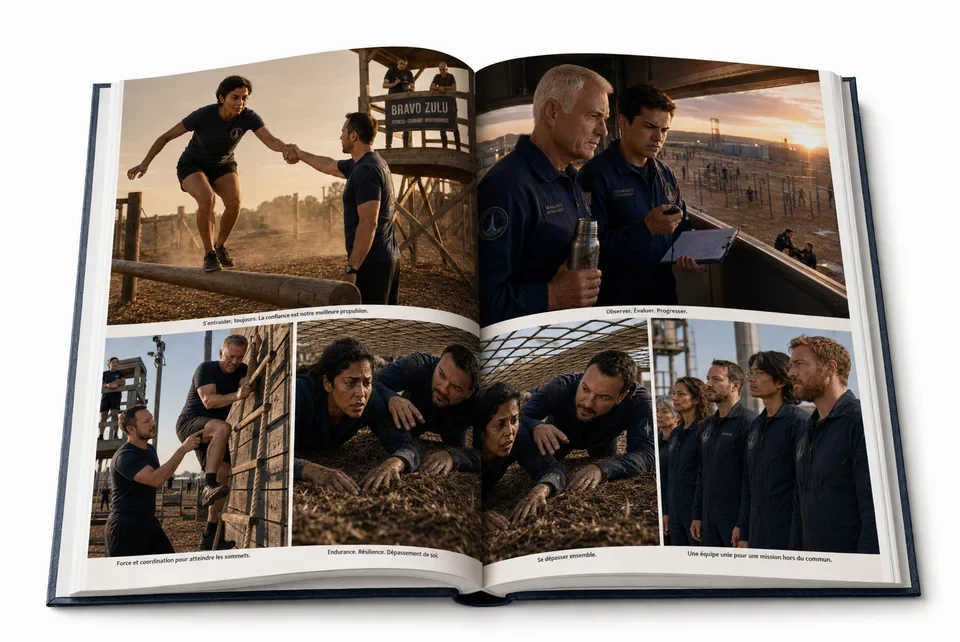
The images reveal how individual profiles gradually become a group. Uniforms, exercises, technical briefings and shared fatigue make the future expedition visible without replacing the narrative depth of the novel.
Selection for a permanent Mars settlement cannot be reduced to choosing the most brilliant individuals. The central question is whether different personalities can remain reliable together when isolation, fatigue and danger remove the protections of ordinary life. The spreads use evaluation rooms, group observation, technical simulations and shared training to make that problem visible.
Hermès, the artificial intelligence involved in selection, does not merely assign a score. Its role is to compare skills, behaviour, vulnerabilities and complementarities. David’s profile illustrates the risk of overlooking a person whose value emerges less from conventional prestige than from the place he can occupy inside a collective system.
Uniforms and repeated exercises gradually erase the distance between the applicants. They do not make everyone identical; they create a common language of procedures, responsibility and trust. That transformation is one of the principal subjects of the illustrated book.
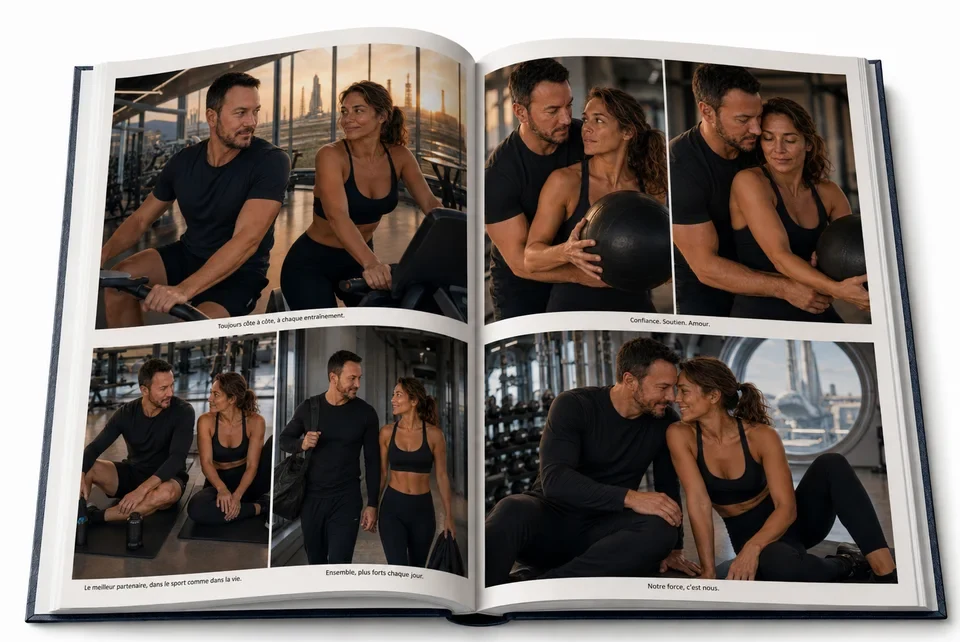
Their relationship is not reduced to a romantic portrait. It is shown inside the constraints of selection, secrecy, discipline and the knowledge that departure may be irreversible.
A relationship is not created by a single romantic image. It grows through glances, gestures, silences, shared effort and the gradual reduction of distance. The visual sequence therefore returns to the same two characters in different circumstances instead of presenting one definitive portrait.
Their intimacy remains inseparable from the mission. They are being assessed, trained and prepared for a departure that may be irreversible. Tenderness exists inside secrecy, discipline and uncertainty. This contrast is essential to the emotional identity of the first volume.
Readers may compare these images with their own mental picture of David and Stella. The companion does not cancel personal interpretation; it records the author’s visual reference while leaving the fictional world open.
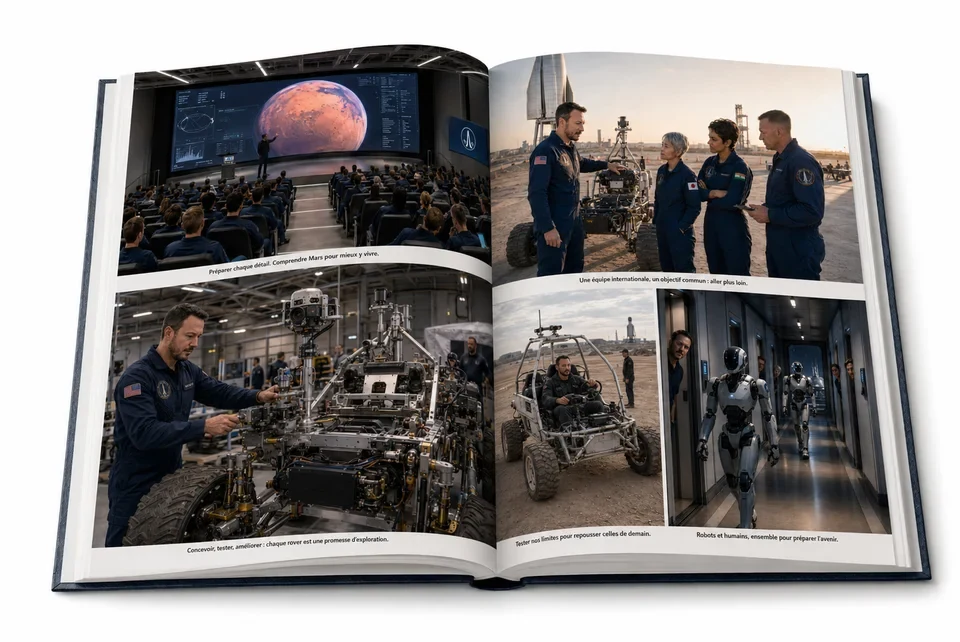
Training, discipline and learning. A journey to Mars depends on far more than a launch vehicle. The future settlers must learn common procedures, emergency responses, robotics, vehicle operation, medical routines and the limits of their own bodies. The training scenes insist on repetition because competence under pressure is built before the crisis occurs.
Physical performance matters, but cohesion matters just as much. Every specialist must understand enough of the others’ work to assist, replace or question them when necessary. The illustrated book keeps the human group at the centre of the technical spectacle: machines only become useful when people know how to depend on one another.
Editorial perspective. Before it became a four-book saga, I Walked on Mars was a world the author needed to see: a city not yet built, candidates not yet chosen, faces not yet attached to names and a mission whose credibility depended on ordinary details.
This colour volume gathers part of that visual imagination. It follows the study of profiles, the first bonds, the learning process, the doubts, the trials and the entire terrestrial preparation required before leaving the known world. It is a companion to the narrative, not a shortened version of it.
The first visual companion follows selection and training. Interfaces, places, clothing, HERMES, exercises and human relationships give concrete form to a mission that initially exists only as a plan.
For the research context behind these issues, see interfaces, signage and working environment · practical training and cross-training
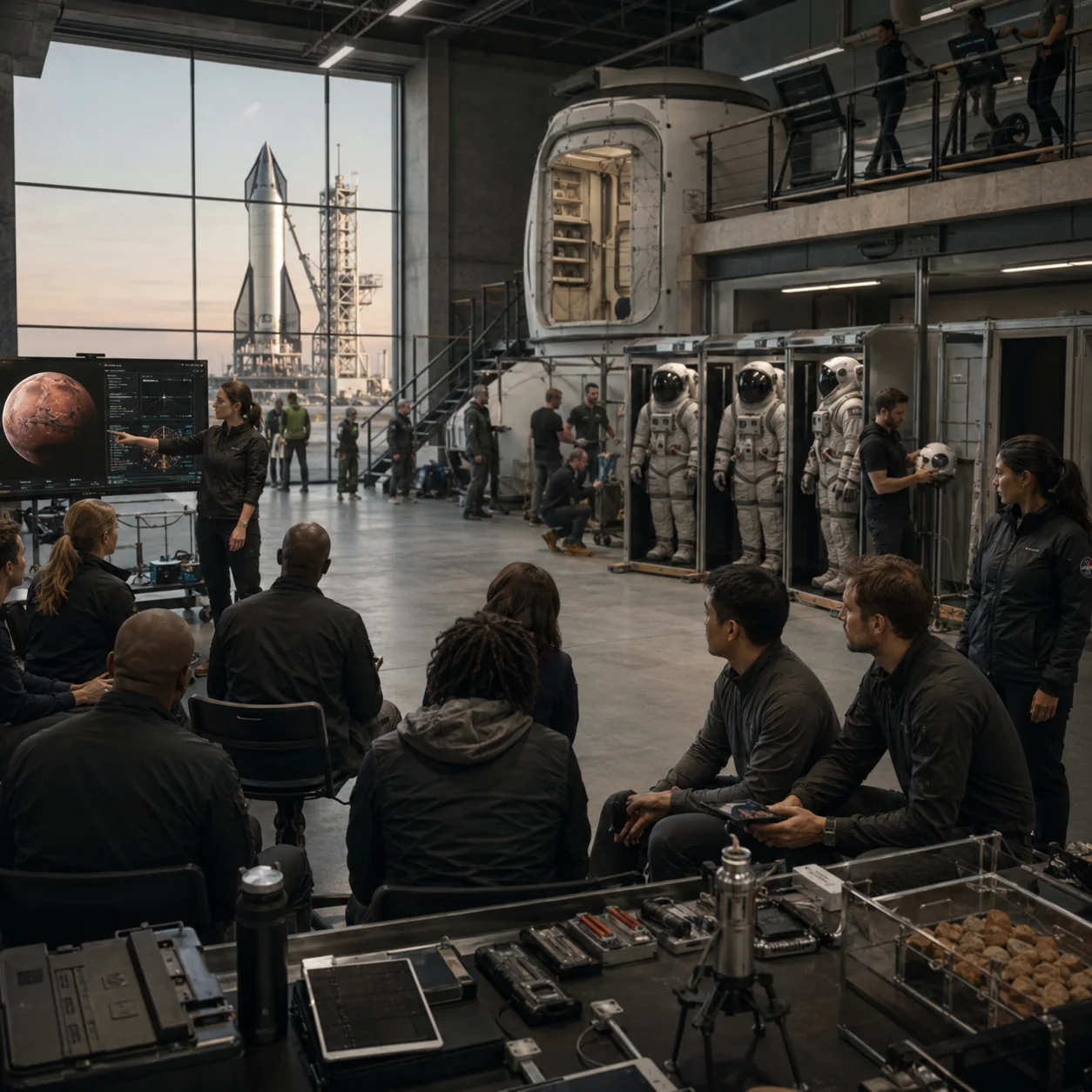
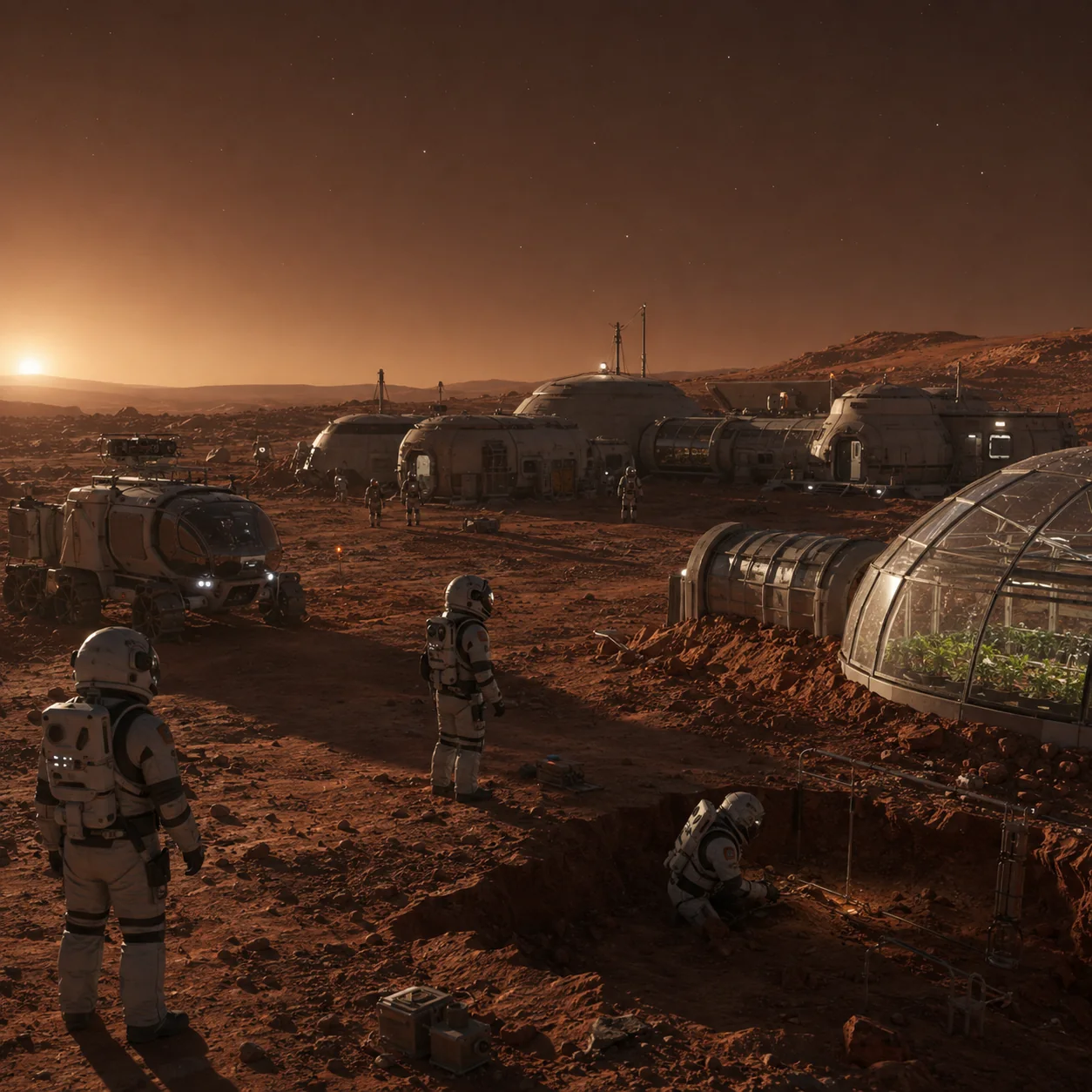
The first volume of the illustrated collection translates the preparation phase into images: interviews, medical and psychological selection, collective training, brief moments of intimacy and the industrial environment of a mission that is still on Earth.
A novel leaves room for each reader to invent faces, spaces and light. During the writing process, however, the author also develops a more precise internal world: the atmosphere of an interview room, the scale of the training campus, the appearance of Hermès, the tension of an emergency exercise and the particular way two characters look at one another before either of them speaks.
This first visual volume follows the human progression of The Great Departure. It begins with applications and assessment, moves through interviews and collective exercises, and ends with a group that is no longer a collection of candidates but the beginning of a crew. The images are therefore arranged according to the story’s development rather than by decorative theme.
The illustrated book can be discovered independently, but it gains meaning beside Book 1, where the political, psychological and technical stakes are developed in full.
The companion can be browsed on its own, especially by readers interested in concept art, space settlement and visual storytelling. Yet its strongest meaning appears beside Book 1, where the political choices, psychological tests and technical preparation are described in full.
The novel explains why the mission is organised as it is and what each candidate risks losing. The illustrated volume gives immediate material form to those decisions. Together, they allow the reader to move between narrative depth and visual scale.
Choose the language and format directly. When an ASIN is confirmed, the button opens the exact Amazon listing. When a format is published but the ASIN still needs to be copied from KDP, a clearly labelled Amazon search link is provided instead of inventing an identifier.
English / United States — Amazon.com
Paperback
I Walked on Mars 1 — The Author’s Vision
French — Amazon.fr
Broché
J’ai marché sur Mars T1 — La vision imagée de l’auteur
Relié
J’ai marché sur Mars T1 — La vision imagée de l’auteur
ASIN still needs to be copied from KDP; a search link is provided in the meantime.
Direct links use confirmed ASINs only. Other published formats are listed without inventing identifiers.
No. It is an illustrated companion that visualises selected places, characters and stages. The complete plot, arguments and character development remain in the corresponding novel.
Only where an authentic English visual spread is available. French text-heavy pages are excluded, and the page states the origin of the remaining images so that no French spread is presented as an English edition.
No. They are an artistic interpretation of speculative fiction, created with digital and generative tools under the author’s editorial direction.
Yes, but it gains depth beside the corresponding novel, which explains the technical, political and psychological stakes that the images can only suggest.