


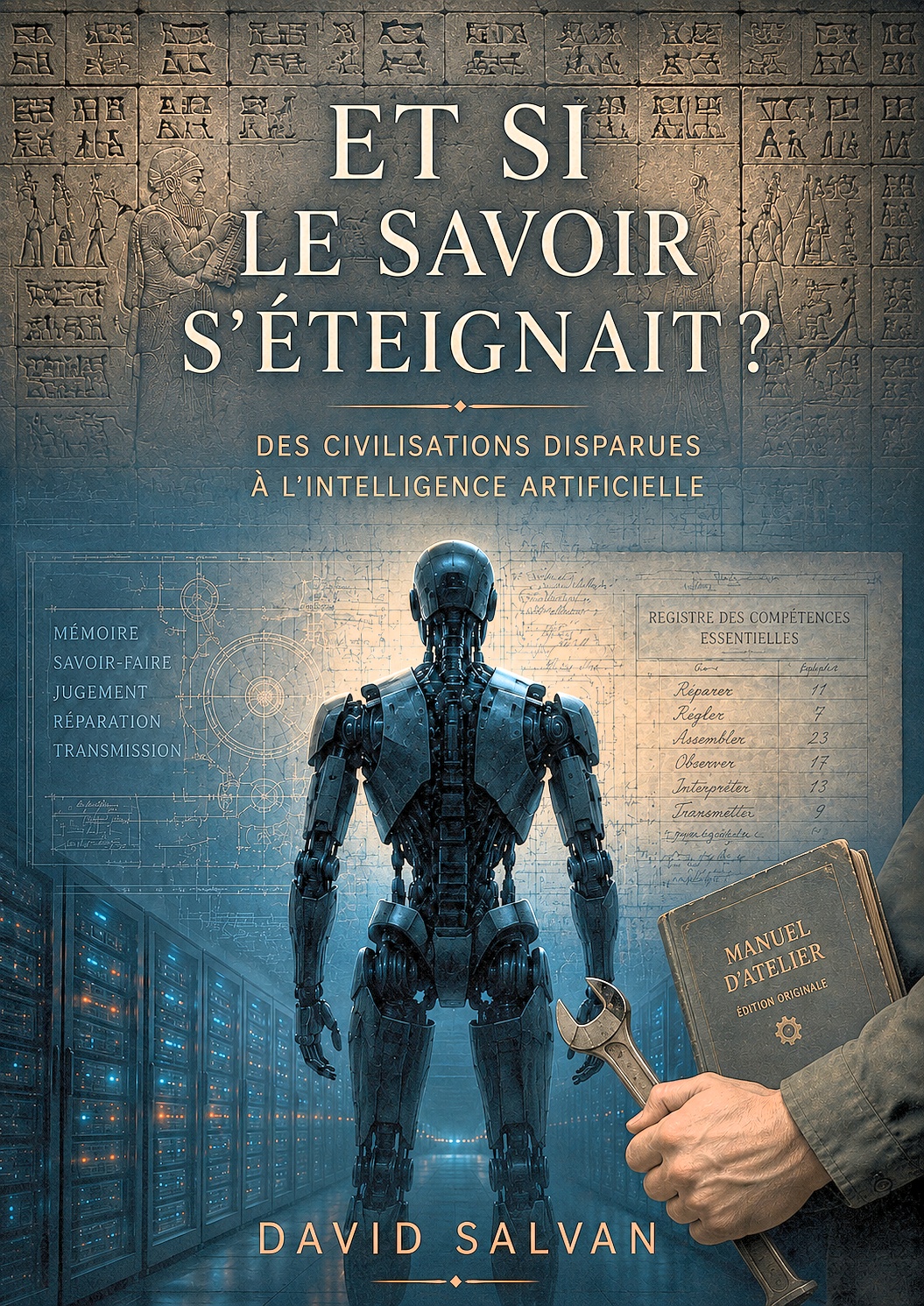
What this book helps the reader understand
- Why an archive is not the same as a living capability.
- How skills disappear when transmission chains break.
- What historical examples reveal about technological fragility.
- How AI can preserve knowledge while also encouraging human deskilling.
Questions this book addresses
The central question: is information enough?
A formula, drawing or database can survive while the ability to interpret, reproduce or repair the underlying system disappears.
Knowledge exists through people, institutions, tools and repeated practice.
A disappeared civilization is not a disappeared people
The book distinguishes the destruction or transformation of states, cities, libraries and specialised practices from the survival of descendants, languages and traditions.
From carved stone to data centres
Clay tablets, monuments, magnetic media, cloud systems and model weights all preserve different fragments.
None is self-explanatory or independent of infrastructure.
What artificial intelligence changes
AI can help recover patterns, translate texts and support experts.
It can also become an opaque intermediary that reduces direct human practice and concentrates dependence.
Case studies and human backups
FOGBANK, the BBC Domesday project, the Antikythera mechanism, unread scripts, industrial continuity and advanced supply chains show why redundant human competence matters.
Available editions
The retail links below refer to the French-language editions. No unavailable English edition is claimed, and no purchase link is invented.
Frequently asked questions
Is the book predicting the end of AI?
No. It studies the loss of human capability when societies confuse access to systems with mastery of them.
Which editions are available?
The French Kindle, paperback and hardcover editions are available through the links on this page.
Information, capability and transmission are different things
A civilisation can retain texts, diagrams and databases while losing the people, tools and institutions required to interpret them. Conversely, a community can preserve a capability through practice even when little written documentation survives. The book distinguishes information from operational knowledge and from the chain that allows knowledge to be taught, tested and corrected.
This distinction changes how we think about digital archives. A perfectly copied file is not a guarantee that future readers will possess compatible hardware, software, vocabulary, context or confidence in the file’s meaning.
Six case studies that make the problem concrete
FOGBANK illustrates how a strategic material can become difficult to reproduce even when the object that used it remains known. The BBC Domesday Project shows how digital memory can become difficult to access because formats and reading systems age. The Antikythera mechanism reveals how a sophisticated technical tradition can disappear and later be reconstructed only through fragments.
Undeciphered writing systems show that signs can survive without readers. Flamanville is used to examine industrial continuity, skills and the consequences of long interruptions. ASML and advanced lithography illustrate the opposite vulnerability: knowledge still exists, but is concentrated in an exceptionally narrow and interdependent chain.
A method separating evidence, hypotheses and foresight
Historical cases, documented technical episodes and prospective scenarios do not have the same evidentiary status. The book marks these differences rather than presenting every comparison as proof. A historical loss can illuminate a modern risk without demonstrating that the same sequence will occur again.
This caution also applies to the expression “disappeared civilisation”. Political systems, cities, archives and specialised capabilities can collapse while descendants, languages and traditions continue. The book studies interrupted capacities, not the disappearance of peoples.
Human backups
A resilient society maintains more than data backups. It keeps trained teams, teaching pathways, physical examples, test environments, independent documentation and the ability to operate in degraded modes. Redundancy may look inefficient until the day a centralised system fails.
The objective is not to reject artificial intelligence. It is to use it without allowing convenience to erase the human competence required to supervise, contest and reconstruct it.