


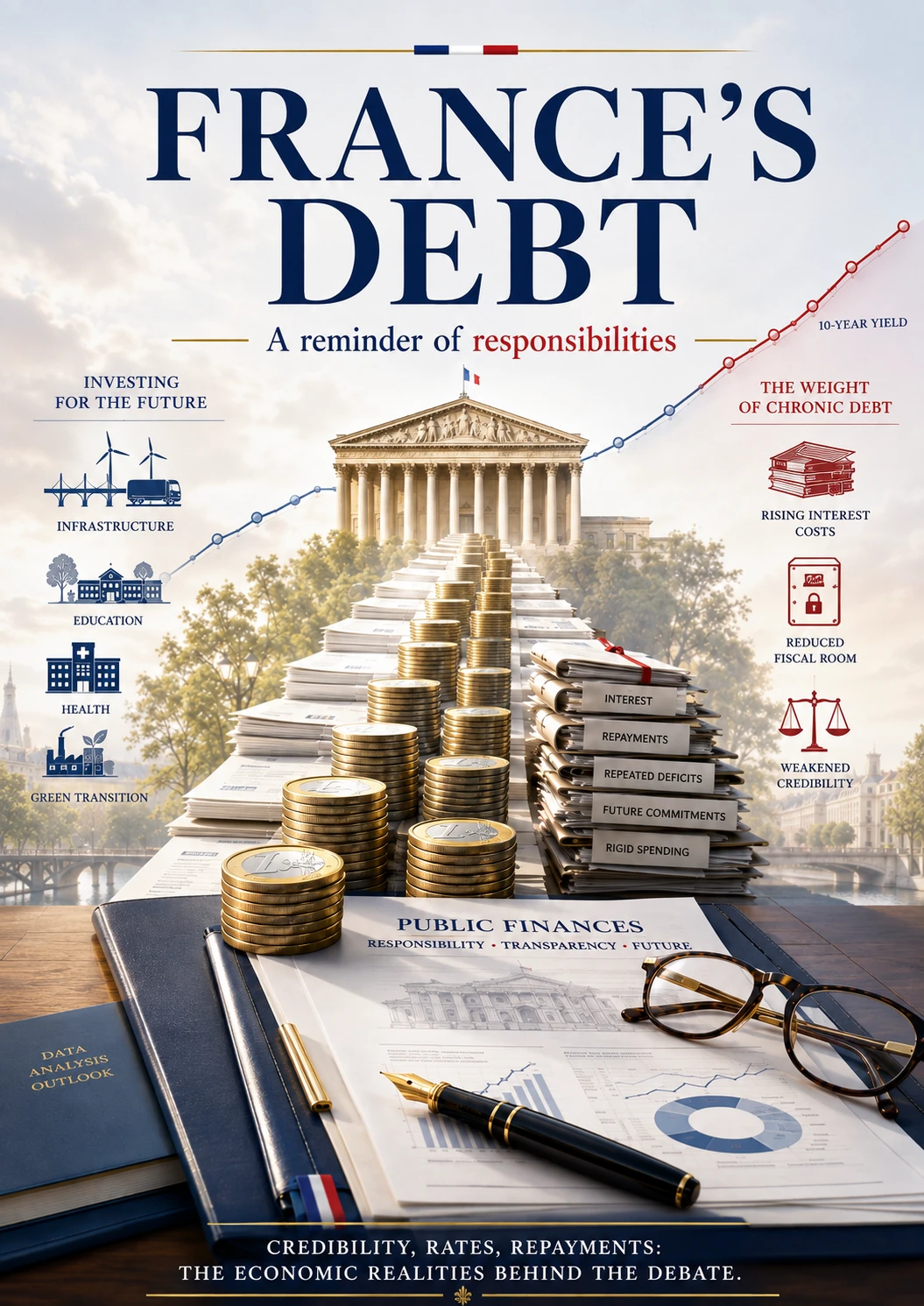
Debt can finance the future. France’s problem lies elsewhere: since 1975, general government has run a deficit every year. Cancelling part of the debt stock without correcting the deficit flow does not remove the mechanism that recreates the debt.
This dossier is a critical analysis of public proposals and statements by political figures. Value judgements are explicitly presented as such. Numerical and legal claims are linked to institutional or primary sources.
I have just discovered, with some astonishment, the comments made by Jean-Luc Mélenchon, declared La France insoumise candidate for the 2027 presidential election, echoing Éric Coquerel’s book Lâchez-nous la dette ! and presenting public debt as a “deliberate strategy to destroy social gains and line the pockets of the privileged”. I want to respond to them, not because it would be illegitimate to question our public-financing system, the role of the European Central Bank or certain European rules, but because France’s financial situation has become far too serious to be reduced to this kind of formula. It is perfectly possible to debate the ECB’s role, seek changes to European treaties, support more public investment, challenge certain austerity policies or propose a different monetary architecture. But presenting debt essentially as a scheme organised by creditors avoids the first question: who created this debt by voting, year after year, for spending above revenue? [S1][S3][S22]
On this point, the French left certainly cannot present itself as an innocent bystander to history. It is obviously not solely responsible, since the right, centrist governments and Emmanuel Macron’s governments have also contributed to the accumulation of deficits. But precisely because responsibility is collective, it is difficult today to portray creditors as the fundamental cause of the problem.
Debt is not bad by nature
Let us begin with something essential: debt can be perfectly useful. The IMF itself points out that debt is neither good nor bad in itself. It allows a state to cushion an economic crisis, support activity during a recession, get through a war or a pandemic and, above all, finance investments whose benefits will extend over several decades. When a state builds rail, energy, hospital or educational infrastructure that will serve for fifty years, spreading the financing over time rather than making one year’s taxpayers bear the entire cost can be perfectly rational. [S21][S20]
Olivier Blanchard, former IMF chief economist, has also shown in his work that when the interest rate remains durably below economic growth, the real cost of public borrowing can be much lower than intuition might suggest. That is precisely why I do not regard debt as an absolute evil. The real problem appears when borrowing intended to finance investment or exceptional crises gradually becomes a permanent way of funding structurally loss-making day-to-day operations.
France, however, has not recorded a public-sector surplus since 1974. The last positive balance was only 0.1% of GDP. Since 1975, according to the historical series reproduced by the Finance Committee of the French National Assembly, French general government has been in deficit every year. That means that for more than half a century, under governments of the left, the right, cohabitation, the centre and then the presidencies of Emmanuel Macron, we have collectively built a system in which we continually spend more than we raise. [S5]
That is the primary origin of our debt. It does not arise from a secret meeting of bankers or from a mysterious strategy designed to dismantle social gains. It arises first from deficit budgets voted through successively for fifty years, to which interest on the existing debt was then added.
Credit is useful; over-indebtedness is not
Strictly comparing a state with a household would of course be economically wrong. A state has a theoretically unlimited lifespan, can levy taxes and continuously refinances part of its maturities, whereas an individual usually repays a mortgage over a defined period. But the analogy remains highly relevant on one elementary principle: borrowing means receiving money today in exchange for a future commitment.
When an individual takes out a mortgage, debt is useful because it allows them to acquire immediately an asset they could not have paid for in cash. But imagine that after buying their home, the same person begins borrowing every month to pay for groceries, ordinary bills or to maintain a standard of living above their income. They then borrow to repay the previous loan, and again the following month because spending remains above resources. At that point, the problem is no longer the existence of credit, but the fact that borrowing is compensating for a structural inability to balance income and expenditure.
The image of a child makes the mechanism even easier to understand. If I give my child €1 to buy sweets and they buy €2 worth, someone has necessarily advanced the missing euro. If this happens every week and they later buy €3 worth while still having only one euro, the problem does not come from the person advancing the money. It comes from the fact that consumption is gradually being organised around spending that is systematically above available resources. That is precisely the distinction to understand between productive debt and chronic deficit.
€3,536 billion of public debt
The figures show the scale of the problem. In the first quarter of 2026, French Maastricht public debt reached €3,536.1 billion, or 117.5% of gross domestic product. At the end of 2025 it still stood at 115.7% of GDP. In a single quarter, the amount therefore rose by €75.6 billion, although INSEE rightly notes that a quarterly change in debt does not directly equal the quarter’s deficit, notably because of movements in cash and financial assets. [S4][S15]
For comparison, public debt was around 20.7% of GDP in 1980. We have therefore moved from a level equal to roughly one fifth of annual economic output to a debt stock larger than that annual output. But the most worrying issue is no longer only its size: it is also its cost. In February 2026, the Cour des comptes estimated that interest costs should approach €74 billion this year and could exceed €100 billion by 2029 if current trends continue.
This means that before financing a new school, a new hospital, additional infrastructure, an industrial policy or a new social measure, tens of billions of euros must already be devoted each year to commitments made in the past. That, concretely, is the weight of debt that has become chronic.
The left shares responsibility, as do the right and the centre
This is precisely where I find the statements by Jean-Luc Mélenchon and Éric Coquerel particularly open to challenge. One can criticise the financial and monetary system, but one cannot have taken part for decades in the country’s budgetary management and then present creditors as the primary cause of the debt.
In 1981, when François Mitterrand arrived at the Élysée, public debt represented about €110 billion in converted value, or roughly 22% of GDP. In 1986, after five years of the Mauroy and then Fabius governments, it reached around €249 billion and 31.1% of GDP. When a new period of left-wing government began in 1988, it stood at about €303 billion and 33.3% of GDP. In 1993, it reached around €515 billion and 46% of GDP. In 1995, after fourteen years of Mitterrand’s presidency—including, of course, the two periods of cohabitation under Chirac and then Balladur—it represented around €664 billion and 55.5% of GDP. [S6]
It would be intellectually dishonest to attribute all of that increase to the left, since periods of cohabitation must obviously be taken into account and annual statistics do not correspond exactly to the dates on which governments enter and leave office. But it would be just as dishonest today to present the left as an outside victim of this process. Between 1981 and 1995, the debt ratio nevertheless rose from 22% to 55.5% of GDP.
History, however, demands the same honesty in the other direction. Under Lionel Jospin, the debt ratio did not explode and even fell slightly relative to GDP in a favourable economic environment. That shows precisely that borrowing is not mechanically tied to a political label. By contrast, under François Hollande, public debt rose from about €1,892.5 billion and 90.6% of GDP at the end of 2012 to around €2,258.7 billion and 98.4% at the end of 2017. Over that calendar period, that represents roughly €366 billion of additional debt and nearly 8 percentage points of GDP. [S7]
The right also contributed heavily to this accumulation. Nicolas Sarkozy governed during an extremely serious global financial crisis, Jacques Chirac and his successive prime ministers did not restore budget balance, and Emmanuel Macron substantially increased borrowing, notably during the Covid crisis but also beyond it. This is therefore a genuinely collective historical responsibility. But precisely for that reason, the left cannot now tell the story as though the debt had been manufactured against it by others.
The 1973 law did not prohibit state financing by the Banque de France
We must also revisit one of the most widespread narratives about French debt: the claim that the law of 3 January 1973 suddenly prohibited the state from borrowing free of charge from the Banque de France and forced it into the hands of private banks. That presentation is historically inaccurate.
An information report by the French National Assembly on the management and transparency of public debt points out that the 1973 law did not prohibit advances from the Banque de France to the state. Article 19 still provided that the conditions under which the state could obtain advances and loans would be set by agreement between the Minister for the Economy and the Governor of the Banque de France, with parliamentary approval. [S8]
Another budget report from the French National Assembly even gives precise figures: these facilities could reach 20.5 billion francs, of which a tranche of up to 10.5 billion francs could be interest-free. Even after 1973, there was therefore still a genuine possibility of direct, partly free financing by the Banque de France. [S9]
The particularly interesting historical point is that the facilities used for the state’s cash-management needs were reduced to zero in 1982 and that no new facilities of this kind were subsequently used. France was then under the presidency of François Mitterrand, with Pierre Mauroy at Matignon and Jacques Delors at the Ministry of Economy and Finance. This obviously does not mean that the left alone invented market financing of the state, but it makes it difficult, to say the least, to claim that it passively endured a system supposedly imposed on it in 1973. [S9]
The complete legal prohibition of direct monetary financing came later. The law of 4 August 1993, adopted in the context of building Economic and Monetary Union, prohibited the Banque de France from directly granting overdrafts or credit to the Treasury and from directly purchasing its securities. Today, this principle appears in Article 123 of the Treaty on the Functioning of the European Union. [S8][S10]
One may support or oppose this rule. One may wish to amend the European treaties, defend a different monetary organisation or allow more direct public financing by central banks. Those are entirely legitimate debates. But they must start from actual history and, above all, must not reverse causality: the state did not run fifty years of deficits because it had to pay interest. It first had to borrow because successive governments spent more than they collected. Interest then worsens the debt, sometimes considerably, but it does not by itself create the original deficit.
The creditor did not write the French budget
This is probably the sentence that best sums up my disagreement with Jean-Luc Mélenchon and Éric Coquerel: the creditor did not write the French state budget. The creditor simply financed the difference between the spending our governments chose to undertake and the revenue they chose to collect.
Take a deliberately simple example. If a state spends 100 but collects only 95, it is short of 5. It can increase revenue, reduce some spending, sell assets, create money directly if the legal and monetary system permits it, or borrow the difference. France has very largely used this last solution. When the operation is repeated year after year for half a century, annual deficits gradually become a colossal stock of debt.
Interest then amplifies the phenomenon. It can even create a snowball effect when its cost becomes sufficiently large. But removing interest without durably eliminating the deficit means treating a consequence without correcting its cause. If the state continues to spend more than it raises, it will have to keep borrowing, even after any partial cancellation of existing debt.
Who are the “privileged” people to whom France actually pays interest?
When Jean-Luc Mélenchon speaks of debt designed to “line the pockets of the privileged”, it is also necessary to specify who actually holds French government securities. The debt is held by banks, insurance companies, investment funds, central banks, institutional investors, savings institutions and, directly or indirectly, by French and foreign households.
The Banque de France reported that in the first quarter of 2026, 55.9% of long-term French public-debt securities were held by non-residents. This figure is fundamental because it means that France depends heavily on the confidence of international investors to continue financing its needs. [S14]
Agence France Trésor therefore plans around €310 billion of net medium- and long-term debt issuance in 2026. At 31 July 2026, marketable central-government debt alone—which does not cover exactly the same scope as total Maastricht public debt—stood at about €2,881.9 billion and had an average maturity of 8 years and 163 days. On 21 August, France’s representative ten-year rate, TEC 10, was around 4.08%. [S11][S12][S13]
We are therefore a very long way from the exceptional situation of the early 2020s, when France could sometimes borrow at extremely low rates, or even at negative rates for some maturities.
A state can default, but default is never cost-free
We then need to distinguish between two issues that are often mixed together in the debate: transforming or cancelling debt held by a central bank is not the same thing as defaulting on private creditors. Jean-Luc Mélenchon himself acknowledged this very clearly in 2020.
In the draft resolution he submitted to the French National Assembly to transform debt held by the European Central Bank into zero-interest perpetual debt, the explanatory memorandum considered the possibility of an actual default and stated that it would be “a disaster and chaos”. On that point, I fully agree with the Jean-Luc Mélenchon of 2020. [S17]
A sovereign state can of course decide to stop paying. No one is going to seize the Élysée in the way a bank can foreclose on a property. But legal sovereignty does not mean the operation would be without consequences. A study by Luís Catão and Rui Mano published by the IMF and examining the history of sovereign defaults shows that, for the post-1970 period studied by the authors, countries returning to markets after a default historically paid an average premium of around 400 basis points when they returned.
One basis point equals 0.01 percentage point. Four hundred basis points therefore correspond to roughly 4 additional percentage points. Five years after default, the average penalty observed in the study was still close to 200 basis points, or around 2 percentage points. These figures should obviously not be mechanically applied to contemporary France, because countries, currencies, periods and circumstances differ. But they illustrate a fundamental principle: default damages confidence, and that damage has a price.
The potential consequences are not limited to higher interest rates. Economic research on sovereign defaults also identifies risks of impaired market access, banking disruption, credit contraction and lower economic activity.
With €310 billion to raise this year, credibility is not an abstraction
Simply imagine that one morning France tells some of its creditors that it no longer recognises its obligations. The next day it still has to pay civil servants, pensions, suppliers, social expenditure and securities reaching maturity. Then it goes back to investors and asks them for tens of billions of euros more.
How would they react? They might continue lending, but logically they would demand higher remuneration to compensate for the risk that a new commitment might also be called into question. The less credible the debtor, the larger the risk premium demanded by the lender.
This is exactly what any individual understands when taking out a loan. A citizen cannot receive €200,000 from a bank and then explain a few years later that the claim is an ideological construction designed to line the banker’s pockets and that they have therefore decided to stop repaying. They can renegotiate the loan, restructure the debt, seek rescheduling or, under certain conditions, use an over-indebtedness procedure, but all these solutions begin precisely by recognising that the claim exists.
Mélenchon’s proposal nevertheless deserves to be described honestly
To be intellectually serious, we should not pretend that Jean-Luc Mélenchon is now proposing an immediate repudiation of the whole of France’s debt. His proposal concerns in particular the share of government securities held within the Eurosystem through the Banque de France. He refers to a substantial part of the stock and argues that this debt could be transformed or cancelled without directly harming a private creditor, since the central bank belongs to the public sector.
This idea is not the same as a general default. As early as 2020, Jean-Luc Mélenchon’s parliamentary proposal was to transform the securities concerned into zero-interest perpetual debt. Economists do indeed advocate various forms of restructuring, cancellation or conversion into perpetual debt for liabilities held by central banks. It would therefore be a caricature to claim that the idea is unknown in the economic literature.
But saying that these securities could simply be “burned” as if they had no counterpart is just as simplistic. When a central bank buys a government bond, it records that security as an asset and creates central-bank money in return. Subsequently removing the asset does not retroactively remove the money created when it was purchased. It changes the central bank’s balance sheet, its future income and potentially its financial relationship with the state.
It should also be remembered that a public central bank can transfer part of its profits to the state when it makes them. One euro of interest paid to a national central bank therefore does not have exactly the same consequences as one euro paid to a foreign private investor. Once again, economic reality is more complex than the simple slogan that interest systematically fills the pockets of a privileged caste.
Current European law prohibits this operation
Christine Lagarde, President of the European Central Bank, addressed this question explicitly in 2021. She stated that cancelling public debt held by the Eurosystem would be incompatible with the European treaties because it would breach the prohibition on monetary financing laid down in Article 123 of the Treaty on the Functioning of the European Union. [S18][S10]
LFI can of course reply that the treaties should then be changed. That is a perfectly legitimate political position. But it should be acknowledged for what it is: a profound change to Europe’s monetary architecture, not a simple accounting operation in which a line is deleted from an Excel spreadsheet with no other consequence.
If Jean-Luc Mélenchon wishes to defend such a break, then the debate should cover all its consequences: what new rules for the ECB, what limits on monetary financing, what consequences for central-bank independence, what safeguards against permanent monetisation of deficits, what potential effects on inflation and what reaction from the other euro-area member states?
That is what a genuine presidential debate on debt looks like.
Even after cancellation, the deficit would remain
Suppose nevertheless, purely for the sake of argument, that Jean-Luc Mélenchon tomorrow obtained exactly what he wants and that a significant share of the debt held by the Banque de France were converted into zero-interest perpetual debt or cancelled. What happens next if the state continues spending more than it raises? It borrows again.
If the deficit persists the following year, it borrows again. Then again the year after that. A few years later, part of the cancelled debt will gradually have been recreated.
This is precisely why analysis of public finances must distinguish the stock of debt from the annual flow of deficit. An exceptional operation on the stock can temporarily reduce debt and interest costs. But as long as budget operations continue to generate large deficits, borrowing starts rising again.
In other words, cancelling part of the meter without fixing the leak may provide some respite. It does not repair the pipe.
The Cour des comptes and the OECD are also sounding the alarm
Jean-Luc Mélenchon can naturally consider that some institutions defend an economic order he wants to challenge. But it becomes difficult to ignore their diagnoses entirely when several independent bodies reach converging conclusions.
The Cour des comptes considers French public finances to be among the most deteriorated in the euro area today. It forecasts interest costs close to €74 billion in 2026 and warns that they could exceed €100 billion in 2029 if the current trend persists. In particular, it highlights the gradual refinancing of older debt contracted at very low rates by much more expensive new issuance. [S15]
The OECD reaches a similar conclusion in its Economic Survey of France published in June 2026. It notes that public debt rose from around 60% of GDP in 2000 to more than 115% in 2025 and considers a return to a durably declining path a priority. It also notes that debt-service costs rose from around 1.3% of GDP in 2020 to 2.1% in 2025. [S16]
Preserving social gains also requires preserving public finances
This is where I find Jean-Luc Mélenchon’s argument particularly paradoxical. He presents debt as an instrument designed to destroy social gains, whereas debt that becomes too costly ends up reducing the resources available to finance those very gains.
Every billion euros devoted to interest payments cannot simultaneously be allocated to hospitals, teachers, security forces, infrastructure, research, defence, the energy transition or long-term care. Borrowing can absolutely save public services during a crisis or finance their modernisation. But when it becomes structural and its cost continually rises, it can ultimately strangle them.
That is why seeking to control debt is not necessarily an anti-social or “ultraliberal” project. On the contrary, it can become the condition that allows a strong social state to continue financing its public policies sustainably.
Fifty years of shifting the cost of our choices into the future
The real French problem may ultimately lie here. For fifty years, successive governments have discovered something politically very convenient: it is much easier to announce spending today than to explain immediately who will actually finance it.
Spending can be increased without raising taxes enough, while refusing to cut other expenditure and borrowing the difference. Citizens receive the benefit immediately, while part of the bill is pushed into the future. The next government does exactly the same, and then the next one again. Fifty years later, we discover a stock of more than €3,500 billion.
The left took part in this mechanism. So did the right. So did the centre. So did Emmanuel Macron. And voters themselves have sometimes rewarded those who promised them more without explaining how those promises would be financed, while punishing those who announced the bill.
Responsibility is therefore far broader than the comfortable story that pits the “privileged” against “the people”.
What I expect from a candidate for President of the Republic
Jean-Luc Mélenchon is a candidate in the 2027 presidential election. It is therefore perfectly legitimate for him to propose a radical transformation of the European monetary system. But precisely because he aspires to govern France, I would like the debate to go far beyond formulas suggesting that the securities could simply be “thrown into the fire” or that the debt was built to “line the pockets of the privileged”.
The real discussion is about what exact share of the debt would be concerned, what the accounting consequences would be for the Banque de France, how its losses and future income would be treated, which treaty provisions would have to be amended, how our European partners would react, how the public deficit would be financed after cancellation, what new debt would continue to be issued, what risk premium investors might demand and, above all, how France could be prevented from rebuilding in ten or fifteen years the debt it had just erased.
Those are the questions a candidate for President of the Republic should answer.
Debt is neither an invention of the rich nor a mere piece of paper
Debt remains fundamentally a tool. Used well, it prepares the future. Used badly, it allows consumption today while passing part of the bill to future generations. That is exactly the difference between credit and over-indebtedness: the former can be extraordinarily useful, while the latter eventually becomes a trap.
France today has public debt of €3,536.1 billion. It plans to raise €310 billion net in medium- and long-term debt in 2026. More than half of its long-term public securities are held by non-residents. Its ten-year rate is now around 4%, and the Cour des comptes warns that annual interest costs could exceed €100 billion in 2029. [S4][S11][S13][S14][S15]
In these circumstances, claiming that the problem is essentially the creditors seems to me above all a very convenient way of avoiding the fundamental question: why did we collectively accept for fifty years that we would spend more than we financed?
For fifty years, the French state asked investors to lend it money. They lent. Successive governments spent that money, and citizens benefited, directly or indirectly, from some of the policies financed by it. Now that the bill is becoming heavy, we can perfectly well discuss financing conditions, the role of the ECB, the level of interest rates, the banking system, Article 123 of the European treaties or even a restructuring of certain debts. But we cannot behave as though the borrowing had never existed or as though the creditor were responsible for the deficit budget we asked it to finance.
The most honest sentence to address to the French today is therefore neither “all the debt must be repaid immediately” nor “we only need to burn the securities”. It is to acknowledge that collectively we have lived for fifty years with spending above revenue and that we must now decide democratically what we want to continue financing, how we agree to finance it and what share of this bill we are still prepared to pass on to future generations.
That is the real debate I would like to hear as 2027 approaches. Slogans can make the debt disappear for a few seconds in a speech. Public accounting, however, always ends up presenting the bill.
Main sources
- [S1] Jean-Luc Mélenchon, official Telegram channel, August 2026 posts on cancelling debt held by central banks and on debt as a “deliberate strategy”. Open source ↗
- [S2] TF1 Info, Vérif’, August 2026: contextualisation of the phrase “throw it into the fire” and clarification of the share of debt targeted by Jean-Luc Mélenchon. Open source ↗
- [S3] L’insoumission, video interview with Éric Coquerel about his book Lâchez-nous la dette !, 21 October 2021. Open source ↗
- [S4] INSEE, Maastricht debt in the first quarter of 2026: €3,536.1bn, 117.5% of GDP, +€75.6bn over the quarter. Open source ↗
- [S5] French National Assembly, change in the public-sector balance since 1971: positive balance of 0.1% of GDP in 1974, followed by annual deficits from 1975 in the series reproduced. Open source ↗
- [S6] INSEE, historical public-debt series: 20.7% of GDP in 1980, 22.0% in 1981, 31.1% in 1986, 33.3% in 1988, 46.0% in 1993, 55.5% in 1995. Open source ↗
- [S7] INSEE, public debt and deficit 2012–2018: €1,892.5bn and 90.6% of GDP in 2012; €2,258.7bn and 98.4% in 2017. Open source ↗
- [S8] French National Assembly, information report on the management and transparency of public debt: the 1973 law did not prohibit Banque de France advances to the state; complete prohibition in 1993. Open source ↗
- [S9] French National Assembly, 2000 Finance Bill: ceiling of 20.5 billion francs for Banque de France–Treasury facilities, including a tranche of up to 10.5 billion francs that could be interest-free; facilities reduced to zero in 1982. Open source ↗
- [S10] Treaty on the Functioning of the European Union, Article 123: prohibition of direct monetary financing of public administrations. Open source ↗
- [S11] Agence France Trésor, indicative 2026 financing programme: €310bn of net medium- and long-term issuance. Open source ↗
- [S12] Agence France Trésor, marketable debt at 31 July 2026: €2,881.9bn; average maturity 8 years and 163 days. Open source ↗
- [S13] Agence France Trésor, key figures: TEC 10 at 4.08% on 21 August 2026. Open source ↗
- [S14] Banque de France, issuance and holdings of French securities, Q1 2026: 55.9% of long-term public-debt securities held by non-residents. Open source ↗
- [S15] Cour des comptes, La situation des finances publiques début 2026: interest costs close to €74bn in 2026 and risk of exceeding €100bn in 2029. Open source ↗
- [S16] OECD, OECD Economic Surveys: France 2026: debt at 115.5% of GDP in 2025 and debt service at 2.1% of GDP. Open source ↗
- [S17] French National Assembly, draft resolution no. 2914 (2020): conversion of debt held by the ECB into zero-interest perpetual debt; the text describes a default as “disaster and chaos”. Open source ↗
- [S18] ECB, letter from Christine Lagarde dated 23 April 2021: cancellation of public debt by the Eurosystem is incompatible with the treaties under Article 123. Open source ↗
- [S19] IMF, Luís Catão and Rui Mano, Default Premium: historical study of the risk premium after sovereign default. Open source ↗
- [S20] Olivier Blanchard, Public Debt and Low Interest Rates, American Economic Review, 2019. Open source ↗
- [S21] IMF, Making Debt Work for Development and Macroeconomic Stability, 2022: debt is neither good nor bad in itself and depends on how it is used and on its terms. Open source ↗
- [S22] Le Monde, 3 May 2026: Jean-Luc Mélenchon formally announces his candidacy for the 2027 presidential election. Open source ↗
This text criticises public positions and proposals. It does not claim that any one party or person is solely responsible for French debt; on the contrary, it sets out a collective historical responsibility and distinguishes facts from the author’s political assessments.