


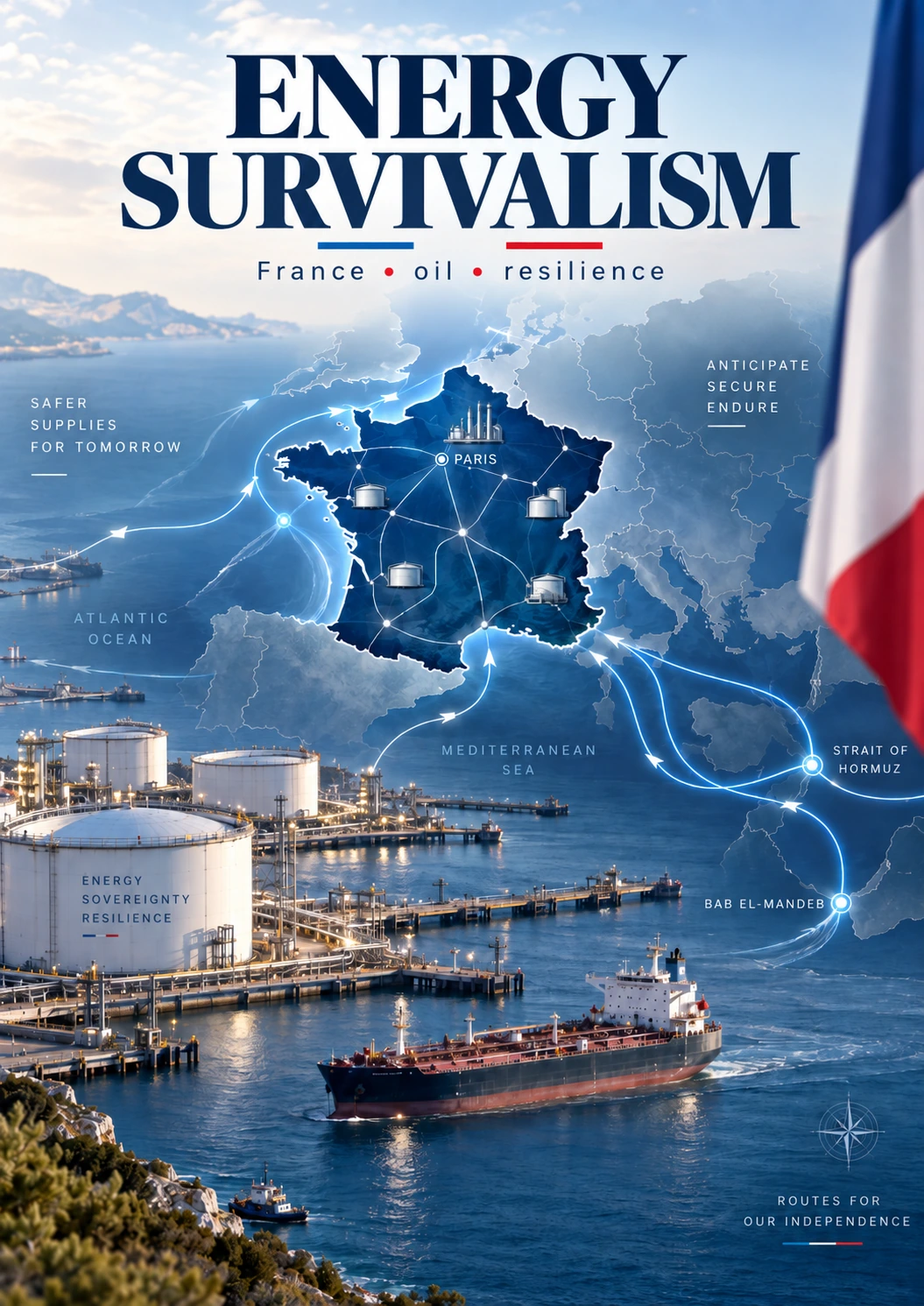
Methodological note
This article deliberately distinguishes five categories of information. An observed datum comes from a published measurement or statistic. An estimate is based on a reconstruction or calculation by a specialized organization. A simulation applies assumptions to existing data. An order of magnitude is used to gauge a plausible scale without constituting a quotation. A scenario describes a hypothetical situation intended to test the resilience of the system. This distinction is essential to avoid turning a hypothesis into an established fact.
Official French, European and international sources are preferred whenever they exist. Professional data are used when they describe industrial or logistical capacities. Reuters is used for some recent events and market data that have not yet been covered by an administrative publication. Links appear in the sources section at the end of the article.
The article is current as of September 13, 2026. The military and oil situation in the Middle East is changing rapidly. The most recent operational facts must therefore be rechecked whenever the article is republished.
Why this article, and why now
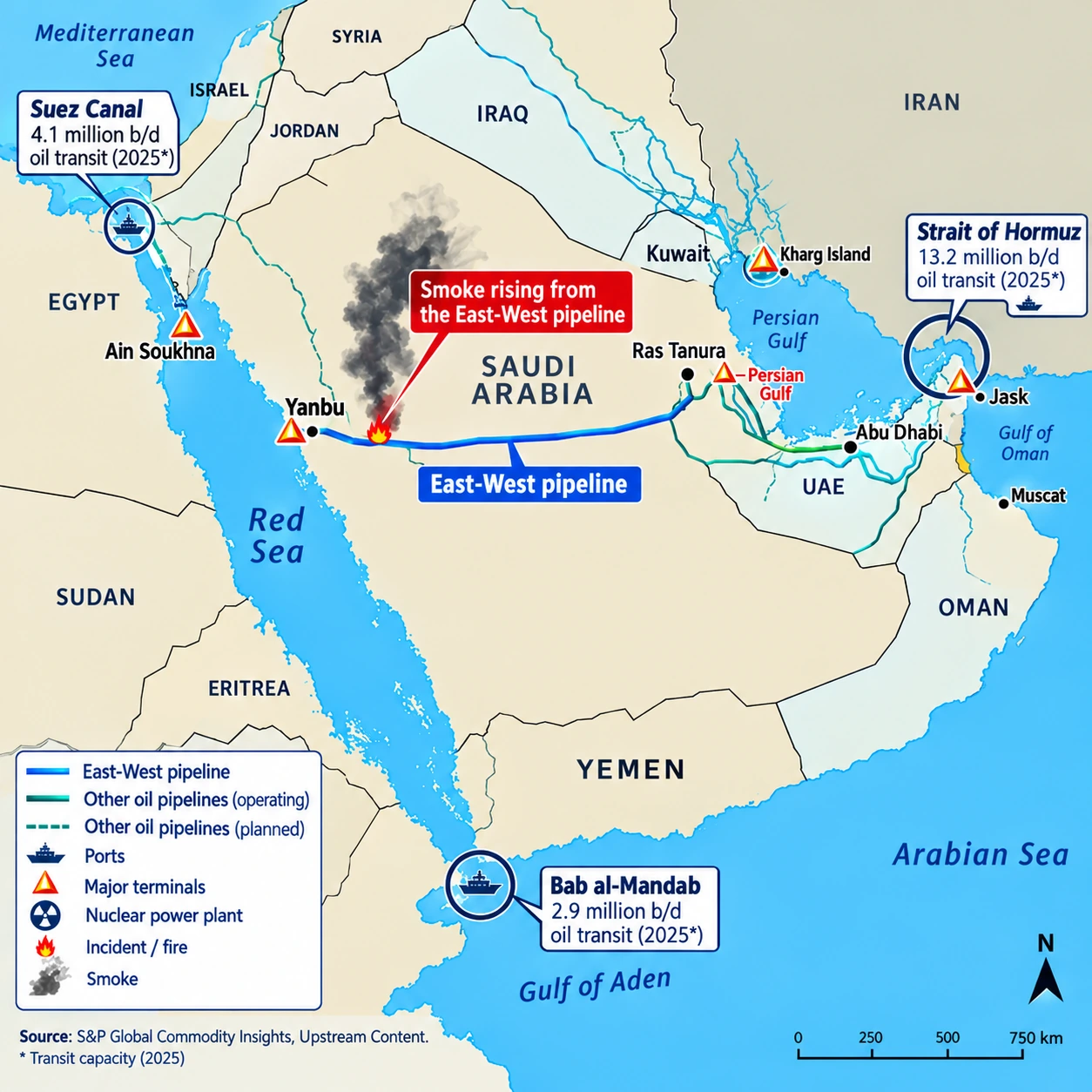
For several months, energy and military events have been overlapping in the Middle East. Taken separately, they can look like a succession of distant alerts. Taken together, however, they form a textbook case for every country that still depends on oil. The Strait of Hormuz is one of the world's main energy chokepoints. In the fourth quarter of 2025, around 21.6 million barrels per day passed through it. By the second quarter of 2026, that volume had fallen to around 4.9 million. [1]
Saudi Arabia has a major land route specifically designed to bypass Hormuz. Its East-West pipeline links the kingdom's eastern producing regions with the terminal at Yanbu on the Red Sea. When the strait becomes dangerous, this infrastructure therefore becomes a major fallback route. In September 2026, it was itself attacked by drones and Saudi Arabia decided to shut it temporarily. Iraqi authorities confirmed that the drones had been launched from their territory. That establishes a geographic origin, but not by itself the perpetrator or sponsor of the operation. [2]
At the same time, flows are being diverted to other routes. Bab el-Mandeb and the Cape of Good Hope are absorbing a growing share of traffic that no longer passes through Hormuz. This redistribution lengthens some voyages, ties up ships for longer, increases fleet requirements and raises insurance costs. A fallback route then gradually stops being mere redundancy and becomes critical infrastructure in its own right. [1][3]
On September 13, the British United Kingdom Maritime Trade Operations service, known as UKMTO, a Royal Navy capability that notably circulates security information between military forces and merchant shipping, reported that a projectile had struck a vessel in the Strait of Hormuz. At the time of the first alert, the extent of the damage and the status of the crew were not yet established. Reuters subsequently reported that a fire had broken out and that the crew had been evacuated by local authorities. [4][5]
We are therefore facing a particularly instructive situation. The main maritime route is severely disrupted. One of the principal land infrastructures designed to bypass it is attacked. Alternative routes become longer, more expensive and more heavily used. Commercial vessels themselves remain exposed. This is not yet proof that France will run out of fuel tomorrow morning. It is, however, a warning about how several supposedly independent layers of security can deteriorate at the same time.
That is precisely why I wanted to write this article. The question is not only what is happening in Hormuz or Saudi Arabia. The question is what France would do if several links in its own energy security were hit at the same time. Do we have enough suppliers that are genuinely independent of one another? Do our supplies use enough different routes? Do our reserves contain the right products and are they available in the right places? Can our refineries produce enough diesel if imports of finished products tighten? Can our ports, pipelines and depots substitute for one another?
In other words, the subject of this article is not Middle Eastern current affairs for their own sake. It is France. The issue is whether our country has been organized to keep functioning when several security assumptions become false at the same time. That is what I will deliberately call the energy survivalism of a state.
France is not exposed only to crude oil
The picture of French crude-oil imports is relatively reassuring. In 2025, France imported 45.9 million tonnes of crude oil. The United States accounted for 22 percent of the total. Kazakhstan accounted for 14.9 percent, Nigeria 11.9 percent, Norway 9.6 percent, and Algeria and Libya 9.4 percent each. The Middle East as a whole accounted for 10.1 percent and Saudi Arabia only 2.4 percent. [6]
That reading becomes misleading if it stops at crude. In 2025, France also imported about 401 terawatt-hours of refined petroleum products. This is equivalent to roughly 34.5 million tonnes of oil equivalent. That unit expresses in a common measure the amount of energy contained in different products. In other words, this is not a marginal dependency. A substantial share of the petroleum energy consumed in France already arrives as finished products. Around 40 percent came from Europe, 14 percent from Saudi Arabia and 13 percent from the United States. The Gulf therefore weighs more heavily on some finished products than its share of our crude imports might suggest. [7][8]
The most worrying point is diesel. French refineries cover roughly half of the diesel consumed in France. The other half must therefore, to an order of magnitude, be obtained as imported already-refined products. At the same time, 67 percent of the 47.5 million cubic meters of road fuels consumed in France were still diesel. [9][10]
Who supplies France, and through which major routes
Diversification must now be measured along two axes. The first concerns the producing country. The second concerns the physical corridor. Two different suppliers do not provide genuine redundancy if their cargoes depend on the same strait, the same terminal or the same pipeline.
France's major entry points are public knowledge. Antifer and Le Havre notably serve the Lower Seine and the Paris region. Fos-sur-Mer is the major Mediterranean gateway and supplies, among other things, the South European Pipeline. Donges and the inland corridor form another strategic system. The French network then relies on pipelines, depots, barges, rail and tanker trucks for final distribution. [11][9]
This architecture has an often underestimated advantage. France has three maritime fronts. It can therefore theoretically receive supplies from the Atlantic, the North Sea or the Mediterranean. But having several ports is not enough. Crude compatibility, terminal capacity, refinery availability, pipeline capacity and the actual ability to move product to the region that needs it must all be verified. [11]
| Origin | Share of 2025 crude | Main corridor | Strength | Main vulnerability |
|---|---|---|---|---|
| United States | 22% | Atlantic | Deep export market and no Hormuz exposure | Global competition for cargoes and freight costs |
| Kazakhstan | 14.9% | Caspian, Black Sea and Mediterranean | Already a major supplier | Concentration on sensitive infrastructure and corridors |
| Nigeria | 11.9% | Atlantic | Direct access to Western Europe | Production volatility and local infrastructure security |
| Norway | 9.6% | North Sea then English Channel | Proximity and political stability | Naturally limited additional volumes |
| Algeria | 9.4% | Mediterranean | Short route to southern Europe | Limited export capacity |
| Libya | 9.4% | Mediterranean | Quality crude and short route | Political instability and interruption risk |
| Middle East | 10.1% | Hormuz, Red Sea and Suez, or around Africa | Major global capacities | Hormuz, Bab el-Mandeb, land installations and war risk |
When a fallback route becomes a critical point itself
U.S. data for 2026 illustrate this phenomenon almost mathematically. One barrel of oil is about 159 liters. In the fourth quarter of 2025, around 21.6 million barrels per day passed through the Strait of Hormuz. By the second quarter of 2026, the volume had fallen to 4.9 million. Meanwhile, Bab el-Mandeb rose from 5.4 to 8.1 million barrels per day and the Cape of Good Hope reached about 9.4 million barrels per day. [1][12]
This redistribution has a cost. The detour around Africa lengthens some routes by roughly two weeks. In September 2026, Reuters reported that in the most exposed situations the additional cost of a transit through the area could reach several million dollars per cargo, with cases estimated at between $10 million and $20 million when freight and war-risk insurance are combined. These are market reports, not a universal official tariff. [3]
The consequence for France is essential. Even when no French barrel originates in Saudi Arabia, scarcity of safe routes and shipping capacity can increase the price of American, African or European cargoes. Oil is a global market, and refined products are also arbitraged internationally.
Diesel reveals a structural weakness in French refining
Refining transforms crude oil into gasoline, diesel, jet fuel—that is, fuel used mainly by jet aircraft—heating oils, bitumen and petrochemical feedstocks. A refinery cannot freely produce any desired proportion of each product. Its output depends on the units it contains and on the nature of the crude oils it processes.
France has long faced a mismatch between its industrial tool and its consumption. Demand became heavily diesel-oriented while historical refineries produced proportionally more gasoline. The ministry notes that this imbalance has long required importing a substantial share of diesel while exporting part of the gasoline output. [11]
In April 2026, the Government summarized the situation especially clearly before the Senate. France refines locally almost all the gasoline it consumes, but only about half of its diesel. At the height of the tensions in March, the Government asked French refiners to increase production wherever possible. [10]
This dependency is strategic because diesel is not only about passenger cars. On January 1, 2026, diesel accounted for about 46 percent of passenger cars, 91.6 percent of light commercial vehicles and 96.2 percent of heavy trucks. Almost all coaches also remained diesel-powered. [13][14]
In other words, diesel is still the fuel of many productive functions: tradespeople's vans, heavy trucks, logistics, coaches, and part of the agricultural and professional machinery fleet. A transition policy can reduce this dependency. It cannot deny it while the actual vehicle and equipment stock has not changed.
The automotive transition does not remove the need to manage the oil transition
The European debate over 2035 illustrates the difficulty. The law currently in force still provides for a 100 percent reduction in average tailpipe carbon-dioxide emissions from new cars and vans from 2035. It is not a ban on using vehicles that are already on the road.
In December 2025, however, the European Commission proposed a major revision. The new scheme proposes a 90 percent reduction in tailpipe emissions in 2035, with the remainder offset by certain low-carbon solutions. The Commission says plug-in hybrids, range extenders and some internal-combustion vehicles could still play a role after 2035. As of September 13, 2026, this proposal has not yet been finally adopted. The European Parliament's first reading is scheduled for November 2026. [15][16]
Germany's automotive crisis shows that the transition cannot be managed as a simple administrative substitution. By the end of the first half of 2026, the German automotive industry employed 42,300 fewer people than a year earlier, a decline of 5.8 percent. That fall cannot, however, be attributed to a single European rule. It also reflects Chinese competition, European costs, technological change, software, batteries and difficulties in some export markets. [17]
The strategic mistake would therefore be twofold. Continuing to invest as though demand for fossil fuels would never decline would be dangerous. Destroying refining capacity too quickly while millions of commercial vehicles and heavy trucks remain dependent on diesel would be equally dangerous.
France's strategic stocks are a real asset, but not unlimited insurance
France has a long-established system of emergency oil stocks. National coverage is calculated under a French metric corresponding to 29.5 percent of the previous year's releases for consumption. This metric differs from the 90-day net-import threshold used in the international framework. It is therefore important not to compare mechanically 108 French days with 90 international days as though they used the same denominator. [18]
SAGESS, the company that manages emergency security stocks, holds most of the mandatory reserves. According to data currently published by SAGESS, its stocks reach about 17 million cubic meters, more than two-thirds of which are refined products, distributed across nearly 90 sites through more than 300 storage contracts. Some parliamentary hearings use slightly lower orders of magnitude depending on the date or scope chosen. The current operational figure published by SAGESS is therefore retained here. This geographic dispersion is already a real resilience asset. [19]
The International Energy Agency has nevertheless made an important criticism. Highly optimized logistics and the regular use of strategic stocks to relieve local tensions can lead those reserves partly to serve as a shared operational stock rather than as a sanctuary reserved for the most serious crises. The agency also noted that France's emergency demand-reduction plan still relied on a catalog of 89 measures drawn up in 2003. [20]
The 2026 crisis also shows that an announced maximum release must not be confused with volumes actually released. On March 11, France committed to being able to contribute up to 14.5 million barrels to the collective mechanism coordinated with the International Energy Agency. By the end of April, 1.7 million barrels had actually been mobilized according to the Government. [21][10]
An oil crisis never stops at the gas station
An oil shock spreads through the entire economy. Brent is one of the main international benchmarks used by markets to price many crude oils, especially in Europe. The Banque de France estimates that a €10 increase in the price of a barrel of Brent can add about 0.25 percentage point to French inflation through the direct energy effect. Once indirect effects are included, the total order of magnitude estimated by that study reaches about 0.40 point. The estimate dates from 2018 and should therefore be read as an empirical order of magnitude rather than a model calibrated specifically for September 2026. [22]
In its June 2026 projections, the Banque de France lowered its forecast for French growth in 2026 to 0.5 percent and inflation to 2.5 percent. In its most adverse scenario, inflation would reach 4 percent in 2026 and 3.9 percent in 2027, while gross domestic product would stagnate in 2026 and 2027. [23]
The shock also hits households. A simulation published by INSEE in September 2026 applies spring 2026 fuel prices to the incomes and driving behavior observed in 2021. In that scenario, 4.7 million car-owning households would have spent more than one month of annual income on fuel. That represents 22.4 percent of motorized households. Among the particularly exposed households, 38 percent are poor. This is a simulation, not a direct observation of 4.7 million households in September 2026. [24]
The shock is also striking an economy that is already weakened. At the end of July 2026, the Banque de France counted 70,605 business failures over the previous twelve months. It would be misleading to attribute those failures to oil. A sustained rise in energy costs nevertheless hits firms already facing cost pressures, especially in transport and logistics. [25]
The lesson of energy survivalism
A serious survivalist does not merely own reserves. He organizes redundancy. He knows how to reduce consumption. He protects his means of production. He verifies that his stocks are genuinely accessible. He accepts the cost of insurance before disaster. Applied to a State, that reasoning leads to fourteen decisions.
The French system relies on several actors that must be distinguished. The level of the storage obligation is set by regulation. The Directorate-General for Energy and Climate, a service of the ministry responsible for energy, organizes the system and authorizes the release of stocks. Oil operators delegate part of their obligation to the Professional Committee for Strategic Petroleum Stocks. That committee builds and maintains the share delegated to it. To hold much of these reserves physically, it relies mainly on SAGESS. [18]
The fourteen decisions that follow should therefore not be read as a list of ideas or a catalog of independent measures. Together they form an architecture of resilience. A decision about stocks makes sense only if products can be refined, transported and delivered. Supplier diversification has value only if their routes do not depend on the same chokepoint. An energy transition is robust only if legacy capacity is withdrawn at the pace at which replacement capacity becomes genuinely available.
A serious national doctrine must also assign to each measure a lead authority, a timetable, a trigger threshold, a budget, a crisis exercise and a performance indicator. The objective is not to pile up precautions. It is to build a system capable of successively losing several layers of security without losing its ability to function. The measures below are developed in that spirit.
1. Treat the current stock level as a floor and test 120, 150, then 180 days
Strategic objective. The first change is to stop treating the current regulatory level as sufficient by definition. France already has substantial coverage. The point is therefore not to claim arbitrarily that six months of stocks are required. It is to require the State to demonstrate, product by product and scenario by scenario, how long the country can hold out when a crisis exceeds the usual duration of a logistical disruption. A prolonged closure of Hormuz, simultaneous tension in the Red Sea, a refinery outage and an incident on a major domestic route do not draw down reserves in the same way as a local failure lasting a few days.
National decision. Every three years, an oil-resilience review should compare at least three coverage levels, for example 120, 150 and 180 days, without assuming in advance that the highest level must be reached. The study should be conducted separately for crude oil, diesel, gasoline and jet fuel because these products are neither interchangeable nor exposed to the same bottlenecks. It should incorporate normal consumption, priority crisis demand, actually available refining capacity, the speed at which imports can be redirected, storage capacity and the time required to rebuild flows. [18][19][20]
Implementation. The Directorate-General for Energy and Climate, the Professional Committee for Strategic Petroleum Stocks, SAGESS and operators could establish a central scenario, a severe scenario and an extreme scenario. For each one, the report should identify the first product to become critical and the date on which it does so. The Government would then have a rational basis for deciding either to add nothing, temporarily increase certain reserves, invest in new tanks, or reduce demand. The approach would be progressive. The most vulnerable product could be strengthened first before tying up billions more across the entire system.
Financial trade-off. The orders of magnitude already calculated show the scale of the issue, not its actual price. A proportional extrapolation from values published by SAGESS suggests around €0.9 billion in additional stocks for a theoretical increase from 108 to 120 days, around €3.2 billion for 150 days and around €5.4 billion for 180 days. These figures are not quotations. They rely on values preceding the 2026 price surge, do not measure the marginal cost of new tanks and do not account for the exact composition of the stock. The State should therefore announce no numerical target before studying the true marginal cost.
Expected result. The right indicator would no longer be only one national number of days of coverage. It would be the number of days genuinely available by product under several crisis scenarios. The measure would be considered successful if the country knows precisely from which scenario onward its current stock becomes insufficient and can economically justify every additional day of reserve.
2. Truly separate operational stock from the strategic sanctuary
Strategic objective. A strategic reserve must not be gradually consumed to deal with every ordinary difficulty. If the same stock is used to cushion a local strike, a regional breakdown, a commercial tension and a major war, the country may discover at the worst moment that its insurance has already been partly used. The challenge is therefore to separate management of routine tensions from the reserve of last resort.
National decision. France should formalize two clearly separated layers. The first would be an operational tension buffer, designed for rapid mobilization during local incidents or temporary disruptions. The second would be a national strategic sanctuary, releasable only when predetermined criteria are met—for example a lasting disruption of several corridors, a physical shortage of a critical product or activation of a major international mechanism. The separation can be legal and accounting-based even if the products are physically stored in shared infrastructure. [18][19][20]
Implementation. The doctrine should specify who may authorize mobilization of each layer, what volume can be released, in what order and with what replenishment obligation. A three-tier system could even be studied, with ordinary commercial stocks, a tension buffer and a safeguarded reserve. What matters is not the number of categories but the existence of explicit thresholds. During a crisis, the Prime Minister and the ministry responsible for energy should have a daily status report showing what still falls under normal management and what is genuinely reducing the country's strategic capacity.
Obstacles and counterarguments. The main criticism is obvious. Ring-fencing part of the stocks reduces operators' flexibility and may leave an expensive resource idle while a region faces a real difficulty. That is precisely why the operational buffer must be sufficient. The sanctuary should not be untouchable as a matter of principle. It should be a stock whose use corresponds to a higher-level crisis, just as a military reserve is not committed to every routine incident.
Expected result. The central indicator would be the share of the strategic sanctuary still available after each local or sectoral tension. The system would be robust if several successive minor crises can be absorbed without dangerously reducing the capacity to respond to a national disruption.
3. Store more of the critical product, not only crude oil
Strategic objective. France must reason more in terms of usable products than abstract tonnes of hydrocarbons. A tonne of crude powers no truck, generator or aircraft until it has been refined. When the bottleneck lies precisely in refineries or imports of finished products, owning crude can create a false sense of security. Diesel is the clearest example because French refineries cover only about half of national consumption. [9][10]
National decision. Reserves should be sized by product from priority uses. Diesel must be assessed against the needs of road freight, commercial vehicles, part of agriculture, public services and certain emergency functions. Jet fuel must be examined separately for essential civil aviation and sovereignty needs. Gasoline and crude would naturally retain their place, but no aggregate indicator should conceal a possible shortage of distillates.
Implementation. SAGESS and operators already have experience in storing and rotating refined products. The policy would therefore consist less in inventing a new system than in changing the target composition of reserves according to real vulnerabilities. Each year, the DGEC could establish a dependency assessment by product integrating domestic production, net imports, stocks, seasonality and substitution capacity. If diesel remains structurally more exposed, purchases and storage contracts would be rebalanced progressively rather than abruptly.
Technical constraints. Refined products are often more expensive to store than crude and must comply with specifications that evolve. They must be renewed regularly to avoid aging and degradation. An excessively large reserve can also become oversized if demand falls rapidly. The target should therefore be adjustable and paired with a downward trajectory when electrification genuinely reduces requirements.
Expected result. The relevant indicator would be the number of days of diesel and jet fuel immediately usable without additional refining. A successful policy must be able to say how long priority functions can continue operating if imports of finished products are interrupted.
4. Build a matrix of suppliers, corridors, terminals and refineries
Strategic objective. Counting supplier countries is not enough. Two different origins may share the same sea, the same strait, the same loading terminal, the same tanker class or the same French port. Statistical diversification can therefore conceal physical concentration. France must map the entire chain, from the foreign field or refinery to the product delivered in a French consumption area.
National decision. A national matrix of suppliers, corridors, terminals, refineries and finished products should be built. Every major flow would receive a risk profile including country of origin, required maritime passages, available alternatives, compatible French terminals, intermediate storage capacity, refineries able to process the crude and the networks that can move the product inland. The matrix would not try to predict the next crisis. It would measure common dependencies.
Implementation. The work could be led by the DGEC together with operators, ports, refiners and zonal authorities. Detailed commercial data would remain protected. A classified or restricted-distribution version would contain precise contracts, volumes, capacities and routes. A public version could be limited to aggregate corridor-concentration indicators. Each year, an exercise would fictitiously remove one major corridor to observe which other flows immediately become saturated.
Trade-off. The main obstacle is confidentiality. Companies have no reason to publish the complete structure of their supplies, and the State must not expose the vulnerabilities it is trying to protect. That does not prevent internal knowledge. The country can perfectly well maintain a highly detailed map without making it public, just as a security doctrine can be published without publishing the precise plan of a critical site.
Expected result. The indicator would be a concentration index by product and corridor. The policy would be considered improved when loss of the primary corridor no longer automatically creates excessive dependence on one single secondary corridor.
5. Buy fallback options before the crisis
Strategic objective. An oil crisis does not only raise the price of the barrel. It simultaneously raises the cost of ships, insurance, port slots, storage and sometimes trade finance. Waiting for the crisis to look for a cargo is like buying insurance when the house is already on fire. A strategic State must therefore consider not only volumes owned but also options that can be activated quickly.
National decision. For volumes essential to national continuity, operators should be encouraged to combine several tools: contracts with different origins; options allowing additional volumes to be called; reserved access to storage or terminal capacity; clauses allowing some cargoes to be redirected; and strictly controlled financial hedges when the purpose is to limit a price shock rather than speculate. The State is not meant to become an oil trader, but it can define resilience obligations for operators performing critical functions.
Implementation. A doctrine could distinguish ordinary commercial requirements from critical needs. For the latter, operators would demonstrate each year that a portion of their supply can be substituted without depending on the primary supplier. Contracts would be tested legally and logistically. An option that exists on paper but depends on an unavailable tanker or a saturated terminal is not a real option. Crisis exercises could therefore include an actual or simulated call on alternative volumes.
Cost and counterargument. This policy has a certain cost. An option, reserved capacity or financial hedge must be paid for even when unused. The private market already manages much of these risks, and badly designed public intervention could simply increase costs. The answer is to limit the requirement to volumes whose absence would have a major collective cost. Strategic insurance does not need to cover all French consumption, only the core that is indispensable to the country's functioning.
Expected result. The success indicator would be the share of critical demand that can be covered within a defined period by volumes independent of the main supplier and corridor. The system becomes genuinely resilient when a fallback contract can be activated in practice, not merely cited in a file.
6. Preserve a flexible core of national refining capacity
Strategic objective. France's dependence on diesel shows that refining must be treated as a sovereignty capability during the transition. The question is not to preserve every refinery at any price. It is to identify the units whose disappearance would create disproportionate external dependence or eliminate a technical capability that would be difficult to rebuild. A modern refinery is a complex set of conversion, treatment and logistics units. Once closed and dismantled, rebuilding it takes years.
National decision. Every major refinery should undergo a strategic-value assessment in addition to its private economic analysis. This assessment would measure its ability to produce diesel and jet fuel, its flexibility across different crude qualities, its port and pipeline connections, the possibility of converting certain units toward low-carbon fuels, and the time required to replace its output with imports. The purpose would be to define a core national refining capacity to preserve while the country remains heavily dependent on liquid fuels.
Industrial implementation. Priority should be given to modernizing existing units rather than indiscriminately building new fossil refineries. Any public investment would be conditional on resilience and conversion commitments. Projects should improve distillate output, crude-feed flexibility, energy efficiency and, where relevant, the ability to progressively integrate renewable feedstocks. The Horizon project at Donges, announced at €450 million for two units, provides only an order of magnitude for what major industrial modernization can represent. The national cost should be studied site by site.
Economic trade-off. The strongest argument against this policy is serious. The International Energy Agency expects global demand for refined products to plateau and then decline, while high-cost European refineries face competition from newer capacity. Artificially maintaining every installation could create stranded assets and force taxpayers to absorb private losses. The doctrine must therefore be selective, temporary and reviewable. Capacity is supported only if its security value exceeds the cost of maintaining it and no credible alternative is available.
Expected result. The country should publish, or retain internally, an indicator of national diesel and jet-fuel production capacity under degraded conditions. Success is not measured by the number of refineries saved, but by the ability to maintain critical volumes during the transition.
7. Never remove a capacity before the real replacement exists
Strategic objective. The energy transition creates a classic planning risk. Removing an old capacity before the new one is genuinely available can temporarily increase the dependency that the transition is meant to reduce. A decade or more can separate the announcement of a 2035 or 2040 objective from the physical transformation of the vehicle fleet, power grids, professional fleets and charging infrastructure.
National decision. Before any closure of major oil or logistics capacity considered critical, a substitution study should become mandatory. It should not ask whether a replacement solution will theoretically exist one day, but whether it will be available on the precise date of closure. The study would examine expected consumption, the actual age of the fleet, European fallback capacity, available ports and pipelines, construction timelines for alternatives and sensitivity to a simultaneous shock.
Implementation. The study could lead to three decisions: close immediately if the replacement genuinely exists; postpone closure for a defined period if the replacement is near but incomplete; or temporarily maintain strategic capacity under an availability contract and with a review date. This mechanism must remain exceptional so that it does not become a permanent way of subsidizing every uncompetitive installation.
Obstacle and safeguard. The main risk is windfall behavior. An industrial operator could seek strategic status for an economically doomed installation in order to obtain public support. The decision must therefore rest on quantified and adversarial criteria: dependency created by closure, replacement-import cost, substitution time, crisis impact, and conversion potential. Independent expertise could be required for the most important cases.
Expected result. The indicator is the gap between required critical capacity and capacity actually available after each closure. The rule is simple: a robust transition does not destroy its bridge before the next one is finished.
8. Protect ports, pipelines, depots and digital systems as one system
Strategic objective. Reserves are valuable only if they can be moved. A power failure, cyberattack, sabotage, port outage or pipeline interruption can isolate volumes that are physically available. Energy security must therefore treat ports, depots, pipelines, digital systems, backup power, rail, barges and road transport as one interdependent network.
National decision. Every major logistics chain should have a continuity plan tested under realistic conditions. The scenario must not be limited to failure of the installation itself. It must include simultaneous loss of its power supply, telecommunications, an information system or an evacuation route. The objective is to know in advance the ability to switch to another terminal, another depot or another mode of transport.
Implementation. Operators, defense-and-security-zone prefects, the ministries responsible for energy and the interior, port authorities and, where sovereignty functions are concerned, the Ministry of the Armed Forces should conduct periodic exercises. These exercises would test backup power, manual procedures, critical spare parts, team availability, cybersecurity and the time needed to restore a minimum level of operation. Some redundancies will be organizational. Others will require real physical investment.
Trade-off. Duplicating every infrastructure would be economically absurd. Redundancy must be concentrated on nodes whose failure would have a major national or regional effect. Cost-benefit analysis should compare the price of duplication or a fallback plan with the economic cost of a prolonged interruption. Some information must remain confidential. Transparency should concern the method and governance, not detailed vulnerabilities.
Expected result. The best indicator is recovery time after loss of a critical node and the percentage of priority demand that can be rerouted. A genuinely resilient network is not one that never fails. It is one that knows how to operate differently when one component fails.
A defense and security zone is a large territorial division used by the French State to coordinate preparation for and management of crises whose scale exceeds that of a single department or region.
9. Measure the days that can actually be delivered in each defense zone
Strategic objective. A national figure can hide a local shortage. One hundred days of aggregate stocks mean nothing to a zone that can no longer be supplied because its main terminal or pipeline is unavailable. Resilience must therefore be measured from the critical consumer back toward the stock, not only from the stock toward a national average.
National decision. France should create a confidential indicator of days that can actually be delivered for each defense and security zone. A defense zone is a large territorial division used by the State to organize preparation for and management of crises that exceed the scale of a department or region. For each zone, the model would calculate how many days of diesel, gasoline and jet fuel remain deliverable under several scenarios, including loss of the main terminal, loss of a pipeline, a refinery outage or restrictions on road transport.
Implementation. The model should aggregate available stocks, their locations, loading capacity, travel times, alternative means and priority demand. Zonal prefects would thus have an operational dashboard. During tension, they would know which zones should receive substitute flows first before local service stations or depots reach a critical level. Detailed data would remain protected, while an aggregate national indicator could be published to provide democratic oversight.
Limits. No model will be perfectly accurate. A strike, extreme weather, an accident or congestion can change lead times. But imprecision is not an argument for retaining an even less relevant indicator. The aim is not to predict to the nearest liter. It is to identify which zone becomes critical first and what means are required to gain several days.
Expected result. The main indicator would be the number of deliverable days by product in the scenario where the first logistics node is lost. A second indicator would measure the time needed to restore minimum supply. This converts an abstract national reserve into real territorial capacity.
10. Rewrite the national demand-reduction plan
Strategic objective. Stocks alone cannot solve a long crisis. When consumption remains durably above supply capacity, every day gained through an orderly reduction in demand is worth as much as an additional day of reserve. The International Energy Agency still noted in 2022 that the French system relied on a catalog of 89 measures drawn up in 2003. [20] A modern doctrine must define in advance what is reduced, in what order and from what threshold.
National decision. The plan could have four levels. A vigilance level without restrictions, devoted to monitoring and preparation. A voluntary adaptation level mobilizing remote work where possible, carpooling, logistical optimization and reduction of avoidable travel. A temporary regulatory level activating certain targeted restrictions. Finally, a priority-allocation level when volumes become physically insufficient. This gradation would avoid moving abruptly from normality to rationing.
Implementation. The plan should explicitly protect functions whose interruption would cause disproportionate harm. Emergency services, health, security, essential agriculture, food supply, certain industrial activities, public transport and sovereignty functions must be prioritized before the crisis. Eligibility rules, controls and distribution arrangements should be prepared in advance. Annual exercises would make it possible to test acceptability and economic effects without waiting for a real shortage.
Trade-off. Reducing demand can slow the economy and penalize already fragile firms. The doctrine should therefore be triggered by physical indicators, not merely by rising prices or political pressure. Each measure should have a maximum duration, a review clause and an estimate of its economic cost. The goal is to reduce substitutable uses before touching essential productive uses.
Expected result. Two indicators should be monitored together: the reduction achieved in liters or barrels per day and the associated economic cost. The best measure is not the one that saves the most fuel at any price, but the one that buys strategic time with the least possible damage.
11. Distinguish a price crisis from a volume crisis
Strategic objective. A spectacular price increase and a physical shortage are two different phenomena. They can occur together, but the economic responses are not the same. A general tax cut can soften a price shock when the product remains available. If fuel is physically scarce, the same cut can stimulate demand and accelerate stock depletion.
National decision. The Government should have two written doctrines before a crisis. The first would be a price-shock doctrine using targeted aid, possibly a temporary tax reduction, support for highly exposed sectors and liquidity measures. The second would be a volume-crisis doctrine prioritizing essential functions, reducing non-priority demand and using strategic reserves. Moving from one to the other would depend on physical data rather than an improvised political threshold.
Dashboard. Indicators could include stock levels by product, refinery utilization, import volumes, delivery lead times, tanker availability, regional tensions and wholesale-price movements. No single indicator would be sufficient. The objective would be to detect the moment when a high price stops being only a budgetary difficulty and becomes the signal of a physical insufficiency.
Budget trade-off. Targeted aid is administratively complex and creates threshold effects. Universal rebates are simpler but expensive and also benefit households or activities that do not need them. The choice must therefore depend on the objective. Protecting purchasing power is not the same mission as preserving scarce liters. Energy taxation must be integrated into supply-security doctrine rather than debated separately.
Expected result. Success would be measured by the share of decisions triggered by predefined, verifiable criteria. A crisis should no longer force the Government to invent a tax mechanism or rationing scheme in a few days. Instruments must be ready even if they are never used.
12. Automatically rebuild stocks after every crisis
Strategic objective. A reserve used today is unavailable tomorrow. Closely spaced crises therefore constitute a specific risk. A country can emerge from a first shock without visible shortage while silently degrading its ability to absorb the next one. Replenishment must be planned before stocks are mobilized, not decided in an emergency once tanks have been drawn down.
National decision. Every release decision should be accompanied by an indicative replenishment trajectory. It would specify the minimum level to restore, the priority order among products and the conditions under which purchases can be accelerated or slowed. It should not be completely automatic. A rigid mechanism could force the State to buy heavily at the market peak and worsen global tension.
Implementation. The DGEC, SAGESS and the Professional Committee for Strategic Petroleum Stocks could use ranges rather than fixed prices. When markets ease and infrastructure has spare capacity, purchases could accelerate. When prices are exceptionally tight or physical availability is low, the schedule could be spread out, provided the strategic level is not allowed to fall below a safety threshold. The first product replenished would be the one with the greatest vulnerability.
Trade-off. Buying back too quickly is expensive and can intensify a price surge. Buying back too slowly leaves the country exposed to the next crisis. The doctrine must therefore balance financial cost and risk cost. Annual transparency on the replenishment level, without revealing sensitive details, would also allow Parliament to verify that mobilized reserves do not remain durably below their target.
Expected result. The indicator would be the time required to return to the target level after each mobilization and the time spent below the minimum safety level. A strategic reserve is truly managed only when its replenishment is planned as carefully as its use.
13. Develop substitutes that critical functions can actually use
Strategic objective. Some functions will remain dependent on liquid fuels long after a large share of passenger cars has been electrified. Aviation, some heavy transport, agricultural machinery, emergency services and military operations do not all evolve at the same pace. Liquid substitutes should therefore not be presented as a magic solution for the whole country, but as an additional layer of resilience for the uses that are hardest to electrify.
National decision. France should identify critical functions able to use, with little or no modification, substitutable fuels such as certain advanced biofuels, renewable diesel or future synthetic fuels. The objective would not be to replace all national diesel immediately. It would be to ensure that part of priority demand can switch to an alternative resource when conventional fossil supplies become severely constrained.
Industrial implementation. Policy must start from the real technical compatibility of engines, standards, production capacity and available feedstocks. Public procurement can provide initial demand for some pathways provided sustainability criteria are strict. Tests, approvals and fallback-supply contracts must be carried out in normal times. A resilience pathway is useless if it has to be certified for the first time during the crisis.
Limits. The cost is higher than for conventional fossil fuels and sustainable feedstocks are limited. Massive use of agricultural resources or wastes already demanded by other sectors can shift the problem rather than solve it. The doctrine must therefore reserve these fuels for uses where their security value is highest and electrification is genuinely difficult.
Expected result. The indicator would be the share of critical needs able to switch to a substitutable fuel without major equipment conversion. Resilience here comes from the ability to choose, not from the illusion of total substitution.
14. Accelerate the move away from oil while securing the transition period
Strategic objective. The best long-term way to reduce oil risk remains to reduce the amount of oil the country needs. France has an important advantage in doing so because its electricity system is relatively low-carbon. But a poorly synchronized transition can paradoxically increase vulnerability for several years if oil capacity is destroyed faster than alternatives are built.
National decision. Policy should set two simultaneous objectives: reduce oil consumption and imports every year, while guaranteeing sufficient residual capacity for uses that do not yet have a replacement. This requires coordination among vehicle electrification, power grids, charging stations, rail, public transport, logistics, renewal of professional fleets and the industrial timetable for refining.
Implementation. An annual oil-dependency balance sheet could track not only total consumption but also consumption by function. It would identify the liters that are easy to eliminate, those that require investment and those that remain strategically difficult to replace. Public policies could then be prioritized according to the oil genuinely avoided per euro invested and the sovereignty gain obtained. Closure of oil capacity would be synchronized with the measured reduction in corresponding demand, not with an isolated political date.
Trade-off. Energy security must not become a pretext for keeping fossil assets forever. Conversely, the climate objective must not lead to ignoring the physical needs of the transition period. Rationality lies in the trajectory. Capacity may be indispensable in 2027, marginal in 2035 and unnecessary in 2045. It should therefore be reassessed periodically rather than declared strategic or obsolete once and for all.
Expected result. The dashboard should track the annual decline in oil imports per unit of wealth produced, the share of critical uses that remain dependent, and residual fallback capacity. The doctrine succeeds when the amount of oil that must be defended falls every year without creating a new dangerous dependency in the meantime.
These fourteen measures form a system. They should not all be financed or triggered at the same time. Some require rapid administrative decisions; others require ten-year industrial investment. Their coherence comes from their interaction. The more France structurally reduces oil consumption, the less stock it needs. The more flexible its refining and corridors, the less it needs a gigantic sanctuary. The more precisely it knows its genuinely deliverable days, the better it can target investment where a disruption would create national risk.
A Government's priority should therefore not be to announce a spectacular number of reserve days or one more isolated plan. It should be to adopt an interministerial oil-resilience doctrine, periodically revised, subjected to crisis exercises and able to demonstrate with data that the country can lose several links without losing economic and sovereign continuity.
Taxation and economic protection must follow the same resilience logic
Excise duty is the specific tax levied on fuel, still commonly referred to by its former French acronym TICPE. Its standard rate on diesel is 60.75 euro cents per liter in 2026. The standard rate on gasoline is 69.02 cents per liter. These taxes are important to public finances. They also mean that a substantial part of the pump price does not depend directly on the cost of crude oil. [26]
A reduction in excise would not fall only on the central government budget. In the 2025 budget execution, the National Assembly reports gross revenue of around €31.3 billion from fuel excise. Around €12.1 billion was transferred to local authorities under the rules established by law. Around €1.2 billion was allocated to AFIT France, the public body that notably helps finance roads, railways, ports and public transport. After refunds and rebates, around €16.3 billion accrued to the State budget. Smaller allocations complete the distribution. A general cut must therefore always answer one additional question: who replaces the abandoned revenue? [27]
A general cut of 10 cents per liter on roughly 47.5 billion liters of road fuel represents, by simple multiplication, about €4.75 billion less excise over twelve months before consumer behavior and special regimes are taken into account. If the maximum mechanical effect on value-added tax is added, the static order of magnitude can approach €5.7 billion. This is not a budget forecast. Not every liter pays the full rate and consumption responds to price.
The French Council of Economic Analysis showed that the rebates applied in 2022 reduced the price paid by about 10.8 percent relative to the no-rebate scenario but also increased estimated consumption by about 2.2 to 4.2 percent. A general rebate protects consumers immediately but also subsidizes households that do not need support and raises consumption of the very product that may need to be conserved. [28]
The most robust doctrine must therefore compare three options in every crisis: no intervention, universal rebate, targeted assistance. The right decision depends on the nature of the shock. If volumes are available and the price threatens the economic fabric, temporary intervention can be rational. If the product is beginning to be physically scarce, artificially keeping the price low for everyone can accelerate the shortage.
The budget issue must not be reduced to immediate revenue alone. A company that disappears also causes future losses of social contributions, taxes, value-added tax and orders for other firms. It would nevertheless be false to claim that a tax cut automatically pays for itself. The right question is to compare the certain cost of intervention with the order of magnitude of the damage it may prevent.
Demand reduction must no longer be treated as a secondary issue
In 2022, the International Energy Agency showed that advanced economies could collectively cut oil consumption by about 2.7 million barrels per day within four months through ten short-term measures. France cannot mechanically transpose those collective figures to its national situation. They nevertheless provide a bank of immediately mobilizable measures: temporary speed reductions, remote work where possible, carpooling, freight optimization, public transport and limiting avoidable business travel. [29]
The strategic value is enormous. A liter not consumed during a crisis is equivalent to one additional liter in reserve. Demand reduction even has one special advantage: it requires no tanker, terminal or refinery.
What should have been done about refining, and what France can still do
The right response is not to rebuild conventional refineries on a massive scale as if the energy transition did not exist. The International Energy Agency expects global demand for refined products could peak as early as 2027 and then decline. At the same time, it anticipates new capacity in Asia and the Middle East and considers high-cost European refineries particularly exposed to closure. [30]
Building a refinery today to operate for fifty years can therefore create a stranded asset. But the alternative is not to let all national capacity disappear. The right strategy is to maintain a flexible, modernized and convertible refining core capable of producing critical distillates during the transition period.
The Horizon project at Donges provides a concrete example of modernization. TotalEnergies announced €450 million of investment in two new units commissioned in April 2026. This example is not the standard price of a national modernization program, but it shows that a credible industrial strategy requires hundreds of millions of euros per major site, not a few regulatory adjustments. [31]
Planning should therefore operate like a general staff. Every three to five years it should recalculate the actual vehicle and equipment stock, diesel demand, military and agricultural needs, European refining capacity, imports of finished products, the pace of electrification and geopolitical risks. An installation could then be maintained, modernized, converted or closed. The decision would no longer be ideological. It would be conditional on the replacement capacity actually available.
Oil security also has a sovereignty dimension that does not fully overlap with the civilian market. The Operational Energy Service, a joint service of the French Ministry of the Armed Forces and Veterans, provides the supply, storage and distribution of petroleum products and alternative energies needed by the armed forces. Its support can also extend to the national gendarmerie and civil protection. NATO classifies continuity of energy supplies among the baseline requirements for national resilience. Its recommendations published in July 2026 notably call for mapping critical chains, planning alternative sources, preparing contractual tools that can be activated in a crisis and organizing exercises involving civilian, private and military actors. It is neither necessary nor desirable to publish detailed operational volumes here. The doctrine must nevertheless guarantee that armed forces, emergency services and essential sovereignty functions can continue to be supplied during a prolonged crisis. [32][33][34]
Can this be called incompetence?
It would be false to say that France planned nothing. It has substantial strategic stocks. It has several maritime fronts. It maintains a network of depots and pipelines. It has diversified its crude suppliers. It still has refining capacity and participates in the collective mechanisms of the International Energy Agency.
The serious criticism lies elsewhere. For a long time there has been a mismatch between the structure of French consumption, the structure of the refining system and the timetable for moving away from oil. France knew that its vehicle fleet had become heavily dieselized. It knew that its refineries produced proportionally more gasoline than diesel. It knew that some capacity was disappearing. It also knew that a vehicle remains in service for many years. On January 1, 2026, the average age of French cars had reached 11.8 years and the average age at scrappage 20 years. [13]
One can therefore speak of an inadequate doctrine if decisions were taken without simultaneously testing multiple crises. The problem is not failure to predict the exact drone of September 10, 2026. The problem would be failure to build a system capable of absorbing the simultaneous loss of a strait, a fallback route, a refinery or a logistics node.
The real rule of a strategic State
A strategic State is not required to predict the exact crisis. Its mission is to keep functioning when its scenario turns out to have been wrong.
This is where the term survivalism takes its full meaning. The point is not to turn France into an autarkic fortress. It is to build margins: several suppliers, several routes, several ports, several means of inland transport, usable stocks, suitable refining capacity, a demand-reduction doctrine, economic-protection plans, and a transition that reduces every year the amount of oil that must be defended.
Personal note
I have no petroleum-engineering degree. I have no formal training in energy geopolitics. I am neither an oil trader, a senior energy civil servant nor a refinery executive. I am simply a citizen who has devoted time to cross-checking public data that our administrations already possess.
Some proposals in this article will need to be corrected, refined or rejected by specialists after study. That is precisely their role. But if a citizen can identify from public sources dependencies, possible redundancies and elementary disruption scenarios of this kind, then a question addressed to the State becomes legitimate. Not: why did you fail to predict this exact attack? But: why does our resilience doctrine still not seem sized to absorb several simultaneous crises when we have the data, engineers, administrations and half a century of oil precedents with which to prepare?
This is one of the mechanisms I discuss in my book Le Déclin organisé de la France. The point is not to preserve oil forever. It is to become able to phase it out without becoming vulnerable to the oil that we still absolutely need during the transition.
Main sources
The references below are clickable in the Word document. They were selected primarily for their official, institutional, scientific or recent operational character.
- U.S. EIA — oil flows through major chokepoints, Q2 2026
- Reuters — Saudi East-West pipeline
- Reuters — freight and war-risk insurance
- Reuters — maritime attack, September 13, 2026
- UK Government — role of UKMTO
- Insee — origin of crude oil imported into France
- SDES — France energy balance 2025
- Insee — definition of tonne of oil equivalent
- Énergies et Mobilités — French liquid-energy supply 2025
- French Senate — fuels and strategic stocks hearing
- French Ecology Ministry — French oil supply chain
- U.S. EIA — barrel definition
- SDES — cars in circulation on January 1, 2026
- SDES — road vehicle fleet and traffic
- European Commission — cars and vans policy
- European Parliament — legislative procedure
- Destatis — automotive employment
- SAGESS — 2025 presentation
- SAGESS — operational activity
- IEA — France oil security policy
- Élysée — G7 videoconference on Middle East war
- Banque de France — oil prices and inflation
- Banque de France — June 2026 projections
- Insee — household fuel expenditure
- Banque de France — business failures
- Legifrance — energy-product excise
- National Assembly — fuel excise report
- CAE — motorists’ reaction to fuel-price changes
- IEA — 10-point plan to cut oil use
- IEA — Oil 2025 executive summary
- TotalEnergies Donges — Horizon project
- French Defence Ministry — Operational Energy Service missions
- NATO — resilience, civil preparedness and Article 3
- NATO — public-private cooperation for resilience
- Complementary source: European Commission Oil Coordination Group, September 8, 2026