


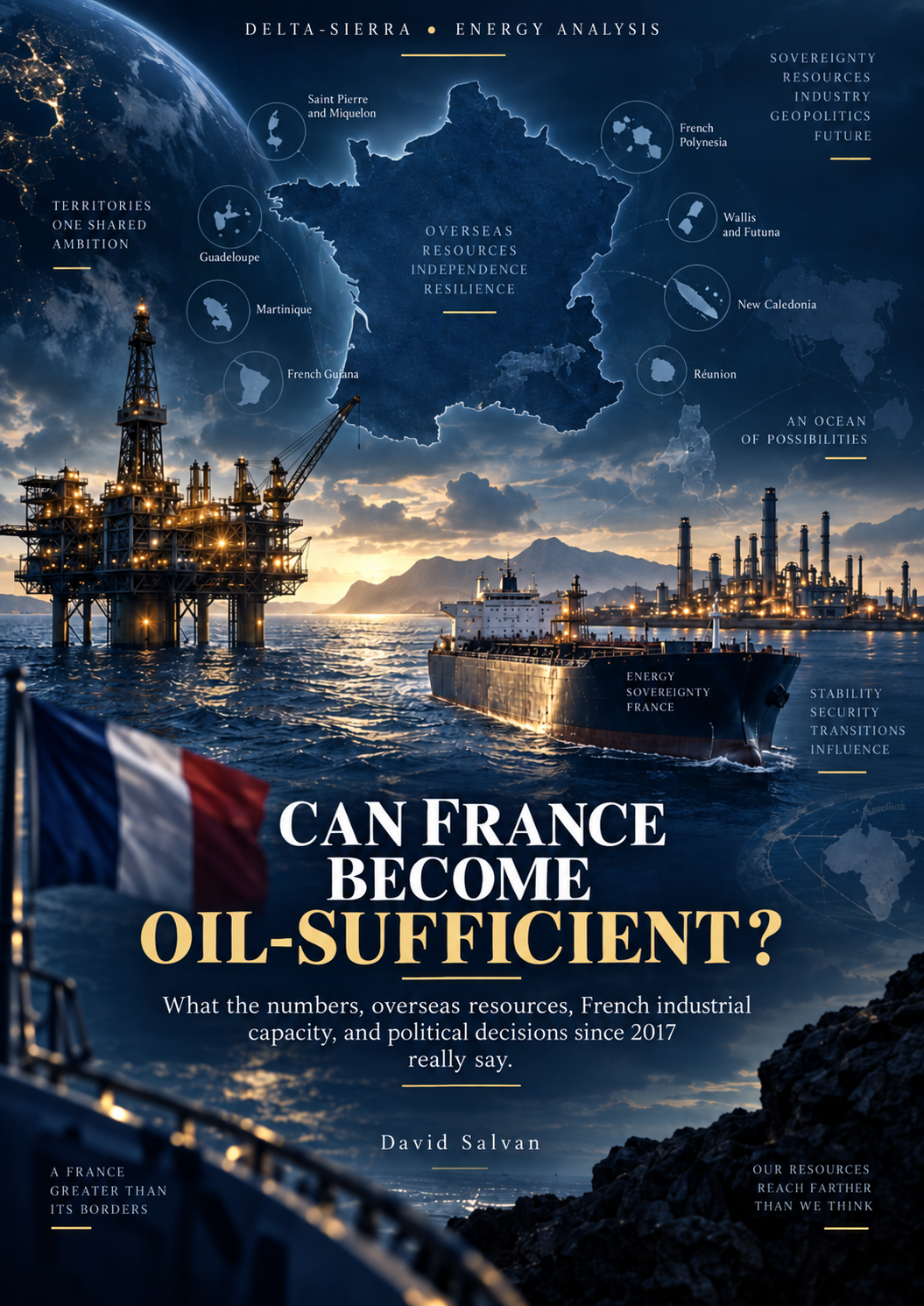
CENTRAL THESIS TO TEST With the proven reserves known today, the answer is no. But the existence of still incompletely explored overseas areas, particularly around Juan de Nova and Saint-Pierre and Miquelon, means that the possibility of future French oil self-sufficiency cannot be settled definitively. The decisive point is that the 2017 law specifically prohibited the opening of new exploration permits in the territories where it applies. The debate is therefore as much about what France possesses as about what it chose no longer to search for. |
|---|
Important: this document systematically distinguishes between a proven reserve, a prospective resource, geological potential and a theoretical gross value. A volume “in the ground” does not mean a technically recoverable volume, a profitable project or a public benefit. The monetary calculations are used to measure orders of magnitude, not to announce a guaranteed budgetary windfall.
CONTENTS
1. The short answer: not today, technically perhaps
2. The starting point: France imports almost all of its oil
3. What does “oil self-sufficiency” actually mean?
4. French Guiana: a real discovery, followed by disappointing results
5. Saint-Pierre and Miquelon: a documented petroleum system, mainly gas
6. Juan de Nova: the most decisive and least complete case
7. The other overseas territories: do not confuse the geographical map with the petroleum map
8. How much would have to be found for France to become self-sufficient?
9. What could it be worth? Gross value, costs and accounting illusions
10. Production is not enough: oil must be extracted, transported, refined and distributed
11. 2017: who legally closed the door to new exploration?
12. 2026: who tried to reopen it, and who voted against?
13. The arguments of those defending the ban
14. Documented consequences of the 2017 legislative choice for exploration
15. Technical verdict: under what conditions could self-sufficiency be possible?
16. What would need to be measured to answer definitively
17. Conclusion
Primary sources and documents
BEFORE READING: THE WORDS AND UNITS TO UNDERSTAND
This dossier deals at the same time with geology, the petroleum industry, mining law, economics and public policy. These fields use many technical terms that can make the subject seem reserved for specialists. It is not. Every essential concept is therefore explained here in plain language, then recalled when it is used in the article.
Crude oil, hydrocarbons and fuels: three different things
Crude oil is the natural liquid extracted from underground. It is generally not poured directly into a car’s fuel tank. It must first be transported to a refinery, then separated and transformed. The word hydrocarbons is broader: it includes oil and natural gas, meaning molecules made mainly of hydrogen and carbon. Fuels are finished products, such as gasoline, diesel or jet fuel. Having crude oil therefore does not automatically mean having the fuel the country needs.
Barrel, tonne, Mtoe, TWh and Tcf: what do these units mean?
The barrel of oil, the traditional unit used by the petroleum industry, corresponds to about 159 litres. When we speak of 900,000 barrels per day, we are describing a daily flow rate, not the total size of a field. A tonne measures mass. An Mtoe, or million tonnes of oil equivalent, is an energy unit that makes it possible to compare different forms of energy on the same basis. A TWh, terawatt-hour, equals one billion kilowatt-hours. Finally, Tcf means trillion cubic feet, or one thousand billion cubic feet of gas; 1 Tcf represents about 28.3 billion cubic metres of gas. These units are explained because they appear in official French and international reports.
EEZ, offshore, drilling, exploration and production
An EEZ, or exclusive economic zone, is the maritime area in which a State has sovereign rights to explore, manage and exploit certain natural resources. The term offshore simply means “at sea”. Exploration means searching: geophysical surveys, seismic measurements and then drilling intended to verify whether hydrocarbons are present. Production comes much later: it assumes that a discovery has been studied sufficiently to build facilities capable of commercial output. Banning exploration and banning production are therefore two different decisions: the first can prevent the acquisition of the knowledge needed to determine whether a field actually exists.
Resource, reserve, discovery and field: the distinction that changes everything
A prospective resource is a volume not yet discovered but estimated as possible from geology. A contingent resource is an accumulation that has been discovered but whose commercial development has not yet been demonstrated. A reserve, under the international PRMS framework, refers to discovered volumes associated with a project considered commercial. Finally, a field is an accumulation of hydrocarbons underground; to be exploitable, its size, quality, depth, possible flow rate and development cost must make the project technically and economically viable. [S27]
That is why the statements “oil has been found” and “we have X billion barrels of reserves” do not mean the same thing at all. A well can encounter oil without there being a profitable field. French Guiana provides a precise example.
P90, P50, P10, 1P, 2P, 3P: why several figures can exist for the same underground resource
Geologists work with uncertainty. In a probabilistic estimate, P90 describes a low case: there is at least a 90% probability of reaching or exceeding that volume. P50 is the median case. P10 is a high case, much less certain. For reserves, the industry also uses 1P, 2P and 3P: the categories progressively include larger volumes but also greater uncertainty. PRMS, the international petroleum-resources classification system, thus separates the commercial maturity of a project from technical uncertainty over recoverable quantities. [S27]
A reading rule for the whole article
Whenever a figure appears, four questions therefore have to be asked: has the hydrocarbon actually been discovered? what share could be technically recovered? is there a commercial project capable of producing it? and what is the source of the figure? A parliamentary amendment citing a historical estimate is useful for understanding a political debate, but it does not have the same evidentiary value as a geological report, a drilling result or a certified reserve estimate.
1. THE SHORT ANSWER: NOT TODAY, TECHNICALLY PERHAPS
France does not currently have sufficient proven oil reserves to cover its consumption. The French Data and Statistical Studies Service (SDES) states that French crude-oil extraction had fallen to 0.6 million tonnes of oil equivalent in 2024 and that domestic production represented only about 1% of national oil consumption. On 1 January 2025, French crude-oil reserves represented around a month and a half of national consumption. [S6]
But this does not close the case. It answers the question: “What can we produce from the fields that are currently proven?” It does not answer another question: “What is actually contained in all the French maritime areas that have not been sufficiently explored?” It is precisely on this second question that the law adopted in 2017 changed the situation.
The law of 30 December 2017, known as the “Hulot law”, organised the end of hydrocarbon exploration and production and prohibited the award of new exploration permits in the territories where it applies. Nicolas Hulot’s ministry wrote as early as September 2017 that a priority of the legislation was to bring the search for new deposits to an end. [S1][S2]
The technical conclusion is therefore twofold: France is not self-sufficient today and could not become so with its proven reserves alone; however, the possibility of future self-sufficiency cannot be settled without distinguishing areas already tested extensively from areas whose geological inventory remains incomplete.
THE POINT THAT MUST NOT BE DISTORTED It would be false to say that “France has hundreds of billions of euros of proven oil and refuses to pump it”. It is, however, documented that “France prohibited new exploration while several overseas areas remain prospective or incompletely characterised”. |
|---|
Why “proven reserves” does not mean “everything that might exist beneath the territory”
Proven reserves are not an inventory of all geologically possible oil. They refer only to volumes already discovered that meet sufficiently robust technical and commercial criteria. An area that has never been drilled, or has been studied only by seismic surveys, can therefore be promising without containing any reserve in the petroleum meaning of the term. This is why the overseas debate concerns first the right to search and measure, even before the question of authorising production.
SDES estimates current French production at around 1% of consumption. This figure therefore answers the question “are we self-sufficient today?” very well: no. By itself, however, it cannot answer the question “could more be discovered in areas that remain insufficiently explored?”. [S6]
2. THE STARTING POINT: FRANCE IMPORTS ALMOST ALL OF ITS OIL
In 2025, France consumed about 0.9 million barrels of crude oil per day. At the same time, it had to import crude and finished petroleum products to cover its needs. UFIP Énergies et Mobilités states that more than half of the diesel consumed in France was imported. Road fuels represented 47.5 million cubic metres over the year, including 32.0 million cubic metres of diesel and 15.6 million cubic metres of gasoline. [S7]
At 900,000 barrels per day, annual crude demand corresponds to about 328.5 million barrels per year. The calculation is straightforward: 900,000 × 365 = 328,500,000 barrels. This provides a useful conversion rule for the rest of the discussion: one billion barrels represents a little more than three years of French crude-oil consumption at the current rate, before accounting for future reductions in demand, refining yields or trade in petroleum products.
France’s energy bill also remains considerable. SDES estimates the energy bill at €45.8 billion in 2025, after €57.8 billion in 2024 according to figures repeated in the 2026 Senate report. [S15][S22] Oil dependence is therefore not theoretical: every year it translates into major foreign purchases and exposure to the dollar, world prices, geopolitical crises and maritime transport capacity.
France nevertheless retains a significant industrial system: on 1 January 2026, six mainland refineries had a total annual processing capacity of 58 million tonnes. They processed around 47 million tonnes of crude in 2025, while domestic consumption of petroleum products reached 64.6 million tonnes. [S8] In other words, even a France producing its own crude would still have to solve the question of refining and the appropriate balance among diesel, gasoline, kerosene and other products.
A concrete example: what does 900,000 barrels per day represent?
One barrel being approximately 159 litres, 900,000 barrels per day represent about 143 million litres of crude per day. This figure must not be confused with the litres of fuel dispensed at service stations: a refinery turns crude into several products, and part of the oil is also used for petrochemicals, bitumen, lubricants and other purposes. UFIP reports in parallel that road-fuel sales alone amounted to 47.5 million cubic metres in 2025. [S7]
Why France imports diesel even though it still has refineries
A refinery does not turn one barrel of crude into one barrel of diesel. It produces a mix of gasoline, diesel, kerosene, naphtha, LPG, fuel oils and other products. The proportions depend on the quality of the crude and the refinery’s conversion equipment. The French market has historically consumed a great deal of diesel. This structure explains why a country can refine oil while still importing a substantial share of its diesel. [S7][S8]
3. WHAT DOES “OIL SELF-SUFFICIENCY” ACTUALLY MEAN?
The word “self-sufficiency” can describe three different realities. The first is geological self-sufficiency: having recoverable volumes beneath national territory equivalent to consumption. The second is production self-sufficiency: being able to produce enough crude every day. The third is self-sufficiency in finished fuels: having refineries, conversion units, stocks, ports and logistics capable of actually supplying the diesel, gasoline, kerosene and other products consumed.
A France producing 900,000 barrels per day would not necessarily stop all imports. Crudes do not all have the same characteristics and refineries are not interchangeable. A country can be self-sufficient on a net basis while continuing to import certain grades of crude or certain products and exporting others. The real strategic measure would therefore be the ability to cover the country’s essential needs, in energy value and volume, without critical dependence on a foreign supplier.
The evolution of demand also has to be included. French consumption of petroleum products is trending downward: SDES estimates that it fell by 25.9% between 2005 and 2024. [S6] If electrification of the vehicle fleet, rail, biofuels and synthetic fuels sharply reduce oil demand over the next twenty years, the same field would mechanically cover a much longer period.
A fourth dimension: strategic resilience
Even a country able to produce as much oil as it consumes over a year can be vulnerable to a refinery outage, a storm, a port accident or a maritime crisis. This is why the European Union requires emergency stocks: at least the equivalent of 90 days of average daily net imports or 61 days of average daily inland consumption, whichever is higher. [S28] Real self-sufficiency must therefore be understood as a system: resources, production flow, refining, logistics and stocks available in a crisis.
Self-sufficiency does not mean autarky
A “self-sufficient” country can continue to trade. It may, for example, export a crude that is too heavy for some of its refineries and import a more suitable crude, or export gasoline while importing diesel. The strategic objective is therefore not necessarily zero foreign ships entering a French port, but the absence of critical dependence: if one supplier disappears, the country must be able to maintain its essential functions.

4. FRENCH GUIANA: A REAL DISCOVERY, FOLLOWED BY DISAPPOINTING RESULTS
The French Guiana case has to be presented carefully, because it is both the best proof that hydrocarbons genuinely exist in the French overseas territories and the best proof that a discovery does not automatically become a commercial field.
In September 2011, the Zaedyus well off French Guiana encountered 72 metres of net oil-bearing reservoir in two turbidite fans. Tullow Oil said at the time that the result proved the presence of a petroleum system in this part of the basin. [S9] Before drilling, the prospect had been presented with a P10 prospective resource potentially reaching around 700 million barrels. After the discovery, public estimates also mentioned around 300 million barrels. [S10]
These figures must be handled with extreme caution. A P10 prospective resource is a high geological case, not a proven reserve. The subsequent appraisal wells were negative or insufficient. The 2026 Senate report recalls that five appraisal wells failed to confirm an exploitable field and that Total relinquished the permit in February 2019 after another unsuccessful attempt. [S15]
French Guiana therefore does not support a claim today that France possesses 300 or 700 million recoverable barrels. It does, however, establish one fact: a petroleum system has been demonstrated in French waters. It also shows why only a sequence of wells can turn “potential” into a “reserve”.
ORDER-OF-MAGNITUDE CALCULATION — FRENCH GUIANA At current French crude consumption of 328.5 million barrels per year, 300 million barrels would represent about 0.91 year of consumption and 700 million about 2.13 years. At a purely illustrative price of €60 to €80 per barrel, the theoretical gross value would be €18–24 billion for 300 million barrels and €42–56 billion for 700 million. These amounts are neither current reserves nor net profit. |
|---|
What does “72 metres of net oil-bearing reservoir” mean?
A well passes through several layers of rock. Saying that Zaedyus encountered 72 metres of net oil-bearing reservoir means that, within the total thickness drilled, about 72 metres of rock met the criteria for containing oil in a significant way. It does not mean that there is a 72-metre column of liquid oil, nor that the field automatically contains hundreds of millions of barrels. The figure describes a useful geological thickness observed in the well. Tullow nevertheless regarded the discovery as proof that a functioning petroleum system existed in this part of the basin. [S9]
What is a “turbidite fan”?
A turbidite fan is a sediment deposit formed at depth by underwater flows carrying sand and particles. Over time, some of these deposits can become porous rocks capable of storing oil or gas. They are therefore classic targets in offshore exploration. The term describes the shape and origin of the geological reservoir; by itself it says nothing about the profitability of a field.
Why several wells are needed after a discovery
The first exploration well mainly answers the question “are hydrocarbons present here?”. Appraisal wells then seek to determine the size, continuity, pressure and properties of the reservoir. A single well can hit an attractive pocket that later proves too small or too discontinuous. That is exactly why the 2011 French Guiana discovery had to be followed by further drilling, and why the later negative results sharply reduced the area’s commercial interest. [S15]
5. SAINT-PIERRE AND MIQUELON: A DOCUMENTED PETROLEUM SYSTEM, MAINLY GAS
The Saint-Pierre and Miquelon case is different. A 2008 French National Assembly report, reproducing IFP assessments from that period, states that the most prospective area lies south of the Bandol well. It cites an estimate for the Laurentian sub-basin of 8–9 Tcf of gas and 600–700 million barrels of oil, and states that 1–1.5 Tcf of gas could be located in the French part if hydrocarbons were distributed evenly. [S11]
The Bandol 1 well, drilled in 2001 for around €35 million, did not demonstrate a commercial field. The report nevertheless states that the results shifted the potential toward formations farther offshore and confirmed the value of continuing investigations. [S11]
The official GéoLittoral portal also continues to describe Saint-Pierre and Miquelon’s maritime space as crossing an area favourable to the presence of hydrocarbons, the sub-Laurentian basin. [S12] This official wording does not mean that an exploitable field exists; it means that the geological potential continues to be recognised.
One Tcf means one trillion cubic feet. A volume of 1–1.5 Tcf represents around 28.3–42.5 billion cubic metres of gas, or approximately 304–455 TWh of energy. With a long-term price assumption of €30–50 per MWh, this corresponds to a theoretical gross value of approximately €9–23 billion. Again, offshore drilling, transport, processing and possibly liquefaction costs must be deducted before any economic conclusion is drawn.
What is a “petroleum system”?
A petroleum system is the set of geological conditions required to form and then concentrate hydrocarbons. It notably requires a source rock, in which organic matter has been transformed by temperature and pressure; a reservoir rock, sufficiently porous to contain oil or gas; an impermeable seal, which prevents the hydrocarbons from escaping; and a geological trap, meaning an underground configuration able to accumulate them. The National Assembly report explains this logic and states that the system known off Nova Scotia extends toward the French EEZ. [S11]
Why the 600–700 million barrels cannot be attributed directly to France
The parliamentary report mentions 8–9 Tcf of gas and 600–700 million barrels of oil for the Laurentian sub-basin as a whole. It does not say that the 600–700 million barrels belong to the French EEZ. The only order of magnitude explicitly allocated to the French side in this presentation is gas: 1–1.5 Tcf, obtained by assuming an even distribution. [S11] This distinction is essential to avoid turning a regional figure into a “French reserve”.
Why Bandol 1 did not “prove there was nothing there”
The Bandol 1 well, drilled in 2001, did not discover a commercial field. But the parliamentary report states that the results shifted the potential toward more downdip formations and confirmed the value of continuing investigations. [S11] In petroleum exploration, a dry or non-commercial well reduces the probability for the tested target; it does not necessarily eliminate an entire basin, especially when other geological structures remain undrilled.
6. JUAN DE NOVA: THE MOST DECISIVE AND LEAST COMPLETE CASE

If one area could change the scale of the debate over French oil self-sufficiency, Juan de Nova would be the most important candidate. This is not a slogan: BRGM, cited by the French Senate in 2026, considers that in the French Southern and Antarctic Lands (TAAF) of the Mozambique Channel, the continental-margin and continental-slope geological setting of Juan de Nova is the most favourable for the potential presence of petroleum systems. The documented campaigns took place through 2013. The “Juan de Nova Maritime Profond” permit was then extended in 2015 until 30 December 2018. The 2017 law closed the possibility of opening new exploration titles, preventing any later restart of exploration under new permits. [S15][S35]
Two French permits had been granted at the end of 2008. The “Juan de Nova Maritime Profond” permit covered about 52,990 km² and included a financial commitment of €47.3 million. The “Juan de Nova Est” permit covered about 9,010 km² with a financial commitment of €27.92 million. Together, this represents 62,000 km² of permits and €75.22 million of initial financial commitments. [S13][S14]
The spectacular figure of 6 to 12 billion barrels has circulated in parliamentary amendments and public positions. It must not be presented as a certified reserve: none of the BRGM or IFPEN documents consulted validates it as a French commercially recoverable volume. It can only be used as a sensitivity scenario to understand what a discovery of that magnitude would mean.
The regional context, however, is unquestionably oil- and gas-bearing. In 2022, the US Geological Survey reassessed the Morondava geological unit west of Madagascar and estimated there an average of about 1.99 billion barrels of technically recoverable undiscovered conventional oil and almost 12.9 Tcf of gas. [S16] This regional geological unit is far larger than the French EEZ around Juan de Nova alone: those volumes therefore cannot be attributed to France. They merely confirm that the regional geological setting should not be treated as a supposedly barren sector.
WHAT WE KNOW / WHAT WE DO NOT KNOW We know that Juan de Nova was covered by significant exploration permits, that BRGM regards it as the French area of the Mozambique Channel most favourable to petroleum systems, and that exploration was not carried through to a demonstration of commercial reserves. We do not know how many recoverable barrels are there. That is precisely the missing information. |
|---|
Another parameter must be noted: Juan de Nova is administered by France within the French Southern and Antarctic Lands (TAAF), but sovereignty over the island is disputed by Madagascar. In 2025, the two States reiterated in a joint communiqué their mutual recognition that a dispute exists concerning, among others, Juan de Nova, the Glorioso Islands, Europa and Bassas da India. That dispute does not by itself alter the present French administration; it would nevertheless form part of the diplomatic environment of any future exploration or production project. [S36]
Dissecting the “6 to 12 billion barrels” figure
This figure is politically important but geologically fragile if used without explanation. It appears notably in an amendment tabled in November 2017 by MP Philippe Folliot, who stated that “several studies” had estimated Juan de Nova’s resources at between 6 and 12 billion barrels. The amendment is a parliamentary source proving that this claim existed in the debate, but it is not an independent geological certification. [S31]
The 2022 Senate report also repeats this range in a broader discussion of the Mozambique Channel. Once again, the regional area is much larger than Juan de Nova’s French EEZ alone. The mistake to avoid would therefore be to turn automatically “6 to 12 billion in political documents about the Channel” into “6 to 12 billion barrels of proven French reserves at Juan de Nova”.
Conversely, a modern US Geological Survey (USGS) assessment covers the regional Morondava geological unit and gives a mean estimate of about 1.992 billion barrels of technically recoverable undiscovered conventional oil and around 12.89 Tcf of gas. [S16] This assessment does not correspond to the French area alone either. Its main significance is that the regional basin can contain oil and gas while leaving unanswered the question of how much is actually located and recoverable inside the French EEZ.
BRGM, USGS, parliamentary amendment: which source should be trusted?
BRGM, the French Geological Survey, is France’s reference public institution for geosciences. The USGS, United States Geological Survey, is its major federal US counterpart. Their geological assessments have a different technical value from a political position. A parliamentary amendment may cite figures that are useful to understand the debate, but when an estimate cannot be linked to a verifiable primary geological study, it must be presented as a historical cited figure, not as a certified reserve. That is the approach adopted in this dossier.
What are a continental margin and a continental slope?
The continental margin is the transition zone between a continent and the ocean floor. It includes the continental shelf and then the continental slope, the submarine incline descending toward the deep ocean. In some basins, these areas accumulated very thick layers of sediment over millions of years, a condition favourable to the formation of petroleum systems. Saying that Juan de Nova lies in a favourable margin-and-slope setting does not mean that a field has been proven; it means the geology warrants further exploration. [S15]
7. THE OTHER OVERSEAS TERRITORIES: DO NOT CONFUSE THE GEOGRAPHICAL MAP WITH THE PETROLEUM MAP
The existence of an immense French exclusive economic zone does not mean that every territory has geologically attractive petroleum prospects. The 2026 Senate report is very clear: Mayotte, Zélée, Geyser and the Glorioso Islands lie mainly in abyssal-plain and volcanic settings, generally unfavourable to the formation and preservation of hydrocarbons. Europa and Bassas da India are also considered a priori relatively unfavourable. [S15]
Guadeloupe, Martinique and Réunion are legally affected by the Hulot law within their areas of competence, but the public geological material consulted does not support assigning them potential comparable with French Guiana, Saint-Pierre and Miquelon or Juan de Nova. It would therefore be misleading to add all overseas territories together as though they formed a single “French field”.
French Polynesia and New Caledonia must also be distinguished legally: the 2026 Senate report recalls that their mining law is governed by their own local rules and that the Hulot law does not apply there in the same way. [S15]
Why the law is not identical across all overseas territories
The term “overseas” covers communities with different legal statuses. In the overseas departments and regions governed by Article 73 of the Constitution, such as French Guiana or Guadeloupe, national law applies broadly. Saint-Pierre and Miquelon has a special regime. The TAAF also operates under a specific framework. By contrast, French Polynesia and New Caledonia have their own mining powers and the Hulot law does not apply there in the same way. [S15] Speaking of a single uniform ban covering “all DOM-TOM” would therefore be legally imprecise.
The term DOM-TOM, still widely used in everyday French, no longer corresponds to a single legal category. It is preferable to refer to French overseas territories or overseas France, then specify the status of each territory when mining law is at issue.
8. HOW MUCH WOULD HAVE TO BE FOUND FOR FRANCE TO BECOME SELF-SUFFICIENT?
At constant consumption of 900,000 barrels of crude per day, France uses about 328.5 million barrels per year. From there, the orders of magnitude are immediate:
- 300 million barrels: about 0.91 year of current consumption.
- 700 million barrels: about 2.13 years.
- 1 billion barrels: about 3.04 years.
- 6 billion barrels: about 18.3 years.
- 12 billion barrels: about 36.5 years.
These figures do not mean that Juan de Nova contains 6 or 12 billion barrels. They simply show why a multi-billion-barrel discovery would completely change the national equation. They also show why a field containing a few hundred million barrels could be economically useful without creating self-sufficiency for several decades.
If, by 2040 or 2050, French oil demand were cut in half through electrification and energy substitution, the same volume would last twice as long. Six billion barrels would then cover around 36.5 years at the reduced rate; twelve billion around 73 years. This is a simple mathematical illustration, not a consumption forecast.
Stock and flow: the most important distinction after reserves
A field can contain billions of barrels without being able to produce one million barrels every day. The stock is the total recoverable volume over the life of the field. The flow rate is what the facilities can produce daily. A large field usually ramps up gradually, reaches a production plateau—a period during which output remains relatively stable—and then declines as pressure falls and the easiest zones are depleted.
Thus, the calculation “6 billion ÷ 328.5 million = 18.3 years” is useful for visualising the total energy contained in a 6-billion-barrel scenario. It does not mean that a single field would automatically supply 100% of French needs for 18.3 consecutive years. To reach self-sufficiency, the combined flow rate of the fields would also have to be high enough at the same time.
Recovery factor: not all the oil in the reservoir ever comes out
Geologists distinguish oil in place—everything physically present in the rock—from recoverable oil. Some remains trapped in the reservoir despite production techniques. The recovery factor is the percentage believed to be extractable. It depends on rock porosity, oil viscosity, pressure, injection techniques and many other parameters. This is why an “oil in place” figure can be far higher than the volume that could actually be commercialised.
9. WHAT COULD IT BE WORTH? GROSS VALUE, COSTS AND ACCOUNTING ILLUSIONS
The amounts often quoted in public debate mix several different concepts. The gross value of a volume of oil is simply the number of barrels multiplied by an assumed price. It is neither the value of the field, nor the operator’s profit, nor the State’s tax revenue.
With an illustrative range of €60 to €80 per barrel, the result is:
- 300 million barrels: €18–24 billion in gross value.
- 700 million barrels: €42–56 billion.
- 6 billion barrels: €360–480 billion.
- 12 billion barrels: €720–960 billion.
But deep-offshore development requires massive investment. The best current regional comparison is GranMorgu in Suriname, led by TotalEnergies and APA: about 750 million recoverable barrels, announced investment of about $10.5 billion, and planned production capacity of 220,000 barrels per day. [S17]
As a pure order of magnitude, covering 900,000 barrels per day would require a flow equivalent to about 4.1 GranMorgu projects operating simultaneously. Mechanically applying the same investment ratio—which is not a quotation—gives almost $43 billion in upstream capital. This calculation does not include all exploration campaigns, port adaptation, refining, security, storage or decommissioning.
The correct question is therefore not “how much is the oil under our feet worth?”. The correct question is: what volume is actually recoverable, at what full cost per barrel, with what risk, tax regime, timetable, present value and share of revenue accruing to the territories and the State?
How much would the State actually receive?
Even if a large volume existed, the oil’s gross value would never equal public revenue. Before the State receives anything, the operator has to be paid, CAPEX amortised, OPEX covered, and insurance, infrastructure, cost of capital and ultimately decommissioning financed. Public receipts would then depend on the applicable fiscal regime, revenue-sharing with the territories concerned, the oil price, the production profile and the project’s actual profitability. A scenario involving several hundred billion euros of gross value would therefore mean neither several hundred billion in profits nor several hundred billion in State revenue.
CAPEX, OPEX and present value: three essential concepts
CAPEX (capital expenditure) means investment spending: drilling, platform or FPSO, pipelines, subsea installations, ports and equipment. OPEX (operating expenditure) means the cost of running production: personnel, maintenance, energy, support vessels, insurance, treatment and repairs. Finally, net present value, usually abbreviated NPV, reflects the fact that one euro received fifteen years from now is not economically equivalent to one euro available today. A “gross value” of €500 billion can therefore lead to a much lower economic value after costs, taxation, delays, risks and discounting.
Why GranMorgu is a useful comparison but not a quotation for France
GranMorgu, in Suriname, is useful because it shows the scale of a recent large offshore project in an area geographically close to French Guiana: more than 750 million recoverable barrels, about $10.5 billion of investment and an FPSO rated at 220,000 barrels per day. [S30] But every field is different. Water depth, distance from shore, crude quality, number of wells, weather conditions, tax regime and local-content requirements can alter costs substantially. The extrapolation “four GranMorgu projects = about $43 billion” is therefore a scale reference, never a French budget forecast.
10. PRODUCTION IS NOT ENOUGH: OIL MUST BE EXTRACTED, TRANSPORTED, REFINED AND DISTRIBUTED
Oil self-sufficiency is not achieved merely by drilling a successful well. A geological resource has to be turned into an industrial chain. A major offshore development includes producing wells, subsea installations, an FPSO or platform, support vessels, helicopters, logistics bases, port capacity, stocks, maintenance contracts, specialist teams, and environmental and maritime safety systems.
France retains significant refining capacity, but it is no longer sized to produce by itself every petroleum product consumed. On 1 January 2026, its six mainland refineries had a processing capacity of 58 Mt per year, compared with about 47 Mt of crude processed in 2025 and 64.6 Mt of petroleum products consumed. [S8] These masses cannot, however, be compared as a simple direct balance: imports and exports of finished products, refining yields, densities and other processing feedstocks also matter.
This means that a self-sufficiency policy would have to combine domestic production with a refining policy. Crude produced in French territory does not automatically become French diesel in the right place and at the right price. Some refineries would have to be adapted, conversion units strengthened and maritime logistics reorganised.
Finally, self-sufficiency would not mechanically guarantee cheap fuel. Oil is a global commodity. Domestic prices would depend on the tax model, production contracts, extraction cost, refining and any decision whether or not to decouple part of the domestic market from international prices. Security of supply and pump prices are two different issues.
What exactly is an FPSO?
An FPSO is a floating production, storage and offloading unit. In practice, it is a very large factory ship moored above or near an offshore field. It receives fluids produced by subsea wells, separates oil, gas and water, treats the oil, stores it and then transfers it to tankers. This arrangement can avoid the need for a pipeline to shore, but it requires very large investment and continuous maintenance.
What exactly does a refinery do?
The first major stage is atmospheric distillation: crude oil is heated and its components are separated according to their boiling points. But a modern refinery does more than separate. Conversion units transform heavier fractions into more sought-after products. Hydrocracking, for example, breaks large molecules with hydrogen to produce more light, higher-quality fuels. Hydrotreating removes sulphur, among other things. Refinery capability is therefore not measured only in tonnes of crude processed, but also by the sophistication of its conversion units.
Political and legal timeline 2017–2026

Why producing domestic crude does not guarantee cheaper fuel
The pump price includes the cost of crude, transport, refining, distribution, margins and taxation. Oil produced under French jurisdiction would remain expensive to extract, especially in deep water. Unless a specific public mechanism were introduced, its value would also be influenced by the world market. Supply self-sufficiency means that the country has greater control over the physical availability of energy; it does not automatically mean a low price for consumers.
11. 2017: WHO LEGALLY CLOSED THE DOOR TO NEW EXPLORATION?
On this point, institutional responsibility is fully documented. The issue is not to attribute a criminal offence or illegality: it is to identify who promoted, voted for, promulgated and implemented the political choice to stop the search for new fields.
Nicolas Hulot was the central government figure in the measure. As Minister of State for the Ecological and Inclusive Transition, he presented the bill to the Council of Ministers on 6 September 2017. His ministry explained that “leaving fossil fuels in the ground” was one of the Climate Plan’s pillars and announced that no new exploration permits would be awarded, in order to bring the search for new deposits to an end. [S2]
Emmanuel Macron bears the presidential responsibility for this policy direction. The official September 2017 communiqué states that the ban had been included in the presidential campaign platform. The law was then promulgated on 30 December 2017 by Emmanuel Macron; it also bears the signatures of Prime Minister Édouard Philippe and Nicolas Hulot. [S1][S25][S34]
In the National Assembly, the bill was adopted at first reading on 10 October 2017 by 388 votes to 92, with 70 abstentions. Among La République en Marche MPs, 297 voted in favour. [S3] The decision was therefore not that of an isolated minister: it was promoted by the executive and approved by a very large parliamentary majority.
The overseas case was explicitly debated. The Senate attempted to introduce an exemption allowing overseas regions to continue issuing certain permits. The 2026 Senate report recalls that this exemption was subsequently removed by the National Assembly on its new reading. [S15] On 1 December 2017, responding to an amendment requesting an exception for French Guiana, Nicolas Hulot said that the provisions had to “apply across the entire national territory”, and the Government opposed the amendment. [S4]
The 2017 debate also shows that objections were already known. French Guianese MP Gabriel Serville warned that French Guiana risked being deprived of economic benefits while neighbouring countries developed their own resources. He stressed that French Guianese MPs and the territorial authority opposed a uniform application of the ban. [S4] The Government nevertheless assumed the choice of a national rule without a French Guiana exception.
Implementation was rapid, but it did not retrospectively erase every earlier right. On 1 February 2018, the ministry announced that Nicolas Hulot, working with Bruno Le Maire, had rejected since 1 January 48 applications for the granting or renewal of mining titles: 42 applications for exploration permits, four extension applications and two concession applications. The same communiqué nevertheless stated that 16 applications already under examination could continue through the procedure in the name of legal certainty and previously acquired rights. The law therefore closed access to new projects while preserving certain earlier titles or rights. [S5][S26]
DOCUMENTED RESPONSIBILITY The official texts therefore identify a clear chain of decision: presidential policy direction, a bill presented by Nicolas Hulot, the government of Édouard Philippe, an overwhelming National Assembly vote in 2017, removal of the overseas exemption, then administrative implementation through the rejection of title applications. These are verifiable institutional facts; their political assessment belongs to the reader. |
|---|
What exactly the 2017 law prohibits
The law did not make every existing concession disappear overnight. Its central mechanism is to stop awarding new exclusive exploration permits and organise the gradual end of production, notably by limiting extensions of concessions beyond 2040, subject to rules protecting existing rights. [S1] For the public, the distinction matters: the legislation mainly closes the door to new exploration while allowing certain previously acquired titles to continue temporarily.
Why Nicolas Hulot is directly associated with the choice to stop searching
Linking Nicolas Hulot to this change is not an after-the-fact reconstruction. The official communiqué of 6 September 2017 explicitly states that the bill he presented would make France the first country to prohibit exploration and production, and repeats the objective of “leaving fossil fuels in the ground”. [S2] Emmanuel Macron, at COP23 in November 2017, also endorsed this direction and referred to Nicolas Hulot’s commitment. [S25] The documented political responsibility is therefore responsibility for having assumed this policy choice; without proven reserves, it does not support a claim that certain oil self-sufficiency was “destroyed”.
12. 2026: WHO TRIED TO REOPEN THE DOOR, AND WHO VOTED AGAINST?
The debate returned to Parliament in 2026. The Senate examined a proposal to lift the ban in certain overseas territories. Its rapporteur, Vincent Louault, explicitly recalled that the ban resulted from the Hulot law and argued that an exploitable discovery could contribute to energy sovereignty and territorial development. [S15]
The Senate adopted the text on 29 January 2026, with wording opening, in particular, an exemption for Saint-Pierre and Miquelon and the overseas regions concerned. [S18]
In the National Assembly, on 11 June 2026, Article 1—the article that would have allowed the ban to be lifted—was rejected by 74 votes to 64, with one abstention. [S19] The result is therefore concrete: a majority of the votes cast that day rejected reopening the proposed legal framework.
The official vote records individual positions. MPs voting against the article included, among others, Gabriel Attal, Manuel Bompard, Mathilde Panot, Sandrine Rousseau and Dominique Voynet. The “against” votes included members of Ensemble pour la République, La France insoumise, the Socialists, the Ecologists and the Democrats. Conversely, MPs from the National Rally, GDR, Horizons and other groups voted in favour. [S19] This is not a political ranking: it documents choices expressed in that specific vote.
Agnès Pannier-Runacher also tabled an amendment seeking to delete the article. She argued in particular that no commercial field had been demonstrated in French Guiana, that estimates in other overseas territories remained speculative, that development would take a long time, and that biodiversity and stranded-asset risks were significant. [S20] Her amendment was not adopted, but her arguments summarise an important part of the position opposed to reopening exploration.
Exact legal status on 20 September 2026
The 11 June 2026 vote did not definitively close the parliamentary procedure. The Senate had adopted the proposal at first reading on 29 January 2026 by 227 votes to 105, with eight abstentions. [S24] In the National Assembly, Article 1 was rejected on 11 June 2026 by 74 votes to 64, with one abstention, and the text was then rejected. [S19] It was nevertheless sent back to the Senate for a second reading, where it remained an ongoing legislative text. [S24] The rigorous formulation is therefore: the National Assembly rejected the proposed reopening at first reading, but the legislative debate was not legally closed.
The Government’s position in 2026
During the debate of 11 June 2026, Economy Minister Roland Lescure opposed reopening. His central argument was that replacing dependence on imported hydrocarbons with dependence on locally produced hydrocarbons would not, in the Government’s view, solve dependence on fossil fuels or the climate problem. He therefore supported electrification and reduced demand rather than new exploration. [S33] This position must be distinguished from the geological question: it does not necessarily say that no resource exists; it argues that it should not be sought or developed under the chosen energy strategy.
Disagreement even within recent governments
The 2026 Senate report recalls that in February 2025 Manuel Valls, then Minister for the Overseas Territories, had said he was prepared to reopen the debate on the Hulot law, while Agnès Pannier-Runacher, Minister for the Ecological Transition, immediately defended maintaining the ban on climate and international-commitment grounds. [S15] The issue therefore cannot be reduced to a simple government-versus-opposition divide: it also ran through the executive itself.
13. THE ARGUMENTS OF THOSE DEFENDING THE BAN
A serious article cannot present the Hulot law as an act without justification. Its supporters defend an explicit climate rationale. Nicolas Hulot’s ministry explained in 2017 that France wanted to contribute to keeping warming below 2°C, reduce fossil-fuel consumption and achieve carbon neutrality. [S2]
Those defending the continued ban now advance four main arguments:
- No demonstrated commercial reserve: French Guiana was drilled several times without a confirmed exploitable discovery. [S15][S20]
- Economic risk: an offshore discovery can require ten to fifteen years before production, with future price and demand risks. [S20]
- Environmental risk: the overseas territories contain a very large share of French biodiversity and offshore operations carry pollution risks. [S20]
- Climate consistency: reopening new projects would be regarded by opponents as incompatible with French and international climate commitments. [S2][S20]
TotalEnergies CEO Patrick Pouyanné himself told the Senate in 2024 that drilling in French Guiana had not confirmed a field and expressed opposition to restarting exploration at Juan de Nova. The 2026 Senate report reproduces this position. [S15] This matters: the case for reopening is not unanimously supported by the petroleum industry itself.
The “stranded asset” risk, explained simply
A stranded asset is an investment that loses a large share of its value before it has been amortised. An offshore field can require ten years or more between the first studies and full production. If, during that period, global oil consumption falls sharply, the carbon price rises or regulation tightens, a very expensive project can become unprofitable before repaying its investment. This is one of the economic arguments made against new long-lead projects.
What the IEA actually says
The International Energy Agency (IEA) does not say that no oil investment is necessary in every possible future. In its NZE scenario—a global pathway consistent with net-zero emissions in 2050 and the 1.5°C objective—it finds that no new conventional oil or gas projects with long development lead times are needed. [S29] The IEA nevertheless states that investment remains necessary in existing assets and that other energy-policy scenarios lead to different needs. Presenting this as a conditional scenario, rather than a physical law, is essential to an honest debate.
Biodiversity: why the risk is particular in overseas territories
Offshore operations can cause ordinary impacts—noise, vessel traffic, controlled discharges—and rare but potentially serious accidents, including a major leak or oil spill. In overseas territories, some marine and coastal ecosystems have exceptional ecological value and may be far from major intervention logistics bases. Opponents of reopening therefore argue that any economic benefit must be weighed against environmental damage that could be difficult to repair. This argument does not prove that hydrocarbons are absent; it concerns whether searching for and producing them is desirable.
14. DOCUMENTED CONSEQUENCES OF THE 2017 LEGISLATIVE CHOICE FOR EXPLORATION
The strongest criticism is not to claim that France abandoned reserves that were already certain. It is to observe that in 2017 the legislature chose to stop searching for new deposits before the geological inventory of several overseas areas had been completed. Nicolas Hulot’s communiqué did not conceal that objective: ending exploration was presented as a priority of the legislation. [S2]
This criticism is particularly relevant to Juan de Nova, because BRGM still regards it as the most favourable area in the French Mozambique Channel. Documented campaigns took place there through 2013, then the Juan de Nova Maritime Profond permit was extended in 2015 until 30 December 2018. The 2017 law subsequently closed the possibility of opening new exploration titles, preventing a later restart under new permits. [S13][S15][S35] It is also relevant to Saint-Pierre and Miquelon, where official documents still describe the sub-Laurentian basin as favourable and where an earlier well shifted the perceived potential toward deeper areas rather than establishing a complete absence of a petroleum system. [S11][S12]
It is less forceful in French Guiana, because, according to the Senate report, around $1–1.5 billion was spent on the six-well campaign and several wells were indeed drilled, with ultimately disappointing results. The French Guiana debate therefore cannot be reduced to “nobody ever looked”. [S15]
There is also a strategic contradiction that fuels the debate: France chose to prohibit new exploration in part of its territory while continuing to import most of its hydrocarbons and while French groups invest in foreign offshore projects. This situation is neither illegal nor intrinsically incoherent—it follows from a climate policy aimed at reducing demand—but it means that reducing domestic production did not eliminate domestic consumption in the short term.
What is certain, what is probable, what remains unknown
Certain: the 2017 law closed access to new exploration permits in the territories concerned; France remains heavily dependent on imports; French Guiana demonstrated a petroleum system without a commercial field; Saint-Pierre and Miquelon and Juan de Nova retain documented geological interest. Uncertain: the volume that might actually be recoverable in areas that have not been drilled sufficiently. Not demonstrated: the idea that these areas would certainly make France self-sufficient for several decades. This hierarchy must remain visible in every conclusion.
The most important intellectual consequence
By prohibiting new exploration, the State can perfectly well pursue a climate objective consistent with its policy. But it also accepts a consequence: some geological uncertainties will remain unresolved as long as the legal framework prevents new data acquisition and new drilling. That consequence is different from the political claim that self-sufficiency would have been certain. The first is documented; the second is not.
15. TECHNICAL VERDICT: UNDER WHAT CONDITIONS COULD SELF-SUFFICIENCY BE POSSIBLE?
With the proven reserves known today: no. Current French reserves are far too small and domestic production covers only about 1% of consumption. [S6]
With French Guiana alone as it is known today: not demonstrated. Discoveries proved a petroleum system, but subsequent wells did not establish a commercial field. [S9][S15]
With Saint-Pierre and Miquelon: interesting potential, especially for gas, but insufficient to conclude that oil self-sufficiency is possible. The potential gas volume could nevertheless represent a significant energy asset if it were one day confirmed and profitable. [S11][S12]
With a multi-billion-barrel discovery at Juan de Nova: yes, self-sufficiency would become technically conceivable. On a purely mathematical basis, 6 billion recoverable barrels would represent about 18 years of current crude consumption; 12 billion about 36.5 years. If French oil demand were eventually halved, those durations would double. But the actual recoverable volume at Juan de Nova is unknown. [S13][S14][S15]
With current infrastructure alone: not completely. Even if oil were found, very large investment would be needed in offshore production and refining would probably have to be adapted. The required flow rate is around four times the planned capacity of the GranMorgu project in Suriname. [S7][S8][S17]
ANSWER TO THE QUESTION IN THE TITLE France could technically become far more self-sufficient, and potentially a net self-sufficient producer, if recoverable resources amounting to several billion barrels were confirmed in its maritime areas and if it accepted the necessary investment. Nothing today establishes that such volumes exist. The current law, by prohibiting new permits in the territories concerned, nevertheless prevents that uncertainty from being fully resolved through new campaigns. |
|---|
Minimum scenario: reduce demand first
Self-sufficiency becomes easier if oil demand falls. If French crude consumption fell, for example, from 900,000 to 450,000 barrels per day, annual needs would fall from about 328.5 to 164.25 million barrels. Mathematically, the same recoverable volume would then last twice as long and the daily flow requirement would be halved. This approach—electrification, conservation, public transport, biofuels and synthetic fuels—can therefore complement possible domestic production rather than necessarily oppose it.
Production scenario: what industrial capacity would be required?
To supply 900,000 barrels per day, a production system would need a combined flow comparable to slightly more than four GranMorgu projects operating simultaneously, because each is designed for 220,000 barrels per day. [S30] This comparison illustrates the scale of the industrial challenge: several major developments, or a few exceptionally productive fields, would be needed. A very large reserve producing only 100,000 barrels per day would not make France self-sufficient at the current demand level.
Full scenario: French oil + refining + stocks + lower demand
The most robust technical scenario would combine four levers: lower demand than today, sufficient domestic production, refineries able to transform the available crude grades into products actually consumed, and strategic stocks able to absorb crises. Only in this broad sense does the word self-sufficiency acquire an operational meaning.
16. WHAT WOULD HAVE TO BE MEASURED TO ANSWER DEFINITIVELY
To turn this political debate into a complete scientific and industrial dossier, France would need a modern and consistent inventory. A serious audit should measure, territory by territory:
- the quality and age of existing seismic data;
- P90, P50 and P10 prospective volumes;
- the geological probability of success for each prospect;
- volumes “in place” and then technically recoverable volumes;
- the possible recovery factor according to reservoir type;
- the cost of an exploration and appraisal drilling programme;
- the full cost per barrel, including decommissioning;
- oil-spill risks, environmentally sensitive areas and the cost of preventive measures;
- port and logistics requirements in each territory;
- the tax regime and the share of revenue accruing to local authorities;
- compatibility with climate pathways and the expected decline in demand;
- the refining investments needed to achieve self-sufficiency in finished products.
Only after such an inventory could a public decision-maker rationally compare three options: do not produce, authorise exploration only in order to know the resource endowment, or authorise both exploration and production subject to conditions. Today, the law decides part of this question upstream by prohibiting the opening of new permits in the territories concerned.
How should a modern inventory be conducted?
A modern campaign usually begins by compiling existing data, followed by 2D or 3D seismic surveying. Seismic methods send acoustic waves and analyse their reflections through different underground layers to build an indirect geological image. They do not “see” oil like a photograph; they help identify structures in which a trap might exist. An exploration well is then required to test for the actual presence of hydrocarbons.
If the first well is positive, appraisal wells, flow tests and reservoir studies follow. Only then can an operator estimate a development plan: number of wells, subsea architecture, FPSO or platform, cost, timetable, taxation and profitability. This sequence explains why a discovery can take years to become a commercial reserve and then a producing project.
PRMS: the international language that should be used in public debate
The Petroleum Resources Management System (PRMS) classifies volumes along two axes: their degree of commercial maturity and the uncertainty over recoverable quantities. The three main classes are prospective resources—not yet discovered; contingent resources—discovered but not yet commercially developable; and reserves—associated with commercial projects. [S27] Systematic use of this vocabulary would avoid much of the controversy created by imprecise expressions such as “potential reserve”.
A hierarchy of sources to avoid spectacular but misattributed figures
For this dossier, sources should be read according to their function. First level: geological and drilling data from organisations such as BRGM, USGS or operators that actually drilled. Second level: primary legal texts—Légifrance, ministerial orders, the Mining Code. Third level: parliamentary reports and votes, indispensable for documenting political debate and voting records. Fourth level: industry data from companies and trade associations, useful for costs and capacity but produced by interested actors. Fifth level: forward-looking scenarios such as those of the IEA, which depend on assumptions and must not be confused with geological observations.
17. CONCLUSION
The French debate over overseas hydrocarbons suffers from two opposite simplifications. The first is the claim that France is certainly sitting on hundreds of billions of euros of oil that could simply be pumped. That is false: commercial reserves have not been demonstrated. The second is the claim that the absence of proven reserves establishes the absence of resources across all overseas areas. That conclusion is also too categorical, particularly for Juan de Nova and Saint-Pierre and Miquelon, where official geological documents continue to identify prospective interest.
The political history, by contrast, is clear. In 2017, Nicolas Hulot promoted legislation whose stated objective was to stop searching for new deposits. Emmanuel Macron promulgated the law on 30 December 2017; it also bears the signatures of Édouard Philippe and Nicolas Hulot. The National Assembly approved it by a large majority. The Senate attempt to preserve an overseas opening failed. At the beginning of 2018, 48 applications were rejected and 16 other cases linked to previously acquired legal situations were allowed to continue through examination. [S1][S3][S5][S26]
In 2026, the debate reopened. The Senate adopted at first reading a text intended to permit new exploration in certain overseas territories; the National Assembly rejected the central article by 74 votes to 64 and then rejected the text, which was sent back to the Senate for a second reading. [S19][S24] It is therefore accurate to say that in June 2026 the National Assembly rejected the proposed reopening, but not that Parliament had definitively ruled it out.
The question “Can France become self-sufficient in oil?” therefore remains without a definitive answer. With what is proven today: no. Under a scenario involving a major overseas discovery: technically yes. Under current law, no new exclusive exploration permit and no new prospecting authorisation intended to search for hydrocarbons can be granted in the territories concerned, preventing that uncertainty from being completely resolved by new commercial petroleum exploration. [S1][S23]
That is where the real collective choice lies: not between certainty about oil and certainty about ecology, but among several strategies concerning sovereignty, knowledge of the subsurface, climate, biodiversity and investment. The facts make it possible to identify decisions and their legal consequences. Judging whether those choices were appropriate belongs to democratic debate.
PRIMARY SOURCES AND DOCUMENTS
[S1] Legifrance — Law No. 2017-1839 of December 30, 2017 ending the exploration and exploitation of hydrocarbons — https://www.legifrance.gouv.fr/jorf/id/JORFTEXT00003633939
[S2] Ministry for Ecological Transition — Press release from Nicolas Hulot, presentation of the hydrocarbons bill, September 6, 2017 — https://www.ecologie.gouv.fr/sites/default/files/documents/2017.09.06%20NH%20CP%20projet%20de%20loi%20hydrocarbures.pdf
[S3] National Assembly — Vote No. 139 of October 10, 2017 on the entire bill — https://www.assemblee-nationale.fr/dyn/15/scrutins/139
[S4] National Assembly — Minutes of the sitting of December 1, 2017, debate on the end of hydrocarbons and French Guiana — https://www.assemblee-nationale.fr/dyn/15/comptes-rendus/seance/session-ordinaire-de-2017-2018/seance-du-vendredi-01-decembre-2017
[S5] Ministry of Ecological Transition — Implementation of the law: 48 mining permit applications rejected, February 1, 2018 — https://www.ecologie.gouv.fr/sites/default/files/documents/2018.01.31_NH_LoiHydrocarbures.pdf
[S6] SDES — Chiffres clés de l’énergie, pétrole, édition 2025 — https://www.statistiques.developpement-durable.gouv.fr/edition-numerique/chiffres-cles-energie/fr/12-petrole
[S7] UFIP Energies and Mobilities — France's liquid energy supply in 2025, published on June 2, 2026 — https://www.energiesetmobilites.fr/presse/informations/approvisionnement-de-la-france-en-energies-liquides-en-2025
[S8] CPDP — The oil/refining market in France as of January 1, 2026 — https://www.cpdp.org/le-marche-petrolier
[S9] Tullow Oil — Interim Management Statement November 2011, découverte Zaedyus en Guyane française — https://www.tullowoil.com/media/press-releases/interim-management-statement-november-2011/
[S10] Senate — Overseas Exclusive Economic Zones: The Moment of Truth, Historical Data on Zaedyus — https://www.senat.fr/rap/r13-430/r13-4303.html
[S11] National Assembly — Information Report No. 1312 on the France-Canada maritime borders and the potential of Saint-Pierre-et-Miquelon — https://www.assemblee-nationale.fr/13/rap-info/i1312.asp
[S12] GeoLittoral — Strategic document for the maritime basin of Saint-Pierre-et-Miquelon, hydrocarbon issues — https://www.geolittoral.developpement-durable.gouv.fr/les-enjeux-du-document-strategique-de-bassin-a1586.html
[S13] Légifrance — Juan de Nova Deep Maritime Permit, decree of December 22, 2008 — https://www.legifrance.gouv.fr/jorf/id/JORFTEXT000020009015
[S14] Legifrance — Juan de Nova Est permit, decree of December 22, 2008 — https://www.legifrance.gouv.fr/jorf/id/JORFTEXT000020009013
[S15] Senate — Report No. 297 (2025-2026) on lifting the ban on hydrocarbons in overseas territories — https://www.senat.fr/rap/l25-297/l25-2974.html
[S16] US Geological Survey — Assessment of Undiscovered Conventional Oil and Gas Resources of Offshore East Africa and the Seychelles, 2022 — https://pubs.usgs.gov/publication/fs20243010/full
[S17] Sénat — Rapport 2024-2025 sur le Suriname, données GranMorgu / TotalEnergies — https://www.senat.fr/rap/l24-750/l24-7501.html
[S18] Sénat — Texte adopté le 29 janvier 2026 visant à lever l’interdiction dans certains outre-mer — https://www.senat.fr/leg/tas25-050.html
[S19] National Assembly — Vote No. 7386 of June 11, 2026: Article 1, 64 for / 74 against — https://www.assemblee-nationale.fr/dyn/17/scrutins/7386
[S20] Assemblée nationale — Amendement n°31 d’Agnès Pannier-Runacher, arguments contre la réouverture, juin 2026 — https://www.assemblee-nationale.fr/dyn/17/amendements/2415/AN/31
[S21] Senate — Proposal and debates for 2026 on hydrocarbon exploitation in overseas territories — https://www.senat.fr/leg/ppl25-298.html
[S22] SDES — Energy balance of France in 2025, provisional data — https://www.statistiques.developpement-durable.gouv.fr/bilan-energetique-de-la-france-en-2025-donnees-provisoires
[S23] Légifrance — Consolidated version of the 2017 law in force in 2026 — https://www.legifrance.gouv.fr/loda/id/JORFTEXT000036339396
[S24] Senate — Legislative file 2025-2026: vote of January 29, 2026 (227 for, 105 against) and transmission for second reading after rejection by the Assembly — https://www.senat.fr/dossier-legislatif/ppl25-185.html
[S25] Élysée Palace — Council of Ministers meeting of September 6, 2017 and presidential positions on the suspension of new hydrocarbon permits — https://www.elysee.fr/emmanuel-macron/2017/09/06/compte-rendu-du-conseil-des-ministres-du-mercredi-6-septembre-201
[S26] Ministry of Ecological Transition — February 1, 2018: 48 applications rejected and 16 applications continuing their processing under the legal certainty provisions — https://www.ecologie.gouv.fr/sites/default/files/documents/2018.01.31_NH_LoiHydrocarbures.pdf
[S27] Society of Petroleum Engineers (SPE), with the World Petroleum Council, the American Association of Petroleum Geologists (AAPG), the Society of Petroleum Evaluation Engineers (SPEE), the Society of Exploration Geophysicists (SEG), the European Association of Geoscientists and Engineers (EAGE), and the Society of Petrophysicists and Well Log Analysts (SPWLA) — Petroleum Resources Management System (PRMS), 2018 update — https://www.spe.org/en/industry/reserves/
[S28] EUR-Lex — Directive 2009/119/EC: obligation to maintain strategic petroleum stocks equivalent to at least 90 days of net imports or 61 days of consumption — https://eur-lex.europa.eu/legal-content/FR/TXT/?uri=CELEX%3A32009L0119
[S29] Agence internationale de l’énergie — The Oil and Gas Industry in Net Zero Transitions : besoins d’investissement selon le scénario 1,5 °C / NZE — https://www.iea.org/reports/the-oil-and-gas-industry-in-net-zero-transitions/executive-summary
[S30] TotalEnergies — GranMorgu, Suriname: over 750 million recoverable barrels, FPSO of 220,000 barrels/day, investment of approximately $10.5 billion — https://www2.totalenergies.com/fr/actualites/communiques-presse/suriname-totalenergies-annonce-decision-finale-dinvestissement
[S31] National Assembly — Amendment No. 6 by Philippe Folliot, November 2017: parliamentary source for the historical range of 6 to 12 billion barrels cited for Juan de Nova — https://www.assemblee-nationale.fr/dyn/15/amendements/0417/AN/6
[S32] Senate — Session of January 29, 2026: debates on the reopening of hydrocarbons in overseas territories and reminder of the 2017 overseas exemption — https://www.senat.fr/seances/s202601/s20260129/s20260129009.html
[S33] National Assembly — Minutes of the sitting of June 11, 2026: Government position and debate on the overseas bill — https://www.assemblee-nationale.fr/dyn/17/comptes-rendus/seance/session-ordinaire-de-2025-2026/deuxieme-seance-du-jeudi-11-juin-2026
[S34] National Assembly — Legislative file 2017: final adoption on December 19, 2017 and promulgation of the law on December 30, 2017 — https://www.assemblee-nationale.fr/dyn/15/dossiers/fin_recherche_exploitation_hydrocarbures
[S35] Légifrance — Order of 21 September 2015 extending the “Juan de Nova deep sea” permit until 30 December 2018 — https://www.legifrance.gouv.fr/jorf/id/JORFTEXT000031239694
[S36] Ministry for Europe and Foreign Affairs — Second session of the France-Madagascar Joint Commission on the Glorioso Islands, Juan de Nova, Europa and Bassas da India, joint press release, June 30, 2025 — https://www.diplomatie.gouv.fr/fr/presse-et-ressources/decouvrir-et-informer/actualites/deuxieme-session-de-la-commission-mixte-france-madagascar-sur-les-iles-glorieuses-juan-de-nova
Editorial caution rule: when a figure comes from a parliamentary document but cannot be linked to a primary geological assessment, it is presented as a claim or historical scenario, never as a certified French reserve. Likewise, the 2026 parliamentary situation is described as a process still under way on 20 September 2026.
METHOD NOTE Monetary values and coverage durations are order-of-magnitude calculations constructed from volumes explicitly identified in the sources. They are neither a reserves audit, nor a project financial valuation, nor a price forecast. Any industrial decision would require seismic data, appraisal drilling, an environmental study, a fiscal model and an up-to-date economic analysis. |
|---|