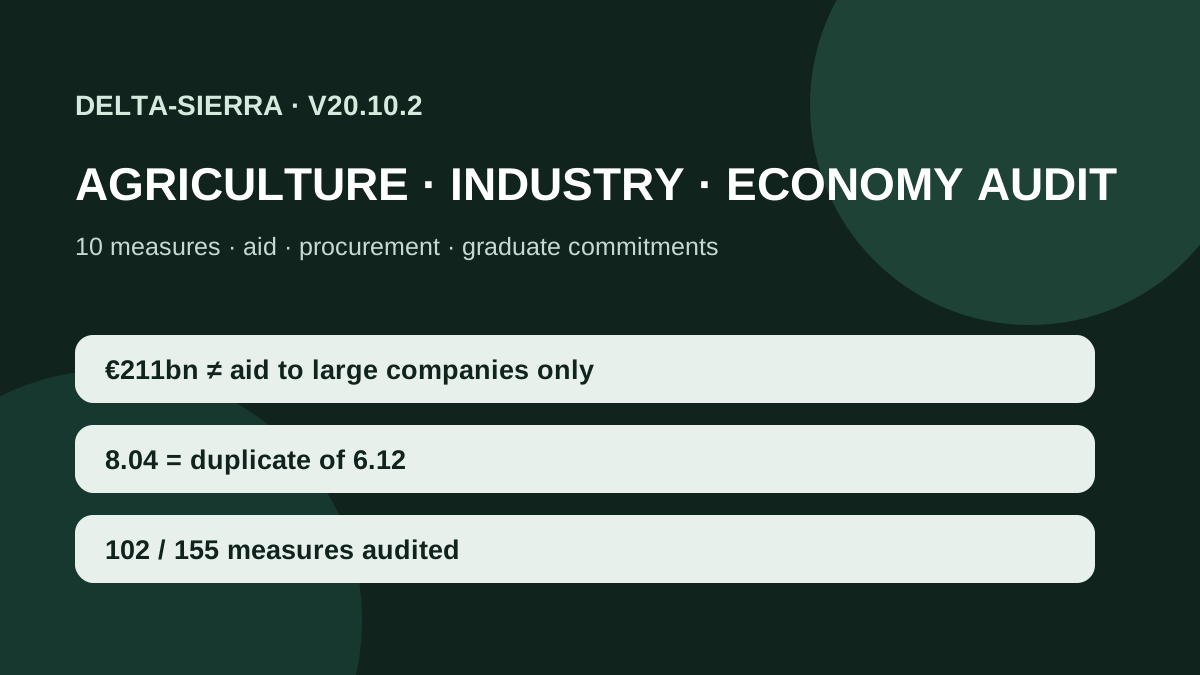
8.04 materially duplicates 6.12. It contributes €0 additional amount to the consolidated total.
PUBLIC FINANCE · CATEGORY 08
Agriculture, industry and economy: audit of 10 measures
The source range is preserved, but business-aid savings are no longer extrapolated from a national total that cannot be allocated precisely: each flow must be tied to a scheme and beneficiary.
Main lock: €211bn is not the large-company pot
The Senate estimates aid to all businesses at at least €211bn under a broad definition in 2023 and €108bn under a strict definition, but states that the amount received specifically by large companies cannot currently be known precisely. The category’s historic €30–50bn range therefore remains a source trace, not an amount that can be mechanically inferred from €211bn.
Three immediate corrections
8.05 shares the same local tax base as 6.05 and 6.13: scenarios are exclusive, never cumulative.
8.07 must be rebuilt company by company and scheme by scheme; tax credits and relief already counted in taxation are removed.
Canteens: policy target, real legal constraint
EGAlim already requires 50% sustainable and quality products, including 20% organic. Reported 2024 purchases reached 29.5% and 11.8%. An 80% target directly based on “French” origin needs legal redesign: procurement law generally cannot favour a specified provenance. The site therefore separates food-sovereignty goals from legally usable award criteria.
Grandes écoles: precedents already exist
ENS institutions already apply a ten-year professional commitment with repayment in case of breach, and École Polytechnique also has a service/repayment regime. These precedents help document 8.09–8.10, but also prevent treating all future repayment as entirely new revenue: the model counts only additional cash beyond existing schemes.
Line-by-line audit
| Measure | Source proposal | Financial nature | Current reference | Consolidation rule | Simulator treatment | Deduplication |
|---|---|---|---|---|---|---|
| 8.01 | Strengthen and enforce the “fait maison” label Structural effect | Consumer-information and enforcement rule; no direct budget saving | The Consumer Code already regulates the “fait maison” label: a dish must be prepared on site from raw products, subject to regulatory exceptions. In June 2026, the National Consumer Council adopted an opinion preparing a reform of the scheme. | The measure should be assessed through compliance rates, consumer clarity and enforcement costs. No amount enters the savings counter without an identifiable expenditure reduction. | €0 default budget effect; any enforcement cost is modelled separately. | — |
| 8.02 | Reach 80% French products in public canteens by 2030 Structural effect | Procurement target; budget effect depends on prices and procurement law | EGAlim already requires at least 50% sustainable and quality products, including 20% organic. In 2024 reported purchases, the observed rates were 29.5% sustainable products and 11.8% organic; 33,797 sites were covered, about 40% of all sites. “France” origin can now be reported voluntarily. | A quota directly based on French origin requires legal redesign: EU public procurement requires equal treatment and non-discrimination and generally prohibits favouring a specific origin. The scenario must therefore test lawful quality, sustainability, seasonality, environmental-performance or direct-supply criteria. | No automatic saving; model purchase-price differential, logistics, waste and agricultural effects. | 8.04 |
| 8.03 | Liberalise citizen food self-sufficiency Structural effect | Regulatory reform; local economic effect, no predetermined budget saving | The proposal potentially spans planning rules, direct sales, home processing, small-scale livestock, gardens and health rules. No single budget aggregate maps cleanly to this heterogeneous scope. | Break the measure into legal sub-reforms before costing it. Potential gains first concern household income, resilience and local activity; revenue losses or enforcement costs must be separated. | €0 by default; sector modules only after precise definition. | 8.05 |
| 8.04 | Cap margins on public procurement contracts €3–5bn per year — direct budget saving, C | Same financial line as 6.12; no additional saving in consolidation | Measure 6.12 already contains the same mechanism (“cap public-procurement margins at 30%”) and was audited in . The €3–5bn amount must therefore be tested only once against procurement data. | Financial owner: 6.12. Line 8.04 remains visible to preserve the source corpus but contributes €0 additional amount to any consolidated total. | Alias of 6.12; the same saving cannot be activated twice. | 6.12 |
| 8.05 | Reduce development tax that hinders business creation Gain for households / businesses | Local tax cut; revenue cost before economic effects | Development tax is already covered by measures 6.05 (payment spreading) and 6.13 (abolition for new housing). 8.05 extends the issue to business creation but uses the same local tax base. | Any reduction must first be costed as a revenue loss for local authorities before estimating any additional investment or activity. The same taxable floor area cannot be counted simultaneously under 6.05, 6.13 and 8.05. | Separate local-tax cost; mutually exclusive scenarios by construction type. | 6.05, 6.13 |
| 8.06 | Radically simplify business procedures Structural effect | Time/productivity gain; budget saving only after real cost reduction | Since 1 January 2023, all business formalities already go through a single online portal operated by INPI, replacing six networks of business-formality centres. Delta-Sierra must therefore measure what it simplifies beyond this existing baseline. | Measure forms removed, processing times, required documents, human interventions, user cost and administrative cost. Time saved affects the deficit only after actual budget or staffing reductions. | Separate productivity account; budget conversion only through non-replacement, lower outsourced services or appropriations. | 2.04, 2.05, 2.06, 2.07, 2.08 |
| 8.07 | Remove aid to large companies without employment commitments Source category range: €30–50bn per year — direct budget saving, C | Potential saving on aid actually abolished; beneficiary-level costing required | The Senate estimates aid to all businesses at at least €211bn under a broad definition and €108bn under a strict definition in 2023, but states that the amount received specifically by large companies cannot currently be known precisely. Corporate-tax credits represented €7bn in 2023, of which €4.3bn was concentrated on large companies, but this component already overlaps the Plan’s tax measures. | Never apply an arbitrary percentage to the €211bn figure. Build a company-by-company and scheme-by-scheme register, distinguish grants, tax expenditures, social-contribution relief, loans/guarantees and EU aid, then remove schemes retained or already counted elsewhere. | €0 by default until a consolidated large-company register is built; activate line by line using the net amount actually abolished. | 6.02, 6.06, 6.07, 6.11, 8.08 |
| 8.08 | Apply strict conditions to industrial aid Structural effect | Eligibility and clawback rule; revenue only when a clause is triggered | The 2025 Senate report notably recommends full repayment of State or local-authority aid when the site or activity that justified it is relocated within the following two years, and ex-ante definition of other repayment clauses. | Conditionality does not create a saving on enactment. It may reduce future aid or generate clawbacks only when conditions are breached. Aid already abolished under 8.07 cannot be counted again. | €0 by default; net recovery only for documented and collected events. | 8.07, 6.06, 6.07, 6.11 |
| 8.09 | Ten-year service commitment in France for graduates of grandes écoles Structural effect | Service obligation; no automatic revenue | Precedents already exist: students at the Écoles normales supérieures are subject to a ten-year professional commitment with possible reimbursement upon breach; École Polytechnique also has a reimbursement regime and, depending on the category of graduate, service obligations that can reach ten years. | Extending the rule to all “grandes écoles” requires defining covered institutions and students, the public consideration received, eligible activities and compatibility with professional and EU freedoms. Training cost cannot be presumed fully recoverable. | €0 revenue; retention and service indicators only. | 8.10 |
| 8.10 | Recover public training costs from graduates who expatriate Uncosted new revenue — revenue | Repayment revenue only where a prior legal obligation exists and is breached | ENS and Polytechnique schemes show that repayment can be organised where a prior commitment exists and its calculation, exemptions and procedure are defined. These schemes already generate claims within their own scope and cannot be counted again as “new” revenue. | Expatriation alone does not create a claim. The triggering event, recoverable public cost, duration, prorating, exemptions and cross-border collection must be defined. Consolidated revenue is the additional net cash collected beyond existing schemes. | €0 by default; net cash only after a valid claim and actual collection. | 8.09 |
Public reusable data
JSON · CSV · Baseline JSON
Primary / institutional sources
- Légifrance — Code de la consommation, art. L122-19 à L122-21
- CNC — avis du 2 juin 2026 relatif à la mention « fait maison »
- Ministère de l’Agriculture — campagne EGalim 2026 et résultats 2024
- DRAAF AURA — origine locale et commande publique, juillet 2026
- EUR-Lex — directive 2014/24/UE, art. 18 et 42
- Audit fiscalité
- Service-Public — taxe d’aménagement
- Guichet unique des formalités — cadre juridique
- Sénat — rapport n°808, aides publiques aux entreprises
- Sénat — crédits d’impôt par taille d’entreprise
- Sénat — recommandations n°19 à 21 sur conditionnalité et remboursement
- Légifrance — engagement décennal des élèves des ENS
- Légifrance — remboursement et obligation de service à l’École polytechnique
- Légifrance — ENS, remboursement en cas de rupture de l’engagement décennal
- Légifrance — École polytechnique, remboursement des frais