AGENCIES · 18 MEASURES ·
State agencies and operators: audit of 18 measures
separates money that flows through an operator from administrative overhead that can genuinely disappear.
The rule that changes everything
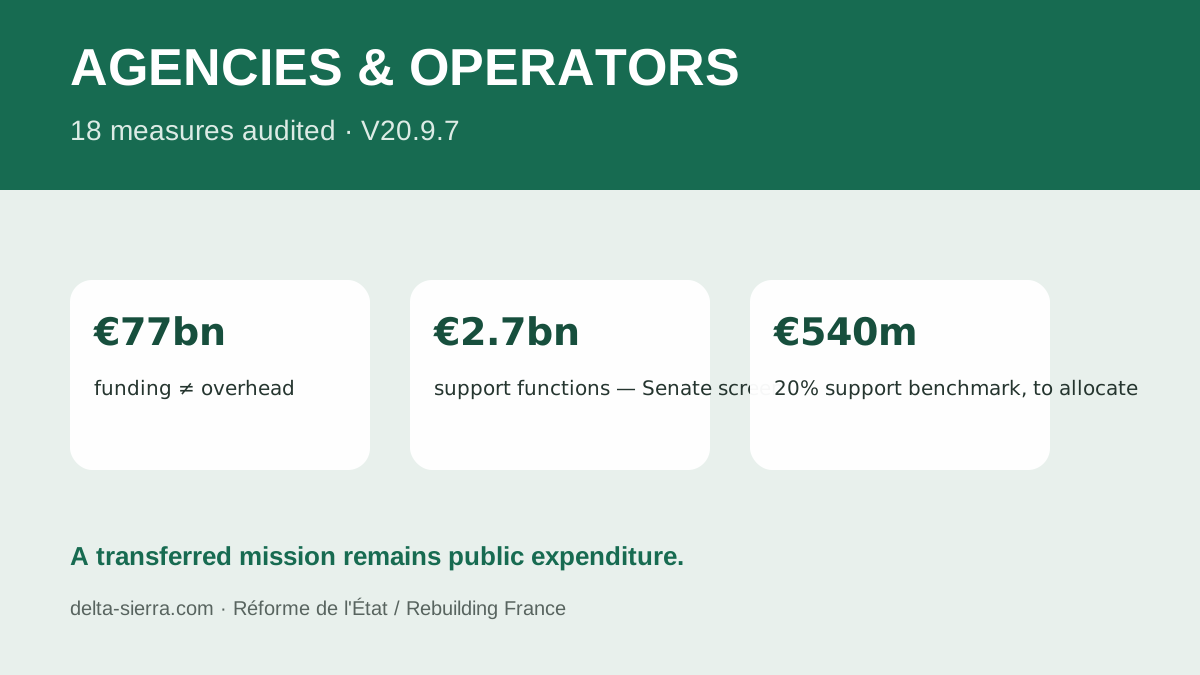
A budget administered is not a saving available. If an agency distributes €1bn of aid and the aid survives the agency's abolition, that €1bn remains public expenditure. Only overhead, duplication or missions genuinely ended may become savings.
The Senate inquiry provides a useful screen: about €2.7bn of support-function cost on the analysed perimeter and roughly €540m from a 20% reduction, itself described as highly ambitious. This benchmark does not replace the Delta-Sierra audit; it prevents funding flows from being confused with administration costs.
Four current corrections integrated
CSA → Arcom. CSA ceased to exist in 2022. Measure 3.14 remains historically traceable, but its current audit now concerns Arcom, with €50.52m in the 2026 draft budget and 378 FTEs.
France Télévisions. The 2026 Finance Act opens €2,425.577m; any privatisation proceeds will always be separated from recurring annual savings.
Radio France. The 2026 reference is €648.03m; 30–45% mechanically equals about €194.4–291.6m, but feasibility depends on the public service retained.
Press. 2026 direct aid is €178.29m and tax expenditure €65m. They are now handled in two separate fiscal columns.
The eighteen measures, separated by financial nature
| Measure | Plan effect / type | Current reference | Public consolidation | Simulator treatment |
|---|---|---|---|---|
| 3.01 Category A: operating-cost audit of the 552 entities retained | Audit and control Detailed costing in measure files | The Senate's 2025 perimeter covers 1,153 national public bodies, including 426 budget operators. Operators receive €77.0bn in public funding, but this includes grants, transfers and earmarked taxes and therefore is not an overhead figure. | Keep the Plan's 552 retained entities as a working perimeter, then audit payroll, property, procurement, communications, IT, governance and intervention spending separately. Never apply a savings rate to all funds administered. | No automatic aggregate saving. Only itemised, deduplicated overhead reductions may enter the model. |
| 3.02 Category A: cap executive compensation | Targeted payroll saving Detailed costing in measure files | The Senate report qualifies the idea of a general agency pay premium: the average monthly gross pay of the operator executives' 'top 10' was €7,986.58 in 2023 versus €16,799 in ministries, although a few operators exceed their relevant ministry benchmarks. | Identify operator by operator the remuneration above the chosen cap and calculate savings only on pay actually reduced to that cap. Do not apply a blanket cut to all executives. | Direct saving only for verified individual excess above the cap; deduplicate against measures 1.15 and 1.20. |
| 3.03 Category A: interministerial pooling of support functions | Targeted budget saving Detailed costing in measure files | The Senate estimates operator support functions at about €2.7bn in 2024 on its perimeter excluding universities and research centres. A 20% cut, described as highly ambitious, gives a reference screen of about €540m. | Use €540m as a parliamentary control benchmark, then rebuild savings operator by operator. Remove gains already captured by merger, abolition, digitisation or non-replacement. | May enter the budget only after entity-level allocation and overlap removal. |
| 3.04 Category A: systematic deployment of artificial intelligence | Productivity gain Detailed costing in measure files | The Senate report records 402,489 FTEs under operator employment ceilings and 77,058 outside them. This is a transformation perimeter, not an automatic AI saving. | Measure time released task by task. Convert it into a budget saving only when procurement, recruitment or a post is actually avoided, reduced or left unfilled. | Separate productivity module until fiscal realisation; mandatory deduplication against 2.07, 2.09, 2.13 and the AI package. |
| 3.05 Category B: merge 35 operator clusters | Restructuring €2.3–4.1bn per year | The Senate notes that operator mergers and abolitions from 2015 to 2019 produced only a 0.8% fall in jobs at constant scope. A legal merger therefore does not translate into proportional savings. | Review all 35 clusters individually: governance removed, pooled support, property, IT, pay-harmonisation and transition costs. The €2.3–4.1bn range remains a historical target to consolidate cluster by cluster. | Enter only each merger's net gain after transition costs and deduplication against 3.03/3.04/2.09. |
| 3.06 Category C: reintegrate entities whose autonomy is not justified | Reintegration Detailed costing in measure files | The Senate report recommends several reinternalisations but stresses that the missions continue. Reintegration changes the administrative vehicle; it does not mechanically remove intervention appropriations. | Value only legal-entity, governance, duplicate oversight, support and property costs avoided, net of costs transferred back to ministries. The historical Category C potential must be rebuilt entity by entity. | Net restructuring only; transferred mission funding remains public expenditure unless a separate policy decision changes it. |
| 3.07 Category D: abolish ADEME and fund aid directly (net amount) | Abolition / transfer Detailed costing in measure files | ADEME's 2024 main budget recorded €1,029.5m in revenue, of which only €60.6m was own-source revenue. The Senate stresses that retained aid schemes would still cost the public budget and already recommends direct State-to-region transfers for some funds. | Strictly separate retained aid, legacy commitments, transferred expertise and overhead genuinely removed. ADEME's budget is not treated as a saving. | Only net overhead removed, after transfer costs and legacy commitments. |
| 3.08 Category D: abolish the French Biodiversity Office (net amount) | Abolition / transfer Detailed costing in measure files | OFB reports a €623m initial 2024 budget, funded 70–80% by the water agencies; €73.5m is contributed to the eleven national parks. These flows therefore cannot be equated with OFB overhead. | Separate environmental enforcement, expertise, biodiversity, parks, grants and support functions. Any transferred mission keeps its cost in the receiving body or service. | Net overhead saving only; transfers to parks and retained missions excluded from savings. |
| 3.09 Category D: abolish AFITF (net amount) | Reinternalisation Detailed costing in measure files | For 2026, AFIT France earmarked revenue and appropriations are estimated at about €3.75bn. Yet the Senate describes a structure with four permanent staff relying entirely on central government and recommends reinternalisation. | The €3.75bn funds infrastructure and does not disappear with the legal entity. Value only governance, accounting, own overhead and budget simplification net of costs taken back by the State. | Reinternalisation with limited overhead savings; infrastructure appropriations are never treated as savings. |
| 3.10 Category D: abolish regional health agencies (net amount) | Abolition / transfer Detailed costing in measure files | Budget funding for regional health agencies under programme 155 is set at €627m for 2026. The Senate report recommends transferring their responsibilities to decentralised State services at regional and departmental levels. | Transferring missions means staff, property, systems and health functions must be taken over. Costing must focus on duplicate and governance costs removed, not the entire envelope. | Net gain after transfer costs, deduplicated against 2.01, 2.03, 2.09 and health reforms. |
| 3.11 Category D: abolish regional agriculture directorates (net amount) | Territorial restructuring €60–120m per year | DRAAFs are decentralised State services rather than autonomous aid envelopes. Their reform directly overlaps abolition of the regional administrative tier and staff mobility. | Keep the historical €60–120m range as a prudent estimate to consolidate through payroll, property, transferred functions and the actual number of posts avoided. | No model entry before deduplication against 2.01/2.03/2.09/2.10 and territorial allocation. |
| 3.12 Category D: rationalise DDT, DREAL and water agencies | Territorial rationalisation Detailed costing in measure files | The Senate identifies the water agencies among major intervention operators, with about €1.9bn in intervention charges. It also notes that DDT/DREAL services perform operational tasks for other operators. These funds are not homogeneous overhead. | Split into three sub-perimeters: DDT services, DREAL services and water agencies; isolate missions, fees, grants, enforcement/control and support. Deduplicate against OFB and regional-tier reform. | Enter only by sub-perimeter, net of transferred missions and flows. |
| 3.13 Category D: abolish 316 marginal consultative committees | Operating saving €120–240m per year | The 2025 Senate report counts 317 consultative bodies on its perimeter. It estimates their real total cost closer to €50m than the €30.9m documented for 2023, and puts a 20% reduction at about €10m. | The historical 316-body perimeter and €120–240m target must be reconciled with the Senate definition before consolidation. Build a committee-by-committee register and aggregate remuneration, secretariat, travel and staff time actually avoided. | Enter only documented annual costs of bodies actually abolished; staff-time gains remain separate until expenditure falls. |
| 3.14 Category D: abolish the audiovisual council and regulatory overlaps | Regulator reform €85m per year | The CSA has not existed since 1 January 2022: it merged with Hadopi to form Arcom. The 2026 draft budget provides €50.52m for the Arcom action and an employment ceiling of 378 FTEs. | Keep the historical wording in the Plan table, but audit the measure against today's Arcom. The €85m target cannot simply be mapped onto a 2026 €50.52m envelope; missions to abolish, transfer or pool must be specified. | No saving above net costs genuinely removed; transferred-mission costs deducted. |
| 3.15 Break up France Télévisions and privatise by asset | Public-media reform €2.6bn per year | The 2026 Finance Act opens €2,425.577m for France Télévisions. This envelope is a reference bound: privatisation would also create transition costs and potentially one-off sale proceeds. | Separate the annual grant reduction, any retained public-service obligations, social/contractual commitments and sale proceeds. Sale proceeds are one-off and must never be added to annual savings. | Recurring saving = net reduction in public funding; disposals go to a separate one-off account. |
| 3.16 Deep rationalisation of Radio France by 30–45 percent | Public-media reform €200–300m per year | The 2026 Finance Act opens €648.033908m for Radio France. A mechanical 30–45% reduction equals roughly €194.4–291.6m, close to the Plan's historical range, without prejudging operational feasibility. | Turn the percentage into an operational programme covering stations, transmission, property, production, digital, staff, retained missions and timing. Costing must be consolidated against an explicit public-service scenario. | Net grant reduction only after transition costs; deduplicate against any wider public-media reform. |
| 3.17 Abolish all public support to the press | Direct aid / tax expenditure €320m per year | For 2026, direct budget support to the written press is set at €178.29m. The Senate adds €65m in tax expenditure, including €58m for the super-reduced VAT rate. These two components have different fiscal natures. | Replace the €320m shortcut with a full inventory of direct aid, tax expenditure and any other schemes. Removing tax expenditure is a potential revenue increase, not a spending cut, and must be modelled separately. | €178.29m theoretical maximum on direct aid before exceptions; €65m in the tax-expenditure module, deduplicated against 6.11. |
| 3.18 Publish an exhaustive count of national public bodies in the Official Journal | Transparency / registry Structural effect | The Senate uses a perimeter of 1,153 national public bodies, excluding basic social-security schemes and other bodies governed by the Social Security Code. This count must be dated and versioned rather than treated as permanent. | Create a versioned public register: identifier, legal status, supervising ministry, mission, staffing, funding, creation, merger, abolition and last verification date. Every perimeter change must be traceable. | No direct budget gain; this is control infrastructure for scope and double counting. |
The Plan dossiers remain the editorial source
This audit layer does not replace the historical dossiers; it adds a current, machine-readable control layer. The French source dossiers remain linked from the Delta-Sierra reform portal and retain their documentary role.
Machine-readable data
Main public sources
- Sénat — rapport n°807, périmètre et finances des opérateurs
- OFB — budget et financement
- Sénat — AFIT France, budget 2026
- Sénat — crédits ARS 2026
- Arcom — fusion CSA/Hadopi au 1er janvier 2022
- Sénat — crédits et emplois Arcom 2026
- Légifrance — 2026 Finance Act, public broadcasting
- Sénat — audiovisuel public 2026