


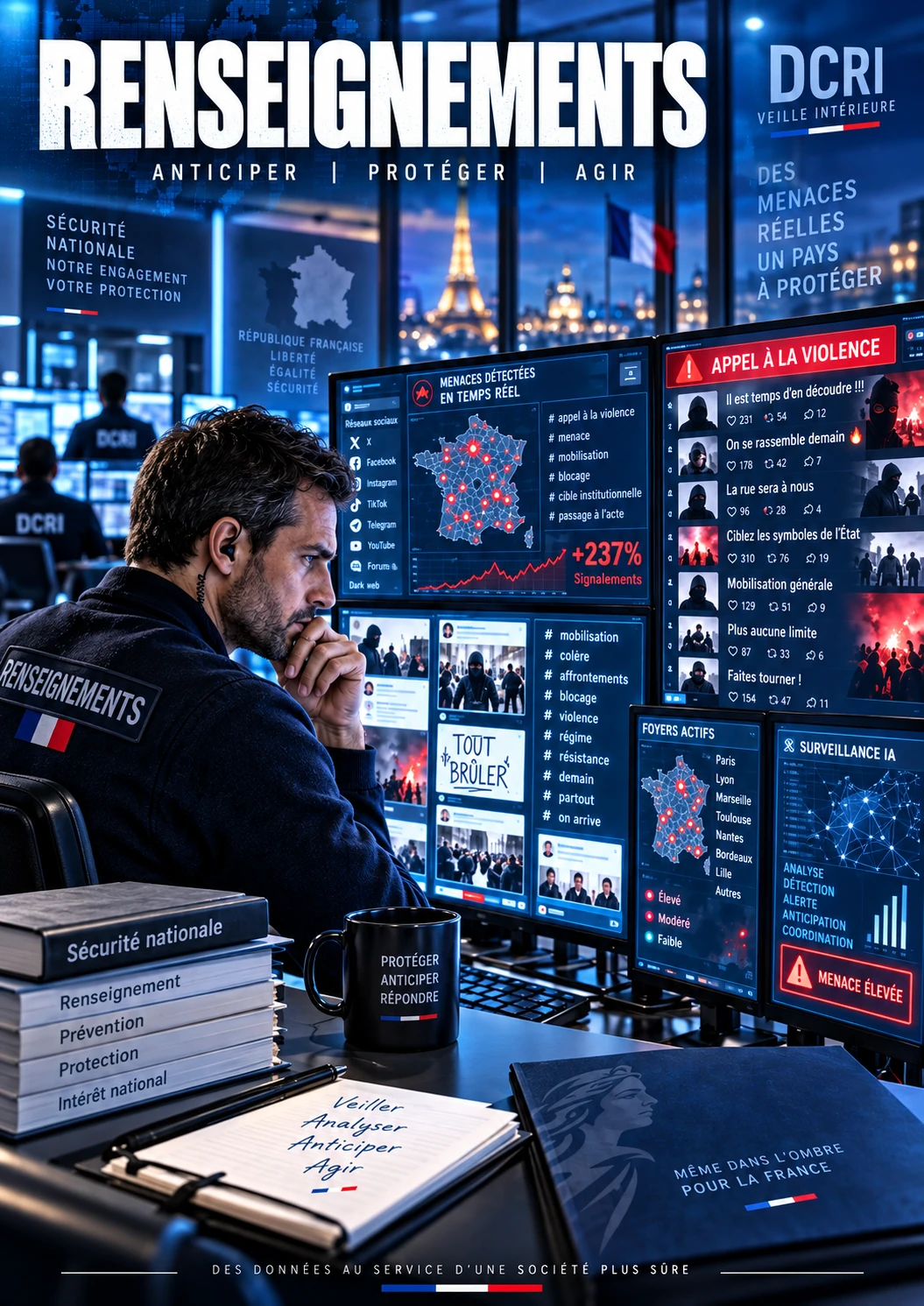
I have just read several articles about the current nervousness within intelligence services as social tensions rise. The scenarios being discussed range from mass demonstrations and blockades to violent attacks on public buildings; some commentaries even mention, as an extreme scenario, an attempt to storm the Élysée Palace. Whether realistic or not, such scenarios are obviously enough to mobilize territorial intelligence and, when more serious threats emerge, other domestic security services. Their job is precisely to detect weak signals, identify risks of escalation into action, and inform the authorities before a situation becomes uncontrollable.
But that reading led me to a question that is discussed far less often: what happens in the mind of the person doing the surveillance?
Imagine an officer who has devoted a career to serving the state, sometimes at the cost of a sacrificed personal life, and who sincerely sees himself or herself as serving the nation and protecting fellow citizens. What does that person feel when required to monitor those very same citizens—perhaps neighbors, friends, or acquaintances—while personally understanding part of their anger? What happens when the officer watches neighbors, relatives, or ordinary French people rebel against decisions that he or she may also consider wrong, while the professional mission is to identify ringleaders, assess risks, and pass intelligence up to those making the decisions?
That is where the question becomes fascinating: is professional duty always enough to neutralize personal conscience?
An officer can perfectly well believe that violence must be prevented while also considering some grievances legitimate. He or she may want to protect institutions without necessarily approving of those who lead them. The officer may even experience the paradoxical feeling that the people being watched are, in their own way, trying to bring about a change that the officer personally considers necessary. It is precisely this kind of conflict between mission, institutional loyalty, personal convictions, and moral conscience that research now examines through concepts such as cognitive dissonance and moral injury. This article explores that conflict.
Who watches what in France?
In France, simply referring to “the DCRI” as the service that follows demonstrations would now be inaccurate: the DCRI has not existed since 2014. Created in 2008 through the merger of part of the former Renseignements généraux and the DST, the Direction centrale du renseignement intérieur was responsible in particular for counterterrorism, counterespionage, protecting economic interests, and detecting extremist threats; in 2014 it became the present-day DGSI, the Direction générale de la sécurité intérieure. The DGSI is the Interior Ministry’s specialized service responsible for threats directly affecting national security and the fundamental interests of the nation: terrorism, violent extremism, espionage and foreign interference, cyber threats, proliferation, or projects capable of seriously harming institutions. It is therefore not, in principle, the service that “counts demonstrators” during an ordinary social protest. That work today falls mainly to the Direction nationale du renseignement territorial, or DNRT, which inherited part of the historical mission of the RG. The National Police explicitly states that its officers detect and monitor demonstrations and gatherings, collect economic and social information, and draft reports intended notably for prefects and the government so as to anticipate risks of public disorder. For the 2026 G7, for example, the DNRT publicly explained that it had worked upstream on various protest scenarios and produced “threat assessments” allowing the authorities to adapt their security arrangements. In Paris, comparable missions are notably performed by the Direction du renseignement de la préfecture de police, or DRPP, while the gendarmerie also has its own operational anticipation chain.
Historically, this function was much more clearly assumed by the famous Renseignements généraux, the RG. Their mission was to inform the government about the country’s institutional, economic, social and, for a long period, political life. The DGSI itself recalls that a 1967 text tasked the RG with seeking out and centralizing intelligence “of a political, social and economic nature” needed to inform the government. They observed public opinion, organizations, social movements, protests, groups liable to disturb public order and, during part of their history, the functioning of political life. Surveillance of political parties was later removed from their remit in the 1990s. When the RG disappeared in 2008, their functions were split: one part dealing with serious threats joined the DCRI and then the DGSI, while monitoring institutional, social and economic life and movements liable to affect public order continued in the structures that have become today’s territorial intelligence services. In other words, when a major mobilization is being prepared on social media today, with calls to block the country, threats against institutions, or risks of violence, it is perfectly normal for several services to examine the situation—but not for the same reasons and not with the same powers. Territorial intelligence primarily assesses public order and the dynamics of the mobilization; the DGSI may become more involved if terrorism, violent extremism, or a threat to the fundamental interests of the nation appears. And the use of intrusive intelligence techniques is not unrestricted: since the 2015 law, they have been legally regulated, generally subject to authorization by the Prime Minister and oversight by the CNCTR.
A territorial-intelligence police officer tasked with observing a social protest and a DGSI officer tasked with preventing a terrorist act do not necessarily experience the same moral conflict, even though both may face a gap between personal convictions and professional mission.
A question therefore deserves to be asked when the state mobilizes police officers, specialized services, or intelligence personnel in the face of a major social protest: what happens psychologically when the officer responsible for observing, infiltrating, monitoring, or implementing an institutional decision begins to experience a conflict between the mission and personal convictions? Contrary to what one might think, this is not merely a philosophical question. A growing scientific literature studies the phenomenon under the term moral injury.
Moral injury is not simply occupational stress. It can arise when a person commits, allows, or witnesses something that deeply contradicts his or her moral values, or when that person feels betrayed by the institution. A systematic review published in August 2026 in Policing: A Journal of Policy and Practice examined 18 empirical studies involving police forces. The researchers concluded that potentially morally injurious events are a significant concern in police work. They can arise in particular from the feeling of having caused harm, having been unable to prevent harm, or having been placed in an institutional situation incompatible with what the officer considered right.
The phenomenon is not limited to conventional policing. In 2022, the RAND Corporation devoted a report to psychological trauma within the U.S. intelligence community. Its authors show that intelligence professionals may face events carrying an extremely heavy moral burden even when they are not the people who make the final decision. An analyst may produce information that contributes to an operation, observe its consequences, and nevertheless feel morally implicated. RAND notably reports the difficulties experienced by personnel confronted with the human consequences of operations to which their work had contributed.
The case of human intelligence, or HUMINT, is even more revealing. In a study published in the International Journal of Intelligence and CounterIntelligence, philosopher Adam Henschke analyzes the moral contradictions inherent in the profession: an officer may have to lie, manipulate, exploit a relationship of trust, or exercise a form of coercion in the name of a higher national-security objective. Conduct normally regarded as morally problematic can therefore become institutionally authorized. According to Henschke, this situation creates precisely the kind of moral risk that can, under certain circumstances, lead to moral injury for the person carrying out those acts.
Undercover police officers are another particularly well-documented example. A systematic review published in 2025 describes their work as psychologically high-risk: chronic stress, difficulty maintaining a coherent identity, isolation, and moral dilemmas linked to the role they must play. An officer may have to maintain relationships with people whom he or she is continually deceiving, witness conduct the officer disapproves of without being able to intervene immediately, or preserve a cover identity while professional and personal identities come into conflict.
This brings us back to a particularly interesting French question. What does a police or intelligence officer feel when tasked with observing a social movement whose demands may personally seem legitimate? What happens when a civil servant monitoring a mobilization shares some of the same economic difficulties as the people being watched? And what happens psychologically to the mission when there is a gap between professional obligation, individual empathy, and the officer’s personal judgment about the fairness of the situation?
We must, however, remain rigorous: the available research does not allow us to assert that French officers who monitored the Yellow Vests or who may monitor a future mobilization automatically suffer moral injury, still less that they are secretly sympathetic to the people under surveillance.
That would go far beyond the scientific evidence. The studies demonstrate the existence of a general mechanism; applying it to a particular French operation remains a hypothesis that would require specific research among the officers concerned. It is precisely this distinction that makes the subject interesting rather than conspiratorial.
But this should also concern those who give the orders. A democracy should not ask only whether a policing or intelligence operation is legally possible. It should also ask what it is demanding, in human terms, from those who carry it out. When institutions expose their own personnel for long periods to situations in which professional duty, empathy, and moral convictions collide, the cost does not disappear simply because it is not immediately visible in operational statistics. It may take the form of guilt, distress, loss of meaning, cynicism, psychological disorders, or a breakdown of trust in the institution.
That is probably the real lesson of this research: a state cannot indefinitely treat its police officers and intelligence personnel as mere executors without a personal conscience. Behind the uniform, the service number, or the security clearance is always an individual capable of wondering whether what he or she is doing is right. And when an institution too often forces its personnel to resolve that internal conflict alone, it can end up injuring the very people it asks to protect it.
There is, moreover, a possible consequence of this inner conflict that is far more radical than simple discomfort: leaving the institution. France has for several years seen an increase in some departures from the police and gendarmerie, although figures sometimes presented as evidence of a “great resignation” must be interpreted cautiously because they may mix retirements, transfers between corps, contract endings, secondments, and actual resignations. The Cour des comptes nevertheless reports a 43 percent increase between 2019 and 2024 in departures from the National Police excluding retirements and internal promotions, and finds that the heavy constraints of the profession and occupational wear explain departures more than pay alone. Early departures also increased in the gendarmerie before stabilizing more recently. These figures obviously do not prove that officers leave the uniform for moral or political reasons, but they intersect with another official finding: malaise, loss of meaning, declining motivation, and retention difficulties are regularly documented within French security forces.
International research provides a particularly interesting perspective here. A 2026 study of 371 police officers shows that moral injury can reduce the feeling that one’s work still produces something positive for society, diminish engagement and job satisfaction, and increase the intention to leave policing. We therefore cannot claim that a French police officer tasked with monitoring a social protest that he or she personally understands will eventually resign; no French study establishes such causality. But we can now pose the question scientifically: when someone enters the police or gendarmerie to protect fellow citizens and begins to experience a lasting conflict between what he or she sees as the moral mission and what the institution concretely requires, how long can that person preserve motivation, loyalty, and the desire to remain?
For readers who wish to check the scientific work directly: the RAND report on the U.S. intelligence community is available here, Trauma in the U.S. Intelligence Community — RAND; Adam Henschke’s HUMINT study here, Moral Risk, Moral Injury, and Institutional Responsibility; the review of undercover police officers here, Mental Health Issues in Undercover Police Officers; and the 2026 systematic review of moral injury in policing here, Moral injuries in police cohorts.