


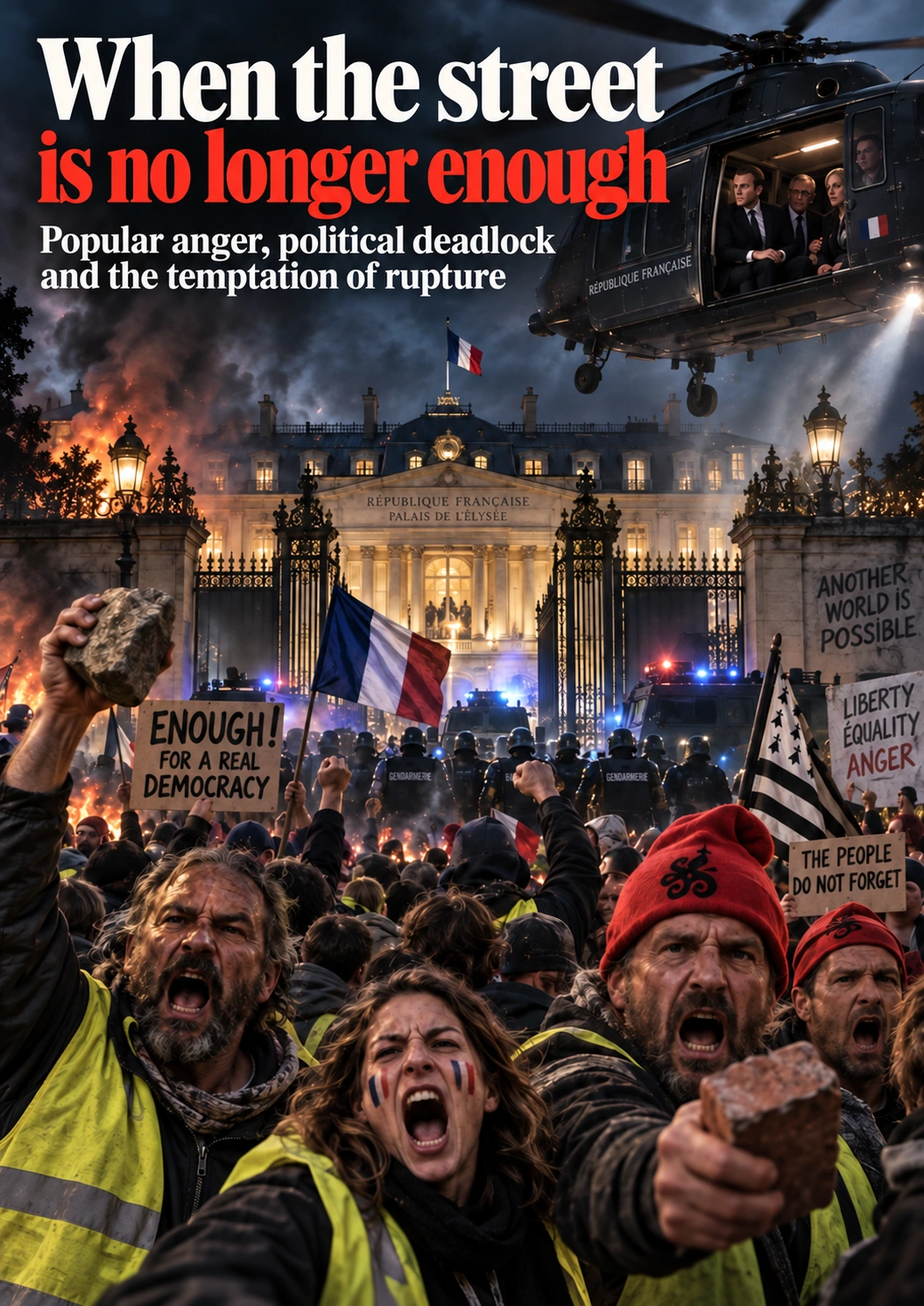
There are moments when a democracy enters a dangerous zone long before shop windows are smashed and long before police charge. The real tipping point begins when enough citizens become convinced that the ordinary means available to them no longer allow them to change what they are enduring. They vote, sign petitions, write to elected representatives, watch opposition parties denounce the government, then see that taxes remain, laws are passed and overall policy changes far more slowly than their anger grows. A question that should belong to the normal functioning of democracy then takes on an almost insurrectionary tone: how can the people hope for legislative, regulatory, budgetary or tax change when the political opposition is not doing its job, or is only doing it partially?
I want to address this question without sanitising it. That means accepting the uncomfortable words: demonstration, general strike, blockade, disobedience, violence, repression, fall of a government. It even means asking the questions many people would rather dismiss before answering them: must demonstrations end up with ministers being chased through the streets? Must the President of the Republic be chased, at the risk of many casualties among protesters? Is violence ultimately the only solution for changing the situation when politics itself is no longer present? Is a “Nepal-style” scenario the last resort when political leaders refuse to listen to the street? Refusing to ask these questions does not make them disappear; it simply abandons them to those who will answer them with the least caution. The purpose of this article is therefore not to call for violence, but to understand how a democracy can avoid reaching precisely that extreme.
This reflection begins with a very concrete observation: many French people feel they are working more and more to finance a public system whose return they do not always perceive. In 2025, compulsory levies represented 43.6% of gross domestic product, public expenditure 57.2%, the deficit 5.1% and public debt 115.6% of GDP. In international comparisons, France has for years ranked among the countries with the highest tax burden: according to the OECD, its tax-to-GDP ratio was 43.5% in 2024, about ten points above the organisation’s average. The OECD also stresses the complexity of the French tax system, while the European Commission notes that public expenditure remains among the highest in the Union. These figures do not prove that every public euro is badly spent; they do, however, help explain why consent to taxation becomes politically explosive when a household or business feels it can no longer breathe.[1][2][3][4]
When taxation stops being an abstraction
Property tax is a good example of this perceived accumulation. The DGFiP states that amounts due for property tax on built properties rose by a further 2.8% in 2025, after +5.4% in 2024 and +9.7% in 2023; the average amount paid by an individual reached €1,117 in 2025. At the same time, Insee reports that personal income-tax receipts rose by 7.9% in 2025 and corporate-tax receipts by 3.7%. Taken separately, each levy has a legal basis, a tax base and a justification. Taken together with VAT, social contributions, energy taxes, local taxes and levies on businesses, they can produce a very simple political feeling: that people spend a growing share of the year working for charges over which the taxpayer has only indirect influence.[5][1]
Fuel concentrates this anger because it is paid for immediately and often determines whether people can get to work at all. In April 2026, Insee measured diesel at an average of €2.26 per litre in metropolitan France. Since 1 March 2026, the standard excise duty has been €0.6075 per litre of diesel and €0.6902 per litre of petrol. At a retail price of €2.20 per litre, the VAT included at a 20% rate represents €0.3667, because the VAT share of a tax-inclusive price at 20% is €2.20 minus €2.20 divided by 1.20. Adding VAT and excise gives about €1.0569 of direct taxation on a litre of petrol sold at €2.20, compared with about €0.9742 on a litre of diesel sold at the same price. It is therefore accurate to say that at this price level petrol bears more than one euro of direct tax per litre; it would be inaccurate to present that figure as uniformly true for all fuels. The Ministry of the Economy also notes that the 20% VAT applies including excise duty, making the structure of the price particularly visible and politically sensitive.[9][10][11]
Business failures reinforce this sense of suffocation, but they too must be described without cheating. At the end of July 2026, the Banque de France recorded 70,605 business failures over twelve months, 19% above the 2010–2019 average. That is a high level. At the same time, more than 1.2 million businesses had been created over twelve months. France is therefore neither an economic desert nor a serene economy: it creates huge numbers of businesses and also sees many disappear. A credible criticism of the tax and regulatory system gains nothing by erasing this contradiction; it should face it and ask why such an entrepreneurial country retains so many vulnerabilities.[6]
The same discipline must be applied to expatriation. Claims that expatriation “has never been higher” or that “most of the great fortunes have already left” cannot be established properly from the available data. On 31 December 2025, 1,784,975 French nationals were registered in the official register of French citizens living abroad, while the administration estimated the total French population abroad at around 2.5 million. Registration is voluntary, however, and the government report notes that the register reached 1,821,519 people in 2017, more than in 2025. There is therefore a very large French community abroad and registrations have recently risen, but there is no serious basis for presenting 2025 as an absolute historical record or for equating every expatriation with tax exile. On such an inflammatory subject, a single false sentence is enough to give an opponent a way to avoid everything else.[7][8]
The street does not vote laws
The first reality is almost trivial, but it explains much of the frustration: a demonstration is not a referendum. Article 3 of the Constitution states that national sovereignty belongs to the people, but specifies that the people exercise it through their representatives and by referendum. One hundred thousand people may march in Paris, a million may mobilise across the country, but they do not directly repeal a tax, a decree or an article of the General Tax Code. A demonstration exerts political pressure; it does not itself possess the legal power to change the law. That is precisely why the institutional relay is central.[12]
The executive can then put forward an argument that is not legally absurd: the president was elected, MPs were elected too, and the crowd in the street does not automatically represent the tens of millions of voters who are absent. But the opposite argument is equally serious. Being elected is not the same as receiving a blank cheque allowing every future decision to be treated as if it had been approved in advance. A presidential election is no more a permanent referendum on every tax increase or reform adopted four years later. The democratic tension lies exactly here: the street cannot proclaim itself the sovereign people on its own, but institutions cannot reduce every protest to a noisy minority simply because an election took place several years earlier.
French citizens also have few national mechanisms for direct decision-making between elections. The shared-initiative referendum has a name misleadingly close to popular initiative: it must first be sponsored by at least one fifth of parliamentarians, 185 of them, and then supported by one tenth of registered voters, around 4.9 million people. A citizens’ initiative referendum, an emblematic demand of part of the Yellow Vest movement, still does not exist at national level. A petition to the Economic, Social and Environmental Council can pass the threshold of 150,000 signatures and trigger institutional consideration, but the CESE is not a second parliament able to repeal a tax. This gap between periodic elections and direct decision-making is one of the places where political frustration is born.[13][14]
This is not merely a French intuition. The OECD’s 2024 trust survey shows that in France 34% of respondents reported high or moderately high trust in the national government, and only 26% felt the political system allowed people like them to have a say in what government does. The OECD finds a huge trust gap between those who feel they have a political voice and those who do not. Its more recent work on citizen participation also highlights a perverse effect: consultation without visible follow-up can increase frustration rather than reduce it. In other words, a democracy can organise more participation and still damage trust if citizens feel their words never change the decision.[41][42][43]
So what is a demonstration actually for?
Research forces us here to abandon slogans. A demonstration can attract attention, change the media agenda, give supporters courage, reveal the intensity of discontent, influence an election campaign or contribute to a concession. It can also generate a great deal of noise and very little decision. Amory Gethin and Vincent Pons studied fourteen major waves of protest in the United States between 2017 and 2022: in their NBER work, revised in May 2026, protests generate considerable digital activity but, on average, limited effects on opinions, voting intentions and policies actually proposed or adopted. This result is not a universal law and cannot be mechanically transposed to France; it simply reminds us that massive media coverage is not synonymous with political victory.[17]
A review published in 2024 in Trends in Cognitive Sciences explains why studies can seem contradictory: one cannot ask whether “protest” works without specifying the tactic used, the target and the outcome sought. Non-violent and socially normative forms can mobilise sympathisers more effectively; more disruptive actions can sometimes increase pressure on reluctant decision-makers. An NBER study published in 2026 on Nigeria even shows that demonstrations can alter fiscal redistribution towards protesting regions, but conditionally and according to political alignments. This rules out two opposite simplifications: “the street is useless” and “all you have to do is take to the street to win” are equally false.[18][19]
General strikes offer another perspective. A study by Kerstin Hamann, Alison Johnston and John Kelly covering 75 general strikes in sixteen Western European countries between 1980 and 2009 concludes that governments made concessions in more than 40% of cases. That is far from negligible, but also far from automatic: the type of government, the governing coalition and partisan context strongly altered the likelihood of concession. Above all, a strike has an immediate cost for those who take part. In the French private sector, the employment contract is suspended and the employer withholds pay in proportion to the duration of the stoppage. Those in power can sometimes wait longer than the employee who has rent, a mortgage and groceries to pay. Economic endurance then becomes a component of the power struggle just as important as the number of demonstrators.[16][15]
It is at this point that the question “you are going into the street to do what?” stops being sarcastic and becomes strategic. A movement that cannot define the exact legal objective it is demanding — withdrawal of a tax, repeal of a law, dissolution, referendum, change to a budget — cannot know how to recognise victory either. It then risks confusing the intensity of its anger with its capacity to obtain a result. Comparative work on more than a million protest events around the world also shows that protests diffuse, peak and then decline: mobilisation is inherently difficult to sustain. Time is therefore not merely background; it is a political resource.[20]
The Yellow Vests: proof that the street can win — and proof of what it can cost
It would be historically false to say that the Yellow Vests obtained nothing. On 4 December 2018, Édouard Philippe announced a six-month moratorium on the increase in the carbon tax, on the convergence of diesel taxation with petrol taxation and on other measures. Very quickly, the executive went further: the fuel-tax increases planned for 2019 were abandoned. A few days later, Emmanuel Macron announced a series of emergency economic and social measures, subsequently translated into a bill. Their scope can be debated, but not the mechanism: a massive social movement forced the authorities to change fiscal and social policy in concrete terms.[21][22][23]
Why did this movement obtain what so many marches do not? Because it was not limited to a ritualised march lasting a few hours. It occupied roundabouts, disrupted activity, imposed a continuous media presence, still enjoyed very substantial social support in early December 2018 and created the impression of a political crisis that might become uncontrollable. On 7 December, Ipsos still measured 59% support for continuing the movement; at the same time, Ifop found 17% of French people directly identifying with the Yellow Vests and another 51% supporting them without identifying as such. In that context, the political cost of maintaining the tax became greater than the cost of backing down.[27][28]
But that partial victory came at a human cost that rules out romanticising it. The Ministry of the Interior recorded 2,549 protesters injured during the movement. The Senate recalled that between 17 November 2018 and 5 February 2019, the national police fired 13,460 LBD projectiles, plus around a thousand firings by the gendarmerie; the authorities acknowledged that some injuries were serious. The toll did not stop with demonstrators: a Ministry of the Interior reply counted, by 27 April 2019, 474 gendarmes and 1,268 police officers injured. Writing that people were tear-gassed, clubbed, struck by LBD rounds and sometimes mutilated is therefore not militant folklore; writing that law-enforcement officers also suffered violence is equally necessary for an honest description of the confrontation.[24][25][26]
It is impossible to prove statistically that “most French people learned the lesson” and have since given up demonstrating for fear of being injured. But the hypothesis is politically plausible: when mobilisation becomes associated in public space with serious injuries, police custody, lost wages and total uncertainty about the outcome, its individual cost rises. A parent may be furious about fuel prices and still decide not to risk physical injury on Saturday. A self-employed worker may support a general strike and know that a week without turnover costs more than the government loses by waiting. That may be one of the most important paradoxes inherited from 2018: anger can remain while the capacity for sustained mobilisation declines.
The most spectacular images of the period must also be treated rigorously. The use of a forklift — the famous Fenwick — to smash through the gate of the Hôtel de Rothelin-Charolais, where government spokesman Benjamin Griveaux had his offices, on 5 January 2019 is a documented fact and led to prosecutions. The idea that a helicopter had been prepared to evacuate Emmanuel Macron from the Élysée on 8 December 2018 was reported in the press, notably by Le Canard enchaîné and then repeated by other media; it is not an official document and must be presented as such. The distinction matters: that the executive took the risk of disorder extremely seriously is beyond dispute; claiming to know exactly how many hours it was from “falling” would belong to political legend.[29][30]
Repression can discourage a movement — or produce the opposite effect
The Yellow Vest experience naturally suggests that costly repression can teach a population not to return to the street. The mechanism exists: injuries, arrests, lost wages and legal risk increase the individual cost of participation. But research on political repression shows there is no mechanical relationship by which more coercion automatically produces less mobilisation. In her landmark review, sociologist Jennifer Earl instead stresses the diversity of forms of repression and their effects: they can deter, fragment or channel a movement, but they can also fuel indignation, strengthen certain activist identities or redirect protest into other forms of action. A more recent interdisciplinary review published in 2022 by Jennifer Earl and Jessica Maves Braithwaite further emphasises that the word “repression” covers very different mechanisms, from visible police control to more diffuse forms, making it impossible to expect the same political effect everywhere.[75][77]
Adria Lawrence’s work on Morocco’s February 20 Movement during the Arab Spring illustrates precisely this second mechanism. In her study, people connected to the first demonstrators expressed greater support for new mobilisation when they were informed of repression by the regime. This result must obviously not be mechanically transposed to France in 2018 or 2026: the regimes, levels of violence and political contexts are different. It nevertheless forces us to correct an overly simple idea. The same episode of repression can frighten one part of the population while simultaneously convincing another that the authorities have crossed a line. In other words, repression can produce demobilisation, but also resentment, solidarity and sometimes a backlash against those who use it.[76]
Should ministers be chased? The question must be asked — then dismantled
Let us come to the most brutal question: must demonstrations reach the point where ministers are chased through the streets? Must the President of the Republic be chased, at the risk of numerous casualties among demonstrators? Is violence ultimately the only solution for changing the situation when politics itself is no longer present? These formulations shock because they move the debate from the right to demonstrate into political violence. In France, the collective expression of ideas and opinions enjoys constitutional protection, but freedom to demonstrate is conceived within a peaceful framework subject to public-order rules. Physically chasing a person is therefore not a “stronger” form of demonstration; it is a change of legal and political category.[45][46]
Comparative research does not provide a ready-made moral answer, but it offers a result particularly awkward for the revolutionary imagination. Erica Chenoweth and Maria Stephan studied so-called maximalist campaigns — regime change, independence, ending an occupation — between 1900 and 2006. In that corpus, campaigns of non-violent resistance were more than twice as effective as violent campaigns. Chenoweth nevertheless insists on a crucial point: this is not a comparison between a riot and a peaceful four-hour stroll. Effective civil resistance combines protests, strikes, boycotts, refusal to cooperate and other tactics capable of affecting the “pillars” that keep power functioning. It works in particular because it allows much broader participation and can produce defections or refusals to obey among elites and institutional actors.[31][32]
Chenoweth’s more recent research itself qualifies the old slogans. The historical advantage of non-violence is not a mechanical law and its effectiveness has declined in several recent periods. But the literature indicates that introducing an organised violent wing into a mainly non-violent movement often tends to reduce participation and make it harder to build a broad coalition. Omar Wasow identifies another mechanism: in his study of African-American mobilisation in the 1960s, non-violent action, especially when met with visible repression, shifted the media and political agenda towards civil rights; violence initiated by protesters instead shifted attention towards “order” and social control and probably generated electoral backlash among some white voters.[33][34]
It would nevertheless be intellectually dishonest to derive the formula “violence never works”. A study published in the American Political Science Review on the 1992 Los Angeles riots concludes that they were followed locally by a lasting shift in some votes towards more liberal policies. Political science therefore offers no comfortable catechism: some violence can change behaviour or force an issue onto the agenda, while other violence strengthens exactly the political forces opposed to protesters’ demands. A comparison covering 78 countries reaches an equally troubling result: anti-government demonstrations can help strengthen institutional constraints on the executive, whereas riots can, when government remains cohesive, strengthen that same executive. Violence can frighten; it can also hand those in power their most effective argument for refocusing on security, hardening the response and rallying those who fear chaos.[35][36]
That is why the idea of “chasing ministers” is strategically far less obvious than it seems. A peaceful crowd of employees, tradespeople, retirees, families and self-employed workers presents the government with a political problem: how should it respond to a broad social coalition? A crowd that turns into a group physically seeking public officials presents the government with an internal-security problem, an area in which the state has incomparably greater means. The change of register can also drive out everyone willing to demonstrate but unwilling to fight. Radicalisation can therefore create the impression of intensifying the power struggle while shrinking the social base that gave the movement its strength.
What exactly do we mean by violence?
At this stage, the word “violence” itself becomes too imprecise to sustain serious reasoning. Smashing a shop window, setting fire to an empty vehicle, throwing projectiles, taking part in a riot, assaulting a person, forming an armed group, committing an attack or entering an insurgent war are neither the same acts, nor the same risks, nor the same objects of research. Erica Chenoweth’s 2023 review in the Annual Review of Political Science insists precisely on this distinction: organised armed violence appears, across the available research, to reduce the chances of success of campaigns based mainly on non-violent resistance, while the effects of unarmed collective violence are far more ambiguous. Using a single word for all these situations therefore leads to comparisons between phenomena that are not truly equivalent.[33]
The coexistence of moderate and radical currents within the same movement further complicates the analysis. Two experiments published in PNAS Nexus, involving a total of 2,772 participants, showed that a faction using radical tactics such as property destruction or violence could paradoxically increase support for a more moderate faction of the same movement through a contrast effect. The radical group becomes less popular, while the moderate group looks more reasonable by comparison. But it is important to specify what these experiments measure: declared support for factions of a movement in experimental scenarios, not the probability of getting a law passed, obtaining a government concession or overthrowing a regime. This is what the literature calls a “radical flank effect”. The finding in no way demonstrates that violence helps a movement win overall; on the contrary, it shows why its political effects can be indirect, contradictory and sometimes very different for the various components of the same mobilisation.[74]
When violence really changed the course of history — without proving it was the only path
A fundamental methodological distinction is needed here. History can show that violence was sometimes decisive in a regime change, the destruction of a legal order or the achievement of independence. It is much harder to prove that it was “necessary”, in the sense that no other route could have produced the same result. That second claim requires knowledge of an alternative past that never existed. The most rigorous words are therefore “decisive”, “constitutive” or “inseparable from the tipping point”. This caution does not reduce the force of the examples; it simply prevents their violence from being turned into a general law of history.[63]
The French Revolution provides the first case, even if it requires going slightly beyond the last two centuries. Popular violence in 1789 did not merely accompany institutional transformations; it weighed on them. During the Great Fear, peasants armed themselves, attacked châteaux and burned the registers recording seigneurial rights; the National Assembly itself linked this unrest to the night of 4 August and the abolition of privileges. Historical work published by Cambridge more broadly stresses that popular violence in 1789 contributed to eliminating the remnants of feudalism and that, in 1792, rural revolts, urban riots and external war contributed to the fall of the monarchy. It would therefore be artificial to tell the Revolution as a peaceful parliamentary reform. But it would be equally artificial to stop there: the same dynamic led to the Terror, civil wars, mass executions and, a few years later, a new authoritarianism. Violence did transform the political order; it guaranteed neither stability nor the freedom that was supposed to follow.[63][64]
The Haitian Revolution offers an even more radical case. Between 1791 and 1804, a population largely reduced to slavery rose up, fought the colonial forces and created an independent state that abolished slavery. The Oxford Handbook of Slavery emphasises the unique character of this revolution: it destroyed a society based almost entirely on slave labour and built, on its ruins, a state in which slavery was prohibited. Here, the absence of any constitutional route offered to enslaved people makes the hypothesis of a purely electoral transformation almost abstract. It nevertheless remains a specific historical case in a system of extreme oppression; it is not a model that can be mechanically transposed to a contemporary democracy.[65]
The Algerian War is another example in which armed violence cannot be removed from the causal account. On 1 November 1954, FLN attacks opened a war of decolonisation while the French authorities still rejected the very idea of independence and reaffirmed French sovereignty. Seven years of war, repression, attacks, guerrilla warfare and political crises later, the Évian Accords organised the ceasefire and opened the way to independence proclaimed in July 1962. Armed struggle was therefore a central element of the balance of power that made this outcome possible. But its human cost, violence against civilians, torture, bombings, reprisals and end-of-war massacres rule out turning it into a romantic image of “effective violence”. A historical change can be achieved while leaving wounds that continue to shape memories several generations later.[66]
Romania in December 1989 shows, on another scale, that a regime can indeed fall in violence. The revolution that overthrew Nicolae Ceaușescu killed 1,104 people and injured 3,321 according to historical data cited by the national agency AGERPRES. The case is all the more instructive because it contrasts with the other transitions of Central and Eastern Europe that year: Czechoslovakia ended forty-one years of one-party rule through the “Velvet Revolution”, while Romania experienced a bloody collapse. Violence accompanied and accelerated the fall of the Romanian regime; it therefore does not prove that communist dictatorships could not fall in another way. The contrast between Prague and Bucharest is almost a natural historical experiment: comparable systems can experience radically different exits.[67][68][71]
South Africa complicates the reasoning still further. After Sharpeville and the banning of the ANC, part of the anti-apartheid movement turned to armed struggle. In the 1980s, this coexisted with mass domestic mobilisation, boycotts, strikes, civic organisations, growing international pressure, sanctions and secret negotiations. South African historical archives show that the government began negotiating with the ANC even before the formal end of the armed struggle, which was suspended in August 1990 as the negotiation process took hold. It would therefore be just as false to say that apartheid fell “thanks to the guns” as to pretend that violence played no role in the balance of power. Transformation resulted from an ecosystem of pressures, some violent, others economic, diplomatic, social and institutional.[69]
And precisely to avoid the intellectual trap of “without violence, nothing changes”, the counterexamples must be placed alongside them. In 1986 in the Philippines, the People Power mobilisation and military defections forced Ferdinand Marcos from power after a largely non-violent campaign. In 1989, the Velvet Revolution ended the Communist Party monopoly in Czechoslovakia within weeks without civil war. In 2000 in Serbia, the Otpor movement, an electoral coalition and a civil-resistance campaign contributed to the fall of Slobodan Milošević; the United States Institute of Peace stresses the central role of non-violent strategy and the refusal of some police and army units to fire on demonstrators. These examples do not mean non-violence always wins. They simply demonstrate that violence is not a universal precondition for political rupture.[70][71][72]
This is where the parallel with France in September 2026 must be handled carefully. One may feel that those in power are “doing everything to make it blow up” when fuel remains heavily taxed, business failures remain high and institutional distrust is strong. But turning that impression into an intention attributed to the government would be impossible to prove. There are other explanations, often much more prosaic: the weight of debt and deficit, the dependence of the state and local authorities on certain revenues, energy objectives, distributive trade-offs and the inertia of a complex tax system. As of September 2026, the Government has not chosen total inaction in response to higher fuel prices: the scheme for low-income workers described as “high-mileage drivers”, open since 27 May and extended to 30 September, pays an allowance initially set at €50 and later raised to €100, presented as equivalent to 20 cents per litre over six months for the average consumption concerned. It has not, however, chosen a general cut in fuel excise or VAT. The real debate is therefore between targeted compensation and a structural reduction in taxation, not between intervention and complete absence of intervention.[73]
The most politically worrying point may lie elsewhere. Nothing permits us to say that a government would want a social explosion. But history shows that a system can perceive signs of tension, understand that certain decisions are becoming inflammatory, and still remain unable to alter course because every retreat creates a budget hole, angers another group or threatens another priority. This distinction is essential. A deliberate desire to provoke crisis would be an extraordinary accusation requiring extraordinary evidence. A political inability to defuse a forming crisis is, by contrast, entirely commonplace in history. And it is precisely that banality that should worry us: major ruptures are not always born from a government that wants an explosion; they can be born from a government that convinces itself, until the final moment, that it can continue to avoid one.
What if it were no longer roundabouts, but the places of power that burned?
What if tomorrow, for the first time under the Fifth Republic, Bercy were set on fire? What if the Ministry of the Interior were stormed and burned? What if the Palais-Bourbon, home of the National Assembly, were itself set on fire? What would happen if the Élysée were stormed? These questions are deliberately provocative. They do not describe a programme of action and obviously do not explain how to attack these places; they allow us to examine what changes when protest no longer targets a roundabout, an oil depot, a supermarket or a specific reform, but directly the buildings and people that embody state power.
The historical parallel with Napoleon must first be corrected. Bonaparte did not fire cannon at a Parisian crowd in 1789. The episode people are thinking of is 13 Vendémiaire Year IV, 5 October 1795. Then a young general, Bonaparte helped defend the Convention against a royalist insurrection and used grapeshot artillery against the insurgents. The example is chilling because it recalls an old reality: when a government considers its institutions physically threatened, the boundary between policing and armed confrontation can disappear very quickly.[47]
The modern question is therefore brutal: would police officers and gendarmes protecting the Élysée “shoot on sight” at everyone trying to force their way in en masse? Legally, that wording would be false. French law does not create, even around the seat of the presidency, a zone in which anyone crossing a boundary can automatically be targeted. Article L435-1 of the Internal Security Code makes the use of weapons by the national police and gendarmerie subject to two cumulative conditions: absolute necessity and strict proportionality. The code of ethics applies the same logic to the use of force in general: it may only be used when necessary and to an extent proportionate to the objective pursued or the seriousness of the threat. In other words, protecting a place as symbolic as the Élysée does not suspend the law; it mainly changes the potential seriousness of the situation to which security forces must respond.[48][60]
These legal words deserve translation into ordinary language. “Absolute necessity” means that a weapon must not become a convenient solution or a means of punishing a crowd: its use must respond to a situation in which officers have no other lawful means sufficient to achieve the protective objective. “Strict proportionality” means that the force used must remain tied to the seriousness of the threat encountered. The Conseil d’État recalled in 2019 that these two requirements apply even during public-order operations and the dispersal of crowds. There is therefore no legal shift from a demonstration to a general permission to shoot merely because the crowd grows large, hostile or approaches a prestigious building. The decisive criterion remains the concrete threat, the need to respond to it and the absence of a sufficient alternative. This clarification is essential: it distinguishes lawful, individualised use of force from a logic of indiscriminate fire directed at a mass of people.[60][62]
The issue of warnings adds another important nuance. To disperse a crowd, Article L211-9 in principle requires two orders to disperse that go unheeded. The same provision nevertheless allows the public forces to use force directly when violence or assaults are committed against them or when they cannot otherwise defend the ground they occupy. Article L435-1, for its part, provides that after two warnings police officers or gendarmes may, subject to the general conditions of absolute necessity and strict proportionality, use their weapons when they cannot otherwise defend the places they occupy or the people entrusted to them. This helps explain what could happen in a scenario of a massive assault without telling a simplistic story: the state response could become extremely severe, and live fire could become legally possible if the situation met the statutory criteria, notably in the event of a serious threat to persons or the impossibility of defending a protected place otherwise. But even in that extreme hypothesis, the law does not turn every member of a crowd into a legitimate target. Violence by one part of the group, the mere presence of other people and the protection of a building are not legally merged into one and the same situation.[48][61][62]
That is precisely what makes the hypothesis politically terrifying. In a confrontation of this kind, two logics would meet: protesters who may believe they are crossing the final symbol of power, and security forces who may consider that they must prevent serious harm to people or continuity of institutions. The human risk would therefore not arise from a rule authorising authorities to “shoot the people”, but from an escalation in which the legal conditions for using much greater force could gradually be met. The distinction is fundamental to understanding the real danger: it is not the existence of a palace that makes shooting possible, but the nature of the threat and the possible impossibility of containing it in another way.
What if Bercy burned? Politically, the image would carry immense symbolic violence. Fiscally, however, it would not abolish a single tax. The Constitution entrusts the law with determining the base, rate and collection methods of taxes. Destroying the Ministry of the Economy building or a local public-finance centre would therefore alter neither the General Tax Code nor taxpayers’ obligations. The idea of setting fire to public-finance centres in every town might give the impression of directly striking “the tax machine”; in law, it would automatically abolish no tax and would mainly add destruction, service disruption and criminal prosecutions to the original anger.[49]
Beyond a certain threshold, the legal classification could also change radically. The Criminal Code defines an “attack” as committing one or more acts of violence likely to endanger the institutions of the Republic or the integrity of national territory; the offence is punishable by thirty years’ criminal detention and a €450,000 fine. This obviously does not mean that any damage to a public building would receive that classification: everything would depend on the facts, their scale, intent and actual capacity to endanger institutions. But a movement deliberately seeking simultaneously to seize or destroy the main seats of power would no longer inhabit the same criminal-law universe as a demonstration that gets out of hand.[50]
The same reasoning applies to the National Assembly. The Palais-Bourbon is a building; the National Assembly is a constitutional institution. Article 24 of the Constitution states that Parliament votes the law and comprises the National Assembly and the Senate. Setting fire to the Palais-Bourbon would therefore make neither MPs, their mandates nor laws already passed disappear. Dissolution of the National Assembly follows a precise constitutional mechanism under the authority of the President of the Republic; it does not result from the physical destruction of the chamber where MPs sit. An attack could materially interrupt proceedings and cause a major crisis, but it would not, by itself, turn the arsonists into a constituent authority.[51][52]
The Élysée raises the same distinction between symbol and institution. If the palace were invaded while the president was evacuated and remained capable of carrying out his duties, he would remain President of the Republic. If a vacancy or incapacity were established under constitutional conditions, Article 7 instead organises continuity of the state: presidential functions are then temporarily exercised by the President of the Senate and, if that person is also prevented, by the Government. In other words, “taking the Élysée” is not legally equivalent to “taking the presidency”.[53]
And the paradox could go further. If coordinated attacks on several institutions created a serious and immediate threat and interrupted the regular functioning of constitutional public authorities, Article 16 of the Constitution provides for exceptional powers designed precisely to allow institutions to continue their mission. In a situation of imminent danger resulting from serious disturbances of public order, the state of emergency under the 1955 law could also be declared by decree in the Council of Ministers, with extension beyond twelve days requiring legislation. An attempt to bring down the government through physical assault could therefore, depending on the circumstances, produce exactly the opposite effect: temporarily strengthening the legal instruments available to the executive.[54][55]
Foreign examples also show that directly targeting the physical heart of state power produces no mechanical result. On 8 January 2023 in Brazil, supporters of Jair Bolsonaro invaded and ransacked Congress, the presidential palace and the Supreme Court. Lula’s government did not fall: federal intervention in the security of Brasília was ordered, about 1,500 people were detained in the immediate aftermath and the first people convicted over the assault received prison terms exceeding fourteen years. In that case, the simultaneous attack on the main symbols of power mainly consolidated the state’s judicial and security response.[56][57]
Sri Lanka in 2022 provides the necessary counterexample. After months of economic collapse and mass demonstrations, protesters invaded President Gotabaya Rajapaksa’s official residence; he fled and then resigned. Pressure from the street had therefore indeed helped bring down the head of state. But the institutional next day is equally instructive: Parliament then elected Ranil Wickremesinghe president by 134 votes, even though some protesters wanted him gone as well. Taking a palace can accelerate a leader’s fall when political authority is already deeply disintegrating; it does not give the crowd the power to choose by itself the successor, the constitution, the budget or the policies that follow.[58][59]
It is here that the provocation “will the plebs have to read a guerrilla manual just to make ends meet?” acquires its real meaning. If the sentence remains a provocation, it forces reflection. If it became literal advice, we would already have left democratic debate and entered preparation for violence. The useful question is therefore not how to turn a taxpayer into an insurgent, but why a democracy would allow the idea to take root that he would have to become one in order to receive an answer.
Yes, when the targets are no longer ports, refineries, supermarkets or rubbish bins, but directly Bercy, Beauvau, the Palais-Bourbon or the Élysée, the nature of the situation changes. It does not necessarily change in the direction protesters hope. The conflict leaves fiscal or social policy and becomes a crisis of constitutional order; the original demand risks disappearing behind the security question, prosecutions become far more serious, less radical citizens often leave the movement and the state can mobilise instruments it would never use against a peaceful march. That is precisely why the question must be asked in blunt terms: not to make assault desirable, but to understand that between “the government is not listening to me” and “I physically attack the seat of power” lies a change of nature whose political, human and legal consequences can be immense.
The “Nepal scenario”: bringing down a government is not yet governing
The Nepalese scenario of September 2025 deserves precise study because it gives substance to the question. An anti-corruption mobilisation largely driven by young people, in a context of anger at the authorities and restrictions affecting social networks, developed into a major political crisis. Prime Minister K. P. Sharma Oli resigned and former Supreme Court Chief Justice Sushila Karki became interim prime minister. If one stopped at those two sentences, one might conclude that the street overthrew the government and that the method worked.[37]
The next sentence changes everything: Nepal’s Ministry of Health put the death toll at 72 and at least 2,113 injured. Public buildings, Parliament, the Supreme Court, police stations, businesses and residences were burned or attacked. That is what a true tipping-point scenario means: not only leaders fleeing and spectacular images, but deaths, injuries, damaged institutions and the obligation to rebuild a political order the following day. The fundamental problem of every revolution lies in the difference between two verbs: bringing down is not replacing. A crowd can make a government impossible; it does not automatically produce a constitution, a majority, a budget or an administration capable of governing.[37]
That is why invoking Nepal as the “ultimate solution” without mentioning its human cost would be a falsification. It is legitimate to study the case as proof that a government can lose power under pressure from the street. It is equally necessary to say that the price was extremely high and that political transition does not erase risks of fragmentation, revenge and instability. The real democratic question is therefore not whether the people are capable of making a country ungovernable. Almost any society can reach that point. The question is how societies obtain change early enough not to need to prove it.
When the opposition denounces but does not turn anger into a decision
This is where the responsibility of opposition parties becomes central. RN, LFI, Les Républicains, Socialists, Greens and other groups may denounce the budget, taxes and economic policy. They do not have the same programmes, and no one can seriously ask them to form a permanent common government. But when they simultaneously explain that a specific measure is a disaster, citizens are entitled to ask what they do with their mandate regarding that precise measure. In the National Assembly, a no-confidence motion can bring down the government under the conditions laid down by Article 49 of the Constitution. On 2 February 2026, after the Government committed its responsibility on the Finance Bill, a motion received 260 votes, when 289 were required. What was missing was not an entire people; it was twenty-nine parliamentary votes.[38][39]
This reality explains a specific anger: some citizens feel they are being asked to lose wages by striking, take risks in the street, block roundabouts and bear the personal cost of protest while those who have precisely a seat, a vote and a parliamentary salary fail to translate that protest into a majority. This feeling may be unfair to elected representatives who genuinely work and whose programme differences are deep; it exists nonetheless. Recent research also shows that the street acts on the opposition: a study published in 2026 in Electoral Studies, covering 24 European democracies, concludes that opposition parties tend to alter their positioning to distinguish themselves more sharply from government when the latter faces major protests. Demonstrations therefore do not speak only to government; they also change the incentives of those who claim they want to replace it.[40]
The problem arises when this repositioning remains purely rhetorical. An opposition can become more radical in its language because it senses anger in the street while remaining unable to create the legislative coalition needed to change public policy. An experiment conducted in six European countries on parties emerging from or close to social movements provides a useful nuance: their voters attach more importance to concrete policy positions than to the mere fact that a candidate is an outsider or has personally taken part in demonstrations. In other words, the political outlet for mobilisation is not simply sending someone who “comes from the street” into Parliament; it still requires a legislative strategy, proposals and a capacity to build coalitions.[44]
If violence is not a reliable strategy, what can actually exert pressure?
The most serious answer is neither spectacular nor comfortable: demonstrations alone are often insufficient, but the alternative to ritual protest is not necessarily a riot. The civil resistance studied by Chenoweth is built on a combination of tactics: demonstrations, strikes, boycotts, non-cooperation, professional action, economic pressure and sustained organisation. The objective is not to produce the most impressive image of anger, but to make maintaining a decision more costly politically, economically or institutionally than abandoning it. That requires a clear demand, an identifiable legal mechanism, intermediaries capable of translating it and a coalition broad enough to last.[31][32]
A general strike can belong to this repertoire, but it only becomes effective if it genuinely changes the government’s calculations before exhausting those who take part. A boycott can put pressure on companies or sectors when its target is clearly connected to the disputed decision. Litigation can block or delay a measure where a legal basis exists. Local, legislative or national elections can transform mobilisation into electoral punishment. Petitions and consultations can help structure a problem, but the OECD warns that participation with no visible effect can, on the contrary, reinforce a sense of powerlessness. What matters, therefore, is not the number of tools available on paper but the existence of a credible chain linking citizen action to a decision.[16][42][43]
The citizens’ initiative referendum logically returns to the debate, not as a magic solution but as an attempt to create that chain. Opponents can raise serious objections: simplification of complex issues, disinformation campaigns, domination by emotion, referendum fatigue, risk of contradictory decisions. Supporters can reply that a democracy that leaves several million citizens feeling they have no influence between elections is itself creating the conditions for street politics. The current RIP does not perform the same function because it begins with a parliamentary initiative and requires a very high support threshold. The real discussion should therefore not naively oppose “representative democracy” to “direct democracy”, but ask what intermediate mechanisms can prevent every deep disagreement from turning into a physical trial of strength.[13][41][42]
This also forces organisers of a movement to answer, before the first march, questions far less photogenic than “how many will we be?” What exact decision is being demanded? Who legally has the power to make it? What text must be withdrawn, amended or put to a referendum? What threshold or event will count as victory, and what will the movement do if the government refuses?
Strategy also means knowing how to prevent twenty contradictory demands from dissolving the mobilisation, how to stop a few scenes of violence from replacing everything else in the media, and how to sustain a coalition long enough when its members cannot sacrifice several weeks of income. A movement that cannot answer these questions does not necessarily lack anger; it lacks strategy.
Ritual protest may be more threatened than protest itself
So I would ask those announcing another mobilisation the simplest question: you are going into the street to do what? If the goal is to smash a bus shelter, burn an employee’s car or damage a public building that will be repaired with public money, the result is easy to predict: more cost and no legal change. If the goal is to appear on BFMTV and TF1 for a few hours to show that “people are unhappy”, the government already has that information. If the goal is to confront law enforcement until new people are injured, the experience of 2018–2019 shows exactly how heavy the cost can be for everyone. And if the goal becomes physically chasing a minister or the head of state, we are no longer talking about a more energetic demonstration but about political violence whose consequences may be far more serious than the policy one originally wanted to fight.[24][25][26][34][36]
If, however, the objective is the withdrawal of a specific tax, modification of a specific budget, repeal of a specific law or holding of a specific referendum, then demonstration regains an intelligible function: it becomes one element in a power struggle directed towards an identifiable decision. The Yellow Vests showed that sufficiently powerful mobilisation could lead the executive to abandon a tax increase. Research on general strikes shows that concessions are possible. Research on protest also shows that effectiveness varies enormously according to tactic, target, public opinion, partisan context and the movement’s ability to endure. There is therefore no single “recipe of the street”; there is an architecture of power relations.[21][22][16][18]
The most dangerous error would finally be to confuse the absence of mass demonstrations with the absence of anger. A family may stay at home because it cannot afford to lose a day’s wages. A craftsperson may open the workshop because there is not enough cash to strike. A retiree may give up demonstrating because of fear of confrontation. Silence can mean acceptance; it can also mean exhaustion or resignation. And resignation is not necessarily reassuring. OECD data show how strongly the feeling of having no political voice is associated with distrust. A stable democracy must therefore look not only at how many people take to the streets, but also at how many have stopped believing in them.[41][43]
That may be the real lesson of the Yellow Vests and, more broadly, of every political crisis that surprises those in government. A society does not necessarily tip because a majority of citizens suddenly becomes revolutionary. It can tip when, for enough people, the cost of doing nothing begins to look greater than the cost of taking a risk. The role of intelligent democratic institutions is precisely to prevent that calculation from becoming rational. They must allow citizens to lose a battle without concluding that the rules are rigged, to challenge a tax without physically confronting the state, and to translate sufficiently broad anger into debate, a vote, arbitration or alternation in power. Otherwise the Republic does not eliminate violence; it merely postpones the moment when some people begin to regard it as their last language.[42][43]
The fundamental question is therefore not: “How far are the people prepared to go to be heard?” It should be: “How far can a democracy allow the impression to take hold that the only way to be heard is to go further and further?”
A democratic state should not measure its strength by the number of demonstrators it can disperse. It should measure it by its capacity to provide peaceful channels powerful enough that no one needs to chase a minister, set a capital on fire or die in the street in the hope of influencing a decision. If we have no credible answer to that question, the problem is no longer only the demonstrators’. It is the problem of our institutions.
* Note on illustrations and publication: any visual generated or substantially modified by artificial intelligence must be disclosed to the reader no later than its first appearance, through a clear and immediately visible notice such as “AI-generated illustration — fictional scene” or, where a real event is being reconstructed, “AI-generated illustration — editorial reconstruction”. The visuals accompanying this article are editorial illustrations generated or modified by artificial intelligence. Any representation of Emmanuel Macron, members of the Government or other identifiable people in an undocumented scene — including helicopter evacuation or an assault on the Élysée — is fictional and does not claim to reproduce an event that actually occurred. If republished independently on a social network or other medium, the AI notice and, where applicable, the fictional nature of the scene must accompany the visual itself or its immediate caption. This transparency meets the disclosure requirement for AI-generated or manipulated content; by itself, it does not provide general immunity from other rights that may be invoked by people represented. Historical events presented as real in the text are, for their part, supported by the sources and checks listed below.[78][79][80]
Sources, studies and factual checks
- [1] Insee, “General government accounts in 2025”: compulsory levies 43.6% of GDP, public expenditure 57.2%, deficit 5.1% and debt 115.6% of GDP. Source ↗
- [2] OECD, Revenue Statistics 2025: in 2024 France had the second-highest tax-to-GDP ratio in the OECD, at 43.5%, compared with an average of 34.1%. Source ↗
- [3] OECD, Economic Survey of France 2026: high taxation and a complex tax system, with numerous tax expenditures. Source ↗
- [4] European Commission, 2026 recommendations for France: public expenditure at 57.2% of GDP in 2025, the second-highest level in the EU; tax burden above the European average. Source ↗
- [5] DGFiP Statistics No. 46, May 2026: property tax on built properties +2.8% in 2025, after +5.4% in 2024 and +9.7% in 2023; average amount paid by an individual: €1,117. Source ↗
- [6] Banque de France, Business failures, July 2026: 70,605 failures over twelve months, +19% compared with the 2010–2019 average; more than 1.2 million business creations over twelve months. Source ↗
- [7] France Diplomatie, French community abroad: 1,784,975 people registered as of 31 December 2025; overall estimate around 2.5 million. Source ↗
- [8] Government report on French citizens abroad 2025: 1,821,519 registered in 2017, a level higher than in 2024; caution on flows because registration is voluntary. Source ↗
- [9] Insee, monthly average diesel-price series: €2.26 per litre in April 2026 in metropolitan France. Source ↗
- [10] Légifrance, standard excise rates from 1 March 2026: €60.75/hL for diesel and €69.02/hL for petrol. Source ↗
- [11] Ministry of the Economy, fuel taxation: excise duty on petroleum products and 20% VAT, applied to the total amount including excise; general presentation showing the large tax share of pump prices. Source ↗
- [12] Légifrance, Constitution of 4 October 1958, Article 3: national sovereignty belongs to the people, who exercise it through their representatives and by referendum. Source ↗
- [13] Ministry of the Interior, shared-initiative referendum: initiative by at least 185 parliamentarians and support from around 4.9 million registered voters. Source ↗
- [14] CESE petitions platform: threshold of 150,000 signatures for admissible citizen petitions under the current system. Source ↗
- [15] Service-Public.fr, right to strike in the private sector: the employment contract is suspended and the salary deduction is proportional to the duration of the stoppage. Source ↗
- [16] Hamann, Johnston & Kelly, Comparative Politics (2013), 75 general strikes in sixteen Western European countries: government concessions in more than 40% of cases, with outcomes depending on political context. Source ↗
- [17] Gethin & Pons, NBER Working Paper 32342, revised May 2026, “The Limited Effects of U.S. Protests”: strong online attention but limited average effects on opinions, voting behaviour and adopted policies for 14 US protest waves in 2017–2022. Source ↗
- [18] Feinberg et al., Trends in Cognitive Sciences (2024), “When Are Social Protests Effective?”: effectiveness depends on tactic, target and outcome; socially normative non-violent actions and disruptive actions do not affect the same audiences in the same way. Source ↗
- [19] Archibong et al., NBER Working Paper 34787 (2026), “Protest Matters”: in Nigeria, protests can influence fiscal redistribution, but effects depend on political alignment; increased police violence in some areas. Source ↗
- [20] Cantoni, Kao, Yang & Yuchtman, NBER / Annual Review of Economics, “Protests”: database covering 1.2 million events in 218 countries between 1980 and 2020. Source ↗
- [21] Info.gouv.fr, 5 December 2018: announcement of a six-month moratorium on the carbon-tax increase, diesel-petrol tax convergence and other fiscal measures. Source ↗
- [22] Vie-publique, 7 December 2018: confirmation that fuel-tax increases planned for 2019 were cancelled. Source ↗
- [23] Élysée, Council of Ministers of 19 December 2018: bill containing emergency economic and social measures announced after the Yellow Vest crisis. Source ↗
- [24] National Assembly, Ministry of the Interior reply: 2,549 protesters injured as recorded by the internal-security forces during the Yellow Vest movement. Source ↗
- [25] Senate, February–March 2019: 13,460 LBD firings by police between 17 November 2018 and 5 February 2019, plus around one thousand by the gendarmerie; acknowledgement of sometimes serious injuries. Source ↗
- [26] National Assembly, reply on LBDs: 474 gendarmes and 1,268 police officers injured as of 27 April 2019. Source ↗
- [27] Ipsos, 7 December 2018: 59% of respondents then wanted the Yellow Vest movement to continue during the consultation period. Source ↗
- [28] Ifop, December 2018: 17% of respondents identified with the Yellow Vests and 51% supported the movement without identifying with it. Source ↗
- [29] Le Monde, 2020: trial of five Yellow Vests over the intrusion into Benjamin Griveaux’s ministry after a forklift was used to break through the gate on 5 January 2019. Source ↗
- [30] Le Dauphiné Libéré, December 2018, citing Le Canard enchaîné: a helicopter was reportedly prepared as an option to evacuate Macron from the Élysée on 8 December 2018; press report, not an official document. Source ↗
- [31] Chenoweth & Stephan, Harvard Kennedy School / Columbia University Press, Why Civil Resistance Works: between 1900 and 2006, the non-violent resistance campaigns studied were more than twice as effective as violent campaigns for maximalist objectives. Source ↗
- [32] Erica Chenoweth, Harvard Kennedy School, Civil Resistance: What Everyone Needs to Know: broader participation, defections by elites and security forces, tactical diversity and discipline as mechanisms of civil resistance. Source ↗
- [33] Erica Chenoweth, Annual Review of Political Science (2023), “The Role of Violence in Nonviolent Resistance”: review of the effects of violence within mainly non-violent campaigns. Source ↗
- [34] Omar Wasow, American Political Science Review (2020), “Agenda Seeding”: non-violent 1960s protests shifted the agenda towards civil rights, while protester-initiated violence shifted attention towards social control and may have produced electoral backlash. Source ↗
- [35] Enos, Kaufman & Sands, American Political Science Review (2019), “Can Violent Protest Change Local Policy Support?”: after the 1992 Los Angeles riots, a lasting local shift in some votes towards more liberal policies; an example showing that the effects of violence are not one-directional. Source ↗
- [36] José Alemán, Oxford Handbook (2015), study of 78 countries: anti-government demonstrations can strengthen constraints on the executive, while riots can strengthen the executive when the government remains cohesive. Source ↗
- [37] Reuters, 14 September 2025: anti-corruption protests in Nepal, resignation of K. P. Sharma Oli, Sushila Karki appointed interim prime minister; toll raised to 72 dead and at least 2,113 injured. Source ↗
- [38] Légifrance, Constitution, Article 49: government responsibility, no-confidence motion and the mechanism of Article 49(3). Source ↗
- [39] National Assembly, 2 February 2026: 2026 Finance Bill deemed adopted after two no-confidence motions were rejected; one received 260 votes out of the 289 required. Source ↗
- [40] Böhmelt & Ezrow, Electoral Studies (2026), 24 European democracies: anti-government protests are associated with opposition parties repositioning themselves to distinguish themselves more clearly from the government. Source ↗
- [41] OECD 2024 trust survey, France country note: 34% reported high or moderately high trust in national government; only 26% believed the system allowed people like them to have a say. Source ↗
- [42] OECD, Citizen Participation in the Policy Cycle (2025): participatory processes without visible follow-up can reinforce frustration and political powerlessness. Source ↗
- [43] OECD trust work: strong relationship between perceived political voice and institutional trust; people who feel they have no say report much lower trust. Source ↗
- [44] Experimental study in six European countries on movement parties: voters value concrete policy positions more than outsider status or protest participation alone. Source ↗
- [45] Constitutional Council / French constitutional framework: collective expression of ideas and opinions is protected, while demonstrations remain subject to public-order rules. Source ↗
- [46] Service-Public / Ministry of the Interior: legal framework for demonstrations and public order in France. Source ↗
- [47] Historical source on 13 Vendémiaire Year IV, 5 October 1795: Bonaparte’s role in defending the Convention and the use of grapeshot against royalist insurgents. Source ↗
- [48] Légifrance, Internal Security Code, Article L435-1: police and gendarmes may use weapons only in cases of absolute necessity and in a strictly proportionate manner. Source ↗
- [49] Constitution, Article 34: legislation determines the base, rate and collection procedures for taxes. Source ↗
- [50] French Criminal Code, legal definition and penalty for an “attentat” involving acts of violence capable of endangering the institutions of the Republic or territorial integrity. Source ↗
- [51] Constitution, Article 24: Parliament votes the law and comprises the National Assembly and the Senate. Source ↗
- [52] Constitution, Article 12: procedure for dissolution of the National Assembly by the President of the Republic. Source ↗
- [53] Constitution, Article 7: continuity of presidential functions in the event of vacancy or incapacity. Source ↗
- [54] Constitution, Article 16: exceptional powers where the institutions, independence, territorial integrity or international commitments are seriously and immediately threatened and regular constitutional functioning is interrupted. Source ↗
- [55] Law of 3 April 1955 on the state of emergency: declaration by decree in the Council of Ministers and parliamentary authorisation for extension beyond twelve days. Source ↗
- [56] Reuters, January 2023: invasion and ransacking of Brazil’s Congress, presidential palace and Supreme Court by Bolsonaro supporters; federal security intervention and around 1,500 people detained in the immediate aftermath. Source ↗
- [57] Reuters, 14 September 2023: first convictions over the Brasília assault, with sentences of fourteen to more than fifteen years in prison for three defendants. Source ↗
- [58] Reuters, 10 July 2022: in Sri Lanka, after the presidential residence was invaded and the prime minister’s private residence burned, President Gotabaya Rajapaksa announced his resignation. Source ↗
- [59] Parliament of Sri Lanka, 20 July 2022: Ranil Wickremesinghe elected president by Parliament with 134 votes after Gotabaya Rajapaksa’s resignation. Source ↗
- [60] Légifrance, Internal Security Code, Article R434-18: a police officer or gendarme uses force only when necessary and proportionately to the objective or seriousness of the threat; weapons are reserved for cases of absolute necessity. Source ↗
- [61] Légifrance, Internal Security Code, Article L211-9: dispersal of a crowd after two unanswered warnings; direct use of force possible when violence is committed against police or when they cannot otherwise defend the ground they occupy. Source ↗
- [62] Conseil d’État, 12 April 2019, No. 427638: absolute necessity and strict proportionality apply in all lawful cases of weapons use, including public-order operations and crowd dispersal. Source ↗
- [63] Cambridge University Press, “Violence and the French Revolution”, The Cambridge History of the Age of Atlantic Revolutions: popular violence in 1789 contributed to removing feudal remnants; in 1792 revolts, riots and war contributed to the monarchy’s fall. Source ↗
- [64] National Assembly, “Night of 4 August: abolition of privileges”: link between the Great Fear, attacks on seigneurial rights and decrees abolishing the feudal system. Source ↗
- [65] Oxford Handbook of Slavery in the Americas, “Slavery and the Haitian Revolution”: the Haitian Revolution as the only historical case to destroy a slave society and create a state prohibiting slavery. Source ↗
- [66] French Ministry of the Armed Forces, “The Algerian War” and “Causes of the conflict and beginnings of armed struggle”: FLN attacks of 1 November 1954, initial refusal of independence, war through the Évian Accords and independence in 1962. Source ↗
- [67] AGERPRES, historical dossier on the Romanian Revolution of December 1989: 1,104 dead and 3,321 injured according to the reference work Istoria României în date. Source ↗
- [68] Dragoș Petrescu, “One Bloody Regime Change and Three Political Paradoxes”, Cuadernos de Historia Contemporánea (2020): analysis of the bloody nature of Romania’s 1989 regime change and its legacy. Source ↗
- [69] South African History Online, “Negotiations and the transition” and archives on armed struggle and popular resistance: interaction between armed struggle, mass mobilisation, international pressure and negotiation; armed struggle suspended in August 1990. Source ↗
- [70] Oxford Academic, Sharon Erickson Nepstad, “The Philippines’ ‘Bloodless Revolution’”: civil-resistance campaign, military defections and Ferdinand Marcos’s departure in 1986. Source ↗
- [71] International Center on Nonviolent Conflict, “Czechoslovakia’s Velvet Revolution (1989)”: collapse of one-party rule after a mass non-violent mobilisation. Source ↗
- [72] United States Institute of Peace, “Whither the Bulldozer? Nonviolent Revolution and the Transition to Democracy in Serbia”: role of Otpor, civil resistance and the refusal of some security forces to open fire in 2000. Source ↗
- [73] French Ministry of the Economy, situation as of 3 September 2026 and full details on the “high-mileage workers” aid: window open since 27 May and extended to 30 September; aid initially €50, raised to €100, equivalent to about 20 cents per litre over six months for the average consumption concerned. Source ↗
- [74] Shuman et al., PNAS Nexus (2022), “Radical flanks of social movements can increase support for moderate factions”: two experiments (N = 2,772) show that a faction using radical tactics can, through contrast, increase declared support for a moderate faction while reducing support for the radical faction itself; the study does not directly measure political concessions or campaign success. Source ↗
- [75] Jennifer Earl, Annual Review of Sociology (2011), “Political Repression: Iron Fists, Velvet Gloves, and Diffuse Control”: review of forms, causes and consequences of political repression, whose effects on movements are heterogeneous and context-dependent. Source ↗
- [76] Adria K. Lawrence, British Journal of Political Science, Vol. 47 No. 3 (2017), “Repression and Activism among the Arab Spring’s First Movers”: in Morocco’s February 20 Movement, information about repression can produce backlash and increase support for further mobilisation among some networks connected to early protesters. Source ↗
- [77] Jennifer Earl & Jessica Maves Braithwaite, Annual Review of Law and Social Science (2022), “Layers of Political Repression: Integrating Research on Social Movement Repression”: interdisciplinary review showing the diversity of forms, mechanisms and effects of repression on movements. Source ↗
- [78] French Criminal Code, Article 226-8: publication of a montage or algorithmically generated visual or audio content representing a person without consent; when the artificial nature is not obvious, it must be expressly disclosed. Penalties are increased for dissemination through an online public communication service. Source ↗
- [79] Regulation (EU) 2024/1689 on artificial intelligence, Article 50(4) and (5): deepfakes must be disclosed as artificially generated or manipulated; for clearly artistic, creative, satirical or fictional work the disclosure may be adapted, but information must remain clear and distinct no later than first exposure. Source ↗
- [80] Cour de cassation, First Civil Chamber, 24 June 2026, No. 25-20.483: image rights are a component of the right to privacy; their use must be balanced, depending on context, against freedom of expression. The statement “AI-generated” meets a transparency requirement but does not automatically neutralise other rights of the person represented. Source ↗
The bracketed numbers in the article refer to the references below. Links are clickable. Primary and institutional sources were prioritised for French data; academic articles are used for the mechanisms of protest and political violence.