


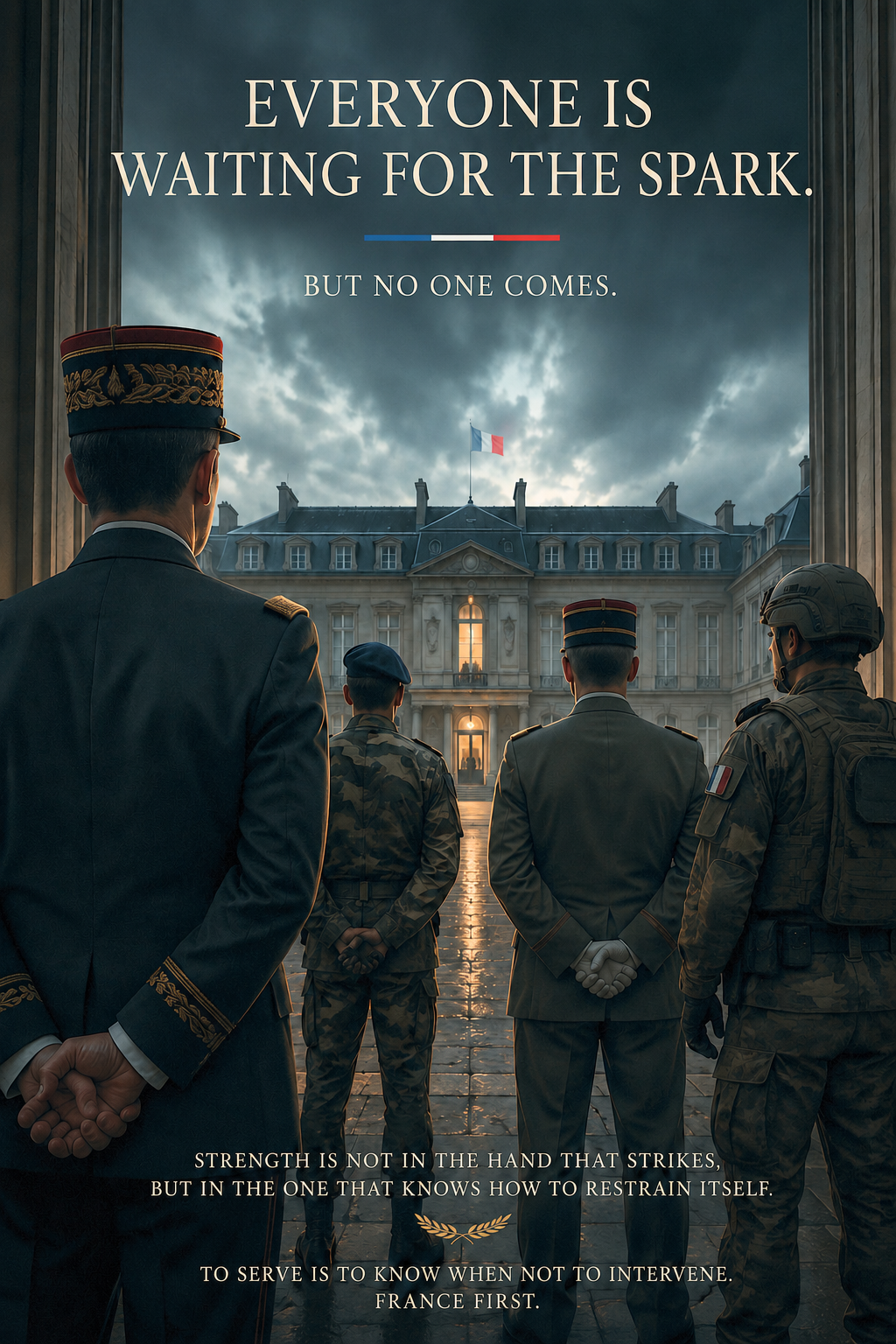
This article examines a political, historical and psychological phenomenon. It is neither a call for insurrection, nor an invitation to violence, nor a justification for military intervention against French institutions. On the contrary, it argues for organized, democratic, civic and non-violent action.
A prophecy repeated for decades
This subject has followed me for a long time. As early as 2002, I was discussing it with activists, patriots and Roger Holeindre. Since then, I have heard the same announcement hundreds of times: “It’s going to blow.”
It returns after every disappointing election, every political crisis, every scandal, every new tax, every factory closure, every riot and every decision perceived as a national humiliation. This time, we are told, the limit has been crossed. This time, the people will take no more. This time, the explosion is inevitable.
Yet the years pass, and the predicted explosion never comes.
That does not mean the anger is imaginary. Economic downgrading, deindustrialization, public debt, weakened essential services, loss of trust in institutions and a feeling of political powerlessness produce genuine discontent. But it is a mistake to confuse the intensity of anger with a population’s ability to turn it into collective action.
Saying “it’s going to blow” sounds like a forecast. In reality, the phrase often expresses a much more personal hope: that someone else will accomplish what one cannot, does not know how to, or does not want to accomplish oneself.
The secret expectation that someone else will act
The person who predicts the coming explosion almost never says that he himself will trigger it. He hopes a leader will emerge, a general will step forward, a providential figure will unite the discontented, or an unforeseen event will transform diffuse exasperation into a national movement.
But he generally wants someone else to take the first risk.
Someone else will expose himself, jeopardize his job, face the courts, compromise his professional situation, place his family under pressure and bear the consequences of possible failure. Everyone waits for the spark, provided they do not themselves become the fuel.
This attitude is not necessarily contemptible. It often reflects a rational calculation. The individual cost of commitment is immediate, concrete and potentially considerable, while the collective benefit remains hypothetical. A person who acts may lose income, reputation or liberty without any certainty that the sacrifice will alter the course of events.
But when millions of people make the same calculation simultaneously, generalized anger produces immense immobility.
Why society does not tip over
The Roman expression “bread and circuses” was not coined by Caesar. It comes from Juvenal’s Tenth Satire, which denounced a population that had surrendered part of its political power in exchange for material satisfaction and entertainment, summarized by the Latin phrase panem et circenses.
Our age has perfected this mechanism. It no longer rests merely on food and spectacle, but on an extremely dense network of material, social and emotional ties. Citizens own a home or hope to keep it, repay loans, raise children, depend on a salary, run a business, await retirement, rely on insurance, use public services and organize their lives around relative stability.
Even when a citizen believes his country is declining, he almost always has something he legitimately fears losing.
He may denounce the government every day while refusing to sacrifice his job. He may judge the institutions deeply defective while fearing a criminal record. He may want radical change while seeking to protect his home, his business and his family. Such caution is not necessarily cowardice. It reflects a fundamental human reality: collective disorder first threatens individual lives.
That is why societies do not automatically rise up as difficulties accumulate. They can adapt to slow deterioration far more easily than to a sudden rupture whose consequences no one controls.
Anger is not yet political power
A population can be profoundly dissatisfied without becoming revolutionary. Millions of people can share the same videos, denounce the same leaders and express the same fears without forming a movement capable of acting.
Anger produces words, comments, publications and sometimes demonstrations. Political capacity requires much more. It requires lasting organization, strategy, identified leaders, skills, material resources, a sufficiently coherent doctrine and, above all, a credible vision of what should replace the contested order.
A crowd can knock down a barrier or occupy a building. It cannot necessarily draw up a national budget, supply hospitals, maintain electricity, pay pensions, guarantee public order, administer territories, negotiate with foreign powers and rebuild institutions recognized as legitimate.
The essential question is therefore not merely how a system might fall. It is what happens the next day.
Destroying authority can take a few hours. Building legitimacy often takes years.
Those who dream of an inferno generally imagine that the fire will destroy their adversaries while preserving everything they love. History shows, however, that political explosions rarely distinguish corrupt institutions from indispensable services, real decision-makers from ordinary employees, legitimate anger from vengeance, or necessary reform from irreversible destruction.
Fire does not possess the precision attributed to it by those who contemplate it from a distance.
Sacrifice still requires a community
Another difficulty must be faced. Collective sacrifice presupposes a moral community strong enough for each person to accept risking something for others.
Yet many citizens now feel that France no longer shares a common definition of its history, its future and what deserves to be transmitted. Some believe patriotism has become suspect. Others feel national history is systematically reduced to its faults. Still others no longer recognize themselves in the institutions or doubt that their compatriots wish to preserve the same inheritance.
This feeling may be exaggerated, manipulated or amplified by social media. It nonetheless produces real political effects. A person who no longer believes he belongs to a community of destiny finds it difficult to sacrifice himself for it.
A nation is not merely territory bounded by borders. It also rests on a minimal agreement about what should be protected, continued and handed down. When that agreement fragments, patriotism ceases to be a collective force and becomes a solitary conviction.
This partly explains why patriotic exasperation does not mechanically become general mobilization. The citizen no longer asks only what he should defend. He asks for whom, with whom and for what purpose he should defend it.
Why the armed forces cannot become the arbiter of political life
Service members may experience this dilemma especially intensely. They are trained to serve France, accept risk and obey in circumstances where a mistake may cost lives. They may love the nation deeply while disapproving of a government, a diplomatic orientation, a military reform, an industrial policy or the abandonment of strategic capabilities.
But in a democracy, that disapproval does not give them the right to choose the government.
The French Constitution distributes responsibility precisely. The President of the Republic is commander-in-chief. The Government determines and conducts national policy and has the armed forces at its disposal. The Prime Minister directs government action and is responsible for national defence. The armed forces are therefore not an autonomous power placed above civilian institutions.
Nor is a soldier bound by blind obedience. The Defence Code requires loyal execution of orders, but prohibits performing an act that is manifestly unlawful or contrary to applicable international law. At the same time, military status requires discipline, availability, loyalty and neutrality.
That distinction is fundamental.
A soldier must refuse a manifestly unlawful order. He cannot, however, decide on his own authority that a lawful government has become an enemy to overthrow because he considers its policy disastrous. A policy may be contestable, ineffective or deeply harmful without thereby constituting a manifestly unlawful order.
If every officer could decide according to personal conscience which government still deserves obedience, the army would cease to be the nation’s army. It would become the army of its commanders’ political convictions.
The courage to possess force without using it politically
Military courage is often represented as the capacity to act. Yet there is another form of courage, less spectacular but essential to democracy: possessing force without believing oneself entitled to decide in place of the people.
An officer may command personnel, possess weapons, benefit from efficient organization and enjoy strong social legitimacy. That power gives him no more political rights than other citizens. On the contrary, it imposes greater restraint.
Military honour therefore lies not only in fighting when a lawful order requires it. It also lies in refusing to turn the Republic’s weapons into instruments of political arbitration.
This principle must remain valid even when service members share the concerns of part of the population. It must also remain valid when the proposed intervention is described as temporary, reasonable or intended to save the institutions. Every coup begins with the promise that it will be temporary. Nothing guarantees that those who take power will later agree to return it.
Massu and the crisis of 1958: a precedent, not a model
General Jacques Massu is regularly invoked in certain patriotic conversations. On 13 May 1958, a demonstration in Algiers led to the creation of a Committee of Public Safety chaired by Massu, against the background of the Algerian War, the collapse of the Fourth Republic and fear of civil war. The committee demanded that Algeria remain French and helped bring General de Gaulle back to power.
That precedent cannot be detached from its historical context. It does not prove that military intervention is a normal or desirable method for resolving democratic crises.
The fact that a rupture contributed to the birth of a new regime does not make the method legitimate in all circumstances. An intervention approved today because it matches our convictions could tomorrow justify an intervention carried out in the name of exactly opposite convictions.
The real question is therefore not whether we approve of an officer’s presumed intentions. It is whether we accept that possession of weapons should determine who has the right to govern.
Once this principle is granted to one camp, it cannot be denied to the next.
Spain and Portugal: two different lessons
On 23 February 1981, armed Civil Guards led by Antonio Tejero stormed the Spanish Congress of Deputies during the investiture session of Leopoldo Calvo-Sotelo. The coup attempt failed and is remembered by Spanish institutions as the defeat of those who sought to interrupt democracy by force of arms.
The episode reminds us that the duty of a patriotic soldier may consist precisely in refusing to follow those who claim to save the country by force.
Portugal’s Carnation Revolution presents a different case. On 25 April 1974, the Armed Forces Movement ended the Estado Novo dictatorship and opened the way to democratization. The military rupture was not entirely bloodless: four people were killed by shots fired by the political police. Nevertheless, it led to a constituent process, elections and the restoration of civilian institutions.
The Portuguese lesson is therefore not that the armed forces should govern whenever they deem power illegitimate. It is that military intervention against a dictatorship can acquire democratic legitimacy only by actually returning power to citizens.
An army that opens the way to popular sovereignty does not perform the same function as an army that claims to exercise that sovereignty permanently in the people’s place.
The providential man as an excuse not to organize
The providential man is psychologically comforting. He allows people to hope that one exceptional individual will solve in a few weeks what millions of citizens have failed to organize over twenty years.
Waiting for such a man relieves people of the need to build a movement, draft a program, train leaders, establish local networks, raise funds, verify facts, persuade the undecided and win a majority.
But providential men present two dangers. The first is that they rarely appear. The second is that those who claim to embody the nation alone do not always agree to leave power.
A person who regards himself as the sole saviour easily comes to view every opposition as treason. Since he identifies his own person with national salvation, contesting his authority necessarily means, in his mind, fighting the nation itself.
A democracy therefore cannot rest on the hope that a superior man will miraculously correct collective errors. It must produce institutions capable of controlling even leaders admired by a majority.
Non-violence is neither passivity nor powerlessness
Rejecting violence does not mean accepting inaction.
A famous comparative study by Maria Stephan and Erica Chenoweth examined 323 major campaigns conducted between 1900 and 2006. It found that predominantly non-violent campaigns achieved their objectives in 53 percent of cases, compared with 26 percent for violent campaigns. Their advantage came in particular from their ability to bring together broader sections of the population, preserve legitimacy and trigger shifts in loyalty within institutions.
Those figures are not a magic formula. Later research showed that non-violent campaigns became less effective when movements limited themselves to symbolic demonstrations, neglected grassroots organization or failed to diversify their methods.
Genuine political non-violence is demanding. It requires documenting abuses, going to court, exposing contradictions, establishing independent media, organizing boycotts, creating solidarity networks, defending whistle-blowers, training campaigners, working locally and building a credible alternative.
It may also take the form of public and non-violent civil disobedience. But such action must not be confused with secret violence or intimidation. Civil disobedience openly accepts legal consequences in order to challenge a rule considered unjust. Its moral force comes precisely from refusing clandestine coercion.
Non-violence is therefore not the absence of conflict. It is a way of waging conflict without handing the future of the country to men with weapons.
Courage begins when we stop waiting
It is easy to repeat that someone should do something. That sentence avoids answering a more uncomfortable question: what can I do now, with my means, my skills and my constraints?
A person waiting for a general can already write, investigate, train, persuade, join an association, support independent media, help draft a program, participate in elections, strengthen local networks, finance a legal action, defend someone under pressure and transmit knowledge.
These actions seem tiny compared with the fantasy of a great national conflagration. Yet they produce the very things an explosion cannot improvise: competence, trust, organization and legitimacy.
A political alternative is not born on the day power falters. It must have been prepared long beforehand.
Without that patient work, those who overthrow an old order discover that they possess neither the people, institutions nor methods needed to build the next one. The vacuum is then filled by the most organized, not necessarily by the most just.
Responsibility does not lie only at the top
Those who govern bear immense responsibility. They have authority, administration, budgets and the power to decide. They must answer for their choices.
But citizens cannot attribute the whole national situation to leaders while considering themselves entirely foreign to it.
A democracy deteriorates when its leaders become mediocre. It also deteriorates when citizens renounce learning, organizing, choosing and acting.
National responsibility does not begin only at the presidential palace. It begins in everyday decisions about information, work, commitment, transmission and courage.
It begins when one decides whether to vote or abstain, build or merely comment, join an organization or remain alone, support a serious project or wait for a miracle.
Stop waiting for the explosion
For more than twenty years, I have heard that “it’s going to blow.”
It did not blow after the elections, after the crises, after the scandals, after the riots or after the industrial disasters. The sentence survived every failed prediction because it does not truly describe the future. It postpones responsibility.
It allows the speaker to believe that history will eventually solve the problem without requiring him to build the solution.
But history does not work for us. It does not produce programs, teams, institutions or legitimacy by itself.
The military will not save a people from its own political abdication. A providential man will not replace organization. Anger will not become competence by accumulating. Violence will not preserve only what we wish to preserve.
Everyone waits for the spark.
The real courage may consist in ceasing to wait for it.
And in beginning, without weapons and without a saviour, the long work that democratic recovery requires.
That may be why, for so many years, “it is going to blow” and nothing ever does.